Misanthropic and petty, scheming and nagging, reviled by their neighbors and barely tolerable to themselves, The Bungle Family was the quintessential domestic comic strip of the 1920s. Critical historians like Bill Blackbeard, Rick Marshall and Art Spiegelman have singled out Harry J. Tuthill’s masterpiece as an especially dark and pointed critique of the modern petit bourgeoisie. But George, Jo and Peg Bungle were really the penultimate satirical family of 20s strips. George was no more a man on the make, looking for that get-rich-quick invention or financial scheme, than Barney Google, A. Mutt or even Andy Gump. His wife Jo was no less socially self-conscious and ambitious, nor more of a nag, than Jigg’s Maggie. And Jo wasn’t even in the habit of throwing things. Nor was the Bungle family dysfunction any worse than the in-fighting at Moon Mullin’s boardinghouse.
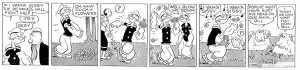
In early 20th Century theater and film, the “sissy” was the dreaded antithesis of two-fisted pulp hyper-masculinity, at best, and at worst was a stereotypical euphemism for what was unspoken in general culture, homosexuality. Wimpy, the dandyish, appetite-driven counterpoint to Popeye’s principled violence, is of course Popeye’s best tutor for all things “sissy.” To make this sexual dynamic even weirder we have Popeye’s Pappy bewildered by his prancing progeny. It reads like an unintended burlesque of Popeye “coming out”. Per a previous post, These dailies precede Popeye deceiving the underground demons to come up and fight.
It is important to note that this gender-bending sequence was followed immediately by another adventure cycle involving Popeye getting the crap beaten out of him in a land of highly muscled women. And this is all happening right after E.C. Segar’s death in October 1938. The strip was being continued unsigned by assistants for the time being.
Where do we even start to highlight the wicked strangeness of Winsor McCay’s “Dream of the Rarebit Fiend?” The master comics artist drew over 800 nightmares in the first decade of the 20th Century, and… Read more: Random Nightmares: Winsor McCay Gets Rarebit
Along with chaos, mayhem and violence, obsessive behavior was a core theme of early newspaper cartooning. Consider the many titular anti-heroes of these years, like Hungry Henrietta, Superstitious Sam, Jingling Johnson, Sammy Sneeze. Or the… Read more: Dingbat Calls In the Klan: Herriman’s Bourgeois Obsessive
The authoritarian strain in modern democracies has only heightened since I first posted this bit of cartoon wisdom several years ago. In 1937, H.T. Webster’s Casper Milquetoast (The Timid Soul) responds to Italy’s Benito Mussolini… Read more: The Timid Soul Toys With Fascism


 Panels & Prose