
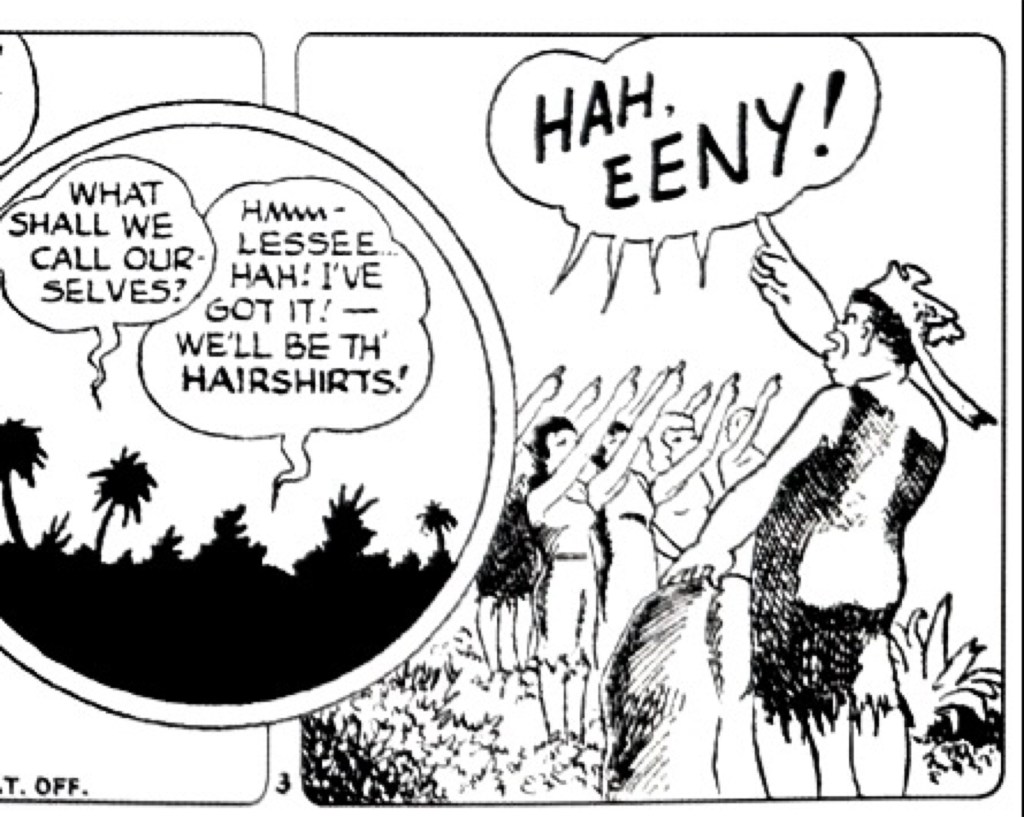
V.T. Hamlin was unambiguous about introducing to Alley Oop’s kingdom of Moo the interloping dictator Eeny in 1938. “She was Hitler,” he admitted in an interview later in life. Even three years before America’s entry into the war in Europe, Hamlin felt it was inevitable. The villainous dictator Eeny would reappear during wartime as well, but in this first episode we see Hamlin’s take on how bad leaders co-opt good people.

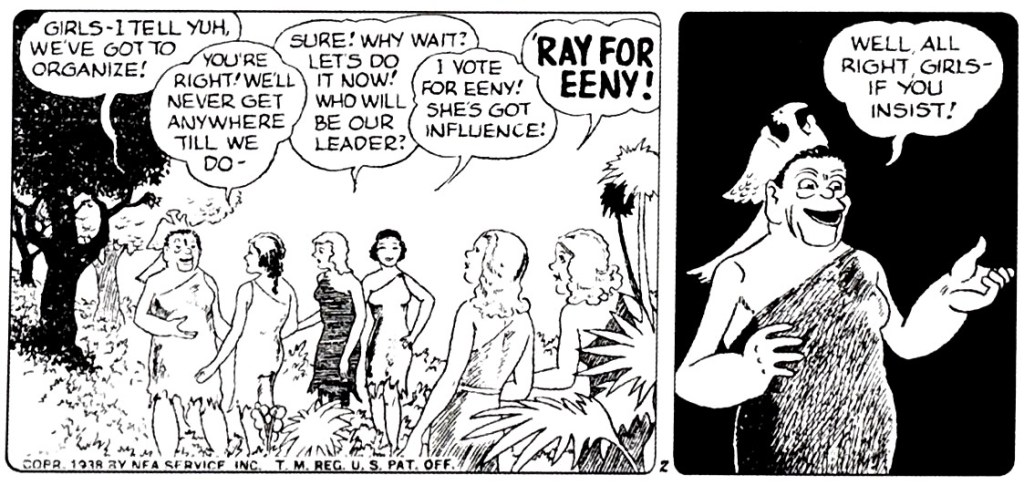

The saga begins with a dinosaur snatching Queen Umpa into the jungle where she meets this mysterious citizen of “Jerooly,” Eeny. The meeting may be more than coincidence. Soon after Eeny frees the queen, her designs on controlling Moo unfold. Channeling some of the cultural vibe of Depression-Era culture, Moo has turned decidedly matriarchal. Umpa took the crown when her tired husband opted for semi-retirement. She surrounded herself with a female court and advisors, including Alley’s perennial girlfriend Oola as “Grand Wizer.” Echoing Hitler’s rise to power as German Chancellor earlier in the 30’s, Eeny usurps Oola as the leader’s closest advisor and then turns the Queen into a mere figurehead for her own growing powers.
Hamlin is not after subtle allusions to real world politics, but he shows remarkable insight about the dynamics of fascism. Eeny teases at Mooians’ fears of inferiority and backwardness, primising to use technology and a firm hand to bring a “new order.” Her tools for gaining power with minority support are chillingly familiar. She flatters a select group of Moo women into a secret society of “hairshirts” who blackball and intimidate dissenters into obedience. She diffuses the Queen’s power and even the legitimacy of elections to turn existing institutions and the Queen herself into window dressing for her own dictatorship.

Alley Oop smells a rat. But Eeny craftily tries to co-opt her opposition and make Oop “Assistant Dictator,” a position Alley thinks will help him depose her.
Unlike parts of contemporary Europe, prehistoric Moovians soon regret their dalliance with fascistic order. After a series of power plays and an assassination attempt on Alley, Oop and friend Foozy conspire to end Eeny’s reign by exploiting her phobia for rats. It is hard to believe that Hamlin’s reference to vermin is coincidental here. He was obviously plugged in to world news, and knew enough of Naziism’s rise to power to map a rough approximation onto his fictional Moo, including perhaps Hitler’s infamously anti-semitic references. The artist seems to take special relish in depicting Eeny’s terror in the April 12, 1938 daily that shows a thug losing her shit over a menacing Mickey-like mouse and a handful of fireflies. Hamlin’s energetic style peaks in this period. His use of expressive typefaces, blacks, pacing and animated explosion of Eeny’s terror, and the punchline panel all show a remarkable economy of form. It is a wonderfully satisfying revenge sequence that reduces Eeny and her fascistic ideology to its essence – cowardice disguised as a bullying thug.

Eeny makes a wartime reappearance, however. Shortly after her first attempt to take over the Moovian monarchy, Oop and Oola are pulled into 1939 by Dr. Wonmug’s time machine. This radical pivot in the strip’s trajectory recasts Alley Oop forever after as an eon-hopping historical adventure hero. But in 1942, Oop time travels back to Moo, only to find Eeny has returned and exploited Moo’s political complacency. It is now a “Moozy New Order,” complete with a violently suppressed citizenry and “concentration caves.” “Well I guess it was our own fault,” explains a beaten Moovian. “Most of us not carin’ who was runnin’ the country.”
As an early proponent of America’s entry into the European conflict, Hamlin embraced the war effort and was sharply critical of American isolationists and others who seemed soft on fascism. In this episode, however, the focus is less on Eeny and the dynamics of dictatorship than it is on Moo’s domestic front and the threat of propaganda to undermine the resolve of Oop’s resistance fighters. The Moovian mob that had been an arm of Eeny’s thuggery now becomes an agent of positive conformity, policing unpatriotic attitudes. In a notably fair-minded move, Oop contains both his king and the crowd’s murderous response to the naysaying “traitor”. He redirects their violence toward simply exiling the dissident to live among the Moozys.

The explicit topicality in the Eeny episodes just highlights an essential but overlooked quality of Hamlin’s Alley Oop. It was fundamentally a political strip, and a very American one at that. Like many of the screwball monarchies of 1930s pop culture, Moo has shaky and insecure leadership and a capricious citizenry. The populace is alternately framed as a principled “people,” a threatening “mob” or impressionable “masses.” Oop is a working class everyman who is often dismissed and underestimated both by king and subjects. He is at times working in service of his community and often at odds with the group-think of the crowd. In fine midwestern patois, our prehistoric salt of the earth admits, “By gum, I never thought folks could be so dumb” when Moozy propaganda sows doubt among fellow Moovians. Like countless national folk heroes before him, from Natty Bumppo to Tom Joad, he is suspended between individualism and community, the embodiment of the eternal American tension, self vs. society. He is uneducated and of humble birth but nature’s nobleman, forever resourceful, resilient, and an inventive, practical problem solver. Alley Oop is the quintessentially democratic man. And so he knows a fascist when he sees one.
Discover more from Panels & Prose
Subscribe to get the latest posts sent to your email.
 Panels & Prose
Pingback: When Superman Was Woke? – Panels & Prose