On Feb. 14, 1921 the orphan who came to be known as Skeezix landed on Walt Wallet’s doorstep, forever changing the trajectory of the Gasoline Alley comic strip and making it a singular American work of art. Until then, Walt had been the main character in a small tribe of neighborhood fellas who loved to tinker with cars (hence “Gasoline Alley”) and trade quips and jibes. Male bonding, circa 1919. With the introduction of Skeezix, however, the strip became a uniquely introspective saga of everyday human connections. Unlike anything else on a comics page that included Thimble Theatre, The Gumps, Mr. and Mrs., Moon Mullins, Little Orphan Annie and Wash Tubes and Captain Easy, Gasoline Alley explored the progression of generations, community dynamics and values, the emotional cadence of everyday human interaction in a granular, gentle way.
Gasoline Alley is best known for being the only major American strip that let its characters age and even pass away. By the 1930s, Skeezix would hit early adolescence, and the strip became one of the first works of pop culture to focus on this modern phenomenon of the “teenager.” Many of the main first generation characters in this male bonding epic would die, usually quietly and off stage, several decades after the strip launched.
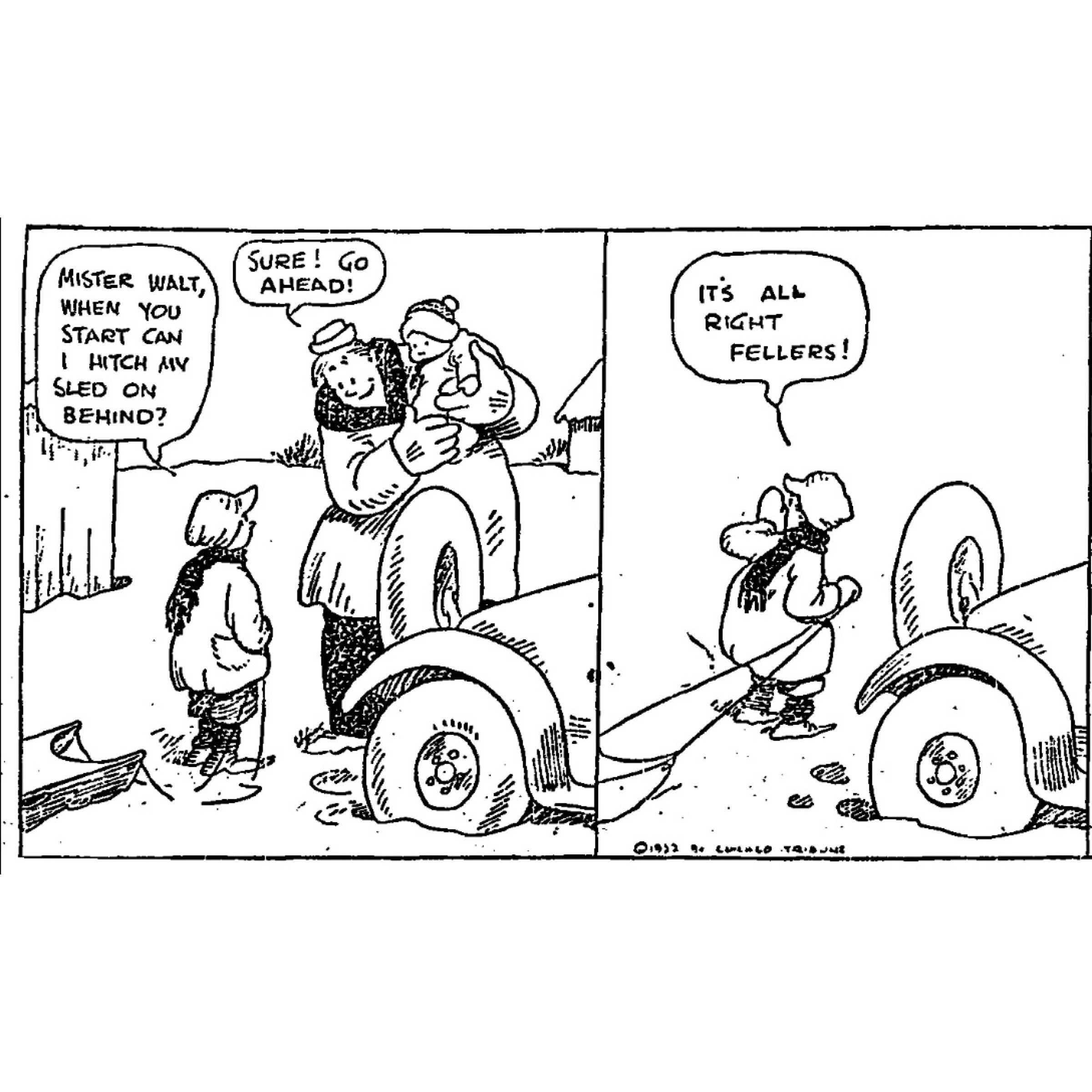
Authored by Frank King, Gasoline Alley was a genuinely homespun comic strip. While many American cartoonists had their roots in the Midwest and small towns, King brought that personal experience to the center of the strip. He patterned many of the characters after friends and acquaintances. Walt was based on a childhood friend. Skeezix’s growth paralleled King’s own son, including those rough teen years. But more than anything else, King based his strip on the language, rhythms and emotions of everyday exchanges. As Jeet Heer points out in his excellent introductions to the ongoing reprints of the strip, Gasoline Alley was not a gag strip or a soap opera, nor was it slapstick or satire. Strips rarely ended with a punchline or a cliff hanger. The four daily panels typically added perhaps a little insight into a character, advanced a plot line just a smidge, or showed characters interacting in a small way that expressed the depth of their connection with each other. The joys of the strip were cumulative, an extended immersion in the little interactions and feelings of a tightly knit cluster of friends and family, people who knew one another well and forever.
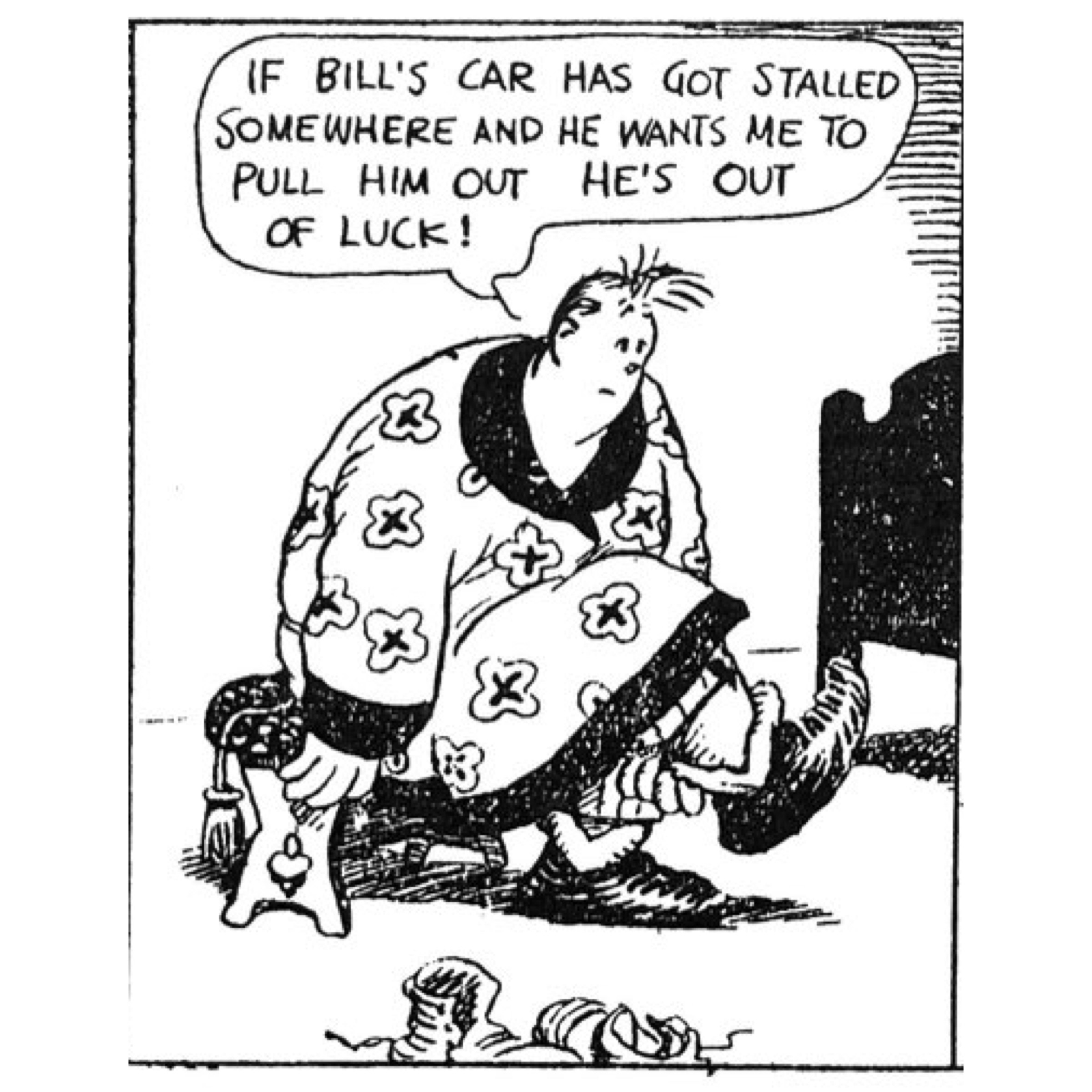
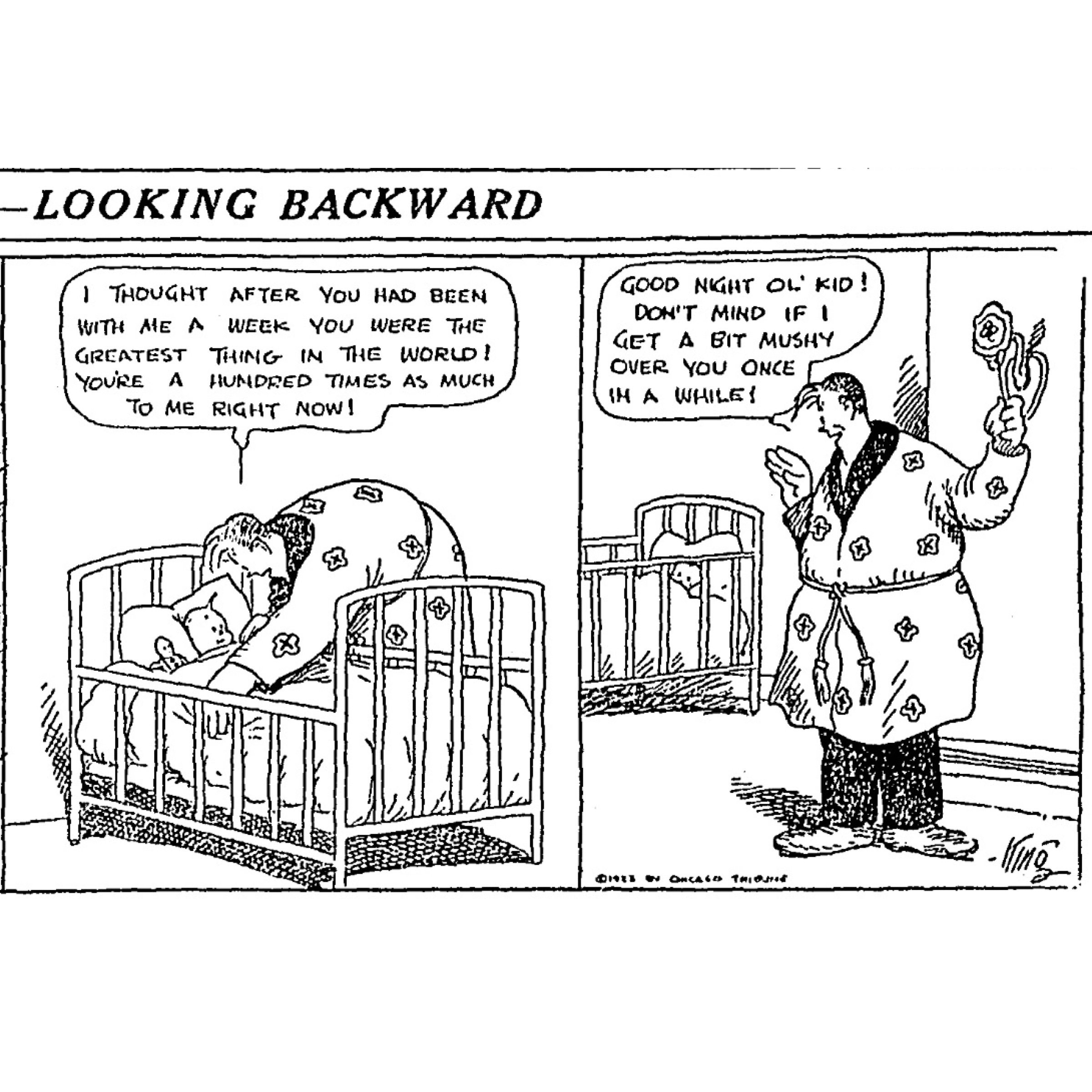
Which is to say that no small collection of reprinted strips here can really capture the unremarkable remarkableness of Gasoline Alley. I find that extended immersion is King’s world is truly compelling but takes days and weeks of persistent exposure. As Heer says, “Gasoline Alley achieves its hold on its audience by being ruminative and cumulative.” It lets you peer into the nuances of family, immediate and extended and the subtle ways in which people know and appreciate one another. But the strip below, which marked the first anniversary Skeezix’s appearance, hints at the kind of emotional depth and intimacy King crafted here. As a single father for the first years of Skeezix’s life, Walt proved to be the prototypical sensitive male, that rare figure in popular culture of the nurturing man. It is a good example of how King was getting at aspects of modern American culture that were not accessible in other more compressed popular arts like film, novels or even the pulps. Gasoline Alley is the quintessential comic strip. It demonstrates more than any other strip how the medium can build worlds subtly, incrementally, and over the course of decades in four panels a day.
On Oct. 4, 1931 Chester Gould’s Dick Tracy launched with the strip above. To commemorate the birthday of my personal favorite strip of all time, I am gathering some of the pieces I have written around Dick Tracy over the last couple of years.
Billy DeBeck described his own comic anti-hero as a “low-life” with a heart, but it took a few years from Barney Google’s introduction in 1919 for DeBeck to find his real character. Barney started as yet another henpecked husband, a servile schemer whose daily antics focused on outflanking his overbearing wife. From the start, however, DeBeck’s imagination veered towards outlandish solutions to everyday slights and oppression, At one point the early Barney plots to avoid his wife’s wrath by getting beat up to garner sympathy. Barney was DeBeck’s man on the margins, bouncing from job to job, always broke, forever buffeted by wife, bosses, circumstances or dumb bad luck.
As DeBeck came to understand his own character, Barney literally shrank in stature, from a tall but stooped supplicant to a figure half that original size, now more crushed than stooped, a compact underling of life whose famously oversized “google eyes” always seems to be looking up at other characters. With so little space between Barney’s nose, mouth, torso and legs, he looks like a crumpled ball of formerly human features, the visual embodiment of a man pressed down into a diminutive stature.
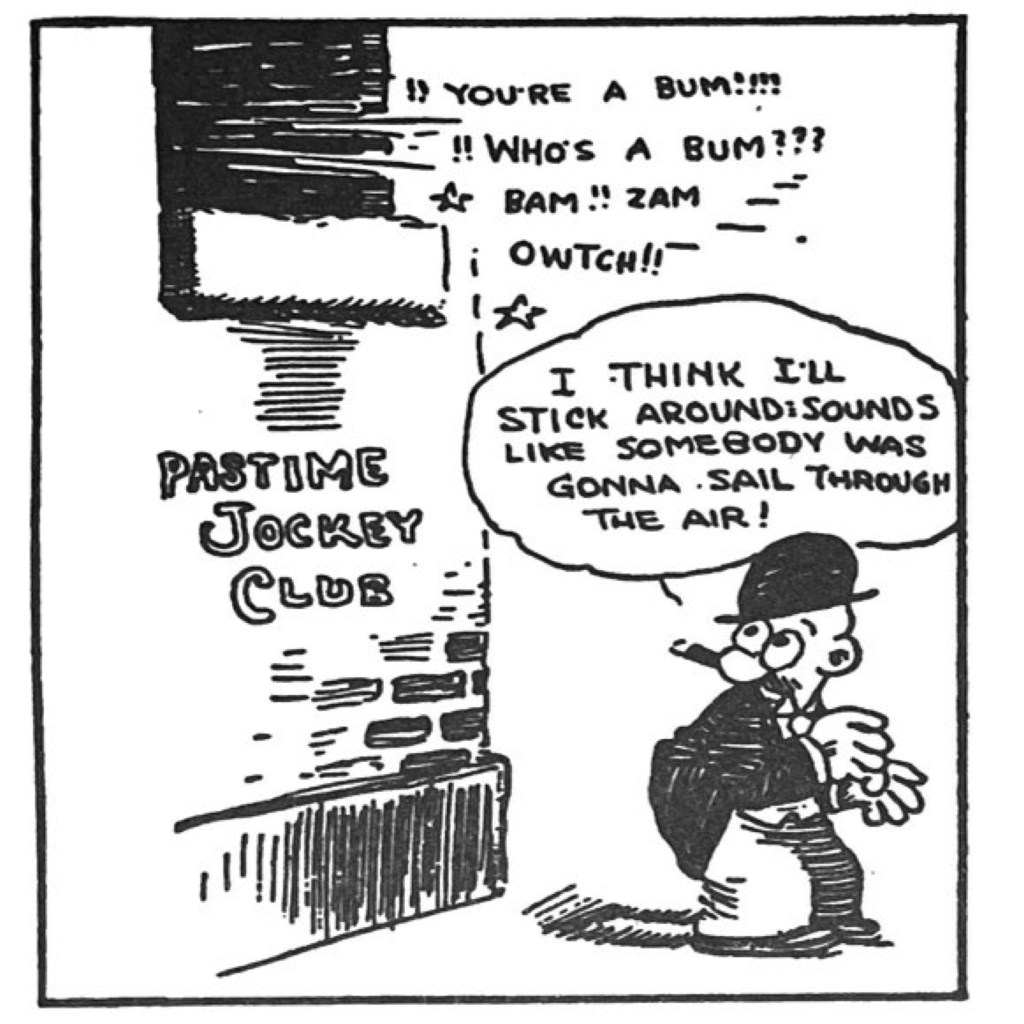
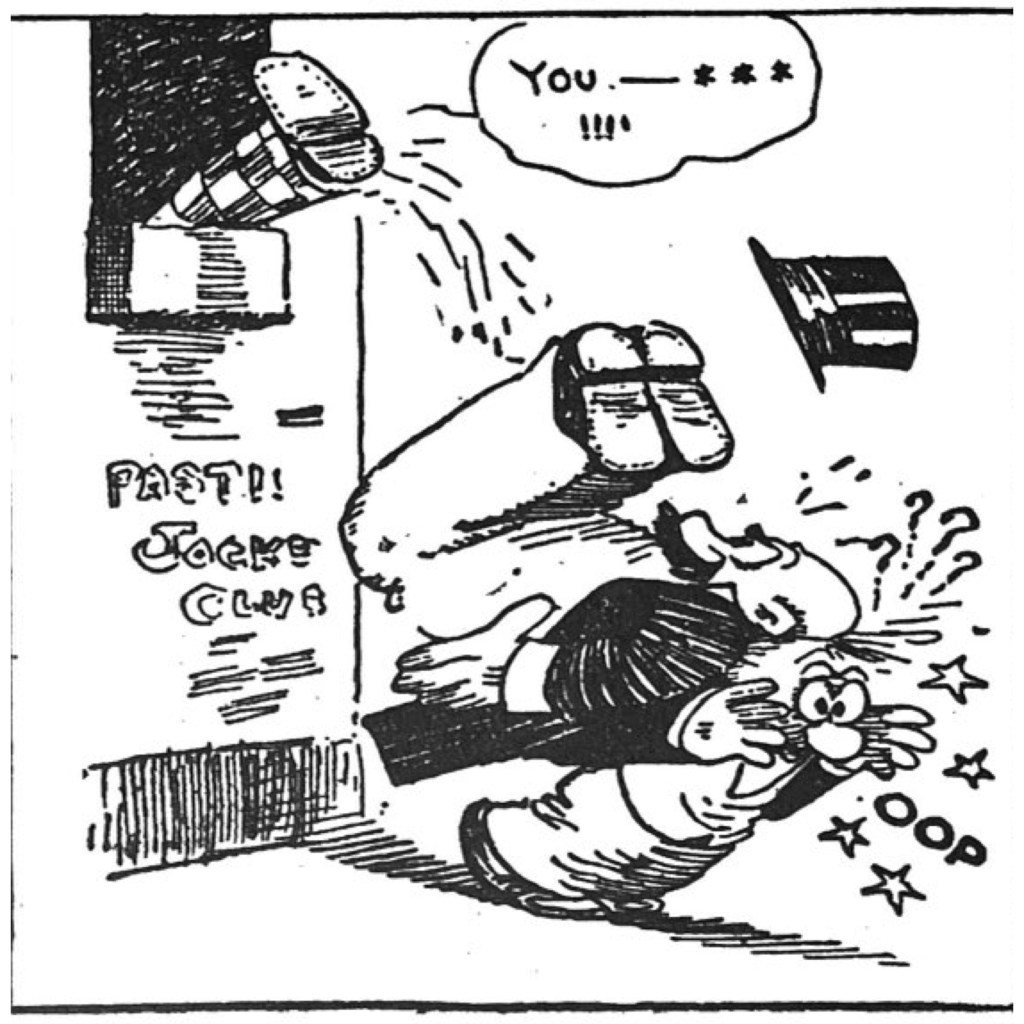
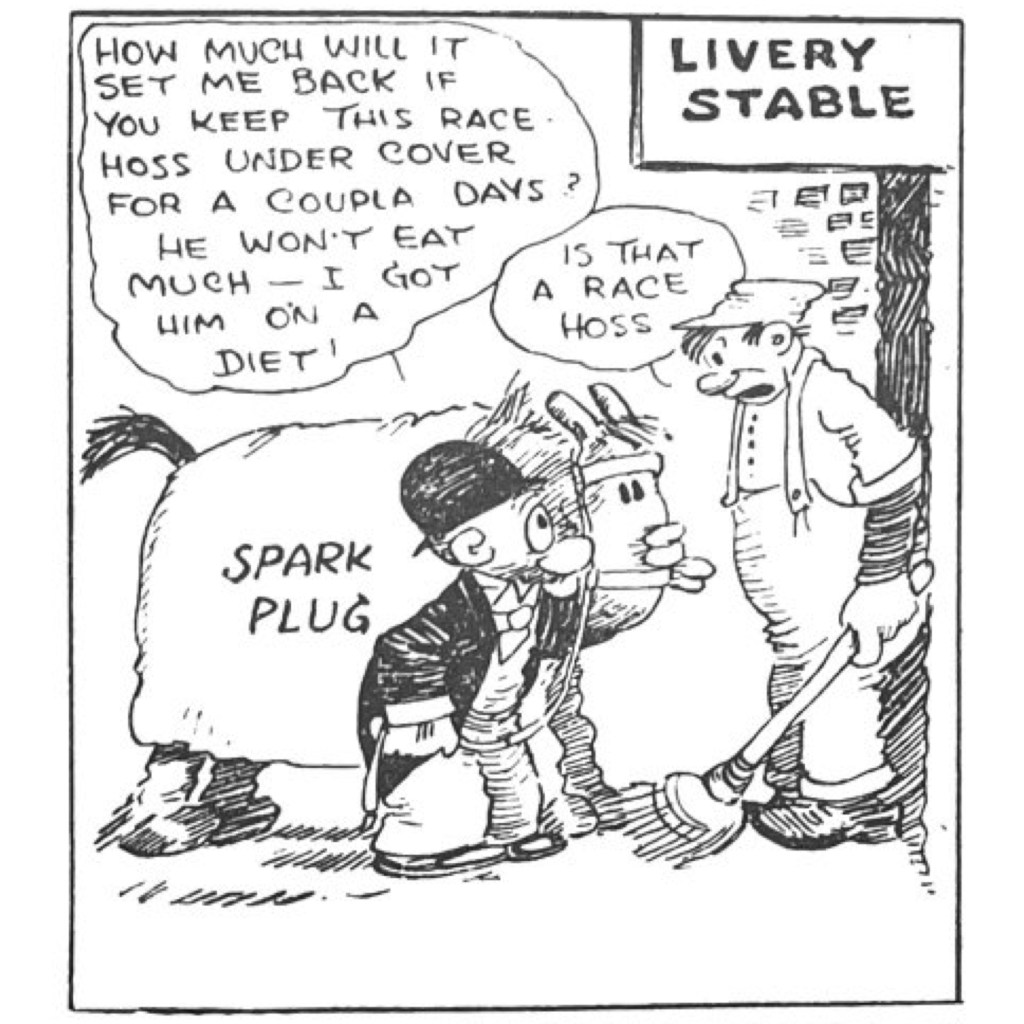
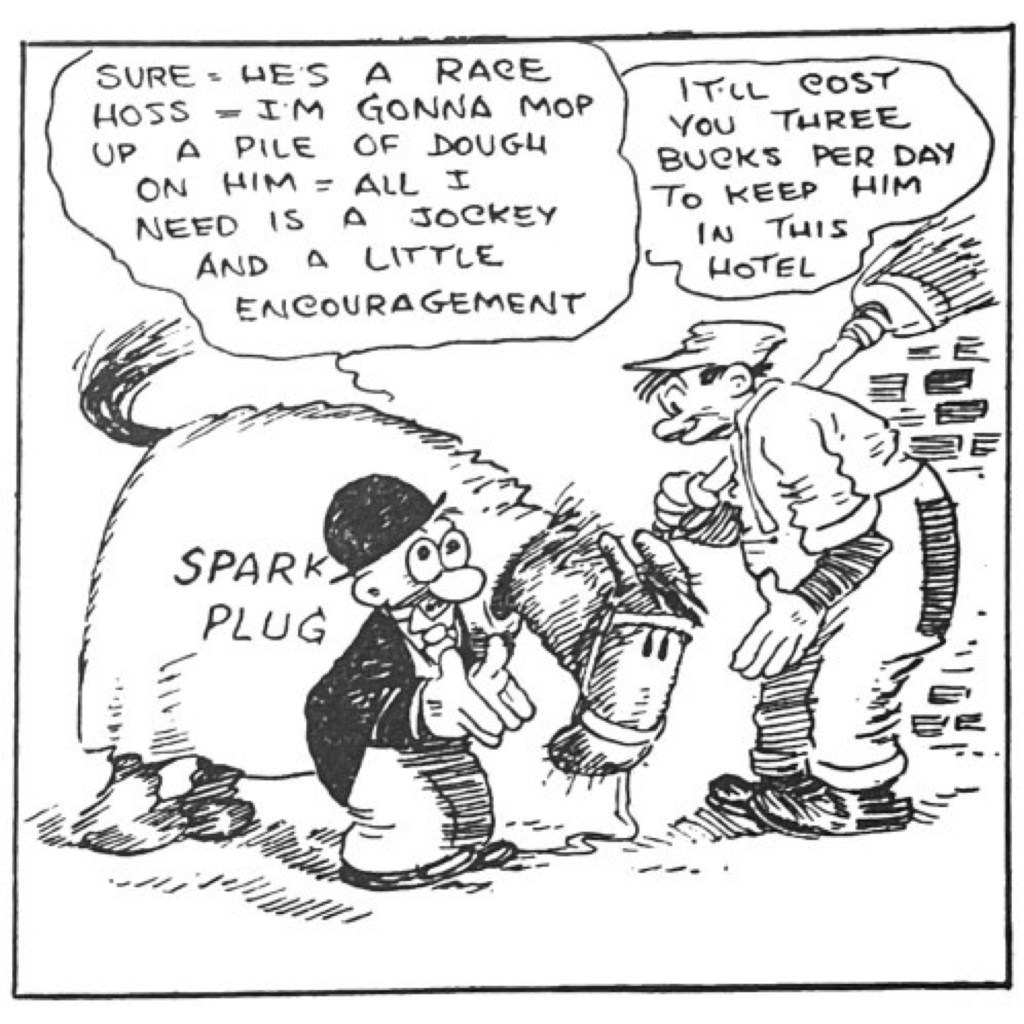
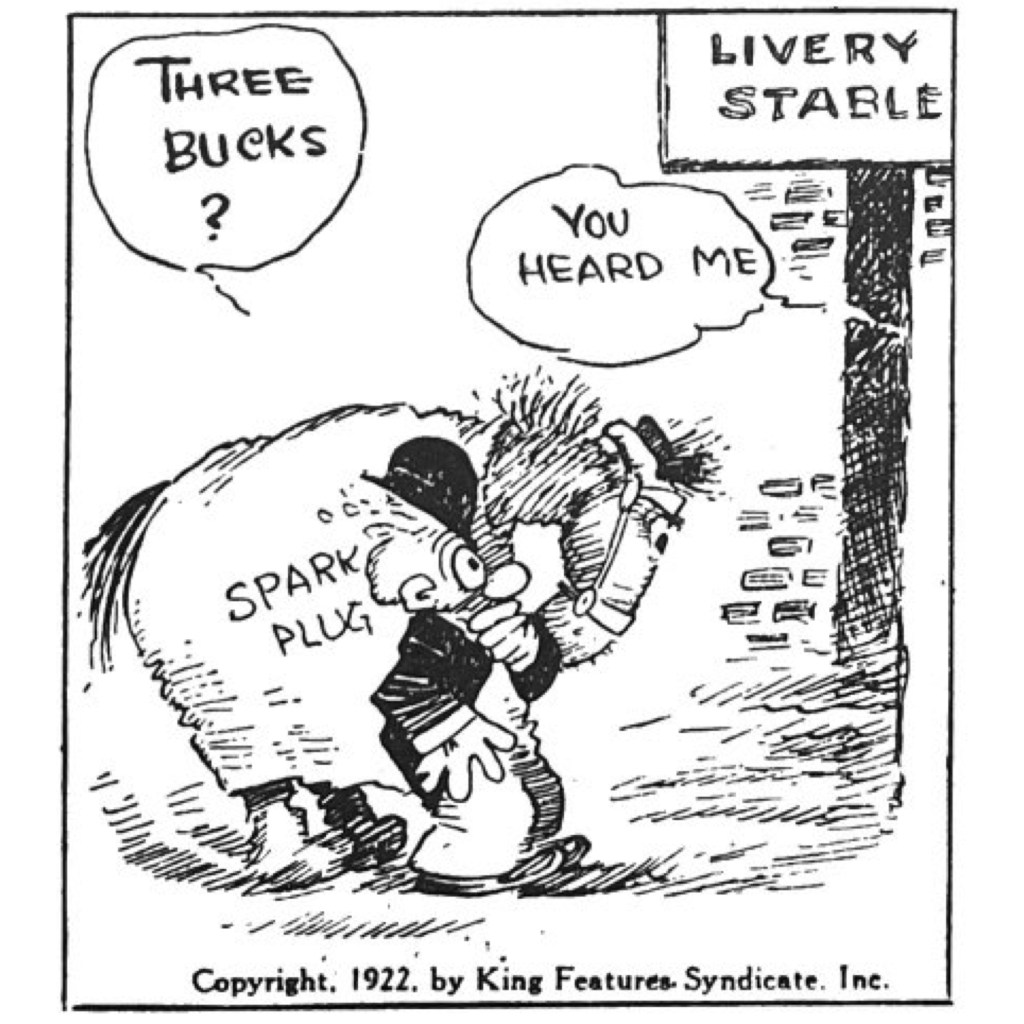
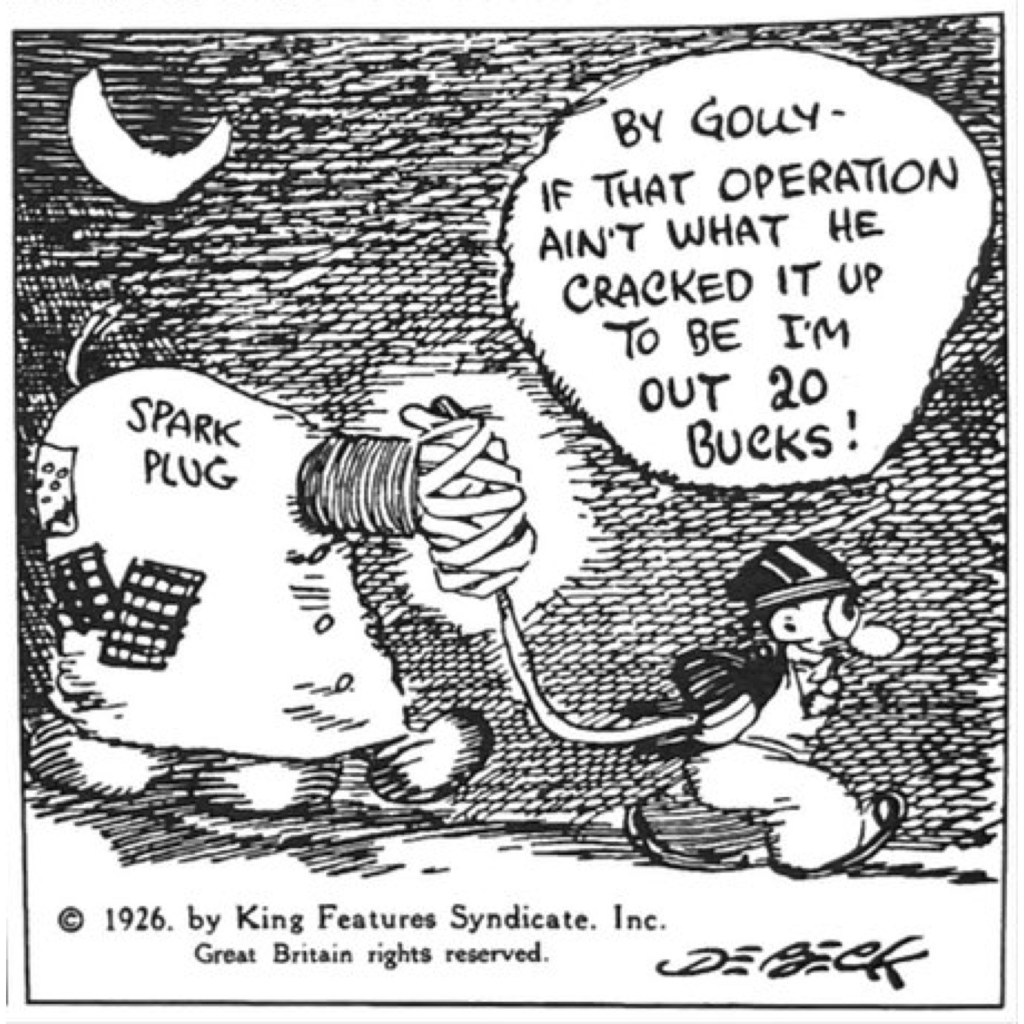
But the real heart of Barney Google comes out when he connects with Spark Plug, the horse that would win and lose countless races over the next decade. See above the first strip in 1922 introducing Sparky. In many ways, the horse replaced Barney’s wife as his love-hate interest. Barney raged whenever his nag lost a race but never could bring himself to stay mad for long. There was real romance here. It is not surprising that Spark Plug became a merchandising hit in the 1920s. One later comics historian compared the nag to Snoopy in the level of his fame.
But the coming of Spark Plug also literally raised the stakes for Barney’s conniving. Now he is on a larger stage, traversing the country with Sparky, plotting to get race entry fees, looking for shortcuts. And his fortunes rise and fall radically, from wealthy purses Sparky wins to big bets that come cup a cropper. And Barney starts looking the part, now donning a top hat and formal coat. He has evolved from petty existential haplessness to riding up and down the rollercoaster of American pluck and luck. Barney Google becomes both a celebration and satire of American ambition. He is always on the make, looking for the big chance, and a universe of pitiless institutions, authorities and chance bounce this compressed ball of a character up and down fortune’s wheel. DeBeck is working in a grand tradition of American comic archetypes and echoing some of the tropes that were driving the great slapstick silent clowns of the same decade. Chaplin, Lloyd and Keaton also explored the marginal man, luckless but big-hearted and managing an absurd cosmos with clever survival skills.
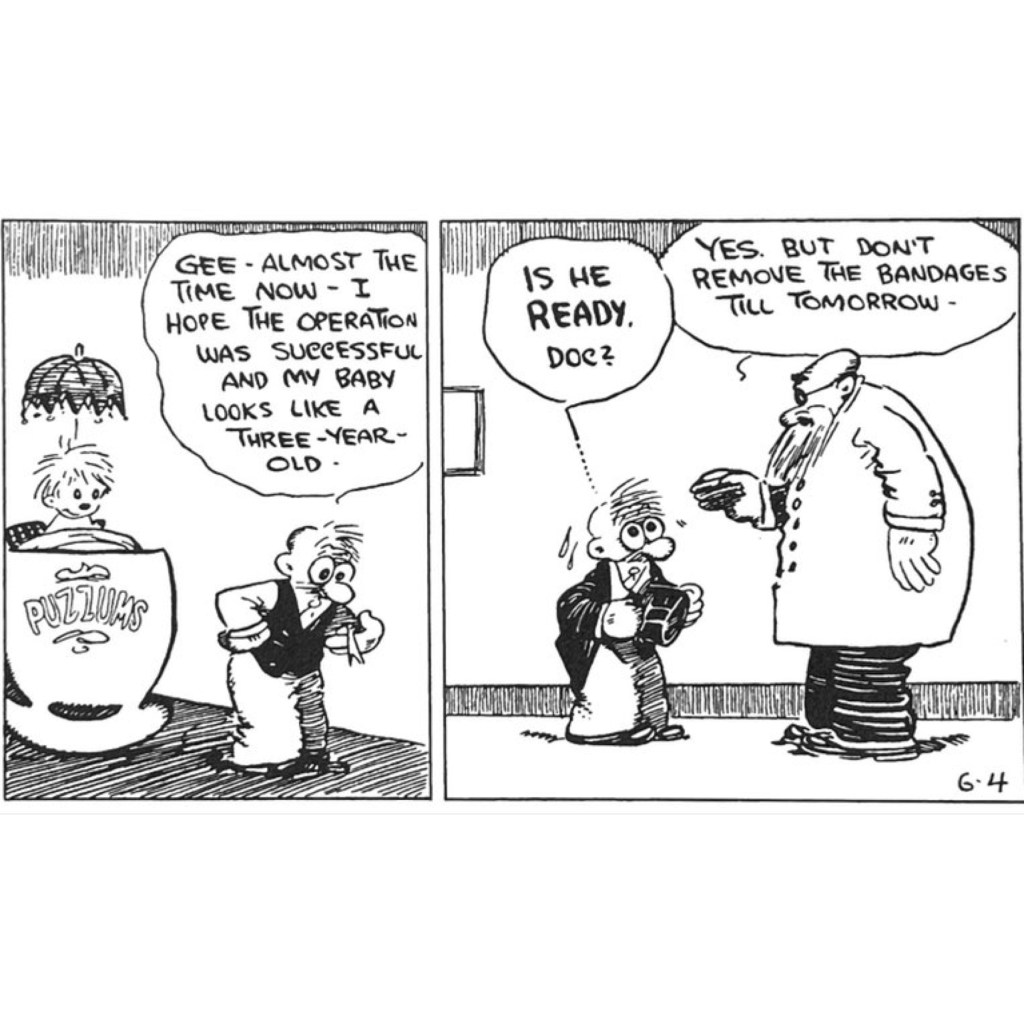
And there was relentless scheming, DeBeck knew no bounds in dreaming up ways that Barney could make money, thwart rules, fool race officials, or just cheat to help Spark Plug win. In the strip above he gets Sparky a facelift in order to convince the race judges that his horse is a genuine three-year-old.
DeBeck’s plotting of Barney Google’s machinations to succeed were so convoluted that he became famous for recap strips that just reminded readers what his little schemer was up to. And it is this low-level conniving that is the beating heart of Barney Google. Barney is a hapless creature in the comic strip tradition of Happy Hooligan, Slim Jim, Mutt and Jeff, Boob McNutt, Boob Baxter and even Baron Bean. The lovable loser was a particular hero of the American comic strip. It begs so many questions about the role of this art form in Americans’ everyday lives. There was a special kind of social satire going on here, under cover of clever banter, situation comedy and screwball antics. At heart, many of the comic strip figures of the 1920s – Google, Andy Gump, Boob McNutt, Moon Mullins — were more victim than victor.
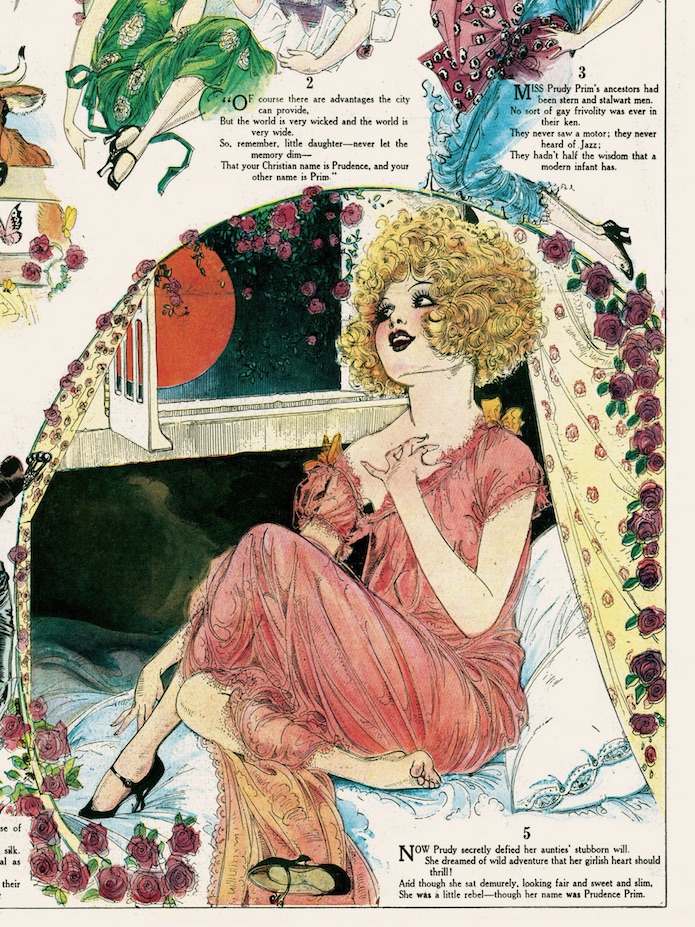
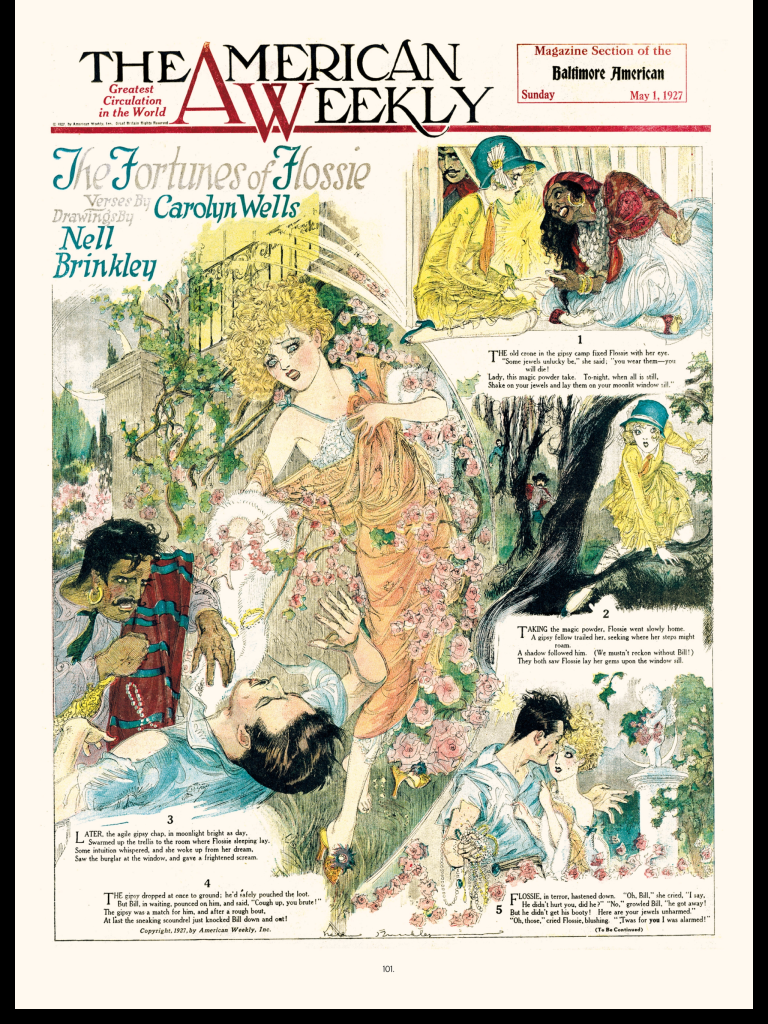
Those curls! Those explosions of curls often outsized even the heads of Nell Brinkley’s (1886-1944) famous “Brinkley Girls” of the 1910s and 1920s. They had a life of their own, dense with insanely, finely penned line detail. In some of Brinkley’s full pagers of the 1910s, those curls could own the page, become part of the character’s expression, somehow embody the heady fantasies in which “Brinkley Girls” usually engaged. It was a visual signature so recognizable and appealing they launched Brinkley-endorsed hair products with her name attached.
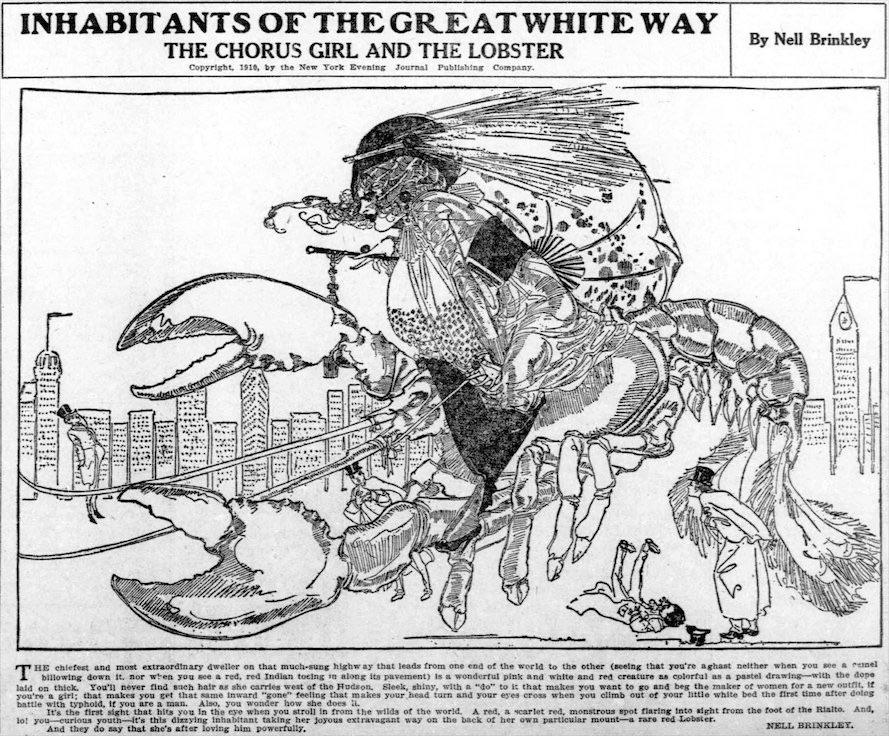
But those Brinkley curls were more than a cartoonist’s signature. They embodied important aspects of Nell Brinkley’s art and contribution to comics and pop culture that critics miss… when they pay attention at all. For, even though she was called the “Queen of Comics” in her day, Nell Brinkley has been poorly served by subsequent comics history. She doesn’t appear in many anthologies, and I have heard some question whether her work even qualifies as comics. Thankfully, Trina Robbins has maintained her reputation and memory in a book devoted to the many iterations of the “Brinkley Girls” and more recently by devoting 50 pages to reprinting her work in the magnificent The Flapper Queens: Women Cartoonists of the Jazz Age. I can only speculate how the overwhelmingly male field of comics history may not appreciate, let alone value, the hyper-romanticism of Brinkley’s work. I believe she deserves to be included among the pantheon of greats. In many ways, Brinkley extended into the emotional realm the principles of caricature and fantasy that McCay had practiced in Nemo and screwball cartoonists like Milt Gross brought into the physical slapstick realm. They were over-the-top, eccentric and implausible, and unapologetically so. Her artistic command of the full Sunday comics page, her use of line, color, expression and fantasy rival anything the better-known pioneers put to paper. The cartoon aesthetic established by McCay, Opper, Gross and Herriman allowed artists and readers to defy logic, bend propriety, bruise conventions, rearrange physics, ignore plausibility. Indeed her 1910 fantasy image for the New York Evening Journal, “The Chorus Girl and the Lobster,” showed how well she could mimic the rarebit fiend hallucinations of Winsor McCay. But across the rest of her career, Brinkley channeled the latitude cartooning allows into realms of emotion, gender roles, social relations, romance.
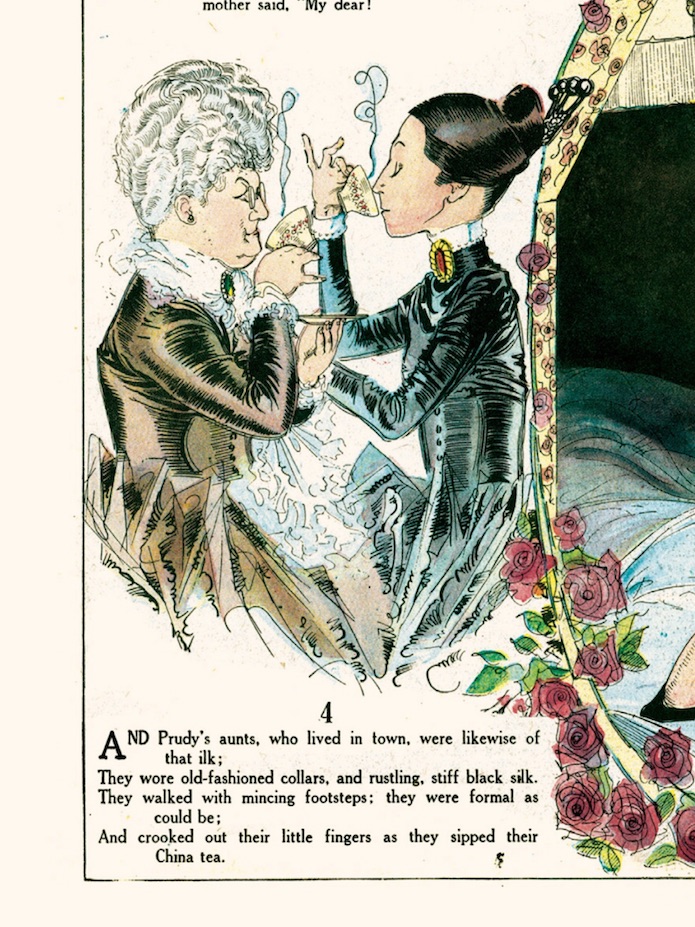
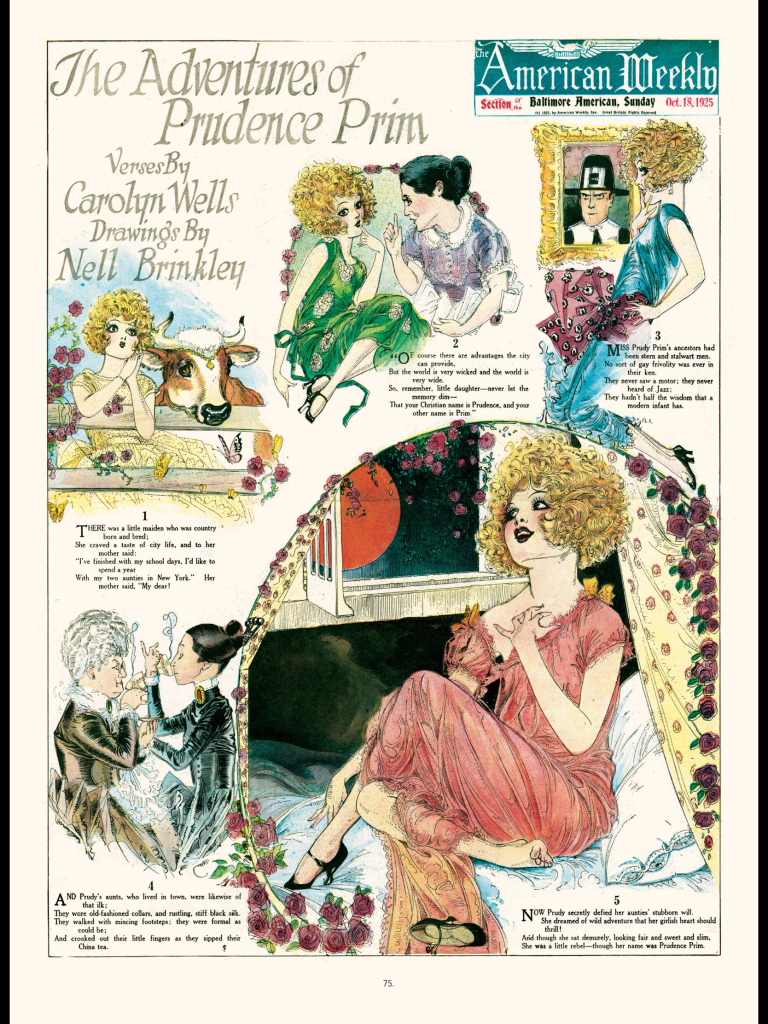
Born in Colorado, Nell’s early artistic talent found its way into children’s books and illustrations in the major state newspapers. Hearst lured her to New York in 1907 where her effusively curly heroines, quickly dubbed “Brinkley Girls,” were a major hit. They were featured in songs, theatrical revues and even licensed hair curling products. While Brinkley did many spot illustrations and even famously covered a scandalous murder trial, her most enduring work took the peculiar form of the graphic short story. Running across a dozen or more weekly episodes, these finite “Romantic Series” included the wartime “Golden Eyes” ( a fiancé follows her betrothed to the front lines), “Kathleen and the Great Secret” (a couple involved in corporate espionage), “Betty and Billy and Their Love Through the Ages” (a romance projected by crystal ball into past historic eras), “The Adventures of Prudence Prim” (a farm girl comes to the big city), “Dimples’ Day Dream” (heroine fantasizing adventure, fame and career success).
Golden Eyes was a full-page single image and text serial across late 1918 and early 1919. It tells the patriotic wartime tale of Golden Eyes, her dog Uncle Same and her man Bill when he (Bill, that is) leaves to fight as the US entered the European war “Over There.” But it is also where Brinkley weaves a socio-political fantasy for the women who were left to serve and support from home by putting Golden Eyes and Uncle Sam into the intrigue and muck of the war. Girl and pooch dash off toward the front, get captured by the enemy, cold cock a rapacious Hun with a champagne bottle and even crawl through the mud of the barren No Man’s Land among WWI trenches. And she looks impeccable and stylish doing it.
And that is no small thing. Golden Eyes’ has a seemingly endless wardrobe of brightly colored ruffled and layered gowns, high heels, and tightly tailored uniforms in which she could model alluring style ideas to her loyal followers while also saving the world for democracy. It is too easy to dismiss such fancy, because Therin lies the appeal and cultural power of Brinkley’s work. She uses the improbabilities of cartoon world to make the personal political, to overlay romance and patriotism. It imagines Golden Eyes and her readers out of the helplessness and fear of being “Over Here” and fantasizing power and effectiveness in the world.
And this is the alluring dance she does throughout the teens, 20’s and 30s, blending the personal and political, letting her heroines assert themselves into a man’s world within the safe context of fantasy or eventual domestication into marriage. But assert herself she does.
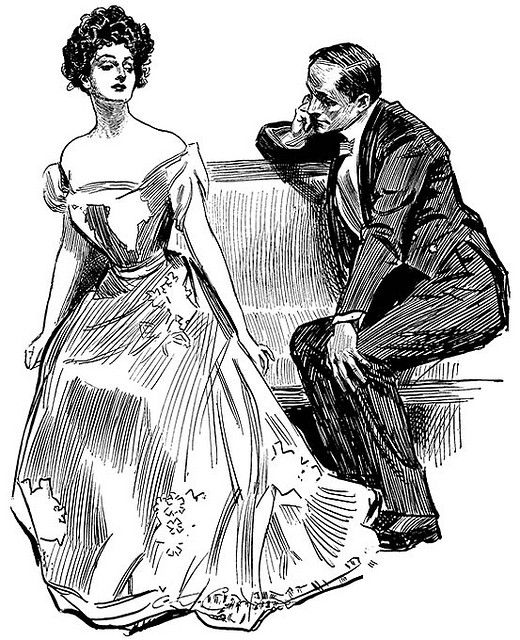
What Charles Dana Gibson’s “Gibson Girl” was to pre-WWI America, an attempt to visualize an “ideal” American womanhood, the “Brinkley Girl” was to the 1910s and post-WWI culture. And the contrast between the two archetypes are as stark as the eras that each idealized. Popularized in the 1890s, The Gibson Girl generalized and abstracted the white middle class woman as curvy and fully corseted but far from subservient. Gibson often depicted them as independent and well-educated, always striving for both self and social improvement. She often took on progressive causes, like Women’s Suffrage, but never seems fully poised to step into a man’s world. She embodied many of the social changes for women that were in the air without challenging the status quo. Visually, Gibson depicts her as composed and aloof, a robust hourglass figure topped by a massive pompadour, often with half-closed eyes that gave a sense of control and remove. The Gibson “girl” was very much a self-contained woman in control.
The Brinkley Girl was dramatically different. Brinkley was revising the archetype quite self-consciously. As she describes one early character, “Frank and strong, and happy and good, just a girl — an American girl such as many of you know — a strange young combination of peacock and saint, little girl and sapient woman, athlete and romantic baby, changing as the winds — and as unchanging.” It would be a mistake to reduce Brinkley’s romantic heroines to Flapper era party-girls, although she loved to draw Gatsby-style gala scenes. She was capturing in her heroines a sense of expression and independence that was radically different from Gibson’s idea and as explosive as their signature head of hair. Just as she was replacing the upswept pompadour with coronas of unruly curls, bodices with sequins, feathers and flowing gowns, Brinkley was liberating the feminine personality. That explosion of curls was also an explosion of self-expression, a notably more passionate and performative assertion into the world. Part of the fantasy she crafted so effectively in her art was indeed letting women have it all.
And so the journey could get wondrous and weird hallucinations, conflations and juxtapositions. Golden Eye decided to pursue her love for Billy to war torn France, where she could at once help win the war and win her man. She is accompanied by their patriotic dog Uncle Sam and the visual symbol of love, a cherub. Having a fashionable woman with seemingly endless wardrobe changes traipsing through the ruins of Europe’s front lines leads to surreal scenes. In one week we find her deep in the French trenches, in a spotless white dress amidst the dark outlines of muddy fields and scorched trees. The Betty and Billy series used a crystal ball device to project these two lovers into every imaginable era of world history. From pre-historic jungles to Egypt, Babylon and Old Virginia.
Brinkley worked unapologetically in a mode of high fantasy, but of a self-conscious kind. And that was what makes her work so glorious. She called attention to the fantasizing of her heroines and seemed to celebrate the radical leaps from reality she and they were taking. There was nothing frivolous about these daydreams. In fact, one of her 20’s characters, Dimples, spends the entire series resisting her lover’s pleas to marry him in favor of her daydreams of having a range of careers, including become the first woman President. Her romantic serials almost always resolved these adventures in the marriage of our heroine, but Brinkley made the journey more compelling and important than the final, if inevitable, nuptial.
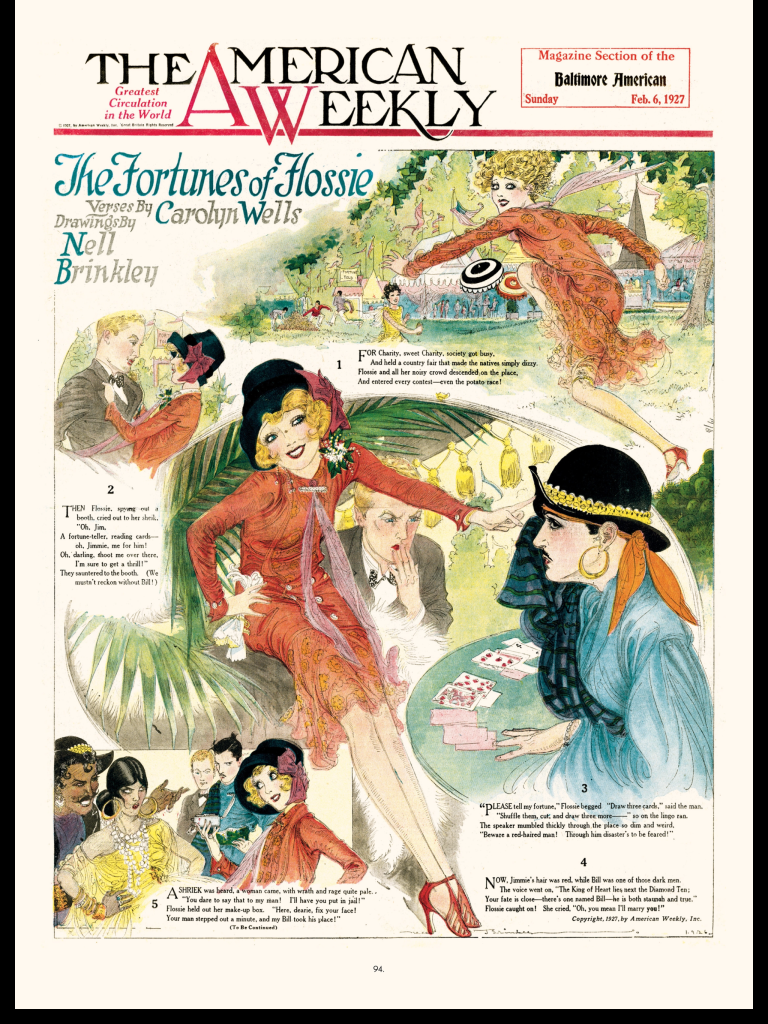
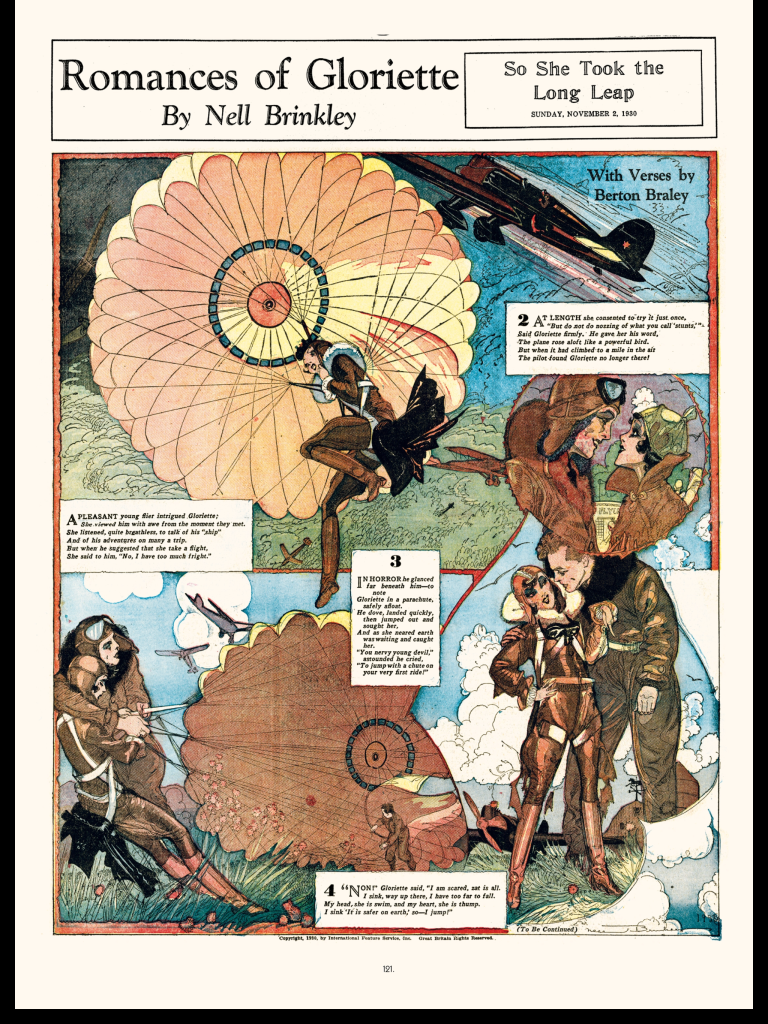
Visually, Brinkley built her fantasies carefully. In the first serials, the stories were told in each Sunday episode by a single evocative full page scene with accompanying text. In the stories of the 1920s this format evolved into something closer to but not quite like a comic strip, with five or six numbered vignettes and blurbs advancing the story. Brinkley never resorted to speech balloons or even firm panel outlines. Instead, her vignettes floated on the page without definite borders in a dreamlike motif.
In all of these formats, Brinkley invented a visual style that was at once ethereal and precise. She was famous for a thin and heavily detailed pen line that echoed Art Nouveau. She used this line work to build incredibly rich environments, whether the stone walls of Montezuma or the crowd scenes at a flapper party. The scrolling stonework or the floral arrangements, or the face of a desert camel – all had a density of realistic attention. Compared to the simpler line work of contemporaries in the Sunday section like Herriman, King, or even fellow nouveau stylist McManus, Brinkley’s art was downright Baroque. And yet she also colored this line work with a watercolor wash that bathed the scenes in mood just as it ran across the careful penwork. The effect was uniquely dreamlike, vivid in detail but unreal.
Comics historians often cite the ways in which early innovators like McCay or Feininger used the full Sunday page to experiment with color and format, but Brinkley in her own way was bringing this spirit into the post-WWI newspaper in these remarkable flights of fantasy. While it is true that Sterrit, Herriman and King did continue to innovate in their Sunday formats especially, no one was working with color, mood and detail as richly as Brinkley.
Also unique to Brinkley’s palette were her primary colors of emotion and expression. She focused on the expressive face in ways that other cartoonists couldn’t within the constraints of panels and balloons. She registered on her characters’ faces those heightened moments of shock, joy, envy, snobbery, ardor and more. There is an emotional intensity to Brinkley’s work that is working at the same high volume as the fantasy. To be sure, she was working in a genre of romance that traded in intense emotion, but she was visualizing these inner feelings on the faces that dominated her page. Indeed you could say that emotional moments were the driving force of her Sunday pages. While most comic artists were using sequential drawing to drive story progression, a slapstick gag or physical action, Brinkley’s sequence of vignettes are illustrating the emotional peaks of a story that is really being told in a linear way in the text. Was anyone else in the comics section working to surface such a full range of emotion and inner worlds? One has to look to the silent screen for this kind of singular focus on expression and visualizing personality.
In Brinkley we see the ties between self-expression and the increasing materialism of modern consumer culture. Her heroines are generally affluent, soaked in the largesse of high fashion, travel, lavish parties. By the late 20s she had become adept at visually swooning over luxe objects, from shiny limos to ornate nightclubs. But Brinkley always seemed to insist on the substance of the surface. She never trivialized the fashion and multiple wardrobe changes of her characters, but instead made them outward expressions of some inner emotion, identity, mood. Her lush use of color, detail, texture lends an erotic quality to all of her work, whether it is depicting an embrace of lovers or a gleaming auto. She seems to be in love with the material world and her art is struggling to lend some sense of depth and authentic emotion to this world of abundance that modern consumer culture had made available, at least to some.
And yet, Brinkley is determined to immerse her heroines in adventure and escape from domesticity. The theme throughout her art, culminating in the 1930s in her final great series celebrating pioneering and accomplished real life women of the sort she foreshadowed and fantasized about in her 10s and 20s strips. Ultimately, Nell Brinkley was a feminist working within the tropes and genres available to her and her audiences in an unmistakably patriarchal America. Brinkley allowed her readers to have it both ways, to pursue the goal of romance and marriage while also engaging the adventure and career identity with which modern American seemed to tease women as possible, if not preferable.
A.B. Frost’s 1884 graphic album Stuff and Nonsense was one of the earliest book-length cartoon collection published in the U.S., and it proved to be a milestone in the evolution of the art. Jim Woodring argues that until this point, most American caricature tended to deal in lifeless, static stereotypes. “This collection laid the foundation of real American cartooning: frisky pen drawings of people and animals that exuded rough, warm, egalitarian humor,” he writes in the recent collection of T.S. Sullivant drawings. Woodring credits Frost with bringing character to American cartooning by using facial expression, movement, gesture and more to individuate what had been stiff social types in most drawing of the day.
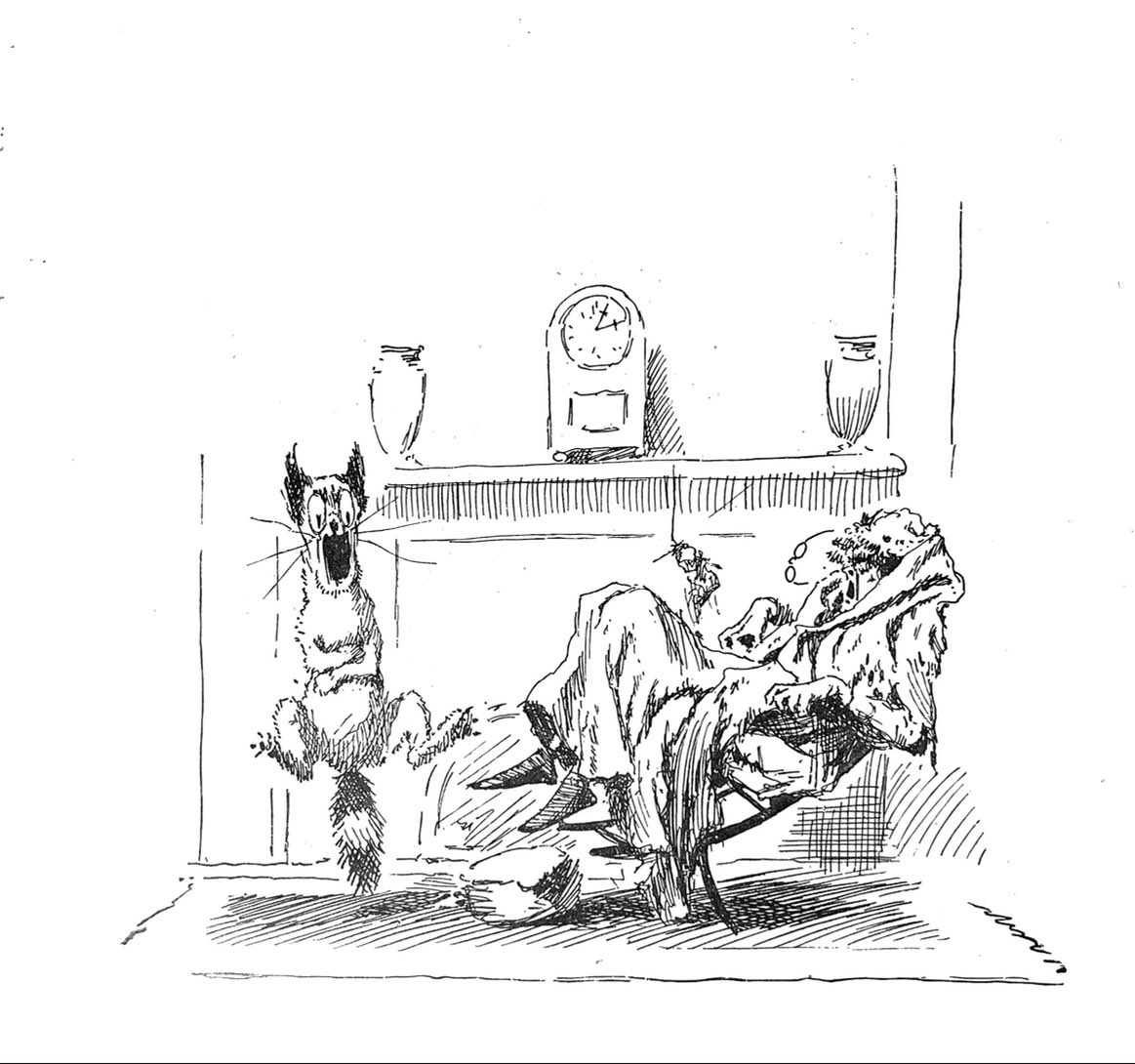
Scanned here from the original Stuff and Nonsense is the first lengthy narrative in the 92-page collection, “The Fatal Mistake: A Tale of a Cat.” Each image is its own full page. The captions I have attached to each are A.B. Frost’s own, although in the original book they are found in the Table of Contents rather than beneath each image.
The Fatal Act
Suspicion
The Pang
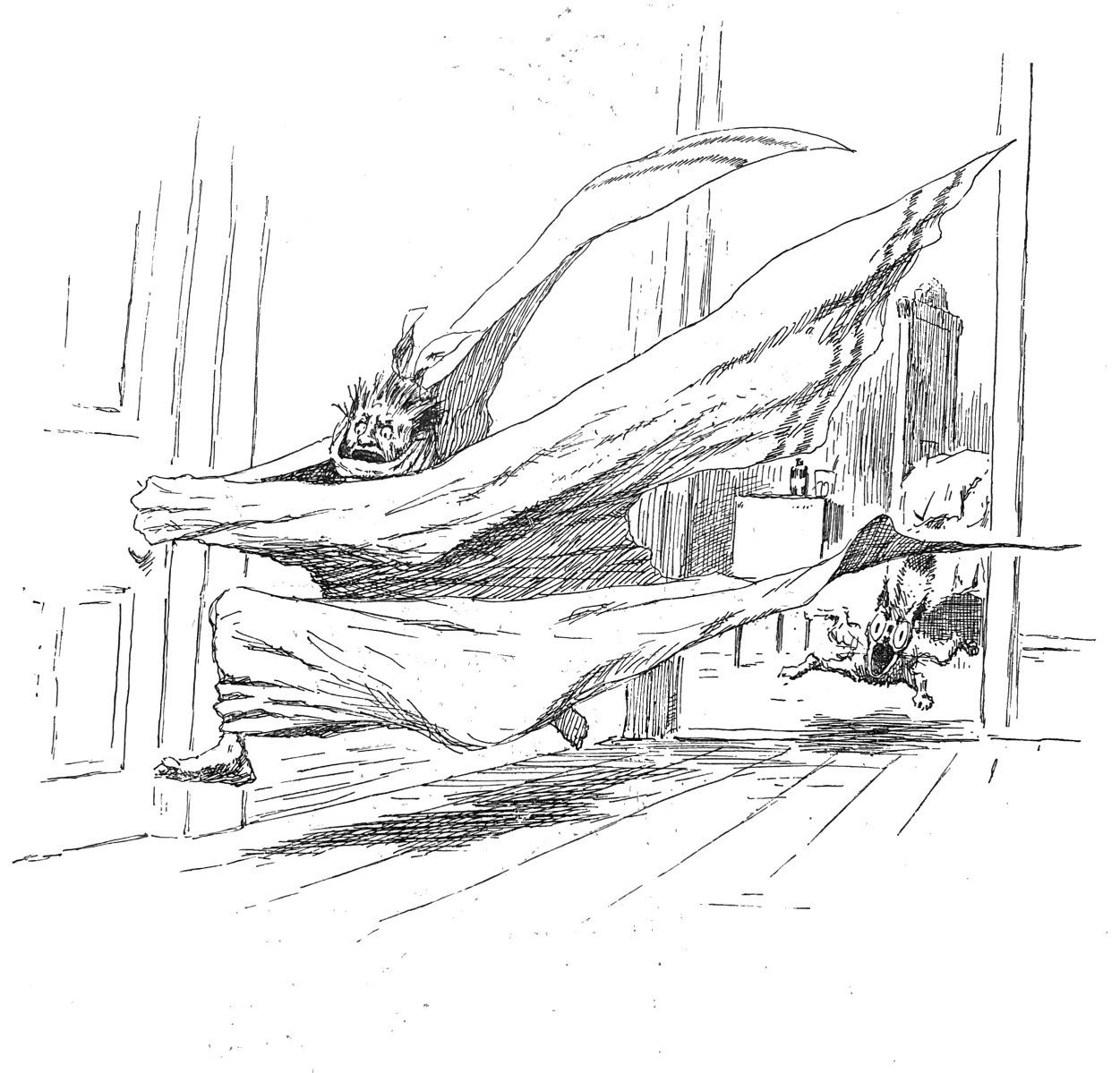
The Rush Through the Hall
And Through the Library
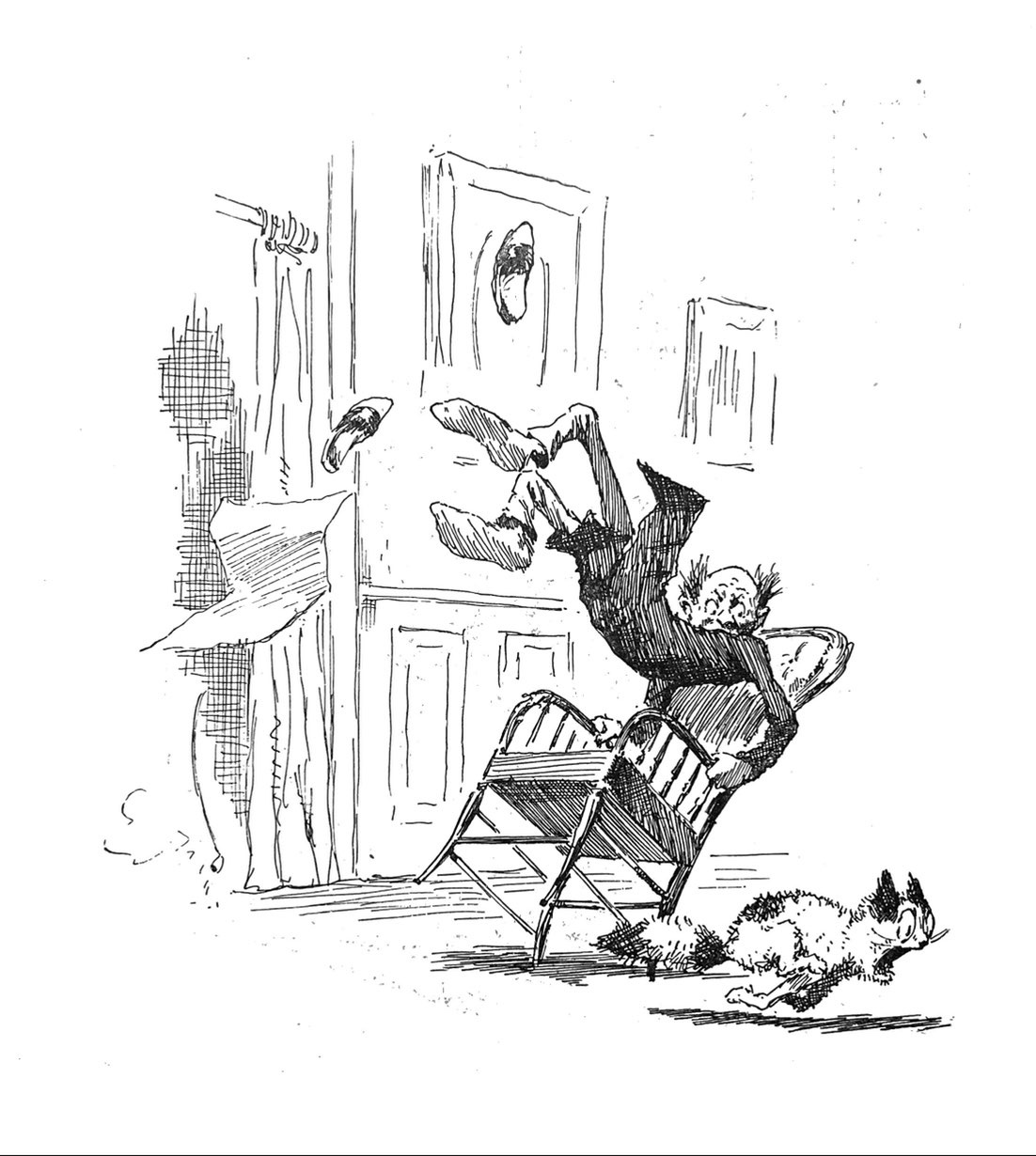
Frost was a regular in the humor weeklies of the 1880s and his influence on the first generation of newspaper cartoonists is apparent here. In just this sequence we can see previewed so many themes and visual tropes of the first decades of comic strips. The comic disruption of middle class stoicism and order with slapstick chaos was the centerpiece of comics. And it was expressed with the cartoonist’s fascination with cause and effect, the physics of exaggerated motion, the shocked response.
The first three reaction images to the poisoned cat seem like Frost exploring with increasing velocity both the shocked facial and physical impacts of the frantic cat. Keep in mind that motion and the art of freezing motion was very much in the air in the late 1870s and early 80s. Eadweard Muybridge had already started his seminal stop-motion studies of animals in motion that impacted both formal and cartoon arts. And while certainly there are precedents for caricatured pratfalls and slapstick in the pioneer Rodolphe Töpffer’s work, Frost’s superb rendering of extravagant cause and effect were helping establish a special cartoon physics that Opper, Outcault, MacDougal and others would further refine in the 90s and 00s.
New Treatment for the Mumps
Likewise for the Gout
Into the Kitchen
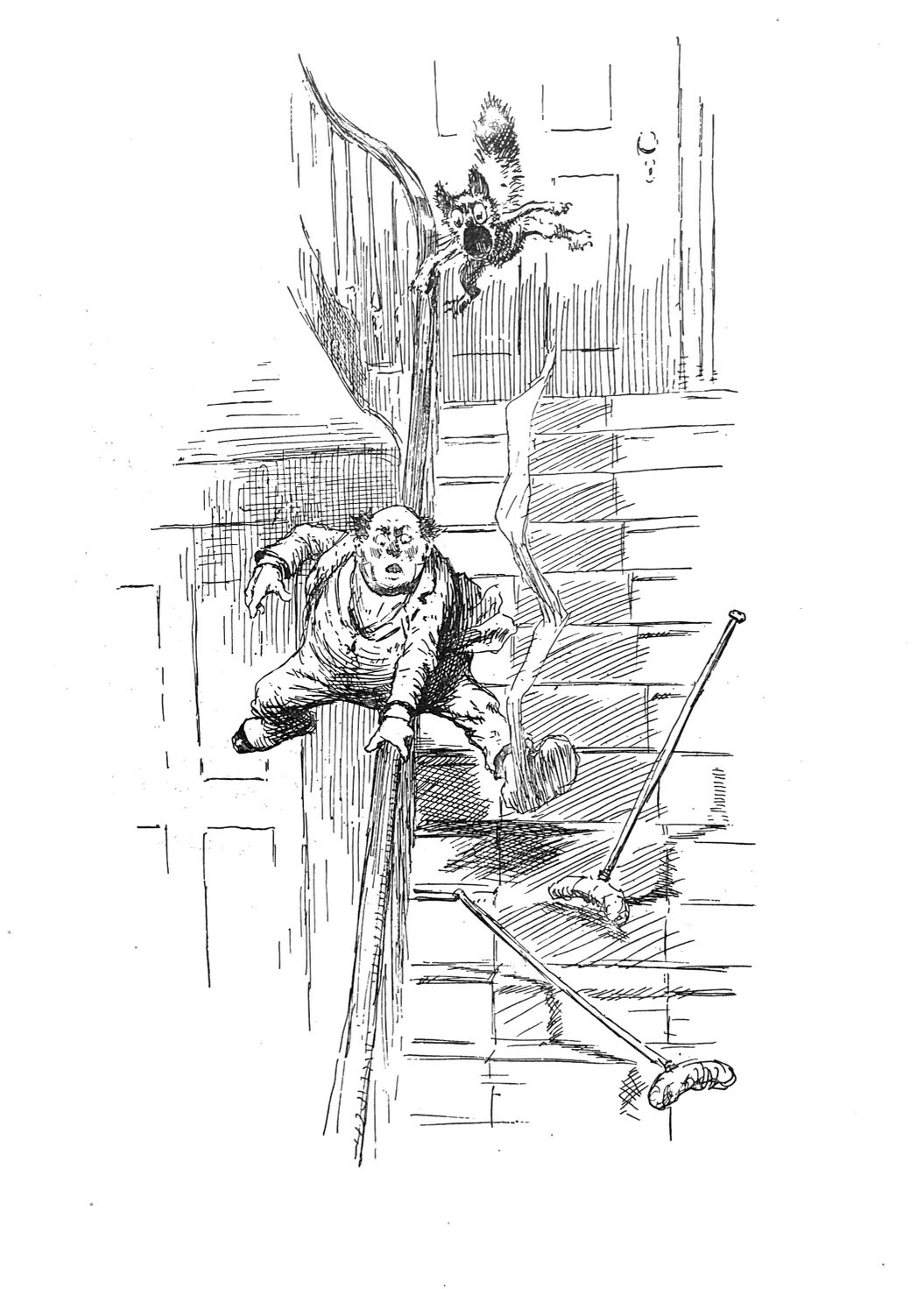
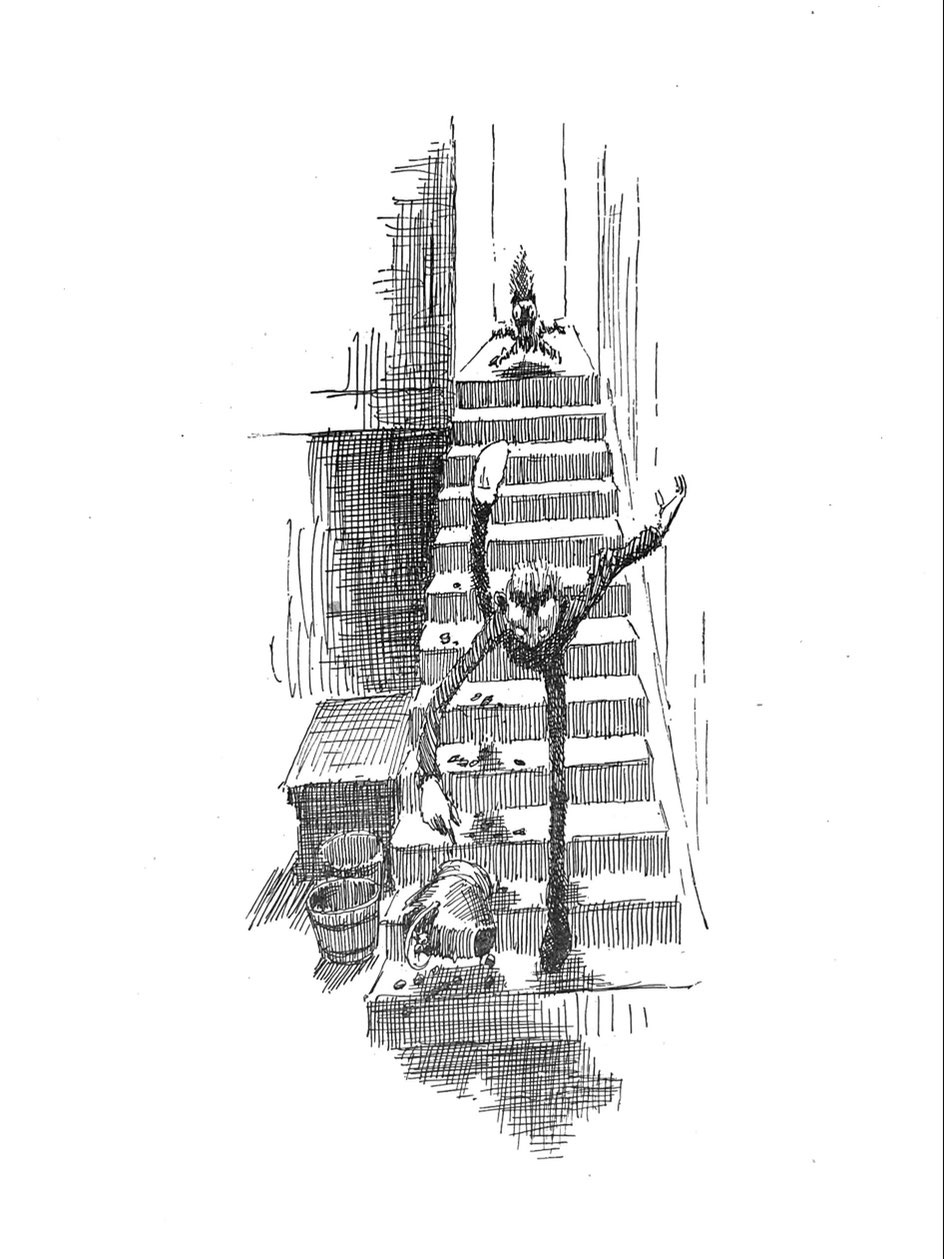
Down the Cellar Stair (A Study in High Perspective)
Frost appears to be relishing the mayhem he is creating as he upends the familiar objects and cast of a common affluent household. This is an anarchic convention that many artists took up in the first five or ten years of the next century in middle class bad boys like Little Jimmy, the Katzenjammers and Buster Brown. And Frost is clearly conscious of his own experimentation. The final page in the selection above is entitled “Down the Cellar Stairs (A Study in High Perspective).” In the next-to-last page of the narrative (below) he brings us behind the charging cat to create a new point of view for the audience that also seems to put the viewer in motion as well. Clearly, he knew what he was doing, test driving the potential of caricature to render new effects.
And it all works so well because Frost is just such a polished caricaturist. The bend of the butler’s inhumanly lanky long legs, the slippers shooting from the toppling man in the library, the enormous bedsheets flailing behind the mumps patient are all so convincingly animated. And make no mistake; this is black humor, comic antics bracketed by an accidental poisoning and finally death. The most effective geniuses of cartoon art always have that ability to make the cartoonish still feel real and the real feel cartoonish.
And Out Into the Cold Cold World
Carrying Everything Before Him
To a Watery Grave
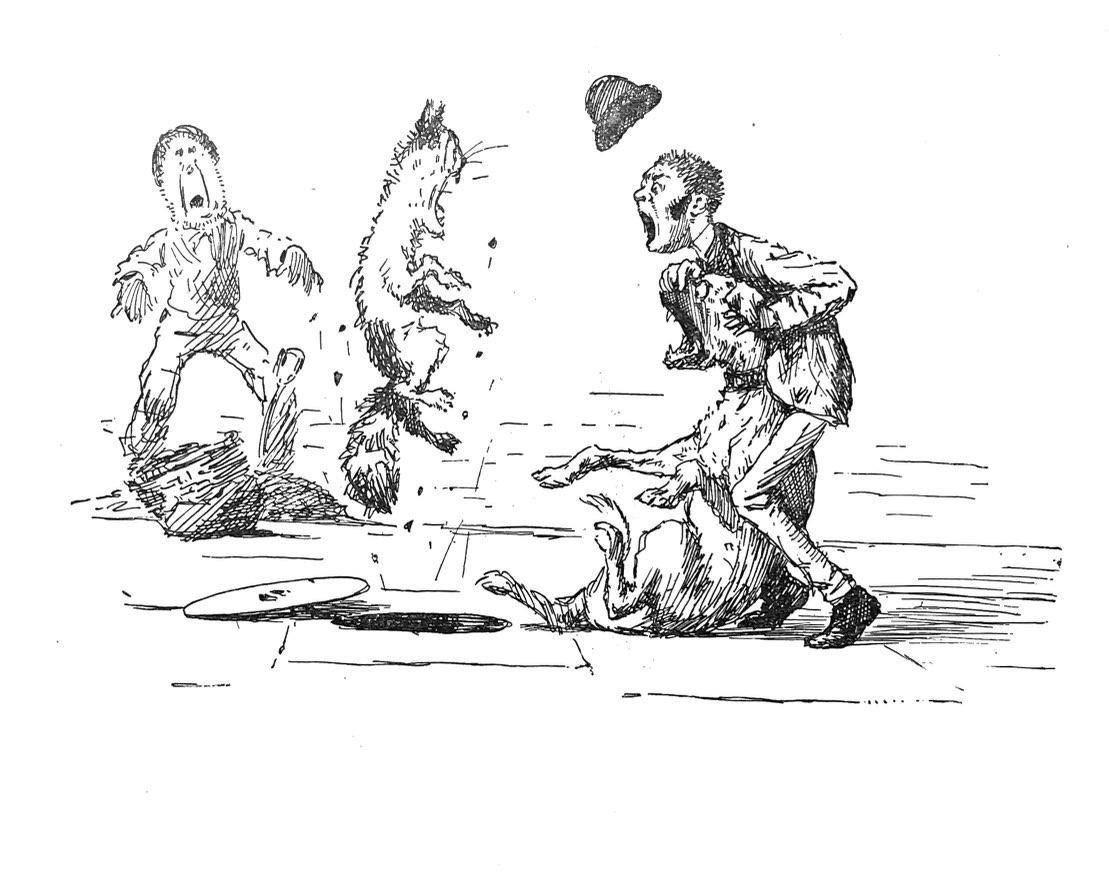
My favorite sequence, however, must be the cat, dog and master in mutual terror erupting from the sewer. All three mouths seem to mimic each other. There is no cause and effect. They are both at once. And yet Frost uses the eyes of each figure to individuate and give each its own voice and character. A decade before the creation of the newspaper humor sections that would nurture a comics universe, A.B. Frost was setting down a comic grammar for this new art to follow.
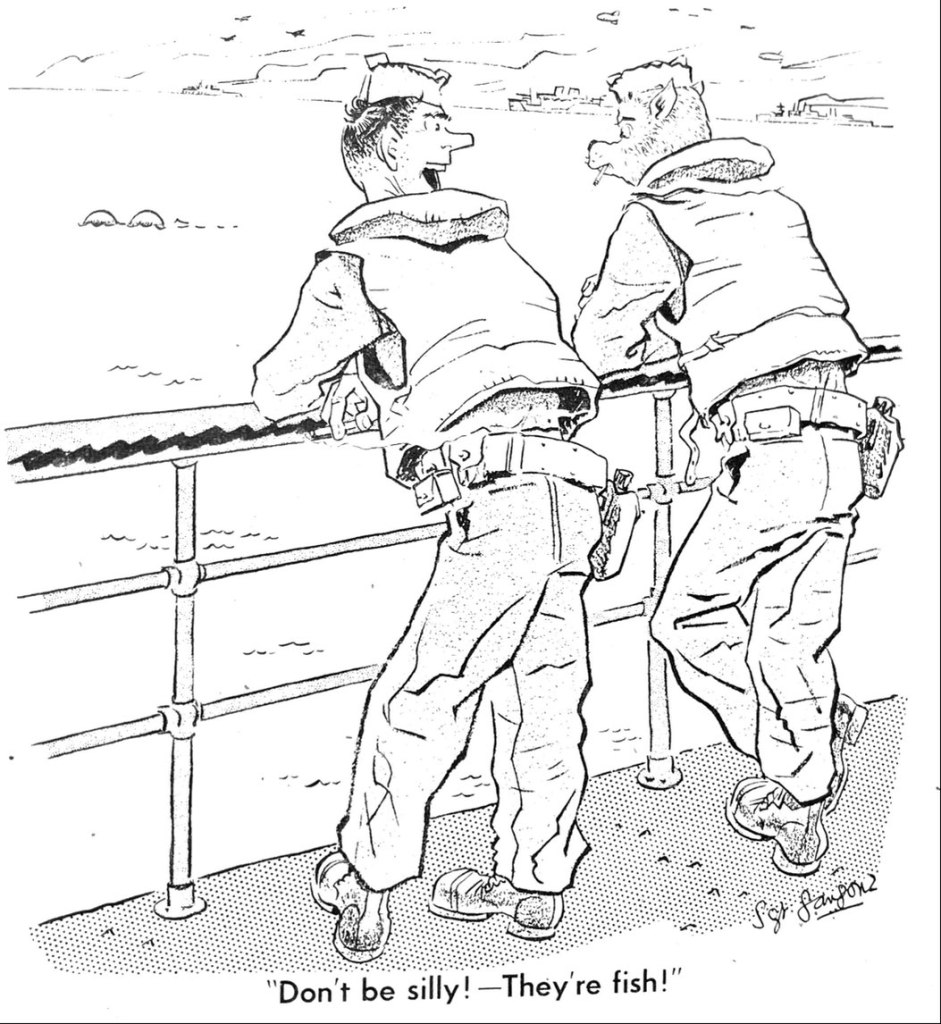
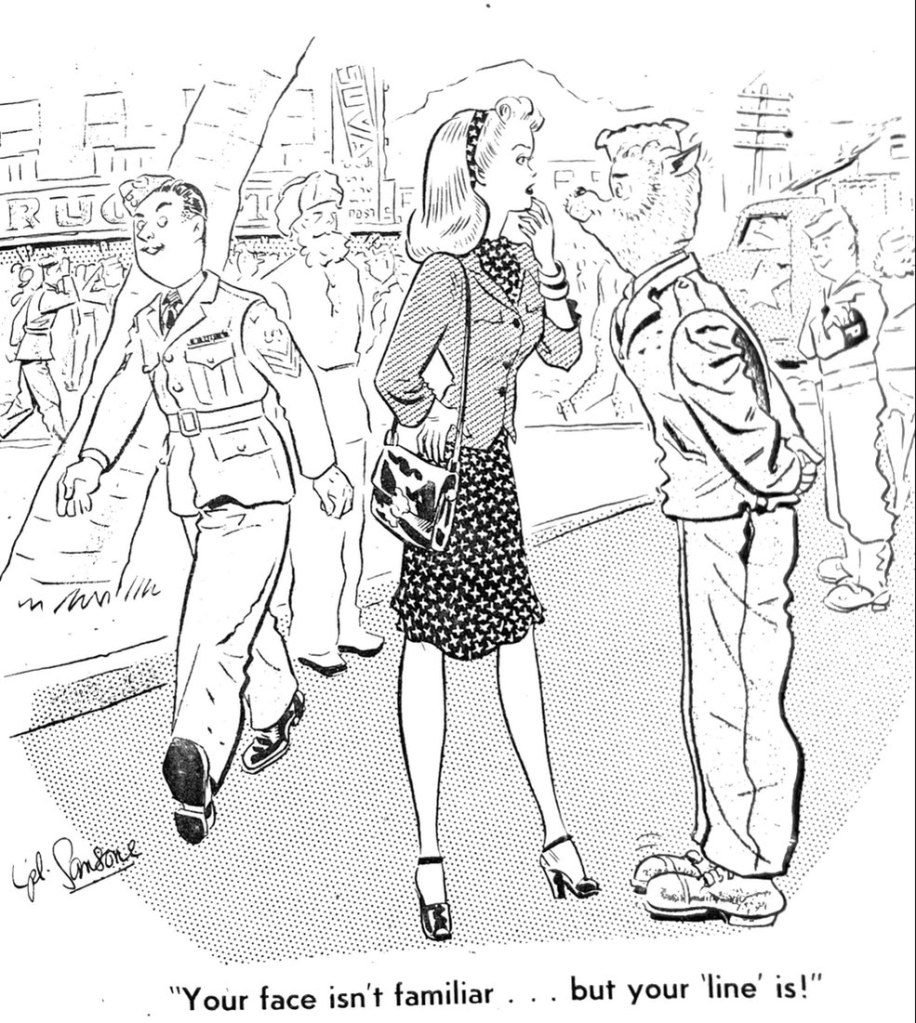
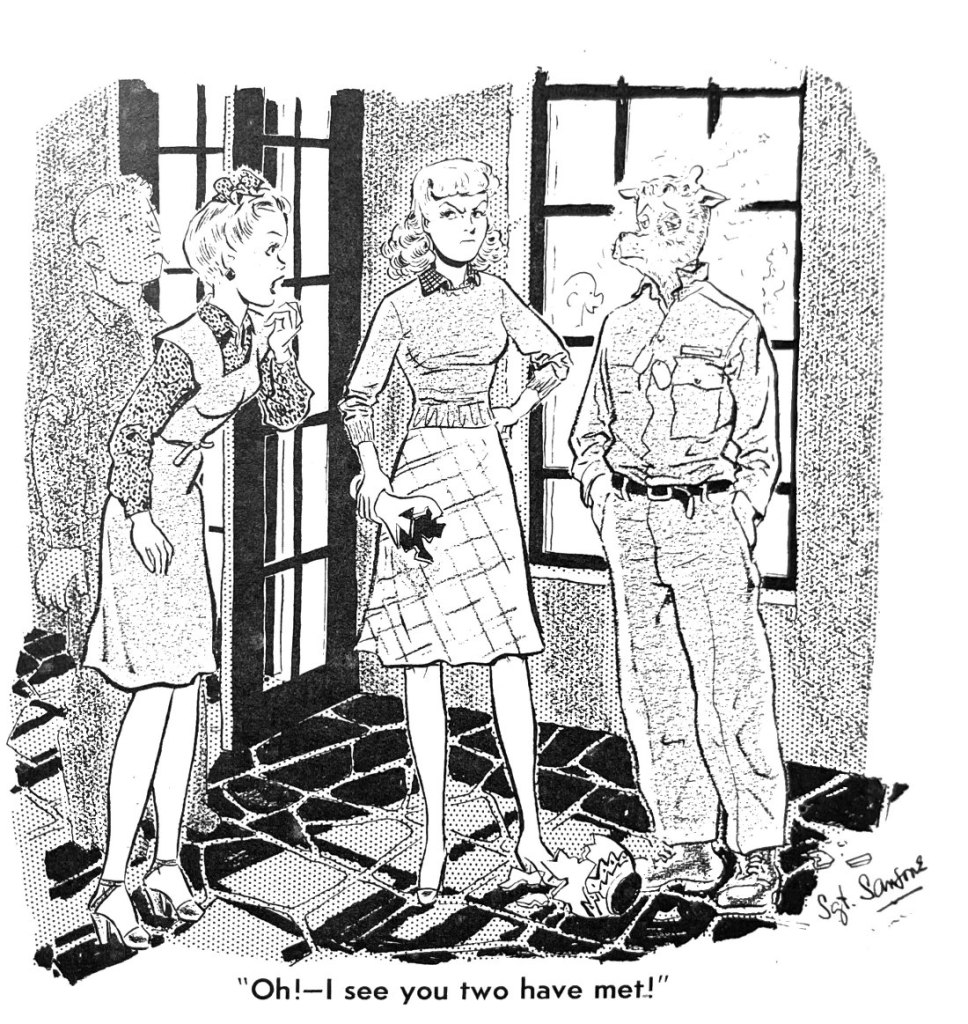
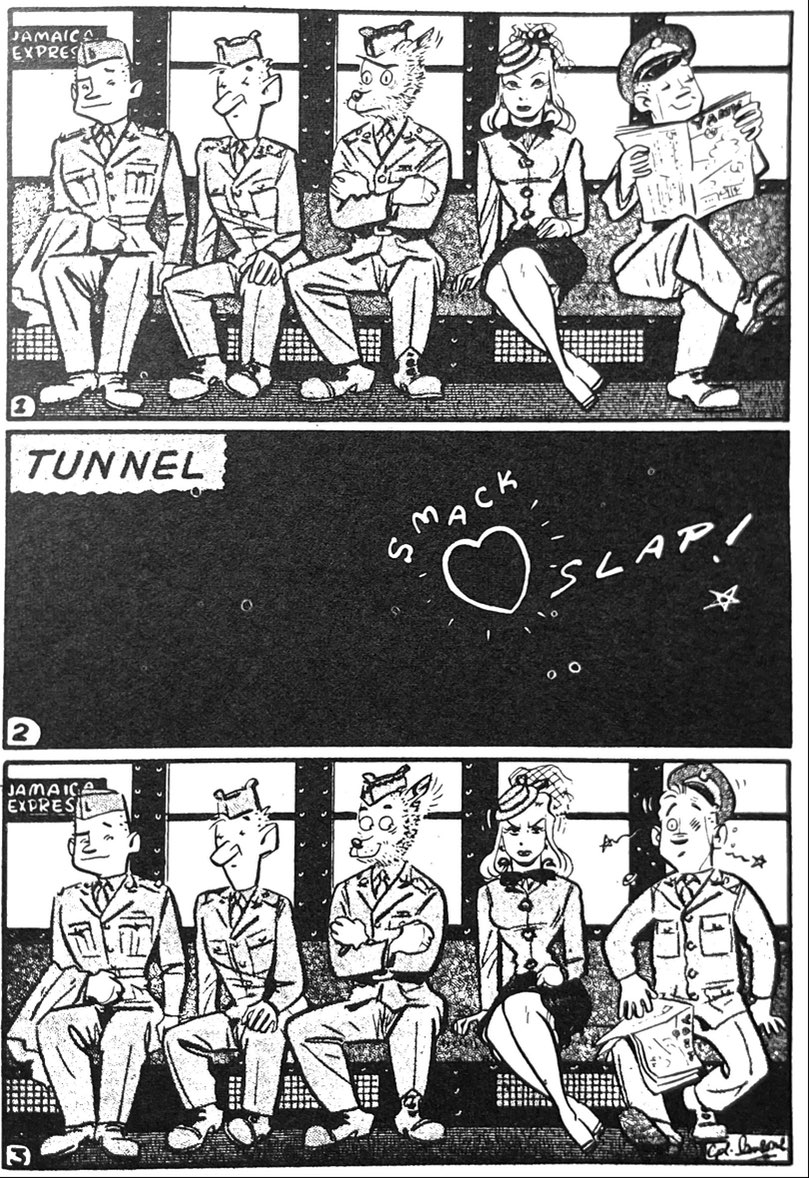
During WWII the country mobilized for a two-front war on every level, including cartooning. Bill Mauldin’s Willie and Joe, Milt Caniff’s Male Call, Sgt. George Baker’s Sad Sack are among the best known strips created for the troops, and many of them enjoyed a greater latitude than newspaper counterparts in their use of language, sexual references, and sheer cheesecake. Less well-known and remembered is Leonard Sansone’s girl-chasing, cat-calling, kiss-stealing “G.I. Wolf”. Also known as “The Wolf” and “Private Wolf,” this one-panel comic featured a GI depicted with a wolf’s head and insatiable, predatory libido. It was a big hit among the troops in its 1942-1945 run, landed Sansone a profile in Life magazine in ’44 and a book reprint “The Wolf” in 1945 with an introduction from the king of male adventure strips Milt Caniff.
G.I Wolf’s humor was based less on hilarity than familiarity. The character was instantly recognizable to most of the late adolescents we sent to war as the embodiment of their inevitable frustrated sexuality. And he is the one lad in the unit most vocal about it. But while the GI Wolf strip is not especially funny, not to mention hopelessly sexist in retrospect, it remains noteworthy. Most of all, it takes horniness itself as its subject. While other strips for the troops, like Caniff’s, ladled on the legs and double entendre for its more adult and lonely male audience, GI Wolf was more direct. Men without women is an inevitable trope of army tales, but it is usually engaged obliquely. Bob Hope shows always featured the latest Hollywood starlets. Airmen painted cheesecake images on their planes’ nosecones. And the marauding of soldiers and sailors on leave was the stuff of lore. But Sansone puts horniness front and center in GI Wolf. He not only personifies the theme with a fantastic wolf-headed character but makes his sex drive the persistent punch-line. And Sansone pushes the theme in fantastic directions. My favorite is the cow talking back to Wolf as he manhandles her udders.
But most often, GI Wolf is recognition humor aimed at enlisted men’s common experiences. Buddies set each other up with disappointing blind dates. Wolf projects his sexuality onto everything, from potatoes he is peeling to cows he is milking to fish swimming off a dock. And so the relentlessness of GI Wolf’s horniness is the real butt of the joke here. His predatory and politically incorrect antics may be familiar but they are not seen here as heroic. Far from it. His fellow soldiers complain about his unproductive fantasizing, even intimate that he may be jerking off too much. His skirt chasing rarely ends in conquest. And most often the damsels he chases hit back…effectively.
Which is not to say Sansone’s GI Wolf was a feminist treat. Slinking away from unattractive dates is a frequent trope of the series. And the entire cat-calling ritual is presented as a mutually agreed upon game between the sexes. In fact in a stupendously dated introduction to the 1945 reprint, Caniff says as much. “No matter how smoothly she tossed her head, I have yet to see a woman who did not betray the secretly pleased expression around the eyes when whistled at or wolf-called by a man or men in uniform,” Caniff writes. Yeesh!
Sgt. Sansone was a member of the Camp Newspaper Service, and GI Wolf ran in the Stars and Stripes newspaper and Yank magazine the armed forces produced for the troops. He was born in Norwood, MA in 1917 and moved to New York City before the war to pursue a freelance art career for advertisers and the early comic book market. After the war, Sanone moved to Miami and developed the Willie newspaper strip. He died in an auto accident in 1963 at the young age of 46.





























 Panels & Prose