Top Holiday Books for Comic Strip Lovers

Panel heads, there is cause for celebration. We are in a golden age of comic strip and comic book reprints. Some of us old-timers have been beating the drum for recognizing the art of the “funnies” for decades. But a new generation of readers was raised on graphic novels and unabashed in their love of comic books and graphic narrative of all sorts. And as much as I myself loathe the rise of superhero genres as mainstream adult fare, even I have to admit that it is helping to increase general respect for the full range of comic storytelling. 

And so we are getting an embarrassment of comic strip reprint riches in recent years. Here are some of my favorite comic strip archives from this past year as well as some secondary material and a few crossovers into the world of early comic book history. Over the next couple of weeks I will be counting down my ten favorite books on comics and reprints of the year.

#10 The Peanuts Papers: Writers and Cartoonists on Charlie Brown, Snoopy & the Gang, and the Meaning of Life, edited by Andrew Blauner. NY: Library of America, 2019. $24.95

Peanuts has become the Krazy Kat of the last half of the 20th Century. Its light and barely guised philosophical musings, mildly depressed tone and angst-ridden protagonist naturally attract hosannas from the dignified set. It feels like half the masthead of The New Yorker magazine got recruited for this one (Jonathan Lethem, Adam Gopnik, Jonathan Franzen, George Saunders, Ann Patchett, Maxine Hong Kingston, Joe Queenan and of course Chris Ware). Generally I am suspicious when branded intellectuals congregate to lend their imprimatur on pop culture. Who needs ‘em, I say. But there really are some nice insights here that can give even Peanuts fans fresh ways into the strip. 
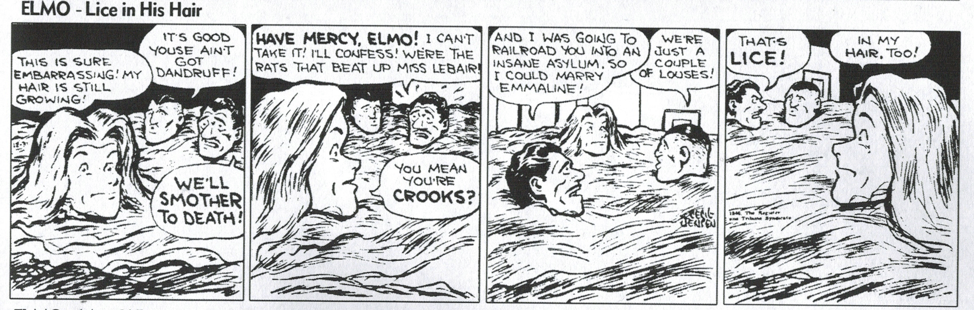
Buried Treasure: Cecil Jensen’s “Elmo”

Thanks to Frank M. Young a long-forgotten Strip of the latter 1940s, Elmo, has been unearthed and reprinted. The strip’s author Cecil Jensen was an editor at the Chicago Daily News, editorial cartoonist and author of the longer-lived Little Debbie strip of the 1950s. 

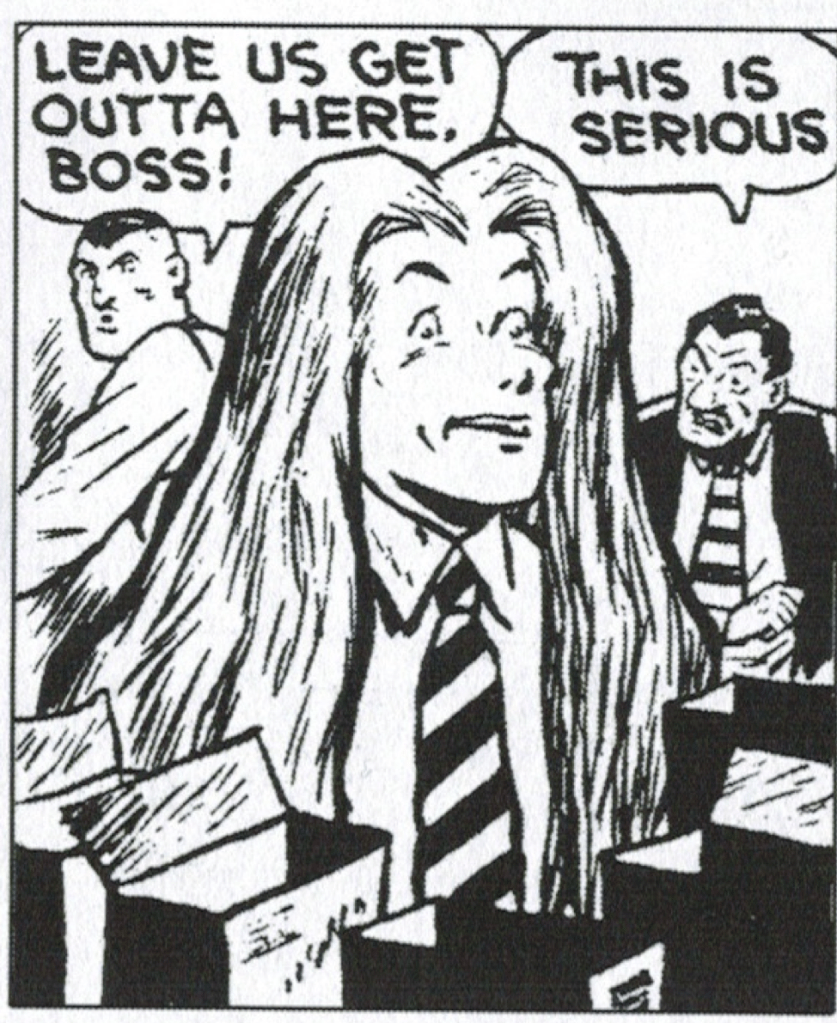
But Elmo was a singular creation that seemed on the surface an Al Capp Li’l Abner knock-off. A rube from the sticks comes to the city and seems to use his half-wit to outwit a cast of broadly drawn types (corporate CEO “Commodore Bluster”, femme fatale and stripper Sultry Lebair, political boss Mr. Hoodlum). Even the visual style feels like a less talented Capp – thick inking, wild hand and body postures, short and sparse blobby lines to craft facial caricatures.

But the plotlines venture further off the rails and more deeply into dark areas of the American soul than Capp ever imagined. In just the first few months I have already read, Elmo saves a rich tycoon from suicide, is rewarded with controlling interest in a cereal company, is hypnotized into thinking he is a skunk, who he lives amongst at the zoo, is kidnapped by Mr. Hoodlum, and force fed breakfast cereal, which grows so much hair on his head it drowns his kidnappers in his tresses. 

This is truly weird but also very critical view of a sinister post-WW II America. Everyone has an angle; every conspiracy contains a double-cross, and death and violence are real and present possibilities always.

The book, published by Labor of Love Press, was issued last summer. A second volume is out that includes samples from the longer Little Debbie run into which Elmo evolved as well the end run of the strip that saw the wild return of Elmo. This is a genuine find.

Merry Ironic Christmas From Hogan’s Alley

Class conflict and tensions in The Yellow Kid ranged from the grim to satires of the middle classes to pokes at violence and pretension among the emigre classes themselves. As I work through his strips I am impressed by the range of his sympathies and diverse perspectives on the city, poverty, violence, race and social class. The Dec. 15 1896 “Merry Christmas Morning in Hogan’s Alley” is a painfully ironic depiction of the holiday among Alley-ites. A “Deer Santy Klaws” letter on the fire escape instructs Santa to use the nearby ladder because there is no chimney. Another chortling boy holds his Merry Christmas sign above a drunk passed out at the foot of a tenement. Somber faces stare into the mayhem of the street. Two mothers shake their fists at each other in the background, a child taunts a foreign missionary asking for donations and handing out tracts. A ruffian uses a pea shooter on another child trying to celebrate in paper hat and drum. The one child in the scene with a gift is an obviously middle class child (in Lord Fauntleroy haircut) hugging her dolly tight as street children look on, some numb-faced, others smirking. The entire scene is framed in the foreground by a cherubic girl holding her hand out to the viewer in search of alms. 

It is a biting, scolding view of class disparity and how some commonplaces of the growing middle class are out of reach of Outcault’s urchins.

Preamble to the Yellow Kid

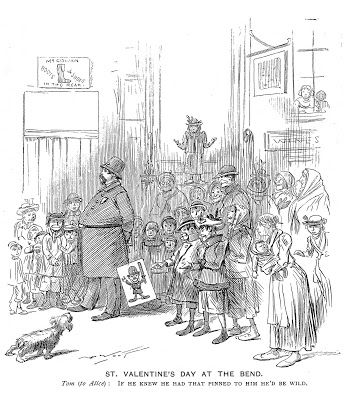
Familiar to all comic strip mavens, the massive Yellow Kid newspaper pages were stunning tableaux of late 19th Century urban immigrant life. But R.F. Outcault was himself inspired by predecessors. Bill Blackbeard, the dean of comic strip history and preservation, begins his great 1995 celebration of the Yellow Kid reminding us how Outcault was echoing Michael Angelo Woolf’s (1837-1899) well-regarded panels for Life, Truth and other magazines of the day. Woolf was a pioneer illustrator of Irish emigres, labeled in his obituary a “tenement artist.” He pioneered the light comic take on alleyway waifs, riffing on their childhood renditions of adult behavior. Just as Outcault depicted his Hogan’s Alley population preparing for political conventions, hosting beauty pageants and mimicking “The Greatest Show on Earth,” Woolf depicted his children having discussions of fashion, hosting union meetings and free balls.

Disclosure: In order to support this site, I maintain relationships with booksellers to which we link and may receive a commission on any purchase you may with them.