Hugh Hefner’s Cartoon Chicago

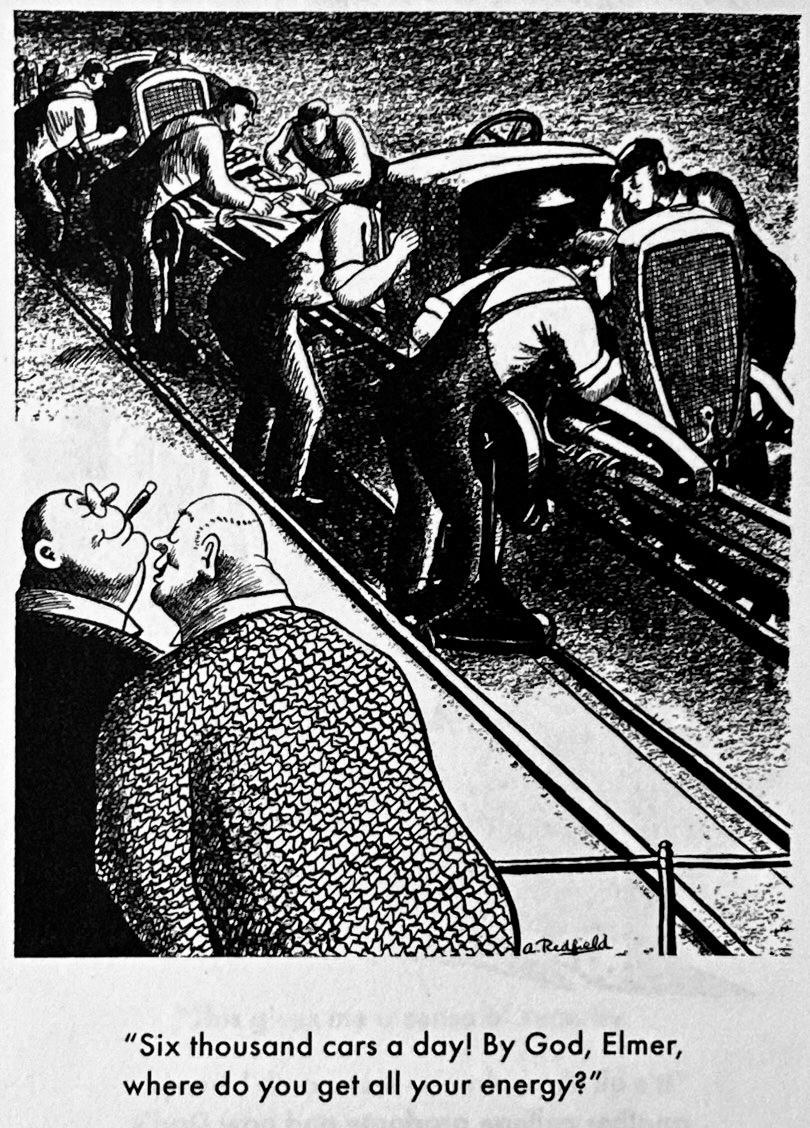
Hugh Hefner was famously supportive of cartooning in the pages of Playbpy for decades, in part because he was a frustrated artist himself. Samples of his own attempts at single panel humor surface from time to time in biographies of the legendary publisher and the history of his landmark magazine. Less well-known is that in 1951 and prior to his meteoric Playboy fame he published a collection of his own comic work focused on the theme of his beloved Chicago., That Toddlin’ Town: A Rowdy Burlesque of Chicago Manners and Morals. This was very much an insiders’ cartoon revue, as Hef broke the volume into Chi-town’s famous districts and infamous institutions like The Loop. Michigan Avenue, Bug House Square, North Clark Street, The El, and the activities for which they were famous: strip bars, b-girls, the city’s multiple newspapers, soapbox orators.

Continue reading

Skyroads: Flying As Fetish

After the fast success of Tailspin Tommy in 1928 from the Bell Syndicate, the John F. Dille company responded with Skyroads about five months after the syndicate introduced Buck Rogers. The otherwise forgettable strip is perhaps most notable as a stable for artists on more important projects.

Continue reading

Prince Valiant Launches

On February 13, 1937, Hal Foster launched his legendary epic Prince Valiant with these first three panels. The scans are from his original uncolored art (via the Fantagraphics Studio Edition) and illustrate Foster’s masterful use of light and shadows to render his forms. Full first Sunday below

Continue reading

Boy Wonder: Tailspin Tommy’s Machine Romance

“Boy!! That’s the life for me. Gosh…” The first of the major aviation-themed strips, Tailspin Tommy (1928-1942) embodied many of the essential qualities of the genre. From its start, the strip had an infectious, boyish wonder…about the air, about technology, about modern progress itself. Like most in the category, it was drawn by a pilot and flying enthusiast (Hal Forrest) in a rough style that fetishized planes and flight images yet fell flat in depicting characters and earthbound life.

Continue reading

Connie and Frank Godwin’s Gentle Realism

Frank Godwin’s 1927-1941 adventure strip Connie should have been among the standout strips of its day on a number of counts. While its launch as a Sunday light-hearted take on the modern working gal (a la Tillie the Toiler, Ella Cinders), its extension to a daily in 1929 turned the lithe and stylish Connie Kurridge (yes, “Kurridge”) into one of the first comic strip adventuress. While others consider her the pioneering female adventure character, it seems to me Harold Grey’s Little Orphan Anniehad already been working this genre since 1924. Still, Connie was the first woman in strips to take on the typical tropes of pulp drama – globe-hopping, eccentric villainy, world-shattering consequences. She employed a combination of savvy, courage, physical daring and comely attraction to both overcome and disarm her antagonists. And the scene-shifting was impressive. In the first years of the strip she moves from being an aviator to reporter to charity worker and eventually in the 1930s as a white defender against the “Yellow Combine” when she time travels to 2349 AD.

Continue reading

Like a Comet: Frazetta Races In

On Jan. 28, 1952, Frank Frazetta’s breathtaking talent for dramatically charged action and erotic, muscular figure drawing finally made its way into newspapers with one of the most gorgeous, if short-lived, strips of the decade, Johnny Comet. The eponymous adventure was set in the racing world, a theme that should have tapped naturally into the car customization craze of the 50s. It was ceonceived and distributed by the McNaught Syndicate, ghost-written by Earl Baldwin, but co-credited to Frazetta and 1925 Indianapolis 500 winner Peter DePaolo who served more as an advisor and was attached to the project to lend an air of authenticity. Hobbled perhaps by uninspired scripting, Johnny Comet failed to catch on despite its standout visual poetry.

Continue reading

Secret Agent X-9: Watching Alex Raymond Mature

Nearly 90 years ago yesterday Jan. 22 1934, the collaboration between Dashiell Hammett and Alex Raymond launched as Secret Agent X-9. Designed to respond to Dick Tracy’s massive success with the literary cachet of Hammett and the rising talent of Raymond, X-9 looked better on paper perhaps than it did, well, on the actual page. The famous innovator of the hard-boiled style was at the tail end of his productive output and clearly did not give his best effort. After crafting just a few very uneven scenarios, Dash got canned.

Continue reading