Most media, cultural and certainly women’s studies historians have long understood that the post-WWII era represented a twisted nadir for the representations of women in American popular culture. During wartime, women famously took on more prominent, responsible and even strenuous roles in the workforce than ever before. And once the war ended and the male troops returned, these same women upon whom the home front depended were explicitly urged by ever quarter of American society to surrender these gains for the sake of passing these jobs back to the traditional male breadwinners. There was nothing subtle to this process either. Many women were badgered back into domesticity, often accused of “stealing” livelihoods from returning veterans. Other aspects of popular culture like the the rise of the femme fatale trope in noir and crime fiction, the ditzy blonde bombshell, the irrational, imbalanced feminine figure in thriller genre – all helped undermine the legitimacy of women taking more powerful roles in the post-war “man’s world.”
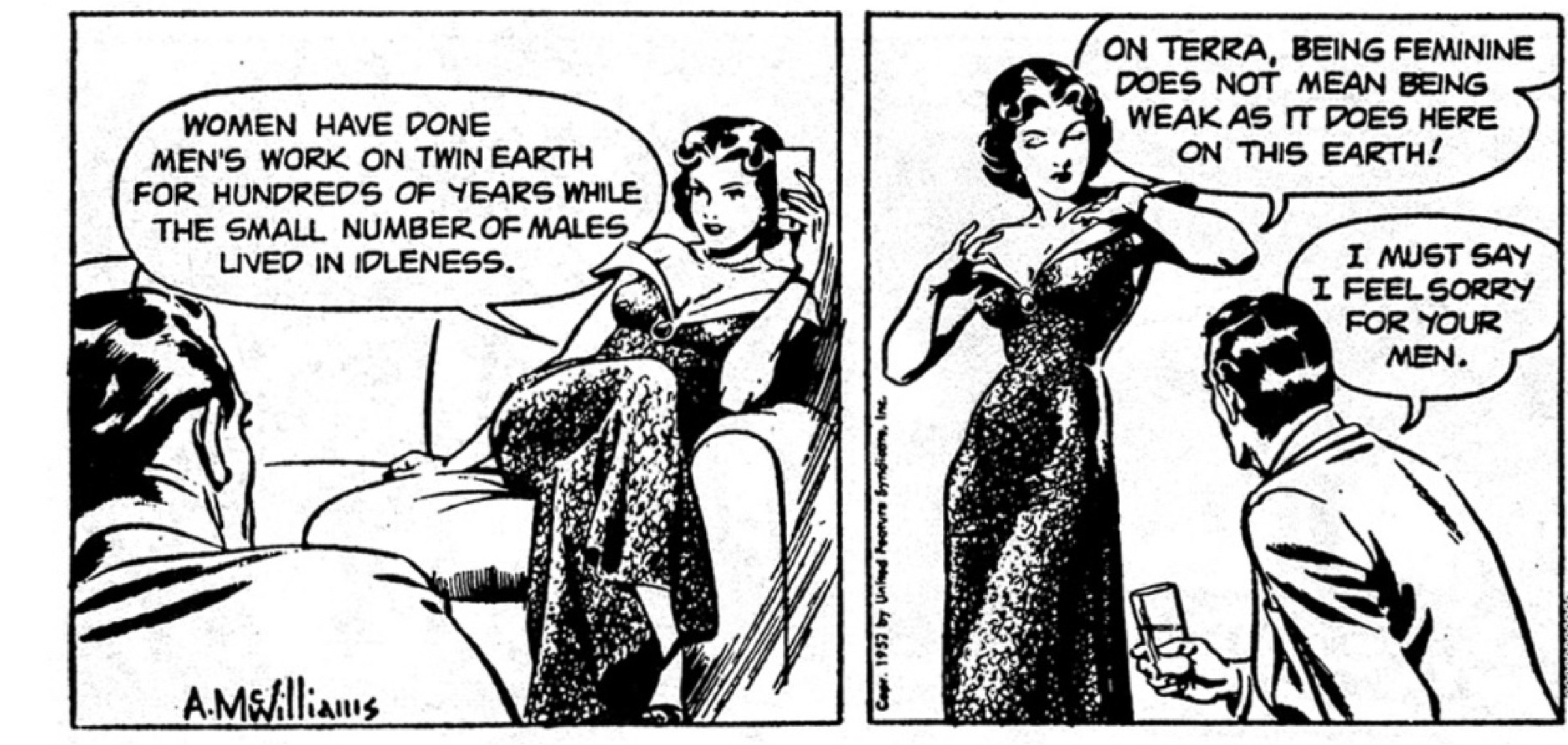
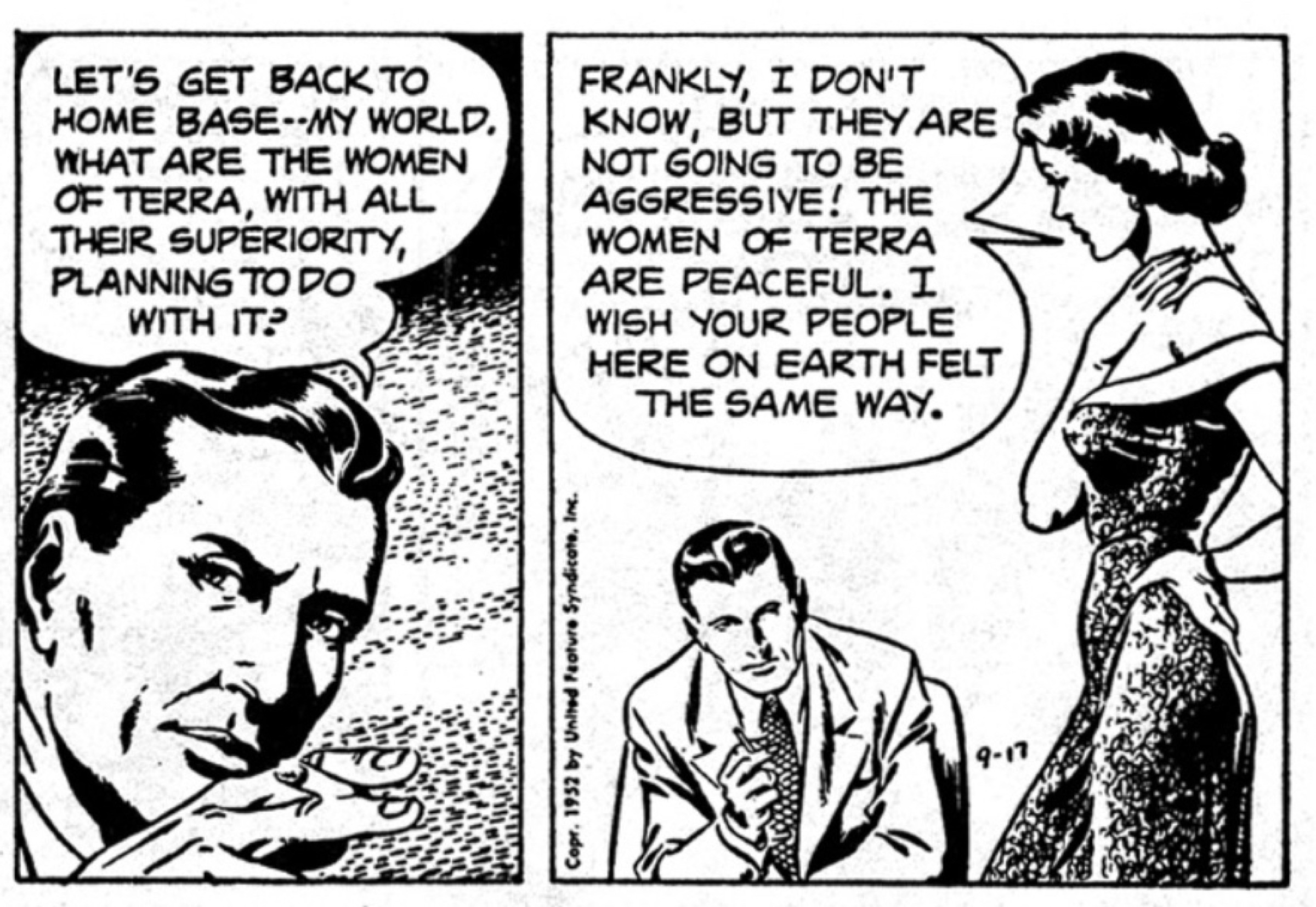
This context makes the premise of the Twin Earths sci-fi strip all the more curious and fascinating. Running from the middle of 1952 to 1963 in dailies and 1953-1958 in a separate storyline in Sundays. When the overlooked strip is remembered at all, it is for some prescient gadgetry that anticipated later everyday tech. To be sure, the writing by comic book illustrator and editor Oskar Lebeck and drawn by comics veteran Al McWilliams was often leaden and unexciting. But Twin Earths was home to some genuinely intriguing and thoughtful futurism that echoed literary science fiction. And as I make my way through the strip’s early years, it is the basic premise of Twin Earths’ divergent social organizations that is most striking. The twin Earth (Terra) is a female-dominated society where a diminishing population of males is retained mainly as idle breeders. The Terran spy Vala infiltrates our earth to ensure this male-dominated planet is not developing its technology towards destructive ends. She pairs up with FBI agent Gary Verth to avoid Communist spies and assassins from her own host planet. The banter between the two, especially Vala’s accusations of masculine aggression (an early take on male “toxicity”?) is a remarkable standout at a cultural moment when most popular culture sought to diffuse, defeat and mock women aspiring to power.
By 1937, Harold Gray seemed to have fallen into an especially foul mood. It was several years into his nemesis F.D.R.’s “New Deal,” which Gray felt represented everything he and his “Little Orphan Annie” disdained: social uplift, misguided do-gooders, institutional authority. From the start, Gray was never shy about voicing his populist perspectives and what he saw as core agrarian values of self-reliance, individualism, and deep suspicion of government bureaucracy of all sorts. His chief scholar, Jeet Heer, has done a much better job than I can here outlining Gray’s vein of Populism and how it ran much deeper than knee-jerk reactionary conservatism. And I have argued in these posts how Gray’s cultural politics were grounded in familiar mid-western traditions and a tension between 19th Century values of “character” and 20th Century notions of “personality. But it is clear that in response to FDR and the popularity of the New Deal Gray got more radical and vocal about his views. And perhaps not coincidentally, the strip grew even darker in the later 1930s.
As Here argues in the introduction of the 7th volume of the Library of American Comics reprint series, Annie was always a gritty, street-smart tale, but Gray usually kept physical violence off-panel. Yet, as the strip approached its creative height in 1936-38, that violence started moving into frame. Heer argues that Gray likely was responding to world conflicts, a greater personal sense of mortality as well as competition from more action-oriented strips that dominated the 1930s. I think Gray may also just have been growing angrier and more resentful towards a culture from which he felt ever more alienated. Gray’s moral vision was always as as simple and plainspoken as his drawing style – venal villainy countered by saccharine sentimentality. But it is clear, Gray was getting darker and seeing the world in starker ways by 1936. In fact the lead-up to one of the most jarring bits of in-panel violence in Little Orphan Annie begins with a remarkable Sunday strip on Oct. 8, 1936 that maps the modern world as a perennial “jungle” of predators and good-hearted strivers. As Annie’s newfound friend and flower-seller Ginger, reflects, “But the rules are still jungle – the survival of the fightingest.”
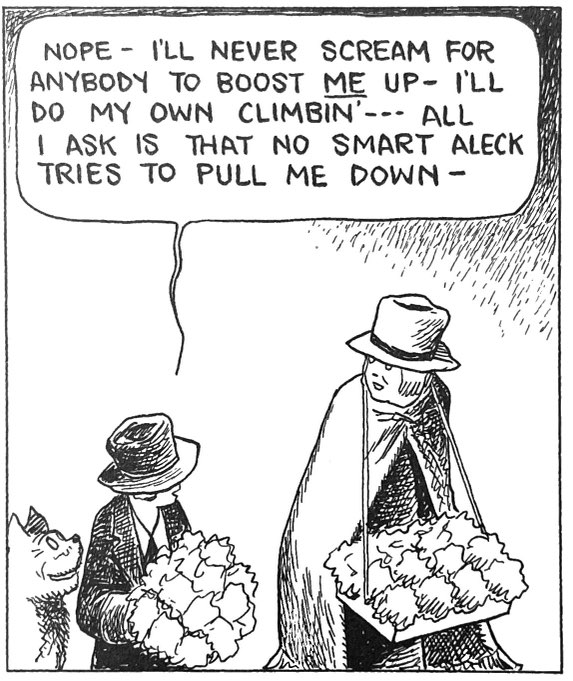
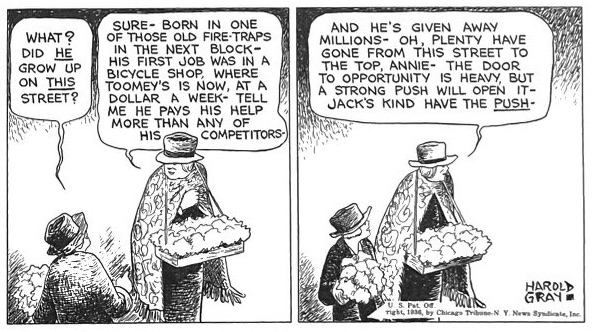
In the coming weeks, Gray uses Ginger as his populist mouthpiece. Annie had always been a chatty strip to begin with, but in these months the moral bromides, punditry and snide asides crowded most panels. Gray clearly had a lot to get off of his chest…about the corruption of politicians and lawyers and their collusion with thugs…about the mixed motives of “uplifters”…about the productivity and generosity of earned wealth…the moral hazard of handouts and unearned wealth. Gray was not a simplistic or sentimental reactionary. He had relatively progressive racial views. And as he outlined through Ginger in these months, his sense of individualism was a principled rejection of the sociological generalizations he saw driving a lot of reformist uplift and welfare. His populist sociology rejects environment as determinative of behavior.
No one ever accused Harold Gray of subtlety. Annie was as much folk punditry as it was an adventure. But he was artful, albeit dogged, in creating opportunities for his avatars to voice another homily. A street fight triggers bromides on rising out of the “hard kindergarten” of the streets. Passersby making an offhanded comment on these city kids not getting a chance in life set up Ginger’s counter-argument about the dangers of unearned advantage. Meeting an old friend lets her reflect on the morality and generosity of earned wealth. And all of this in just three strips.
Gray’s wordiness can divert us from his considerable and evocative graphic skills. He visualizes his principles and arguments that are as clear and un-subtle as his ideology. The street scenes in the Oct. 26 strip above illustrate the teeming diversity, the danger, raw violence of the city as well as the individuality of the humanity he sees there. That third panel depicting the “rushing tide of life” expresses at once a suffocating crowdedness and individuation.
Gray’s visual voice was singular and somehow it succeeded in establishing his mixed view of humanity, society and the cosmos. His laudable human figures were usually solid, husky and well-planted. Annie herself has tree trunk legs that look and feel organically rooted in much the way his friend Chester Gould like to plant Dick Tracy in the frame. It is the visual embodiment of self-reliance and resilience. The infamous hollow eyes of Gray’s cast underscore how little he and many other daily cartoonists relied less on facial expression and more on words, composition and action in a frame to express feeling. Much like Frank King and Gasoline Alley, Annie visualized the plain spoken style of its creator.
While they were very different artists, to be sure, Gould, King and Gray had visual voices that helped define the worlds we were in for those three or four daily frames. That to me is one of the comic strips’ singular aesthetic qualities, to establish diverse and distinct fictional worlds through these signature styles. For Gray it took the shape of bulky, pillowy figures that lived in a 2D world of little forced perspective or even movement. Gray’s characteristic hatch work helped communicate a grimness to his worldview – the persistence of shadows. Arguably, he did not have the stylistic talent or range of many peers. King had a great sense of panel pacing and rhythm, a feel for place and landscapes, he used relentlessly. Gould leaned heavily on his penchant for muscular action, grotesque violence, forced perspective and those vast planes of inky blacks.
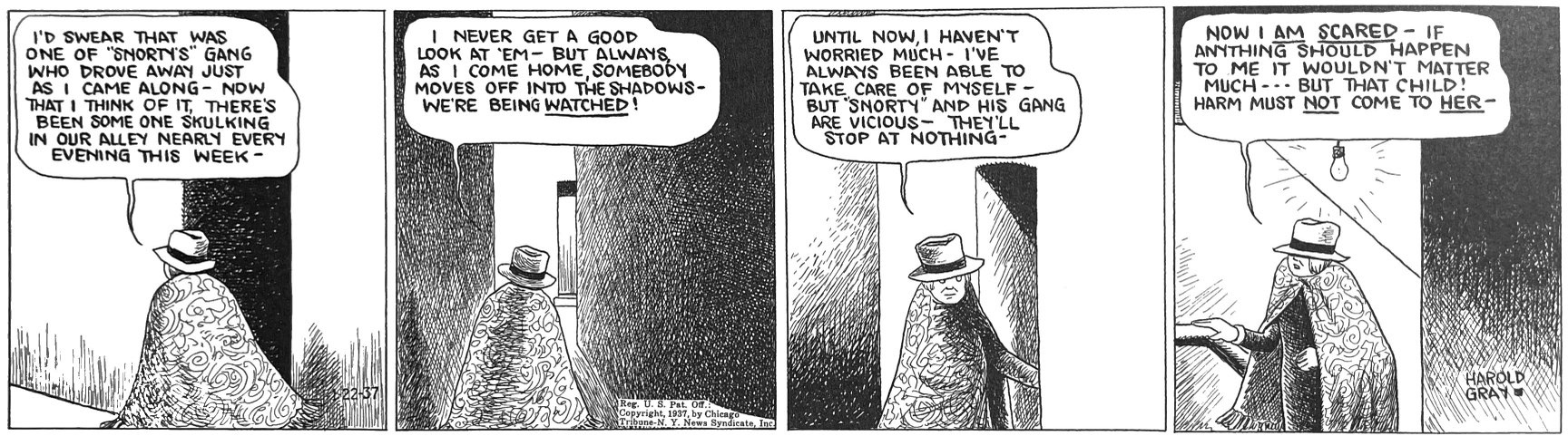
Gray flexed his style sparingly. But he was capable of great visual power. In the run up to the tragic violent death of flower lade Ginger, we get this gorgeous showcase of crosshatched planes, light-source, and cross-cut pace that feels like German Expressionist film.
The local gang of hoods target Ginger because she refuses to pay into their protection racket. Her graphic murder that comes days after the foreboding strip above is a rare instance of a Gray panel exploding in explicit violence.
It is probably best that Gray depicted violence so sparingly. He wasn’t very good at it. But this moment is of a piece with the months of the strip’s immersion in the modern city and its many musings on the modern “jungle.” And it embodied the emotional energy, perhaps even the anger and pessimism that seemed to drive what many comics historians regard as his creative peak in the storylines and characters in the last half of the 1930s.
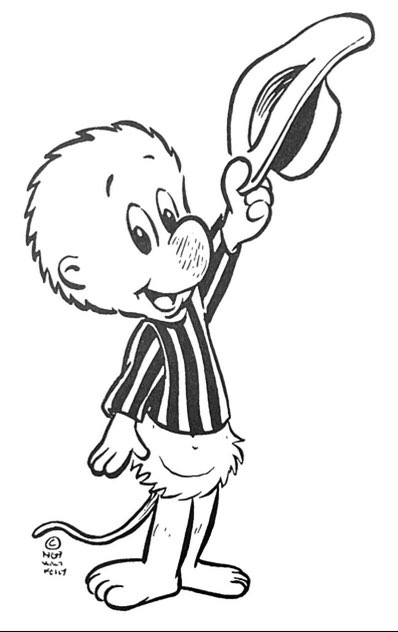
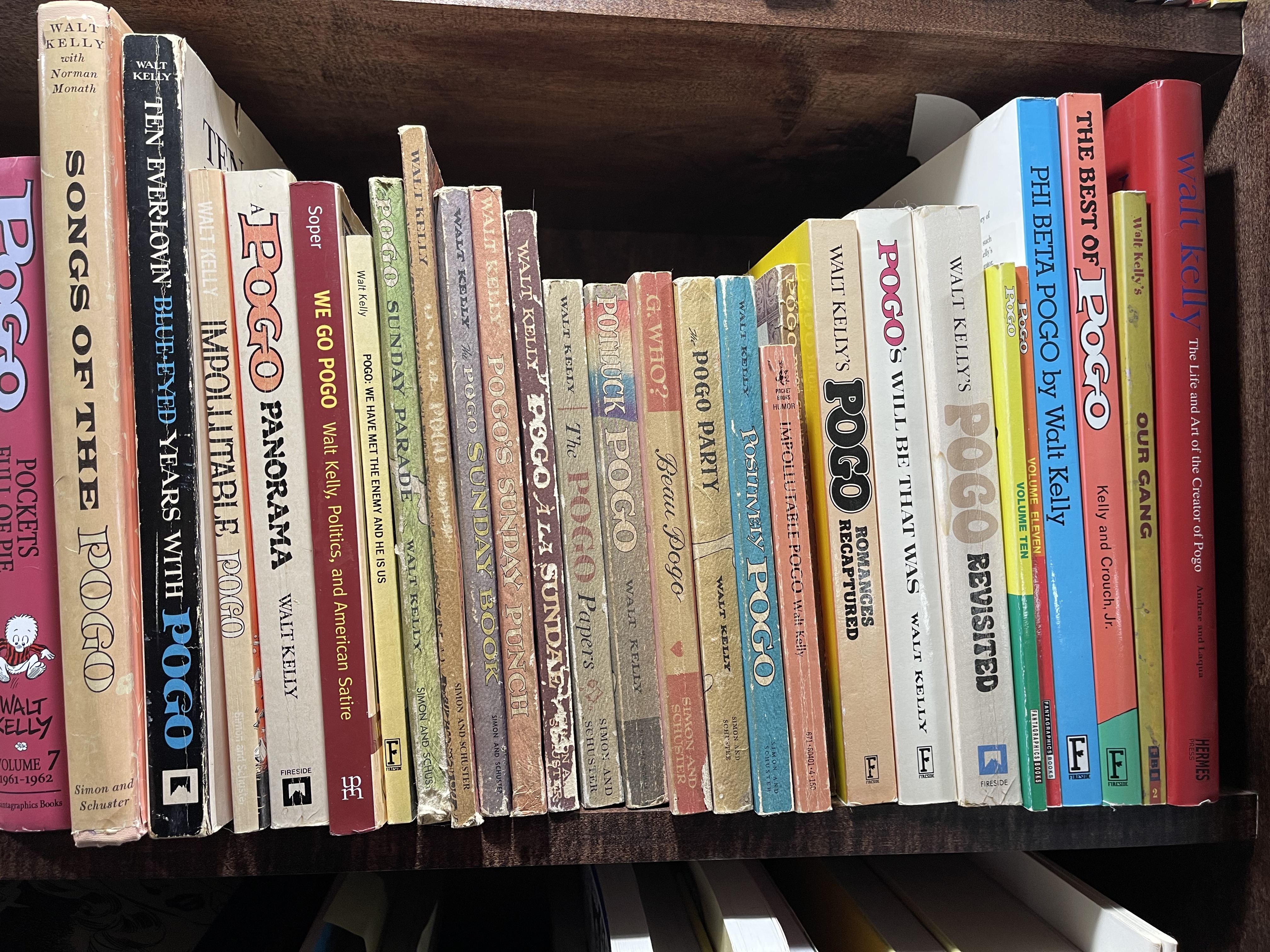
One of Pogo Possum’s best swamp buddies, Robert Yarrington, my friend and father-in-law, passed this weekend. Bob had been reading Walt Kelly’s masterpiece in all its comic book and strip forms from the time “Pogo and Albert” first appeared in Dell comics years before that small world was revived and expanded as the Pogo strip in 1948. He amassed a small library of the familiar old Pogo reprints over the years that he bequeathed to me when his grew unable to enjoy them, and we both worked through the recent Fantagraphics complete reprint together. Bob’s steel trap memory for the books and comic strips he read even decades ago always left me aghast and humbled. I barely recall characters and endings I read last week let alone when I was 20. One of my joys over the last decade has been bringing Bob new reprints of Pogo, Little Orphan Annie, Prince Valiant (one of his particular faves) and some of the pulps he loved like Erle Stanley Garner’s A.A. Fair series. His eyes widened as his memory kicked in and I knew he was about to recite some piece of minutiae from a strip or potboiler he had read six decades ago. It was a treat to see someone who lived and relished pop culture so deeply. Comics helped him learn to read, and he repaid the favor with lifetime devotion to the medium.
Bob’s Pogo collection remains enshrined on its own shelf in the Panels and Prose Library.
Here are just a few Pogo passages to remember Bob I think he would like.
Bob was especially fond of the Pogo songbook and Kelly’s artfully fractured versions of familiar standards. The joke at the core of “Deck Us All With Boston Charlie” is that none of us remembers the full lyrics to Christmas Carols. Kelly’s crew, however, have trouble remembering their own wrong version of the song. And so in Okefenokee Swamp, during every year’s run-up to Christmas, Kelly comes at the same joke in different ways.
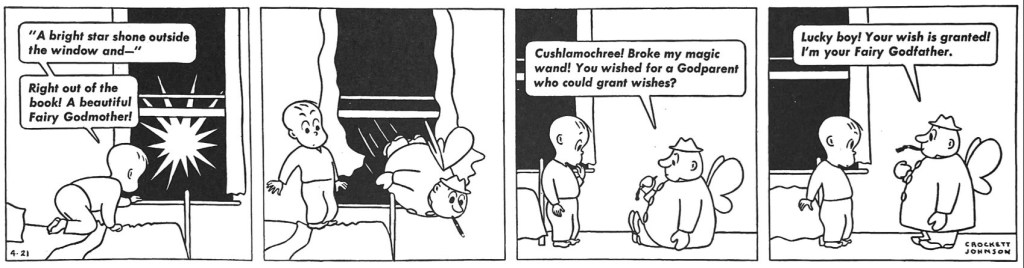
Bob had excellent taste in comics. He was thrilled that Fantagraphics was reprinting one of his youthful favorites, Crockett Johnson’s Barnaby. Starting in 1942, this wild tale of a boy, Barnaby, and his cagey, cigar-smoking, scallawag Fairy Godfather Mr. O’Malley is a singular American classic Bob pushed me to appreciate. I didn’t warm to it immediately but have come to appreciate this wry take on parenting, childhood and modern American life.
In his last days with us, and after he could enjoy the stream of volumes we sent him from the Library, he did enjoy the company of our English Setter Nicky, who is a bit of a cartoon himself.
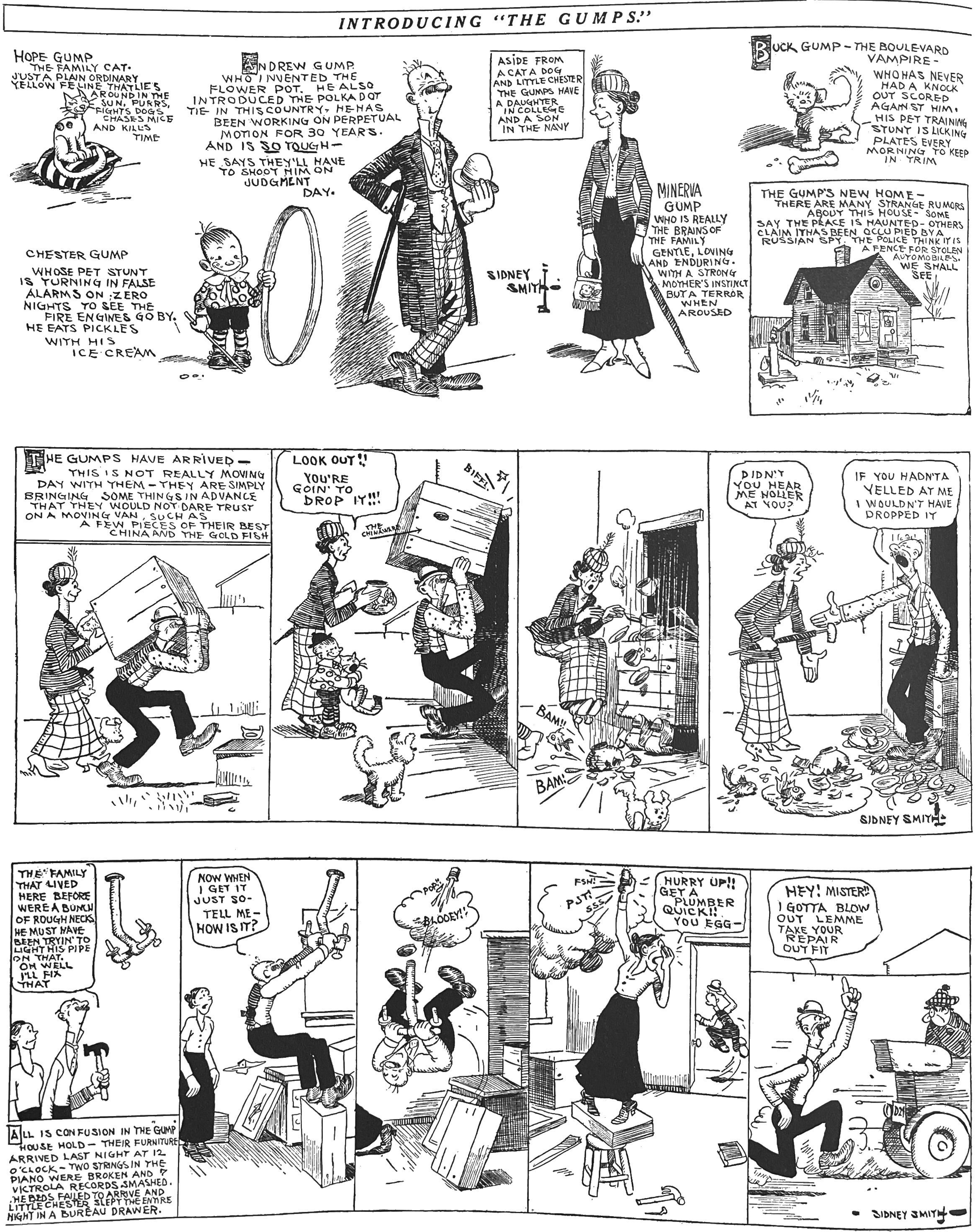
One of the singular comic strip launches must be the artful transition from Sidney Smith’s relatively short-lived (1912-1917) Old Doc Yak to one of the great runs of inter-war family strips, The Gumps (1917-1959). Doc Yak was a goat and centerpiece of an early sitcom daily. Smith ended the Yak run to start his Gumps series by literally evicting his hard-luck goat from the premises. In the early days of 1917, Yak’s landlord threatens to toss his deadbeat tenant unless he pays up. Failing to raise the back rent, Yak takes a powder, leaving the landlord with a taunting note (never likes the place anyway) and an empty property. In the final panel of Feb. 10, 1917, the landlord announces that new tenants will be moving into the property and the strip on Monday.
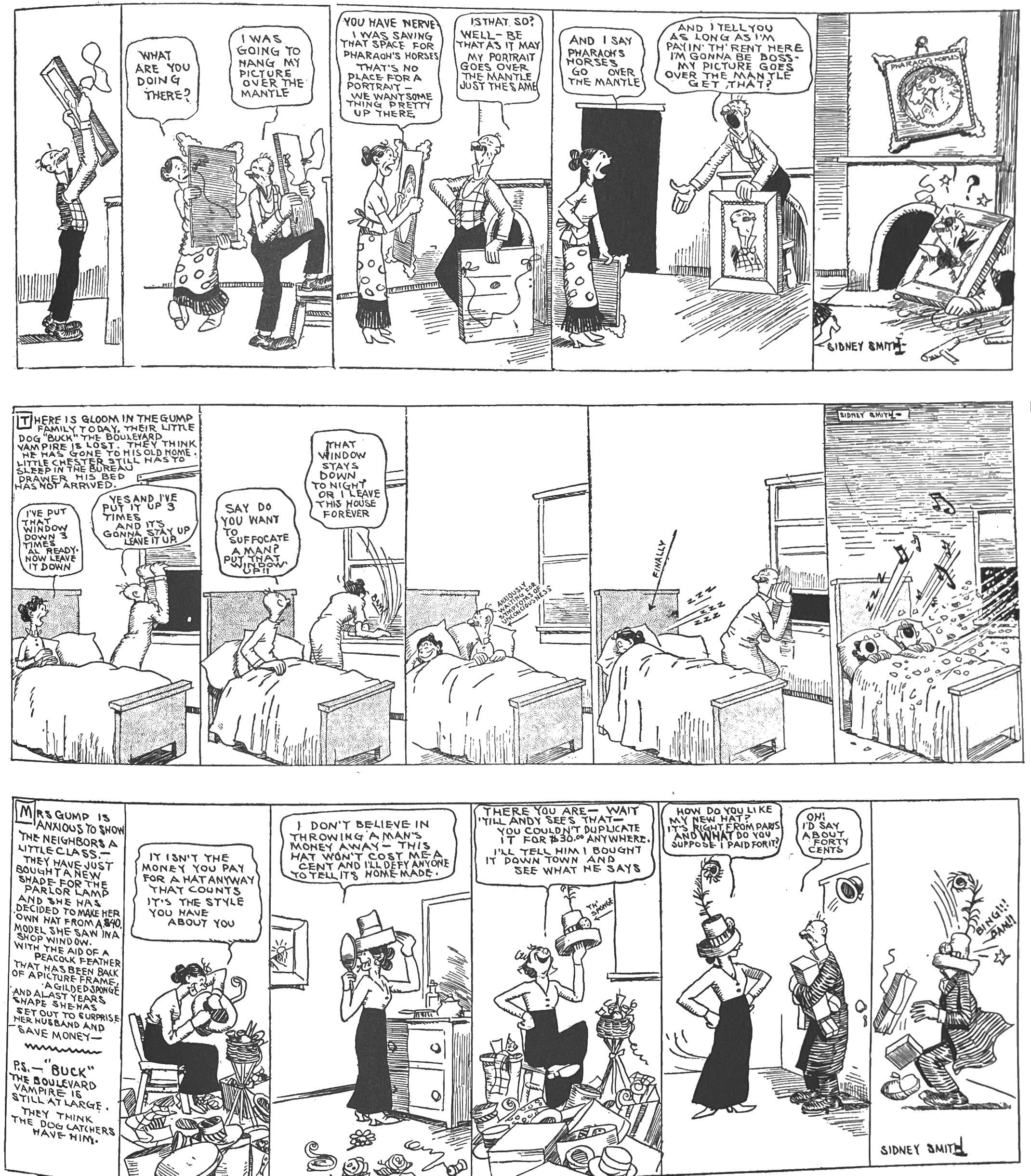
And on that following Monday, indeed, the eerily jawless Andy Gump and the Gump clan are introduced. The strip was quite literally vacated by one character and occupied by a new one. in fact, in the closing day of the Yak series Smith tells the reader “Doc has but one day left to raise the rent or be thrown off this page.”
Andy Gump himself would go on to become one of the most recognizable and seminal sitcom dads in the early decades of century. The besieged and aggrieved comic father figure had been foreshadowed already in the Dingbat Family, Bringing Up Father and Smith’s own Old Doc Yak. But Andy helped crystallize and propel the sitcom formula. Overconfident of his knowledge, skills and savvy, Andy was the kind of oafish but ineffectual blowhard that would become the bedrock of radio and TV family comedy for, well, forever. His patient wife Min is understood as the quiet “brains of the family” as well as its heart. Life of Riley, The Honeymooners, The Jeffersons (and pick any 2000s famcom) rode the same formula. Which is to say that America has been laughing about the middle and working class father figure pretty much since they were invented. But the formula really seems to have taken shape in the comic strips of the 10s and 20s.
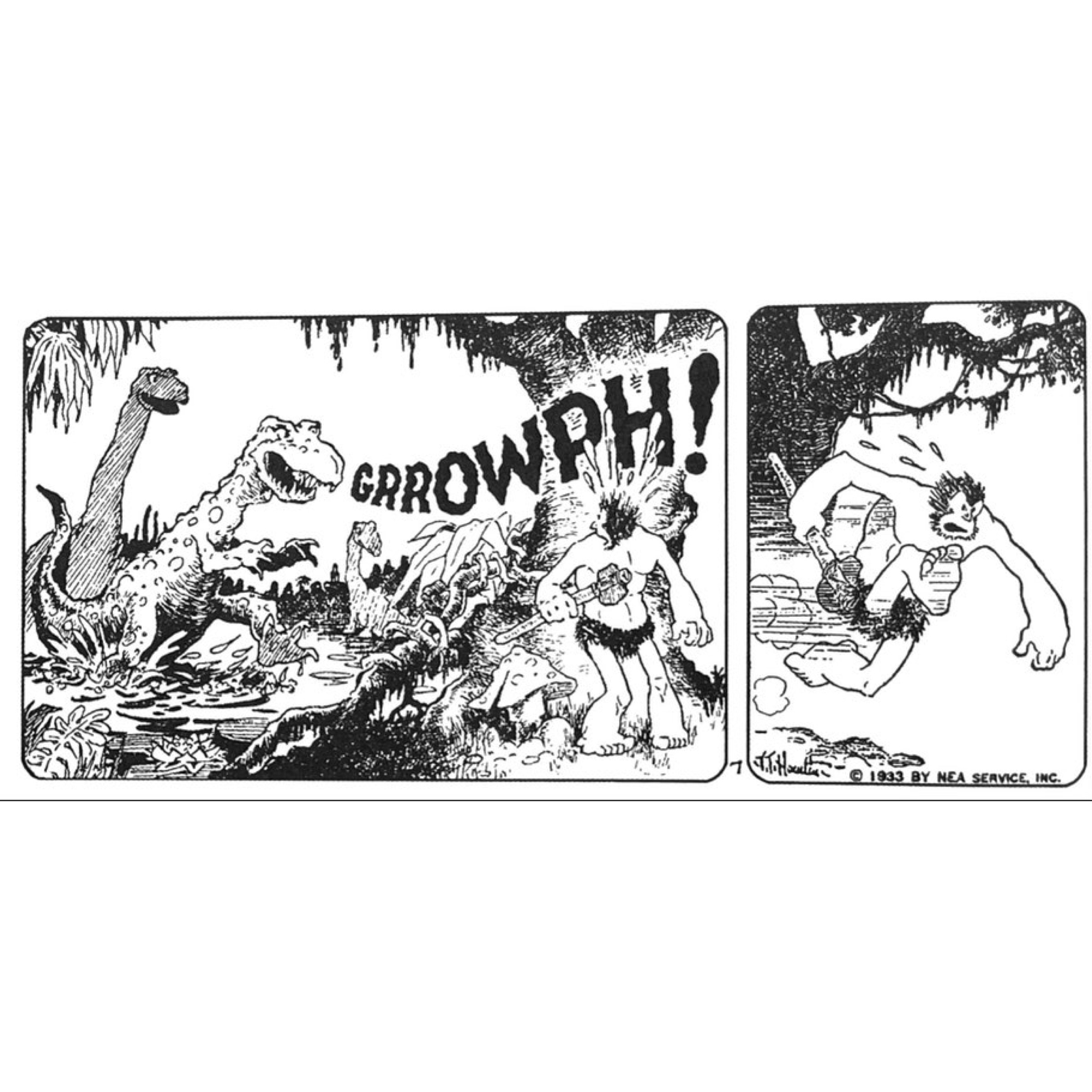
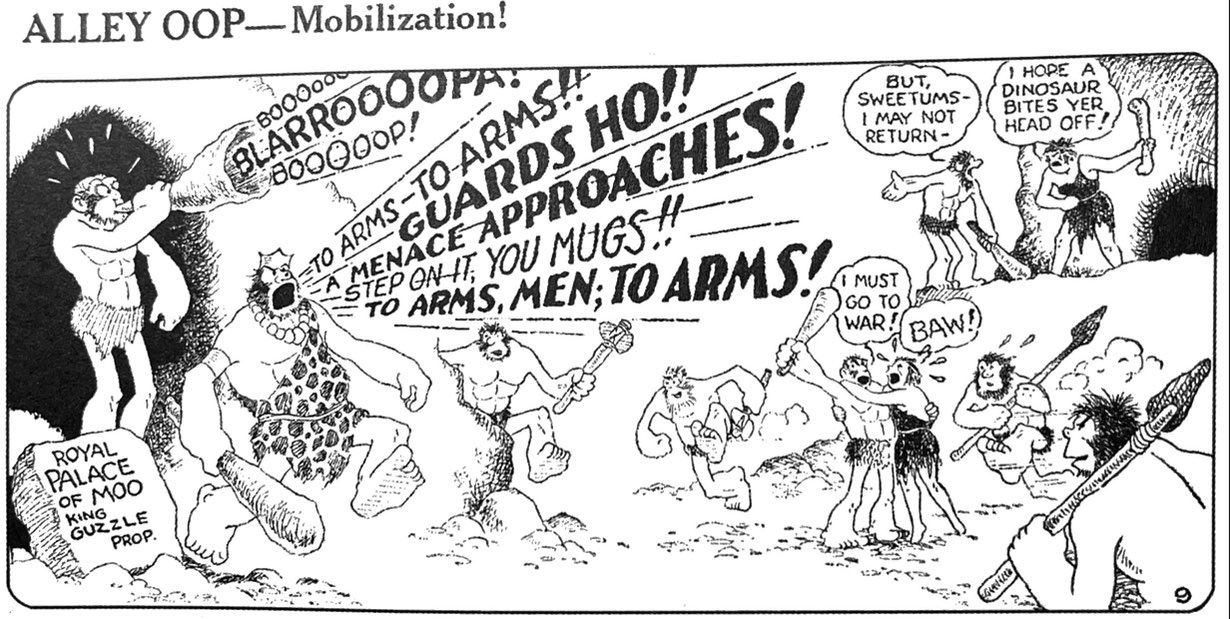
“Off to a Flying Start” is how V.T. Hamlin titled his introduction to the Alley Oop character and world in late 1932. And in fact Hamlin’s eponymous hero cries for help in the opening panel…only to be chased by the prehistoric dinosaurs of this fantastic “Bone Age.” For the next six or seven years, Hamlin’s art and story were at their best when his furry-crowned, thick-limbed everyman scurried at the center of screwball mayhem. We now have a great opportunity to review and reconsider Alley, as the small press Acoustic Learning recently launched reprint series of both Hamlin’s early adventures and later work by his successor Dave Graue.
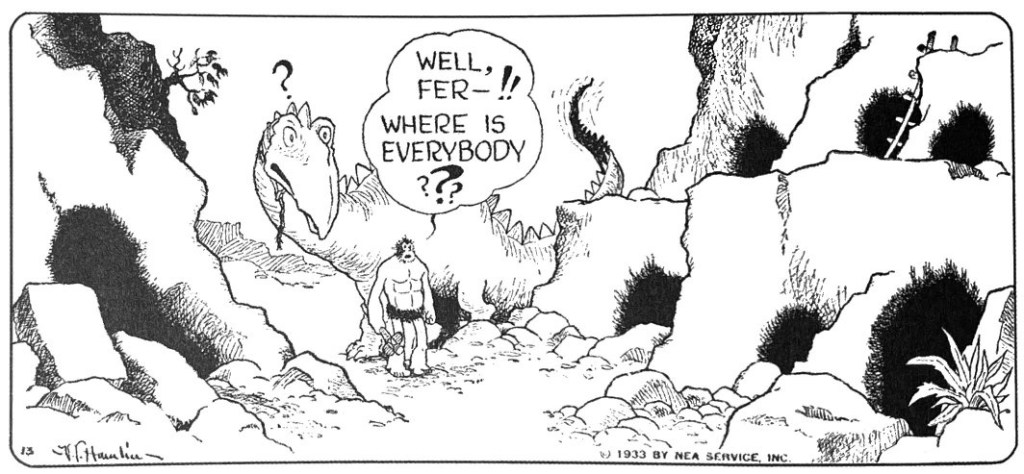
My first impression diving into Alley Oop is Hamlin’s strong feel for set, background and character design Hamlin had from the beginning. Unlike Segar’s Thimble Theatre, Capp’s L’il Abner and certainly Gould’s Dick Tracy, Alley Oop doesn’t begin in a crude style that only finds its signature style over months and years. Hamlin goes into Alley Oop knowing he wanted to contrast fine-lined, simple but polished characters with detailed and accurate scenery and dinosaurs. Hamlin had a cultivated curiosity about prehistoric creatures in one of his many jobs as an illustrator in the Texas oil industry. He well knew the historical fantasty at the center of Alley Oop. The age of dinosaurs long preceded any human ancestors. But he was dedicated to drawing, naming and animating his Bone Age dinos as accurately as he could.
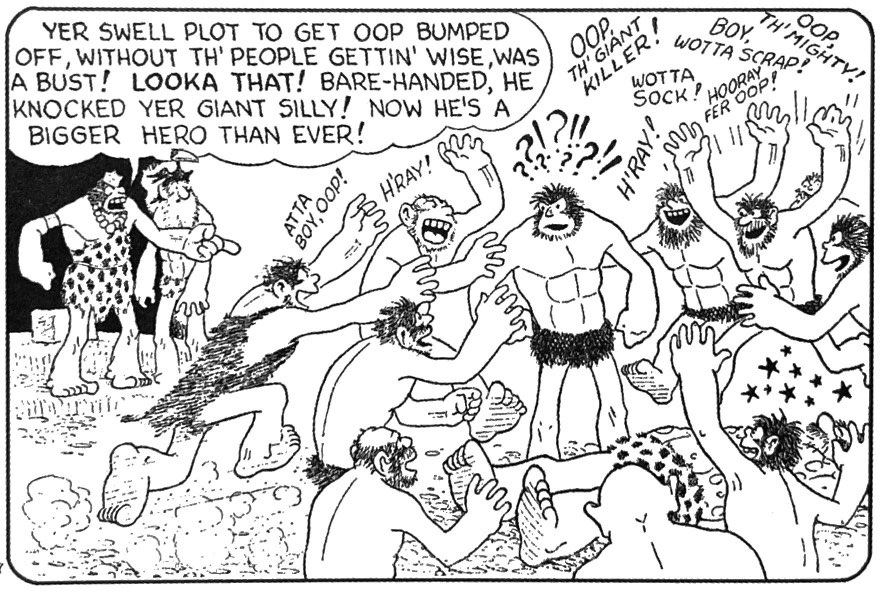
By contrast, his cast of cartoon humans, the males at least, are carefully built with a bit of the era’s deco minimalism. Oop, his rhyming buddy Foozy, Guz, the King of the Moos and the tribes of cave men are small of head, with enviable four-pack abs, and forearms and calves shaped like bowling pins. He builds his characters in order to animate them. Those bottom-heavy limbs become wonderful devices when fleeing, fighting or rioting. The action poses, freeze-frames of punches thrown and received, crowds of cave men imploding or exploding, all have an expressiveness that sits between cartoon abstraction and naturalism. This fine-lined, controlled art style is served very well in this reprint. The strips fully render Hamlin’s thin line shading of background flora and the dinosaurs.
Alley Oop is also one of those rare strips, along with Walt Kelly’s later Pogo, that renders the words as part of the art. From the strip’s first panel, Hamlin shows his distinct deco styling for characters shouting. They move from small to larger type sizes, megaphone-like, into the air. And Hamlin plays with bolding, differing type styles and sizes, words moving in and out of word baloons, to express tones, crowd murmerings, sound effects. In some ways he was bringing to his comic strip layers that mimiced the early days of the talking motion picture, still in its infancy when Oop appears in 1932/33.
And much like Segar’s approach to Popeye, even Gray’s Annie, Hamlin brings a populist sensibility to the strip. Conventional wisdom suggests that Alley Oop becomes more interesting and a genuine adventure strip in 1939 when he introduced a time travel device that brought Oop and girlfireind Ooola across major historical ages. But from the start, Oop is an everyman hero, good of heart, who is less of an adventurer than a victim of circumstance. He quickly becomes the unintentional antagonist to King Guz, the insecure and thin-skinned leader of the Moos. Guz envies Oop’s popularity when the cave man returns to the tribe astride his tamed pet dinosaur Dinny. Guz’s machinations to retain prestige and diminish Oop is the driving force of the strip’s first year. Oop fits neatly within the pantheon of Depression-era common many heroes. Prohibition, which didn’t end until the December 1933, and a deepening Depression had already undermined public trust in institutional authority, the purity and wisdom of legal and political institutions. Popular culture registered a generalized distaste for authority in everything from the romanticization of gangsters in the press to images of kings, politicians, policemen and bosses as either hapless or imperious. We usually come upon common men like Popeye, Tom Joad, Micky Mouse and Mr. Oop just trying to go about their business, only to become heroic in the face of the moral duplicity (or just stupidity).
As simple and familiar as these everyman heroes may seem, the idea of the inherently moral, simple and unpretentious “nature’s nobleman” runs deep and long in American culture, extending back to the tales of James Fennimore Cooper’s frontier hero Natty Bumppo and Jacksonian politics of the 1840s. American popular literature is filled with examples of the naturally ethical, American individualist asserting basic common sense and morality against both little human and big insitutional corruptions. Cast as he may be in the Bone Age, Oop was certainly in that tradition, one that had special valence to Depression-Era.
October 2, 1955 saw the first Sunday entry for a strip that had been running all week from the Chicago Tribune syndicate. Written by Gus Edson, who also had taken over legendary strip The Gumps, and drawn by former comic book cover artist Irwin Haden, Dondi follows the adventures of of a refugee orphaned by WWII.
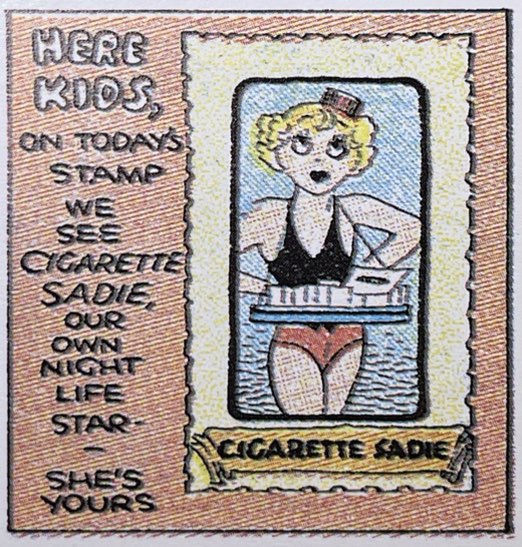
This wise-cracking cigarette girl, seemingly working in an underground speakeasy was an odd “topper” strip for this wildly popular strip. The signature on the fourth panel is the giveaway, of course.
Cigarette Sadie was the filler strip for the Sunday Dick Tracy episodes. Considering the the straight-laced righteousness of Tracy, this was a bit of a counterpoint to the strip’s buttoned-down sensibility. adie is the featured collectable “stamp” in this edition, but in other weeks the collectible usually involved a character from the Tracy strip.














 Panels & Prose