

Thanksgiving 1921
Gasoline Alley may be a singular American masterpiece. It was unlike any other cultural utterance of its day. In it, creator Frank King exposed aspects of modernizing American culture other cultural sources overlooked.
The remarkable gentleness of Frank King’s Gasoline Alley is its signature distinction from much of the comic strip universe of the 1920s and 30s. It has no henpecked husbands, no nagging wives, no snarky kids, no withering repartee among supposed friends. All of the familiar domestic and small town tensions are there, but King’s is a sweeter, gentler version of the tropes his fellow cartoonists deployed in The Gumps, The Bungles, Moon Mullins, Barney Google, Mr. and Mrs., Thimble Theatre or Bringing Up Father. These strips were the heart of the medium’s move in the late 1910s and 1920s into the suburban and family sphere. But King’s take on this world was distinct for what it was not. Husbands don’t suffer flying rolling pins or eviction from their homes at the hands of jealous spouses in Gasoline Alley America. In the narrow confines of this alley, wives get mildly peeved when their husbands do too many favors for the new single woman in town, and they follow her lead in bobbing their hair. Walt’s garage tribe, Avery, Doc and Bill, gently chide one another without ever truly straining their eternal friendship. So far in my reading of King, I have yet to see a character get angry enough with a friend or spouse even to stop talking to them.
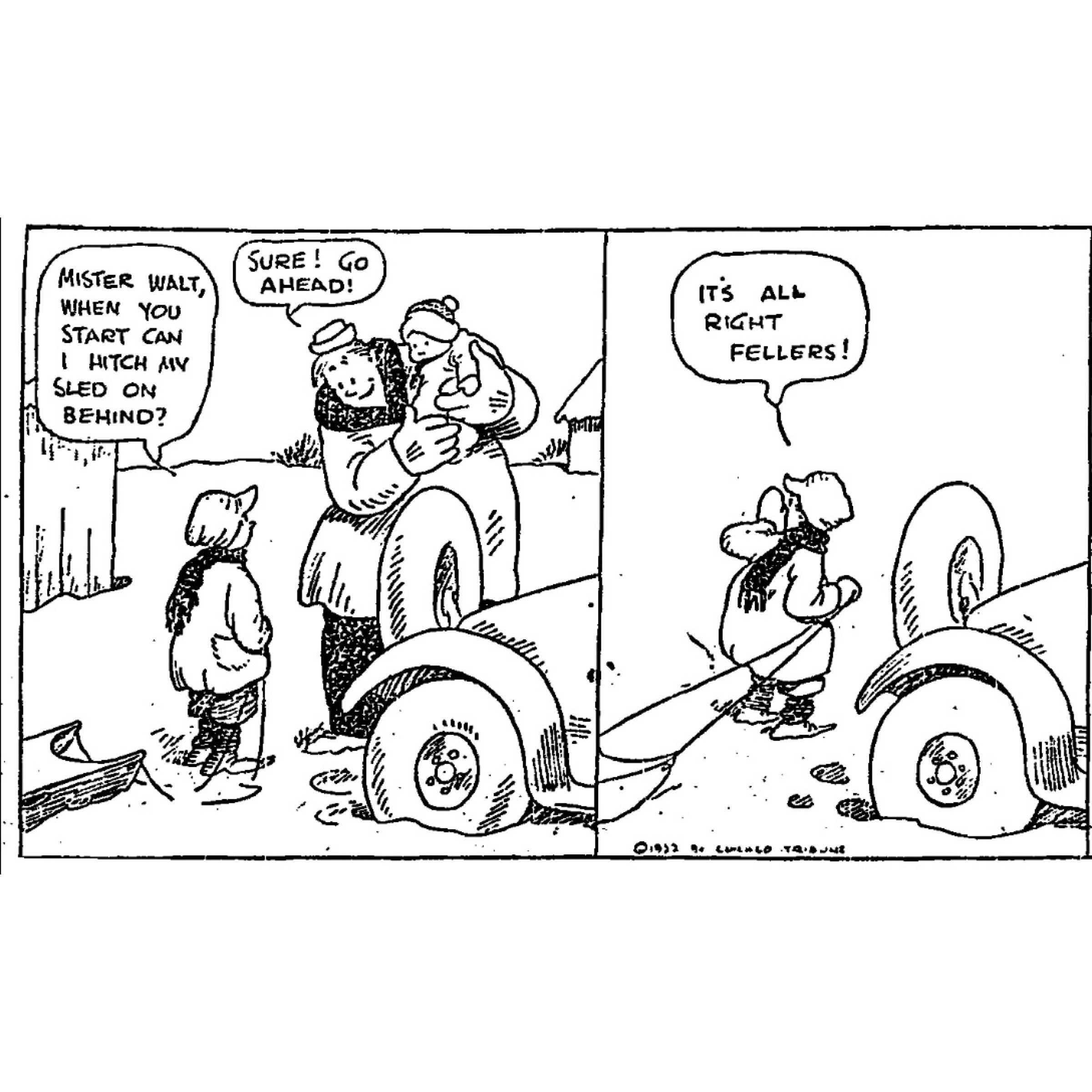
King’s talents ran deeper. The little gestures and moments of emotional significance were his terrain. And he created a perspective for the reader that was more giving and loving than the grumpy, shallow nostalgia and easy irony effected by rest of the comic page. In the Thanksgiving 1921 image above we see the classic gender divide that fuels much of comicdom. But in King’s hands it is rendered as separate but mutually respectful spheres. During a road trip to National Parks, King creates a strip of panels depicting passersby waving hello to the travelers. It is a quiet testament to quiet human connection.

Frank King (1883-1969) himself may not have understood how the title for his Gasoline Alley strip suited his own aesthetic ambitions for his decades-long novel. The strip was named after the the back alleys of early 20th Century American cities, where pioneering car owners erected the first backyard garages to house and maintain the first romanticized gadgets of the modern age, the car. But his frame was quite narrow, with the feel and composition of a small town, much like the Tomah, Wisconsin of his own childhood. His initial focus was a tightly woven group of friends, Walt Wallet, his fellow car enthusiasts Avery, Bill and Doc and to a lesser degree their wives. That world expanded slowly, organically in real time with the introduction of the foundling Skeezix on Walt’s doorstep in 1921. It was indeed an alley of American life. But King was not crafting the usual “slice of life” comic we find in J.R. Williams Out Our Way, Gene Ahern’s Our Boarding House or the many Clare Briggs series like Real Folks at Home, even though King apprenticed under many of these strips and artists. defined by immediate family, small town sensibilities, friends who know each other subtly and deeply.
Often it is hard to grasp what any given Gasoline Alley strip is about or what was accomplished by that day’s four panels. There is rarely an obvious gag or punch line, and if there are they feel weak. Skeezix gets sand in his pants from playing in the sandbox. Walt comes upon his evolving love interest Mrs. Blossom sewing Skeezix’s drawers and decides not to intrude. Walt agrees to wait for a package coming to Mrs. Blossom, only to sit all day in vain. During a road trip to National Parks, King creates a strip of panels devoted solely to wordless images of passersby waving hello to the travelers. “Ho Hum” a frustrated Walt says in the final panel, a feeling a reader might share at the end of many Gasoline Alley dailies. Nothing happens.


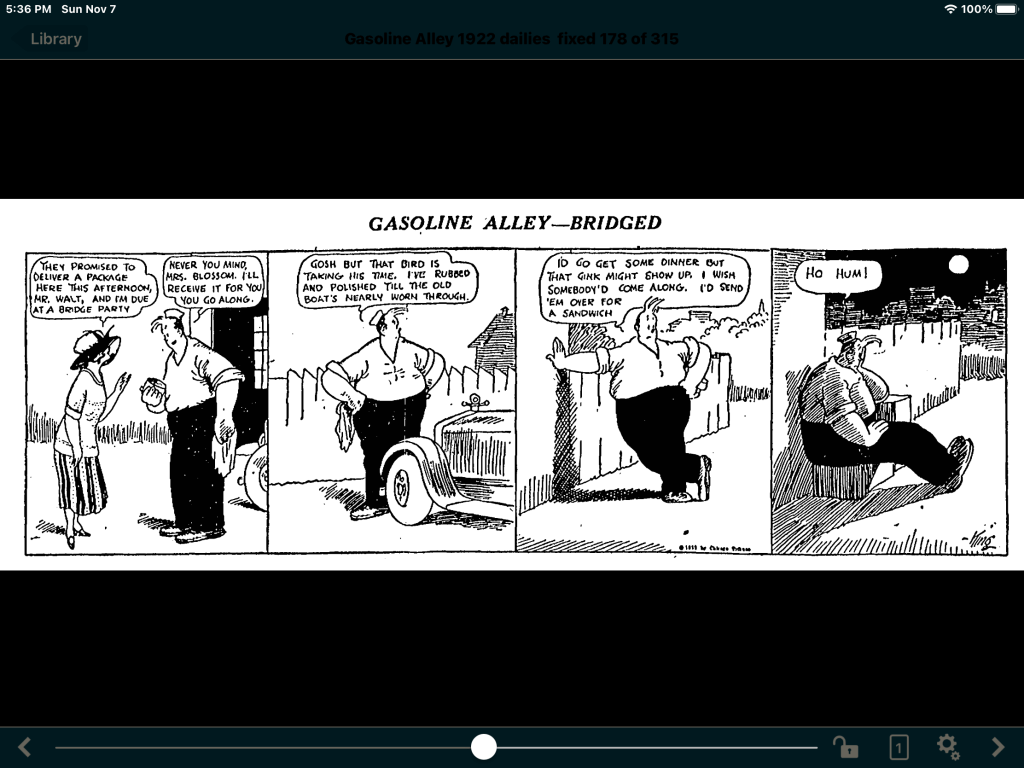
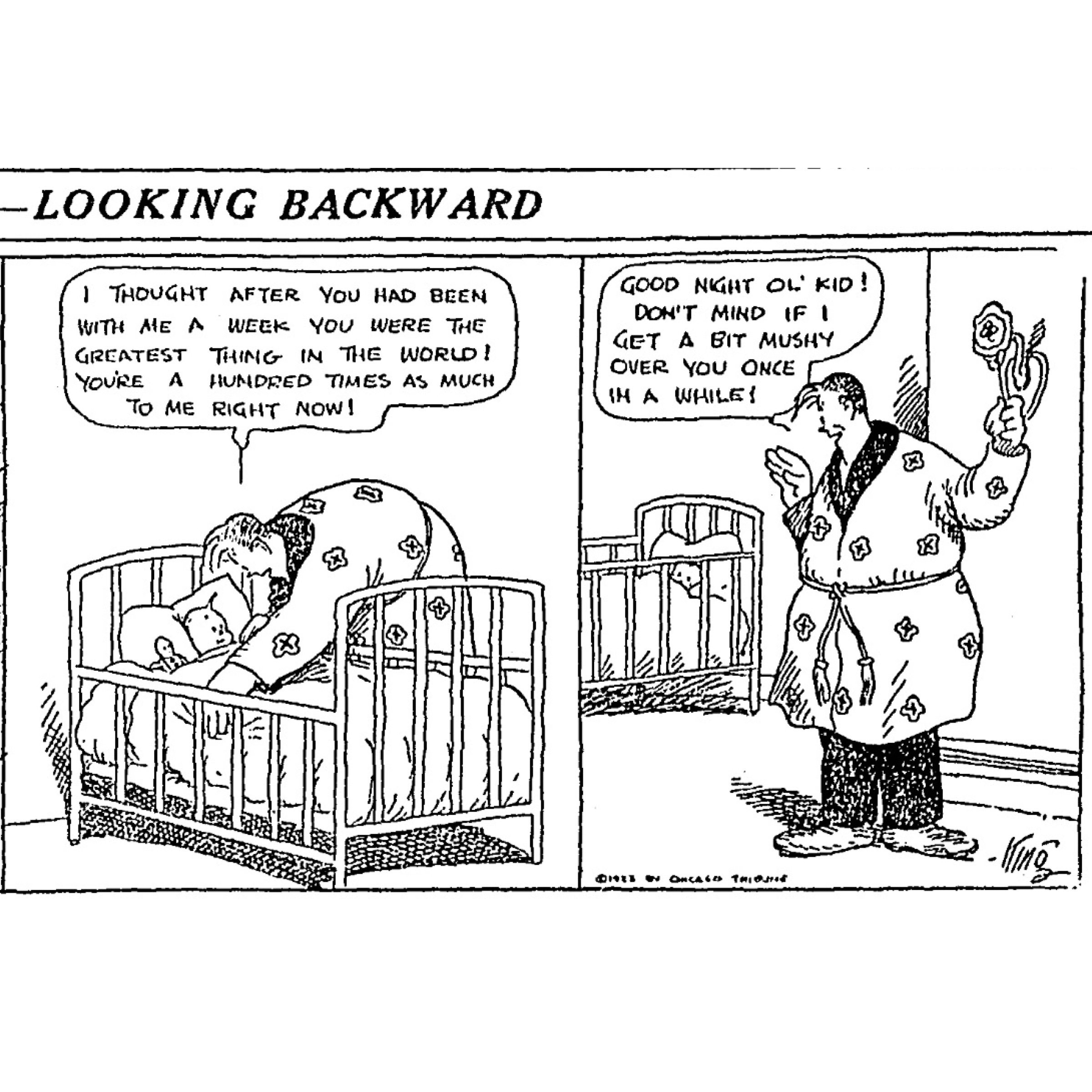
And yet, everything happens. In the unique cadence and focus of Frank King’s comic strip world a little and a lot are going on at once. These little glimpses of Skeezix, without gag or storyline, mark his development for us and help put us into the everyday world of the Alley and its commonplaces. And as the only major strip to watch its characters age in real time, King is mimicking the incremental changes much the way King himself was observing and marking his own son’s childhood. King peppers these little checkins with Skeezix every few weeks. In one we see him favoring Walt or Mrs. Blossom, all according to who last gave him a piece of candy. And each is mildly hurt by feeling snubbed. Yes. The little protean, irrational responses of a toddler can tug at our personal insecurities and self-worth in emotionally piercing ways. In another daily, the family maid Rachel wonders who is ringing the front door bell, only to find it is little Skeezix. Yes. A small moment tells Rachel and us shows without telling how a child grows into self-consciousness, power over things and people. It uses the unique cadence of the everyday strip and pantomime to pull us into the vision of a young parent watching the subtle ways a human being develops. And it uses a plainspoken, very Midwestern, show, don’t tell, visual voice to do it. There is a reverence for the small, everyday expressions of inner feeling and emotional exchange, done without mawkish sentiment. As Donald Phelps put it expansively in his Reading the Funnies, “the function of his art seemed not to impose the folksy haberdashery and cosmetics of Norman Rockwell, not yet to yoke with his interpretation of their lives, but to convey, by pooling his craft with theirs, and by rendering their corporate style as a way of life itself (p. 198).”

Gasoline Alley’s special place in modern American culture, its genius really, is in counterpoint to the modern aesthetic sensibilities around it both on and off the comics section.
Start with the visual center and emotional heart of the strip – the doughy, roly-poly Walt Wallet. Visually, Walt is the opposite of the typical bigfoot characters around him on the comics page. His is not the squash, big-headed figure of Fisher’s Jeff (Mutt and Jeff), McManus’s Jiggs (Bringing Up Father), Milt Gross’s Pop (Nize Baby) or DeBeck’s Barney Google. Walt is the inverse bigfoot – massive, but impossibly small-headed and relatively small-footed. King usually depicts him as a mass divided by ink black trousers and white button-down shirt. He is often canting forward and seems ready to teeter. He is all-heart, all pillowy comfort. And while he dominates most panels in form he never dominates in spirit. With the arrival of Skeezix in 1921, Walt becomes the most unlikely of pop culture males – the sensitive man-nurturer – perhaps the only one in American pop and literary culture at the time. And like his visual contrast to other strips, Walt is apart from the bloviating, scheming satirized fathers like Andy Gump, Barney Google, Moon Mullins. And Perhaps King meant this Walt’s weight problem is baked into the character from the start.

In the newly domesticated comic strips of the 1920s, most artists were inventing the tropes of modern situation comedy that grounded radio, romantic comedy and television: disempowered, scheming but hapless husbands; domestic disharmony borne of miscommunication; gender politics; wives manipulating husbands; husbands’ misfired jealousies. It lacks the withering, distrustful repartee of Mr. and Mrs. and Moon Mullins, let along the flying rolling pins and plates of Maggie and Jiggs. Gasoline Alley dallies on occasion with these sit-com elements but at heart was onto something else. It was a gentler vision of domestic and neighborly relations, a daily idyllic respite from the the knowing, ironic and sharp-tongued tone of 1920s American culture.
While Gasoline Alley was inspired by and originally set in the urban alleyways and walkups of 1910s Chicago, where King conceived of the strip, it looks and feels more like a small town. In fact, there is little visual evidence of urban life here, and King generally was leaning on his memories of his boyhood rural home and people in Wisconsin. More to the point, Gasoline Alley embraced the village ethose that Sinclair Lewis, Sherwood Anderson, Edgar Lee Masters, H.L. Mencken’s and F. Scott Fitzgerald’s smart set were fleeing, mocking and condemning. Much of American letters of the time engaged in a “revolt from the village” that rejected the sentimental regionalism of William Dean Howells, Sarah Orne Jewett, Hamlin Garland, Charles Chestnutt that tended to locate the spriritual heart of the nation in the small town idyll.
King was extending the dwindling traditions of American Regionalism, the tone of Hamlin Garland, Edward Egglesten, Willa Cather. Like many of these authors, King envisions the village as self-contained, comfortably insular and defined by its limited populace. Outside developments like the auto, bobbed hair and clothing styles and radio technology are engaged, even embraced, as alien intrusions that are absorbed through the sensibilities of the town. Walt’s eventual love interest Mrs. Blossom introduces the bobbed hair style to the wives of Gasoline Alley, but it is a curio that gets quickly dropped. The car itself, a model of modern tech and mass production, is recast as a locus of male bonding and a vehicle for engaging natural landscapes. Gasoline Alley is the inverse of modernization. Its world changes and shapes modernity at least as much as modernity changes them.
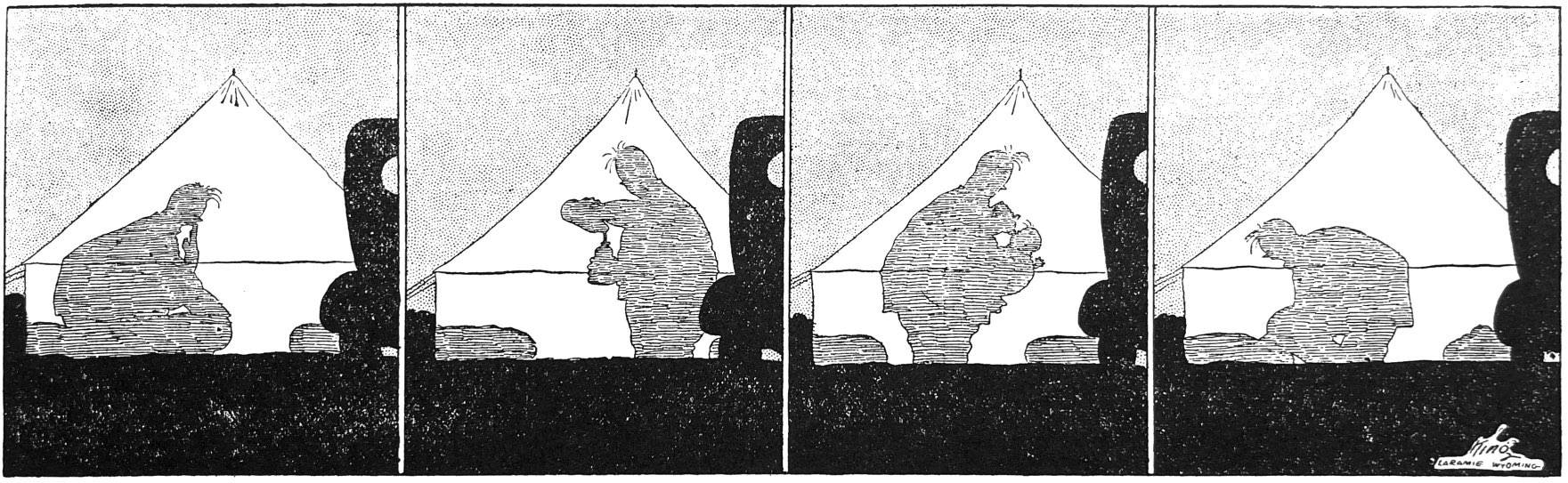
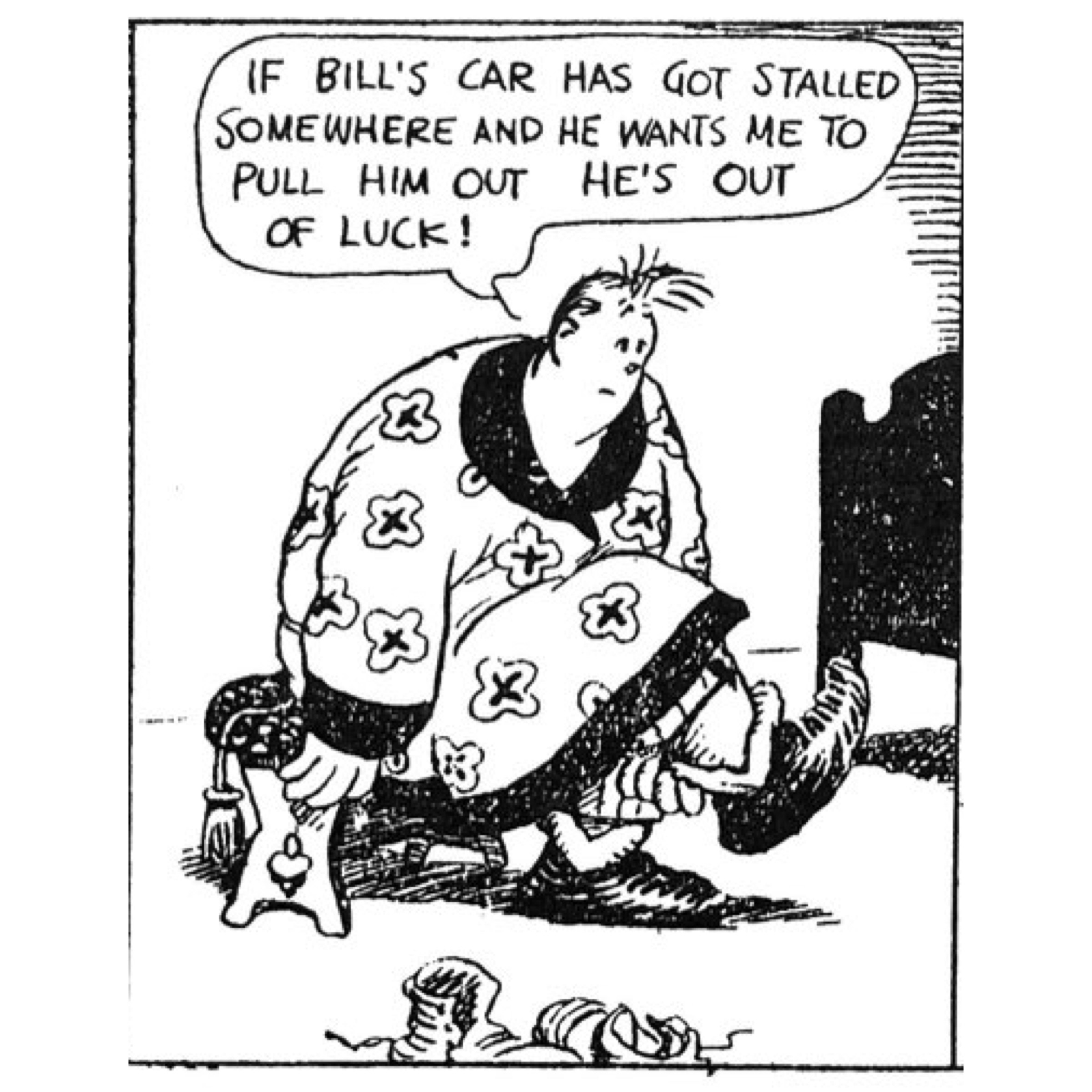
Frank King had nothing but understanding and curiosity about the small town American. And just as importantly he had no reverence for them either. There is no mawkish sentimentality to Gasoline Alley. King depicts many touching moments of small human connection and kindness among his cast. A day’s strip shows Walt and co. on vacation touring the country, depicted as three wordless panels of locals making welcoming waves at the passing car. Walt sewing Skeezix’s britches as the child is bent over his knee. Walt hugging the one person among his friends who praised his new wire car wheels rather than bemoan their downsides. Walt in silhouette in four successive panels getting up in the middle of the night to feed Skeezix and sleepily slip into bed. Most of these sequences are pantomime, and King never feels the need to underscore them with sentiment. Again, this is the embodiment of the plainspoken American style – show, don’t tell. And what King showed for the most part was an inner emotional reality with a subtlety and complexity that rivaled and perhaps exceeded the richest introspective novels.
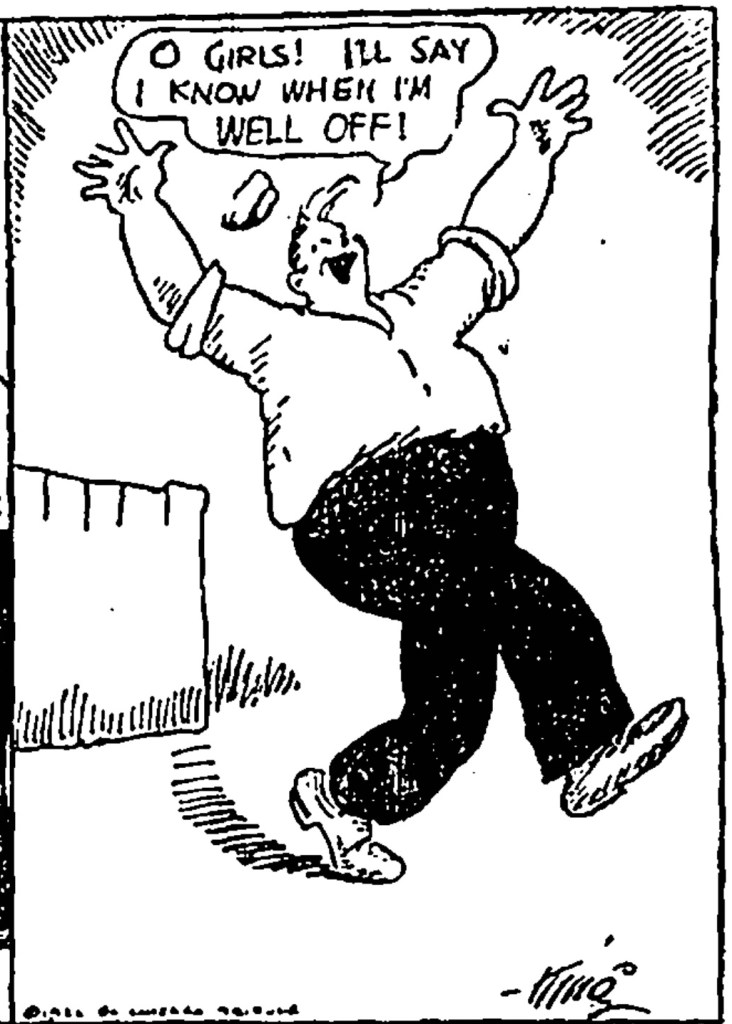
Much of 1922 is spent on a romantic slow burn of Walt coming to realize what the reader and his friends already know – that he is in love with newcomer Mrs. Blossom. Walt is a confirmed bachelor. A signature Gasoline Alley sequence shows some awkward domestic exchange among Bill, Avery or Doc and their respective wives, ending in a panel of Walt strutting away declaring how he is so “well off” being single.
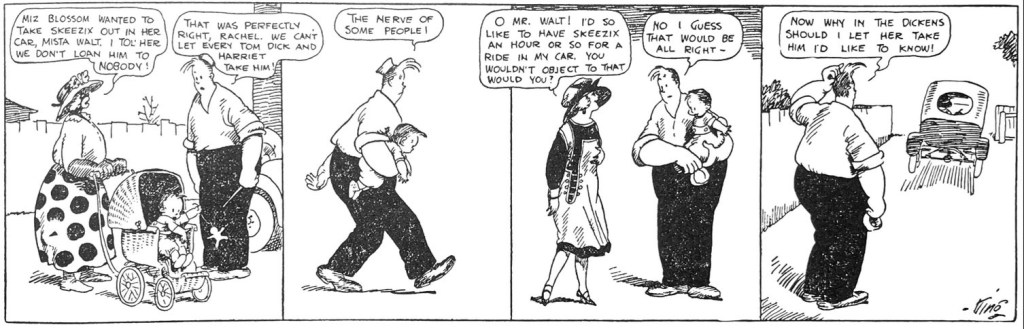
He protests too much of course. The attractive Mrs. Blossom moving into the neighborhood initiates one of the longest approach-avoidance sequences in modern literature. And here is where King uses the iterative qualities of the daily strip to render ambivalence on a grand scale. One day finds Walt peering over fences wondering what the newcomer looks like or claiming indifference to his buddies stumbling over one another to help her tend to her car. When Mrs. Blossom starts gushing over Skeezix, Walt is overcome with mixed feelings – pride, resentment, jealousy, and more. In one memorable strip Walt marches through the first panels insisting he will firmly reject Mrs. Blossom’s offer to take baby Skeezix for a ride in her car. But upon confronting her in the final panels, he hands the tot over to her and then wonders why he just did that. King is exploring ambivalence, suppressed feeling and befuddlement over one’s own real feelings in a way only the comics strip can dramatize. Each day’s strip displays his feelings moving one way or the other, so that cumulatively we feel their depth.
And King’s touch is so light but sublime in capturing the silly beauty of our inner lives. One strip has Walt putting on jacket and tie, brushing up his signature hair swoop in front of a mirror – primping and sprucing uncharacteristically for Walt. And in the final panel we see that all of this preparation was not to go on a date but to make the phone call to ask Mrs. Blossom out for a date.
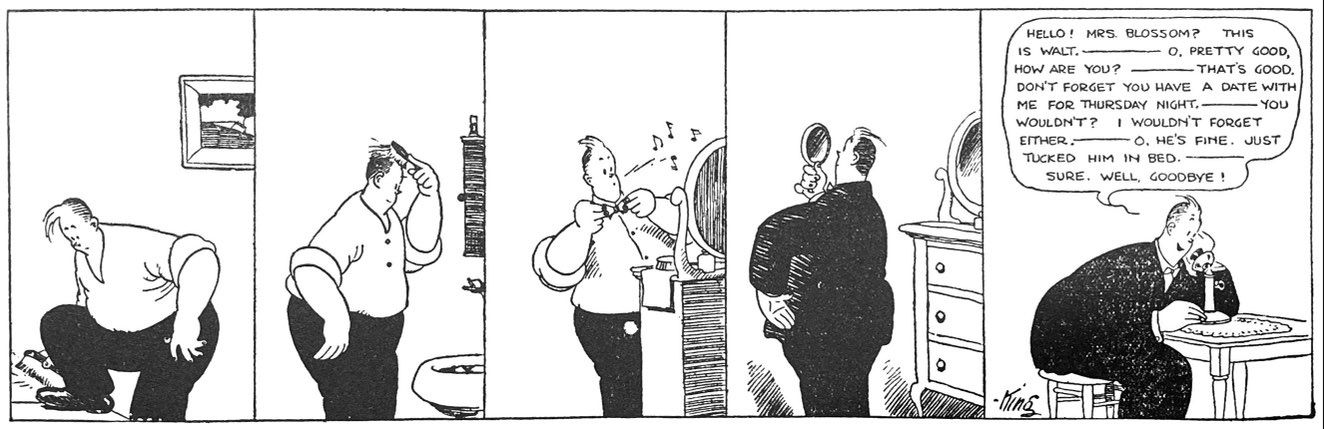
Showing, not telling.









 Panels & Prose