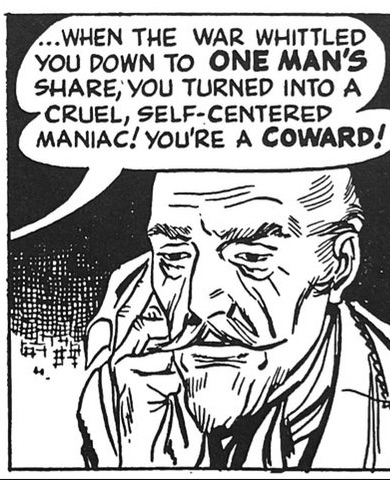
Warren Tufts (1925-1982) was a self-taught artist and historian of the mid-19th Century Westward migration, and he combined both avocations into two of the most compelling and distinct adventure strips of the 1950s. In Casey Ruggles (1949-1954) and Lance (1955-1960) he brought visual and historical realism to an otherwise romanticized vision of the West that flourished in post-WWII pop culture. In Tuft’s West of the 1840s, settlers were as often selfish, greedy, cowardly, incompetent, sadistic and capriciously violent as they were an heroic forward guard of civilization and commerce. Tufts had a mixed view of human nature that allowed all of these qualities, good and bad, to coexist in many of his characters.
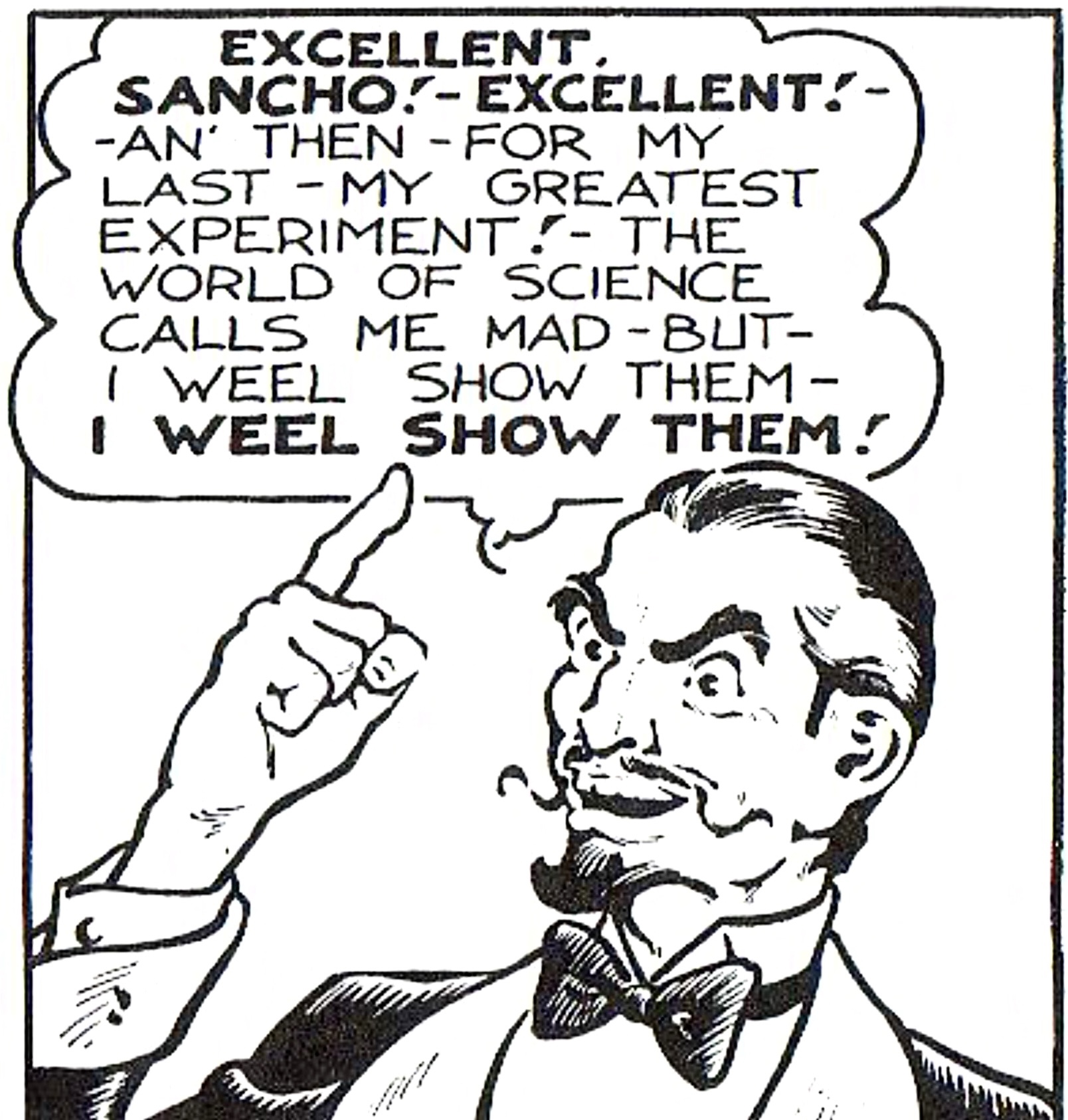
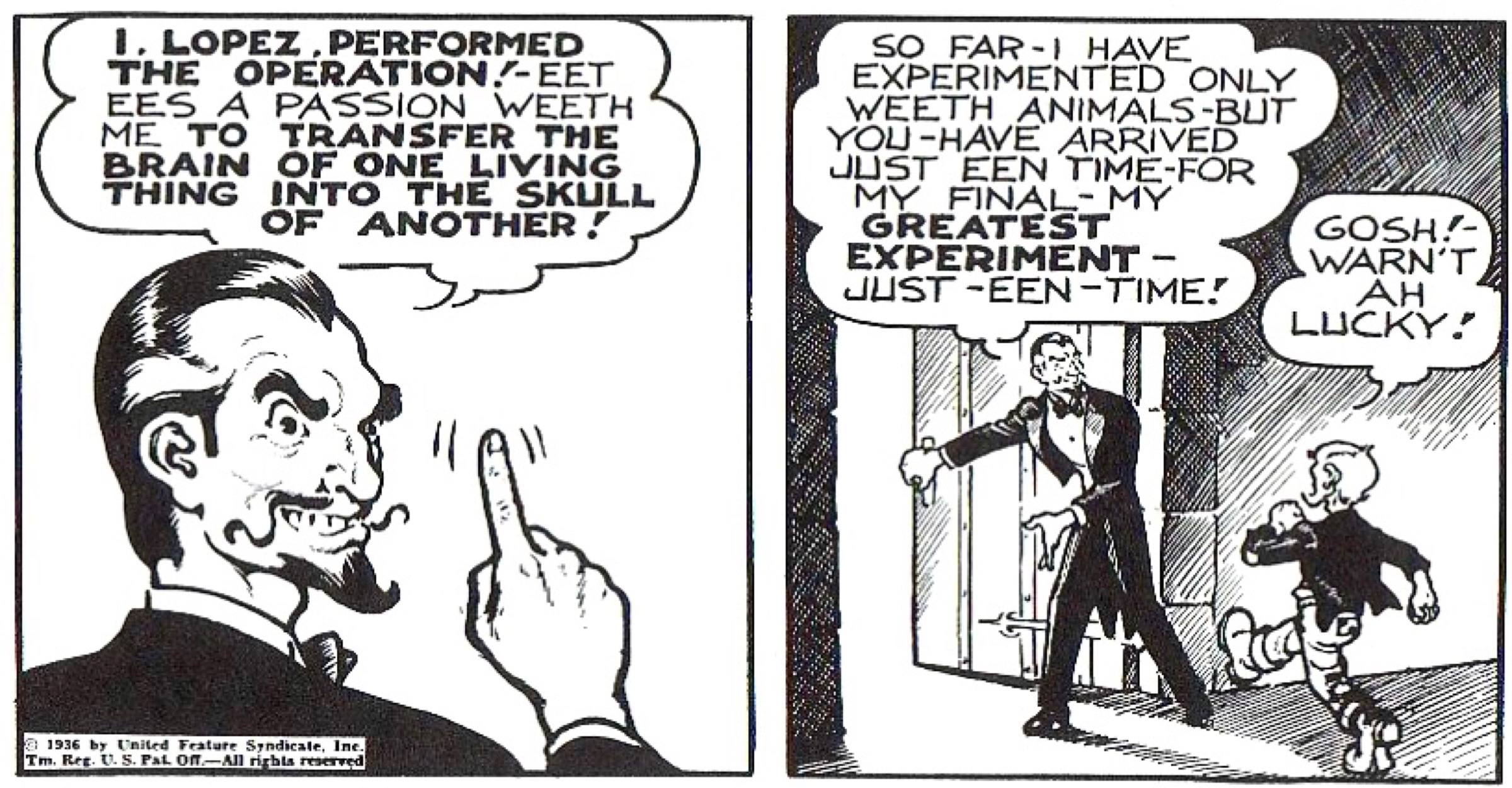
I’m a sucker for a good mad scientist, and the 1930s were brimming with them. We find them in pulp magazines, film and comic strips. Often bald, bespectacled, puny, deeply alienated and resentful, they were the prototypes of nerds-gone-wrong. The power-mad doctors, professors and other masters of technology were cautionary tales for a modernizing America about the risks of science without moral guardrails. In 1936, Al Capp put his unique satirical spin on the tropes when Mammy and Pappy Yokum briefly encounter Dr. Lopez, who is doing the old brain-transplant scheme. And Capp goes against type, making his laboratory fiend an elegant Spaniard in a tux and well-coiffed goatee.
This is a brief episode from the early years of Li’l Abner, and it finds Capp lurching towards the pop culture parody and signature visual stylings that would propel the strip into its greatest period in the 1940s and 50s. In its first stages, Capp felt constrained trying to satisfy the two dominant strains of mid-century comics – adventure and domestic sit-com. Capp leaned heavily on country vs. city culture clashes in the early years. Con men and thieves drop into Dogpatch, only to be defeated by the “rubes,” and hillbillies come to the city to send up the pretentions of sophisticates and expose the shallow selfishness of city folk. But after a few years, Capp starts turning to pop culture as his enduring source for send-ups and social commentary.
Capp’s wit, comic timing and visual style are also maturing here. He focused on faces, taking pride in facial expression as the center of the strip. Despite a crew of assistants often inking bodies and drawing backgrounds, Capp always insisted on doing the faces himself. According to one biographer, he kept a mirror near the drawing board so he could act out the facial expressions of his characters. And this comes through if you track these panels just via the faces. He loves putting eyebrows, eyes and mouth in extreme poses. You can almost see Capp mugging for his mirror in order to capture just the right pose. Few cartoonists of the 30s relied so fully on facial expression as Capp. Alex Raymond comes to mind. In fact it wasn’t until the 1950s when Raymond’s brand of realism became standard, and the comics panels shrunk, that we see cartoonists use close-ups and facial drama in the ways Capp is doing in the 1930s and 40s.
But I especially like the pacing, humor and pathos in the strip above. When Dr. Lopez aborts his plan to trade Pappy’s brain for a gorilla’s (because Pappy’s is too small), Mammy soothes her shamed husband with the assurance, “mebbe it were an unusual smart gorilla.” It is both a great punch line, timed and framed perfectly as a kicker in the back ground, but it is tender. The Yokums are a matriarchy that Capp had claimed was based on the relationship between his own assertive mother and retiring father. Capp’s burlesque of that dynamic in the Yokums turns Mammy into an assertive Mom with a killer punch. At one point Pappy recalls their elopement, when it was Mammy who brought the ladder and whisked her man off. But Capp crafts Mammy carefully, and perhaps informed by emotional notes of his own family history. She is always careful never to diminish her husband and minister to his ego as mindfully as she does to his body.
While it goes without saying that Hal Foster was a much more buttoned down, stiff and restrained adventure artist than the ebullient Alex Raymond, he had his moments of gratuitous cheesecake. Here, from some 1939 sequences, Prince Valiant strips down for some manly bathing.
Hal Foster was never shy about pouring on the bloody swords, celebrations of battle, corpse-coated fields of war. In fact some foreign markets censored the strip when they felt Prince Val’s love of war crossed the line. But showing skin? Not so much.
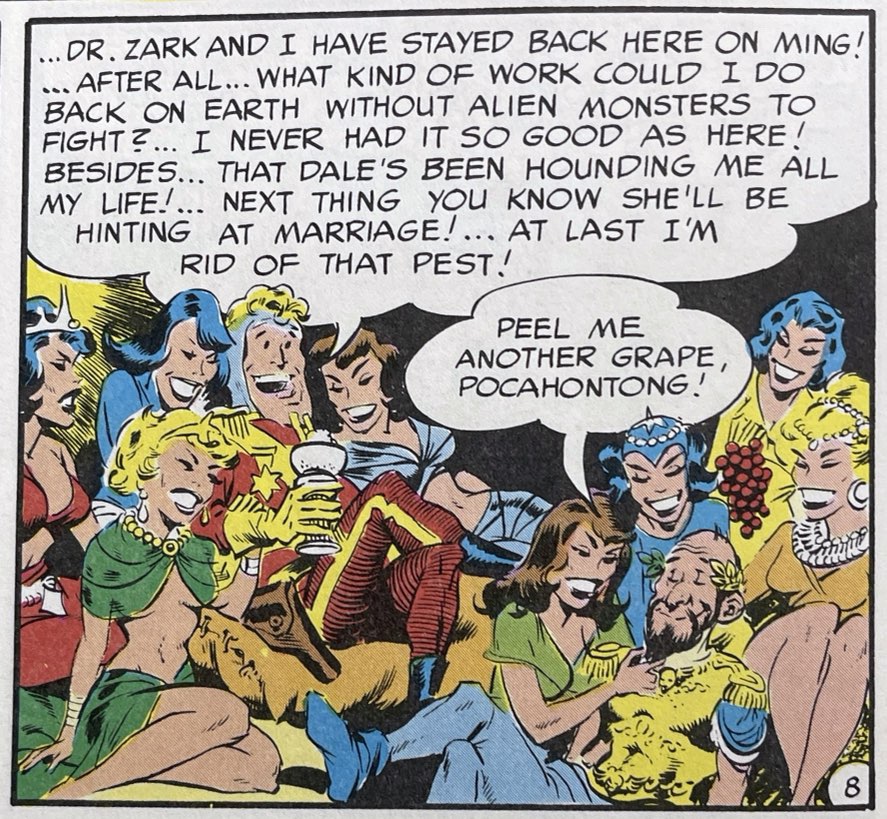
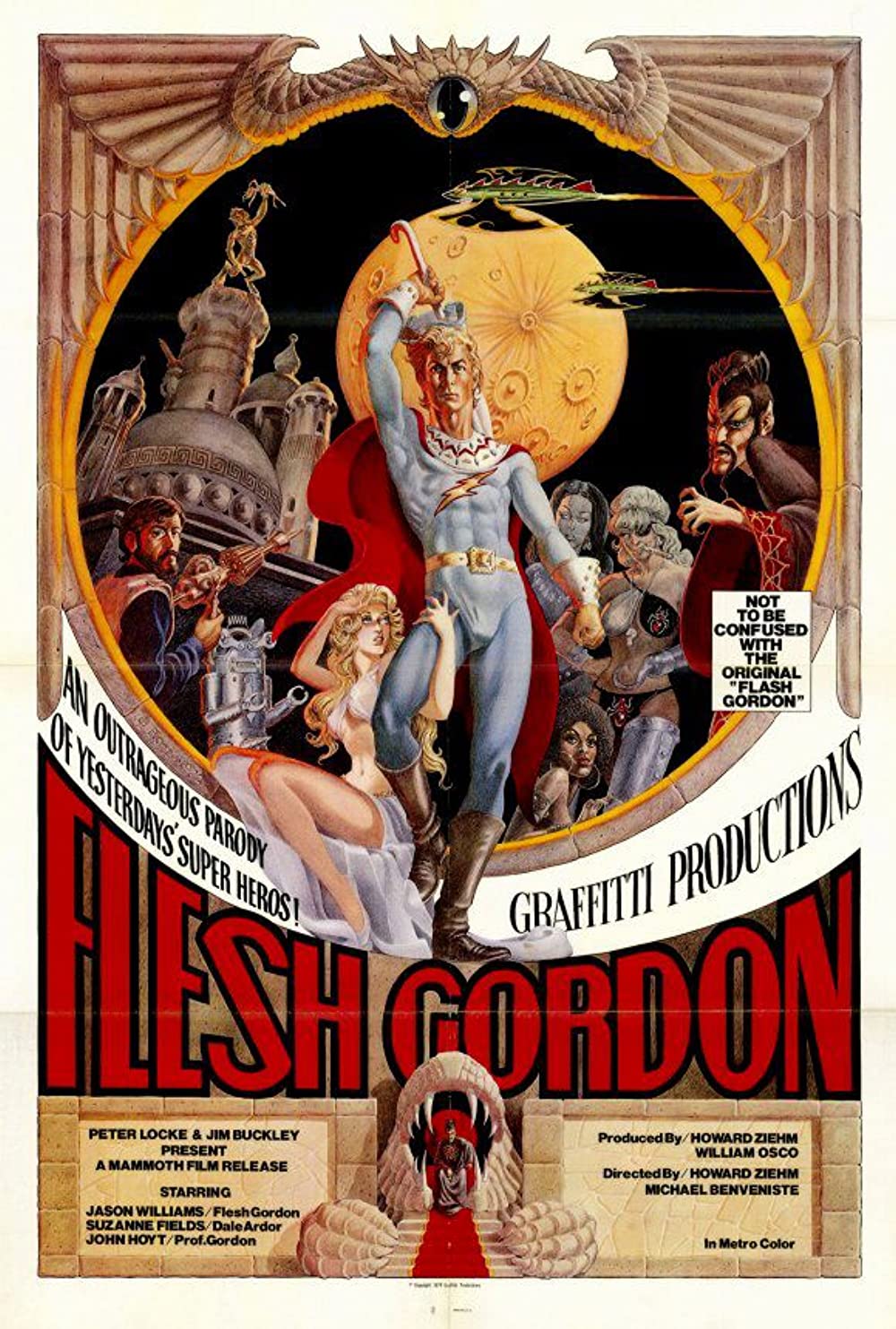
Alex Raymond loved bodies. Male bodies, female bodies, animal and alien bodies. He couldn’t wait to disrobe them, pop on loincloths or skin-hugging gossamer robes and bras, put them on show, flex their muscles. And this made his 1930s space opera Flash Gordon (1934) a masterpiece of subverted sexual energy. Two of the most famous satires of the great strip, Harvey Kurtzman’s MAD magazine parody, Flesh Garden (May, 1954) and the software porn cult classic Flesh Gordon (1974) got this about Raymond’s work. In many ways, Flash Gordon was laughable. Its dialogue and plotting were sub-literate. Its conceptions of aliens (Lionmen, Sharkmen, Powermen) pedestrian. Its conceptions of technology (Disolvo-Rays, Oxo-Liquifiers) paled beside even Buck Rogers. And its even sillier sexual politics (alien princesses pursuing the irresistible Flash and the forever jealous, swooning, fawning, nagging Dale Arden) were embarrassingly adolescent. And yet it was a fetishist’s delight, and certainly the most erotic mainstream comic strip of all time.
The special genius of Flash Gordon is Alex Raymond’s talent for visualizing primal urges and tired tropes with such detail, energy, operatic extravagance that they registered deeply with the viewer. His mastery of bodily form, facial expression and panel composition supercharged visually the familiar adolescent fantasies and fetishes that he and co-writer Don Moore lifted from pulp fiction magazines of the era. Xenophobia, hyper-masculinity, emasculation, dominatrices, bondage, miscegenation – all of the fodder of adventure pulp stories were dialed up to eleven by Raymond’s art.
Misanthropic and petty, scheming and nagging, reviled by their neighbors and barely tolerable to themselves, The Bungle Family was the quintessential domestic comic strip of the 1920s. Critical historians like Bill Blackbeard, Rick Marshall and Art Spiegelman have singled out Harry J. Tuthill’s masterpiece as an especially dark and pointed critique of the modern petit bourgeoisie. But George, Jo and Peg Bungle were really the penultimate satirical family of 20s strips. George was no more a man on the make, looking for that get-rich-quick invention or financial scheme, than Barney Google, A. Mutt or even Andy Gump. His wife Jo was no less socially self-conscious and ambitious, nor more of a nag, than Jigg’s Maggie. And Jo wasn’t even in the habit of throwing things. Nor was the Bungle family dysfunction any worse than the in-fighting at Moon Mullin’s boardinghouse.
In early 20th Century theater and film, the “sissy” was the dreaded antithesis of two-fisted pulp hyper-masculinity, at best, and at worst was a stereotypical euphemism for what was unspoken in general culture, homosexuality. Wimpy, the dandyish, appetite-driven counterpoint to Popeye’s principled violence, is of course Popeye’s best tutor for all things “sissy.” To make this sexual dynamic even weirder we have Popeye’s Pappy bewildered by his prancing progeny. It reads like an unintended burlesque of Popeye “coming out”. Per a previous post, These dailies precede Popeye deceiving the underground demons to come up and fight.
It is important to note that this gender-bending sequence was followed immediately by another adventure cycle involving Popeye getting the crap beaten out of him in a land of highly muscled women. And this is all happening right after E.C. Segar’s death in October 1938. The strip was being continued unsigned by assistants for the time being.
Gladys Parker was among the most recognizable and well-reported cartoonists of the 1930s and 40s. It was hard to miss her. She was the spit-curl image of her avatar Mopsy, the sharp-tongued and stylish star… Read more: Quips and Curlicues: Mopsy’s Stylish Return
Where do we even start to highlight the wicked strangeness of Winsor McCay’s “Dream of the Rarebit Fiend?” The master comics artist drew over 800 nightmares in the first decade of the 20th Century, and… Read more: Random Nightmares: Winsor McCay Gets Rarebit
Along with chaos, mayhem and violence, obsessive behavior was a core theme of early newspaper cartooning. Consider the many titular anti-heroes of these years, like Hungry Henrietta, Superstitious Sam, Jingling Johnson, Sammy Sneeze. Or the… Read more: Dingbat Calls In the Klan: Herriman’s Bourgeois Obsessive
The authoritarian strain in modern democracies has only heightened since I first posted this bit of cartoon wisdom several years ago. In 1937, H.T. Webster’s Casper Milquetoast (The Timid Soul) responds to Italy’s Benito Mussolini… Read more: The Timid Soul Toys With Fascism
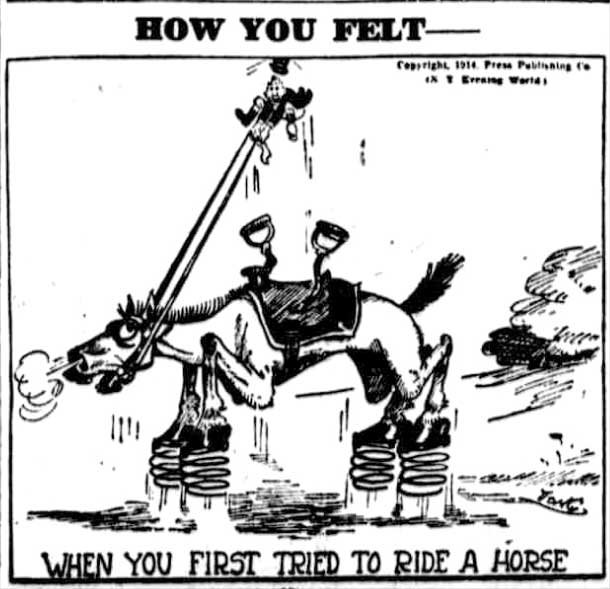
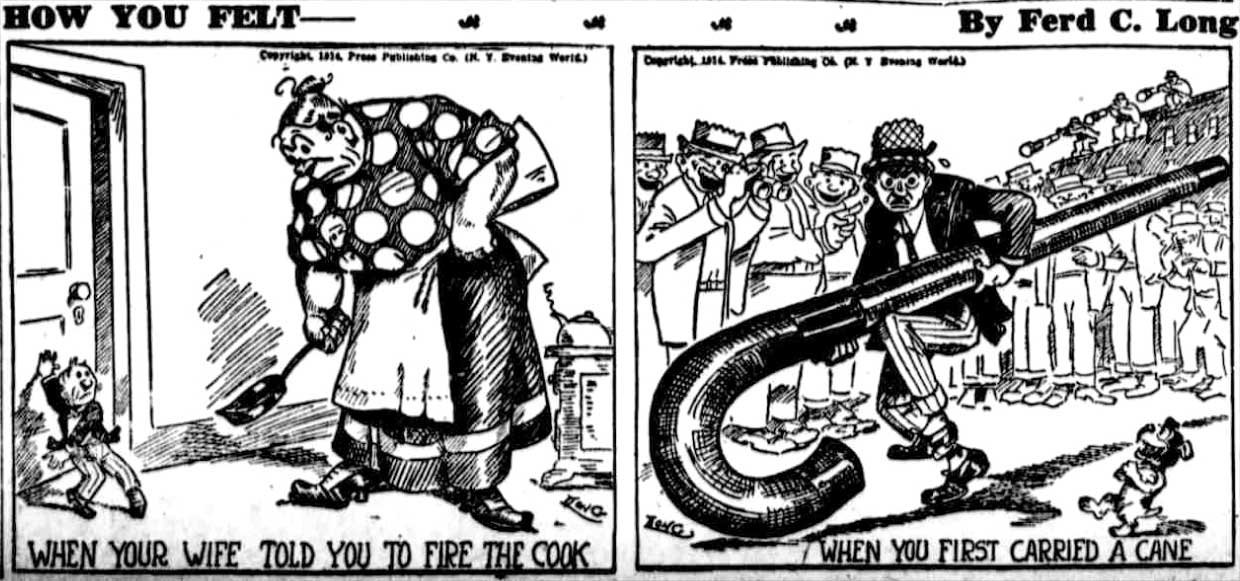
I don’t know who this Ferd. C Long was, nor how long the engaging “How You Felt” strip ran. But it captured me instantly as a great example of early cartoon experiments that explored some of the unique qualities of the new medium. The great team at Barnacle Press, who nobly harvest every scrap of early comic strips they can, gathered these. Like many strips of the day, it took up a simple single conceit – in this case using visual exaggeration to capture a feeling. The result is a fantastic surrealism that communicates in a singular way a range of small and common responses to the world.








 Panels & Prose