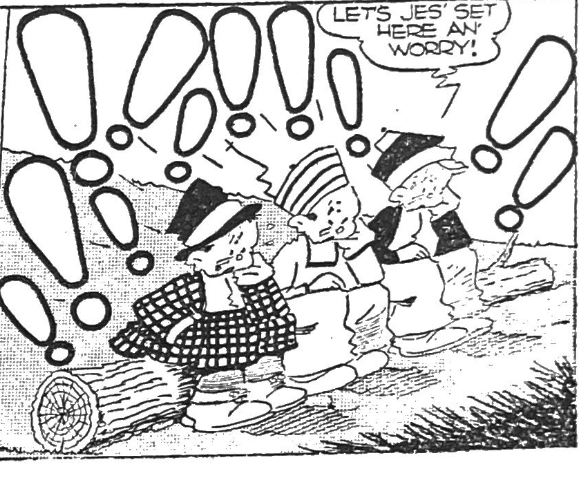
The suburban kid gang strip Just Kids by August Daniel “Ad” Carter ran 1923-1956, initially as a knock-off of Gene Byrnes’ Reg’lar Fellers. But it evolved into a more contemplative, nuanced projection of adult sensibilities into child characters that anticipated Charles Schulz’s Peanuts. Preceded by earlier iterations, Our Friend Mush, Mush Stebbins, and Just Kids in the teens, it was picked up by Hearst in the 1920s and it remained a bit of a beloved back bencher through much of its run.
Nearly 25 years ago IDW’s Library of American Comics began reprinting the full run of Chester Gould’s Dick Tracy, starting with the strip’s premiere in late 1931. This week, with the release of Volume 29, the series reached its end, marking Gould’s retirement in 1977. I had been planning to mark this occasion by posting the very first 1931 strips alongside the very last 1977 strips to illustrate the evolution of Gould’s style as well as the decade’s long consistency of his vision. Little did I know that Gould himself would beat me to it. See below.
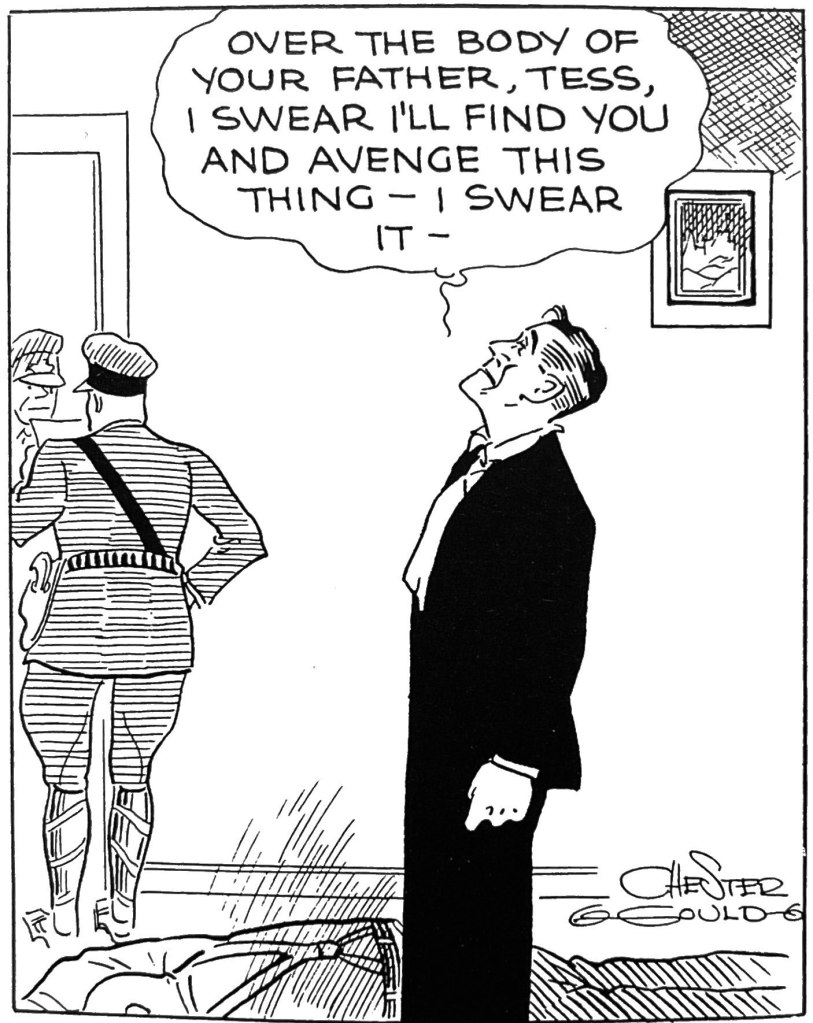
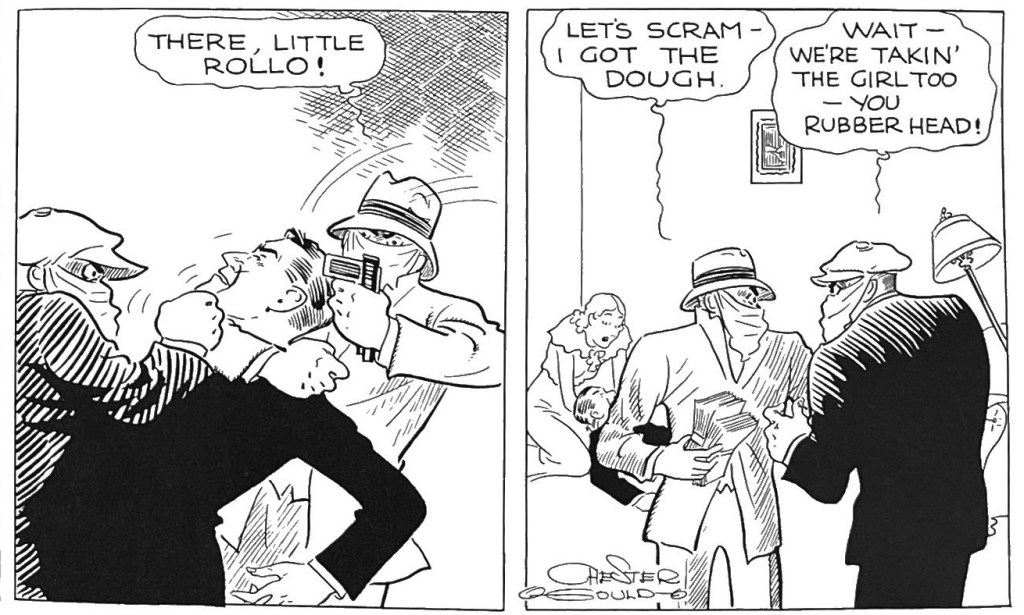
The first week or so of Tracy locates the origin of Dick’s moral commitment to fighting gangsters in the robbery/murder of Emil Trueheart, father of his new fiancé Tess. Tracy was not a cop by trade, but a young man still finding his way. In the sort of surrealistic moment that would typify Gould’s storytelling and visual style for the next 4 decades, Tracy not only finds his moral mission but becomes a “plainclothes” detective as well as a natural leader for the force within weeks of the strip’s launch. The moment of moral truth is captured in the featured panel at the top of this post.
Between 1931 and 1977 Gould’s style had gove through several evolutionary stages. By 1977, Gould’s ink lines had grown thicker and a bit rounder. His more extensive use of close-ups and medium frames were a begrudging accommodation to the shrinking space allotted to strip artists even by the late 1970s.
Gould invented his hero as “Plainclothes Tracy” in a series of spec strips he sent to legendary publisher Joseph Patterson, who was in the process of building the New York Daily News into a pioneer of tabloid newspapers. Patterson suggested the change of name to the simpler “Dick Tracy” and seemed to understand that Gould’s penchant for violence, grotesque villainy and even sadism mapped well against his vision of the tabloid style. The gorgeously colored Tracy Sunday strip would be the cover wrapper for the Sunday Daily News for decades.
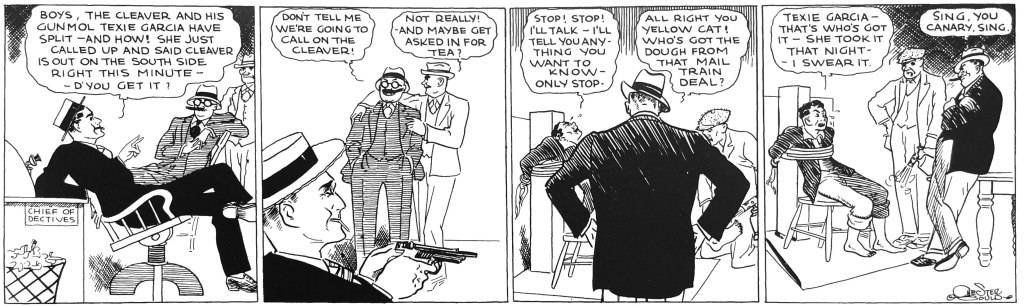
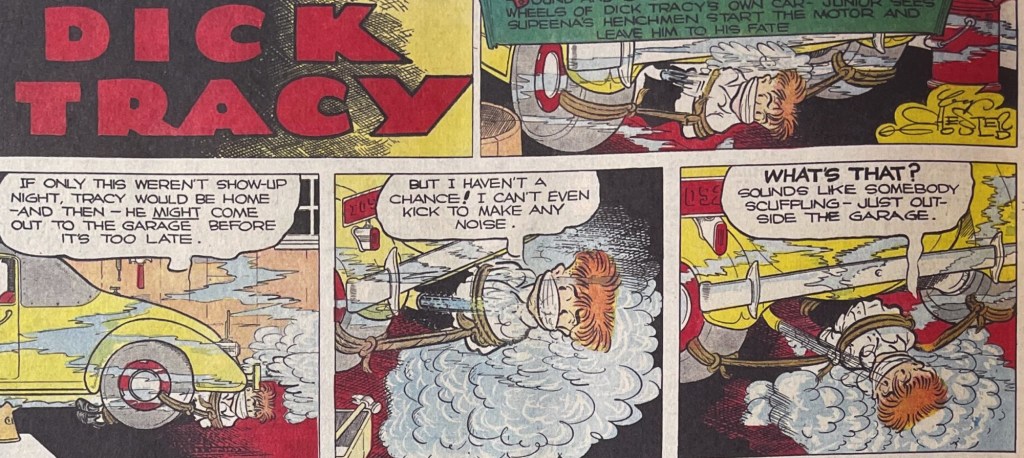
Famous for the brutality of his cartoon vision of crime and punishment, it is revealing that the first panel of the Plainclothes Tracy spec strip is a scene of bondage and torture among thugs.
By the mid 1930s, his signature thick outlines, highly abstracted iconography, extensive use of fields of blacks, and series of bizarre villains were all fully established. The Sunday page below is from 1937 and The Blank adventure.
Dick Tracy holds a special place in my own journey into comic strips. The lush reprint of classic adventures, The Celebrated Cases of Dick Tracy by Bonanza Books in 1970 was one of a trio of reprints that captivated me with the form. It was around that time that I first got hold of Jules Feiffer’s The Great Comic Book Heroes and a Chelsea House oversized reprint of early Buck Rogers strips.
But it was Gould’s starkness in style and story, the extremity of art and character, that pulled me in then and still does decades later. I can think of no other comic strip artist that had such a singular vision. There has always been a peculiar geometry to Gould’s art. His panels alternated between use of deep perspective and no perspective, a weird penchant for flatness and depth. The stances of his characters, especially Tracy and his long inky black columnar legs, was so eccentric and physically improbable. Even though Gould became famous for his love of procedural detail in detection, gadgetry and eventually sci-fi crime-fighting inventions (i.e. the two-way wrist radio), his visual language was minimalist and abstract. His daily strip truly popped from the page of his fellow and able artists because it felt like being dropped into an expressionist daydream.
Gould was as famous for the brutal simplicity of his moral vision as he was for the violence of the action in his strips. The villains were not only surreal grotesques, but they met their end in grisly ways that suggested nature (or God) itself was meting final judgment. The impaling of wartime spy The Brow on an American war memorial flagpole is the best known. But Gould followed a formula with every adventure that moved towards a protracted manhunt and chase of the villain, which usually ended with the rogue’s end often via some strange knot of fate and chance.
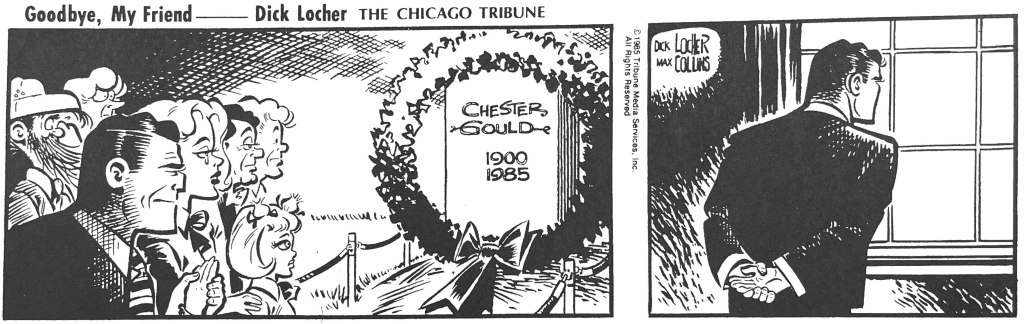
Gould himself met a more peaceful end in 1985. The strip’s writer Max Collins and artist (ands former Gould assistant) Dick Locher memorialized him in the same simple, declarative style for which the master himself was known for decades.
Hot on the heels of his first comic strip success, Mandrake the Magician, author, Lee Falk crafted a second and arguably more important bridge between dime novel and pulp heroism and the “super” heroes soon to dominate the American pop culture scene. Falk recalled later he had originally conceived of The Phantom having an alter ego as a millionaire playboy, echoing pulp heroes The Shadow and The Spider. Within the first months of the strip’s premiere in 1936, however, he changed course. “I became intrigued with the whole mythical notion about 400 years and 20 generations of Phantoms in the jungle. The more I got into that, I keep adding to the background.
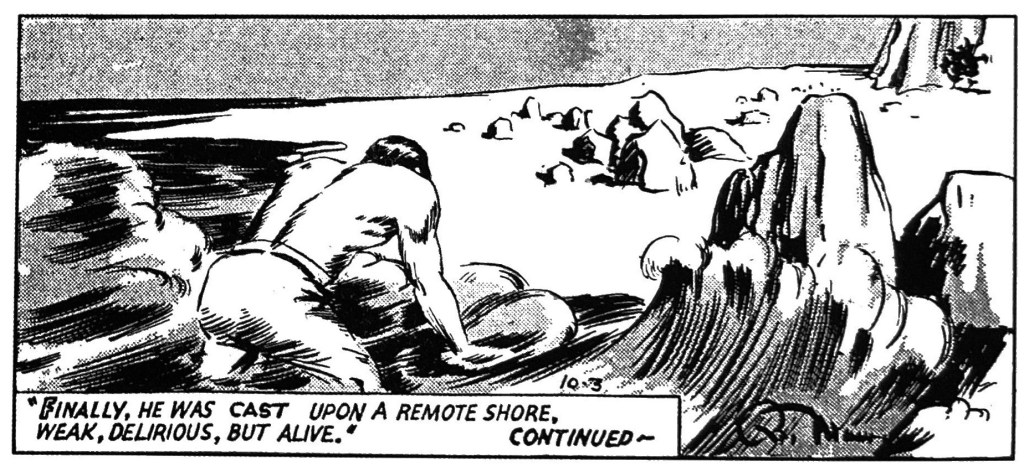
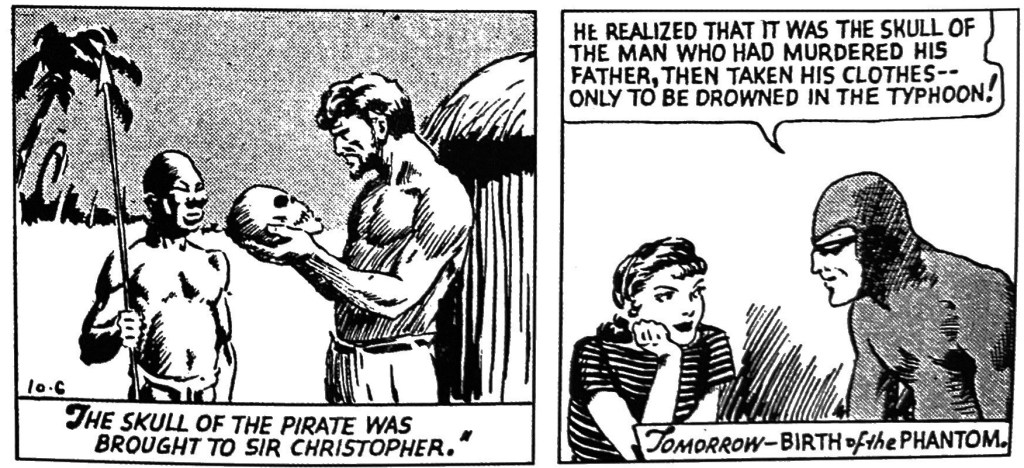
The Phantom reveals his origin story to love interest Diana Palmer (1936)
Here The Phantom relays in thumbnail form to his perennial love interest Diana Palmer, the origin of The Phantom legend. It is a 400 year-old revenge fantasy, in which generations of Phantoms avenge the treachery of Singh pirates. The first-born son of each generation of Phantom must dedicate himself to fighting “all forms of piracy.”
Among jungle natives, of course, The Phantom is known as “The Ghost Who Walks.” Like much of pulp adventure fiction of the day, The Phantom was colonialist fantasy writ large, complete with ignorant or naive native cultures championed by this white (in purple wrapping) savior.
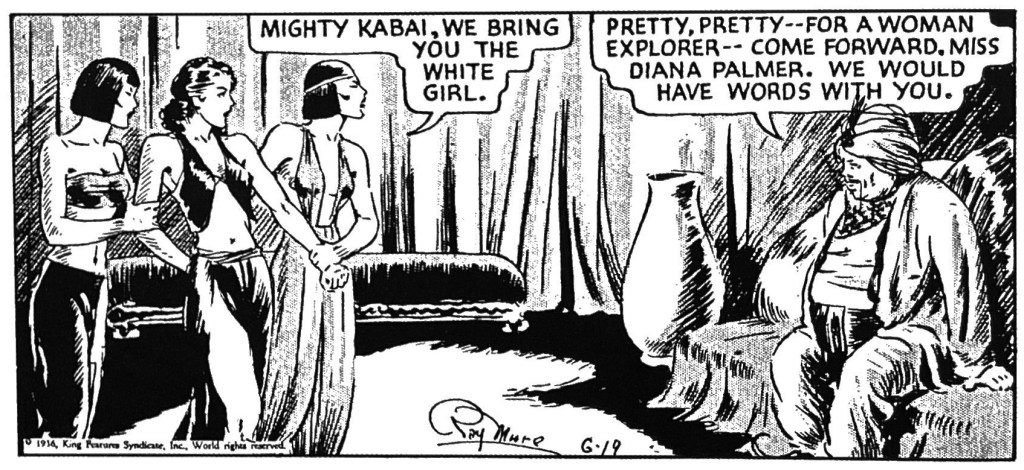
While The Phantom had no super powers, he was the first hero to don the skintight costume that would soon become standard for comic book super heroes with the arrival of Superman several year’s later. The strip was drawn by Ray Moore, following an Alex Raymond style that King Features encouraged across its adventure line of strips.
Like the spicy pulps of the era, The Phantom always had an erotic and sadomasochistic undercurrent that provided more titillation for young and old male readers than usual. Falk and Moore seemed devoted to depicting women in various states of undress and with gossamer thin gowns that were as skintight and revealing as The Phantom’s own outfit.
In fact the series begins with Diana Palmer in short shorts, low-slung tank top and boxing gloves pummeling her male opponent. This set the subtext for the series. For a 400-year-old Ghost, The Phantom finds himself bound and tortured more than you would think possible. And the female love interests and villains alternate between being damsels in need of saving or dominatrixes asking for a slap-down. The second major adventure cycle in the series is about a band of female pirates, the Sky Band, which quickly becomes a figurative S&M orgy of women alternately endangering The Phantom and falling in love with him.
The series has been enduring, however, thriving in comic strip form for these many decades and in comic books as well. Falk continued to author the strip until his death in 1999.




 Panels & Prose