

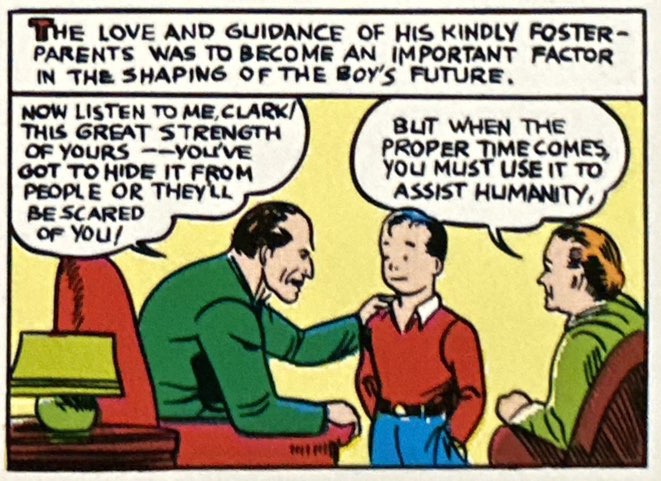
America needed a hero. That is how Superman creators Jerry Siegel and Joe Shuster remembered the late-1930s world in which their modern myth soared. Everyone is familiar with the Clark Kent origin story: orphaned by cosmic circumstance; rocketed to Earth; fostered by the Kents in the american breadbasket; super-powered by our planet’s physics; and taking on his secret identity as the milquetoast reporter. It is that rare mass mediated pop culture fiction that genuinely approaches folk mythology. It is an origin that compels retelling for every generation. Less attention has been paid to his political roots, however. Every comic strip in the adventure genre especially has an identifiable political slant, most obviously in its choices of wrongs to right and the villains to subdue. The famously conservative Chester Gould in Dick Tracy and populist Harold Gray in Little Orphan Annie were the most overt. Less obvious was the implicit imperialism of Milton Caniff’s Terry and the Pirates and most of the adventure pulps, which characterized non-Western cultures as at best quaintly primitive or at worst inherently brutal.
And so too did the early conception of Superman in 1938 embody that pre-war moment. In looking at the first storylines, I was struck by Siegel and Shuster’s choices for criminality to avenge: lynching, miscarriage of justice, violence against women, capitalist lobbying for war, arms dealing and warmongering. Yes, Superman started life as quite the social justice warrior. Following Ma Kent’s prime directive to young Clark, his powers were to be directed “to assist humanity,” which was personified in his first story as “Superman: champion of the oppressed, the physical marvel who had sworn to devote his existence to helping those in need.”
As most comic book historians have told and retold, the first Superman appearances were repurposed comics strips, a spec project the teenaged Siegel and Shuster developed and shopped around endlessly through much of the 1930s. The submissions were roundly rejected by newspaper editors and syndicates as crudely drawn childish fantasy, which, of course, they were. Even the visionary Will Eisner advised the duo that the Superman idea was not ready for the big time. But when the reformatted strips found their way into Action Comics, the rest was history. Superman and his many imitators would quickly define the superhero genre as a wildly imaginative canvas filled with exotic supervillains, global threats, criminal masterminds. But in its first iterations, Siegel and Shuster’s terrain was much more local, focused often on everyday injustice.
The first Superman adventure took aim at mob rule, vigilantes breaking into a jail to lynch an innocent man.
Superman not only takes a stand against vigilantism but the inherent dangers of capital punishment. Learning that a wrongfully convicted woman is set for execution, our costumed do-gooder busts into the Governor’s mansion to provide evidence of her innocence with seconds to spare.
In fact, avenging violence against women is one of the early tropes of Superman’s heroism. After rebuffing a gangster’s advances at a nightclub, Lois Lane finds herself kidnapped, in what becomes a long history of Superman saving his colleague in place of the cowardly Clark.
I’m not sure when wife beatings in progress were being called into newspaper assignment desks, but that is what sets us up for Superman’s next heroic assignment.
But Superman quickly moves from the domestic to the global, targeting munitions lobbyists and arms dealers campaigning for war. Eventually, he forces an arms dealer into service in a South American war to demonstrate the fruits of his profiteering. On a side note, the munitions magnate in this sequence is named Emile Norvell. Per Jim Steranko in his Afterward to the DC Archives edition of Superman comics, Siegel and Shuster were alluding to two pulp magazine authors of The Spider and other series, Norvell Page and Emile Tepperman.
And then, bringing the warring generals together to admit the pointlessness of the conflict, Superman forces peace with a handshake.
Soon enough, Superman would take aim at what would become a familiar rogues gallery, direct descendants of the pulp and comic strip crime and adventure genres. Like the superhero itself, the comic book villainy that took fire during WWII pulled together fictional tropes that had evolved throughout the 1930s. Plainclothesman Dick Tracy may have been as square-jawed and straight-laced an institutionalist as they come, but his enemies became increasingly abstract emblems of evil. Beginning with pulp phenomena like Doc Savage and the Shadow in the early 30s, pulp fiction heroism hyper-extended hyper-masculinity towards the supernatural. The hero’s “secret identity” was a convention baked into numerous characters. And in pulp favorites like Operator 5, The Spider and countless others, the stakes escalated to world domination. Everyday city crime bosses weren’t big enough enemies for the likes of quasi-superheroes. And with the arrival of Lee Falk’s The Phantom in 1936, the mystical adventurer got a costume, leotards and a mask. Aside from the alien origin, most of the major elements of the cartoon superhero were assembling by 1938. In the midst of Prohibition-fed crime, the great Depression, and European war drums, America had been calling for heroes throughout the decade.
Political takes on the superhero genre have always been a dime a dozen. Some argue that the genre embeds a set of rightist, even authoritarian presumptions. After all, most superheores are vigilantes working outside institutional justice. They are individualist and adolescent fantasies of personal power and autonomy that seem to romanticize social alienation rather than solve for it. And of course the genre glamorizes force. It makes violence and destruction into a pornographic spectacle rather than a tragedy. But in dipping into Siegel and Shuster’s initial imagining of their boyish fantasy, it does seem to bend towards a politics we might sketch as social justice. Their concern for institutional corruption and injustice, the inhumanity of elites, inhumanity of war, the mistreatment of women, all are noteworthy. Much has already been said about how two Jewish boys in Cleveland, steeped in sci-fi and pulp nerd-ism, felt alienated from a sense of power as well as women. Clearly Superman was their childish response. At the same time, however, those social, psychological roots seem to have informed the boy’s early social sympathies for fellow outsiders, oppressed, disempowered.
And they were channeling a widespread political response both to the hardships of the Depression at home and the fascist threat abroad. If the early Superman issues feel to contemporary eyes notably “liberal” that is because domestic political culture was already starting to define an “American Way” as a democratic antidote to Fascism. Cartoonists were already responding to the threat of world war long before America’s entry into the conflicts in 1941. V.T. Hamlin’s Alley Oop humiliated a prehistoric dictator that the creator himself was a thinly-veiled Hitler. H.T. Webster’s Timid Soul offered remarkable insight about the fascist appeal to common men as early as 1937. And throughout the 1930s, comic strips lampooned the backward tribalism and silly hierarchies of European tradition in a satiric genre I called screwball monarchy. And once the U.S. entered the war, the domestic propaganda machine positioned this as a fight against police states, mob rule, suppression of speech, social injustice and racism. At least for a while, Superman was a social justice warrior.
Discover more from Panels & Prose
Subscribe to get the latest posts sent to your email.
 Panels & Prose