


Roy Crane doesn’t seem to garner the kind of reverence held for fellow adventurists like Milton Caniff and Alex Raymond, even though he pioneered the genre in Wash Tubbs and Capt. Easy. Perhaps it is that he lacks their sobriety. After all, Crane evolved the first globe-trotting comic strip adventure out of a gag strip about the big-footed, pie-eyed and bumbling Tubbs. But when he sent Wash on treasure hunts and international treks into exotic pre-modern cultures he kept one foot in cartoonishness style and the other in well-researched, precisely rendered settings, action and suspense. It was a light realism, with clean lines, softly outlined figures, often set in much more realistic panoramic backgrounds. This was not the photo-realist dry-brushing and feathering of Raymond, nor the brooding chiaroscuro of Caniff.
And yet, Crane helped invent many of the comic strip adventure conventions that more revered artists took in other directions. His panel work and daily rhythms helped establish how to represent adventure action and use daily cadences to build tension and advance continuities. He established the use of realistic exotic settings as essential to the comic adventure. He innovated the use of text as art by using bolding, word size and shape to enhance the tone, emphasis and rhythm of dialogue in speech balloons. In effect, Crane was among the most intentional and thoughtful American cartoonists. He thought hard about the unique aesthetic qualities of the form, but he did it is a light and simple form that made it all look too easy. As well, Crane brought a unique authenticity to adventure. He had lived the life of a hobo, an itinerant worker and traveler who had lived life on the rails, in Mexico, Cuba and even briefly for the circus.
In 1943, frustrated by his syndicate NEA’s control of the Wash Tubbs and Capt. Easy property, Crane jumped to the more prestigious King syndicate to create and own his own wartime aviation feature, Buz Sawyer. It was here that Crane continued to innovate, most notably with his heavy use of Benday Dots and even more advance Craftint paper to bring new levels of shading to the newspaper comics medium.
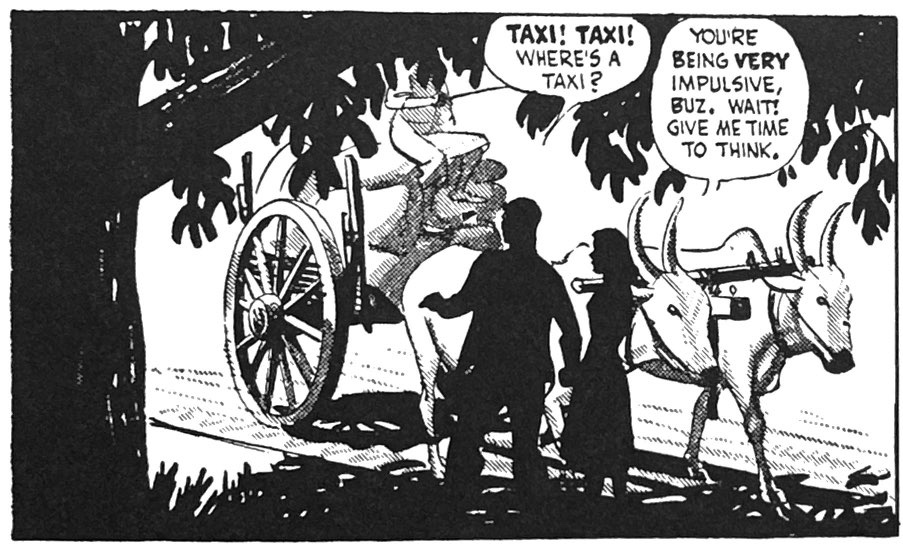
The select panels above are just a few stunning examples of Crane’s artful layering of tines in a scene to both tell story and establish mood. In one panel he recreates the blinding light of headlights, layering in the vague shadows of charging thugs, to project us into a very recognizable sense of confusion and terror. In the next panorama, we get Crane at his scenic best, using his new tools to bring a sense of depth and place. And in the last panel, his shading of the beast-drawn cart, enlarged but in the distance, creates a unique sense of foreground/background tension.

This three day sequence of Buz and pal Sweeney on a camping trip shares Crane’s own love of nature. But as always his use of panorama is never gratuitous. He balances the grandeur of these realistically rendered mountains and passes with Sweeney’s comic discomfort in kicker panels that have one foot in adventure and the other in the gag genre. And here in a few days of panels we get the essence of Crane’s mastery of the form, juxtaposing adventure realism and cartoonishness, heroism and real suspense with the legacy of light comic strip satire. And again, Crane made it look almost too easy. There is a subtle mastery to his work that is unique to the form. Other adventurists like the giants of the 30s-50s, Raymond and Caniff, channelled the styles of illustration art, classic chiaroscuro and cinematic technique. And all of this was brilliant, but it also made it easier for subsequent critics to elevate their work through association with more respected traditions. Crane strikes me as more of a cartoon purist, someone who was pioneering the strip’s unique capabilities for artistic expression and aesthetic effect.
Discover more from Panels & Prose
Subscribe to get the latest posts sent to your email.
 Panels & Prose
Pingback: Flesh, Fantasy, Fetish: 1930s and the Return of the Repressed – Panels & Prose