
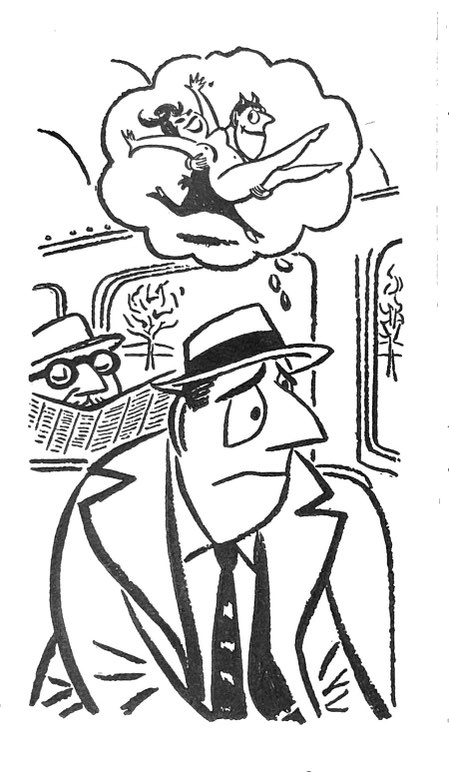
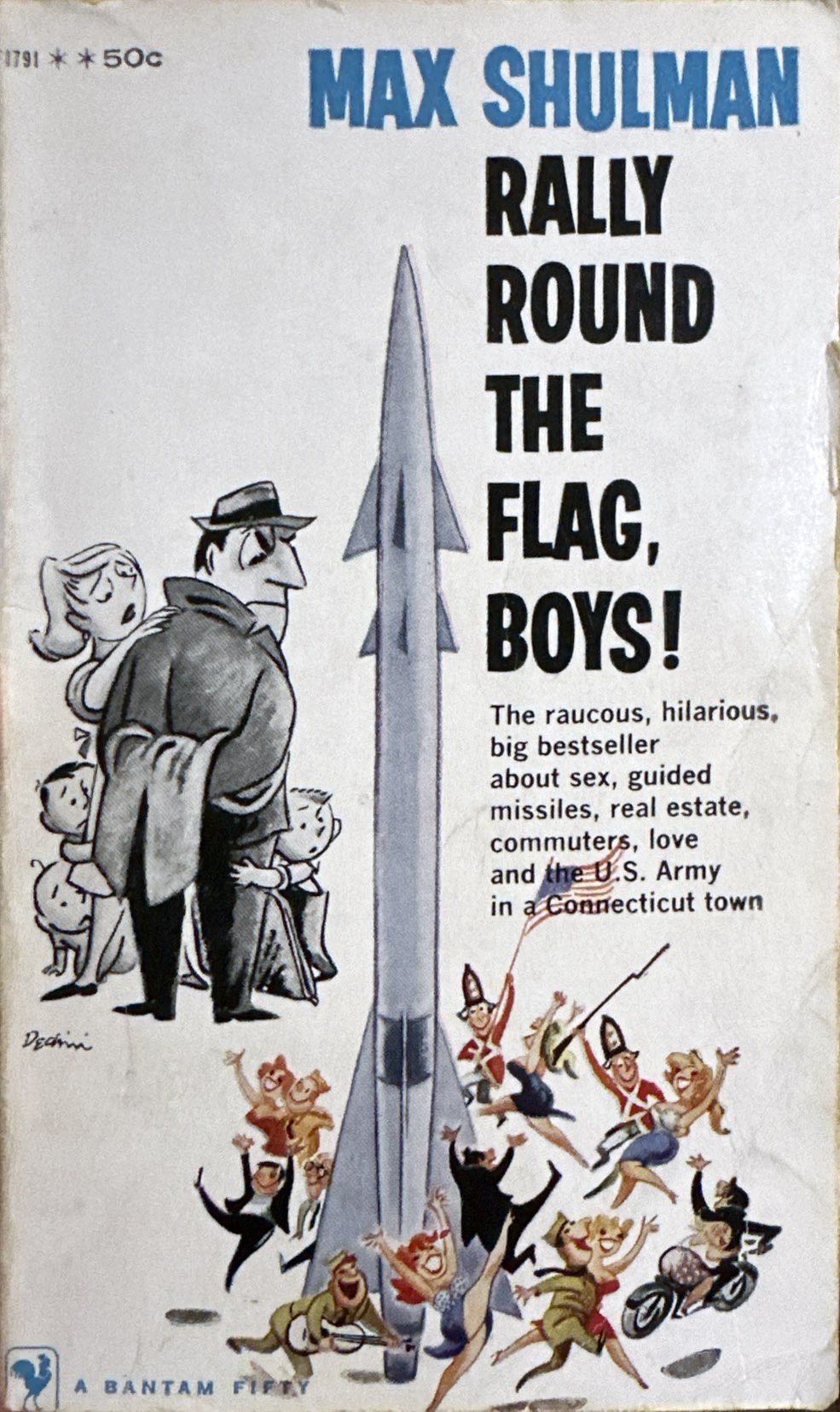
You may not think you know Max Shulman and Eldon Dedini, but you have seen their stuff. Shulman was a comic novelist of the 1940s and 50s whose most famous, enduring creation was The Many Loves of Dobie Gillis, a short story collection that became an MGM musical in 1953 and a genuinely witty TV sitcom (1959-1963). But throughout those those decades, Shulman was a bestselling satirist of mid-Century suburbia. His 1943 breakout college satire Barefoot Boy With Cheek was followed by The Feather Merchants, the Dobie Gillis collection and Rally Round the Flag, Boys!. In their Bantam paperback releases, many of Shulman’s novels enjoyed cartoon complements by Eldon Dedini, best remembered as a longtime Playboy magazine regular. His cartoon style is immediately recognizable: highly abstracted balloon faces, sharp triangle noses, bright watercolor washes. His lascivious satyrs were among jhis signature series in Playboy.

Both Shulman and Dedini were well attuned to the sexual subtext of the post-WWII stereotype of suburban normality. His novels poked behind the well-trimmed shrubbery and regimented train commutes to send up the infidelities, boozing, quiet desperation and guilt…oh, so much guilt laying behind the blandness.
Dedini was the perfect man for the job of illustrating Shulman’s light satirical jabs at Mad Men-era conformity. He grokked the weird combination of modern male insecurity, dissatisfaction and horniness, and somehow could capture it all in a few spare, inky lines – just the right wry eyebrow arc, thought balloons filled with curvy cuties, the male leer. And it matched well the insights and tone of Shulman’s writing. One of the writer’s best tirades in Rally Round the Flag, Boys! skewers pretentious suburban teens cosplaying juvenile delinquents.
“Grady was a member of the new school of juvenile delinquency, the You-Too-Can-Be-A-Rebel School. The headmasters were Elvis Presley and the spook of Jimmy Dean, and the entrance requirements were completely democratic. A boy was no longer excluded from the glamorous ranks of the delinquents simply because he had had the rotten luck not to be born in a slum; all he had to do was look as though he had. If he would wear his hair in a duck-tail cut and his sideburns at nostril level, forsake grammar, dress in black khaki trousers with the cuffs narrowed to fourteen inches, never do his homework, and spit a lot, his origins, no matter how respectable, would not be held against him.)”
Max Shulman, Rally Round the Flag, Boys!
And Dedini has these faux JDs dead to rights, drawing them as cookie cutter toy rebels, as conformist and fearful of the women they purport to conquer as their buttoned-down dads.

The American 1950s exists in popular history as a repressed, conformist mono-culture that set itself up to be upended by a 1960s counterculture. The truth is much more nuanced and complex than that in too many ways to explore here. Suffice to say, the Cold War-fueled aggressive Americanism appeared to be a burlesque even to many living in it, and the signs of cultural resistance were easily seen. From the rise of film noir to EC and MAD comics, the beats to Playboy magazine. Shulman’s regular send-ups of suburban guilt-ridden hypocrisy were being consumed by those very same guilt-ridden suburban hypocrites. American middle class culture can be both silly and self-aware all at once. In fact much of comic strip humor relied on that same paradox.
Discover more from Panels & Prose
Subscribe to get the latest posts sent to your email.
 Panels & Prose