Jungle Jim Is A Ramblin’ Man…And Quite the Charmer

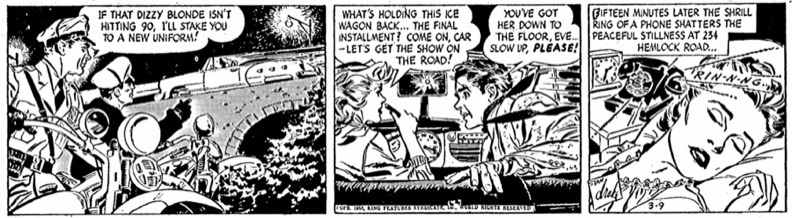
No one could mistake master artist Alex Raymond for a proto-feminist. In his and scribe Don Moore’s dual successes of the 1930s, Flash Gordon and Jungle Jim, barely-clad distressed damsels abounded. To be sure, Raymond understood better than any comic strip artist the erotic potential of the formal, His male and female bodies were delicious. But it also goes almost without saying that the adventure genre has always been about male prowess and potency against forces natural, exotic, institutional and especially feminine. Comics artists like Carl Barks and Al Capp, among others, have recounted that newspaper editors often cited the 12-year old boy as the ideal target market for adventure strips. Well, yeah, sure…along with their horny Dads.

The adventure hero’s cavalier approach to women, romance, and all that icky girly stuff is clear in Jungle Jim’s caddish handling of two rival gal pals Lil and Kitty in this late 1941 interstitial between two episodes. Jim has no time for romance, and writes to Dear Jane letters, excusing himself from commitment. Lil gets the I’m-just-a-ramblin’-sorta-guy” brush off and Kitty gets the mock magnanimity ploy. “Find a nice substantial businessman… .” What a gentleman.

Continue reading

Flashing Flash: Or, A Paper Doll That I Can Call My Own

Paper dolls and cut-out toy models are centuries-old, but the format was a natural fit for the modern newspaper comic from its beginnings. We tend to identify the comic strip paper doll with “women’s strips” from the great fashionistas, Jackie “Torchy” Ormes or Gladys “Mopsy” Parker. But in 1934, Alex Raymond’s Flash Gordon got into the act with a series that ran in every Sunday from August 18 to December 16. While Raymond focused mainly on Dale Arden as well as the various princesses and other female characters the still-young strip had amassed by then, he covers most of the cast, from Zarkov in a tuxedo to Ming the Merciless’ collection of flamboyant collars.

Continue reading

Secret Agent X-9: Watching Alex Raymond Mature

Nearly 90 years ago yesterday Jan. 22 1934, the collaboration between Dashiell Hammett and Alex Raymond launched as Secret Agent X-9. Designed to respond to Dick Tracy’s massive success with the literary cachet of Hammett and the rising talent of Raymond, X-9 looked better on paper perhaps than it did, well, on the actual page. The famous innovator of the hard-boiled style was at the tail end of his productive output and clearly did not give his best effort. After crafting just a few very uneven scenarios, Dash got canned.

Continue reading

Flash Gordon (June 16, 1935).

Into the Heart of Juliet Jones

The thoroughly engaging and visually captivating The Heart of Juliet Jones is an underrated gem of 1950s comic strip photo-realism and romantic adventure. Its admirable run began in 1953 (through 1999), under the artful pen of Stan Drake and the scripting of Elliott Caplin. The first week of the strip is added below, and it illustrates the melodrama of the this soapiest of soap operas.

The basic setup involves the Jones family – a widowed father “Pop Jones,” his 30-something unmarried daughter Juliet and teen wild-child other daughter Evie. Sibling rivalry and the tension between responsible Juliet and adventurous man-obsessed Evie form the basic dynamic. I am working from details in the excellent reprints of the early strips by Classic Comics Press (2008). The first volume has introductions by Leonard Starr (of Mary Perkins fame) and Armando Mendez.

Continue reading

Rip Kirby Introduces the 1950s

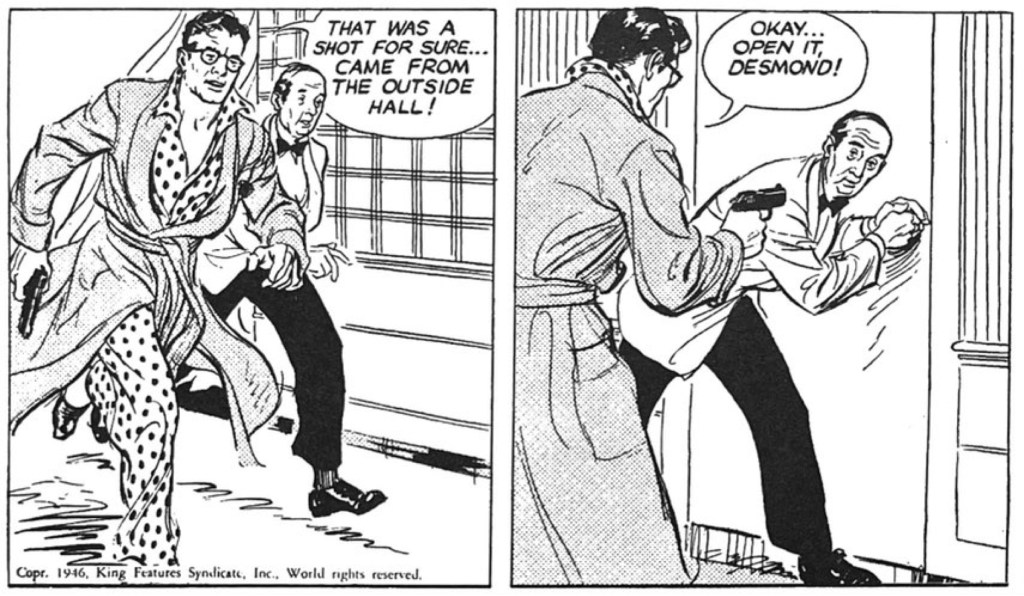
In the first days of Alex “Flash Gordon” Raymond’s post-WWII detective adventure Rip Kirby, it was clear the master was going to redefine the look of comic strip adventure. Day two of the March 1946 launch story speaks volumes about the influence Raymond was going to have on a decade of 50’s adventure style. The panel progression here is so engaging. The first two panels are energized so that you can almost feel the weight of the murder victim slump into Kirby’s arms and instantly change valence of the scene. And that final close up communicates the deadly reality of the situation by bringing us right into the complex reaction to beauty and death. The photo-realism is here, as is the increasing influence of cinematic points of view, timing, and close-ups. And arguably, the next decade would also see in comic strip adventure a turn inwards, toward psychological realism, the emotional lives of characters, that accompanied the more photographic style of the art. All of these elements would be deployed in different ways by Stan Drake in the Heart of Juliet Jones, Leonard Starr in On Stage, Warren Tufts in Casey Ruggles and Lance and John Cullen Murphy in Big Ben Bolt.

Continue reading

Flash and Dale: “Go On. Fight Your Magic Men!”

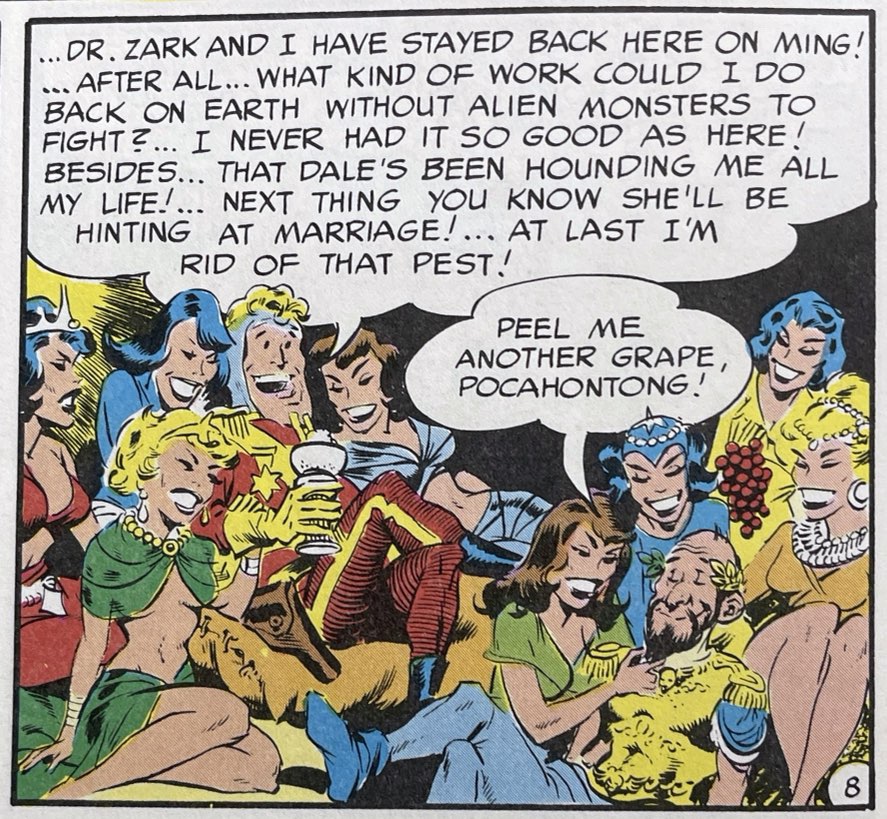
A little intergalactic lovers’ quarrel. Planning a wedding is hard enough without waves of alien foes gumming up the calendar.