
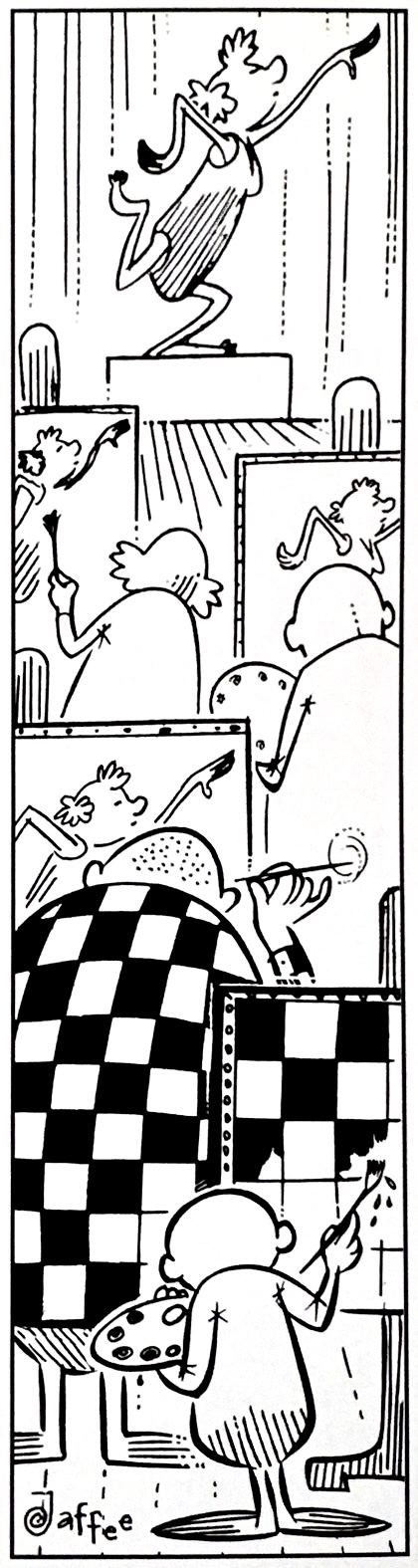
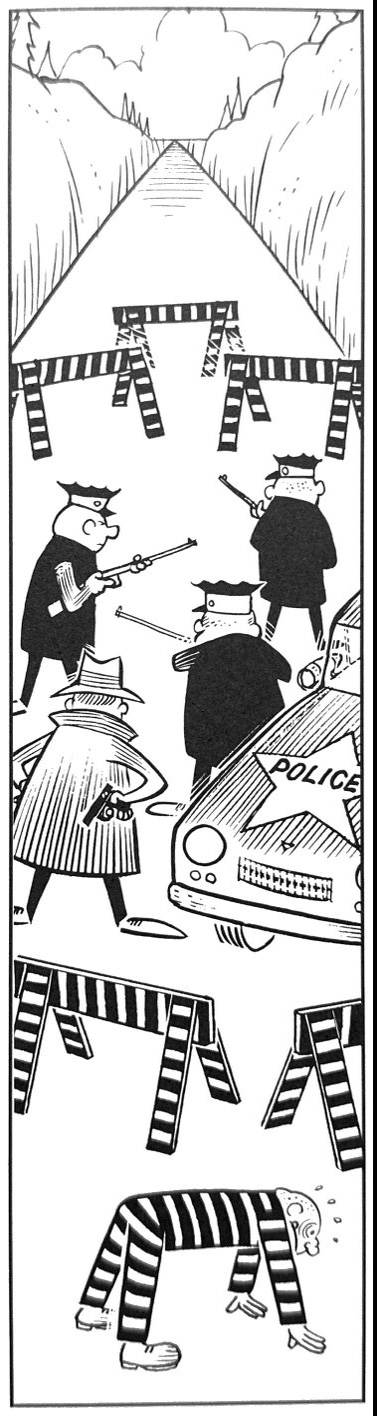
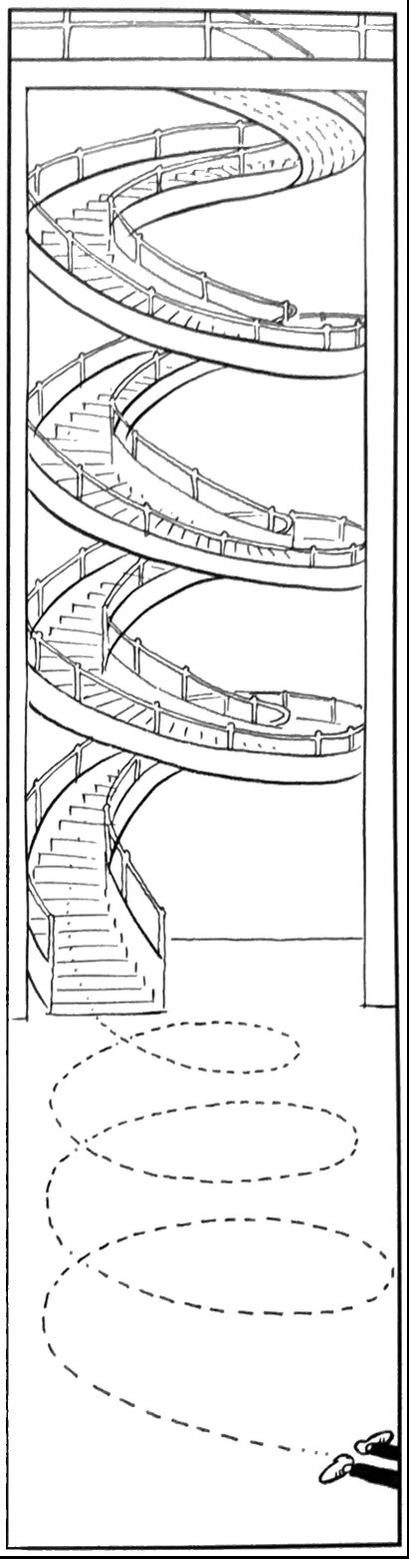
With the sad passing of Al Jaffee this week, cartooning lost its oldest and longest-working artist. In fact, the man behind 55 years of MAD magazine Fold-Ins held the Guinness Book of World Record for having the longest career in the field. But his 1964 invention of that classic foldable end-page gag was not his first stab at rethinking form. His inspiration for the fold-in was an inversions of the then-trendy magazine fold-out. But it turns out that zigging when others zagged was a bit of a thing with Jaffee. Back in the mid-1950s he broke into the syndicated newspaper comic strip market by literally turning convention on its side. He called them Tall Tales.
Continue readingTag Archives: comic strips
Popeye The Disgustipated Dictipator

E.C. Segar seemed to love the screwball monarchy set piece that captivated 1930s comedy. He used the premise of the madcap cartoon kingdom at least three times: once in the early 30s defending Nazilia, later in the 30s when he installed Swee’Pea as a king, and most notably in the sailor man’s founding of his own kingdom of Spinachova in 1935. Starting on April 22, 1935 with Popeye’s decision to build an ark and ending with him abandoning the utopian venture in defeat and disgust on March 19, 1936, Popeye’s act of radical escape from Depression-Era America was among the longest continuities in the history of Thimble Theatre. But the Spinachova epic was important in a number of ways. It was the closest Segar came to political satire. The tension between “dictipator” Popeye and his “sheep” (the people) is basically a political one that turns the trendy populism and folk romanticism of the day on its head. It was also a saga of defeat for Segar’s hero, an extended example of our otherwise heroic, even super-powered folk moralist showing all manner of very human weaknesses. And finally, most importantly perhaps, the episode was Segar at his absurdist peak, a tour de force of relentless zany side trips, inane situations and surreal resolutions that were the cartoonist’s hallmark. While Thimble Theatre’s Plunder Island storyline was likely Segar’s most successful continuity in developing character, plot and comic suspense, he was using the roomier canvas of Sunday pages for deeper, more immersive sequences. The Spinachova saga was executed across nearly a year of dailies, which may give us the fullest picture of this artist’s range within the truncated cadences of this format.
Continue readingBuck Rogers Solar Scouts: “An Asset to My Parents, My Country”

Toy ray guns and spaceships, cereal premiums, and radio shows spun off from Buck Rogers’ phenomenal popularity in the 1930s. The property was tailor made for merchandising and licensing, of course. Gadgetry was the strip’s core appeal. A number of comic strip’s created kid clubs around their heroes. Dick Tracy had his Detectives Club, and later the famous Crimestoppers. Little Orphan Annie’s radio show had its own Secret Society with a toy decoding device for over-air messages (famously depicted in the film A Christmas Story), and the strip enlisted her fans into Junior Commandos during World War II. In addition to servicing fans, keeping audiences engaged, these clubs were also early examples of marketing data collection, See for instance Buck Rogers’ Space Scouts application above. While some of the data inputs were tongue in cheek, of course, club applications
(“previous rocket ship experience”?), the club members promotions worked much like sweepstakes for other consumer product manufacturers, a way of getting first part data on their audience.
“All the Moose That’s Fit to Print”: Bullwinkle in Print
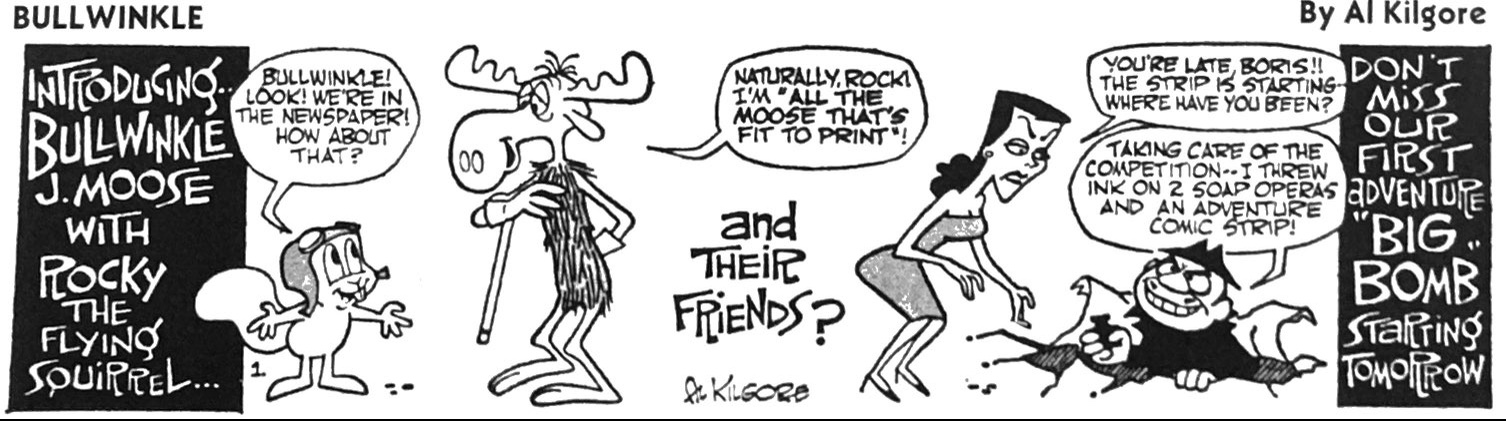
On July 24, 1962, the successful Rocky and Bullwinkle Show made its way onto the newspaper comics pages. Written and drawn by Al Kilgore, who had worked on the comic book iterations of the successful TV cartoon series, and some scripts for the show itself, it was a rare instance of faithfully translating popular cartoons to daily print. From this first strip, Kilgore embodied the wry self-consciousness of the Jay Ward Production. the inaugural story “Big Bomb” carried the same absurdist satirical tone and topicality of the TV series.
Continue readingSmilin’ Jack
Skyroads: Flying As Fetish

After the fast success of Tailspin Tommy in 1928 from the Bell Syndicate, the John F. Dille company responded with Skyroads about five months after the syndicate introduced Buck Rogers. The otherwise forgettable strip is perhaps most notable as a stable for artists on more important projects.
Continue readingConnie and Frank Godwin’s Gentle Realism

Frank Godwin’s 1927-1941 adventure strip Connie should have been among the standout strips of its day on a number of counts. While its launch as a Sunday light-hearted take on the modern working gal (a la Tillie the Toiler, Ella Cinders), its extension to a daily in 1929 turned the lithe and stylish Connie Kurridge (yes, “Kurridge”) into one of the first comic strip adventuress. While others consider her the pioneering female adventure character, it seems to me Harold Grey’s Little Orphan Anniehad already been working this genre since 1924. Still, Connie was the first woman in strips to take on the typical tropes of pulp drama – globe-hopping, eccentric villainy, world-shattering consequences. She employed a combination of savvy, courage, physical daring and comely attraction to both overcome and disarm her antagonists. And the scene-shifting was impressive. In the first years of the strip she moves from being an aviator to reporter to charity worker and eventually in the 1930s as a white defender against the “Yellow Combine” when she time travels to 2349 AD.
Continue reading Panels & Prose