Stereotyping The New American City

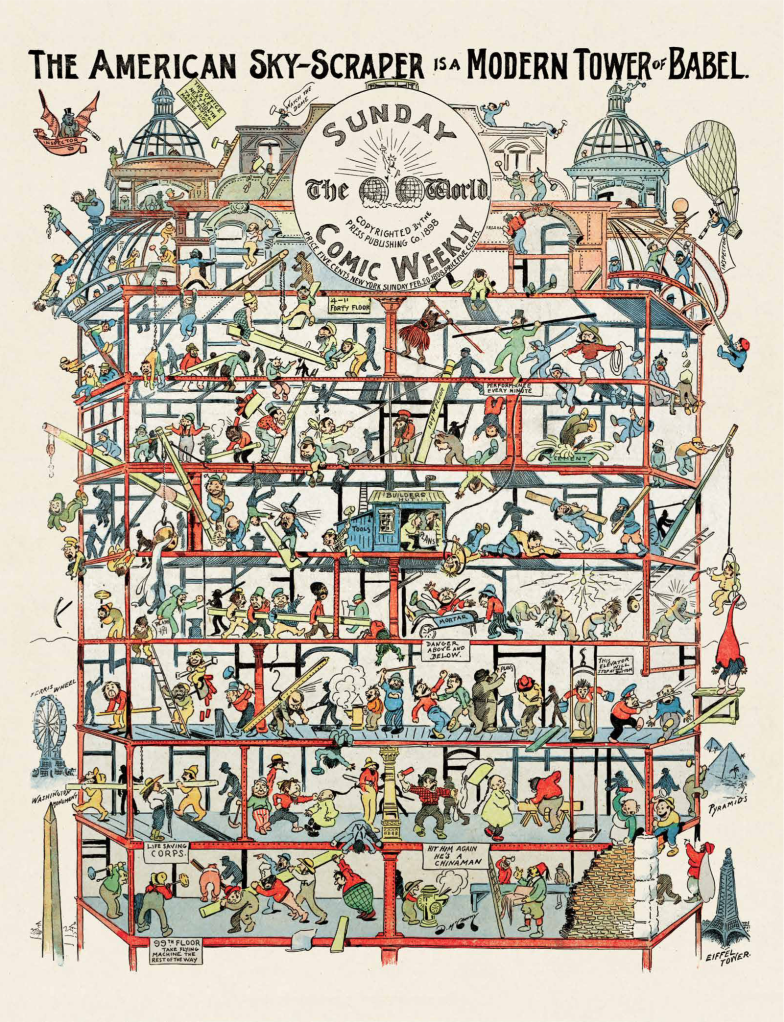
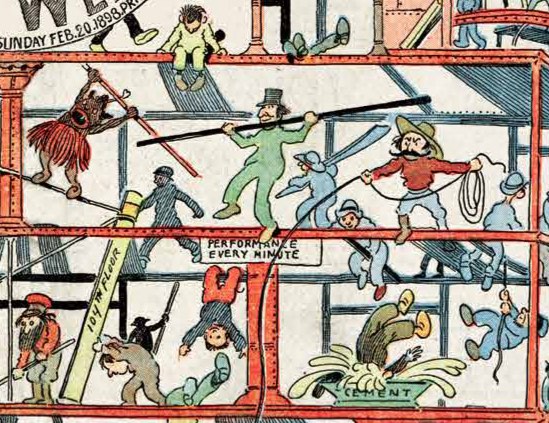
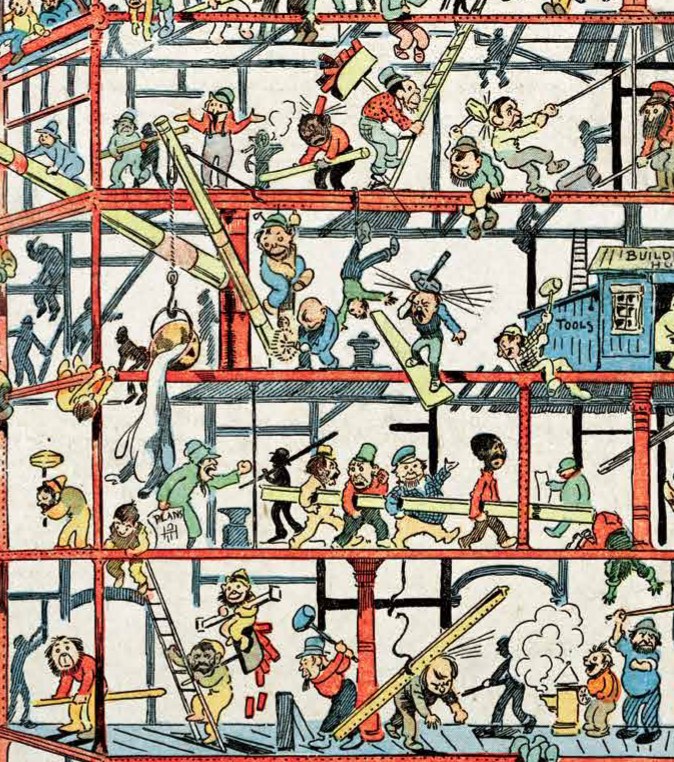
New York World staff cartoonist Dan McCarthy’s 1898 “The American Sky-Scraper Is a Modern Tower of Babel” is a trove of tropes that characterizes so much of the first decade of American newspaper comics. Like R.F. Outcault and Walt McDougall, McCarthy uses that massive Sunday newspaper page to draw a tableaux caricature of the cityscape, the new and rapidly changing environment the World readers experience each day.  

Some of the most talented and ambitious early newspaper cartoonists used the full page tableau format to capture the energy of the city. Outcault’s Hogan’s Alley was the first to use the format to depict the city scape, which is to say it was an interpretation of that new experience. Walt McDougall was another fan of the tableau to depict social landscapes, including his magnificent “Life in the City as the Countryman Sees It.”  Comic artists seemed to absorb the physical energy of turn-of-the century America and direct and shape it into popular art. Just as the slapstick, chases and fight scenes of early film were aesthetic conventions that channeled the antic energies of modern urban progress, mechanization and rapid change, so too did modern preoccupations with motion, energy, cause and effect, the urban experience shape the aesthetics of early comic art. 

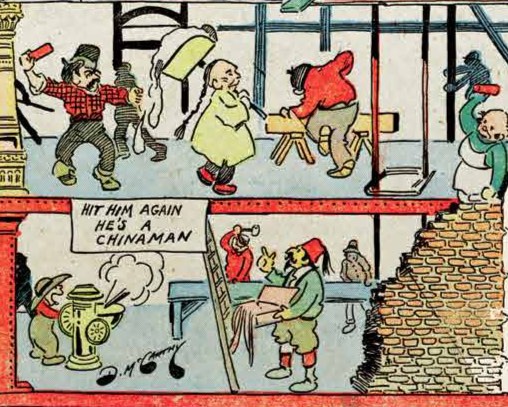
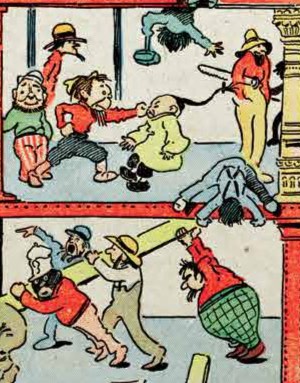
Dan McCarthy 1898. McCarthy was a well-regarded caricaturist for the humor weeklies and eventually for the World. He founded a caricature school but died in the first decade of the 20th Century in his 50s. His “The American Sky-Scraper is a Modern Tower of Babel” is a caricature of urban progress seen through the lend of ethnic diversity. The panoply of so called “hyphenated American” – Italian-, Irish-, Chinese-, Eastern European-, and African-Americans – are all stereotyped here at the same time they are acknowledged as the builders of the new city. 

You can spend hours dissecting McCarthy’s depictions of individual ethnic groups here, and there are some predictable bigotries. They are mainly distinguished by their common visual stereotypes of the day. Italians with triangular hats and handlebar mustaches. Irish with chin beards and simian face. Chinese figures with yellow long shirts and thin braided pony tails. Eastern Europeans/Jews with full beards, hats and high boots. The Irish characters often seem to be ready for a fight. One African-American sports primitive dress. And for some reason the Chinese-American figures are on the receiving end of deliberate violence. But generally, this “Tower of Babel” is a tableaux of chaos, slapstick mishaps all in service of a mechanically sophisticated scientific wonder. The tension between the chaotic energy and play of McCarthy’s workers and the rigid symmetry of the structure they are building is of course the “joke” here.

But McCarthy’s cross section of both the building itself and the New York population generally embodies the ambivalence of WASP America towards the massive waves of emigration during this era.

In other depictions of emigration, Americans seemed to greet emigrates as newcomers and fledgling Americans. It was generally acknowledged that a fast-growing and internationally ambitious America needed this infusion of cheap labor to fuel its growth. And so the stereotyping was not of the most vicious and dehumanizing sort we find elsewhere in American culture. Here it is more patronizing and imperialistic. The American middle class seemed to recognize that immigration was key to American ambitions, but patronizing stereotyping kept these emigres at a distance and always inferior.  

Great Moments: A. Mutt Meets Jeff (1908)


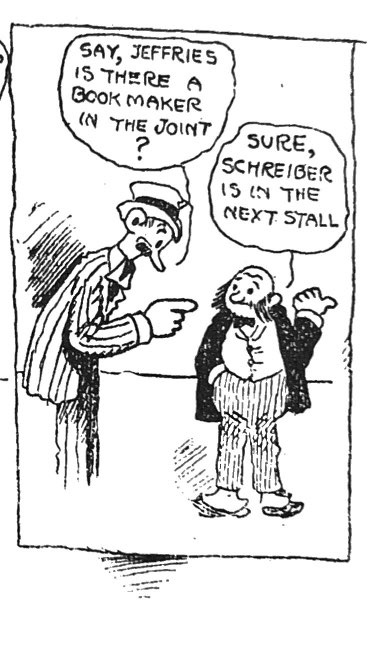
One of the longest lasting marriages in comic strip history began on March 27, 1908 when Bud Fisher’s wildly popular A. Mutt comic strip anti-hero meets a character who soon became his companion until the strip finally sputtered to an end in 1983.

As told by Jeffrey Lindenblatt in the NBM reprint of early strips, A.Mutt had a whirlwind start in the five months from its brilliant inception to the introduction of Jeff. Bud Fisher was a self-taught artist who talked his way onto the the San Francisco Chronicle in 1906. He worked his way up from layouts in the art department to spot illustrations around news stories to regular caricatures in the sports section. Here is where Fisher sold editors on an idea for a daily strip that would top the sports section with betting neophyte A. (Augustus) Mutt’s uninformed picks to win one of that day’s horse races. The next day’s strip would include Mutt’s winnings, losings and mood after the real world results.


A.Mutt was an instant hit, but its Chronicle run lasted only 26 days. The strip attracted the attention of no less than notorious newspaper staff raider William Randolph Hearst, whose rival San Francisco Examiner battled the Chronicle for circulation. As he had done so many times in his “Yellow” newspaper war with Joseph Pulitzer in New York a decade before, Hearst drowned Fisher in cash and the promise of national syndication to lure him to the Examiner less than a month after A.Mutt launched. Eventually Fisher would leave Hearst too for a much more lucrative syndication deal that became a model for decades of lavishly paid cartoonists.


Fisher’s final A.Mutt for the Chronicle appeared on Dec. 10, 1907, but that last iteration had one very important (and lucrative) addition – “Copyright 1907 by H.C. Fisher.” In Lindenblatt’s telling, Fisher accompanied the artwork to the printing department that day and before the printing plate was struck added that copyright note that led to his being one of the wealthiest cartoonists of his and subsequent decades. Until his death in 1953, Fisher benefited from gushers of revenue from licensing, theatrical and syndication deals that saw Mutt and Jeff on just about anything willing to pay Fisher royalties. There were a number comic strip millionaires during the golden era of newspaper circ wars, but few were as showy and press savvy about that’s wealth than Fisher.


It is under Hearst’s banner that A.Mutt moved quickly away from racing track picks, added Jeff and because a buddy strip that also introduced extended continuities. Alas, the sad anachronistic later decades of Mutt and Jeff strips obscured its earlier, genuinely witty, edgy slapstick years.

But in its early years the strip was indeed gritty. In fact, Mutt meets Jeff in an asylum, one of many incarcerations for him. This time he meets up with multiple cases of delusional inmates, including a diminutive fellow who fancies himself boxer Jeff Jeffries.

While the strip soon evolved beyond its origin as a sports cartoon, it carried with it to mainstream comics pages the sharp-tongued banter, slang, and snide irreverence that typified much of sport page cartooning. Mutt and Jeff took on politics, lampooned public figures, poked at social pomposity, and even ventured down to Mexico in the 1910s to engage with Pancho Villa.

Mutt was also among the first of a staple for the comics pages – the hapless schemer. Always looking for a buck, failing at the serial jobs he tries, the early Mutt conspires with Jeff (who is usually more flush) just to score a much-needed meal. Well evolved from the early simpletons of comics like F.O. Opper’s Happy Hooligan’ and Ed Carey’s Simon Simple, Mutt was like Harriman’s Baron Bean and Goldberg’s Boob, the American always on the make but falling short, working the angles unsuccessfully at the margins of America’s booming modern economy. The rising middle classes at whom 20th Century newspapers generally were aimed seemed to delight in the misfired ambitions of characters like Baron and Mutt, later Moon Mullins, Bobo Baxter and to some degree Andy Gump. It is a figure that extends into Laurel and Hardy, Abbott and Costello, Chester Riley and Ralph Kramden. Failed ambition is often leavened ironically with empty bravado and inflated self-confidence. It is light satire of America’s core tropes: social and economic ambition, masculinity, mobility, looking for the main chance.

The candor of Mutt and Jeff is in full display in 1918 when the duo scheme to dodge the draft.

Kat and Mouse: Herriman’s Creative Absurdism

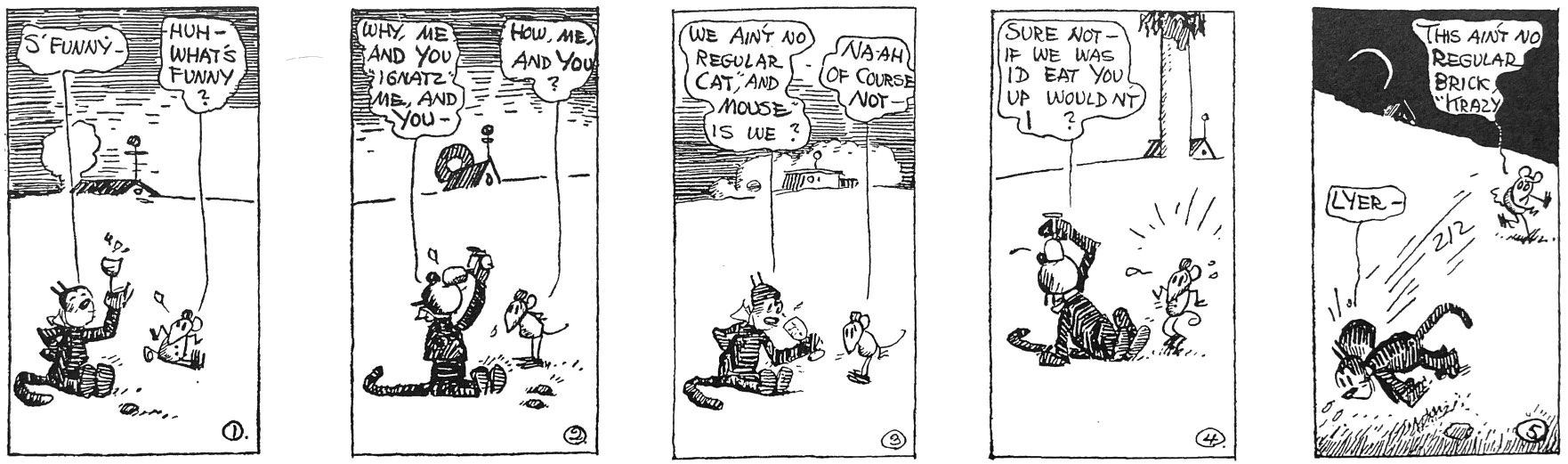
Herriman enjoyed calling attention to the absurdities of his own strip. In these dailies (1919) he also uses his signature device of changing the background landscape from panel to panel. All together Herriman is creating an absurdist space in which Krazy, Ignatz and the Coconino County cast focus on language and interpersonal dynamics.

The unique aesthetic of the comic strip is its ability to create an immersive environment through visual style, composition and character that we fall into for less than a minute a day across three or four sequential panels. Herriman used the full palette available to those panels to ground us in his characters by making the physical environment disorienting and fluid.

Krazy Kat Gender Reveal?

Dick Tracy: Conservative Icon

The hawklike nose and chin that stepped right off of Mount Rushmore were Dick Tracy’s visual signature. He was unapologetically a “square” literally inside and out. That rocklike defense of authority and institutions was precisely what Chester Gould intended as a counterpoint to the romanticized gangsterism of late Prohibition. And this impatience with “bleeding hearts” who seemed soft on crime was part of the strip from the start and an honest expression of Gould’s own sensibilities.

Tracy showed little regard for penal reform, rights of the accused or any ambivalence about police authority. Far from an aging curmudgeon, however, Gould’s views were present from the beginning of the strip and formed the center of the Dick Tracy ethos.

And so it should come as no surprise that from the start Tracy was not exactly a feminist treat. This early passage from the first year of Tracy around 1932 finds Dick being a real dick – mistakenly accusing his fiancé Tess Trueheart of ruining a planned raid on a gangster boss meeting by leaking the plan to friends. It’s a good example of Tracy as buffoon.

By the time Gould retired in the late 1970s Tracy had already become a counter-culture icon of right-wing deference to authority and defense of police at all costs. And this was nothing new. As early as the 1940s, rival cartoonist Al “Li’l Abner” Capp lampooned Tracy’s stoicism, violence and straitlaced devotion to law and order with his recurring Fearless Fosdick character.

Buck Rogers and the Steampunk Future of 1930s America

The hero of Buck Rogers was never Buck himself, really, so much as the future itself. And that was fortunate, because neither writer Phil Nowlan nor lead artist Dick Calkins was competent at the actual craft of the comic strip.

No one ever accused Calkins of artistic dexterity. The overall look of Buck Rogers was wooden, lacking in perspective or proportion, barren of expressiveness or even basic blocking of figures within the panel. Limbs often seemed out of scale with bodies and positioned with the naturalness of a marionette. Moreover, Calkins worked with assistants throughout the original artist’s run who reportedly popped in to do different parts of the strip, including some fetching female figures that were disorienting to a reader accustomed to the strip’s unconvincing art.

Which is to say that the limited range of Calkins’ talent pretty much matched writer Phil Nowlan’s narrow narrative reach. The adventure itself lacked character, suspense, pace or setting.

But enough Buck bashing. I’ll save my rant on Nowlan’s many storytelling and cultural sins for another time. In fact, it is the basic badness of the Buck Rogers comics strip, especially in the 1930s, that makes its chief claim on our attention stand out. While other adventure strips of the day like Little Orphan Annie, Dick Tracy, Popeye, Wash Tubbs and Capt. Easy clearly were about their eponymous protagonists and their villainous antagonists, the only compelling feature of Buck Rogers, 2429 A.D. was the future itself. To their credit, everyone concerned seemed on the same page of what the strip really was about. In the 1940s, Dill Syndicate head John Dill reflected that in the late 1920s he was looking for a strip set centuries in the future “in which theories in the test tubes and the laboratories of the scientists would be garnished up with a bit of imagination and treated as realities.”

And that is precisely where Buck Roger’s 25th Century adventure is compelling and fun, when it projects the technologies and lab experiments of 20s and 30s America into the future. And oddly, this where Nowlan and Calkins two dimensional approach to story and art excelled. The flip side of their shared weakness in depicting human depth or expression was a loving attention to detail when it came to objects without a pulse or soul. They had a catchy way of imagining gadgetry of the future. As I detail below they had a pretty good track record of anticipating technologies that would become commonplace after WWII. Many of them, like TVs, robots, and even rocket ships were either in development in some form or were part of the early science fiction ether where Nowlon got his start.

Adventure comics historian Ron Goulart suggests that Calkins’ technical drawing style was indebted to early sci-fi magazine cover artist and illustrator Frank R. Paul, who appeared often in Amazing Stories and Wonder Stories, the main pulp vehicles for early speculative fiction. The story that caught publisher Dille’s eye was Nowlan’s iteration of Buck as “Anthony Rogers” in “Armageddon – 2419 A.D.” in Amazing Stories Aug. 1928. The evolution of that story into Buck Rogers brought a niche genre into the mainstream and became most Americans’ first exposure to the science fiction genre’s ability to imagine a far future. And today it comes off as a captivating steampunk melange of retro stylings for aspirational technology.

When it came to gadgetry, Calkins showed an appreciation for rendering the details of mechanism, materials and surfaces. His horizontal and vertical hatch work across metal surfaces became a signature of most Buck Rogers technology. But his thick line work and flat perspective leant a cartoonish quality to the machine, a touch of Rube Goldberg’s contraption aesthetic that made this future tech feel more imagined than precise.

Drones

It was not too much of a stretch for 1929 Americans to envision a future where wireless communication, TV tech, flight and visual surveillance would merge. But Nowlan and Calkins were pretty spot on in expecting a drone-like device

Buck Rogers, Early Brick Phone Adopter

Buck might be rocking a pre-iPhone Nokia hand brick there. Nevertheless, the 2049 (via 1929) “Radiophone” seems to sense how the two chief inventions of the modern world – radio and the phone – were destined to merge.

“Self-Developing Ultra-Violet Prints”: Instant Photos

Buck Rogers was especially good at understanding how multiple technologies would complement one another and find new uses over time. Here the vision of high def televisual transmission blends with a self-developing photo process that anticipated the first Land camera in 1948 that introduced consumers to the concept of self-developing photos. The basic idea of instant images, had been developed in more cumbersome formats as early as 1928.

Surveillance Video and TV

Surveillance via TV technology is a major element of the Buck Rogers future. In this case Detecto Television uses hidden cameras across the Mongol empire to help a rebel faction plot insurrection.

Spyware

Nowlan seemed to understand that as all technology gained more power through wireless communication they would become subject to hacking and spying. Phone wiretapping was invented in the 1890s and became a common law enforcement tool during the Prohibition era of the 1920s. Nowlan simply projected the basic concept onto the communications mainstay of 2049 – the Televisor.

Steampunk Military Industrial Complex

Nowlan and Calkins were most captivating when the former dug into his sci-fi toolbox and the latter married cartoon illustration with futuristic blueprints. They loved to stop the action, blow apart typical panel breakdown and just ogle over the spec sheets of tomorrow. Above, they outline the rebel Americans’ rocket ship cruiser, complete with functional details like “spring landing skids“ that helped us imagine the blueprint brought to life. Nowlan and Calkins’ vision of rocketry seemed effective enough to inform the designs we meet in the movie serial versions of Buck Rogers. Fish-shaped cruisers skidding to a stop on their bellies were a mainstay of the sci-fi serials of the 1930s.

Calkins seemed to take special personal pride in these illustrations, which reflect much greater care and attention to detail than he showed elsewhere. This respect for machinery may have held over from the artist’s WWI experience. He often reverted to signing the strip “Lt. Dick Calkins” and at times adding “Air Corps Res.”

“Iron Man” Origin Story

Perhaps the finest Calkins and Nowlan geek out comes with “Iron Man,” their remote controlled robot soldier. They devote what would have been a three panel progression to a panoramic illustration of the device’s specs and functionality.

Dick Tracy 1932: The Glorious Weirdness of Chester Gould

Chester Gould’s imagination was as relentless as it was strange and even strangely mundane. His four decade run of Dick Tracy was distinguished by his signature villain grotesques, striking graphic violence and often arch-conservative politics. Reviewing Tracy’s first year of strips lately, I was struck by a few scenes that both veered from the strip’s eventual form but also practiced many of its regular notes. In the image above, for instance, Tracy pumps himself up for the coming challenge of bringing down his first major nemesis, Big Boy, and rescuing a kidnapped boy. The later Tracy would of course become a rock of resolve that wouldn’t have admitted even this kind of self-encouragement. At this point, even for Gould, Tracy is still human and not yet iconic.

And yet the two-fisted and eccentric manliness of Tracy and many of his pulp fiction counterparts was central to the character from the beginning. And Gould’s politics clearly were already set as early as 1932. Tracy was conceived as a lawman who necessarily had one foot outside police institutions. In fact, before the murder of fiancee Tess Trueheart’s father Emil, Dick was a civilian who had not yet found his calling. He swears upon Emil’s dead body that he will avenge the murder, which sets him on a quick path to becoming a leader among the “plainclothes” unit of the city police department. But his impatience with the bureaucracy is apparent in his unconventional methods and capacity for personal revenge and violence upon his villains. When he finally corners Big Boy, we get a crescendo of police brutality that stretches across several days. It ends with Tracy sending Big Boy crashing through a ships’ cabin door.

The twisted genius of Gould was in having it both ways with Tracy. He professed a deep respect for the law, and Tracy’s straight-backed uprightness was a feature of the strip’s characterization as well as it’s blocky noir style. And yet vigilante justice was meted out both by Tracy and Gould alike. Indeed, his colleagues in the force like Pat Patton and subsequent colleagues are seen as relatively timid and even feminized by their institution in a way that the indomitable masculinity of Dick is not. And the overall violence of the strip is clearly an extension of Tracy’s own vengefulness. The protracted chase of villains on the lam became a part of the Dick Tracy formula, and it was punctuated by the villain’s gruesome torture by nature along the way, often ending in grisly death. Violence for Gould always seemed to be the ultimate social purifier.

By Gould’s own admission, he often made it up as he went along, rarely knowing where his plots were headed and how he would get Tracy out of a jam. And so from its early days the plotting and devices often feel ham-handed, implausible or genuinely weird. His pursuit of Big Boy onto an ocean liner leads Tracy to knock out an innocent staffer to don his uniform and to dress in drag just to get onto the boat and get close to the kidnappers. Less tortured paths clearly are available to his characters, but Gould’s love of novel, unlikely story paths usually wins out.

By 1942, a decade after its launch, Gould’s visual signature for Tracy is fully established. His hawklike nose, perpendicular chin and straight lips are as much a statue as a figure, more chiseled from stone than drawn in ink. And in this self-portrait Gould himself sweats under Tracy’s command. He has created a caricature of law and order, authority and masculinity that would become a lodestone. Al Capp soon would mock his violence and surreal story and villainy. His love of authority and violence, impatience with countercultural trends would make him seem a relic by the end of the run. Yet, as much as Gould himself seemed a straight arrow defender of formal institutions, Dick Tracy itself was grounded in a surreal imagination that eschewed simple realism, broke violently with the propriety of the comics page and took us into very strange places.