Pioneer Slapstick: A.B. Frost’s Poisoned Cat (1884)

A.B. Frost’s 1884 graphic album Stuff and Nonsense was one of the earliest book-length cartoon collection published in the U.S., and it proved to be a milestone in the evolution of the art. Jim Woodring argues that until this point, most American caricature tended to deal in lifeless, static stereotypes. “This collection laid the foundation of real American cartooning: frisky pen drawings of people and animals that exuded rough, warm, egalitarian humor,” he writes in the recent collection of T.S. Sullivant drawings. Woodring credits Frost with bringing character to American cartooning by using facial expression, movement, gesture and more to individuate what had been stiff social types in most drawing of the day.

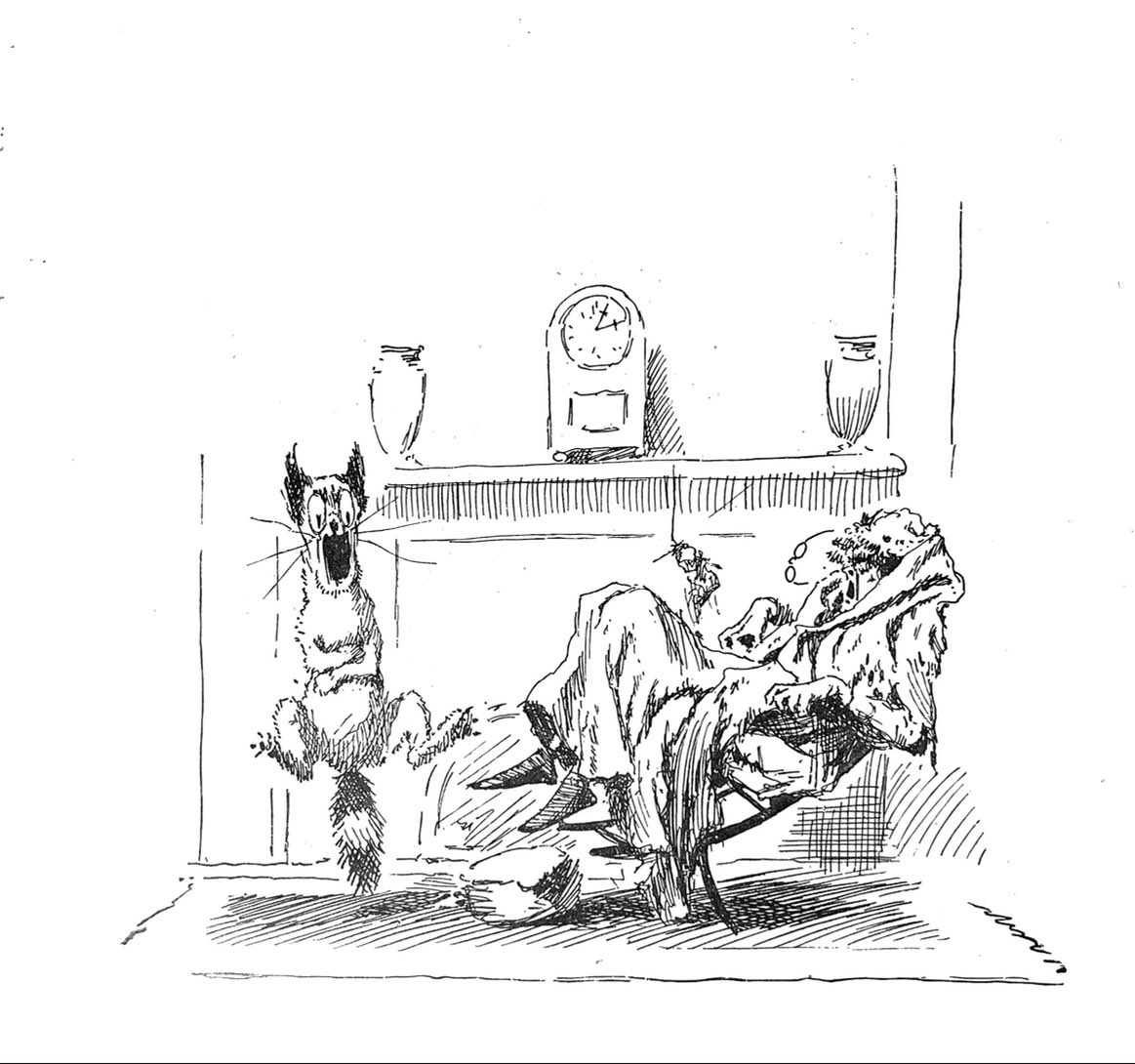
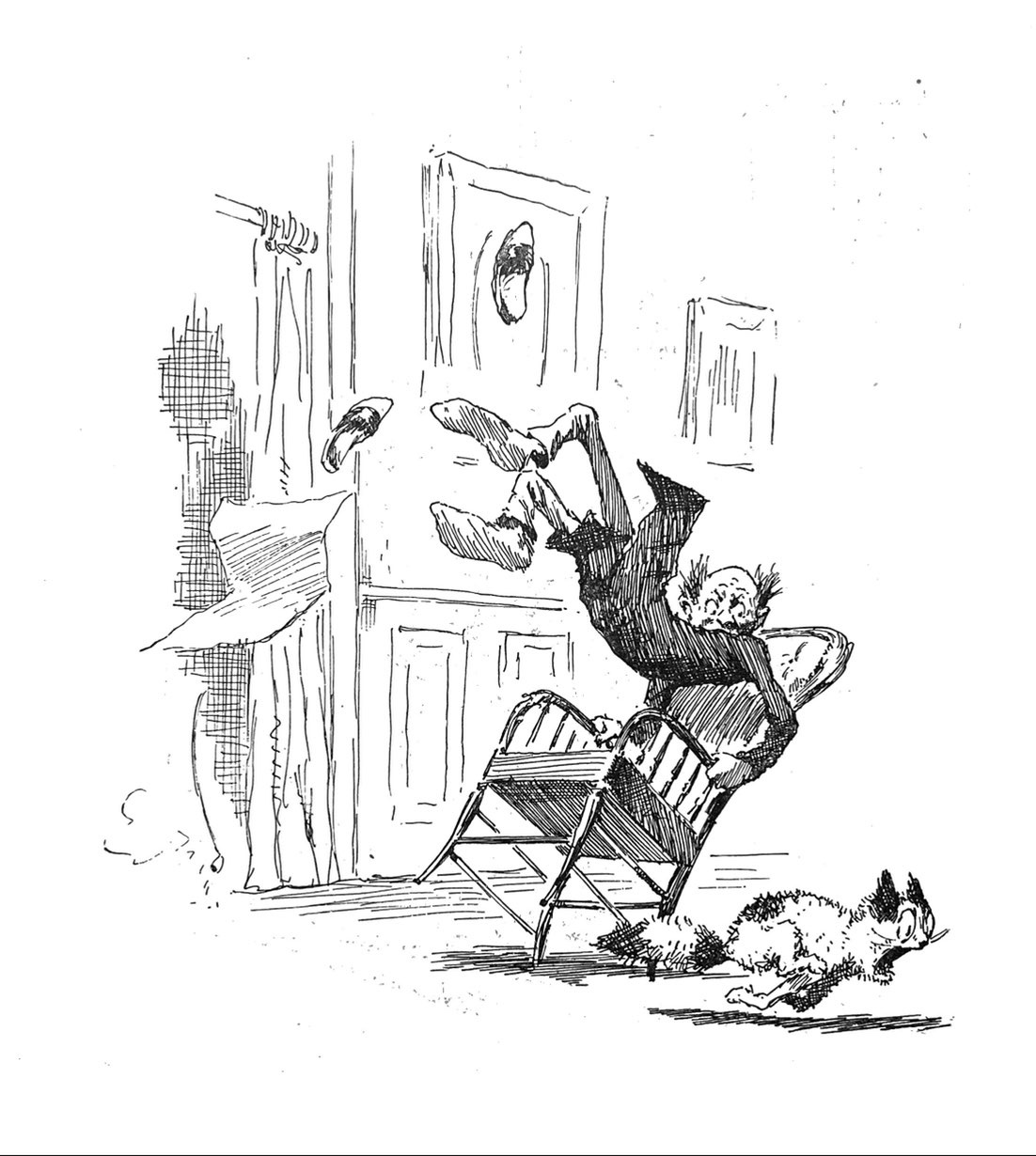
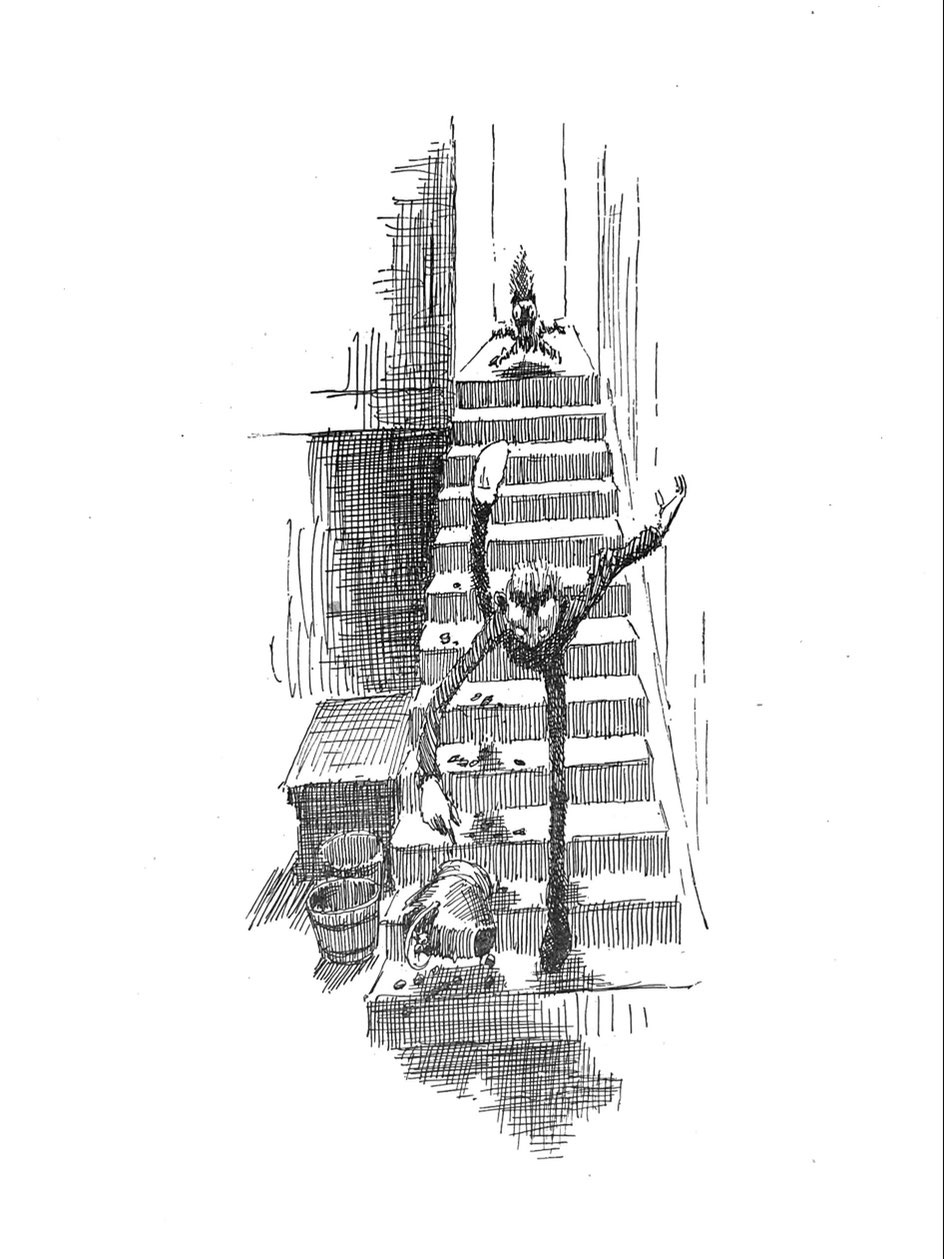
Scanned here from the original Stuff and Nonsense is the first lengthy narrative in the 92-page collection, “The Fatal Mistake: A Tale of a Cat.” Each image is its own full page. The captions I have attached to each are A.B. Frost’s own, although in the original book they are found in the Table of Contents rather than beneath each image.

Frost was a regular in the humor weeklies of the 1880s and his influence on the first generation of newspaper cartoonists is apparent here. In just this sequence we can see previewed so many themes and visual tropes of the first decades of comic strips. The comic disruption of middle class stoicism and order with slapstick chaos was the centerpiece of comics. And it was expressed with the cartoonist’s fascination with cause and effect, the physics of exaggerated motion, the shocked response.

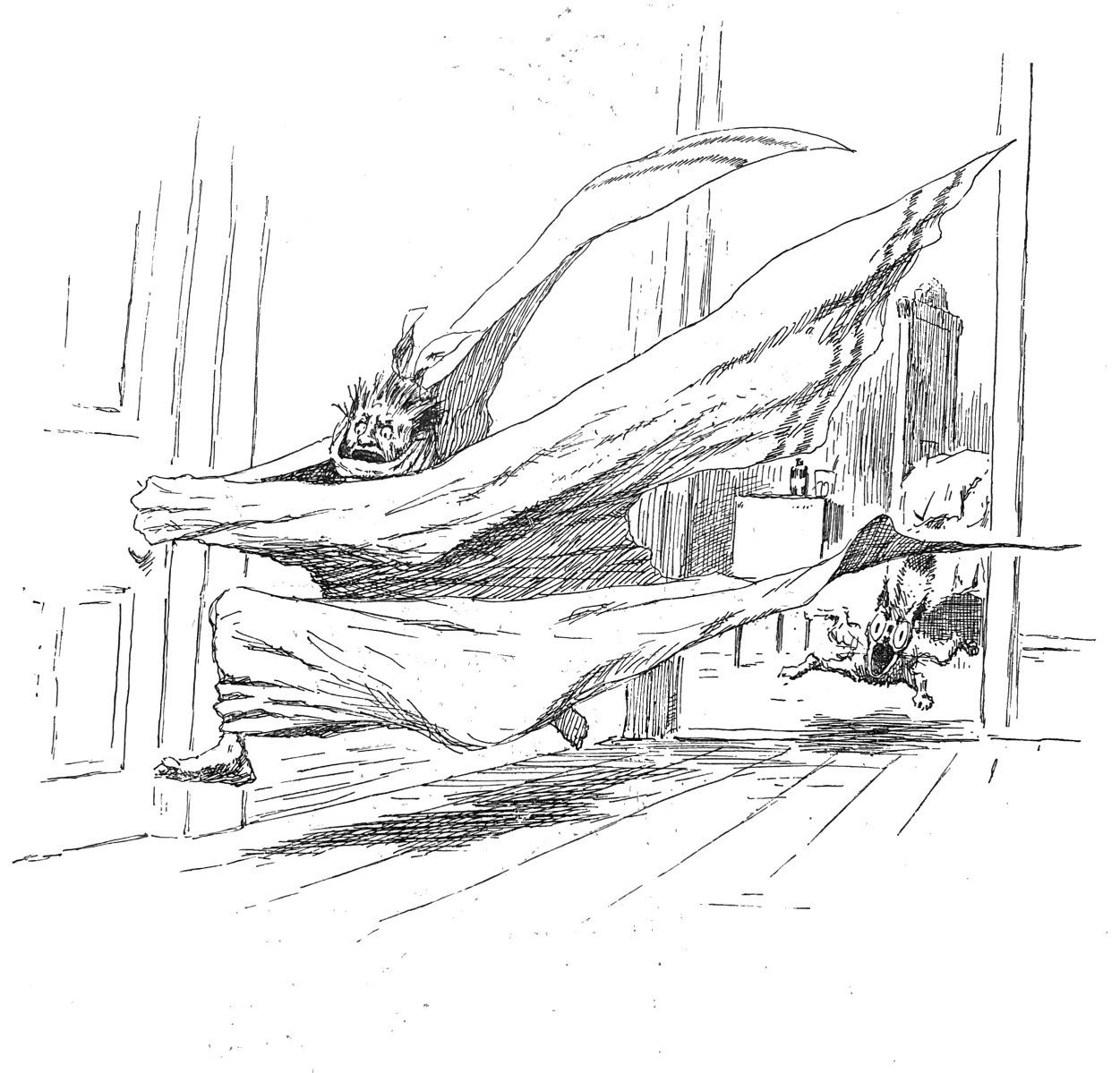
The first three reaction images to the poisoned cat seem like Frost exploring with increasing velocity both the shocked facial and physical impacts of the frantic cat. Keep in mind that motion and the art of freezing motion was very much in the air in the late 1870s and early 80s. Eadweard Muybridge had already started his seminal stop-motion studies of animals in motion that impacted both formal and cartoon arts. And while certainly there are precedents for caricatured pratfalls and slapstick in the pioneer Rodolphe Töpffer’s work, Frost’s superb rendering of extravagant cause and effect were helping establish a special cartoon physics that Opper, Outcault, MacDougal and others would further refine in the 90s and 00s.
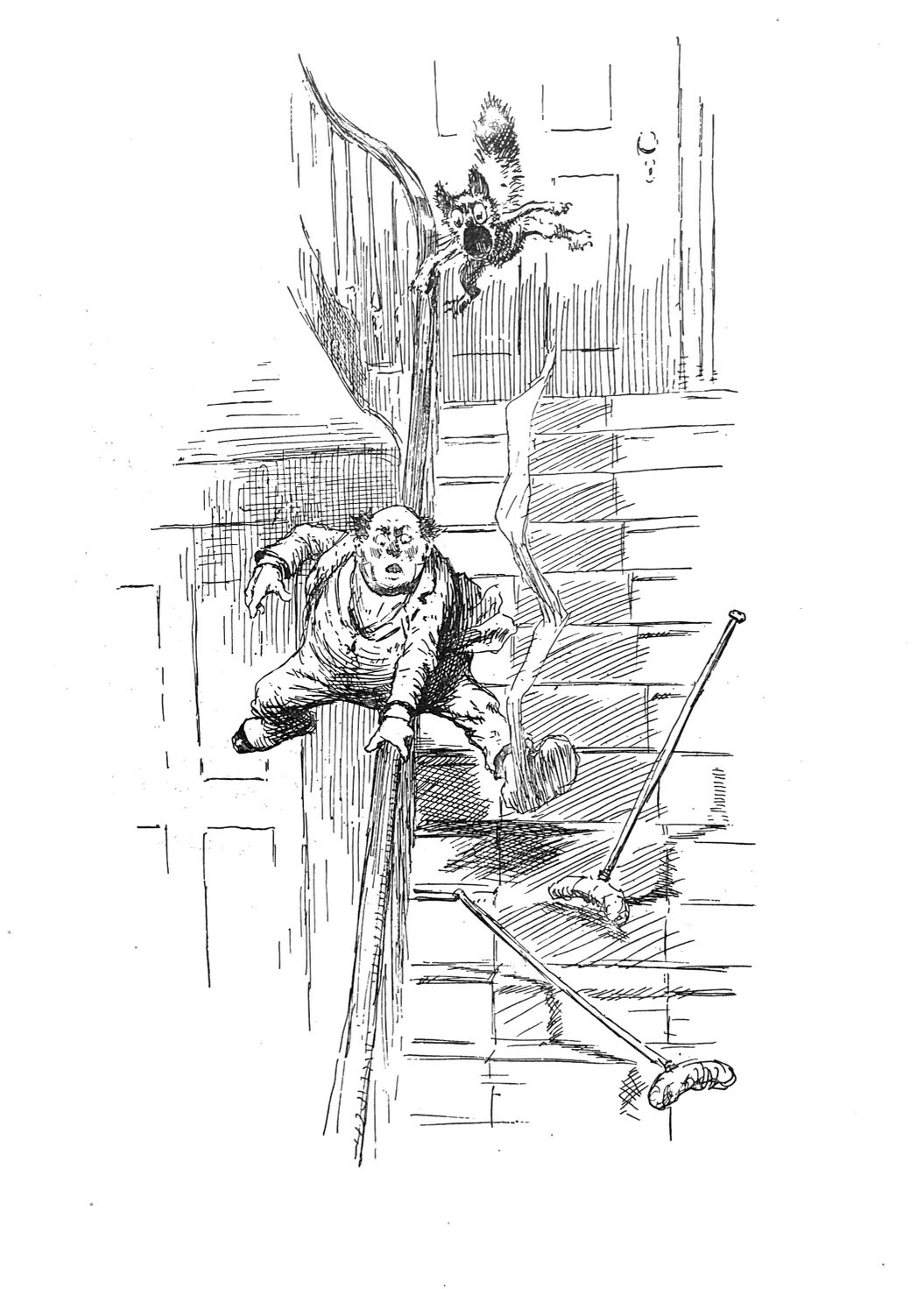
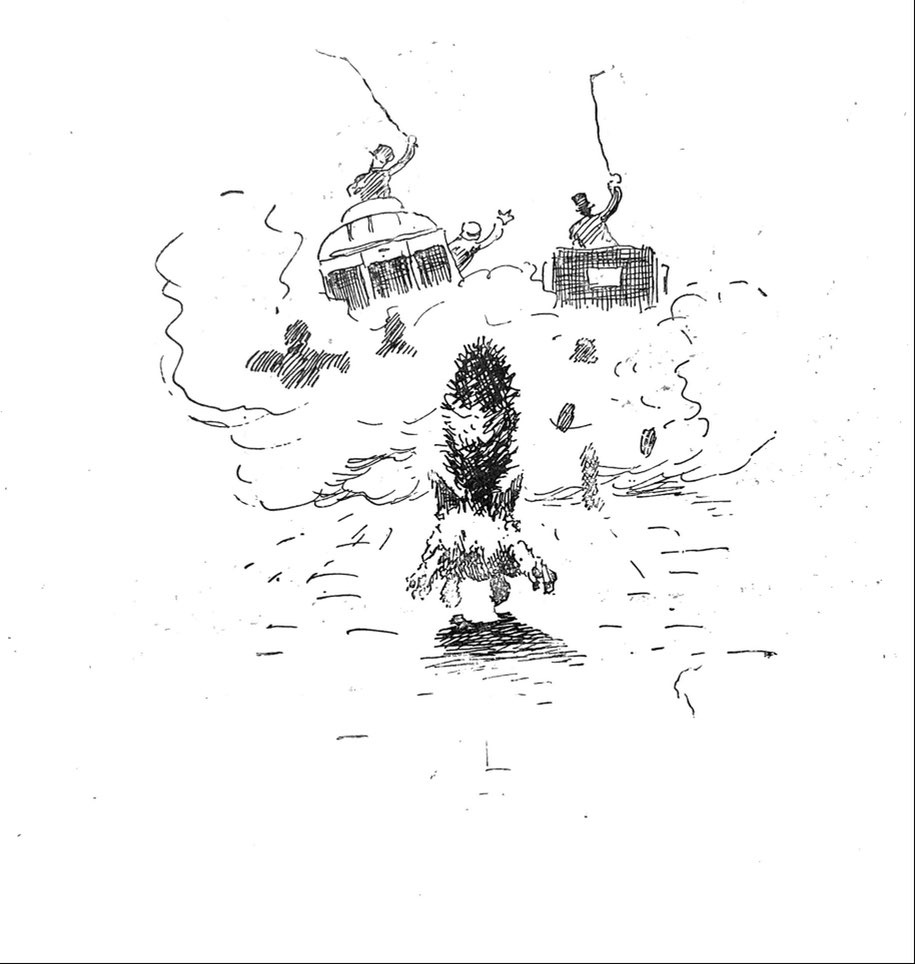
Frost appears to be relishing the mayhem he is creating as he upends the familiar objects and cast of a common affluent household. This is an anarchic convention that many artists took up in the first five or ten years of the next century in middle class bad boys like Little Jimmy, the Katzenjammers and Buster Brown. And Frost is clearly conscious of his own experimentation. The final page in the selection above is entitled “Down the Cellar Stairs (A Study in High Perspective).” In the next-to-last page of the narrative (below) he brings us behind the charging cat to create a new point of view for the audience that also seems to put the viewer in motion as well. Clearly, he knew what he was doing, test driving the potential of caricature to render new effects.

And it all works so well because Frost is just such a polished caricaturist. The bend of the butler’s inhumanly lanky long legs, the slippers shooting from the toppling man in the library, the enormous bedsheets flailing behind the mumps patient are all so convincingly animated. And make no mistake; this is black humor, comic antics bracketed by an accidental poisoning and finally death. The most effective geniuses of cartoon art always have that ability to make the cartoonish still feel real and the real feel cartoonish.
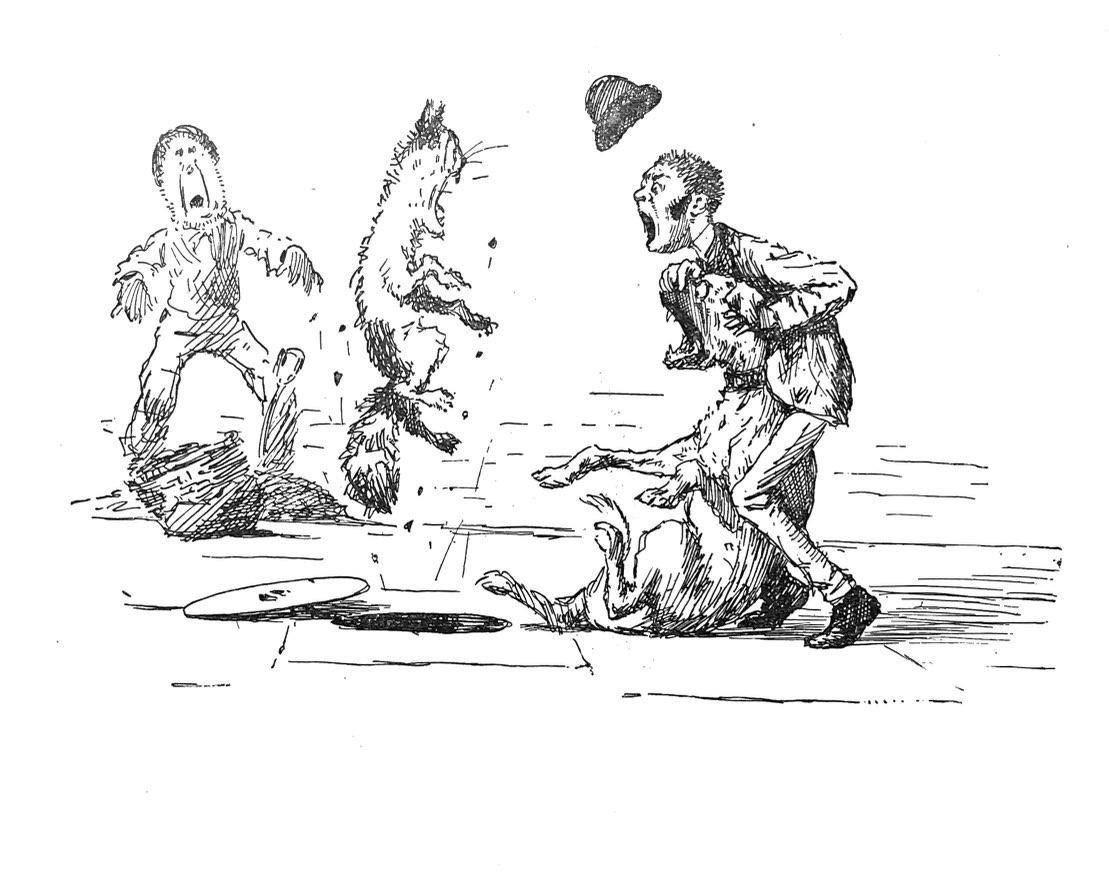
My favorite sequence, however, must be the cat, dog and master in mutual terror erupting from the sewer. All three mouths seem to mimic each other. There is no cause and effect. They are both at once. And yet Frost uses the eyes of each figure to individuate and give each its own voice and character. A decade before the creation of the newspaper humor sections that would nurture a comics universe, A.B. Frost was setting down a comic grammar for this new art to follow.

Death Becomes You: Tracy Villains Meet Their Fitting End

Retribution was Chester Gould and Dick Tracy’s model for justice from the beginning. The strip started in 1931 literally as a revenge narrative. Standing over the murdered body of his fiancé Tess Trueheart’s father, civilian Tracy swears vengeance on the killers. He quickly joins the police force, but the themes of retribution and conviction by poetic justice remained a hallmark of the strip across four and a half decade run. From the beginning Chester Gould unapologetically crossed the lines of good taste. By the late 1930s in criminals like The Mole, B.B. Eyes, Flattop, Pruneface and the like, Gould started using outward disfigurement as expressive of inner villainy. And the level of explicit violence and even torture in Dick Tracy was unlike anything else on the comics page, or elsewhere in pop culture for that matter.

The revenge motif was baked into the strip’s moral universe. Tracy villains didn’t just need to be sought, caught and jailed. They needed to be hounded and often tortured along the way. Many of Tracy’s prey ended up behind bars, but just as often they met poetically just ends. Gould turned the grisly, fitting deaths of villains into his own special kind of art. Here are some examples from the first two decades of the strip that highlight Gould’s dark talent for retributive justice and capital punishment Dick Tracy style. At these climactic moments we see most clearly the visual, moral and often bizarre world,

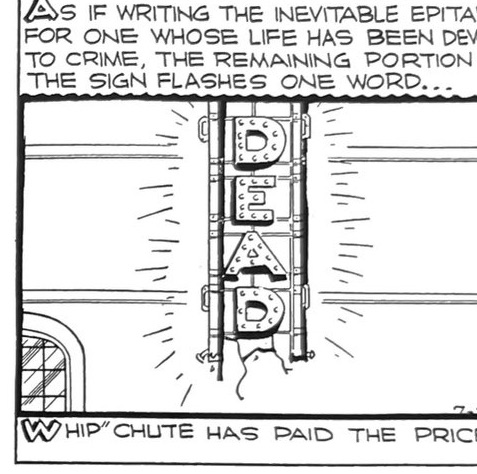
Final Curtain for Whip Chute – 1939

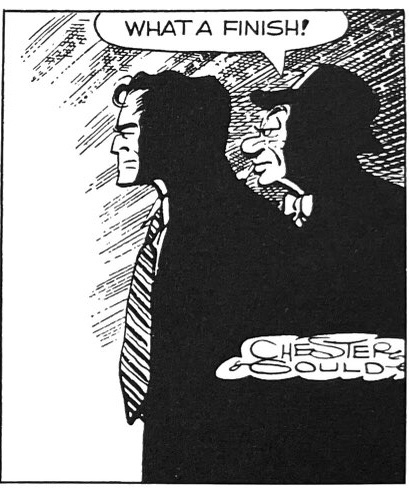
Subtlety was not in Chester Gould’s quiver. Here he triple underlines his irony.

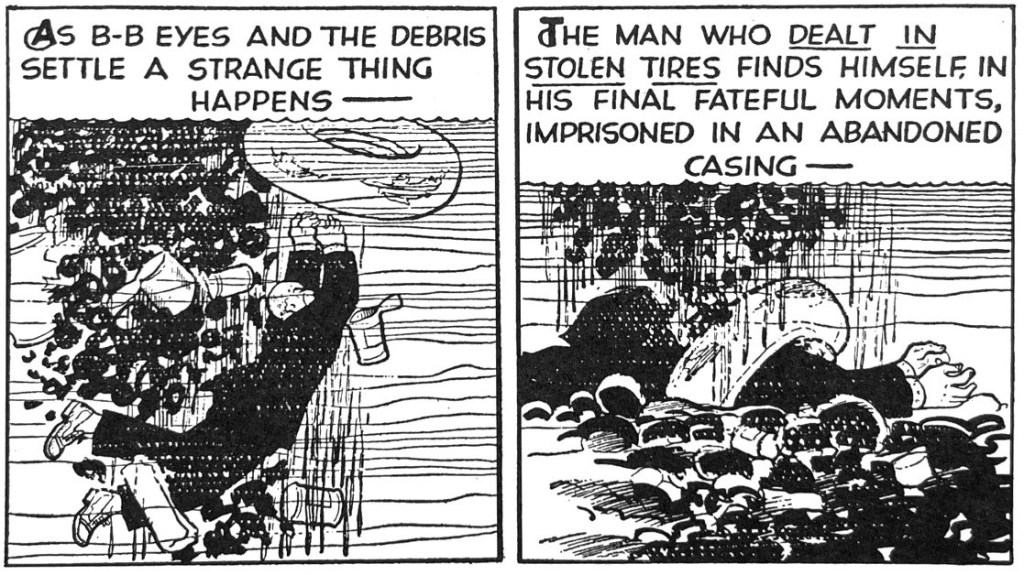
B-B Eyes Gets Dumped – 1942

More than anything, Gould loved to kill and humiliate Tracy villains in slo-mo. Here, B-B Eyes hides in a garbage barge in the final leg of a desperate flight from justice, only to get dumped, trapped and drowned. Gould had a special talent for using the panel. framing and zoom techniques to communicate feeling through his use of space. His signature tight shots on dead villains often conveyed the loneliness and claustrophobia of death itself.

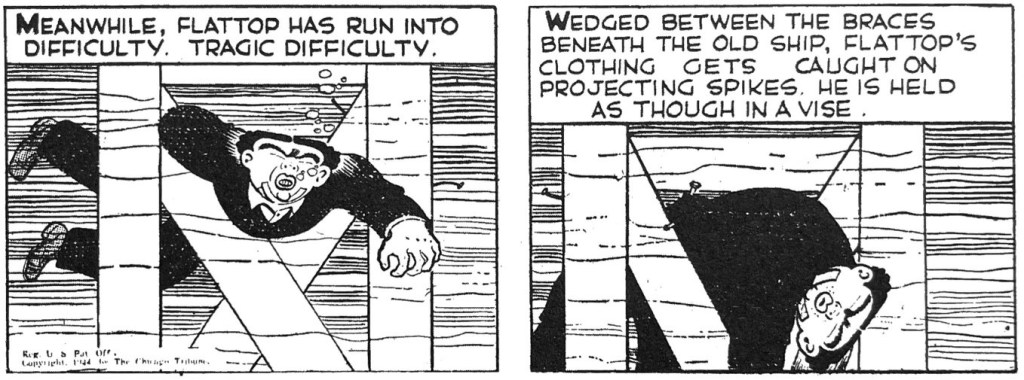
Flattop Gets Spiked – 1944

In 1944, Gould concocted two of his most venal villains. Flattop was simply psychopathic as a hit man, and he would be followed by The Brow, who was sadistic and a spy. Hiding beneath a ship being constructed, Flattop gets hung up on protruding spikes, leading to another close-up of deserving death.

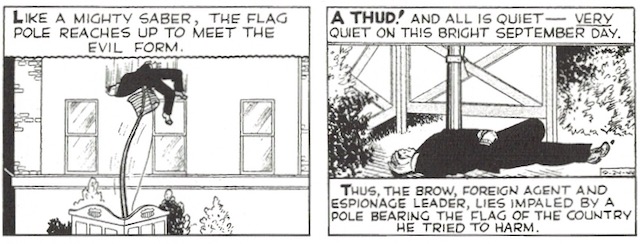
The Brow Is Killed By Patriotism – 1944

Far and away the most inventive and stomach-turning death in the first decades of Dick Tracy was the impaling of The Brow. I covered this in greater detail and with more context elsewhere. But here again is the wartime spy getting impaled on the flagpole commemorating the city’s war dead. The bending flagpole is a gruesomely brilliant touch to amplify that moment of maximal tension that will ultimately pierce the villain.

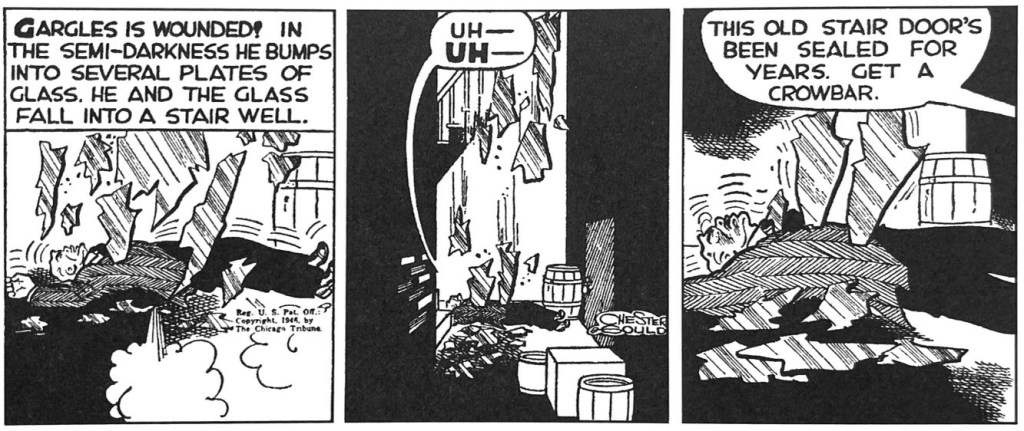
Gargles Eats Glass – 1946

Falling through a skylight, again in comic strip slo-mo, Gargles gets sliced across three panels. And Gould can’t resist giving us his final shudders. In fact Gargles hangs on until the next strip so his final words exonerate an innocent suspect just in time for Christmas. One of the hallmarks of Dick Tracy was the strip’s extremism, Gould’s penchant for balancing unmatched graphic violence and angry vindictiveness with maudlin sentimentality. This sequence leads up to a Christmas strip that celebrates the villain’s death and the joy of the season.

Mumbles’ Cry for ‘Elp’ – 1947

Making a speech impediment somehow expressive of a villain’s evil was a questionable move to begin with. But Gould doubles down on this conceit by having Mumbles frantically, futiley hail for “ELP”.

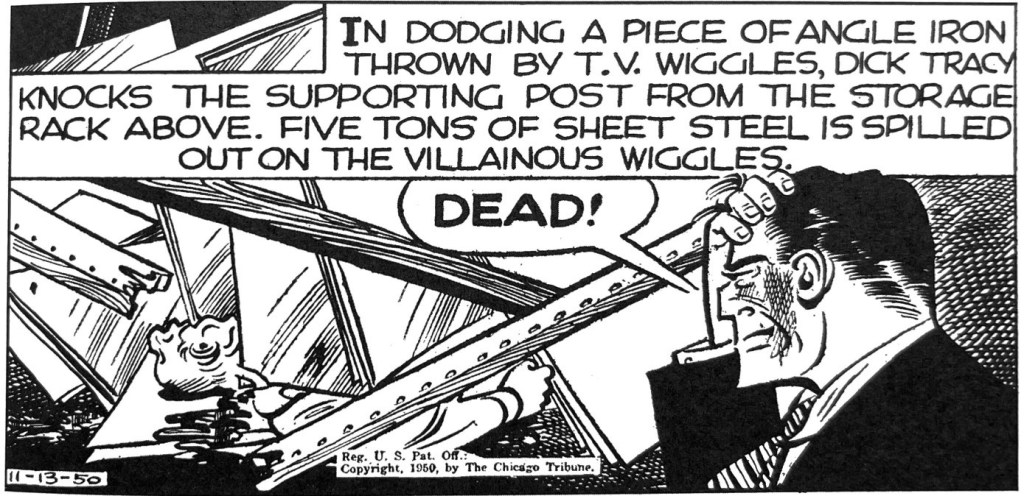
T.V. Wiggles Can’t Move – 1950

Gould loved to draw in that little bit of grisly business to convey violence. While he used a heavy, cartoonish line and unreal, expressionist style that set the strip far apart from the illustrative style of most adventure strips, Gould used other ways of communicating hard-boiled reality. He had a penchant for objects penetrating bodies. Bullets often passed through their targets in shootout sequences. And as the deaths of The Brow and Gargles showed, the impaled body has a special place in Gould’s sense of horror. The death of T.V. Wiggles comes from fallen metal sheets that form an ersatz coffin. But it is that little corner of metal piercing a flap of neck flesh that telegraphs the experience of death itself.

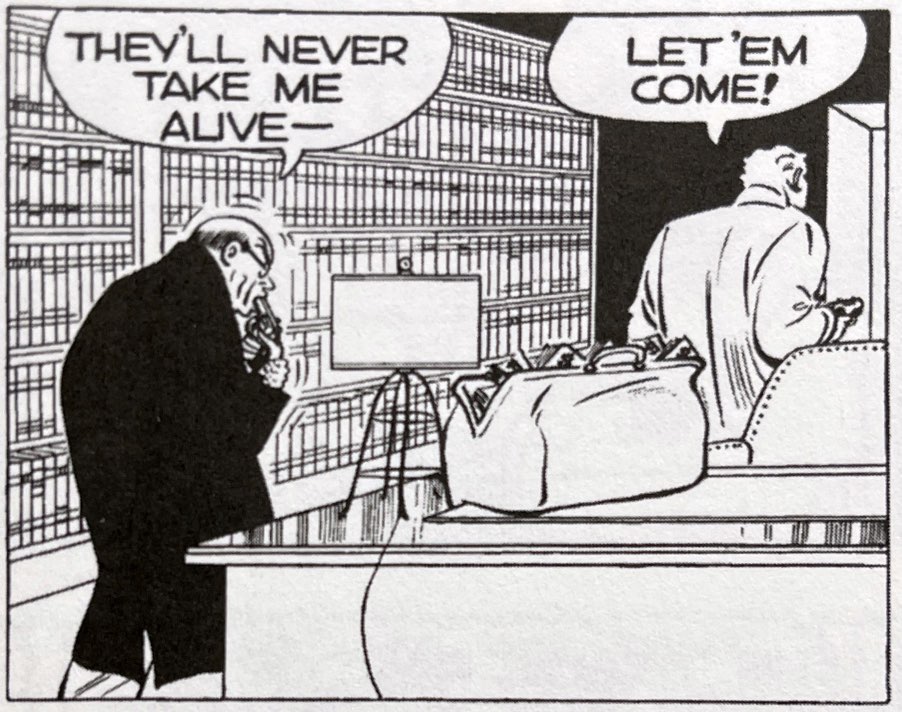
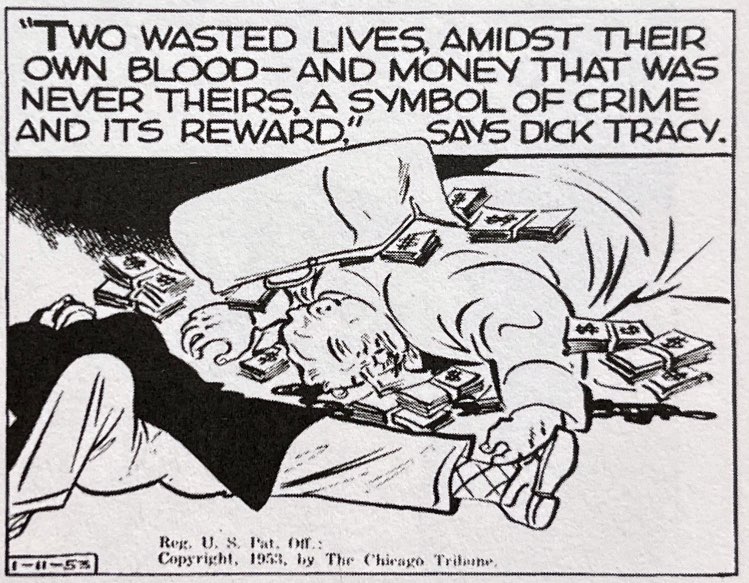
Mr. Crime and Judge Mix Blood and Money – 1953

Mr. Crime was among Tracy’s most ruthless, pitiless villains of the 50s, and in the context of the Gould moral universe I am surprised (and a bit disappointed) that he suffers a simple shootout with Tracy. In fact Gould reserves the grisliest image for Mr. Crime’s extorted dupe, Judge Ruling. When cornered, the corrupt Judge chooses suicide. But of course Gould can’t give us a gunshot sound effect heard through a closed door. We have to get an image of Judge Ruling eating the gun, complete with cheek lines to suggest how deep he has planted the barrel. But we’re not done with this duo. As is his wont, Gould closes in for a final tableaux of both villains swimming in their own blood and money.

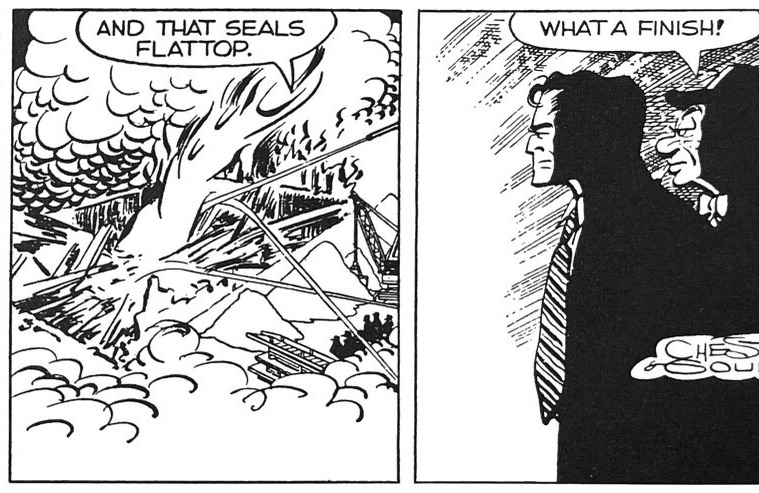
Flattop Jr.’s Near Miss – 1956

Flattop Jr. was indeed the son of the original Flattop, but he was framed by Gould as a neglected youth who embodied the overhyped scourge of the 1950s – the juvenile delinquent. He appears to meet his end in a theater fire he himself set to cover his escape. Despite the massive explosion Gould depicts dramatically, and the presumption of having died in the inferno, Jr. turns up later where his genuine death takes place in the middle of another villain’s cycle. And so that final contemplative panel here turns out to be ironic.

Popeye Has Daddy (Pappy) Issues

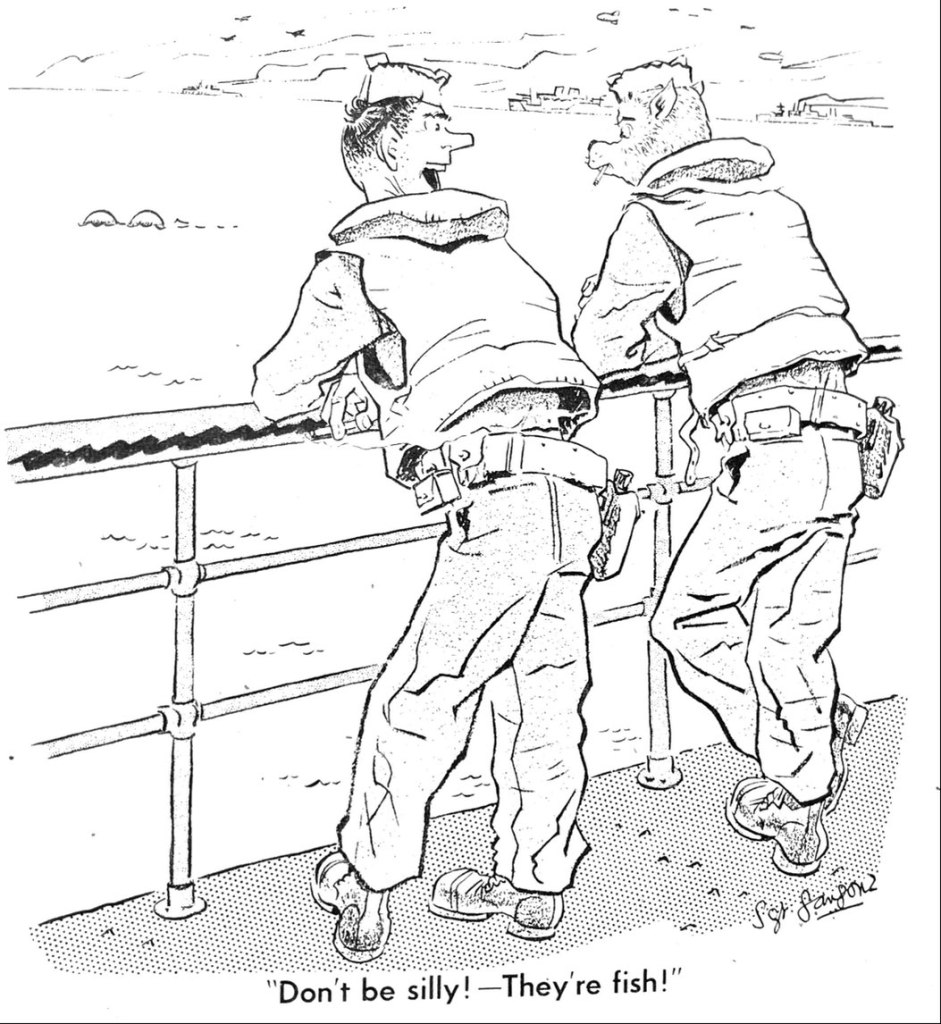
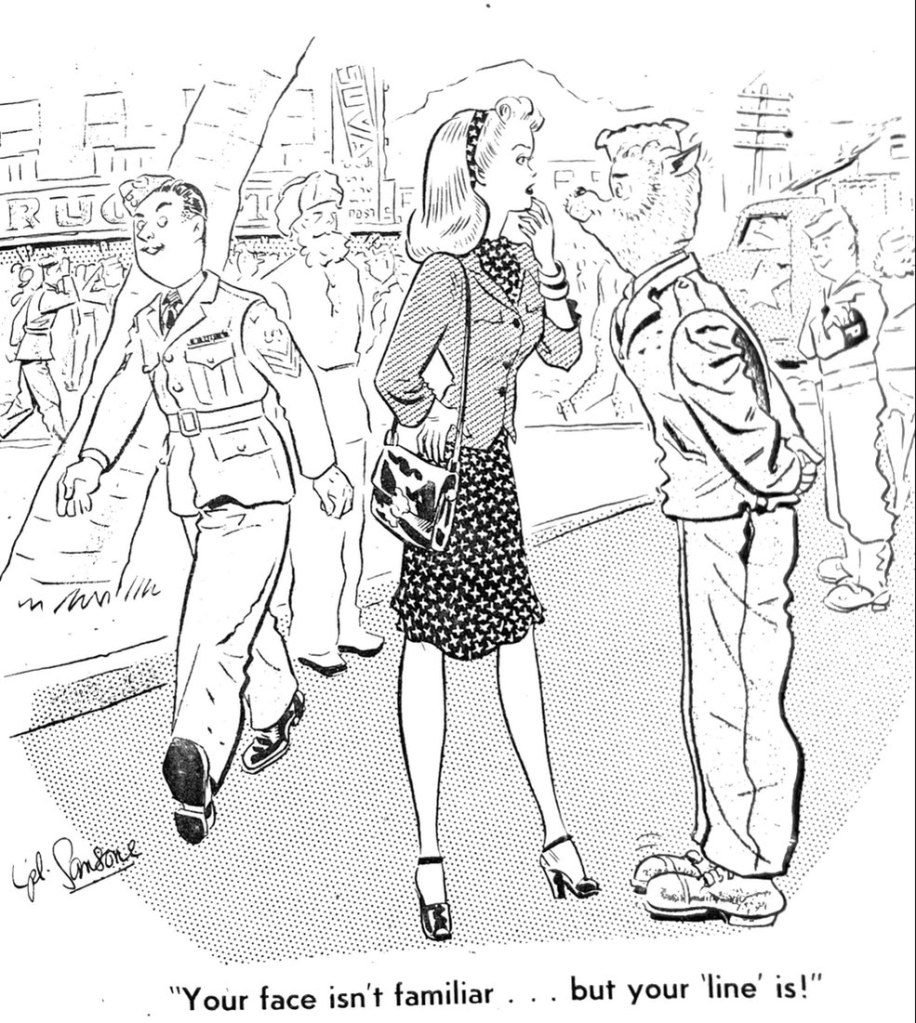
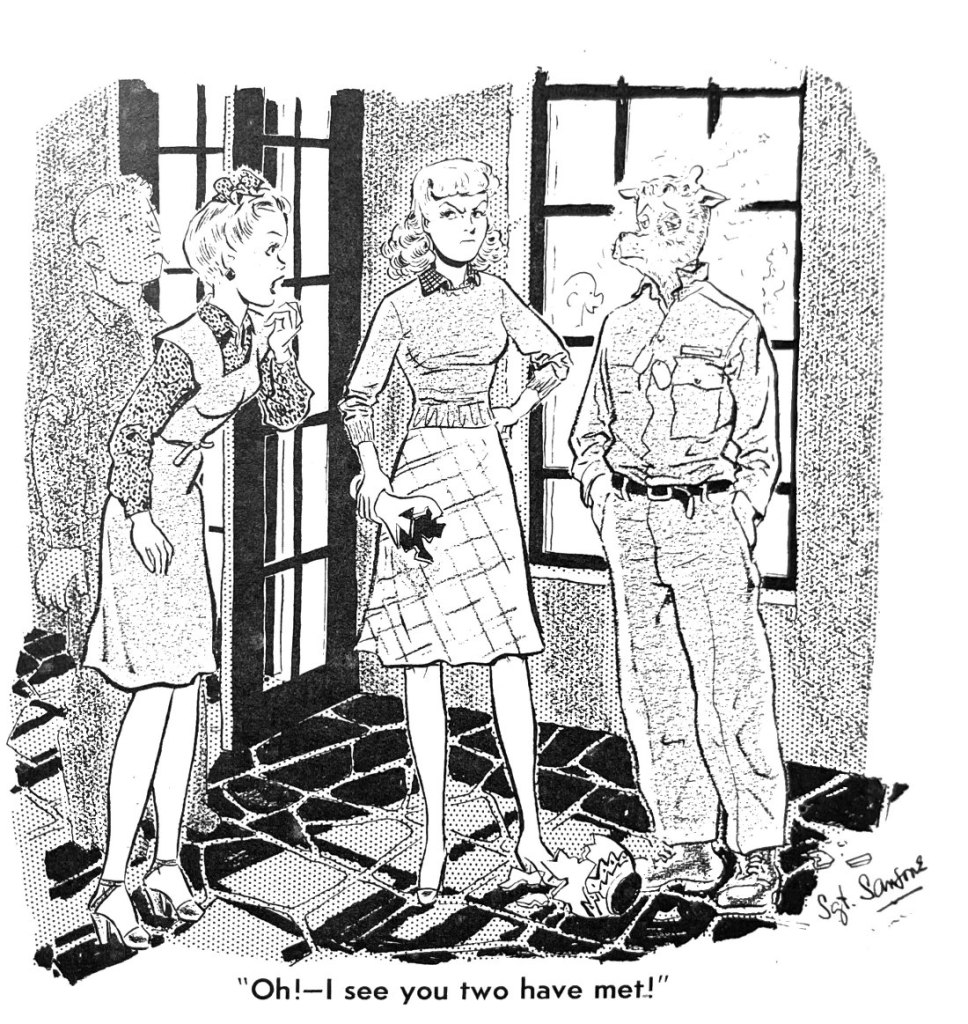
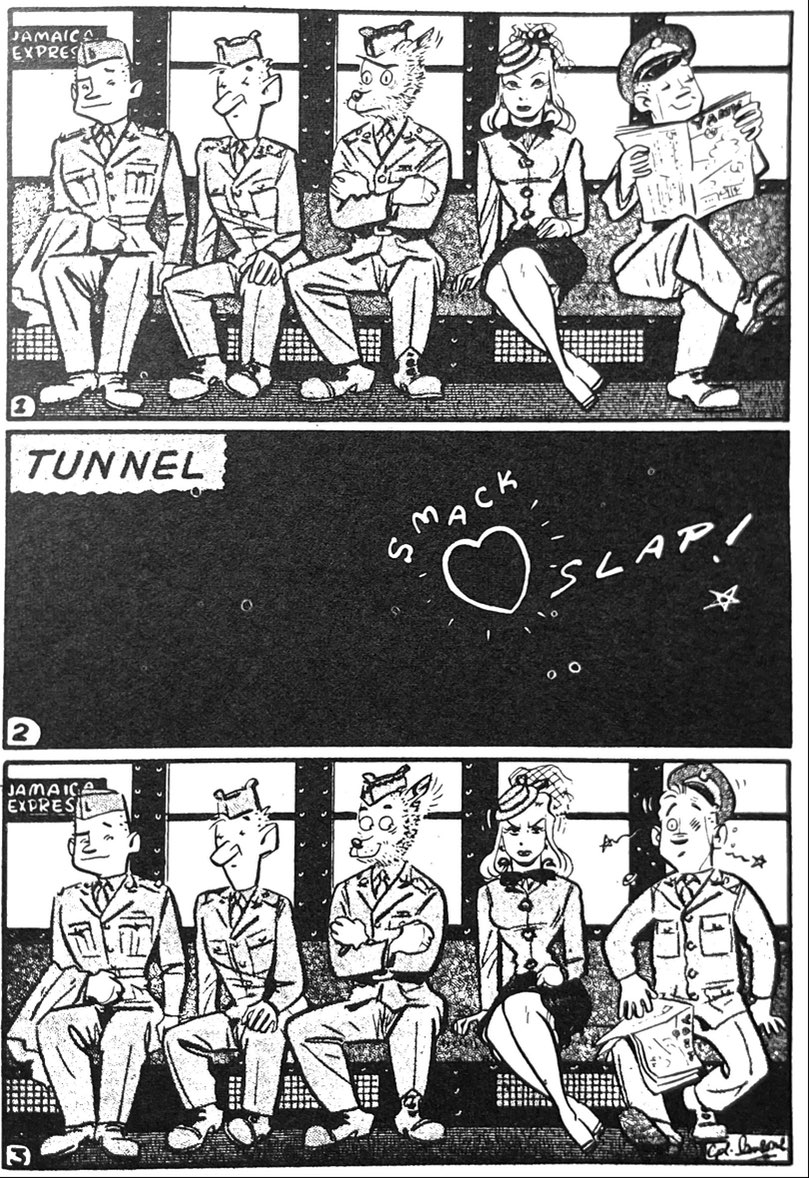
Howwwwl!: During WWII, G.I. Wolf Was On The Prowl

During WWII the country mobilized for a two-front war on every level, including cartooning. Bill Mauldin’s Willie and Joe, Milt Caniff’s Male Call, Sgt. George Baker’s Sad Sack are among the best known strips created for the troops, and many of them enjoyed a greater latitude than newspaper counterparts in their use of language, sexual references, and sheer cheesecake. Less well-known and remembered is Leonard Sansone’s girl-chasing, cat-calling, kiss-stealing “G.I. Wolf”. Also known as “The Wolf” and “Private Wolf,” this one-panel comic featured a GI depicted with a wolf’s head and insatiable, predatory libido. It was a big hit among the troops in its 1942-1945 run, landed Sansone a profile in Life magazine in ’44 and a book reprint “The Wolf” in 1945 with an introduction from the king of male adventure strips Milt Caniff.

G.I Wolf’s humor was based less on hilarity than familiarity. The character was instantly recognizable to most of the late adolescents we sent to war as the embodiment of their inevitable frustrated sexuality. And he is the one lad in the unit most vocal about it. But while the GI Wolf strip is not especially funny, not to mention hopelessly sexist in retrospect, it remains noteworthy. Most of all, it takes horniness itself as its subject. While other strips for the troops, like Caniff’s, ladled on the legs and double entendre for its more adult and lonely male audience, GI Wolf was more direct. Men without women is an inevitable trope of army tales, but it is usually engaged obliquely. Bob Hope shows always featured the latest Hollywood starlets. Airmen painted cheesecake images on their planes’ nosecones. And the marauding of soldiers and sailors on leave was the stuff of lore. But Sansone puts horniness front and center in GI Wolf. He not only personifies the theme with a fantastic wolf-headed character but makes his sex drive the persistent punch-line. And Sansone pushes the theme in fantastic directions. My favorite is the cow talking back to Wolf as he manhandles her udders.

But most often, GI Wolf is recognition humor aimed at enlisted men’s common experiences. Buddies set each other up with disappointing blind dates. Wolf projects his sexuality onto everything, from potatoes he is peeling to cows he is milking to fish swimming off a dock. And so the relentlessness of GI Wolf’s horniness is the real butt of the joke here. His predatory and politically incorrect antics may be familiar but they are not seen here as heroic. Far from it. His fellow soldiers complain about his unproductive fantasizing, even intimate that he may be jerking off too much. His skirt chasing rarely ends in conquest. And most often the damsels he chases hit back…effectively.

Which is not to say Sansone’s GI Wolf was a feminist treat. Slinking away from unattractive dates is a frequent trope of the series. And the entire cat-calling ritual is presented as a mutually agreed upon game between the sexes. In fact in a stupendously dated introduction to the 1945 reprint, Caniff says as much. “No matter how smoothly she tossed her head, I have yet to see a woman who did not betray the secretly pleased expression around the eyes when whistled at or wolf-called by a man or men in uniform,” Caniff writes. Yeesh!

Sgt. Sansone was a member of the Camp Newspaper Service, and GI Wolf ran in the Stars and Stripes newspaper and Yank magazine the armed forces produced for the troops. He was born in Norwood, MA in 1917 and moved to New York City before the war to pursue a freelance art career for advertisers and the early comic book market. After the war, Sanone moved to Miami and developed the Willie newspaper strip. He died in an auto accident in 1963 at the young age of 46.

Notable Books: The Flapper Queens: Women Cartoonists in the Jazz Age

Trina Robbins is an under appreciated national treasure, alas, for some of the same reasons the cartoonists she presents here have been overlooked by too many comics histories. For the most part, cartooning was a man’s game in the 20th Century, and so has been the writing of its history. Except for Trina. Robbins was among the only female artists in an underground comics movement famous for its misogynist art. Her Pretty in Ink history of women in the field remains the major work, because she has waged a lonely battle for including this talented minority of comic artists.

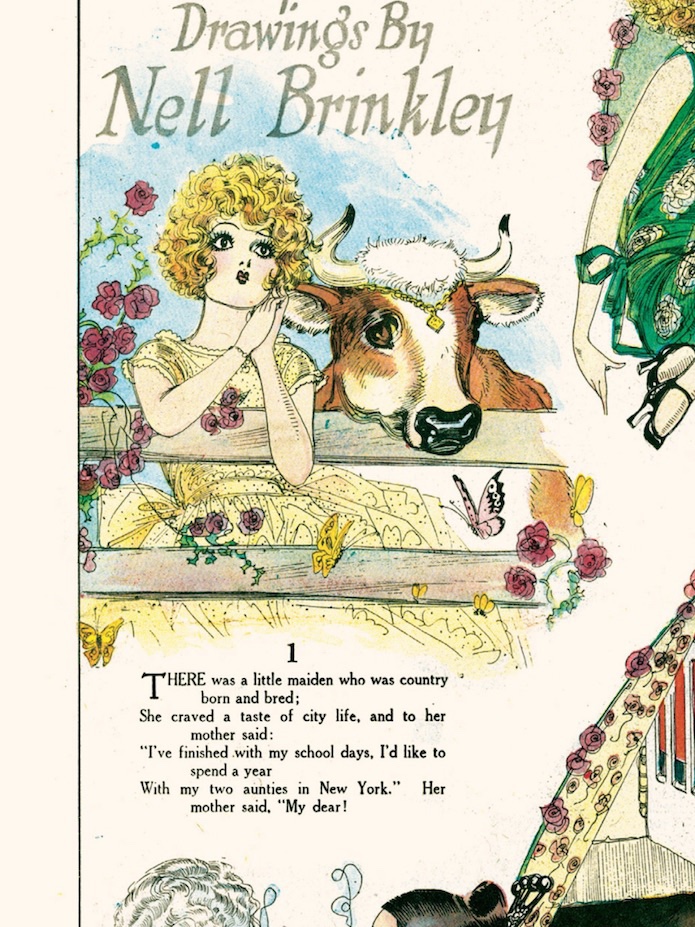
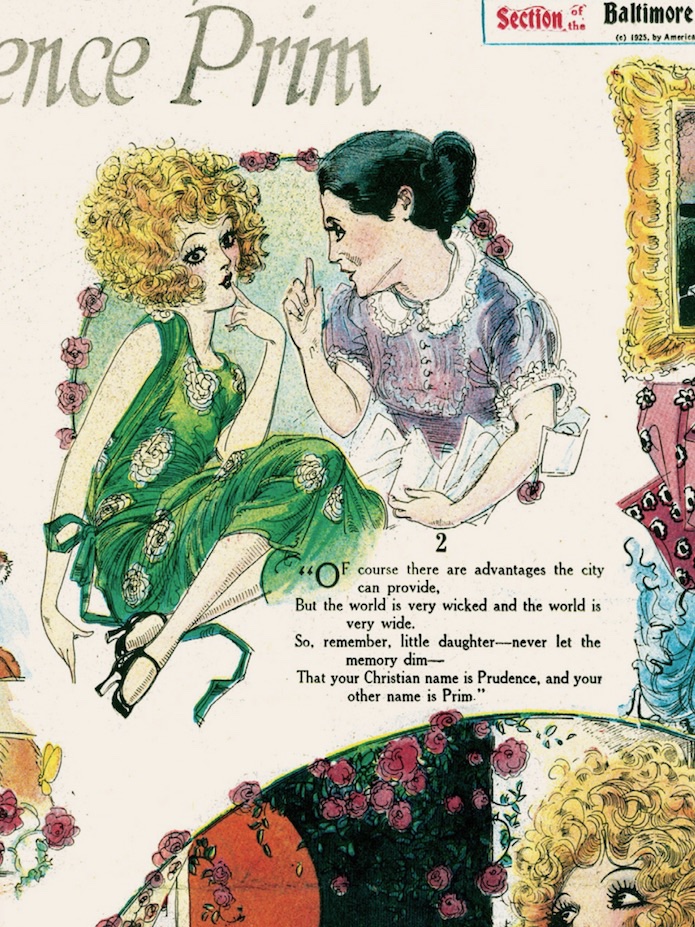
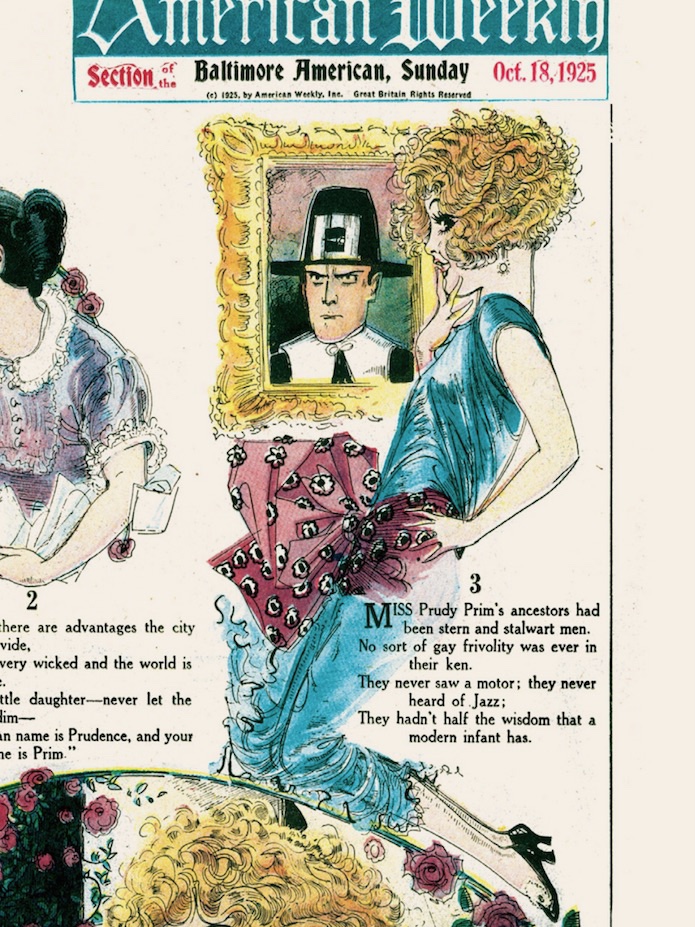
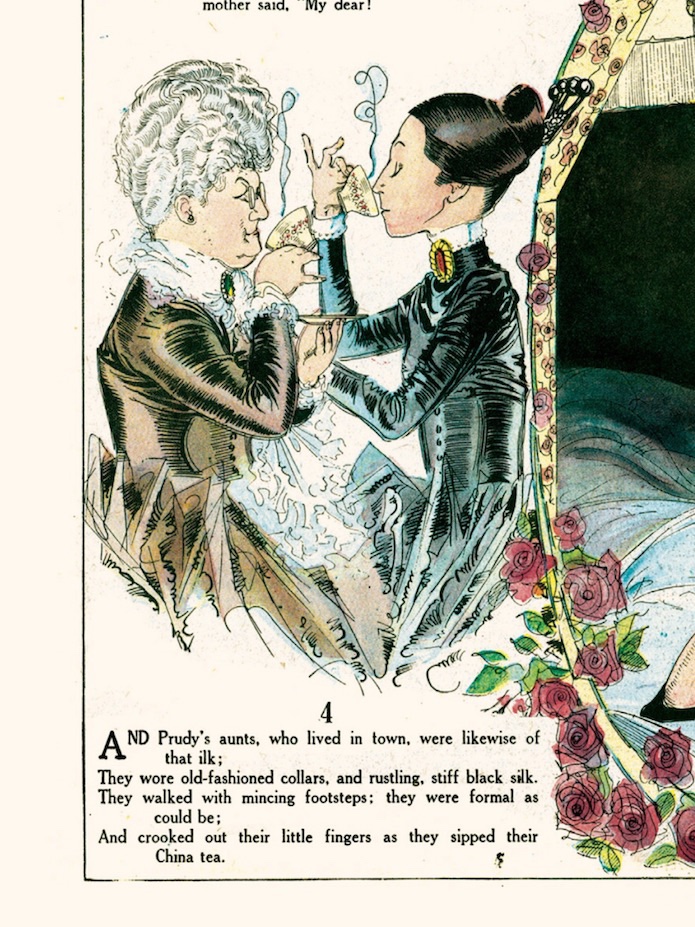
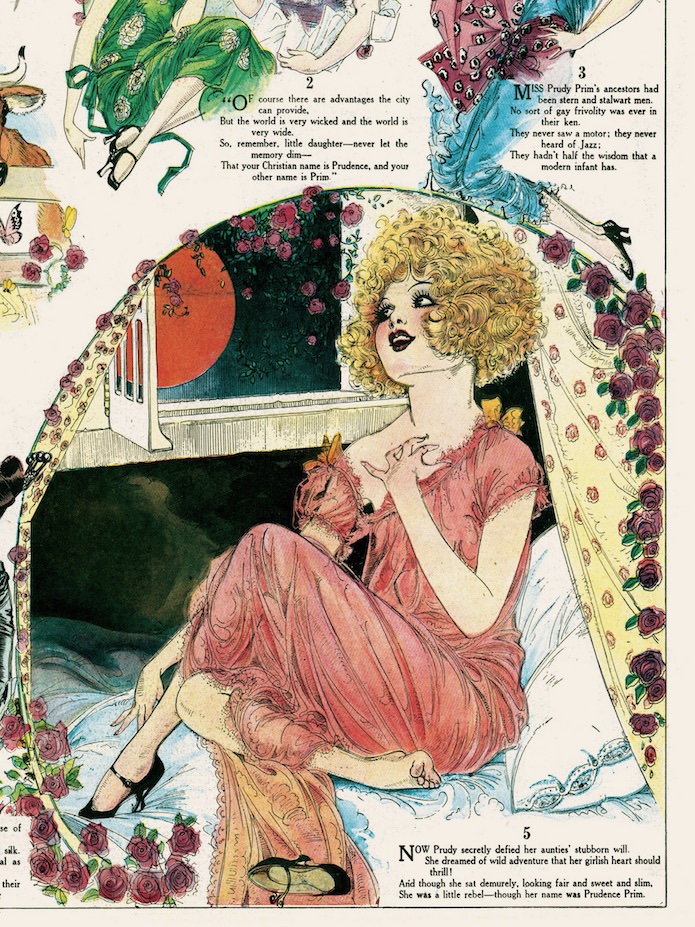
But Pretty in Ink had to cover so much ground, we didn’t get to dwell deeply into any artist or group. With The Flapper Queens: Women Cartoonists in the Jazz Age, however, she gets the chance to reprint satisfying helpings of Nell Brinkley (fully 50 pages!), Eleanor Schorer, Edith Stevens, Ethel Hays, Fay King and Virginia Huget. Since this is more a history in reprints than a history with reprints, Robbins shows more than tells. But she shows so much about how these women helped define the post-WWI era, or at least mass media’s aspirational version of it. Their focus on social interactions and fashion come through as expressions of feminine power and personality.

With a third of the book devoted to Brinkley, we get to see the most famous of female cartoonists evolve beyond the Gibson style into an Art Nouveaux and then Deco fine line work and precision. Robbins bookends the book with Brinkley’s changing views of American women, the artist’s criticisms of the very flighty flapper she celebrated in the 20s, and the active, engaged professional women she depicted in the 1930s.

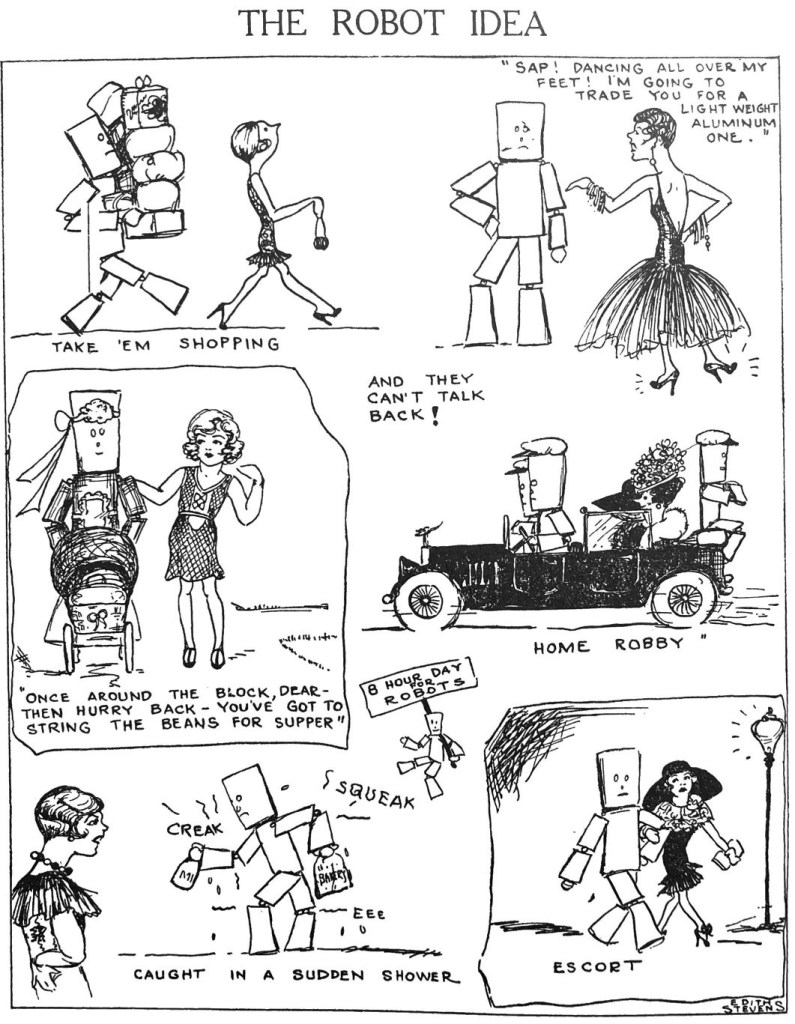
But along the way, Robbins gives us revealing samples across the careers of many women who continue to be overlooked by conventional comics histories. Edith Stevens’ Us Girls series blended fashion, biting wit and social observation in a series that was pithier and more insightful than many of the observational strips we continue to reprint elsewhere.

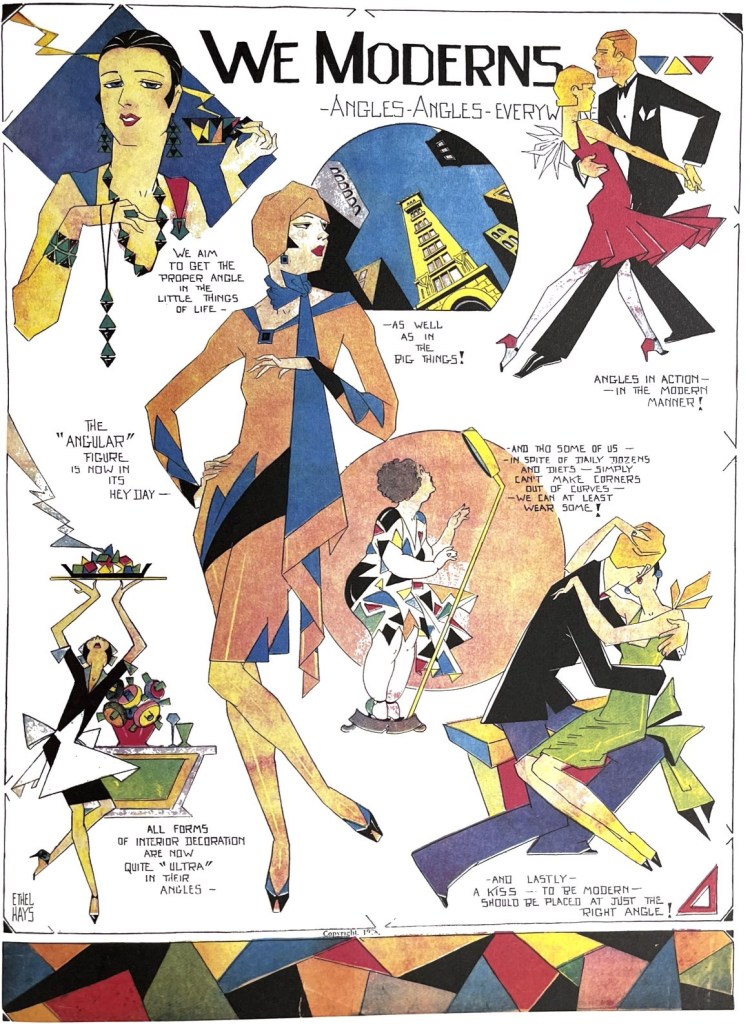
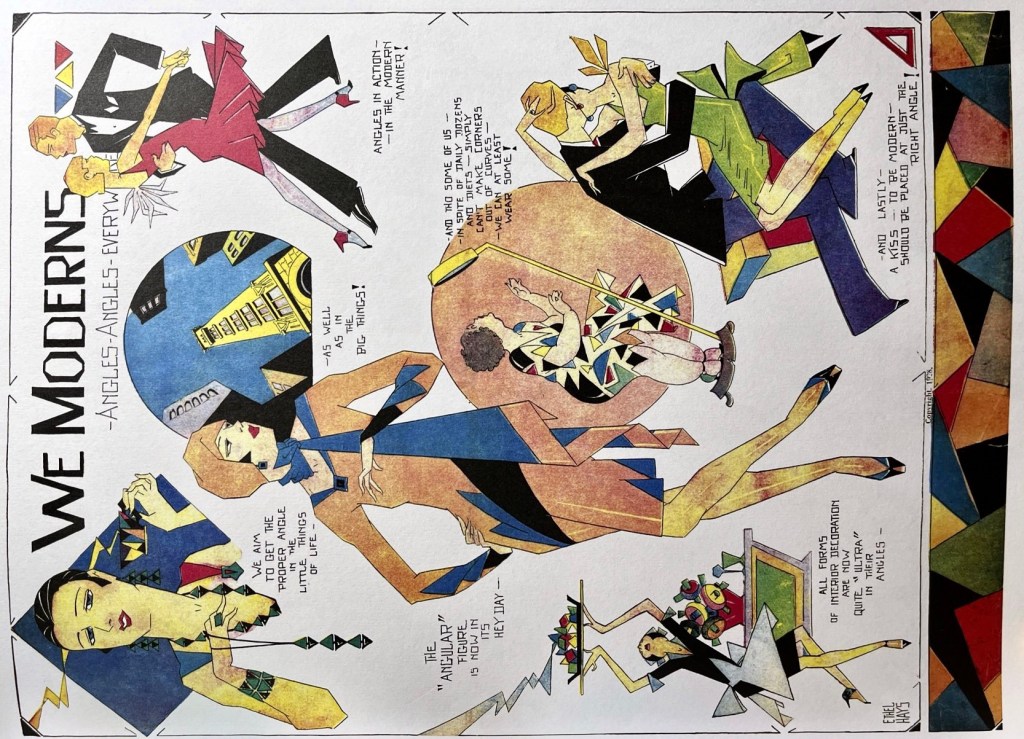
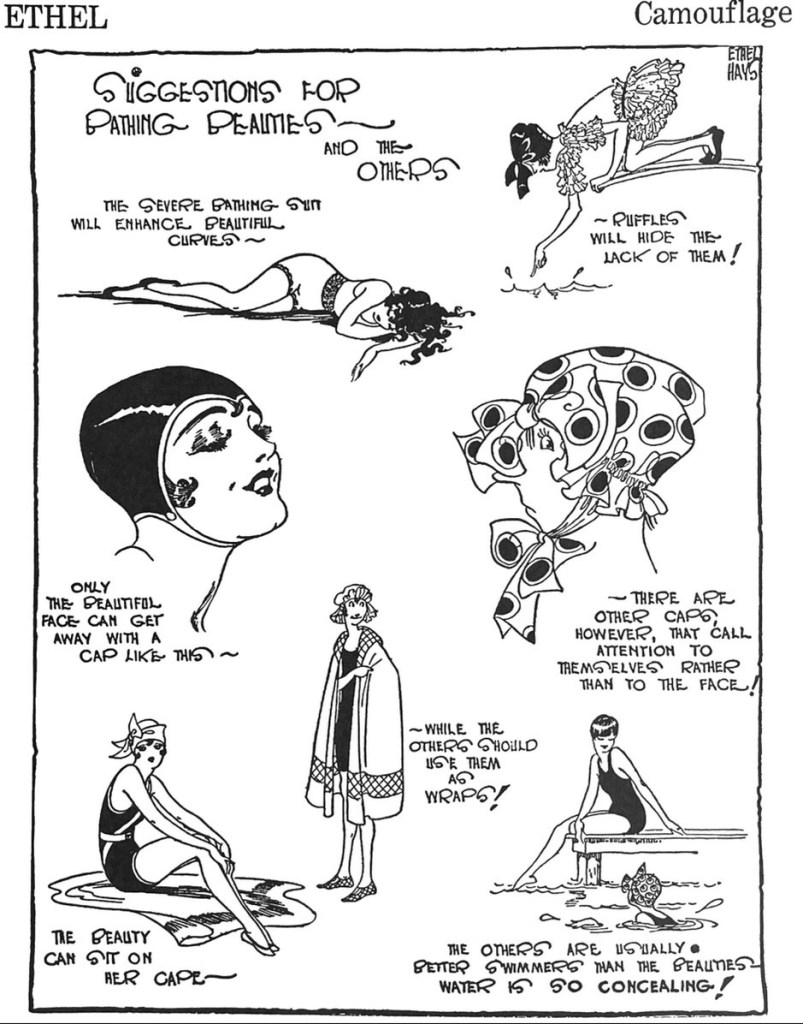
Robbins also focuses in on Ethel Hays, who channeled both Brinkley and John Held to chronicle the 20s and 30s in striking full page, richly colored Sundays that overwhelm the eye with color, a great sense of body angles and attitude. Like many of women in this book, she found creative ways to weave fashion styles, romantic advice, social commentary and a bit of cheesecake.

Hays’s “We Moderns” piece at the top of this entry is a great example of the creative richness and thoughtfulness we miss when, like their editors at the time, we consign women cartoonists of the day to the “fashion” artists bucket. Indeed, Hays, Brinkley and Huget not only paid attention to clothing, hair and even body styles, but they wove these concerns in with larger social, personal and aesthetic ideas. In “We Moderns” Hays actually brings these threads together in a startling visual think piece. She links the “angles” of modern fashion with architecture, clothing, dance, personal politics and even her own Deco-infused art style. Nell Brinkley was adept at using her characters’ clothing as instruments of drama, personality, reaction. They exploded from the page as effectively as her signature facial expressions – signals of inner-feeling. These artists didn’t just depict the visual styles and fashions of the inter-war years. They showed a rare understanding of why they mattered.

Fay King was perhaps the most socially engaged of the group, and her strips highlighted trends like women becoming more involved newspaper readers. Meanwhile Virginia Huget bridged the 20s and 30s with aspirational tableaux that romanticized college life and affluence. I also appreciated the inclusion of the wonderful Annabelle strips by Dorothy Urfer. This is a visually rich and wry look at sexual politics. It left me wanting mor.

And the reproduction/resotration work in Flapper Queens is superb, bringing forward the rich color and detail that made these images so absorbing in their time. Comics historians love to gush over the ways in which McCay, Feininger, King and the usual suspects among the kings of comics made innovative use of the full Sunday page, especially in the first decade of comic strip history. But the oversized, beautifully colored reproductions in this book show how artists like Brinkley, Hays and Huget especially burst from the Sundays of the 20s and 30s with dazzling uses of layout, splash images and narrative progression that rival and exceed many of their male peers.

Which brings me to the historical importance of Robbins’s Flapper Queens. Reviving these artists truly expands our understanding of comics history and especially the ways in which these very talented artists and social observers related to the surrounding culture between the World Wars. To overlook them is to miss some of the most striking art the comics were producing during this era. More to the point, these artists had a wry, sly and nuanced take on the politics of domestic relations. This book shouldn’t just “fill a gap” in comics history. It should make us broaden and reconsider the cultural work the comics were doing in American minds in the last century.

This is hands down my pick as the one indispensable addition to comic strip history in the last year.