
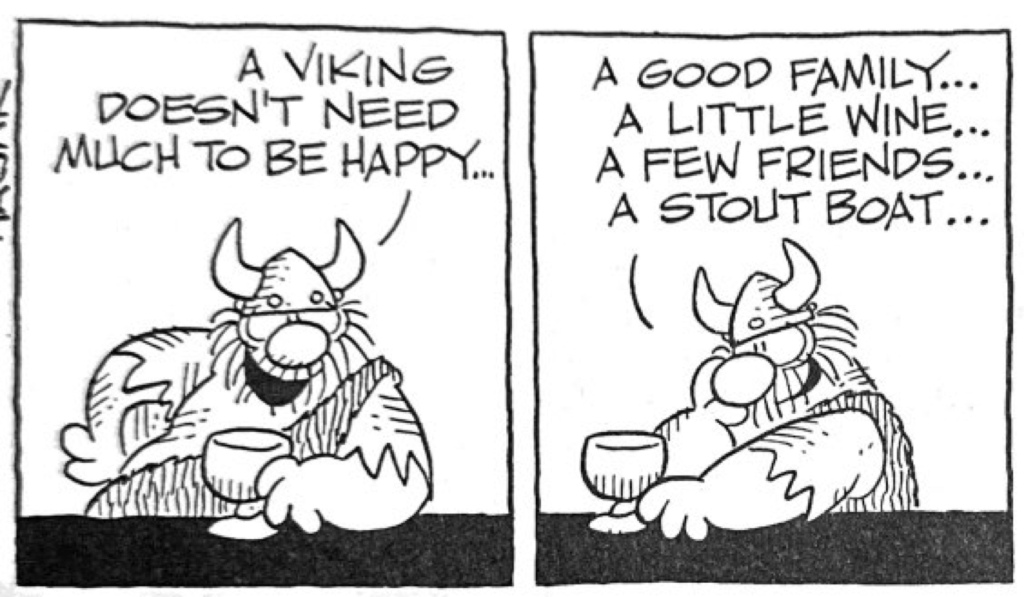
Like all of the most endearing comic strips. Dik Browne’s Hagar the Horrible came from a personal place. As Dik’s son Chris Browne tells it in the barbarian-sized collection, Hagar the Horrible: The First 50 Years (Titan, $49.99), the Brownes often joked about dad’s beefy, bearded, playfully irascible demeaner as Hagar-like. And it turns out, most of the eventual strip was loosely based on the character types and dynamics of the Browne household.
And also like most successful comic strips, it was at the intersection of art and commerce. Brown was already enjoying comic success in his partnership with Mort Walker on Hi and Lois. But as his eyesight declined and his career longevity seemed unclear, he wanted a more lucrative project that might involve the family itself. He worked very deliberately on crafting the right marketable project when it struck him that two google eyes between a horned cap and bulb nose had possibilities. Hagar the Horrible, his domineering wife Helga, bookish son Hamlet and conflicted feminist daughter Hony emerged as the perfect pre-modern sitcom family. King Features pre-sold it into 200 papers at start on Feb. 4 1973, but it soon became their fastest growing strip. By 1978 it was in over 1,000 outlets, with regular paperback reprints and a hearty merch and licensing business. Recruiting family members into an incorporated business entity, Papa Brown got that hoped-for long-term security for his tribe. Dik’s son Chris, who had contributed all along, took over the strip in 1989 after his father’s death.
While always worth a ten-second read and a mild grin, Hagar never struck me as the kind of strip that courts deep devotion. Even for a cartoon, which by design is open to many points of entry, the Hagar cast is too broadly written for much identification. The Sunday strip, not represented in this collection of dailies, was where we saw some of the Hagar family, pets and friends developed a bit more. A lot of Hagar the Horrible’s gag humor is based either in modern sitcom tropes or fun modern references cast back in time. Helga likes sending Hagar off to pillage with a shopping list and remind him who rules the roost. There are a lot of references to the difficulties of hemming metal armor, getting a bookworm son interested in the family business of ravaging villages, dad’s appetite, Helga’s dates, etc., etc.
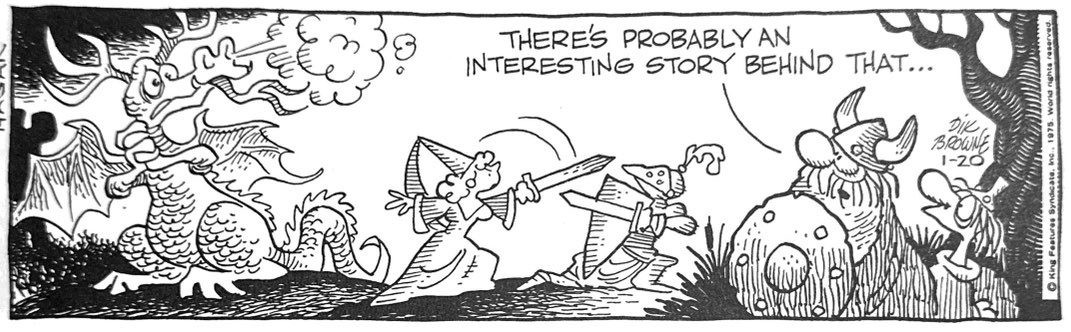
From Jimmy Swinnerton’s 1902 Mount Ararat, to V.T. Hamlin’s Alley Oop (1932) to Johnny Hart’s B.C. (1958), comic strips have explored modern manners in pre-modern worlds. In some sense, Hagar the Horrible was a bit of a welcome throwback itself. By putting his barbarian family in a pre-modern setting Browne (who was already in his mid-50s in the 1970s) was somehow able to revisit gender and family types that seemed out of place after the counter-culture. It allowed us to play with the fraying tropes of henpecking wives, bloviating hubbies, hapless underlings and suitors for a curvaceous daughter. Coming on the cusp of Doonesbury, Cathy or even For Better or For Worse, Hagar the Horrible was an anachronism that leveraged anachronism.
Which doesn’t diminish the strip’s charms. As the always insightful Brian Walker notes in his background piece to this volume, there was self-conscious artistry to Hagar. The character design was wonderfully burlesque. Hagar himself had a great Muppet vibe, fuzzy and furry, with simple circles and comic bulk. Helga’s jutting chest was an emblem of matriarchal power. Part of the strip’s basic design involved Browne’s declining eyesight and his need for something easy to draw and see. But Walker also points out that Brown was drawing a counterpoint to the rest of the comics page, which felt to him too polished and mechanical. He thought the reader needed to see and feel the artist doing his craft in order to engage with the strip. He used aged, goopier ink, a rough line and darker backgrounds on speech balloons to make a more human artistry pop off the ever-shrinking comic strip space.

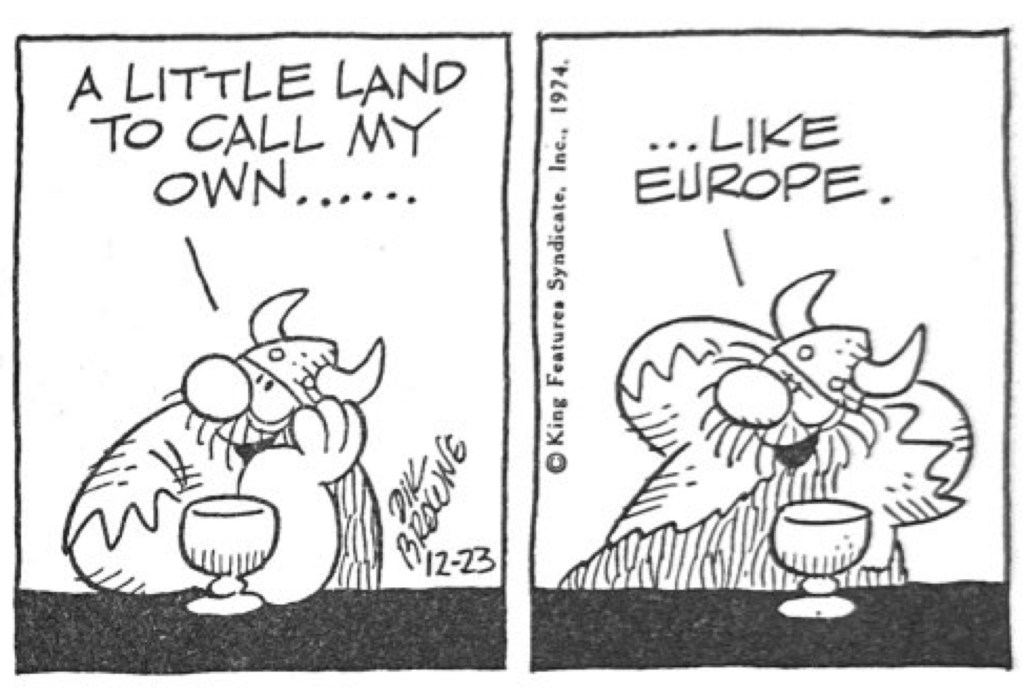
And there were some pretty good gags along the way. I especially like when Browne reverted to a single long panel to let the viewer piece together the elements of the joke. “HAVE A LITTLE TROUBLE FINDING YOUR WAY HOME LAST NIGHT, DEAR?” Helga asks the bed-ridden Hagar as the prow of his boat pokes through the front door. And I am always up for a little barbarian humor. When Hagar muses about just wanting “a little land to call my own…” the kicker panel blurts “…like Europe.”
But we come to mildly amusing strips like Hagar the Horrible as much for the tone and sensibility, the simplistic style and cute anachronism as we do for insight or even much of a laugh. Later in its run you can see more topical references that one imagine were posted on office and refrigerator walls. In one strip Hagar warns a castle that his invading band is the “transition team.” But generally, Hagar was a comfortable five to ten second visit into a world that was much more carefully constructed than it was consumed. And this is a part of the comic strip art. After all, the uniqueness of the daily strip was in its consumption. Hagar sat within six or more other strips of varying styles, genres and tone. It was a five second drive-by that the reader could use as a part of a larger review of the page – maybe a light side dish, a palette cleanser, or a dip into clean simple humor that finished the meal. And this only works because Browne had created this Hagar sensibility that a reader could recognize instantly, fall into and out of effortlessly. That is no small thing.
Titan’s is precisely the kind of reprint collection a strip like Hagar the Horrible deserves. Most of its hefty 480 pages contain three strips a\per page coursing through the 50 year history. While I wish there had been some rough dating here to indicate chronology more precisely, this best-of model is just right for a gag-driven favorite. You can dip into any page and snack on any batch among hundreds of morsels. It is a barbarian’s buffet.
Discover more from Panels & Prose
Subscribe to get the latest posts sent to your email.
 Panels & Prose
Pingback: Shelf Scan: Celebrating Peanuts, Beetle Bailey, Hagar and Donald – Panels & Prose