
Along with chaos, mayhem and violence, obsessive behavior was a core theme of early newspaper cartooning. Consider the many titular anti-heroes of these years, like Hungry Henrietta, Superstitious Sam, Jingling Johnson, Sammy Sneeze. Or the irrepressible raging “Outbursts of Everett True,” the sex addiction of Mr. Jack, the insufferable politeness of Alfonse and Gaston, or the numerous strips about absent-minded codgers or irrepressible pranksters. Seen through the lens of early 20th Century comics, the new American cityscape was characterized by obsessive behaviors, idiosyncratic personalities, uncontrollable ticks – compulsions of every sort. The annoying monomaniacs in our midst formed the heart of early comics. It was an art well-suited to the daily newspaper: a comedy of everyday frustrations and observations.
And George Herriman certainly had a handle on manic single-mindedness. His most famous creations, Krazy and Ignatz, performed operatic OCD: a cat fanatically romancing a mouse, whose compulsive response to her idealism is to launch a brick. Krazy and Ignatz came at their obsessive personalities honestly. As all comics nerds well know, Herriman’s duo were conceived as warring pests living beneath the family that lived beneath “The Family Upstairs.” Between 1910 and 1912, E. Pluribus Dingbat waged an obsessive, increasingly escalating war with his floor-pounding, plaster-peeling upstairs neighbors who remain maddenly invisible to him and us behind their inaccessible apartment door. We have covered the Dingbats elsewhere for their seminal role helping to invent one of the 20th Century’s most important popular genres, the domestic situation comedy. But the strip also culminated in grand fashion, the young medium’s predilection for obsessive personalities and behaviors.
Although Herriman famously tired of the noisy neighbor conceit, and was eager to move on to spinning off a new world for Krazy and Ignatz, “The Family Upstairs” was a minor masterpiece itself. While other obsessive and highly idiosyncratic cartoon characters quickly wore thin and disappeared, the strip proved popular enough for Herriman’s editors to press him for more. In many ways, it was a perfect expression of the niche newspaper strips were creating for themselves, comic takes on the modern situation. Annoyance with the neighbors was recognizable to any reader, and The Family Upstairs turned a familiar frustration into grand burlesque. Part of the strip’s charm came from Herriman turning the claustrophobic Dingbat flat into a panorama of contemporary culture.
E. Pluribus goes to wildly unlikely lengths to bring down his neighbors. He recruits the world’s most famous detective, who in turn recruits troops from the Russian Czar. He hides himself in a safe, tries to use magnetic devices, a pointing pup, a wild horse. Dingbat tried every imaginable device to dislodge these pests, from stilts and nitrous oxide to sleep inducing flowers. He employs a mystic to deploy “hoop snakes,” multiple Indian chiefs to wage war, clairvoyants, bagpipers, and all manner of disguises. Virtually every ethnic group shows up in the form of an outlandish stereotyped talent. He even recruits a fellow cartoon character, Harry Herschfield’s villainous Desperate Desmond.
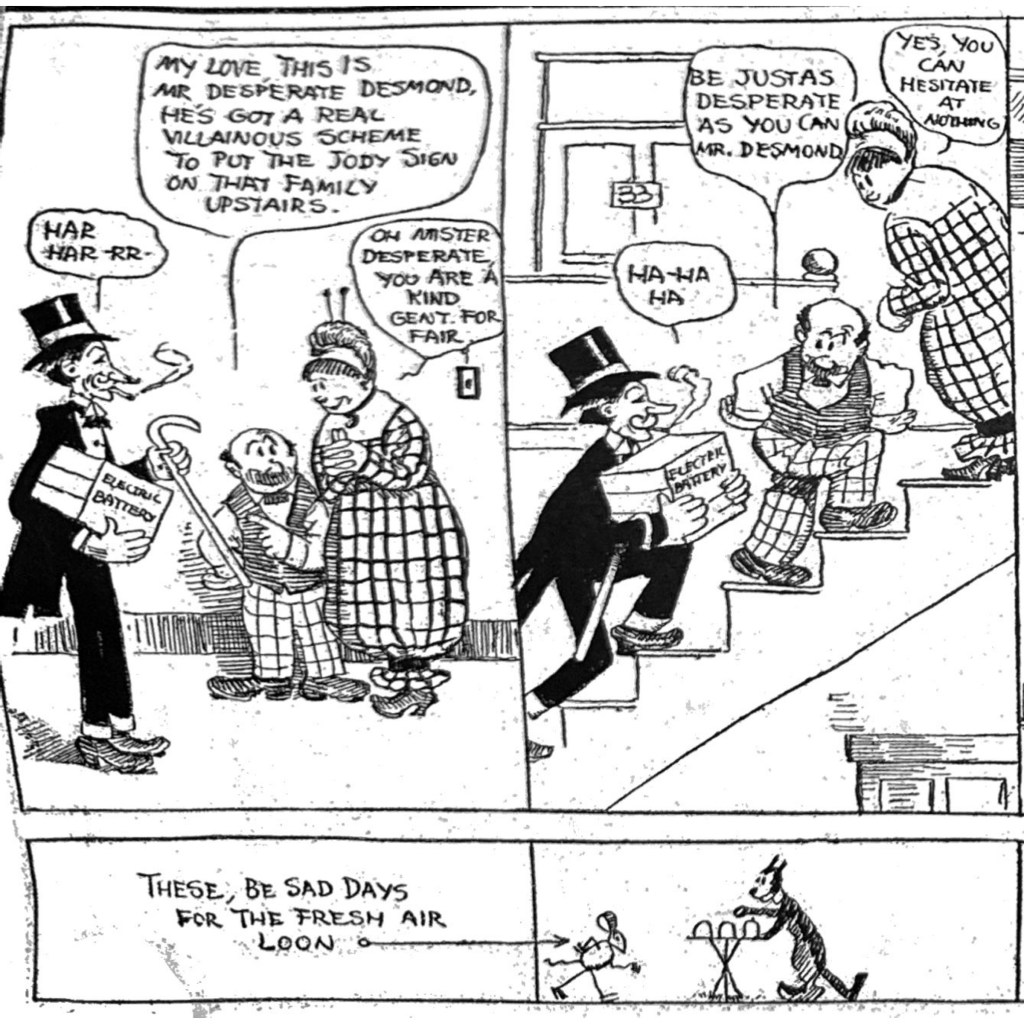
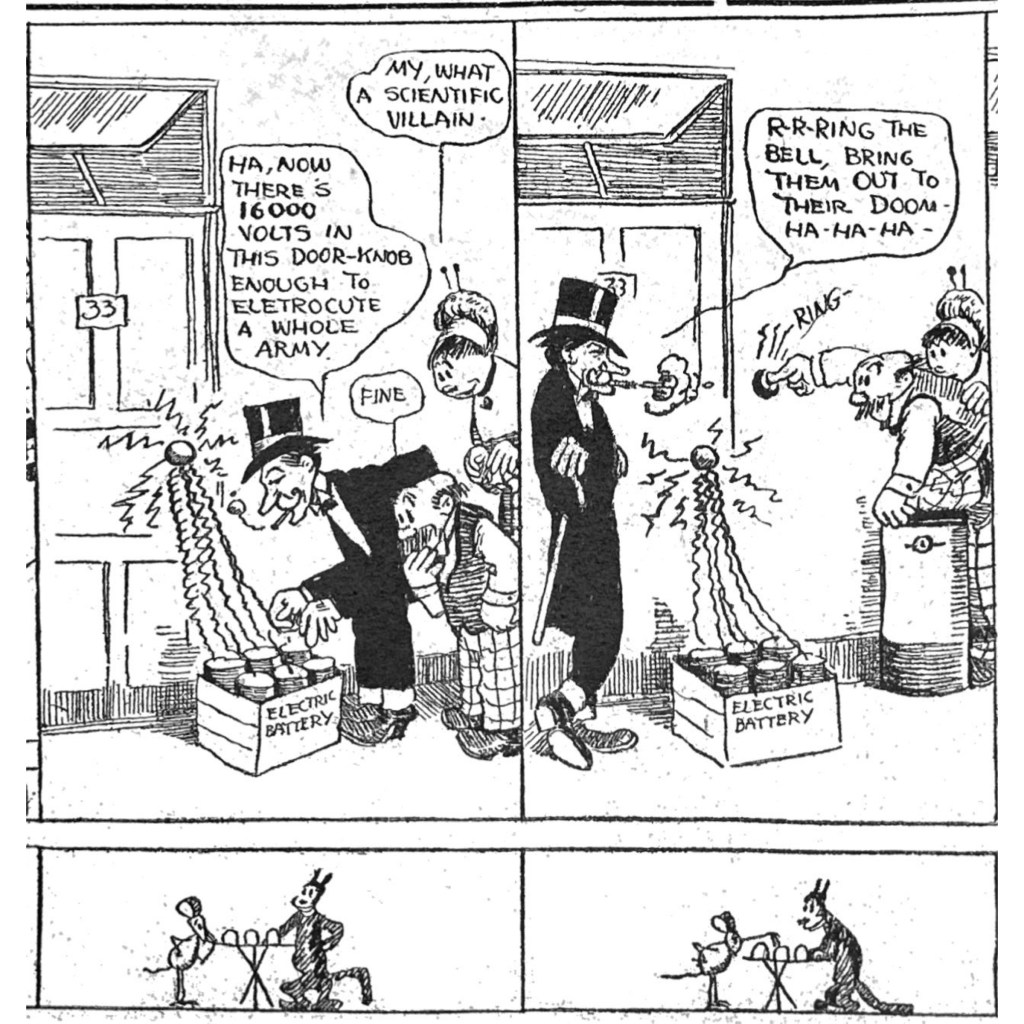
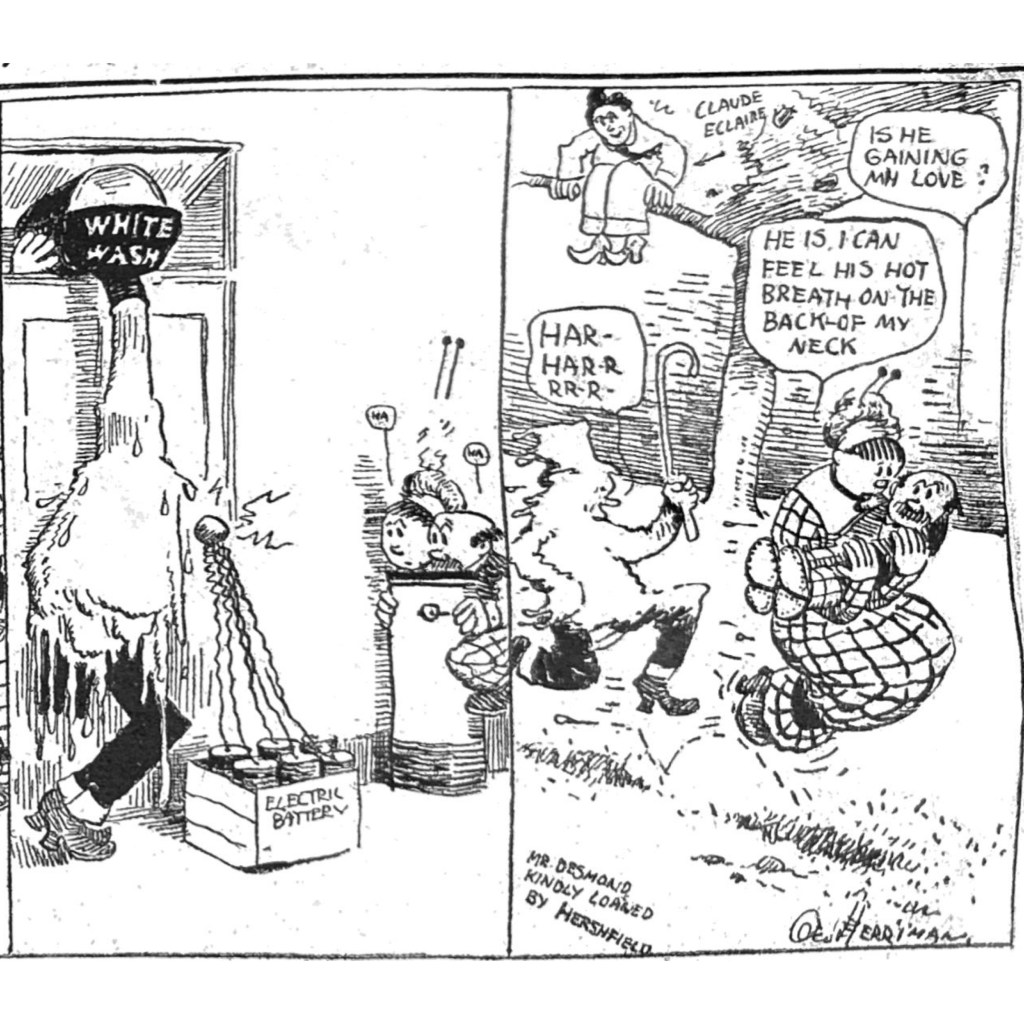
Herriman cast a very wide cultural net in composing The Family Upstairs. In many ways, the Dingbats’ apartment was the inverse of his eventual masterpiece Krazy Kat. Coconino Country and the ever-changing vistas of Herriman’s beloved southwest was an infinite setting for contemplative, even metaphysical themes. The Dingbats contains worlds of action and characters to a universe of one flat and a staircase. In that sense, it was a perfect modern newspaper strip; it absorbed into its cartoon world the fads, social types, and exoticism represented in the rest of the paper.
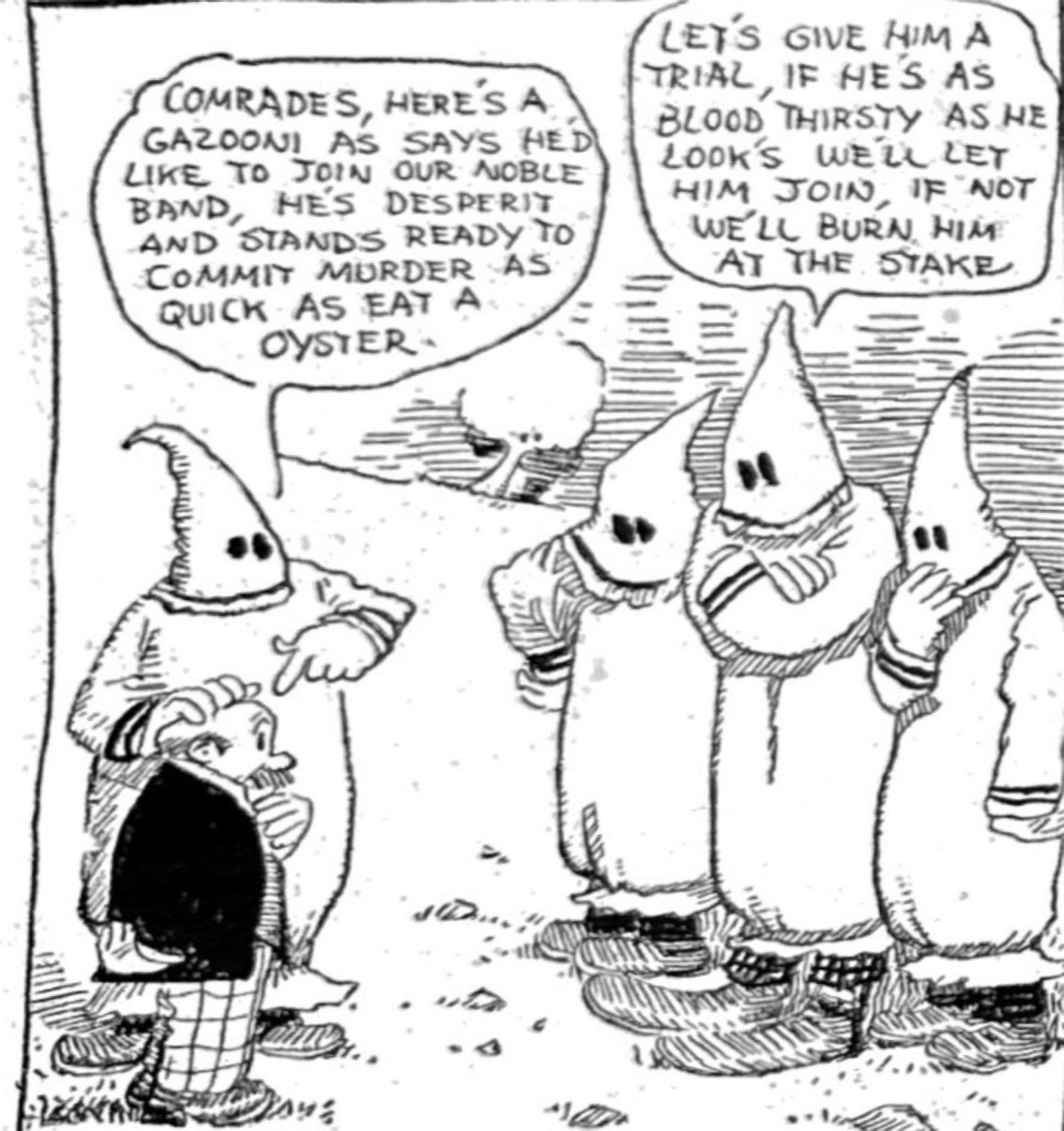
But calling in the KKK was extreme even for the day, and is jarring to modern eyes. But this bit of weirdness demonstrates how outlandish Herriman could get in this strip. In 1910, the Ku Klux Klan had not yet been revived since its deadly rampage against Reconstruction efforts in the 1860s and 70s. But its savage reputation endured in popular culture. Its revival in 1915 was inspired by D.W. Griffith’s fawning depiction of the Klan in his dubious masterpiece “The Birth of a Nation.” It is even more remarkable that Herriman, who was Black but “passed” as white, invoked their murderous legacy here. And as E. Pluribus discovers in the kicker panel, the Klan is nothing to play with.
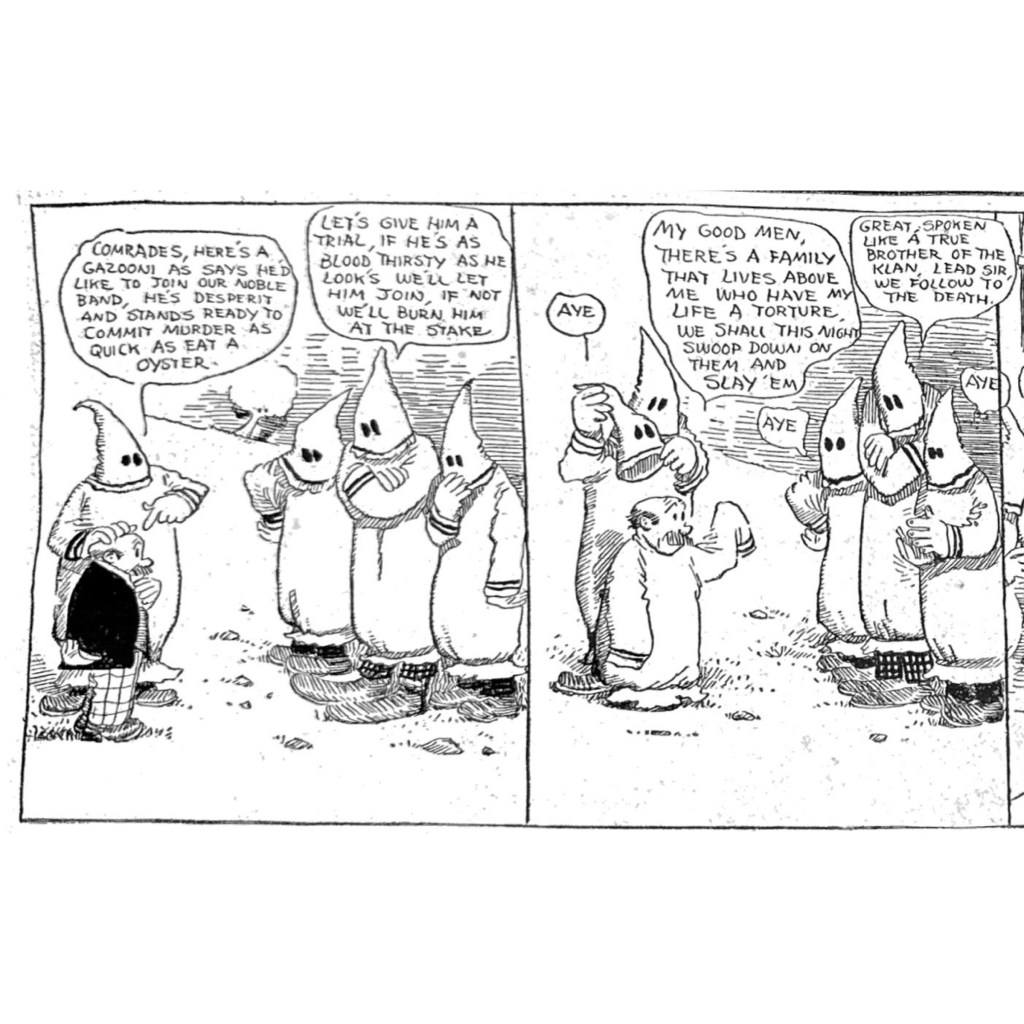
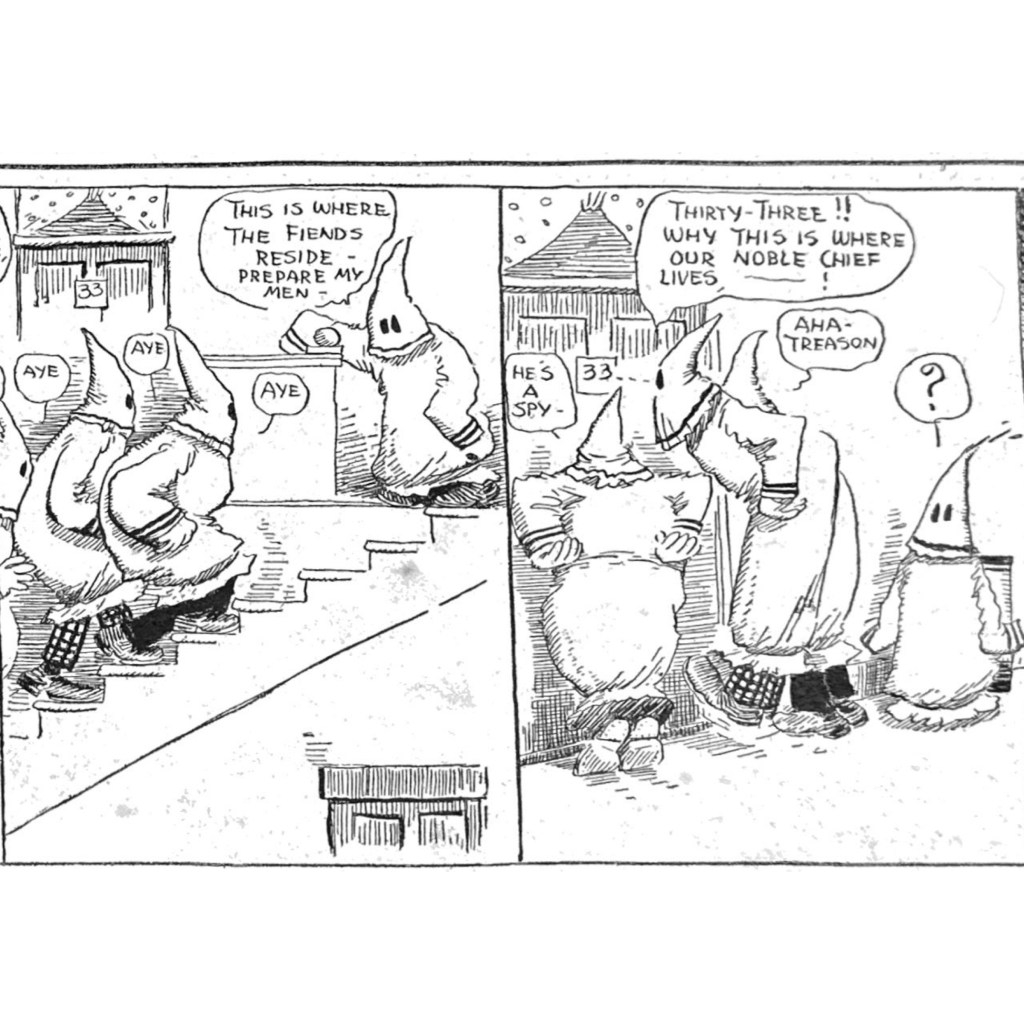
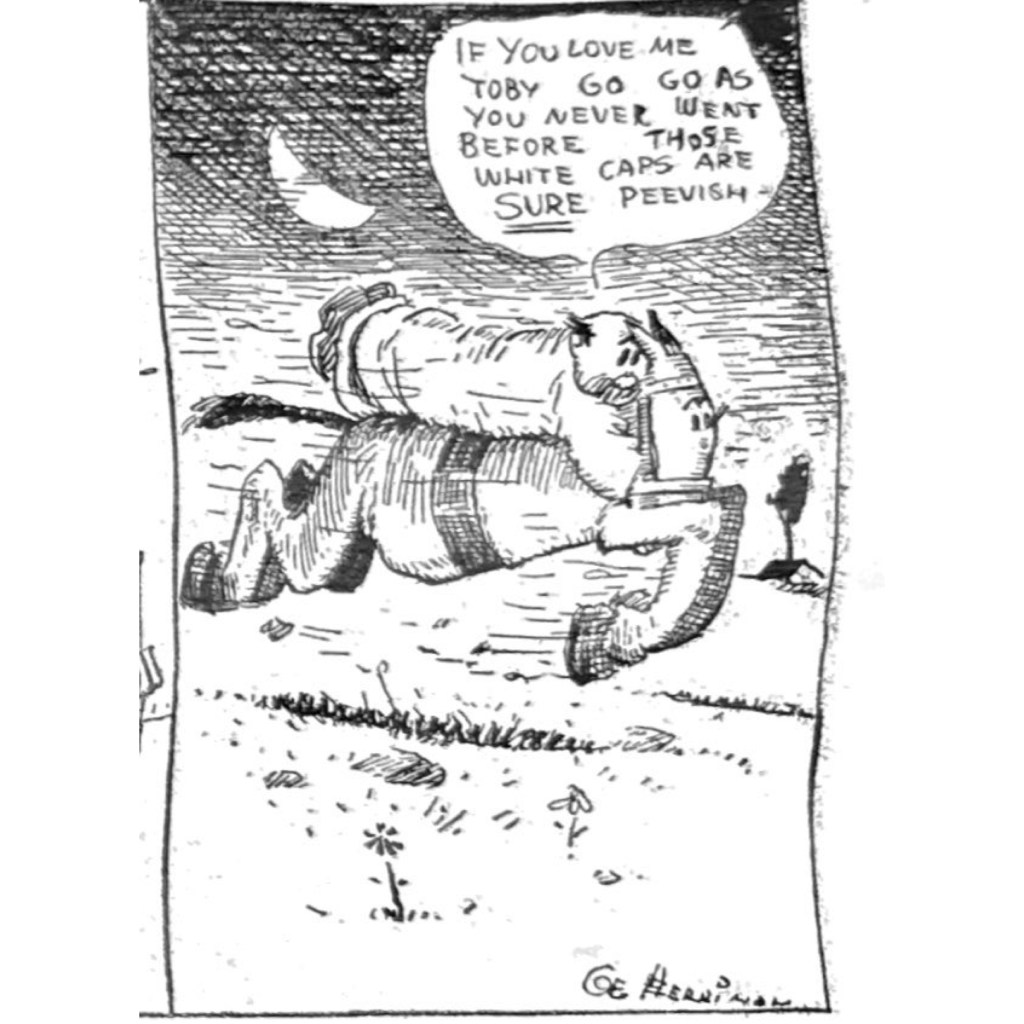
Just as important to the strip’s sustained interest is the mystique of the neighbors themselves. Dingbat’s obsessiveness may be warranted. In this strip, “Apt. 33” turns out to belong to the Chief of this Klan chapter. But that only adds to the mystique of the unseen renters behind the door. Who is this family upstairs, anyway? All we get is a parade of associates, from Teddy Roosevelt to friends, garbagemen, talented monkeys, all of whom easily defeat E. Pluribus’s schemes. Are they an elite, a secret society, thugs, or just the snide smart kids who shun us? By artfully keeping them anonymous, Herriman lets them become a cypher for our sense of oppression and discontent.
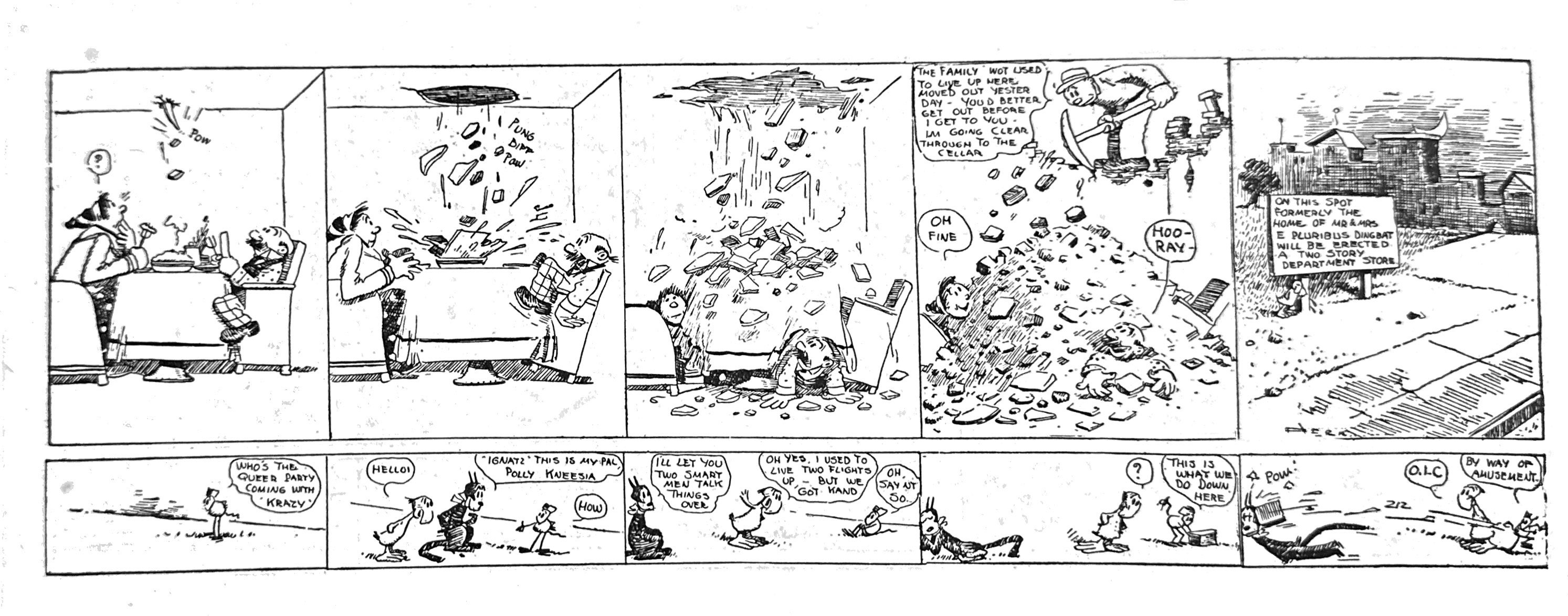
It is fitting that E. Pluribus’s grandly eccentric and escalating obsession with the family upstairs ends, as perhaps it must, apocalyptically. Herriman brings the strip to a mostly satisfying conclusion by cutting off the source and even the setting of his hero’s torment. The obsession is not resolved, because his nemesis simply moves away without a big reveal. But somehow for Herriman, simply installing better neighbors is not enough of a denouement. He had to bring down the house.
Many historians like to tag the early years of the newspaper comic strip as a wonderful period of creative “anarchy,” and this is partially true. The medium was unrestrained by aesthetic conventions, so artists like Winsor McCay, George McManus, Herriman and many others played freely with the form in ways we never saw again. The reach and business of syndication imposed a more sober approach to formats and content, especially after 1912. And the earlier comics wwere famously irreverent to authority of all sorts, especially the pranksters who bedeviled parents, cops, and foppish sophisticates. But the term “anarchic” has a deliberately vague, suspiciously political flavor that I am sure indulges the armchair radicals many critics and academics imagine themselves to be. I know whereof I speak. I was in that first generation of trained pop culture scholars who loved tagging favorite pieces of mass media as covertly “subversive,” “disruptive,” “surreal” or “anarchic.” Sure, there was some substance (and tons of theory) behind these claims…but it was also a flex. And it can cut us off from more substantial critical paths that recognize the prosaic ways popular art works in a culture.
Rather than the politically inflected “anarchic,” we might well explain the content of the early comics as “manic,” which is more personal than political. The share of strips that focused on idiosyncratic personalities, explosions of passion, obsession, irresistible impulses, fixations and especially anger was massive. The job of the cultural critic is to ask why we see these kinds of patterns in this place and time? What function did it serve? Or what issues did it allow artists and readers to explore together? This preoccupation in early cartooning with social performance, obsessed characters, personal ticks, not to mention the cavalcade of ethnic typing, is likely registering a crisis over selfhood itself in the new, crowded, diverse city.
The best cartoonists took this trope and fashioned it into wonderful art. The cast of Gus Mager’s wildly popular “Monks” strips was comprised of characters whose personae were dominated by a single trait (Henpecko, Groucho, Joko). Mager developed this cast of single-trait types into a grand satire. And Herriman, bless him, focused cartooning’s predilection for exploring mania and obsessive single-mindedness onto an everyday middle-class schlub and the claustrophobic frustrations of modern apartment living. This is when popular art becomes great, when artists glean and dramatize the vague underlying anxieties and conflicts in a concrete, compelling way.
If there is anything “disruptive” and “anarchic” in Herriman’s Family Upstairs, it is its refusal to resolve the situation or the mystery. We never get to see the invisible forces that plagued E. Pluribus Dingbat. More to the point, who was the hero and who was the villain here? The upstairs family often seems joyously roguish, admirably resilient, relentlessly hedonistic, forever thumbing their nose at the obsessed bourgeois Dingbat who craves dullness. Who are we rooting for across these two years of strips, and where do our sympathies lie? Underlying this whole situation is a very American contest of the rowdy and adventurous versus the calm, bland, encroaching order of civilization. Herriman knows better than to come down on one side or the other. We never discover the reality of the family upstairs, and who knows if E. Pluribus can ever find peace anywhere. Maybe ambiguity is the most meaningful subversion.
Discover more from Panels & Prose
Subscribe to get the latest posts sent to your email.
 Panels & Prose
I have just embarked on the journey this strip provides. After reading your post I am more anticipant than ever to read them.
Thanks, Mike. Finding them can be tough. Got to my earlier piece on The Dingbats where I included a lot of samples. There is a full reprint of the run, but it was part of the old Hyperion Library that is costly when you find them.