Walt McDougall’s City – The Rube’s-Eye View

It is a shame that Walt McDougall has been overlooked by most comic strip history, because he left a lot of great material behind. While accounts differ over who originated different formats, everyone agrees he was among the first modern political cartoonists for the weekly humor magazines of the 1880’s and 90’s. He was among the first to create Sunday newspaper comic images in color. He visualized L. Frank Baum’s “Queer Visitors from the Marvelous Land of OZ” and penned “Peck’s Bad Boy.” newspaper series. And he was among the first syndicated cartoonists. His autobiography This Is The Life was one of the first lengthy chronicles of the early days of cartoon art as told by a practitioner.

But as I mentioned in my last post on one of my favorite McDougall panels, “Familiar Sights of a Great City – No. 1 The Cop Is Coming,” he was one of many early comic artists to take the new city experience as his subject, “Life in the City as the Countryman Pictures It” makes the country vs. city disjunction explicit.

Here he brings to life the “Countryman’s” caricature of city life. This one rich and very busy tableau serves up many of the age’s fears about the new city environment, and many of them have to do with deception, con games, wealth. Notice the many window signs for mail order houses and by-mail courses, alluding to many such come-ons most Americans knew from the classified ads in the backs of national magazines and local newspapers. At each corner of the panel we see rural folk as our point of identification, wary of the city’s seductions. The streets are literally paved in cash. The street sweeper complains about having to clean up the money. The loca bank is transferring moneybags down a Chouteau through the window. And Mssrs. Rockefeller and Morgan carry their own valises of “Cash” down the left sidewalk. McDougall satirizes the velocity of urban build-out and industry in the Waterstock Bldg that is under construction but advertises rooms ready today.

Starting with the multi-layered crowd-scapes of R.F. Outcault’s “Hogan’s Alley” the comic arts were uniquely positioned to depict the sensations of modern urban life. The full page could freeze the cityscape and let the eye travel across its multiple planes of disconnected action, dialogue and relationships. Film was good at depicting the crowd as a throng – an undifferentiated force. Artists like Outcault, McDougall and later Harrison Cady and Harvey Kurtzman instead used the large panel as a way to find order and sense, or at least meaning, in what otherwise seems like chaos when in motion.

In one sense artists of this crowd style both interpret the new masses and instruct us in how to view the urban world. These images force our eye into the the detail of the crowd, to ferret out the little stories, miniature satires, little in-joke details. They are giving us a powerful vision of how not to see the crowd as a crowd but as a glorious and exciting tableau of many small worlds all somehow going in the same direction.

Also interesting to me is how the image is about subjectivity itself. McDougall is bringing to life a specific fantasy of the new city, using the comic page to dramatize the way a particular part of America caricatures another.
Great Moments: A. Mutt Meets Jeff (1908)


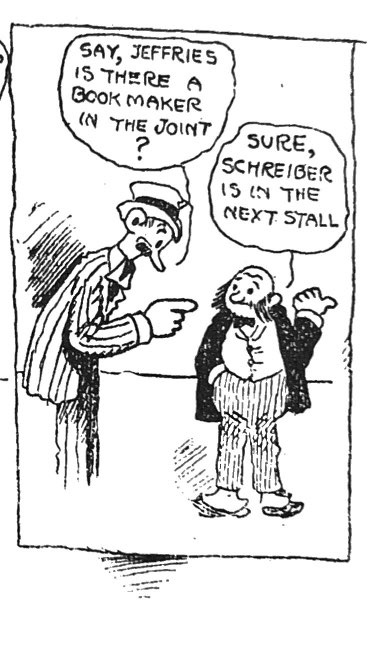
One of the longest lasting marriages in comic strip history began on March 27, 1908 when Bud Fisher’s wildly popular A. Mutt comic strip anti-hero meets a character who soon became his companion until the strip finally sputtered to an end in 1983.

As told by Jeffrey Lindenblatt in the NBM reprint of early strips, A.Mutt had a whirlwind start in the five months from its brilliant inception to the introduction of Jeff. Bud Fisher was a self-taught artist who talked his way onto the the San Francisco Chronicle in 1906. He worked his way up from layouts in the art department to spot illustrations around news stories to regular caricatures in the sports section. Here is where Fisher sold editors on an idea for a daily strip that would top the sports section with betting neophyte A. (Augustus) Mutt’s uninformed picks to win one of that day’s horse races. The next day’s strip would include Mutt’s winnings, losings and mood after the real world results.


A.Mutt was an instant hit, but its Chronicle run lasted only 26 days. The strip attracted the attention of no less than notorious newspaper staff raider William Randolph Hearst, whose rival San Francisco Examiner battled the Chronicle for circulation. As he had done so many times in his “Yellow” newspaper war with Joseph Pulitzer in New York a decade before, Hearst drowned Fisher in cash and the promise of national syndication to lure him to the Examiner less than a month after A.Mutt launched. Eventually Fisher would leave Hearst too for a much more lucrative syndication deal that became a model for decades of lavishly paid cartoonists.


Fisher’s final A.Mutt for the Chronicle appeared on Dec. 10, 1907, but that last iteration had one very important (and lucrative) addition – “Copyright 1907 by H.C. Fisher.” In Lindenblatt’s telling, Fisher accompanied the artwork to the printing department that day and before the printing plate was struck added that copyright note that led to his being one of the wealthiest cartoonists of his and subsequent decades. Until his death in 1953, Fisher benefited from gushers of revenue from licensing, theatrical and syndication deals that saw Mutt and Jeff on just about anything willing to pay Fisher royalties. There were a number comic strip millionaires during the golden era of newspaper circ wars, but few were as showy and press savvy about that’s wealth than Fisher.


It is under Hearst’s banner that A.Mutt moved quickly away from racing track picks, added Jeff and because a buddy strip that also introduced extended continuities. Alas, the sad anachronistic later decades of Mutt and Jeff strips obscured its earlier, genuinely witty, edgy slapstick years.

But in its early years the strip was indeed gritty. In fact, Mutt meets Jeff in an asylum, one of many incarcerations for him. This time he meets up with multiple cases of delusional inmates, including a diminutive fellow who fancies himself boxer Jeff Jeffries.

While the strip soon evolved beyond its origin as a sports cartoon, it carried with it to mainstream comics pages the sharp-tongued banter, slang, and snide irreverence that typified much of sport page cartooning. Mutt and Jeff took on politics, lampooned public figures, poked at social pomposity, and even ventured down to Mexico in the 1910s to engage with Pancho Villa.

Mutt was also among the first of a staple for the comics pages – the hapless schemer. Always looking for a buck, failing at the serial jobs he tries, the early Mutt conspires with Jeff (who is usually more flush) just to score a much-needed meal. Well evolved from the early simpletons of comics like F.O. Opper’s Happy Hooligan’ and Ed Carey’s Simon Simple, Mutt was like Harriman’s Baron Bean and Goldberg’s Boob, the American always on the make but falling short, working the angles unsuccessfully at the margins of America’s booming modern economy. The rising middle classes at whom 20th Century newspapers generally were aimed seemed to delight in the misfired ambitions of characters like Baron and Mutt, later Moon Mullins, Bobo Baxter and to some degree Andy Gump. It is a figure that extends into Laurel and Hardy, Abbott and Costello, Chester Riley and Ralph Kramden. Failed ambition is often leavened ironically with empty bravado and inflated self-confidence. It is light satire of America’s core tropes: social and economic ambition, masculinity, mobility, looking for the main chance.

The candor of Mutt and Jeff is in full display in 1918 when the duo scheme to dodge the draft.

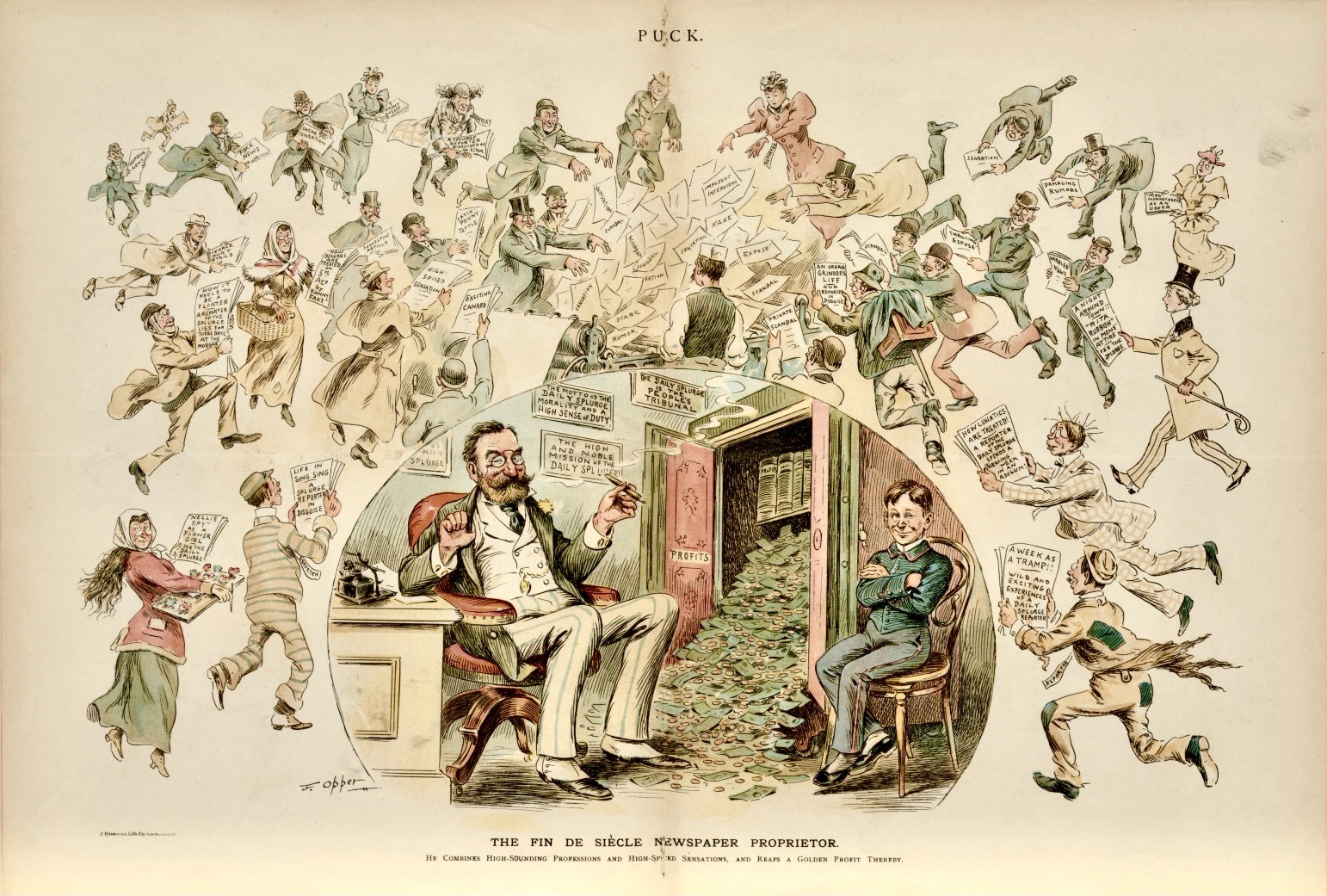
The Original ‘Fake News’: Opper Takes Aim At Newspapers

Before Frederick Burr Opper became a pioneer of early newspaper comics (Happy Hooligan) he was a critic of the medium. In this cartoon from the March 7 1894 issue of the top humor magazine of the day, Puck, Opper targets the increasingly sensational mass circulation city newspapers. While not called out by name, the caricature is clearly Joseph Pulitzer (1847-1911), publisher of the New York World. Ironically, Opper would sign on with Pultizer’s rival William Randolph Hearst and his New York Journal. In fact, Opper’s cartooning skills would be one of the main weapons in the Pulitzer/Hearst newspaper wars of the 90s.

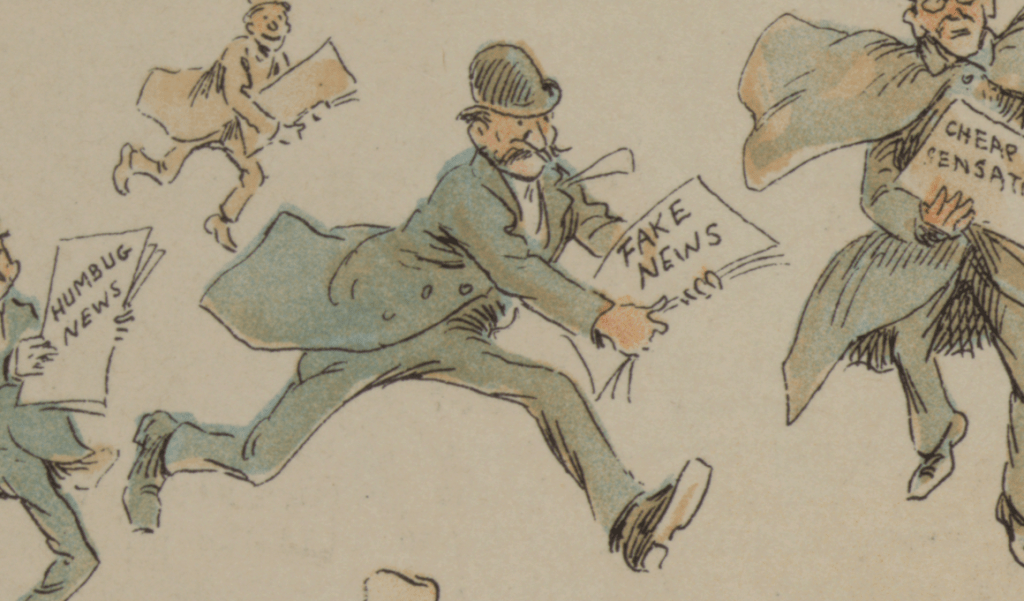
Before the rise of newspaper comics over the next decade, cartooning was the domain of American humor magazines like Puck, Judge and others. And Opper was one of Puck‘s most popular illustrators. In many ways the rapid expansion of daily newspapers rang the death knell for the humor weeklies, so it wasn’t surprising to see them come after the dailies as “vulgar,” profiteering and sensationalist. Indeed, the newspapers were even accused of peddling “fake news,” as you can see depicted in the upper left quadrant.

Kat and Mouse: Herriman’s Creative Absurdism

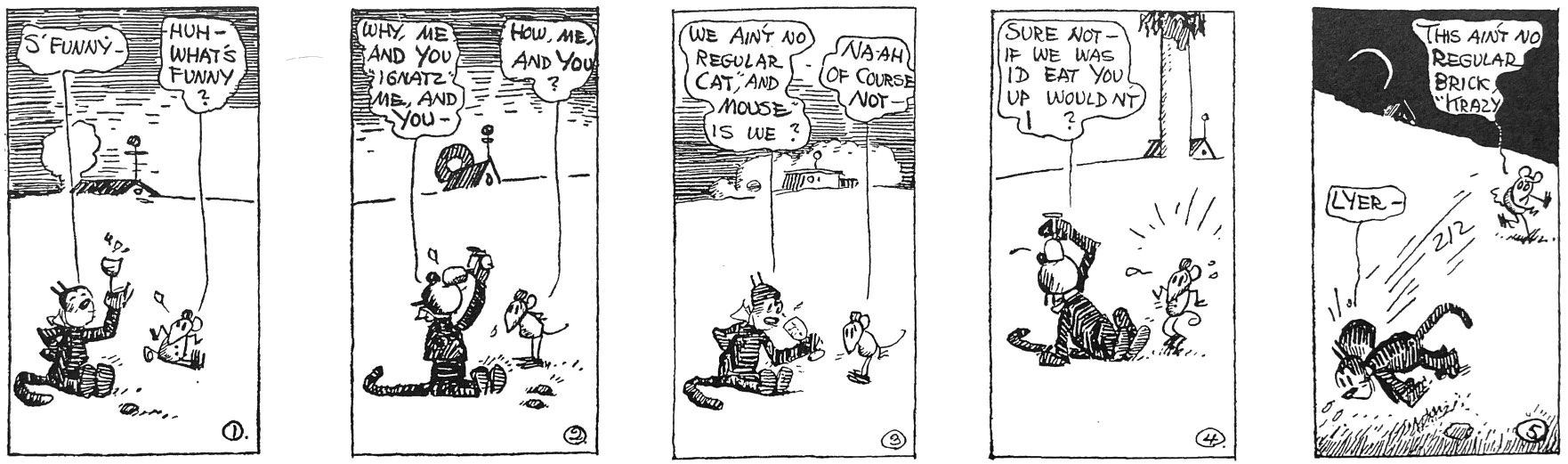
Herriman enjoyed calling attention to the absurdities of his own strip. In these dailies (1919) he also uses his signature device of changing the background landscape from panel to panel. All together Herriman is creating an absurdist space in which Krazy, Ignatz and the Coconino County cast focus on language and interpersonal dynamics.

The unique aesthetic of the comic strip is its ability to create an immersive environment through visual style, composition and character that we fall into for less than a minute a day across three or four sequential panels. Herriman used the full palette available to those panels to ground us in his characters by making the physical environment disorienting and fluid.

Buck Rogers and the Steampunk Future of 1930s America

The hero of Buck Rogers was never Buck himself, really, so much as the future itself. And that was fortunate, because neither writer Phil Nowlan nor lead artist Dick Calkins was competent at the actual craft of the comic strip.

No one ever accused Calkins of artistic dexterity. The overall look of Buck Rogers was wooden, lacking in perspective or proportion, barren of expressiveness or even basic blocking of figures within the panel. Limbs often seemed out of scale with bodies and positioned with the naturalness of a marionette. Moreover, Calkins worked with assistants throughout the original artist’s run who reportedly popped in to do different parts of the strip, including some fetching female figures that were disorienting to a reader accustomed to the strip’s unconvincing art.

Which is to say that the limited range of Calkins’ talent pretty much matched writer Phil Nowlan’s narrow narrative reach. The adventure itself lacked character, suspense, pace or setting.

But enough Buck bashing. I’ll save my rant on Nowlan’s many storytelling and cultural sins for another time. In fact, it is the basic badness of the Buck Rogers comics strip, especially in the 1930s, that makes its chief claim on our attention stand out. While other adventure strips of the day like Little Orphan Annie, Dick Tracy, Popeye, Wash Tubbs and Capt. Easy clearly were about their eponymous protagonists and their villainous antagonists, the only compelling feature of Buck Rogers, 2429 A.D. was the future itself. To their credit, everyone concerned seemed on the same page of what the strip really was about. In the 1940s, Dill Syndicate head John Dill reflected that in the late 1920s he was looking for a strip set centuries in the future “in which theories in the test tubes and the laboratories of the scientists would be garnished up with a bit of imagination and treated as realities.”

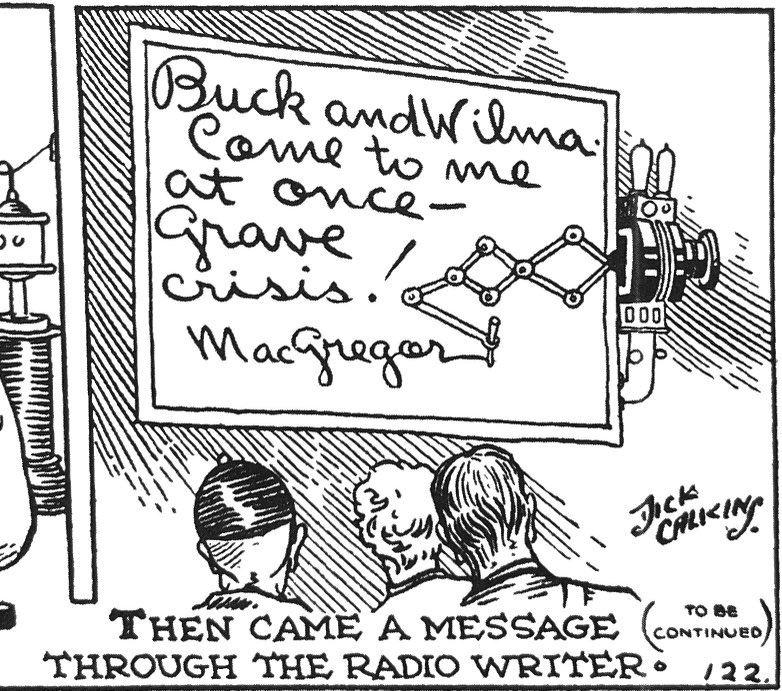
And that is precisely where Buck Roger’s 25th Century adventure is compelling and fun, when it projects the technologies and lab experiments of 20s and 30s America into the future. And oddly, this where Nowlan and Calkins two dimensional approach to story and art excelled. The flip side of their shared weakness in depicting human depth or expression was a loving attention to detail when it came to objects without a pulse or soul. They had a catchy way of imagining gadgetry of the future. As I detail below they had a pretty good track record of anticipating technologies that would become commonplace after WWII. Many of them, like TVs, robots, and even rocket ships were either in development in some form or were part of the early science fiction ether where Nowlon got his start.

Adventure comics historian Ron Goulart suggests that Calkins’ technical drawing style was indebted to early sci-fi magazine cover artist and illustrator Frank R. Paul, who appeared often in Amazing Stories and Wonder Stories, the main pulp vehicles for early speculative fiction. The story that caught publisher Dille’s eye was Nowlan’s iteration of Buck as “Anthony Rogers” in “Armageddon – 2419 A.D.” in Amazing Stories Aug. 1928. The evolution of that story into Buck Rogers brought a niche genre into the mainstream and became most Americans’ first exposure to the science fiction genre’s ability to imagine a far future. And today it comes off as a captivating steampunk melange of retro stylings for aspirational technology.

When it came to gadgetry, Calkins showed an appreciation for rendering the details of mechanism, materials and surfaces. His horizontal and vertical hatch work across metal surfaces became a signature of most Buck Rogers technology. But his thick line work and flat perspective leant a cartoonish quality to the machine, a touch of Rube Goldberg’s contraption aesthetic that made this future tech feel more imagined than precise.

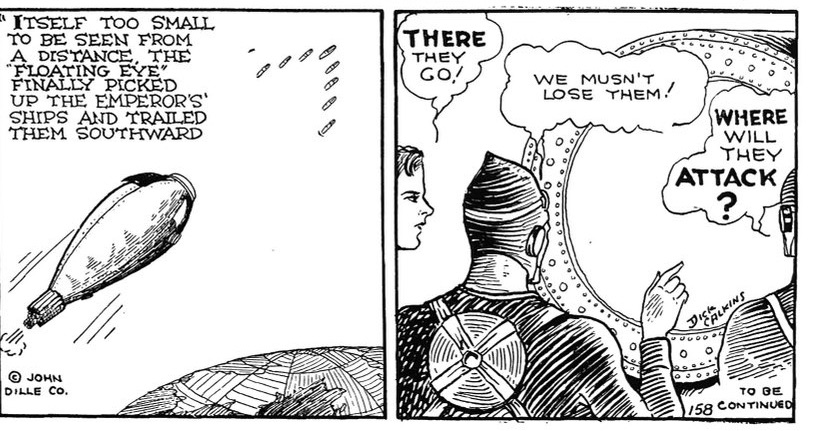
Drones

It was not too much of a stretch for 1929 Americans to envision a future where wireless communication, TV tech, flight and visual surveillance would merge. But Nowlan and Calkins were pretty spot on in expecting a drone-like device

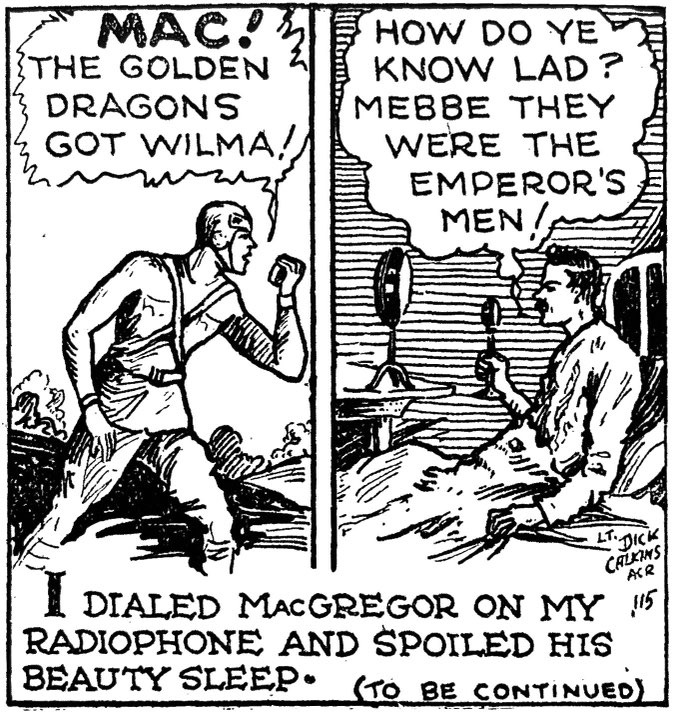
Buck Rogers, Early Brick Phone Adopter

Buck might be rocking a pre-iPhone Nokia hand brick there. Nevertheless, the 2049 (via 1929) “Radiophone” seems to sense how the two chief inventions of the modern world – radio and the phone – were destined to merge.

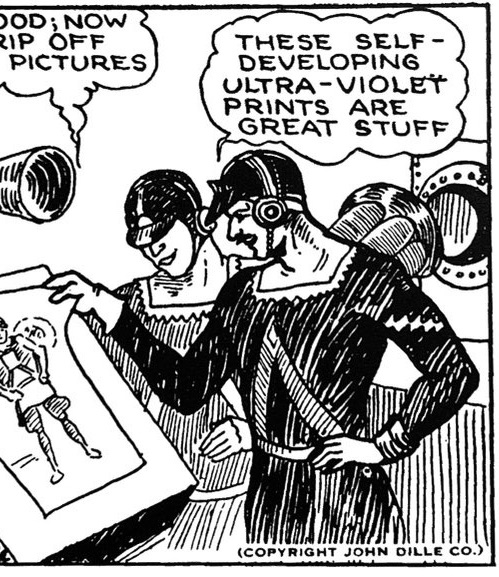
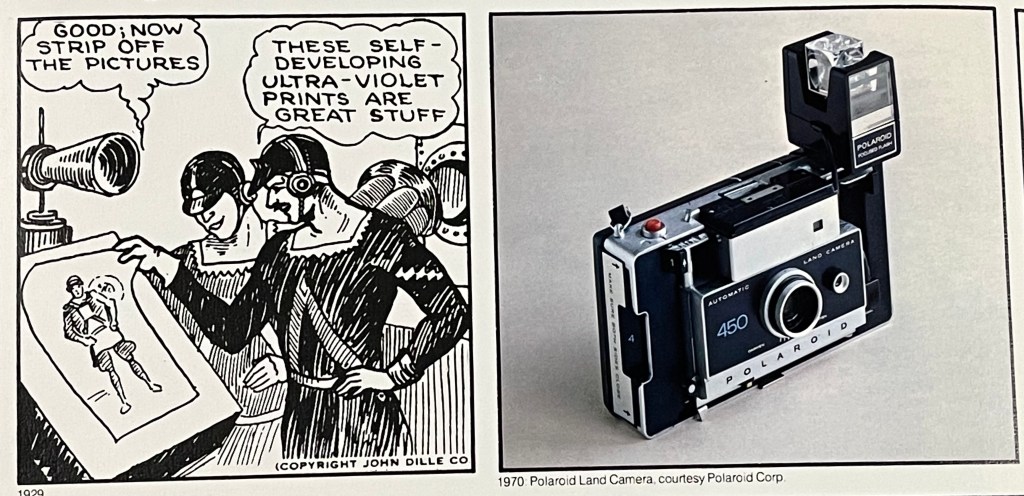
“Self-Developing Ultra-Violet Prints”: Instant Photos

Buck Rogers was especially good at understanding how multiple technologies would complement one another and find new uses over time. Here the vision of high def televisual transmission blends with a self-developing photo process that anticipated the first Land camera in 1948 that introduced consumers to the concept of self-developing photos. The basic idea of instant images, had been developed in more cumbersome formats as early as 1928.

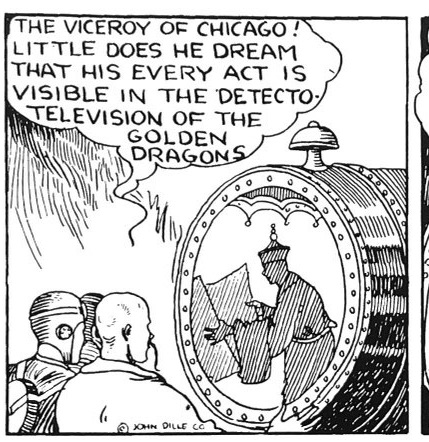
Surveillance Video and TV

Surveillance via TV technology is a major element of the Buck Rogers future. In this case Detecto Television uses hidden cameras across the Mongol empire to help a rebel faction plot insurrection.

Spyware

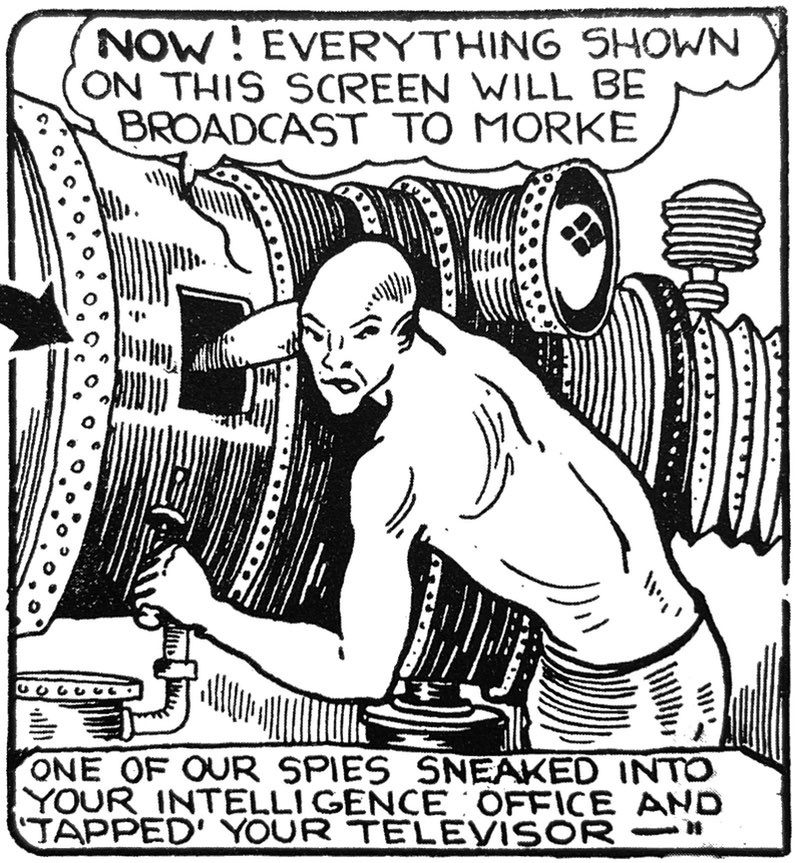
Nowlan seemed to understand that as all technology gained more power through wireless communication they would become subject to hacking and spying. Phone wiretapping was invented in the 1890s and became a common law enforcement tool during the Prohibition era of the 1920s. Nowlan simply projected the basic concept onto the communications mainstay of 2049 – the Televisor.

Steampunk Military Industrial Complex

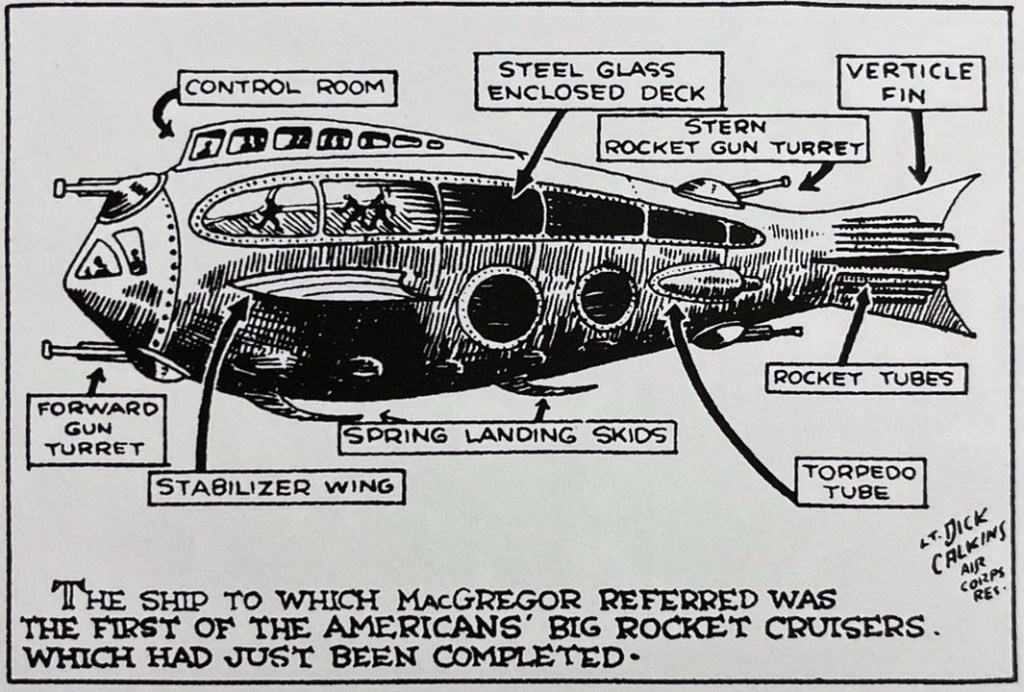
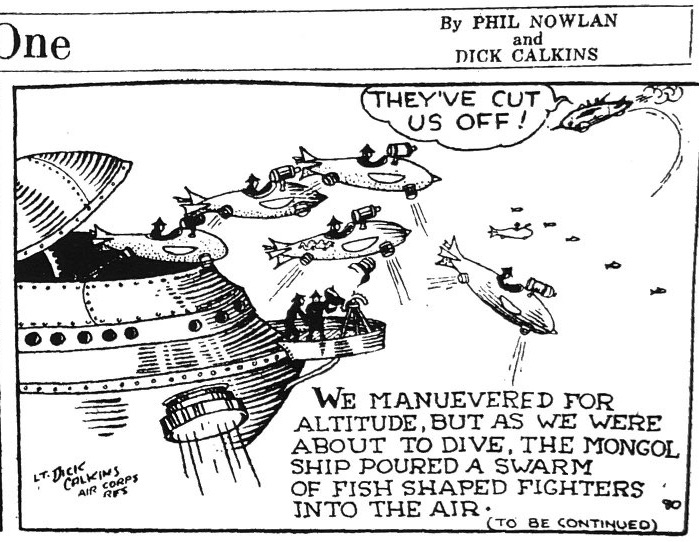
Nowlan and Calkins were most captivating when the former dug into his sci-fi toolbox and the latter married cartoon illustration with futuristic blueprints. They loved to stop the action, blow apart typical panel breakdown and just ogle over the spec sheets of tomorrow. Above, they outline the rebel Americans’ rocket ship cruiser, complete with functional details like “spring landing skids“ that helped us imagine the blueprint brought to life. Nowlan and Calkins’ vision of rocketry seemed effective enough to inform the designs we meet in the movie serial versions of Buck Rogers. Fish-shaped cruisers skidding to a stop on their bellies were a mainstay of the sci-fi serials of the 1930s.

Calkins seemed to take special personal pride in these illustrations, which reflect much greater care and attention to detail than he showed elsewhere. This respect for machinery may have held over from the artist’s WWI experience. He often reverted to signing the strip “Lt. Dick Calkins” and at times adding “Air Corps Res.”

“Iron Man” Origin Story

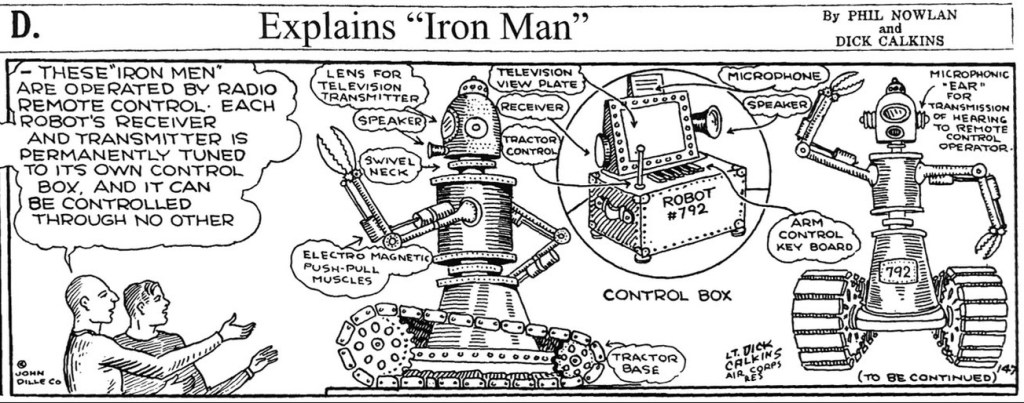
Perhaps the finest Calkins and Nowlan geek out comes with “Iron Man,” their remote controlled robot soldier. They devote what would have been a three panel progression to a panoramic illustration of the device’s specs and functionality.

Past Tomorrows: Back to the Buck Rogers Future

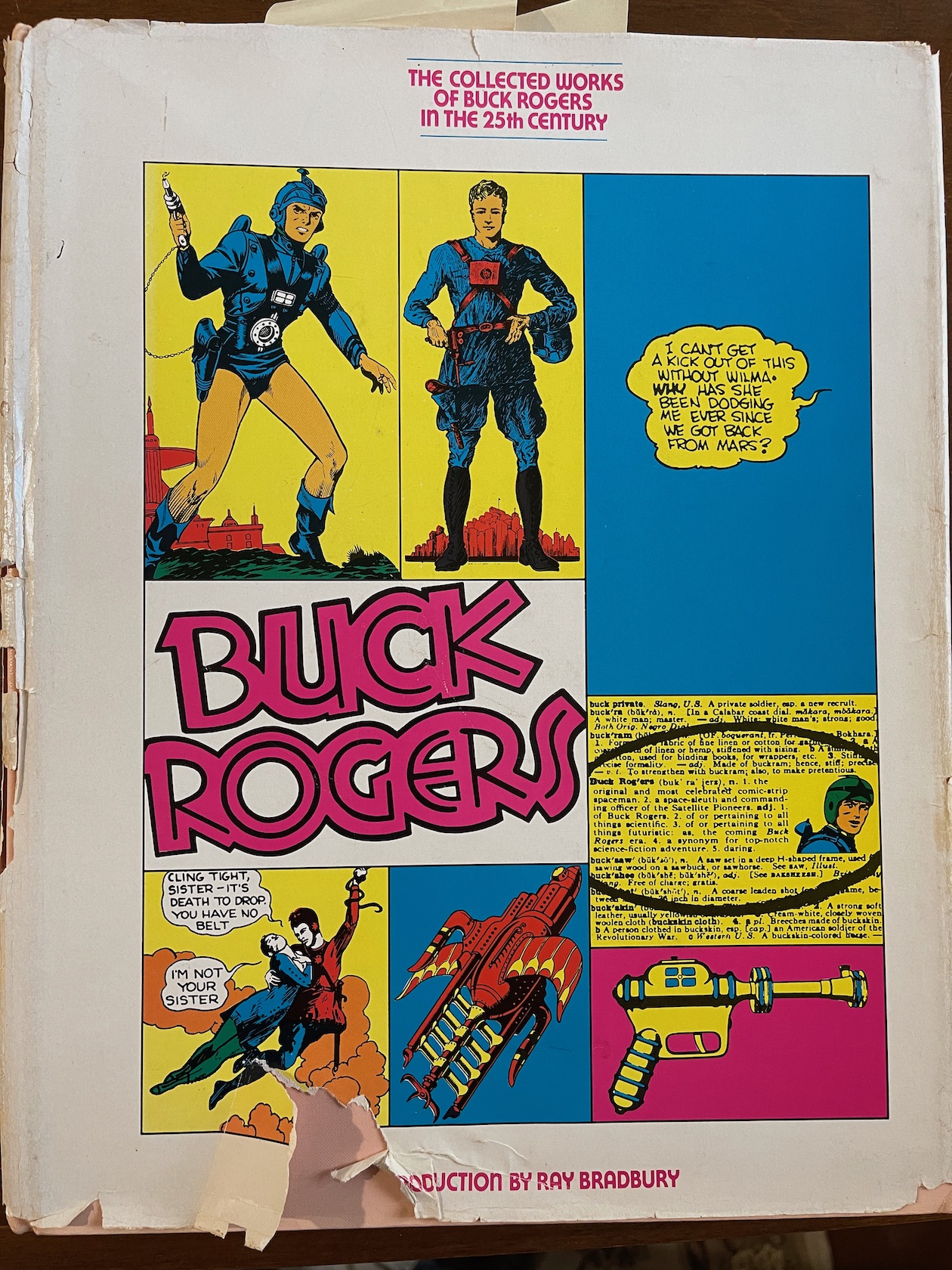
The 1969 moonwalk sparked both a wider interest and new respect for the science-fiction genre and tons of reflection on the ways speculative fiction anticipated contemporary tech. References to our realizing a “Buck Rogers” future flooded the media zone, and Chelsea House published in late ’69 one of the earliest oversized reprints of classic comics, The Collected Works of Buck Rogers in the 25th Century, introduced by Ray Bradbury writing about “Buck Rogers in Apollo Year 1.”

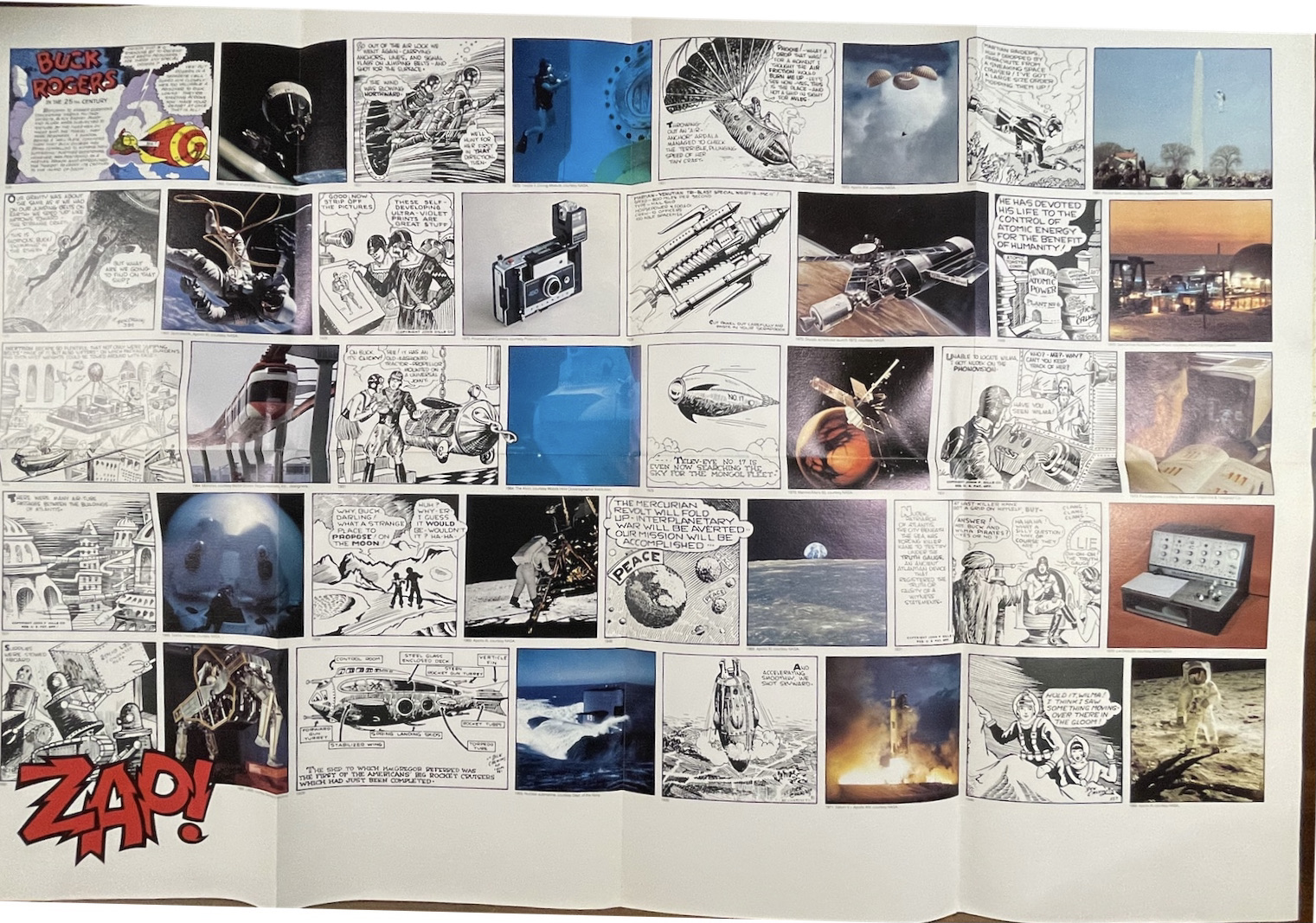
I was age 11 at the time, and had my own fleeting dalliance with sci-fi that drew me to this Chelsea volume at the local library and helped start a much deeper, longer love affair with newspaper comic strips. But an unusual source of comics fandom came into my house at the same time – a trade advertisement for high quality paper stock from the Warren Paper company. Some background. My father was a commercial artist with his own small ad agency in Northern New Jersey. We received at the home office a ton of trade magazines and ads. The S.D. Warren Paper Company promotions were far and away the smartest, most alluring trade marketing I have seen, then or since. To demo the print effect of their premium paper stocks, they created these lush, deeply researched pieces of content marketing that dug into topics like magic or the history of the circus, etc. I recently came upon the one Warren promote that remains etched in my memory – the 1970 celebration of how the Buck Rogers strip imagined accurately the gadgetry and transformative technology of the future.

The one-piece fold-out opened first onto that gorgeous splash above, with the classic Dick Calkins portrait of Buck in mid battle. These are the kinds of magnified newspaper comics images that helped the 12-year-old me into a love of the form. The line art of Calkns, Chester Gould, Will Eisner are among the first classic artists to captivate me. The art style of Buck Rogers felt at once primitive and technical. Calkins did not have a strong of perspective or even anatomy. Most of his figure positions look stiff rather than dynamic. And yet he brought to ray guns and flying ships a dreamy precision that made them live, perhaps even more than his humans.

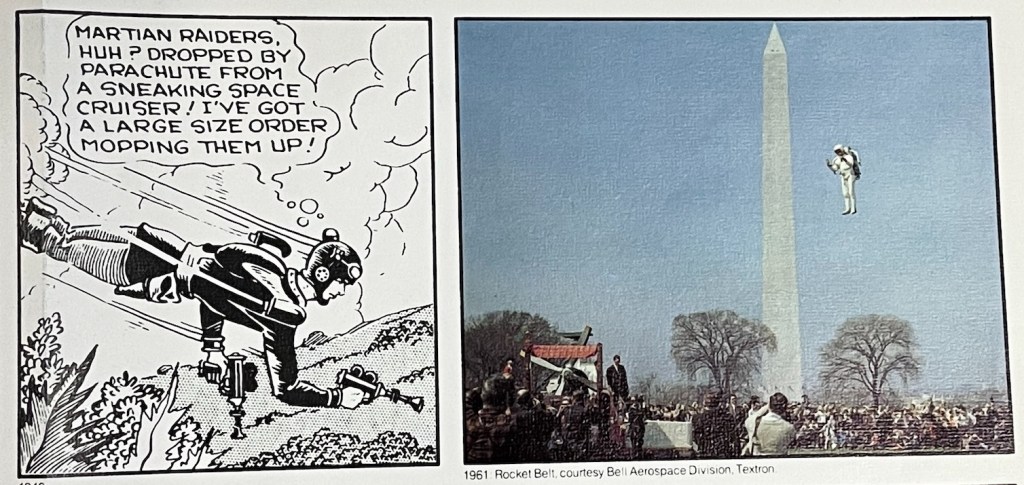
The Warren promo folds out above to a panorama of comparing old Rogers panels to modern innovations like instant cameras, jet packs, surveillance satellites, monorails and more.

This wonderful look back to how the past imagined its future was all in the service of showing off S.D. Warren’s “Lustro Offset Enamel” paper stock, a product name that itself sounded a bit like a cartoon invention. Still, you can’t argue with a content marketing campaign so well done that an 11-year-old remembers it fondly 50 years later.

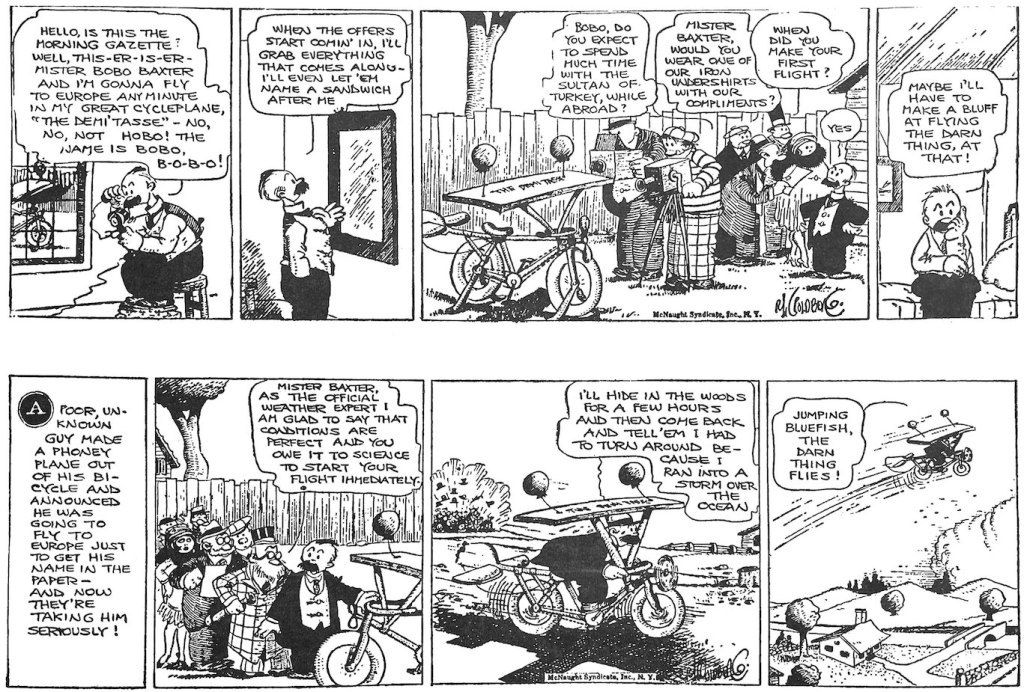
Bobo Baxter: Rube Goldberg’s Bleak Screwball

Rube Goldberg (1883-1970) is best remembered for his cartoon inventions, ridiculously intricate mechanical solutions for common activities. These send-ups of modern technology and the romance of engineering appeared under multiple titles and formats across his career, but took most regular form in Collier’s Weekly between 1929 and 1931 as The Inventions of Professor Lucifer Gorgonzola Butts, A.K. His Foolish Question panels ran from the teens in various forms for decades. And his best-known continuous character strip of hapless failure Boob McNutt ran for more than a decade in the 1920a.

But it is in his forgotten small masterpiece Bobo Baxter (1927-1928() that I think we see Goldberg’s array of talents for satirizing the modern world come together into a persistent and satisfying whole. And at the same time Bobo shows how a sad note of alienation often lurks beneath the surface of many slapstick characters.

As godfather of comics historians Bill Blackbeard points pout in the intro to a 1970s reprint of the complete (Hyperion Press, 1977) run of strips, Bobo Baxter represented Goldberg moving (or being forced by trends) away from the gag-a-day format to the continuous characters and situations of other 20s strips like Little Orphan Annie, Bringing Up Father, The Gumps, Polly and Her Pals, etc. He had already made his Boob McNutt Sunday strip into a major hit by introducing recurring characters and continuing storylines. In 1927 he sent the form into a daily new creation, Bobo Baxter. 

We meet Bobo as an unsuccessful dreamer, envious of the fame and fortune of well-publicized explorers like Admiral Byrd and aviator Charles Lindbergh. So he builds a flying machine out of a two-seater bicycle, prop,  wing and some balloons. He seems as surprised as anyone that it flies, and he dubs the contraption “The Demi’Tasse”, bound for glory by flying across the Canadian border.

Bobo’s fixation on fame, celebrity and the press course through the strip. He is forever courting journalists and dreaming for the headlines he thinks his oddball journey will merit.

The discipline of storyline and continuity seemed to inspire Goldberg’s satiric sensibilities. In many ways the story becomes a picaresque journey through modern American social types and institutions – all of from which Bobo himself seems woefully alienated. 

Bobo himself is pathetically friendless, and a bit of a comic nebbish. At one point early in the strip he mistakenly reserves a table for his entourage at  the pricey Cafe Du high Hat. When Bobo can’t recruit anyone to come with him, he ends up animating a group of mannequins. 

Likewise, Bobo spends the first months of the strip simply in search of a passenger to bring with him. But it is the haplessness of Bobo’s plan that brings him into contact with a pastiche of American types. There is the desperate henpecked husband who would do anything to escape his onerous wife. There is the jewelry thief who is looking to escape with a pilfered pearl necklace. And there is Bobo’s own assistant Nosedive Kelly who is both too obese and anxious to make the flight but proves to be a self-promoting braggart.

Bobo’s encounters with a cast of American characters produces some wonderful moments where Goldberg’s native visual silliness, satiric eye, and critique of mechanisms both technical and social merge beautifully. Among my favorite moments comes when a Nosedive goes for an insurance checkup. “Your blood pressure is 5 pounds over the legal limit,” “Your ears a very badly designed” and “the hinges of your backbone squeak” he is told.

This is prime Rube. “Goldberg is a satirist not of fads and fanciest of rationality,” wrote Gerald W. Johnson in his 1958 review of political cartooning between the World Wars. 

The hapless comic outsider is a feature of modern comedy that deserves further thought. We see this anti-hero (and it is almost always male) in vaudeville, certainly the silent film clowns and in comic duos like Laurel and Hardy, Abbott and Costello.

But the comic strip turns the figure into a genre. Consider Happy Hooligan, Simon Simple, Moon Mullins, Jiggs, Andy Gump, A. Mutt, Baron Bean, Boob McNutt, among others.

In fact for the first two years of Goldberg’s Boob McN tut, each Sunday strip finds Boob trying to off himself 

In his recent, indispensable history of screwball comics, Paul Tumey characterizes Boob McNutt’s early years as black humor that reflected the post-WWI disillusionment of 20s America.

Maybe. I am more inclined to put Boob’s suicidal comedy and Bobo’s desperation for modern celebrity part of a longer tradition of modern comedy and especially the comic strip – the alienated clown. So many of the comic strip’s comedy fops feel themselves somehow on the curb as the great parade of American life goes by.

Indeed it is arguable that the comic strip itself carves this curbside role for us. On a daily basis, we are invited to look over the shoulder of Jiggs, Happy, Boob, Barney, Jeff, Popeye, Abner, et.al at a main cast of characters of which we are bemused – part of but slightly apart from.

In future posts I hope to explore further this idea that the daily comic strip often created for us a light satire of modern American life and styles, types and trends that registered and leveraged a sense of middle class alienation from the very world they were creating.