The Unsung Black Heroes

Newspapers by and for predominantly Black audiences were a thriving part of the American press throughout much of the 20th Century in most major cities, even if they have been woefully invisible to most media history. More obscure have been the comic strips and their artists that appeared in many of these major newspapers like the Chicago Defender, Atlanta World and Pittsburgh Courier. The dearth of surviving hard copies and poor microfiche renderings have complicated attempts to retrieve that history to publish much-overdue reprints of some of this work. The 1993 Dark Laughter: The Satiric Art of Oliver W. Harrington is among the only extended reprints of a single Black artist I have found. Recently, however, a few industrious comics historians started filling in this blind spot. Ken Quattro’s indispensible Invisible Men: The Trailblazing Black Artists of Comic Books was among my favorites of last year (reviewed here). Also full of great reprinted work is Dan Nadel’s It’s Life As I See It: Black Cartoonists in Chicago, 1940-1980. And Rebecca Wanzo’s more scholarly The Content of Our Caricature: African American Comic Art and Political Belonging has a unique take on how many Black cartoonists navigated the shoals of stereotype.

Earlier this year a small treasure fell into my lap courtesy of Library of American Comics head Dean Mullaney. During an email exchange about the possibility of reprinting Black cartoonists he sent me this pristine rendering of a rare surviving 8-page color comics section syndicated by the Smith-Mann company and appearing in the Pittsburgh Courier for Nov. 11, 1950. Smith-Mann distributed a full-color section to the Courier for only a few years, from August 1950 to Nov. 1955, according to Allen Holtz, who has done some legwork on Smith-Mann at his essential Stripper’s Guide. The sone of one of the syndicate’s founders has posted his own history and extensive samples of the Smith-Mann comics section at The Museum of Uncut Funk.

This Nov. 11 1950 edition Dean sent me includes espionage adventure Guy Fortune (by Edd Ashe), western The Chisholm Kid (by Carl Pfeufer), gag strips Sunny Boy Sam (by Wilbert Holloway) and Woody Woodenhead (by Edo Anderson), sports adventure Don Powers (by Sam Milai), romance strip Torchy Brown Heartbeats (by Jackie Ormes), adventure Mark Hunt (also by Ashe), sci-fi adventure Neil Knight of the Air (credited only to “‘Carl and Mac”), and animal adventure Lohar (by Bill Brady). The full 8-page section is below. In the coming weeks I will tease out a few of these strips and artists for more detail.

Popeye and Olive Scandalize Father Oyl (1930)

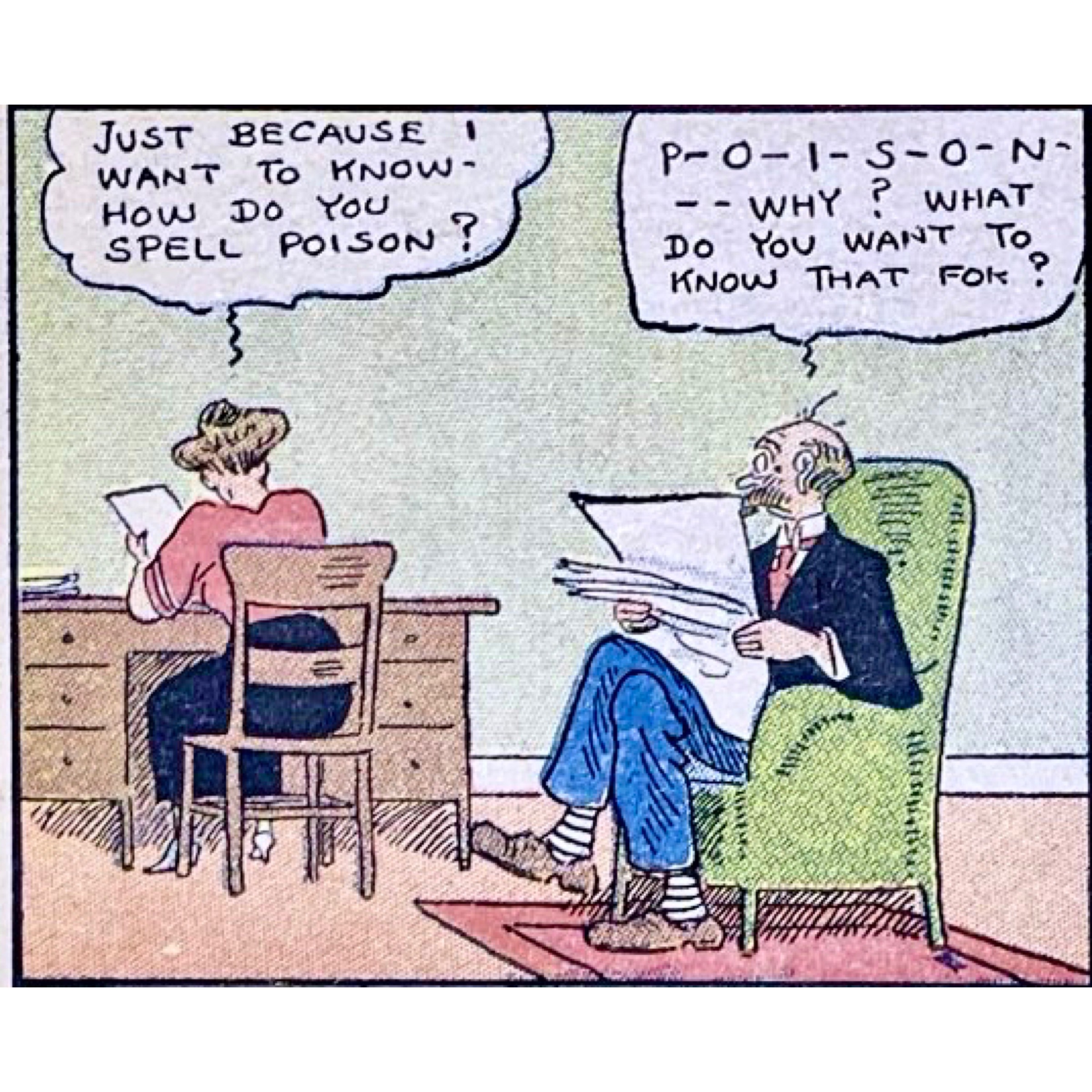
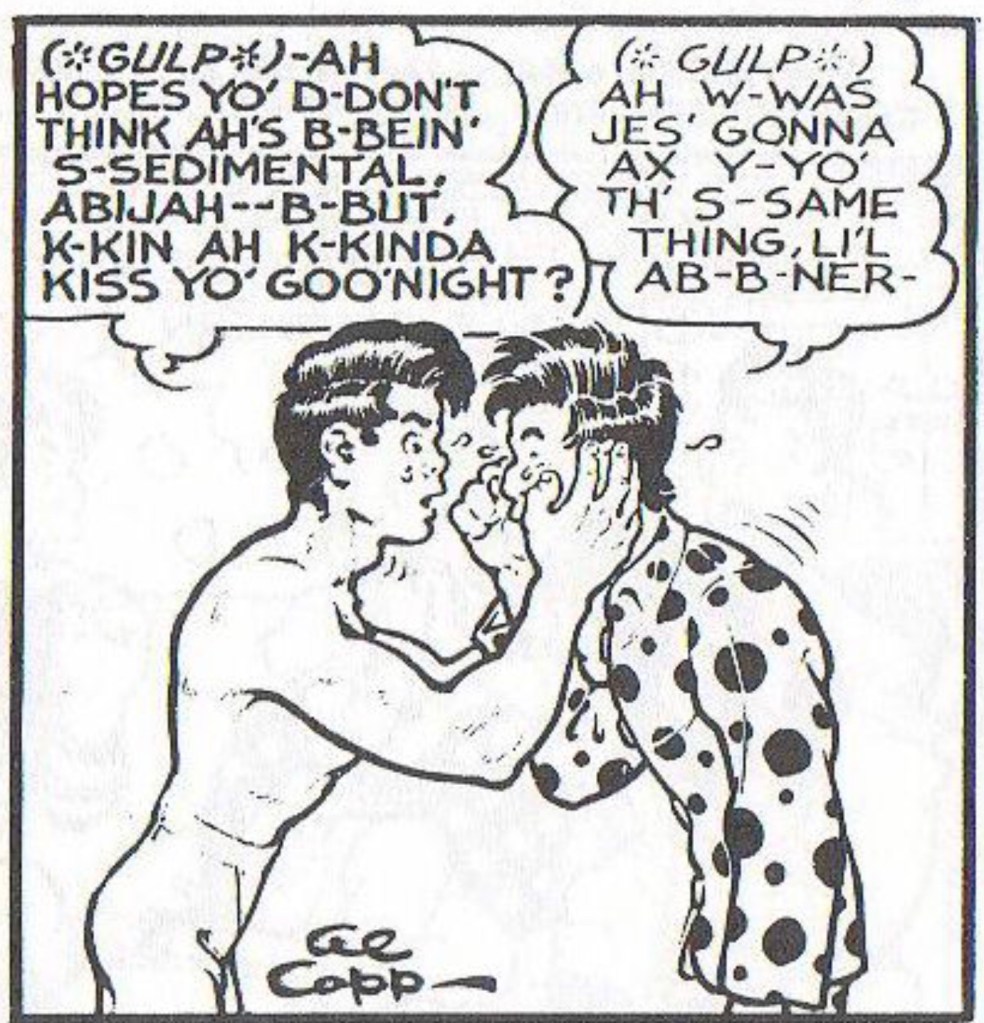
It didn’t take long for Popeye and Olive to hook up after the pugnacious sailor joined the Thimble Theatre in 1929. Popeye because part of the Sunday Theatre in 1930, which is now being reprinted by Fantagraphics. E.C. Segar’s characters had a special kind of grittiness and irascible repartee. And here we see how Thimble Theatre could get remarkably raw. Popeye and Olive’s noisy smooching gets under Mr. Oyl’s skin. The sexuality of the younger generation in 1920s America had been an important topic of discussion across media. WWI had exposed an entire generation to less inhibited European attitudes towards sexuality. The arrival of the automobile especially created a way for boys and girls to escape the scrutiny of their parents. Moral arbiters worried publicly about this new wave of “petting parties” where youth explored their bodies in troubling ways. Apparently, Olive Oyl and Popeye used the Oyl living room for their own personal petting party.

The Emotional Realism of Gasoline Alley

Opper’s Antediluvian Ancestors: The Original Flintstones

This 1903 installment of Frederick Burr Opper’s Our Antediluvian Ancestors bears an eerie resemblance to Hanna-Barbera’s 60’s cartoon sit-com The Flintstones. From the Stone Age name play to the pet dinos to the rock-wheeled auto, it almost feels like source material. The anachronistic approach to the ancients took fuller form in Alley Oop in the 19300s and then again in B.C.

Opper was best known of course for the hapless hobo Happy Hooligan strip and the maddeningly polite duo of Alphonse and Gaston. But in this series we see his affection for the small comic details. Dig that crank and belt mechanism for the Antedeluvians’ car. Apparently, brakes had not been invented yet. Catch the blacksmith shoe-ing the mastodon. And of course there is Opper’s mastery of mayhem. Part of Opper’s physical comedy comes in his telegraphing the disaster unfolding yet still surprising us with unexpected twists. He was helping to invent some of the basic grammar of comic strip slapstick as well as the art of comic timing between panels. I think Opper doesn’t get the credit he deserves for refining some of the physics of early cartoon comedy. He represented frenetic action, cause and effect, and the slow motion effect to establish what made the funnies funny.

Find a deeper dive into Opper’s visual poetry in this earlier post.

Our Antediluvian Ancestors started in Hearst papers in 1901 and ran for several years. While not as popular as some of his other longer running work, this series was reprinted at the time.

Man of Stature: Dick Tracy Promo from 1961

Even 30 years into one of the most successful runs in comic strip history, Chester Gould’s Dick Tracy continued to promote itself to new newspapers that still hadn’t syndicated the iconic hero. This ad ran in Editor & Publisher, the longtime trade bible for print periodical publications. Of course, this “man of stature” led the most grisly, violent and truly weird of all American comic strips. It was also one of the most compelling. For a gallery of gruesome villain deaths, see this earlier post. On the impaling of The Brow. On the general strangeness of Gould’s imagination. On Gould and Tracy’s conservatism.

Serious Fantasy: Nell Brinkley’s Flapper Feminism

A wildly successful woman in the man’s world of cartooning, Nell Brinkley (1886-1944) was intent on letting her comics page heroines have it all. Fantasy was the passport Brinkley used to ferret her characters and readers from the domesticity most experienced to a world of self-expression, assertiveness, fame and professional success. I have written a bit about Brinkley in an earlier review of Trina Robbins’ superb Flapper Queens, and I am in the middle of writing an extended essay on her under-appreciated importance to comics history. But here is a compact example of the wonderful extravagance of her romantic fantasies and the ways she channeled for women a growing frustration with the social roles available to them in 1920s America.

Dimples’ Day Dreams from 1928 came late in the series of graphic short stories Brinkley drew through much of the 1920s, each of which would run for a dozen or so weekly episodes. In Dimples, Brinkley underscores a theme present in most of her work, modern women breaking out of the domestic sphere into adventure, professional competence, intrigue, fame. Romantic engagement and marriage often served as the end point of these series, but not the substance of most episodes. In fact, by the time we get to 1928, Brinkley’s Dimples premise is the tension between social expectations of women, Dimples’ boyfriend begging her to marry, and dreaming of bigger, more satisfying lives.

“Be Pretty Mrs. Jones” urges Dimples “droning” boyfriend. Broken down here into its rough panel structure, this episode embodies Brinkley’s use of feminine escapist fantasy as a motif. And the sheer extravagance of that fantasy is such a delicious part of Brinkley’s work. Dimples isn’t just a celebrated film star in this day dream, but her erotic power threatens to “burn the fuses.” The thrill of Brinkley’s work is its excess. There is the excess of line work and detail. There is the material excess of her heroes’ embrace of Gatsby-era materialism, high fashion, eroticism. It is all there and all over the top.

Compared to just about anyone else working in the Sunday comics pages of the 1920s, Brinkley extended the form into a unique kind of visual storytelling. Her “panels” are aimed less at advancing a linear story than hitting different emotional notes to flesh out a central fantasy. Most of her Sunday strip culminate in an emotional climax rather than a gag or story resolution in an oversized splash image. Compare this progression to that other great comics master of fantasy, Winsor McCay (Little Nemo in Slumberland and Dream of the Rarebit Fiend0. McCay’s fantasies end in a final panel where his protagonist wakes from the dream. Brinkley end with the fantasy at its peak.

Nell Brinkley is not only an undervalued pioneer of American comics, but she is an important figure in understanding the complex history of American women in the last century. On a weekly basis she was engaging her audience’s discontent with the social roles available to them and fantasizing a broader range of options. That she had to use extravagant fantasy and daydreaming to get there only underscored the constraints her admiring audience experienced and felt.

Death Becomes You: Tracy Villains Meet Their Fitting End

Retribution was Chester Gould and Dick Tracy’s model for justice from the beginning. The strip started in 1931 literally as a revenge narrative. Standing over the murdered body of his fiancé Tess Trueheart’s father, civilian Tracy swears vengeance on the killers. He quickly joins the police force, but the themes of retribution and conviction by poetic justice remained a hallmark of the strip across four and a half decade run. From the beginning Chester Gould unapologetically crossed the lines of good taste. By the late 1930s in criminals like The Mole, B.B. Eyes, Flattop, Pruneface and the like, Gould started using outward disfigurement as expressive of inner villainy. And the level of explicit violence and even torture in Dick Tracy was unlike anything else on the comics page, or elsewhere in pop culture for that matter.

The revenge motif was baked into the strip’s moral universe. Tracy villains didn’t just need to be sought, caught and jailed. They needed to be hounded and often tortured along the way. Many of Tracy’s prey ended up behind bars, but just as often they met poetically just ends. Gould turned the grisly, fitting deaths of villains into his own special kind of art. Here are some examples from the first two decades of the strip that highlight Gould’s dark talent for retributive justice and capital punishment Dick Tracy style. At these climactic moments we see most clearly the visual, moral and often bizarre world,

Final Curtain for Whip Chute – 1939

Subtlety was not in Chester Gould’s quiver. Here he triple underlines his irony.

B-B Eyes Gets Dumped – 1942

More than anything, Gould loved to kill and humiliate Tracy villains in slo-mo. Here, B-B Eyes hides in a garbage barge in the final leg of a desperate flight from justice, only to get dumped, trapped and drowned. Gould had a special talent for using the panel. framing and zoom techniques to communicate feeling through his use of space. His signature tight shots on dead villains often conveyed the loneliness and claustrophobia of death itself.

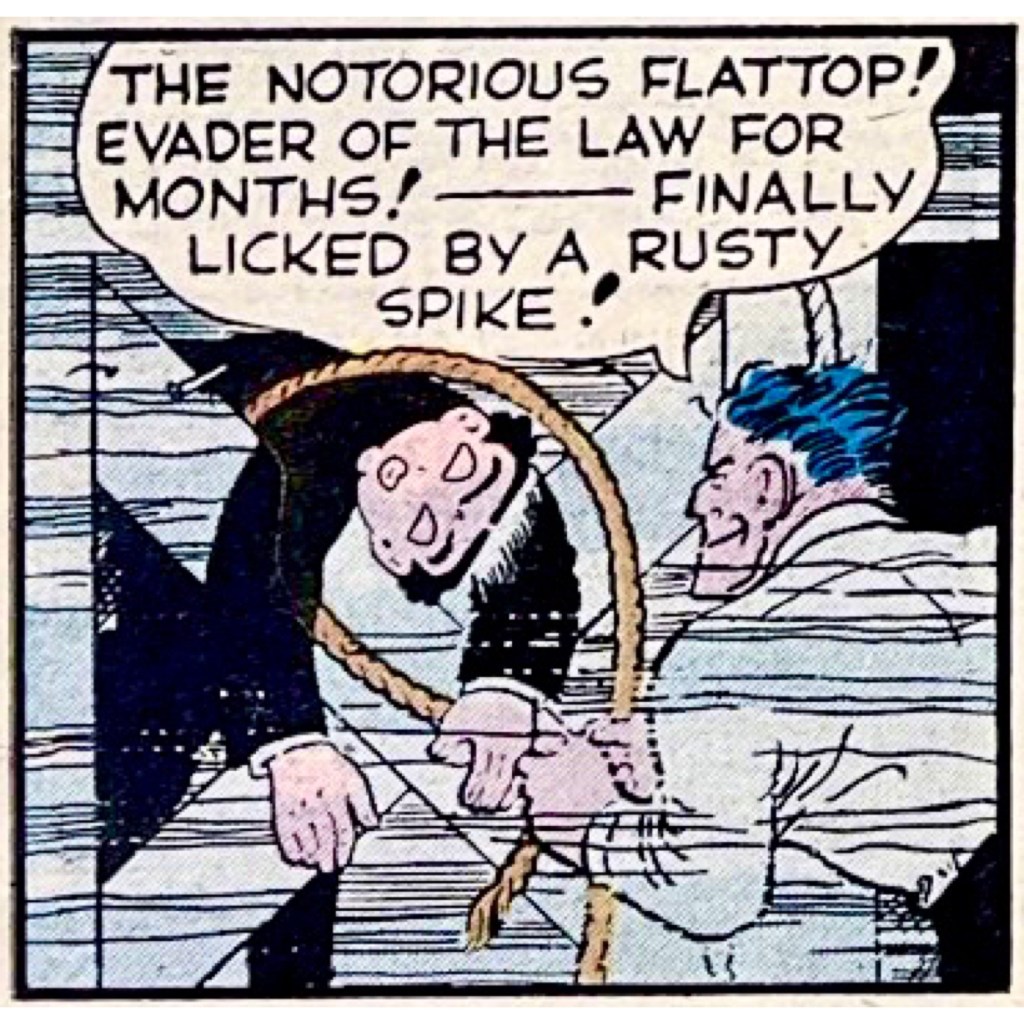
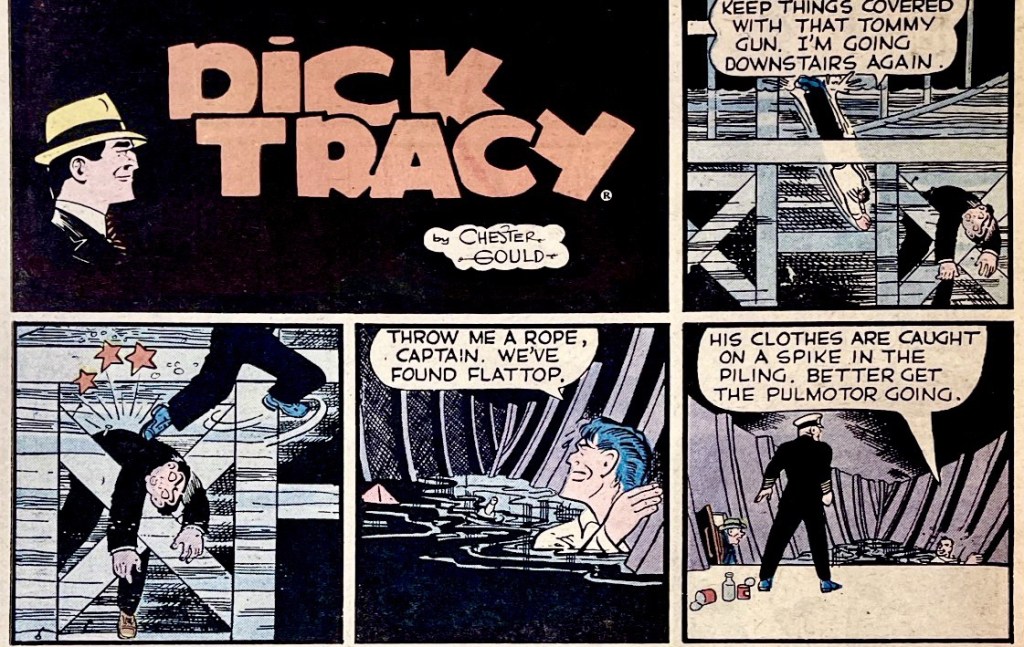
Flattop Gets Spiked – 1944

In 1944, Gould concocted two of his most venal villains. Flattop was simply psychopathic as a hit man, and he would be followed by The Brow, who was sadistic and a spy. Hiding beneath a ship being constructed, Flattop gets hung up on protruding spikes, leading to another close-up of deserving death.

The Brow Is Killed By Patriotism – 1944

Far and away the most inventive and stomach-turning death in the first decades of Dick Tracy was the impaling of The Brow. I covered this in greater detail and with more context elsewhere. But here again is the wartime spy getting impaled on the flagpole commemorating the city’s war dead. The bending flagpole is a gruesomely brilliant touch to amplify that moment of maximal tension that will ultimately pierce the villain.

Gargles Eats Glass – 1946

Falling through a skylight, again in comic strip slo-mo, Gargles gets sliced across three panels. And Gould can’t resist giving us his final shudders. In fact Gargles hangs on until the next strip so his final words exonerate an innocent suspect just in time for Christmas. One of the hallmarks of Dick Tracy was the strip’s extremism, Gould’s penchant for balancing unmatched graphic violence and angry vindictiveness with maudlin sentimentality. This sequence leads up to a Christmas strip that celebrates the villain’s death and the joy of the season.

Mumbles’ Cry for ‘Elp’ – 1947

Making a speech impediment somehow expressive of a villain’s evil was a questionable move to begin with. But Gould doubles down on this conceit by having Mumbles frantically, futiley hail for “ELP”.

T.V. Wiggles Can’t Move – 1950

Gould loved to draw in that little bit of grisly business to convey violence. While he used a heavy, cartoonish line and unreal, expressionist style that set the strip far apart from the illustrative style of most adventure strips, Gould used other ways of communicating hard-boiled reality. He had a penchant for objects penetrating bodies. Bullets often passed through their targets in shootout sequences. And as the deaths of The Brow and Gargles showed, the impaled body has a special place in Gould’s sense of horror. The death of T.V. Wiggles comes from fallen metal sheets that form an ersatz coffin. But it is that little corner of metal piercing a flap of neck flesh that telegraphs the experience of death itself.

Mr. Crime and Judge Mix Blood and Money – 1953

Mr. Crime was among Tracy’s most ruthless, pitiless villains of the 50s, and in the context of the Gould moral universe I am surprised (and a bit disappointed) that he suffers a simple shootout with Tracy. In fact Gould reserves the grisliest image for Mr. Crime’s extorted dupe, Judge Ruling. When cornered, the corrupt Judge chooses suicide. But of course Gould can’t give us a gunshot sound effect heard through a closed door. We have to get an image of Judge Ruling eating the gun, complete with cheek lines to suggest how deep he has planted the barrel. But we’re not done with this duo. As is his wont, Gould closes in for a final tableaux of both villains swimming in their own blood and money.

Flattop Jr.’s Near Miss – 1956

Flattop Jr. was indeed the son of the original Flattop, but he was framed by Gould as a neglected youth who embodied the overhyped scourge of the 1950s – the juvenile delinquent. He appears to meet his end in a theater fire he himself set to cover his escape. Despite the massive explosion Gould depicts dramatically, and the presumption of having died in the inferno, Jr. turns up later where his genuine death takes place in the middle of another villain’s cycle. And so that final contemplative panel here turns out to be ironic.