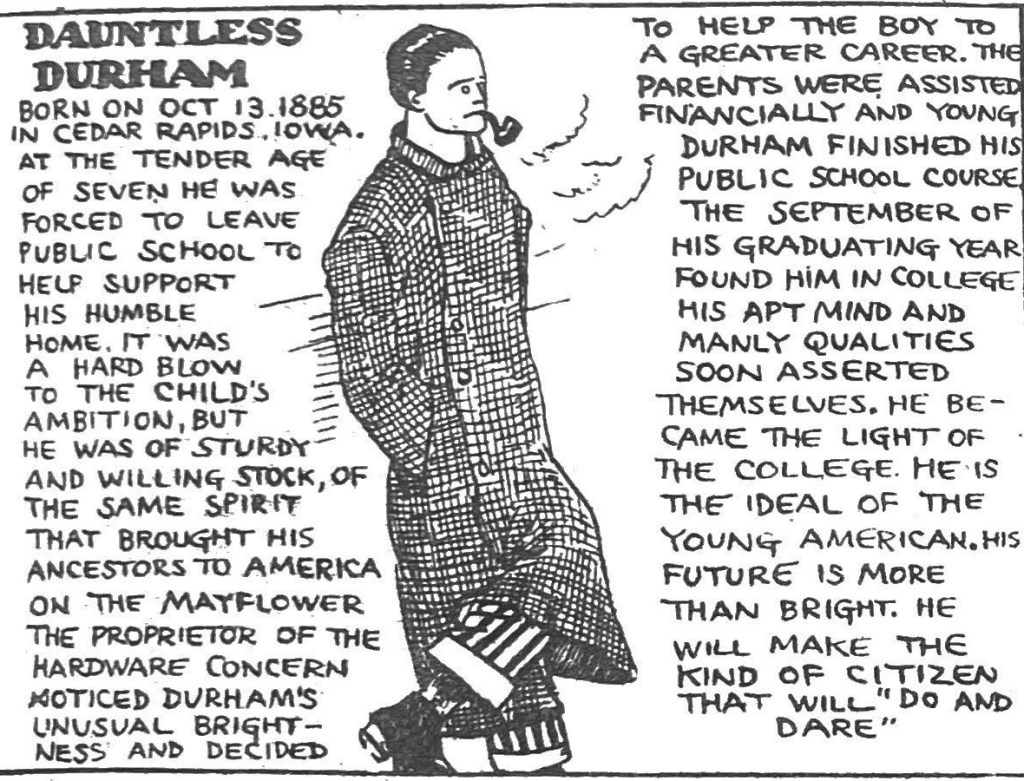
Harry Hershfield’s Dauntless Durham of the U.S.A. only ran for about a year in 1913-14, but it was among the most fully bonkers American comic strips in its imaginative extravagance. Durham was among several sends of the familiar 19th century hero/damsel/villain melodrama. Our damsel is kidnapped relentlessly by the mustachioed, top-hatted Desperate Desmond and rescued in improbable ways from impossible peril.
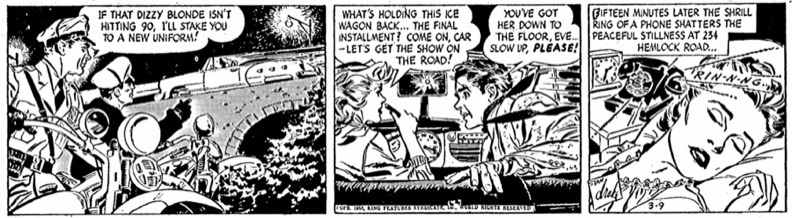
The thoroughly engaging and visually captivating The Heart of Juliet Jones is an underrated gem of 1950s comic strip photo-realism and romantic adventure. Its admirable run began in 1953 (through 1999), under the artful pen of Stan Drake and the scripting of Elliott Caplin. The first week of the strip is added below, and it illustrates the melodrama of the this soapiest of soap operas.
The basic setup involves the Jones family – a widowed father “Pop Jones,” his 30-something unmarried daughter Juliet and teen wild-child other daughter Evie. Sibling rivalry and the tension between responsible Juliet and adventurous man-obsessed Evie form the basic dynamic. I am working from details in the excellent reprints of the early strips by Classic Comics Press (2008). The first volume has introductions by Leonard Starr (of Mary Perkins fame) and Armando Mendez.
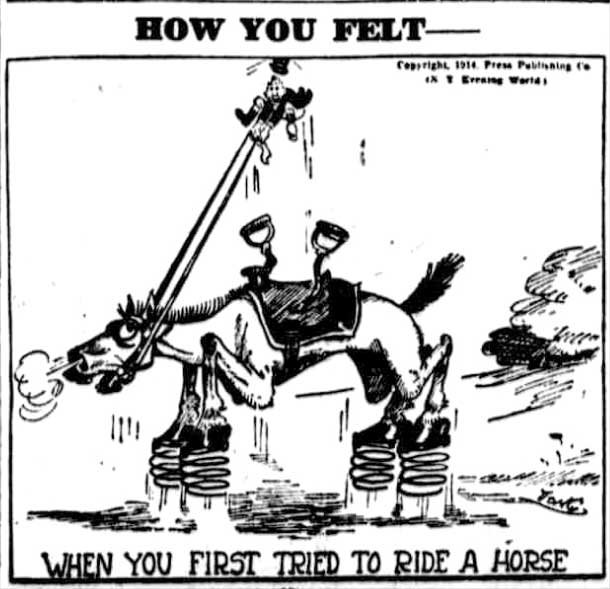
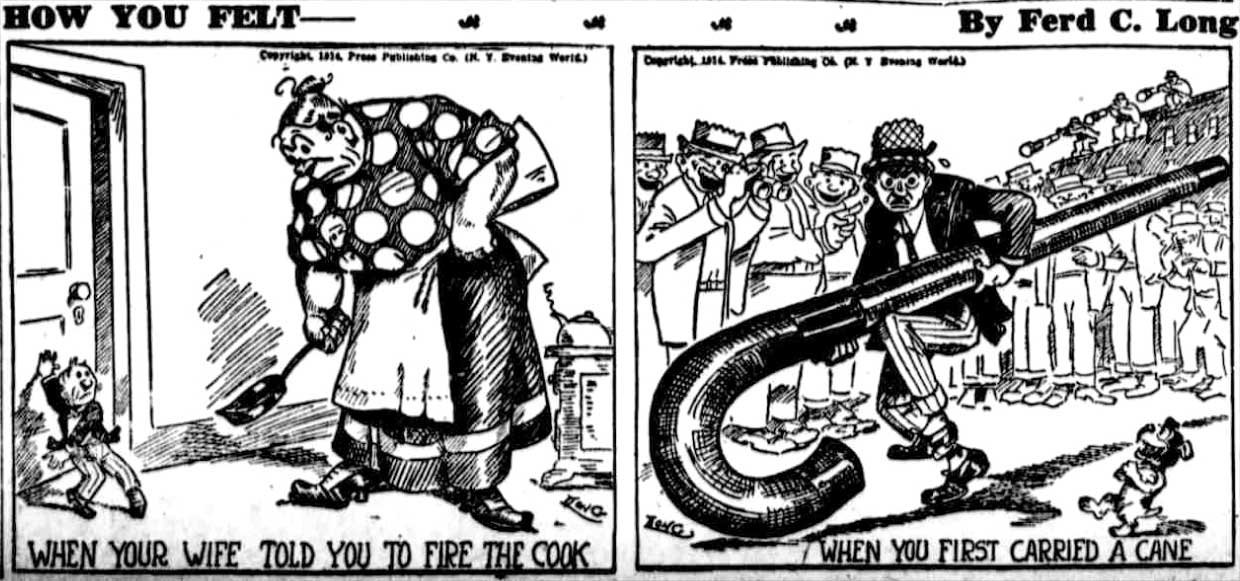
I don’t know who this Ferd. C Long was, nor how long the engaging “How You Felt” strip ran. But it captured me instantly as a great example of early cartoon experiments that explored some of the unique qualities of the new medium. The great team at Barnacle Press, who nobly harvest every scrap of early comic strips they can, gathered these. Like many strips of the day, it took up a simple single conceit – in this case using visual exaggeration to capture a feeling. The result is a fantastic surrealism that communicates in a singular way a range of small and common responses to the world.
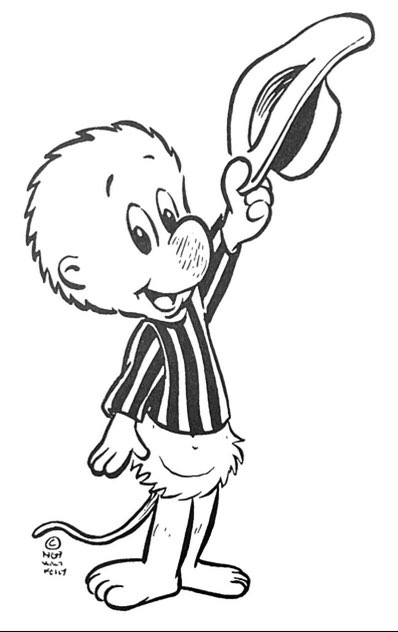
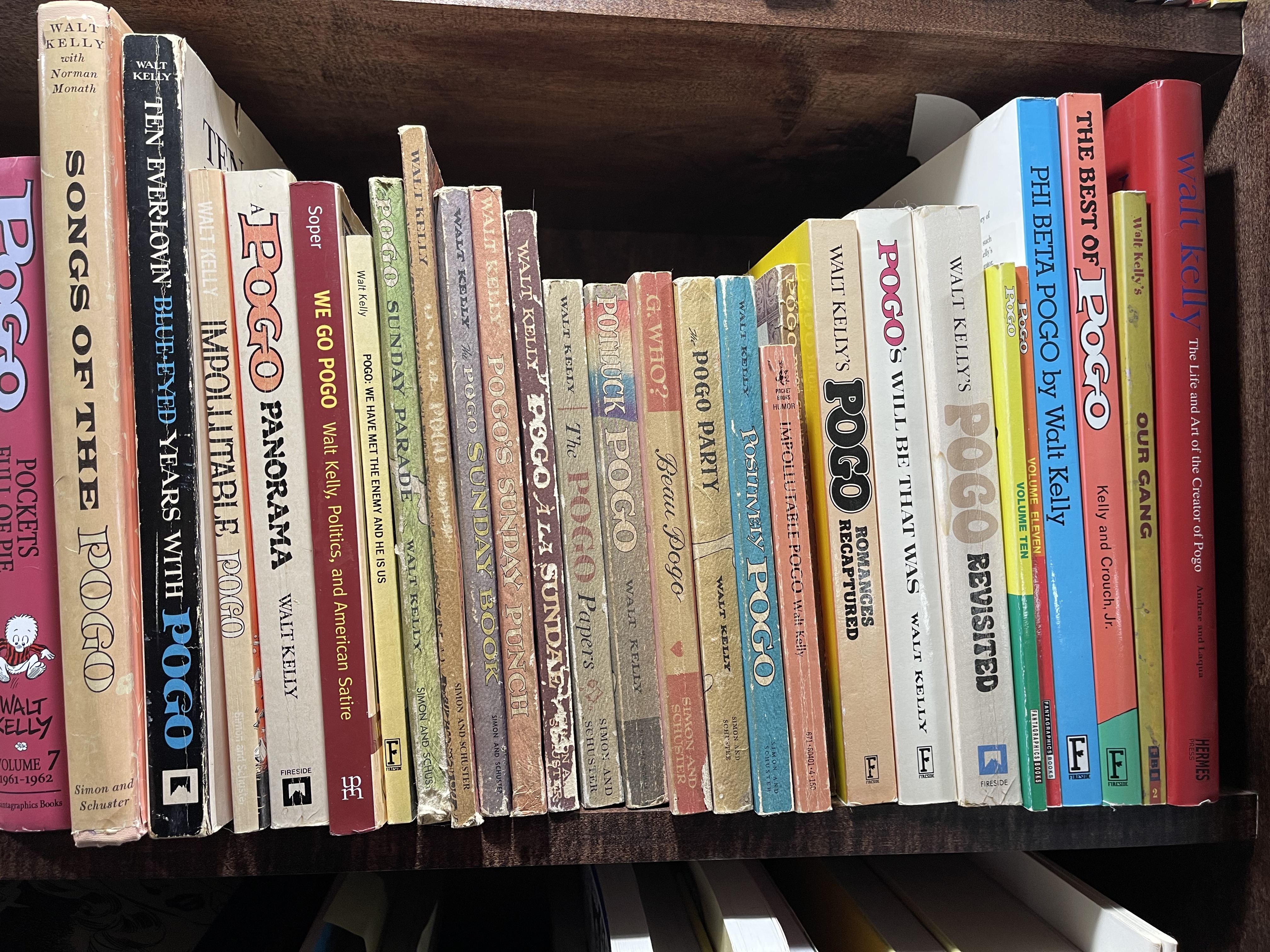
One of Pogo Possum’s best swamp buddies, Robert Yarrington, my friend and father-in-law, passed this weekend. Bob had been reading Walt Kelly’s masterpiece in all its comic book and strip forms from the time “Pogo and Albert” first appeared in Dell comics years before that small world was revived and expanded as the Pogo strip in 1948. He amassed a small library of the familiar old Pogo reprints over the years that he bequeathed to me when his grew unable to enjoy them, and we both worked through the recent Fantagraphics complete reprint together. Bob’s steel trap memory for the books and comic strips he read even decades ago always left me aghast and humbled. I barely recall characters and endings I read last week let alone when I was 20. One of my joys over the last decade has been bringing Bob new reprints of Pogo, Little Orphan Annie, Prince Valiant (one of his particular faves) and some of the pulps he loved like Erle Stanley Garner’s A.A. Fair series. His eyes widened as his memory kicked in and I knew he was about to recite some piece of minutiae from a strip or potboiler he had read six decades ago. It was a treat to see someone who lived and relished pop culture so deeply. Comics helped him learn to read, and he repaid the favor with lifetime devotion to the medium.
Bob’s Pogo collection remains enshrined on its own shelf in the Panels and Prose Library.
Here are just a few Pogo passages to remember Bob I think he would like.
Bob was especially fond of the Pogo songbook and Kelly’s artfully fractured versions of familiar standards. The joke at the core of “Deck Us All With Boston Charlie” is that none of us remembers the full lyrics to Christmas Carols. Kelly’s crew, however, have trouble remembering their own wrong version of the song. And so in Okefenokee Swamp, during every year’s run-up to Christmas, Kelly comes at the same joke in different ways.
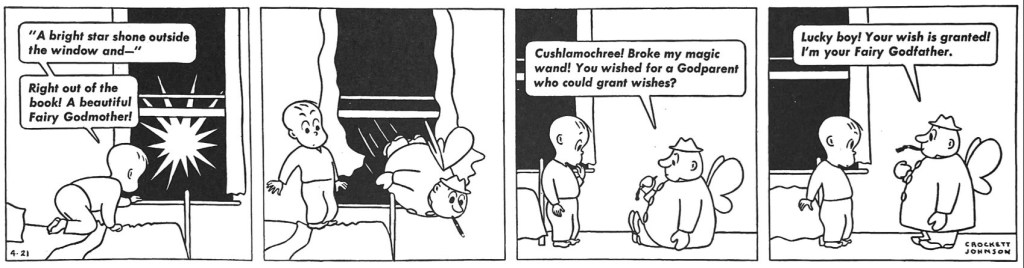
Bob had excellent taste in comics. He was thrilled that Fantagraphics was reprinting one of his youthful favorites, Crockett Johnson’s Barnaby. Starting in 1942, this wild tale of a boy, Barnaby, and his cagey, cigar-smoking, scallawag Fairy Godfather Mr. O’Malley is a singular American classic Bob pushed me to appreciate. I didn’t warm to it immediately but have come to appreciate this wry take on parenting, childhood and modern American life.
In his last days with us, and after he could enjoy the stream of volumes we sent him from the Library, he did enjoy the company of our English Setter Nicky, who is a bit of a cartoon himself.
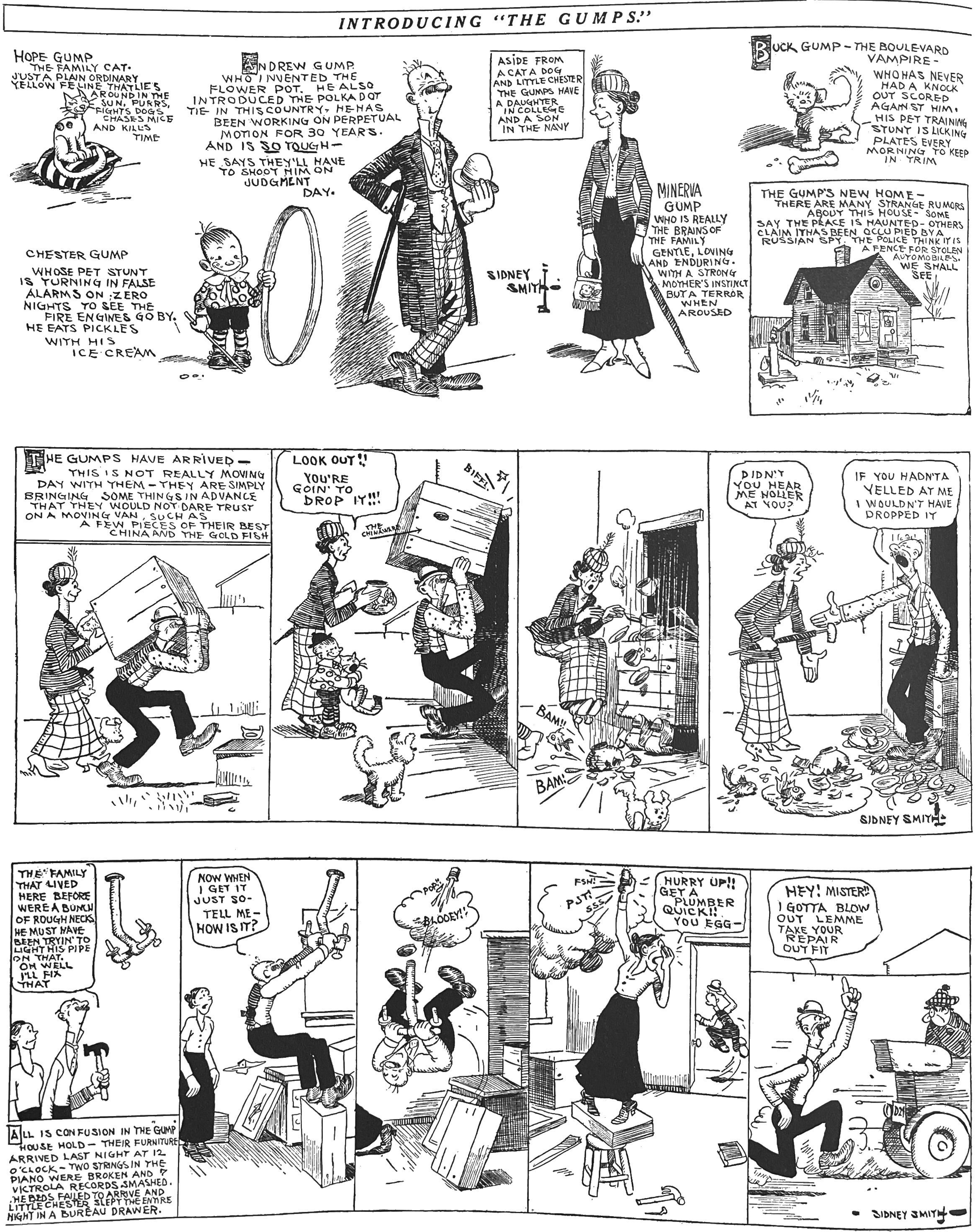
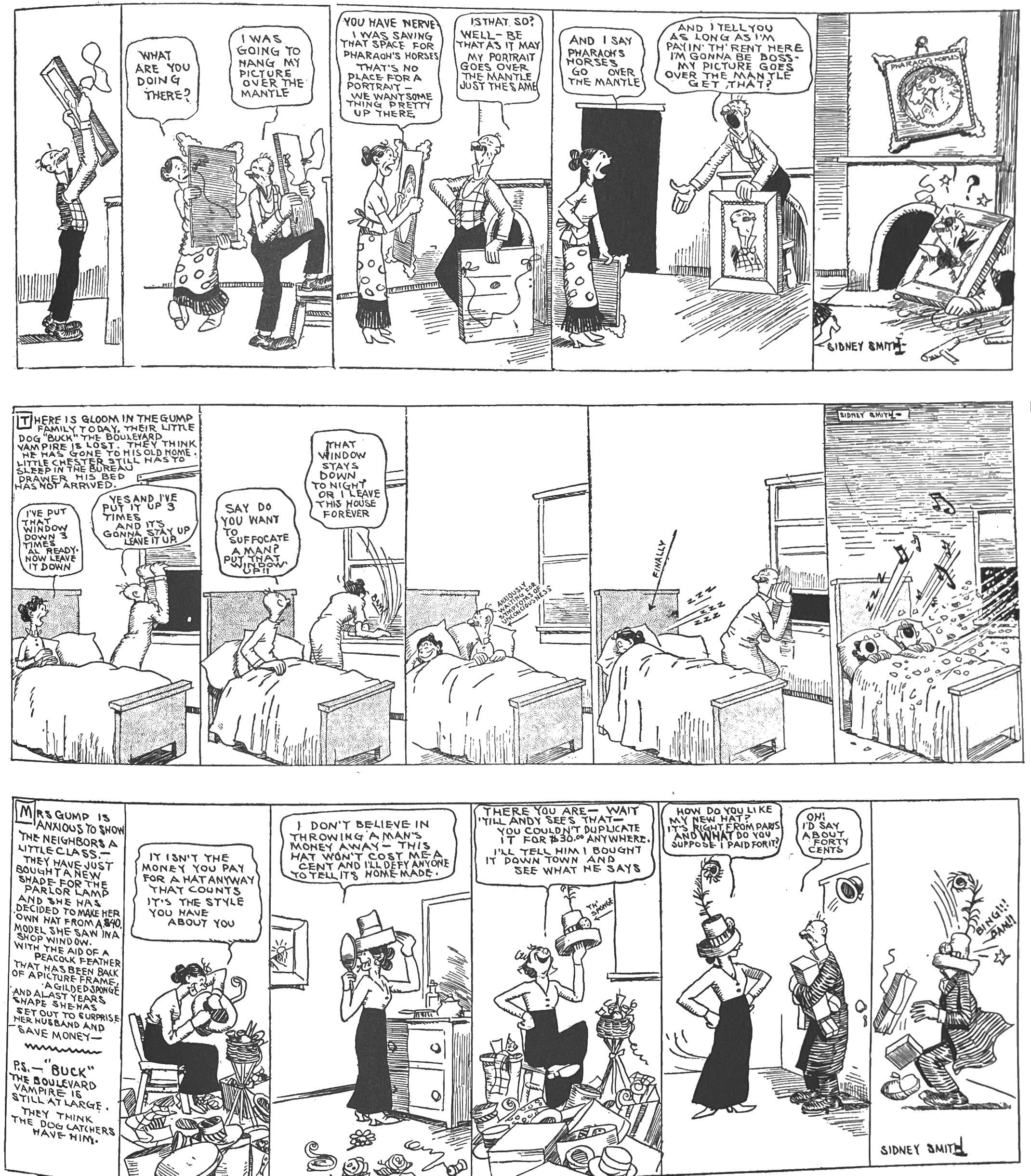
One of the singular comic strip launches must be the artful transition from Sidney Smith’s relatively short-lived (1912-1917) Old Doc Yak to one of the great runs of inter-war family strips, The Gumps (1917-1959). Doc Yak was a goat and centerpiece of an early sitcom daily. Smith ended the Yak run to start his Gumps series by literally evicting his hard-luck goat from the premises. In the early days of 1917, Yak’s landlord threatens to toss his deadbeat tenant unless he pays up. Failing to raise the back rent, Yak takes a powder, leaving the landlord with a taunting note (never likes the place anyway) and an empty property. In the final panel of Feb. 10, 1917, the landlord announces that new tenants will be moving into the property and the strip on Monday.
And on that following Monday, indeed, the eerily jawless Andy Gump and the Gump clan are introduced. The strip was quite literally vacated by one character and occupied by a new one. in fact, in the closing day of the Yak series Smith tells the reader “Doc has but one day left to raise the rent or be thrown off this page.”
Andy Gump himself would go on to become one of the most recognizable and seminal sitcom dads in the early decades of century. The besieged and aggrieved comic father figure had been foreshadowed already in the Dingbat Family, Bringing Up Father and Smith’s own Old Doc Yak. But Andy helped crystallize and propel the sitcom formula. Overconfident of his knowledge, skills and savvy, Andy was the kind of oafish but ineffectual blowhard that would become the bedrock of radio and TV family comedy for, well, forever. His patient wife Min is understood as the quiet “brains of the family” as well as its heart. Life of Riley, The Honeymooners, The Jeffersons (and pick any 2000s famcom) rode the same formula. Which is to say that America has been laughing about the middle and working class father figure pretty much since they were invented. But the formula really seems to have taken shape in the comic strips of the 10s and 20s.
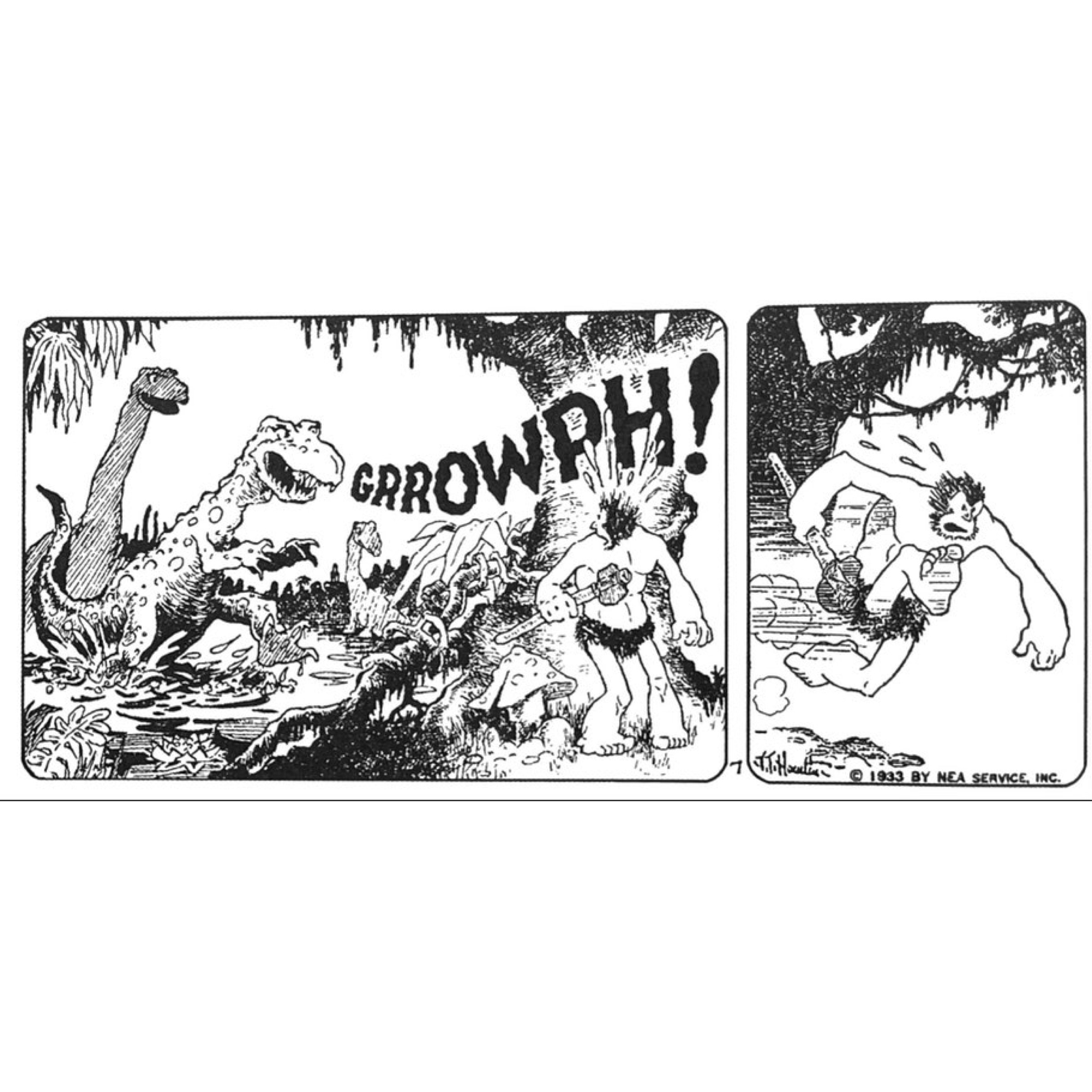
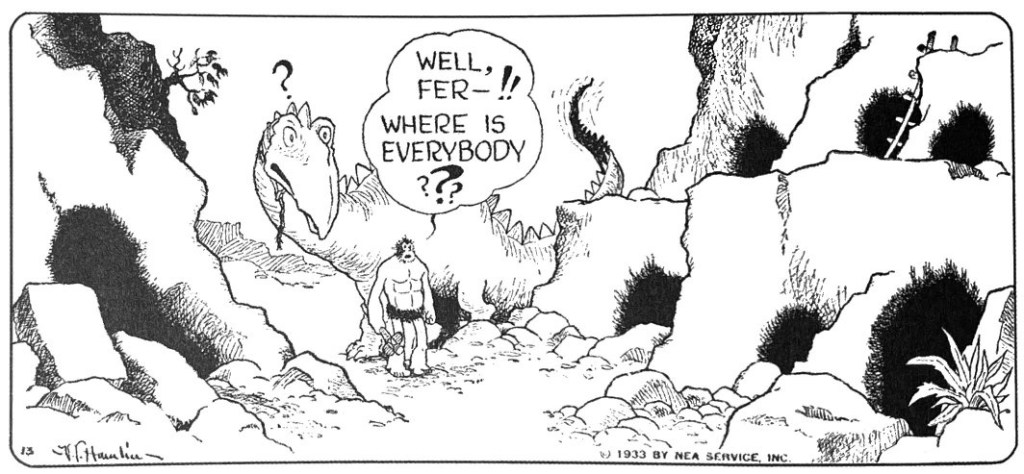
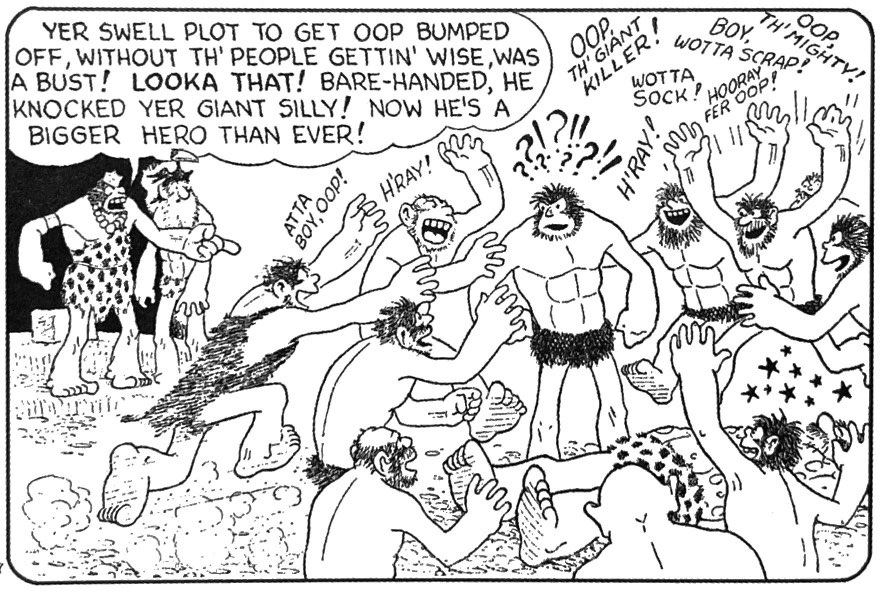
“Off to a Flying Start” is how V.T. Hamlin titled his introduction to the Alley Oop character and world in late 1932. And in fact Hamlin’s eponymous hero cries for help in the opening panel…only to be chased by the prehistoric dinosaurs of this fantastic “Bone Age.” For the next six or seven years, Hamlin’s art and story were at their best when his furry-crowned, thick-limbed everyman scurried at the center of screwball mayhem. We now have a great opportunity to review and reconsider Alley, as the small press Acoustic Learning recently launched reprint series of both Hamlin’s early adventures and later work by his successor Dave Graue.
My first impression diving into Alley Oop is Hamlin’s strong feel for set, background and character design Hamlin had from the beginning. Unlike Segar’s Thimble Theatre, Capp’s L’il Abner and certainly Gould’s Dick Tracy, Alley Oop doesn’t begin in a crude style that only finds its signature style over months and years. Hamlin goes into Alley Oop knowing he wanted to contrast fine-lined, simple but polished characters with detailed and accurate scenery and dinosaurs. Hamlin had a cultivated curiosity about prehistoric creatures in one of his many jobs as an illustrator in the Texas oil industry. He well knew the historical fantasty at the center of Alley Oop. The age of dinosaurs long preceded any human ancestors. But he was dedicated to drawing, naming and animating his Bone Age dinos as accurately as he could.
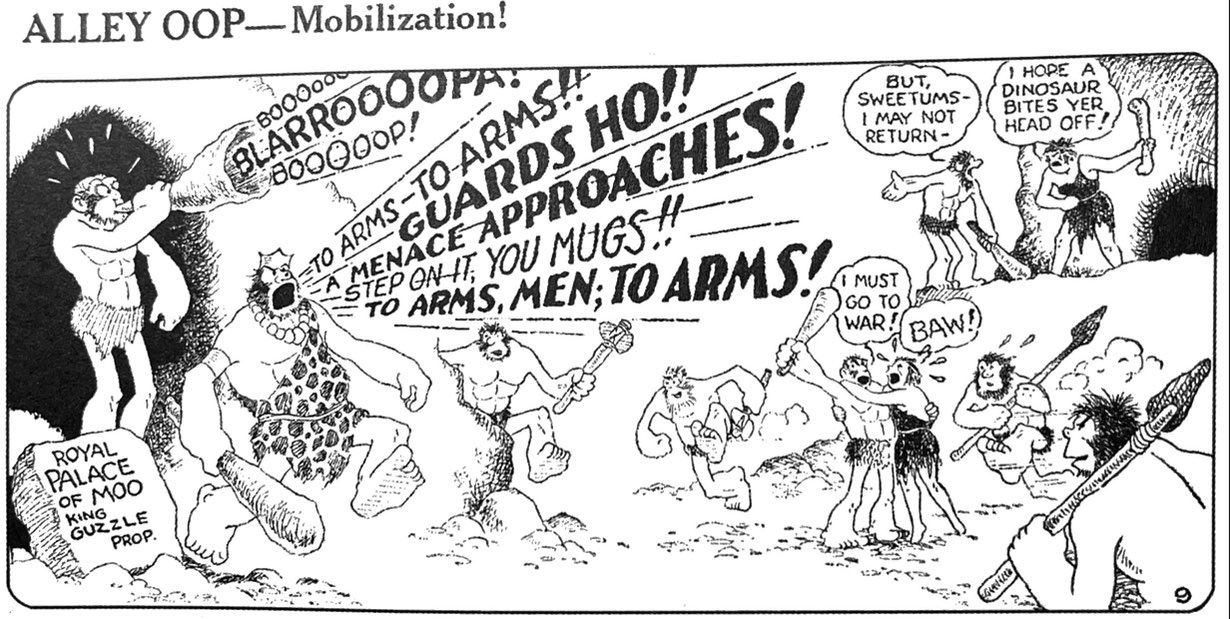
By contrast, his cast of cartoon humans, the males at least, are carefully built with a bit of the era’s deco minimalism. Oop, his rhyming buddy Foozy, Guz, the King of the Moos and the tribes of cave men are small of head, with enviable four-pack abs, and forearms and calves shaped like bowling pins. He builds his characters in order to animate them. Those bottom-heavy limbs become wonderful devices when fleeing, fighting or rioting. The action poses, freeze-frames of punches thrown and received, crowds of cave men imploding or exploding, all have an expressiveness that sits between cartoon abstraction and naturalism. This fine-lined, controlled art style is served very well in this reprint. The strips fully render Hamlin’s thin line shading of background flora and the dinosaurs.
Alley Oop is also one of those rare strips, along with Walt Kelly’s later Pogo, that renders the words as part of the art. From the strip’s first panel, Hamlin shows his distinct deco styling for characters shouting. They move from small to larger type sizes, megaphone-like, into the air. And Hamlin plays with bolding, differing type styles and sizes, words moving in and out of word baloons, to express tones, crowd murmerings, sound effects. In some ways he was bringing to his comic strip layers that mimiced the early days of the talking motion picture, still in its infancy when Oop appears in 1932/33.
And much like Segar’s approach to Popeye, even Gray’s Annie, Hamlin brings a populist sensibility to the strip. Conventional wisdom suggests that Alley Oop becomes more interesting and a genuine adventure strip in 1939 when he introduced a time travel device that brought Oop and girlfireind Ooola across major historical ages. But from the start, Oop is an everyman hero, good of heart, who is less of an adventurer than a victim of circumstance. He quickly becomes the unintentional antagonist to King Guz, the insecure and thin-skinned leader of the Moos. Guz envies Oop’s popularity when the cave man returns to the tribe astride his tamed pet dinosaur Dinny. Guz’s machinations to retain prestige and diminish Oop is the driving force of the strip’s first year. Oop fits neatly within the pantheon of Depression-era common many heroes. Prohibition, which didn’t end until the December 1933, and a deepening Depression had already undermined public trust in institutional authority, the purity and wisdom of legal and political institutions. Popular culture registered a generalized distaste for authority in everything from the romanticization of gangsters in the press to images of kings, politicians, policemen and bosses as either hapless or imperious. We usually come upon common men like Popeye, Tom Joad, Micky Mouse and Mr. Oop just trying to go about their business, only to become heroic in the face of the moral duplicity (or just stupidity).
As simple and familiar as these everyman heroes may seem, the idea of the inherently moral, simple and unpretentious “nature’s nobleman” runs deep and long in American culture, extending back to the tales of James Fennimore Cooper’s frontier hero Natty Bumppo and Jacksonian politics of the 1840s. American popular literature is filled with examples of the naturally ethical, American individualist asserting basic common sense and morality against both little human and big insitutional corruptions. Cast as he may be in the Bone Age, Oop was certainly in that tradition, one that had special valence to Depression-Era.
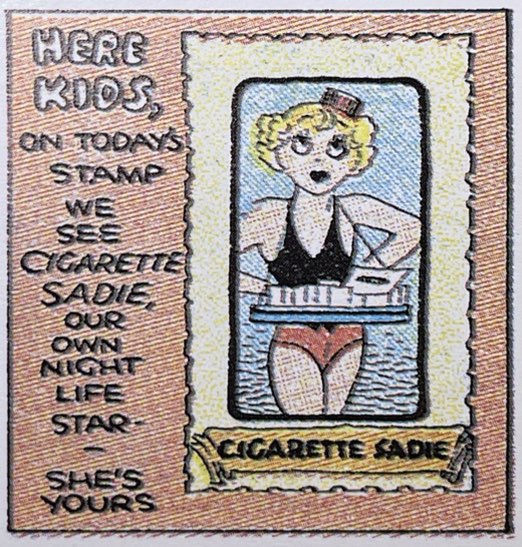
This wise-cracking cigarette girl, seemingly working in an underground speakeasy was an odd “topper” strip for this wildly popular strip. The signature on the fourth panel is the giveaway, of course.
Cigarette Sadie was the filler strip for the Sunday Dick Tracy episodes. Considering the the straight-laced righteousness of Tracy, this was a bit of a counterpoint to the strip’s buttoned-down sensibility. adie is the featured collectable “stamp” in this edition, but in other weeks the collectible usually involved a character from the Tracy strip.











 Panels & Prose