Roy Crane: Shades of Genius

Roy Crane doesn’t seem to garner the kind of reverence held for fellow adventurists like Milton Caniff and Alex Raymond, even though he pioneered the genre in Wash Tubbs and Capt. Easy. Perhaps it is that he lacks their sobriety. After all, Crane evolved the first globe-trotting comic strip adventure out of a gag strip about the big-footed, pie-eyed and bumbling Tubbs. But when he sent Wash on treasure hunts and international treks into exotic pre-modern cultures he kept one foot in cartoonishness style and the other in well-researched, precisely rendered settings, action and suspense. It was a light realism, with clean lines, softly outlined figures, often set in much more realistic panoramic backgrounds. This was not the photo-realist dry-brushing and feathering of Raymond, nor the brooding chiaroscuro of Caniff.

Continue reading

Royal Fetish: Screwball Monarchy in 30s Cartooning

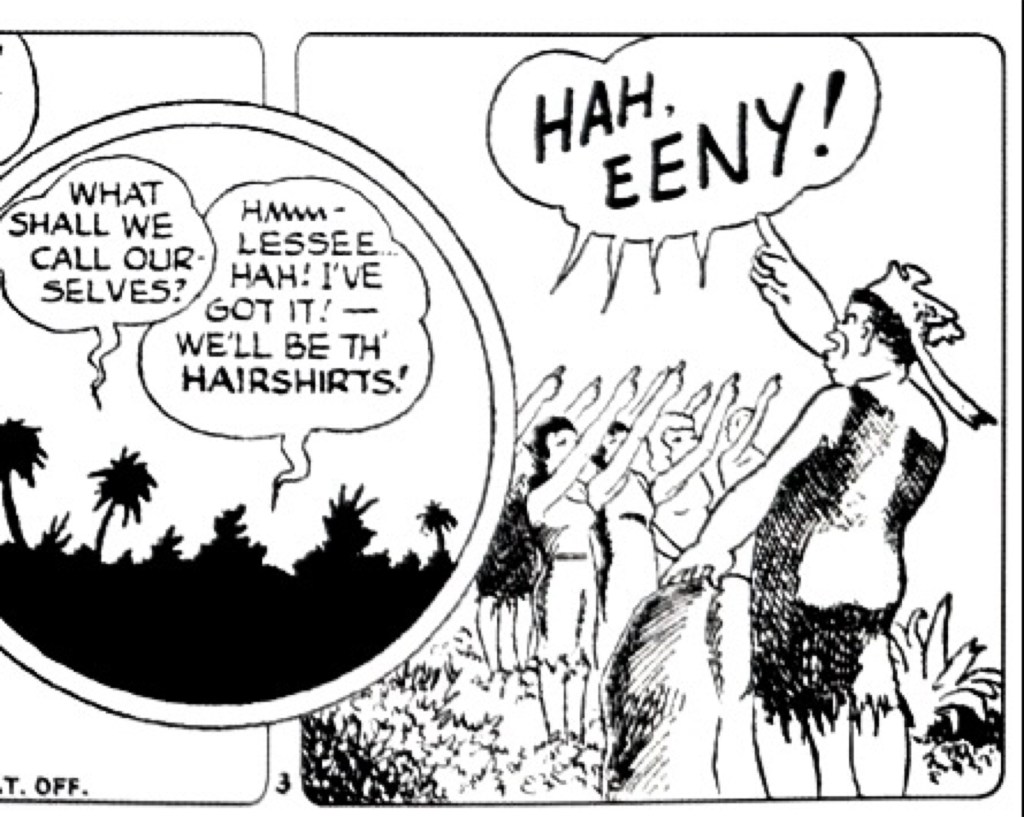
American popular culture took a number of odd turns in response to the trauma of the Great Depression in the 1930s. A fascination with pre-modern civilization, lost ancient worlds, aboriginal tribalism was one of the most pronounced that fueled comic strip fantasy. From Tarzan and Jungle Jim, to The Phantom, Prince Valiant and even Terry and the Pirates, Wash Tubbs and Captain Easy and Flash Gordon, the connection is obvious. At a time when most contemporary institutions were failing, Americans were understandably fixated on pre-modern, anti-modern, prehistoric and fable-like alternative worlds. One of the oddest subsets to this pop anti-modernism was the motif of fantasy monarchy, especially as a setting for comedy and satire.

Continue reading

Red Ryder: Fred Harman’s Scenic Route

One of the longest-lived and popular Western series of the last century, Red Ryder (1938-1965) is barely remembered today…mostly for good reason. Unlike richer, historically-informed efforts like Warren Tufts’ masterful Casey Ruggles and Lance, Red Ryder was closer to Western genre boilerplate, The titular hero is a red-headed journeyman cowpoke who finds and resolves trouble wherever he roams. His woefully typecast sidekick “Little Beaver” was an orphaned Native American boy who provided identification for kid readers, a sounding board for the solitary and stoic Red, and comic relief of a distinctly stereotyped sort. In truth the strip made little effort to delve into character let alone suspense or high adventure.

Continue reading

Junior Marries Moon Maid

By the end of his career in 1977, Dick Tracy creator Chester Gould was notoriously reactionary. His disdain for the counter-cultural forces at play in the 1960s and 70s, for liberal explanations of criminal behavior, were clear in the strip itself. In fact, his resistance to leniency in America’s legal system, and progressivism in general, had been baked into his epic since its roots n the gangster era of 1931. From the start, Dick Tray was an exploration of individual valor and evil rather than institutional or social forces. Gould’s take on the 50s moral panic around “juvenile delinquency” via Flattop Jr. is an excellent example. And the moral universe of Dick Tracy hinged on the personal evil of villains(usually embodied in physical abnormalities) and the poetic symmetry of their deaths via some kind of retributive justice.

Continue reading

Caniff’s Art of the Recap Striptease

Slipping a bit of light erotica into the back pages of the buttoned-down newspaper medium was something of a sport among many comic strip artists throughout the last century. From the ubiquitous Gibson Girls of the the 00s to the curvy and well-delineated flapper daughters and office gals of 20s strips to the imperiled damsels and femmes fatale of 30s adventure, cartoonists understood they were wedging adult cheesecake into a “kids’ medium. Milton Caniff understood the better than anyone the potential here for serving the needs of a daily adventure strip while also pushing the boundaries of the conservative editorial propriety of national syndication.

Continue reading

Li’l Abner’s Culture Wars: Superman, Sinatra and Zoot Suits

One of the pleasures of Al Capp’s Li’l Abner across the decades was that the strip never took itself or any other pop culture phenomenon very seriously. In fact, Capp may have been at his best in his absurdist parodies of pop culture fads, rising celebrities, and politics. Satirical proxies for Margaret Mitchell, John Steinbeck, Frank Sinatra, Marilyn Monroe, Elvis Presley, Marlon Brando showed up in the strip at the height of their popularity. Larger issues like the Cold War, student unrest, Third World politics all found their way to Dogpatch, or Dogpatchers somehow found their way to them. Ironically, what started as a comedy about a backwards and alienated community of big-hearted naives, was really illustrating in its own light way how interdependent and mass mediated the world had become by the 1930s. In Capp’s hands, Dogpatch is anything but disconnected from the rest of the world. The wide world rushes through the hillbilly berg.

Continue reading

Brenda Starr Comes Out Swinging

Like its eponymous heroine, Dale Messick’s Brenda Starr strip had to conquer the systemic sexism of the newsroom to make her mark. It launched in 1940 in constricted, Sunday-only syndication under the skeptical stewardship of New York Daily News legend Captain Joseph Patterson, after he had rejected Messick’s multiple submission for female-led adventure strips. According to lore, Patterson was unabashed in dismissing women in cartooning, claiming to have tried and failed with them in the past, “and wanted no more of them.” Messick’s samples were salvaged from the discard pile by Patterson’s more open minded assistant Mollie Slott, who helped the artist rework her ideas to feature an ambitious and dauntless female reporter. The artist was acutely aware of the gender deck stacked against her. Born “Dalia” Messick, she deliberately adopted the androgynous “Dale” to help get her strips considered more seriously. Slott convinced thge reluctant Patterson to give this red-headed firebrand and Rita Hayworth lookalike a try. History was made.

Continue reading