
R.F. Outcault (1863-1928) institutionalized a number of modern conventions in comic strip history. His Yellow Kid was the first widely recognized recurring character in the newspaper comics of the mid 1890s. And as such he absorbed a key aspect of the emerging modern consumer culture by becoming the first merchandising and advertising juggernaut from the comics medium. And as Bill Blackbeard argues in his exhaustive history of the character, R.F. Outcault’s The Yellow Kid: A Centennial Celebration of the Kid Who Started the Comics (Kitchen Sink, 1993), he inadvertently brought together the fundamental elements of the future comic strip format with his October 25, 1896 half page comic in Hearst’s New York Journal, “The Yellow Kid and His New Phonograph.” (below). Each piece had been seen before. Others had used sequential panel action to depict a temporal narrative. Despite some myth to the contrary, the Kid was not the first recurring newspaper comic strip character of note. The Ting Ling Kids and Brownies both preceded him. And several artists had already used speech balloons to bring speech and image into closer proximity and simultaneity for the reader. But this 1896 strip brings all of those elements together into a compelling synchronous mode of expression.

Comic strip historians have chronicled and argued over Outcault’s role in many innovations in the form, as well as when and where the Kid himself first appeared. Blackbeard’s book is the most comprehensive view I have found. David Westbrook’s analysis of the Kid’s ties to commercial culture are also valuable. Also, R.C. Harvey’s recent piece in Comics Journal.
Richard Marshall’s portrait (1989) is a deft synopsis of Outcault’s bio and contributes a few key insights. First, the Yellow Kid character himself made eye contact with his newspaper audience and became their cypher in a way that was unique and innovative for the form (28). Outcault used the same conceit in his next big blockbuster hit, Buster Brown. Buster’s dog Tighe talks to the reader in wry commentary on Buster’s antics. In both cases Outcault is breaking the fictional omniscience of the reader with a direct address. This both brings the reader into the strip and at once distances them from fully identifying with the action. It constructs the reader not only as spectator but offers a wry, knowing, often skeptical voice to that reader.
Marshall also makes the good point that with the Yellow Kid Outcault started a pattern for the funny pages – kid characters that appealed to both young and old. The comics often allowed for children to identify with the action and let adults observe and enjoy it at once. The comics are singular among popular art forms in their ability to speak across generations and age groups (38).
For my part, I am particularly interested in the way Outcault envisioned the relatively new and quickly growing urban landscape in The Yellow Kid. This represents an important intersection of cultural history and the comic strip in a number of ways. Foremost, the unique qualities of the emerging comic art rendered and interpreted a new reality for America itself – the growth of the major and minor cities, their population by waves of European immigration and migration from shrinking rural areas. The predominantly Irish tenement sections of Manhattan Outcault caricatures in the Hogan’s Alley series for the World and the McFadden Flats/Yellow Kid series in the Journal between 1896 and 1898 were in fact some of the most populous neighborhoods on the planet at the time. Outcault was giving us some of the first visions of crowdedness and the crowd itself we get in American popular culture. Industrialization had helped aggregate people into “crowds” and “masses,” two terms we see coming to prominance at the time. These aggregations of people were easily and often denigrated as “mobs” especially by an anxious middle class and ruling class media in response to collective action, labor strikes and protests. The power and peril of people collected en masse was a persistent anxiety of a rapidly urbanizing America.
It is in this context where I think Outcault’s Yellow Kid tableaux of immigrant class urban childhood achieved their cultural resonance, and perhaps explains some of the comic’s massive if fleeting popularity. Outcault had a way of caricaturing the crowd and the sensations of the city in a nuanced way that both expressed and resolved many anxieties about the new urban reality.
Outcault was not the first to focus on underclass children. During these same years, Stephen Crane wrote and self-published Maggie: A Girl of the Streets, which dove into the violence, class resentment and desperation of the New York Irish working class. In fact this novel begins with a gang beating that was unsparing in depicting child-gangs as fully adult in their capacity for malevolence.
“Howls of renewed wrath went up from Devil’s Row throats. Tattered gamins on the right made a furious assault on the gravel heap. On their small, convulsed faces there shone the grins of true assassins. As they charged, they threw stones and cursed in shrill chorus.”
Journalist and photographer Jacob Riis most famously depicted these neighborhoods as oppressive dens of sadness and scandalous inequity in How the Other Half Lives (1890).
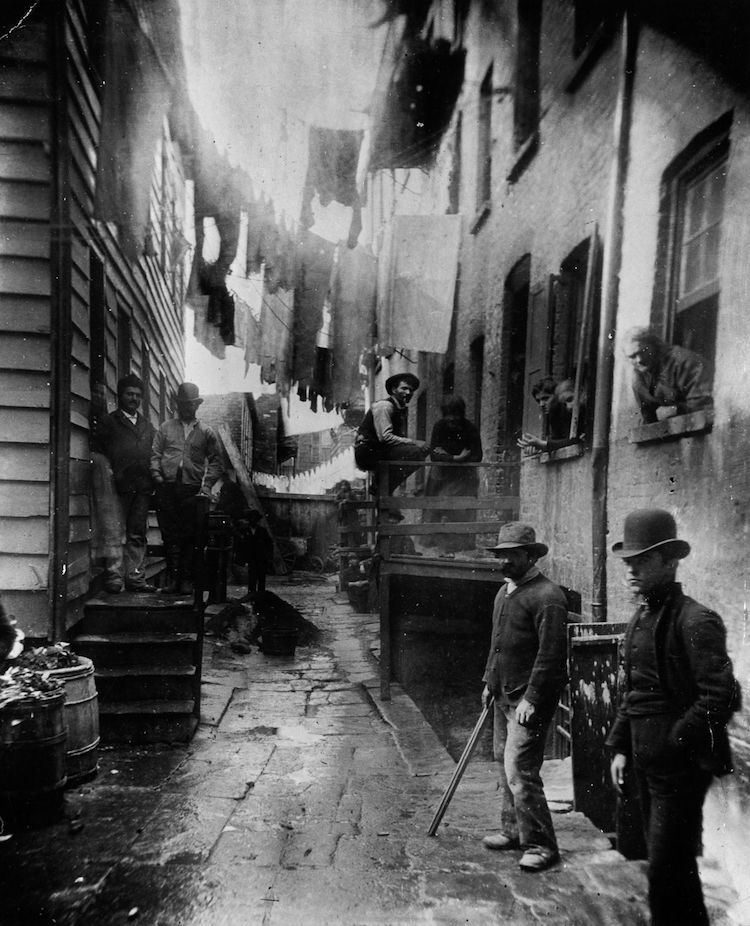
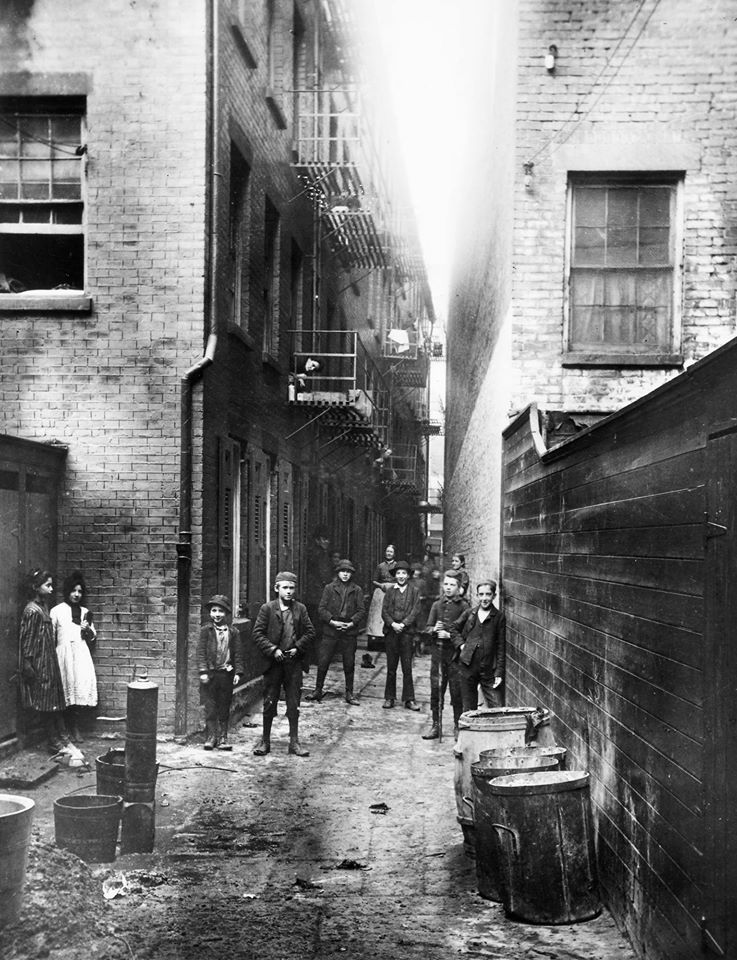
And years before Hogan’s Alley and The Yellow Kid, the urchins of New York’s Hell’s Kitchen were turned into light satire in the pages of the middle class humor magazine Puck by M.A. Woolf. Indeed, Outcault mimicked Woolf’s conceit of depicting impoverished children comically aping the rituals of middle class society.
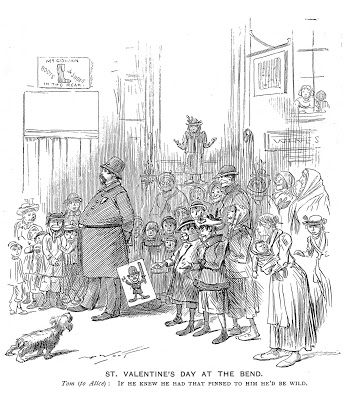
It is in this context of rapid social change, class anxiety, and new urban organization of human beings that Outcault burst onto the scene with a unique creative response to these tensions. Outcault envisioned the urban masses very differently from some peers. He idealized the crowd as a kind of organized, ambiguous chaos – a mass of similar people who coexist in clusters of separate action within the action. And that action is at once violent, resentful, sometimes tender and more all at once.
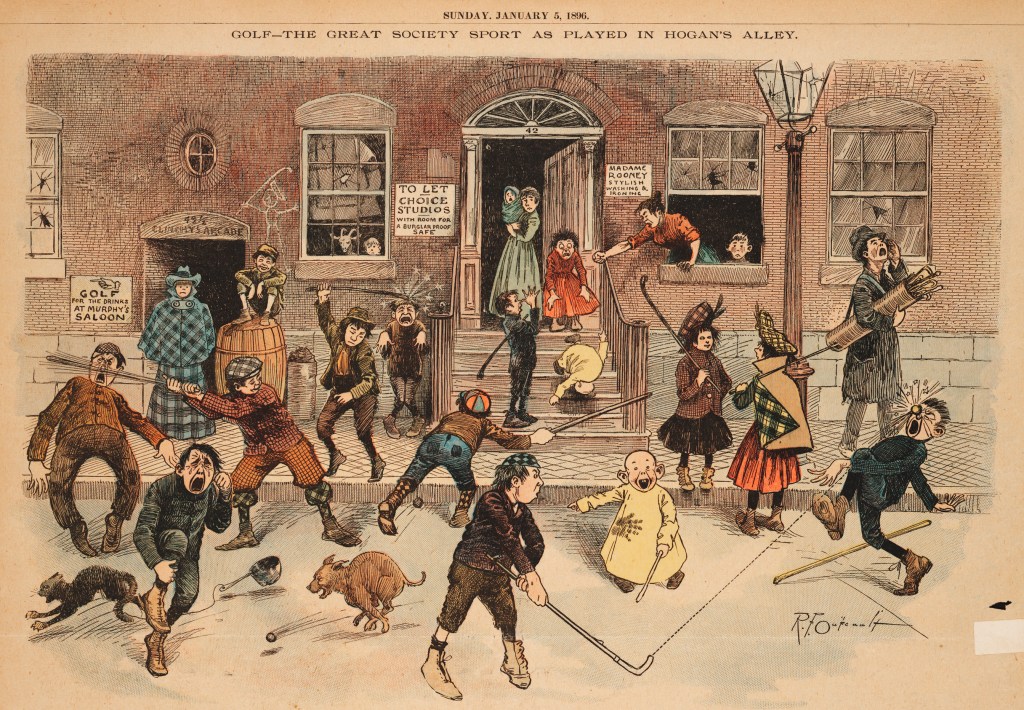
Look at the range of action, emotion and moods that co-exist in this simple “Golf- The Great Society Sport As Played In Hogan’s Alley” (World, Jan. 5 1896). the tableaux is the sum total of many individual set pieces. Stray balls and sticks comically assault urchins. Meanwhile on the stoop alone there are multiple planes of action. A girl fumbles a toddler, echoing the accidental violence from the street. Likewise, a boy taunts one of the enraged or saddened Irish mothers (also on this same stoop) that often populate Outcault’s tenement backgrounds. Right before this stoop we get two calm girls conversing, while to the side an older urchin tries to sell golf clubs for the affair. And this describes just a portion of what goes on across multiple planes of action in most Outcault Yellow Kid tableaux.
There are many ways potentially to depict the city and the crowd. So Outcault’s choices are important because the way he did it likely resonated with viewer-readers. The immediate appeal of Outcault’s vision of the urban crowd is not accidental. It is a particularly appealing way of seeing the urban landscape because it addresses and salves specific anxieties about the social change Americans were experiencing at the time. He sees the urban crowd as a collection of loosely organized clusters of pairs and set pieces of independent action happening within this larger joint occasion. They are all organized by a single occasion that is the site for satire – the horse race, the mock political convention, the beauty pageant, etc. But within this group ritual are all of these small gatherings of others, engaged in bickering, side jokes, little pomposities, etc.
This is a strikingly different way of envisioning the urban setting and group from Jacob Riis’s images of oppressive environments. It is at once grim and joyous. It is also distinct from what most filmmakers would devise in just the next decade. Griffith’s crowds are waves of anonymous people punctuated perhaps by just a couple of heroes. Film envisioned crowds as undifferentiated masses, often threatening physical forces – battle scenes, protest mobs, rat race city streets and commuters. Outcault by contrast refuses to let the crowd be a mob. Instead he breaks this crowd ritual down into a loose conglomerate of family, friends, rivals, accidental sub-groups. This is mass seen as community where individual characters still thrive and assert themselves, where they aren’t anonymized and dehumanized by their environment.
Outcault depicts the city as a rich pastiche. In a single panel he can show the new city as oppressive, beating down the choices and spirit of Hogan’s Alley denizens (generally the adults on the periphery of the action). But an inch away, his raucous urchins are asserting their creative, satiric energies against their environment. He sees where many different realities co-exist. Arthur Asa Berge captured this ambiguity when he described the Yellow Kid’s city aesthetic as “nihilistic exuberance in a strip that is at once comic and menacing (32).”
Outcault is also giving new urbanites an idealized way of seeing their own environment. It is a freeze frame of urban chaos. It stills the chaos in a way that lets us examine it, break it down into humanized pieces, see it within a larger coherence. The Yellow Kid not only depicts the city but also offers middle class and rising class readers a way of seeing it, containing and controlling some of its most anxiety-producing elements.
It is worth noting that the height of Outcault’s complex vision of urban life occurred fleetingly in the history of the strip, roughly in the last half of 1896 in the months leading up to his October departure from Pultizer’s World to join Hearst’s rival Journal. Under the more conservative Hearst, Outcault’s work was demonstrably less edgy, with much less tugging at class tensions and physical violence. And when the Kid and gang ventured off for a world tour of comics depicting their visit to foreign lands, the former grim, dark humor and ambiguity were gone forever.

The Sept. 20, 1896 thrashing of the local dogcatcher (“What They Did to the Dog-Catcher in Hogan’s Alley”) is one of Outcault’s final Hogan’s Alley pieces for Pulitzer before the move, but it is about the darkest in the series. It registers the depth of inner city resentment and distrust of institutional authority. Outcault’s urchins are not mocking society airs but taking sticks, feet, rocks and even the threat of an axe to a city worker. They even light their official wagon on fire. The shawled mothers at the doorway and windows respond to their kids’ own violence with a sort of sad resignation. Interestingly, Outcault keeps the two objects of this gleeful sadism anonymized. The Dog Catcher in the foreground
It was an extension of the newspaper itself, a medium that exploded and transformed in these decades as a necessary map of this challenging new urban environment for working and middle classes. Outcault offers a way of seeing the city. It’s genius is in organizing the clutter and chaos of the new social reality without fully romanticizing it.





 Panels & Prose