Notable Books: The Flapper Queens: Women Cartoonists in the Jazz Age

Trina Robbins is an under appreciated national treasure, alas, for some of the same reasons the cartoonists she presents here have been overlooked by too many comics histories. For the most part, cartooning was a man’s game in the 20th Century, and so has been the writing of its history. Except for Trina. Robbins was among the only female artists in an underground comics movement famous for its misogynist art. Her Pretty in Ink history of women in the field remains the major work, because she has waged a lonely battle for including this talented minority of comic artists.

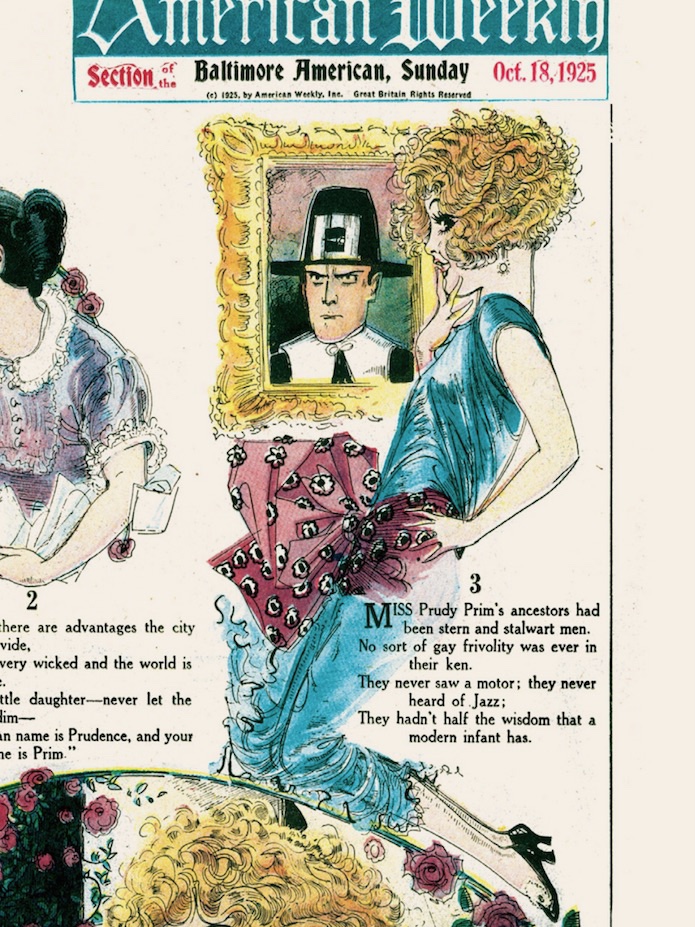
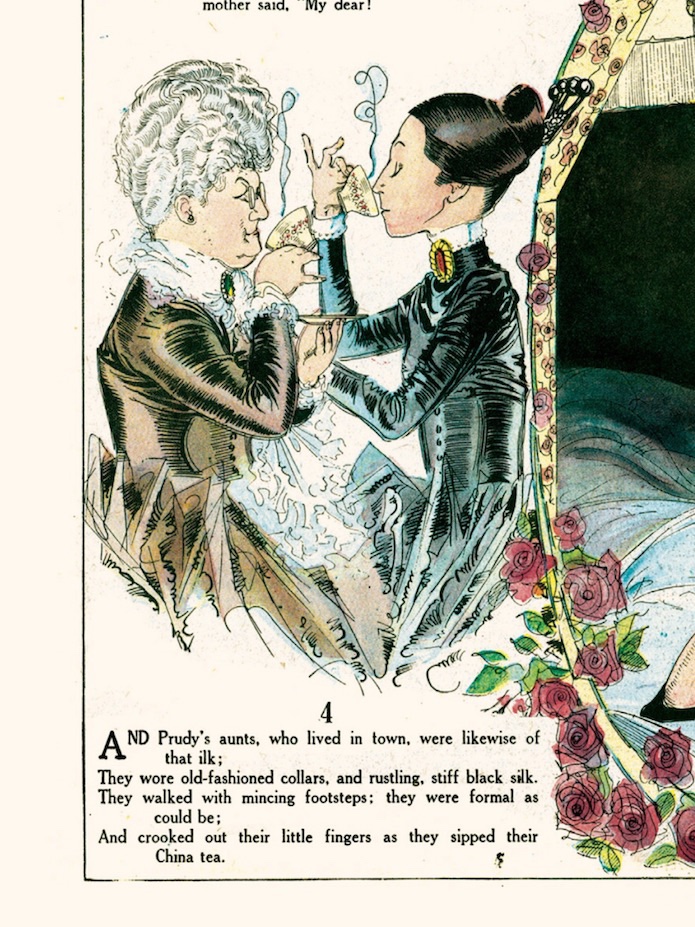
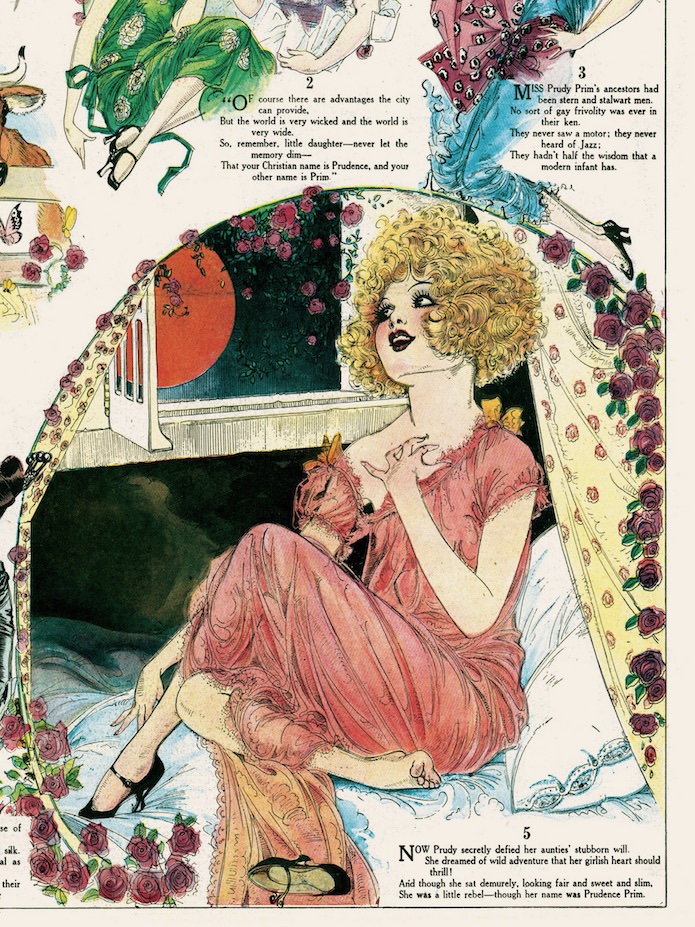
But Pretty in Ink had to cover so much ground, we didn’t get to dwell deeply into any artist or group. With The Flapper Queens: Women Cartoonists in the Jazz Age, however, she gets the chance to reprint satisfying helpings of Nell Brinkley (fully 50 pages!), Eleanor Schorer, Edith Stevens, Ethel Hays, Fay King and Virginia Huget. Since this is more a history in reprints than a history with reprints, Robbins shows more than tells. But she shows so much about how these women helped define the post-WWI era, or at least mass media’s aspirational version of it. Their focus on social interactions and fashion come through as expressions of feminine power and personality.
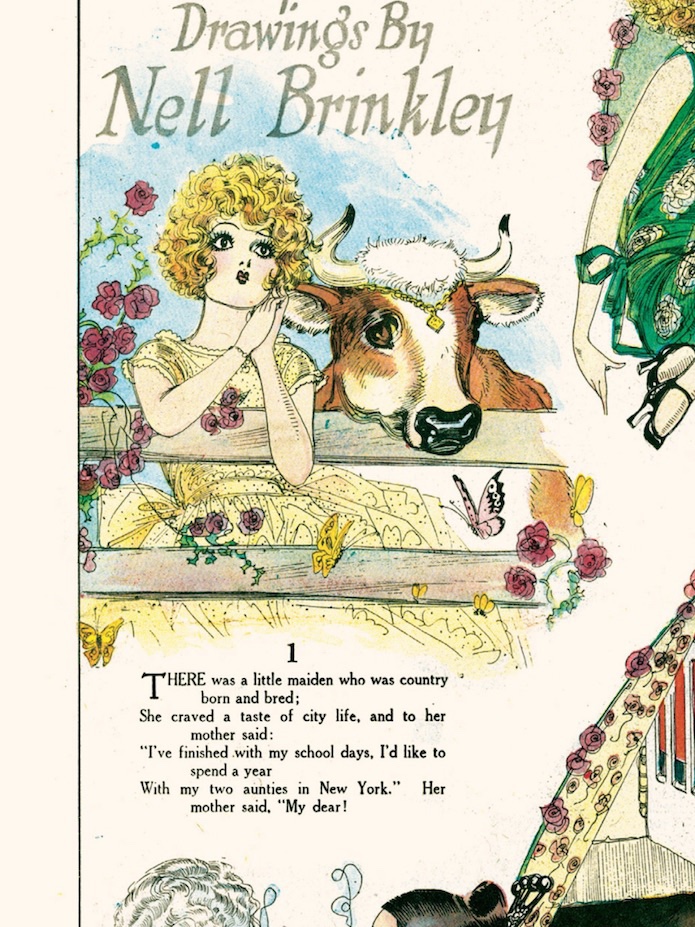
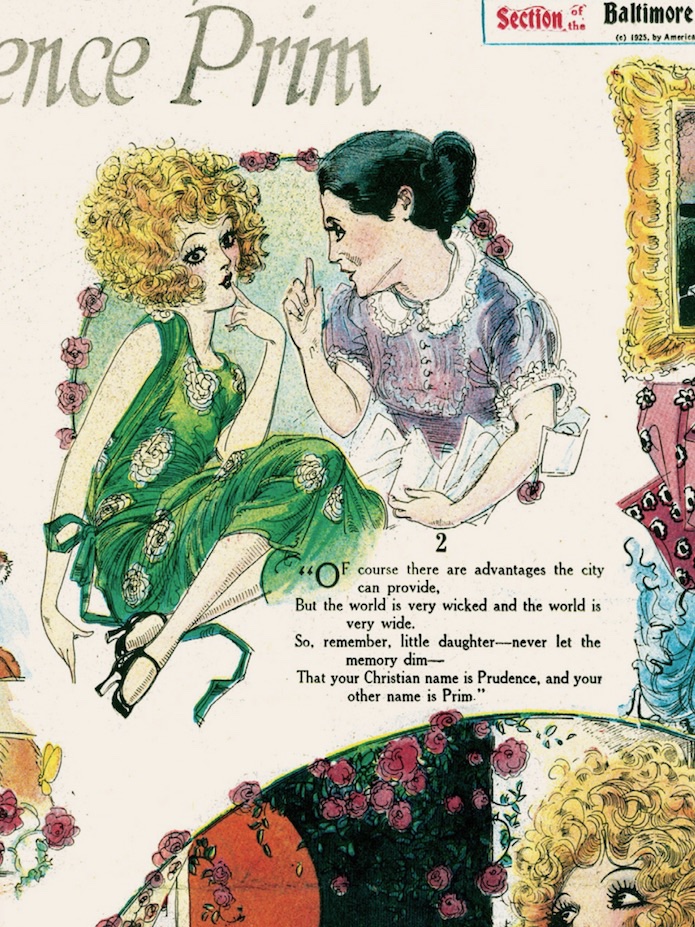
With a third of the book devoted to Brinkley, we get to see the most famous of female cartoonists evolve beyond the Gibson style into an Art Nouveaux and then Deco fine line work and precision. Robbins bookends the book with Brinkley’s changing views of American women, the artist’s criticisms of the very flighty flapper she celebrated in the 20s, and the active, engaged professional women she depicted in the 1930s.

But along the way, Robbins gives us revealing samples across the careers of many women who continue to be overlooked by conventional comics histories. Edith Stevens’ Us Girls series blended fashion, biting wit and social observation in a series that was pithier and more insightful than many of the observational strips we continue to reprint elsewhere.
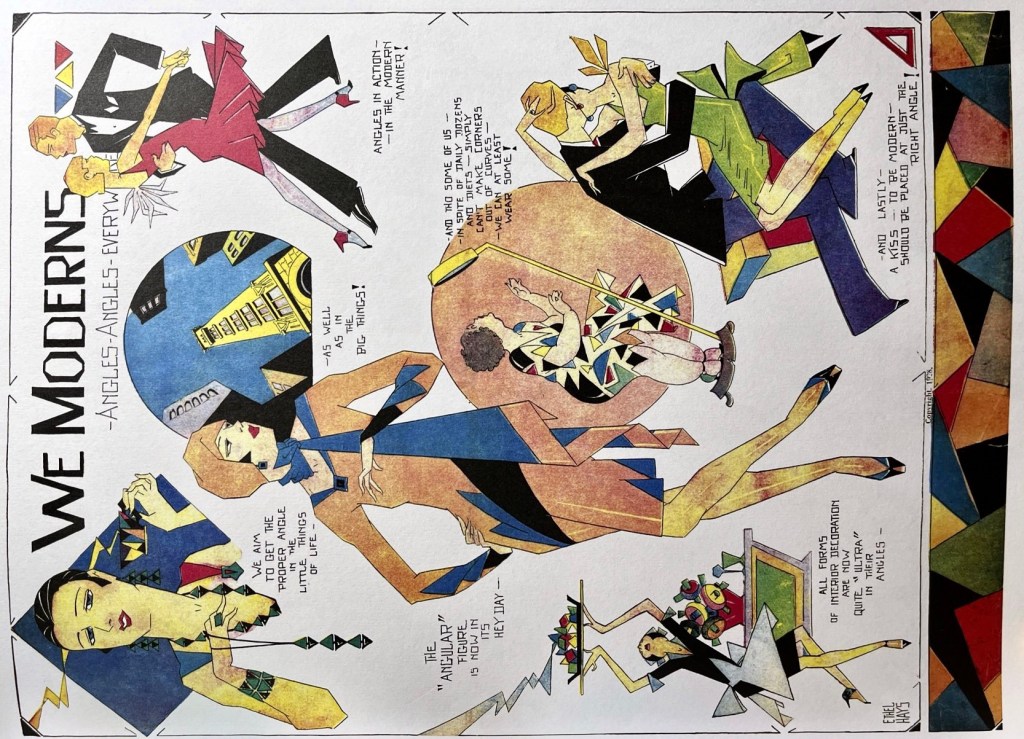
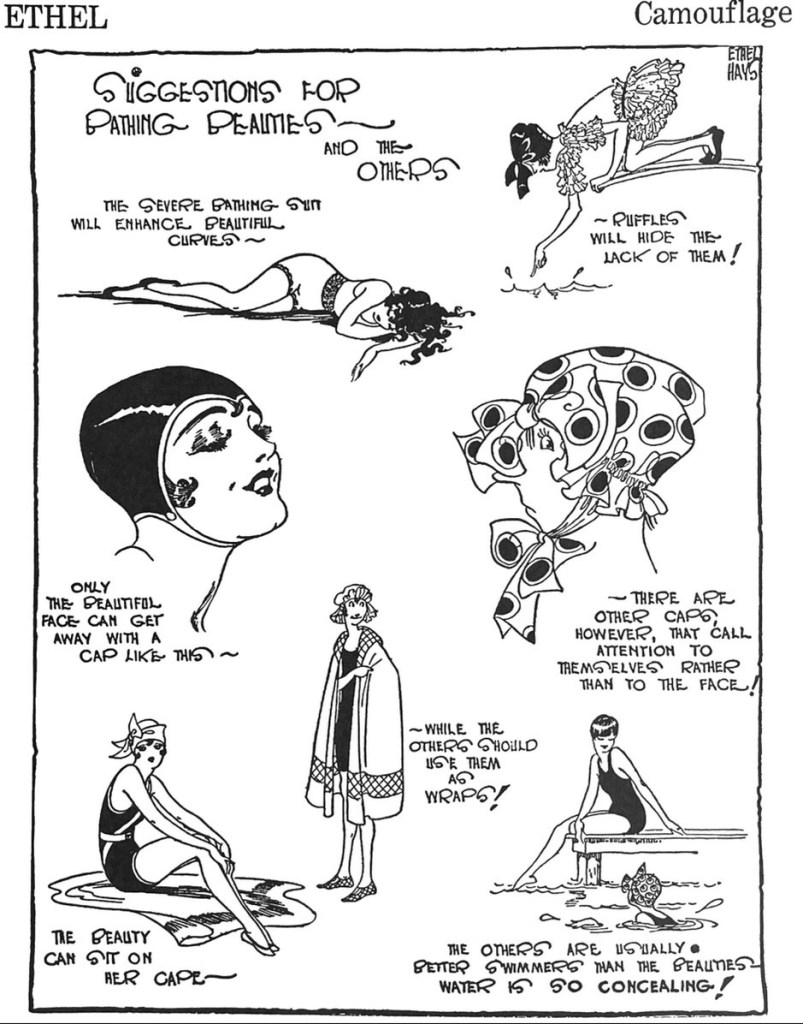
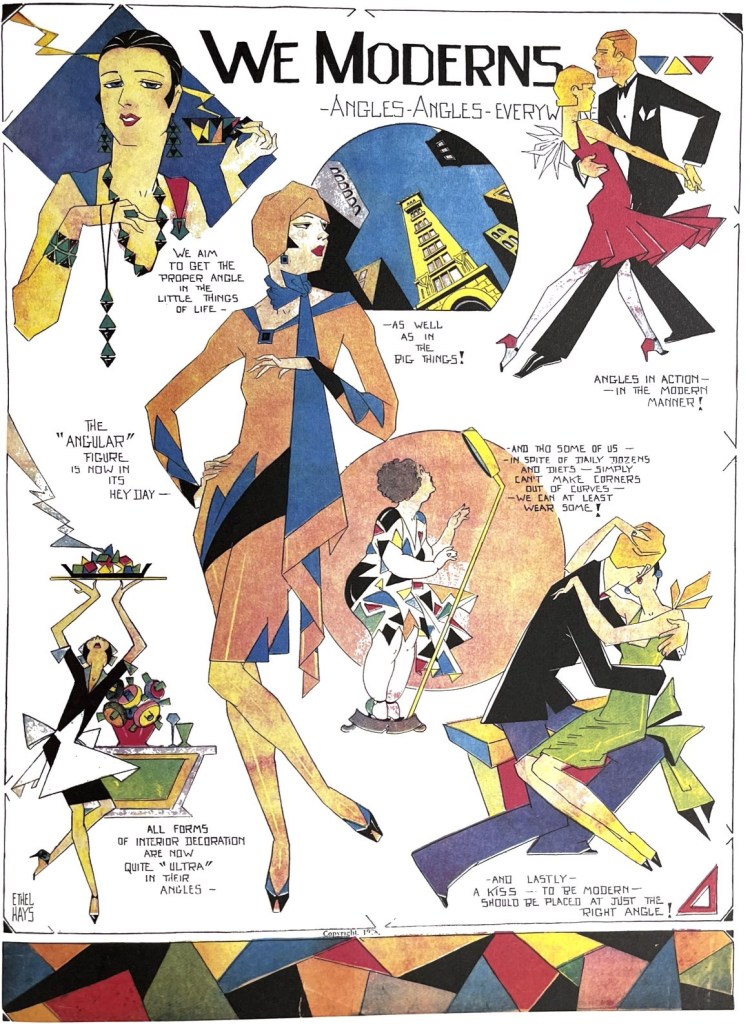
Robbins also focuses in on Ethel Hays, who channeled both Brinkley and John Held to chronicle the 20s and 30s in striking full page, richly colored Sundays that overwhelm the eye with color, a great sense of body angles and attitude. Like many of women in this book, she found creative ways to weave fashion styles, romantic advice, social commentary and a bit of cheesecake.

Hays’s “We Moderns” piece at the top of this entry is a great example of the creative richness and thoughtfulness we miss when, like their editors at the time, we consign women cartoonists of the day to the “fashion” artists bucket. Indeed, Hays, Brinkley and Huget not only paid attention to clothing, hair and even body styles, but they wove these concerns in with larger social, personal and aesthetic ideas. In “We Moderns” Hays actually brings these threads together in a startling visual think piece. She links the “angles” of modern fashion with architecture, clothing, dance, personal politics and even her own Deco-infused art style. Nell Brinkley was adept at using her characters’ clothing as instruments of drama, personality, reaction. They exploded from the page as effectively as her signature facial expressions – signals of inner-feeling. These artists didn’t just depict the visual styles and fashions of the inter-war years. They showed a rare understanding of why they mattered.

Fay King was perhaps the most socially engaged of the group, and her strips highlighted trends like women becoming more involved newspaper readers. Meanwhile Virginia Huget bridged the 20s and 30s with aspirational tableaux that romanticized college life and affluence. I also appreciated the inclusion of the wonderful Annabelle strips by Dorothy Urfer. This is a visually rich and wry look at sexual politics. It left me wanting mor.
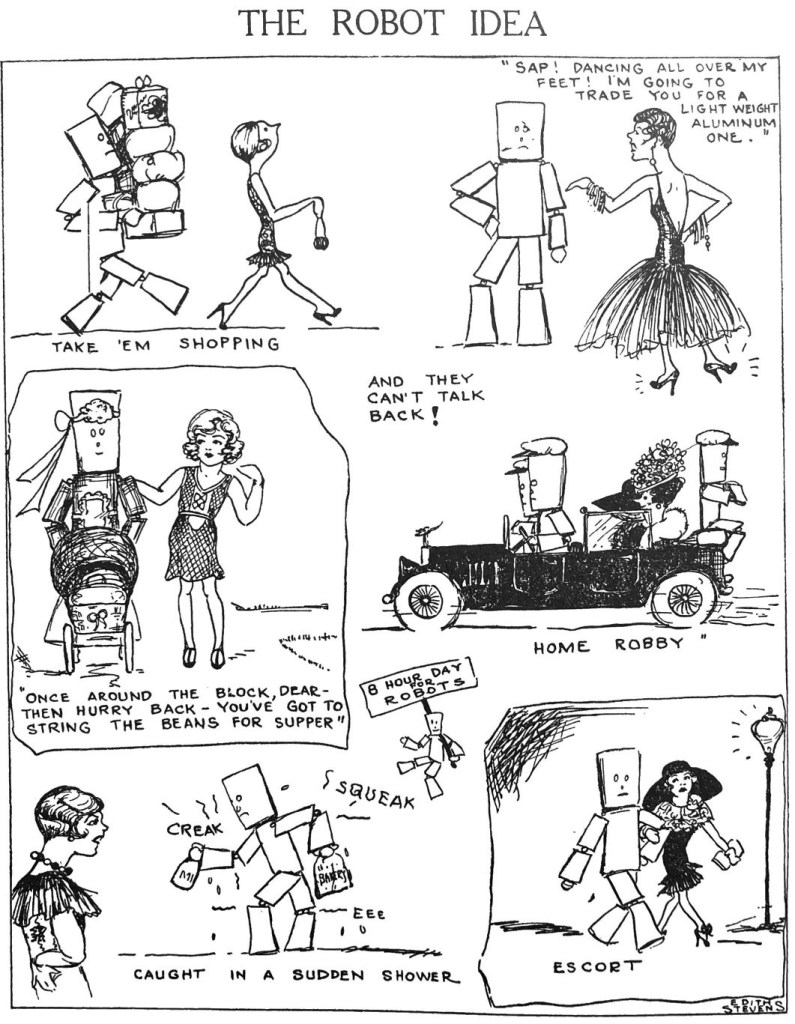
And the reproduction/resotration work in Flapper Queens is superb, bringing forward the rich color and detail that made these images so absorbing in their time. Comics historians love to gush over the ways in which McCay, Feininger, King and the usual suspects among the kings of comics made innovative use of the full Sunday page, especially in the first decade of comic strip history. But the oversized, beautifully colored reproductions in this book show how artists like Brinkley, Hays and Huget especially burst from the Sundays of the 20s and 30s with dazzling uses of layout, splash images and narrative progression that rival and exceed many of their male peers.

Which brings me to the historical importance of Robbins’s Flapper Queens. Reviving these artists truly expands our understanding of comics history and especially the ways in which these very talented artists and social observers related to the surrounding culture between the World Wars. To overlook them is to miss some of the most striking art the comics were producing during this era. More to the point, these artists had a wry, sly and nuanced take on the politics of domestic relations. This book shouldn’t just “fill a gap” in comics history. It should make us broaden and reconsider the cultural work the comics were doing in American minds in the last century.

This is hands down my pick as the one indispensable addition to comic strip history in the last year.

Notable Books: Gross-ed Out

Gross Exaggerations: The Meshuga Comic Strips of Milt Gross

I would consider this oversized collection of the zany scribbles of Milt Gross a companion volume to my favorite book of 2019, Paul Tumey’s Screwball. It further revives our appreciation of artists like Rube “Boob McNutt” Goldberg, Bill “Smokey Stover” Holman and Gus “Sherlocko” Mager whose fame has faded as their madcap gag humor fell out of style. With The Sunday Press’ Gross Exaggerations: The Meshuga Comic Strips of Milt Gross we get a sustained immersion in a single artist who was the face of madcappism through the 20s and 30s in strips like Nize Baby and Count Screwloose. As the full title suggests, the book underscores Milt Gross’s cultural contribution of bringing Yiddish language, dialect and humor styles into mass media, perhaps in ways that no other more “serious” medium could. Peter Maresca’s Sunday Press continues to impress with its use of multiple critics to surround each of its reprint volumes with several contextual lenses through which to appreciate the art.

Milt Gross was widely known to 20s and 30s Americans, and frequently reprinted. But you haven’t seen him like this, arguably at his “Grossest.” The 13×17 scale gives us full Sunday pages as they were experienced. I found myself appreciating Gross’s use of implied action between panels to drive the humor and heightened sense of pace. For this alone I am grateful, and it helps make the case for this class of reprint. As well, the reproductions are as impeccable as they are instructive. They reveal the deliberate and functional quality of Gross’s seemingly frantic line work.

But this immersion in his work also surfaces Gross’s satirical eye. While many of the domestic family strips of the 1920s gently poked at the gender, sexual and generational politics of post-war life, Gross blows up the family unit altogether and pits all members in perennial warfare, with the inept, resentful pop in the lead. Gross brings into the 1920s the tropes of the first decade of bad boys in comics. Most strips end with a spanking or the threat of violence, and mama advising her husband, “not the head, Morris.” Moreover, Gross kept his strip and its comedy steeped in the frantic energy of the city when his peer comic artists were moving to the growing American suburbs. And Count Screwloose flees the asylum weekly but only to witness the inanities of everyday “sane” America. This is enough to send him back to his more lreliably delusional pals in the hospital by nightfall.

Gross Exaggerations is a welcome invitation to revisit a master of purposeful screwballism and consider its artistry.

Moon Mullins On the Margins

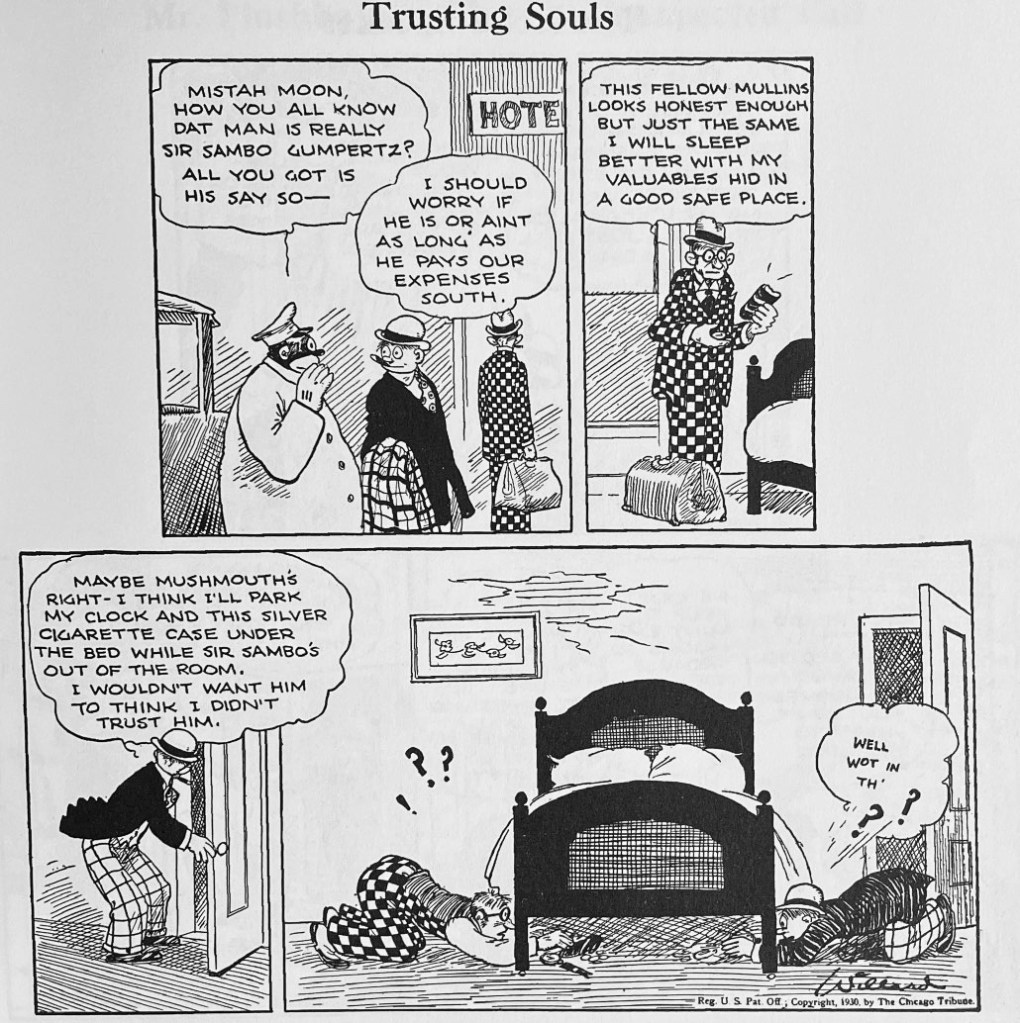
He was a “banjo-eyed” former boxer whose life’s work seemed to be avoiding a life of work. Frank Willard’s Moon Mullins (b. 1923, Chicago Tribune syndicate) was a boarding house situation comedy, where Moon and his little brother Kayo schemed, loafed and tussled with a like-minded cast. But what distinguishes Moon Mullins in my mind is the authenticity, affection and artistic talent Willard brought to a strip that tugged against the middle class fantasies of 20s American culture. While much of the comics page moved towards gentler domestic comedy in the 1920s (The Gumps, Bringing Up Father, Gasoline Alley, Polly and Her Pals, et. al.) Moon’s world was an alternative America that was relentlessly mean, self-interested, devotedly unproductive.

Moon Mullins’ visual signature blended caricature nicely grounded in physical detail. He assisted Billy DeBeck, whose Barney Google was another strip about socially marginal characters, but he had a more naturalistic style. The run down neighborhoods and well-worn rooms of Moon’s world come through in cross-hatched corner, splashes of broken wall plaster, the stray broken fence slat. His characters are weightier, individualized and expressive of inner qualities. Moon’s wry, laconic approach to life lives in his usual posture, relaxed, disinterested.

The gangly, bespectacled boardinghouse owner Emmy Schmaltz is as tightly wrapped as her ever-present bun. Her figure recalls Segar’s depiction of Olive Oyl but without irony. The absence of sex-appeal is genuine, even if her hunger for a man throughout the 1920s drives her own scheming comedy.

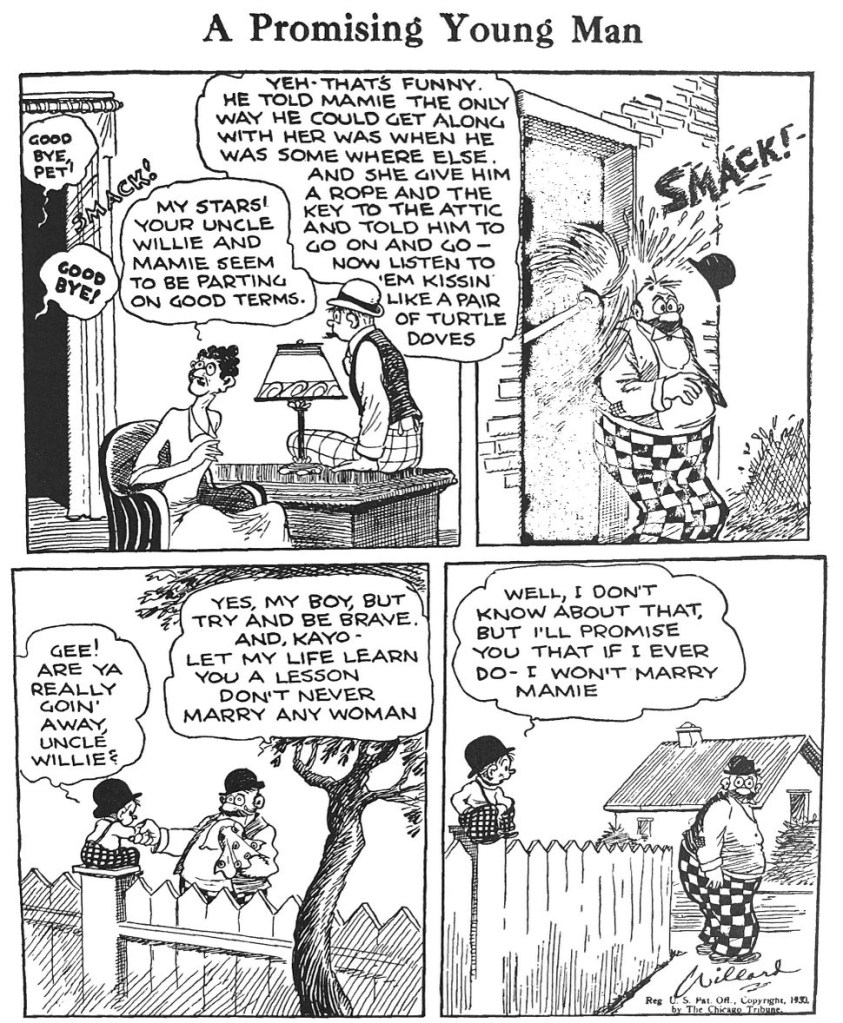
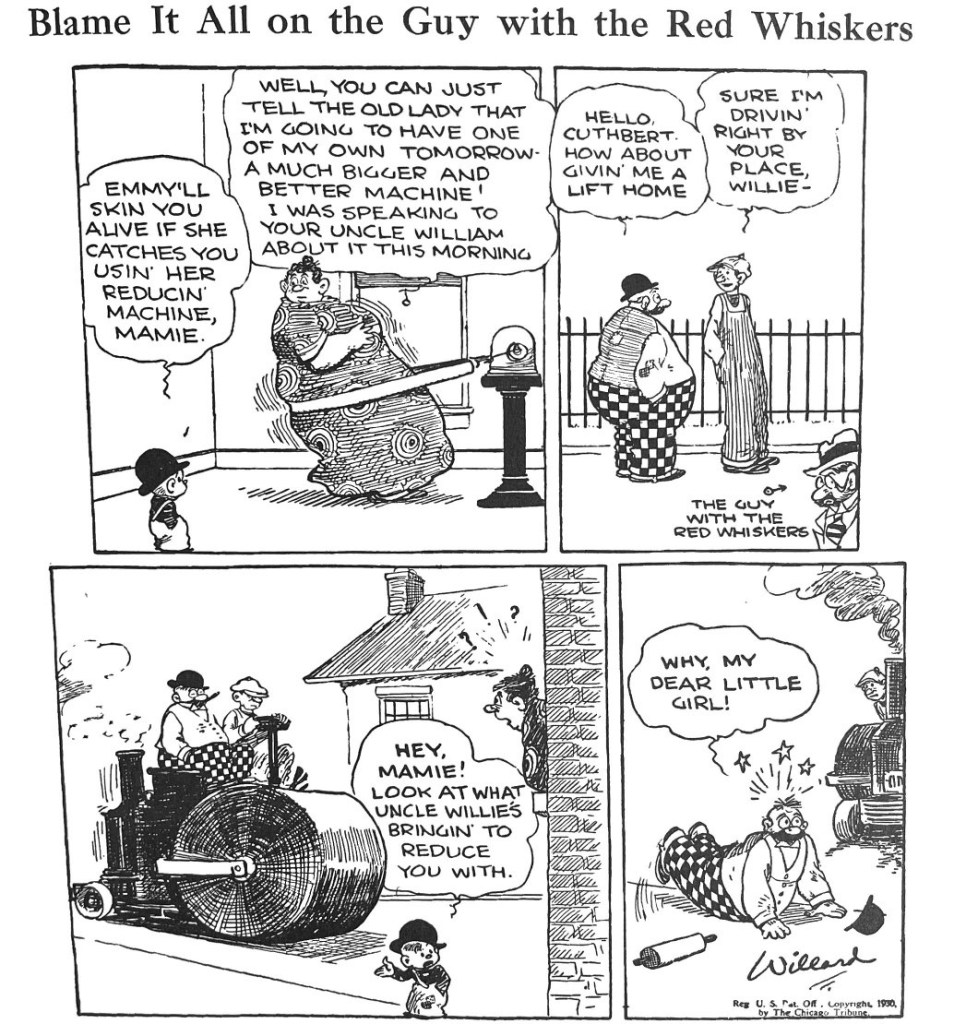
The sloppily stout Uncle Willie and his equally massive wife Mamie are models of domestic disharmony, usually resulting in Willie taking a kitchen implement to the head and being tossed from the house.

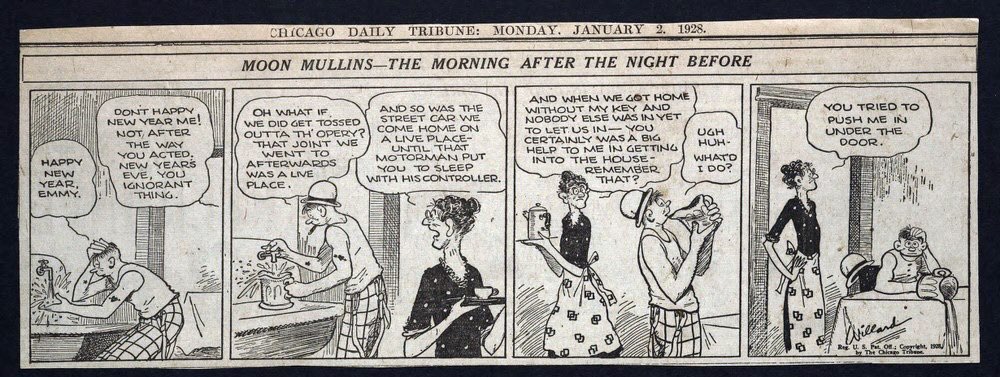
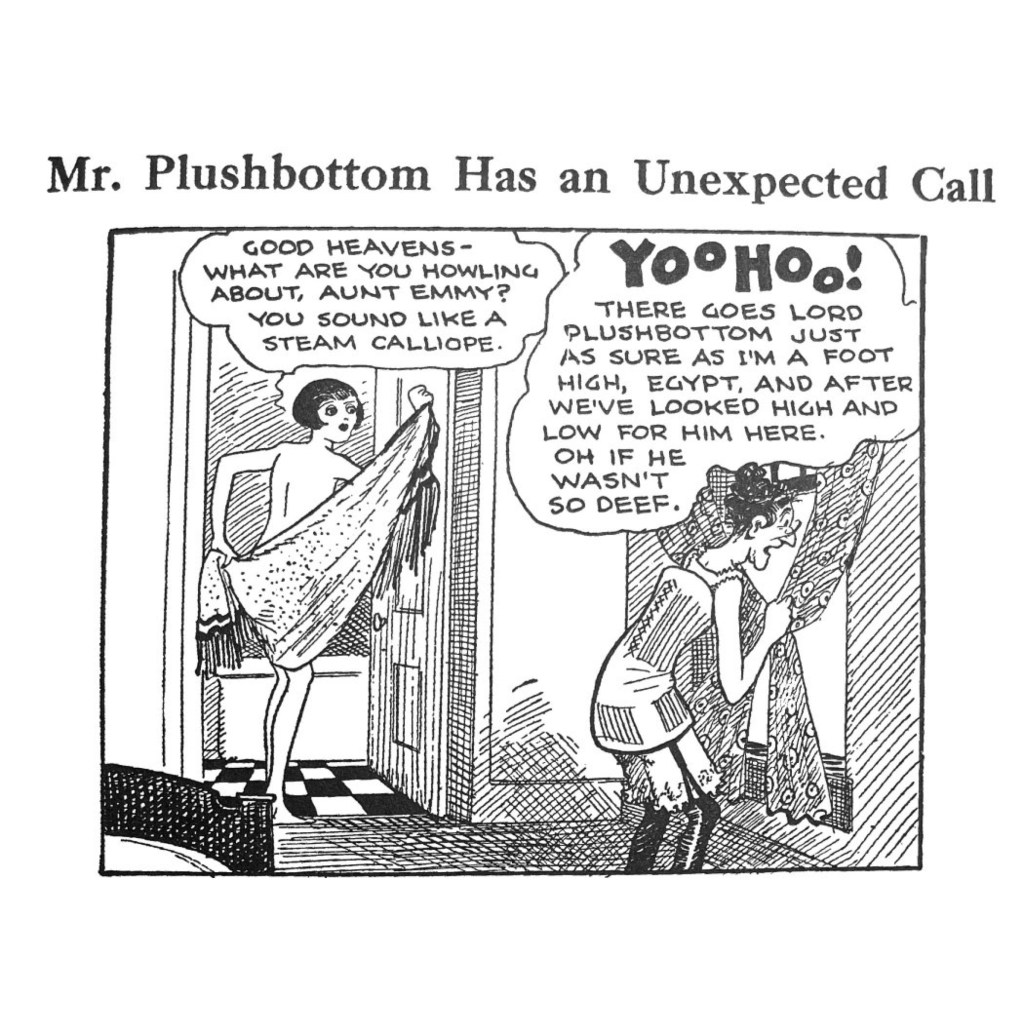
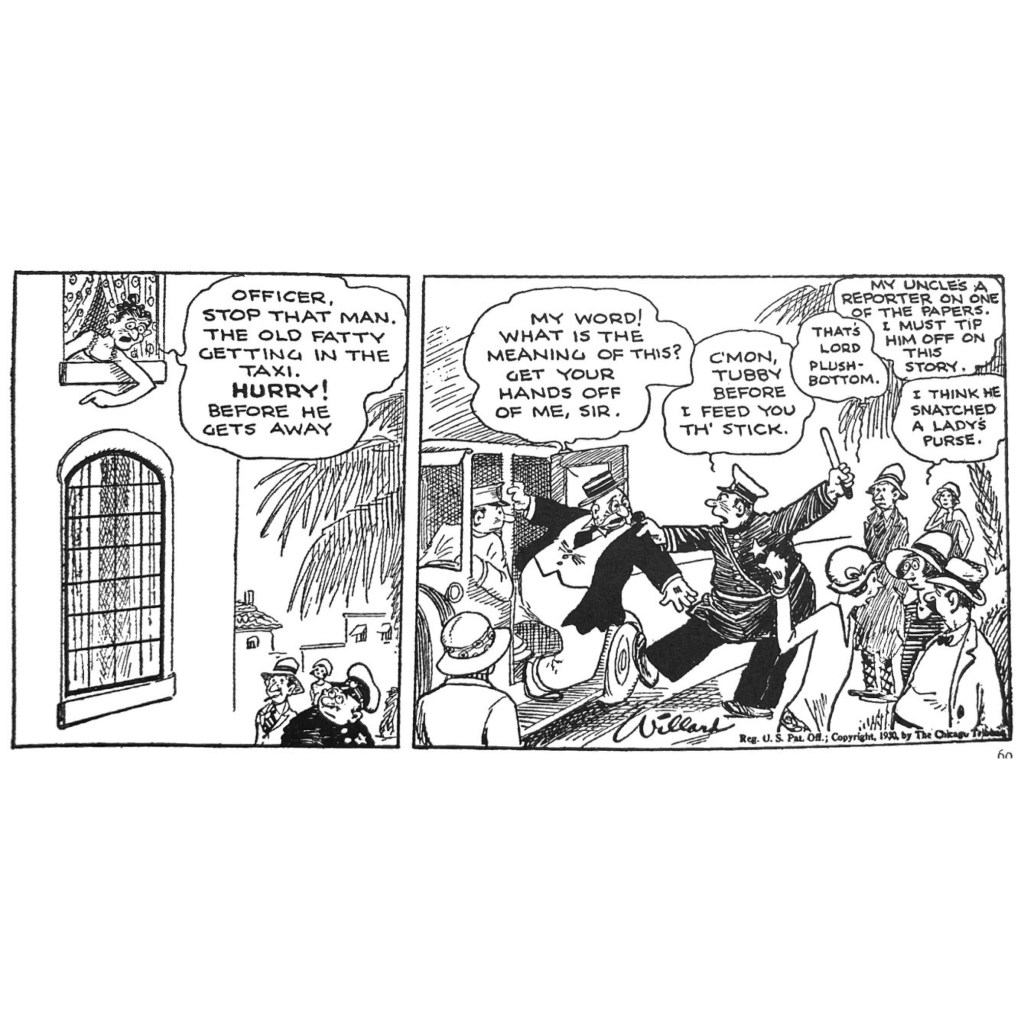
Willard had a deft sense of comic strip cadence, with a great ability to advance an episode yet tell a complete story in just three or four daily frames. In the sequence above, part of a 1931 road trip to Florida, Emmy is trying to get Lord Plushbottom’s attention. The usual sit-com tropes ensue: miscommunication, misapprehension, confusion. Premise, activation and gag all take place within three panels.

Willard had a special talent for slapstick timing, usually on display in the Sunday gag strips. Like the best slapstick silents, he used careful panel editing and cadence to capture the flow of unintended cause and effect. The strip above is a good example of how tired tropes feel fresh and funny mainly from the way Willard times his action and layers into them the sit-com notes of misapprehension. Or, in the strip below, Willard blends some of the dark scheming of his characters, Emmy’s creepy faked suicide plot, with a beautifully rendered birdshot-to-the-ass scene – from weirdly dark to classically comic in three panels.

It was Willard’s great comic sense that gave him license to portray an unsentimental vision of marginalized America in ways that were uncommon to the hapless but good-hearted domesticity across the rest of the comics page let alone the idealizations of American life in the rest of popular culture. More on this in the next post.

Reviving Gilbert Seldes: Krazy Kat’s First BFF

The great, woefully under-appreciated American culture critic of the early 20th Century Gilbert Seldes remains my own North Star of pop culture criticism. I could go on forever about this guy, and almost did. I started researching a biography of him and his critical legacy, but Michael Kammen beat me to it with his fine 1996 evaluation of Seldes’ life and work. Still, my own appreciation of Seldes’ open, democratic spirit of criticism is a bit different from Kammen’s, even if I didn’t feel at the time that the world needed a second book-length study of the man. I explored some of those ideas in an essay Tom Heintjes kindly published in Hogan’s Alley No. 6 in 1999. It is reprinted below. I will also post soon Seldes’ original take on Krazy Kat and the comics generally from 1923’s The Seven Lively Arts. Almost a century later, I still think Seldes’ early observations about the unique aesthetic and cultural qualities of the comic strip remain indispensable to anyone trying to appreciate the form. – Ed.

The Critic That Walks By Himself

The longtime and often lonely historians of the American comic strip have enjoyed an embarrassment of riches in recent years. What with centennial exhibits, commemorative postage stamps, some truly luscious reprints of seminal work and even—God help us—occasional academic scrutiny, the comic strip form seems poised to assume a place among the “respectable” mass media. But assembling the history of any medium, including the comic strip, requires more than rediscovering its primary documents, however fun that may be. A rich chronicle of an art form must also recount how the medium integrated itself into people’s lives, how it was understood and debated. In America, such a history must begin with the first thoughtful and genuinely critical celebrant of the modern popular arts in general and of the comic strip in particular. He was more responsible than any single American for getting common readers and other intellectuals to think about the comics that they enjoyed. Gilbert Seldes (1893-1970) was the father of comic-strip criticism, and his insights about the form represent an alternative, albeit now largely overlooked, path in the serious appraisal of our national pleasure.

Continue reading

Krazy Kat Gender Reveal?

Bobo Baxter: Rube Goldberg’s Bleak Screwball

Rube Goldberg (1883-1970) is best remembered for his cartoon inventions, ridiculously intricate mechanical solutions for common activities. These send-ups of modern technology and the romance of engineering appeared under multiple titles and formats across his career, but took most regular form in Collier’s Weekly between 1929 and 1931 as The Inventions of Professor Lucifer Gorgonzola Butts, A.K. His Foolish Question panels ran from the teens in various forms for decades. And his best-known continuous character strip of hapless failure Boob McNutt ran for more than a decade in the 1920a.

But it is in his forgotten small masterpiece Bobo Baxter (1927-1928() that I think we see Goldberg’s array of talents for satirizing the modern world come together into a persistent and satisfying whole. And at the same time Bobo shows how a sad note of alienation often lurks beneath the surface of many slapstick characters.

As godfather of comics historians Bill Blackbeard points pout in the intro to a 1970s reprint of the complete (Hyperion Press, 1977) run of strips, Bobo Baxter represented Goldberg moving (or being forced by trends) away from the gag-a-day format to the continuous characters and situations of other 20s strips like Little Orphan Annie, Bringing Up Father, The Gumps, Polly and Her Pals, etc. He had already made his Boob McNutt Sunday strip into a major hit by introducing recurring characters and continuing storylines. In 1927 he sent the form into a daily new creation, Bobo Baxter. 

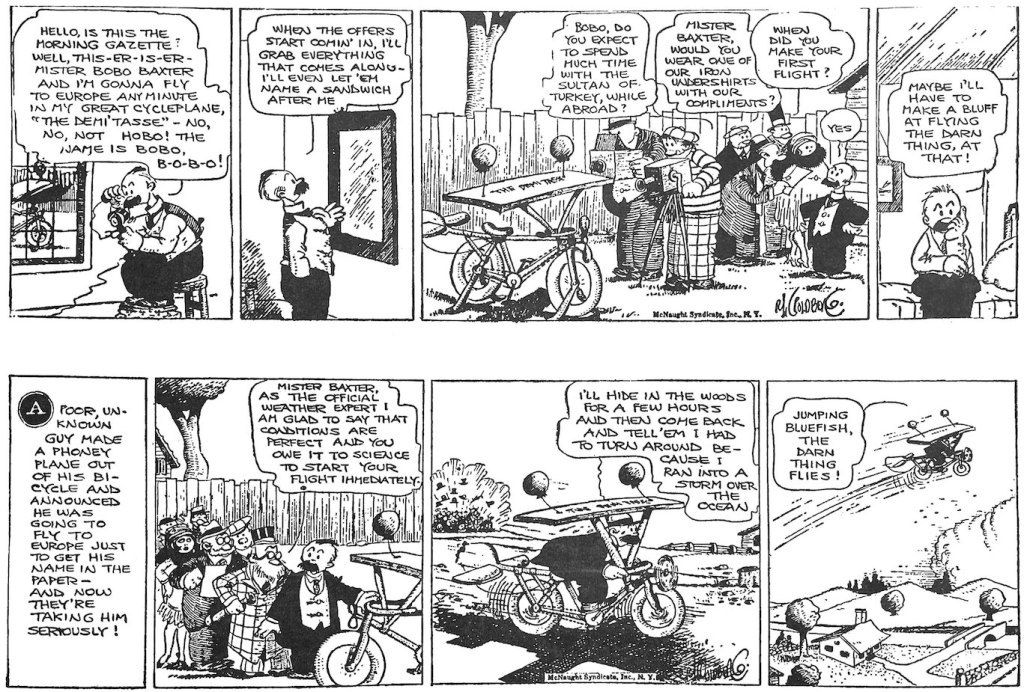
We meet Bobo as an unsuccessful dreamer, envious of the fame and fortune of well-publicized explorers like Admiral Byrd and aviator Charles Lindbergh. So he builds a flying machine out of a two-seater bicycle, prop,  wing and some balloons. He seems as surprised as anyone that it flies, and he dubs the contraption “The Demi’Tasse”, bound for glory by flying across the Canadian border.

Bobo’s fixation on fame, celebrity and the press course through the strip. He is forever courting journalists and dreaming for the headlines he thinks his oddball journey will merit.

The discipline of storyline and continuity seemed to inspire Goldberg’s satiric sensibilities. In many ways the story becomes a picaresque journey through modern American social types and institutions – all of from which Bobo himself seems woefully alienated. 

Bobo himself is pathetically friendless, and a bit of a comic nebbish. At one point early in the strip he mistakenly reserves a table for his entourage at  the pricey Cafe Du high Hat. When Bobo can’t recruit anyone to come with him, he ends up animating a group of mannequins. 

Likewise, Bobo spends the first months of the strip simply in search of a passenger to bring with him. But it is the haplessness of Bobo’s plan that brings him into contact with a pastiche of American types. There is the desperate henpecked husband who would do anything to escape his onerous wife. There is the jewelry thief who is looking to escape with a pilfered pearl necklace. And there is Bobo’s own assistant Nosedive Kelly who is both too obese and anxious to make the flight but proves to be a self-promoting braggart.

Bobo’s encounters with a cast of American characters produces some wonderful moments where Goldberg’s native visual silliness, satiric eye, and critique of mechanisms both technical and social merge beautifully. Among my favorite moments comes when a Nosedive goes for an insurance checkup. “Your blood pressure is 5 pounds over the legal limit,” “Your ears a very badly designed” and “the hinges of your backbone squeak” he is told.

This is prime Rube. “Goldberg is a satirist not of fads and fanciest of rationality,” wrote Gerald W. Johnson in his 1958 review of political cartooning between the World Wars. 

The hapless comic outsider is a feature of modern comedy that deserves further thought. We see this anti-hero (and it is almost always male) in vaudeville, certainly the silent film clowns and in comic duos like Laurel and Hardy, Abbott and Costello.

But the comic strip turns the figure into a genre. Consider Happy Hooligan, Simon Simple, Moon Mullins, Jiggs, Andy Gump, A. Mutt, Baron Bean, Boob McNutt, among others.

In fact for the first two years of Goldberg’s Boob McN tut, each Sunday strip finds Boob trying to off himself 

In his recent, indispensable history of screwball comics, Paul Tumey characterizes Boob McNutt’s early years as black humor that reflected the post-WWI disillusionment of 20s America.

Maybe. I am more inclined to put Boob’s suicidal comedy and Bobo’s desperation for modern celebrity part of a longer tradition of modern comedy and especially the comic strip – the alienated clown. So many of the comic strip’s comedy fops feel themselves somehow on the curb as the great parade of American life goes by.

Indeed it is arguable that the comic strip itself carves this curbside role for us. On a daily basis, we are invited to look over the shoulder of Jiggs, Happy, Boob, Barney, Jeff, Popeye, Abner, et.al at a main cast of characters of which we are bemused – part of but slightly apart from.

In future posts I hope to explore further this idea that the daily comic strip often created for us a light satire of modern American life and styles, types and trends that registered and leveraged a sense of middle class alienation from the very world they were creating.

Just Kids – A Bridge to Peanuts

The suburban kid gang strip Just Kids by August Daniel “Ad” Carter ran 1923-1956, initially as a knock-off of Gene Byrnes’ Reg’lar Fellers. But it evolved into a more contemplative, nuanced projection of adult sensibilities into child characters that anticipated Charles Schulz’s Peanuts. Preceded by earlier iterations, Our Friend Mush, Mush Stebbins, and Just Kids in the teens, it was picked up by Hearst in the 1920s and it remained a bit of a beloved back bencher through much of its run.

Born in Baltimore, the maker of this long-lived strip that depicted kids as thoughtful, precocious adults was himself a victim of childhood trauma. He not only lost his mother at a young age, but was present when she was struck and killed by a streetcar. As a reporter at the Brooklyn Reporter he met Clare Briggs, who encouraged him to submit a strip proposal to a syndicate. Carter finally caught their attention in 1916.

The kid trio centered on Mush Stebbins, Fatso Dolan and Pat Chan represented and interesting multicultural group situated in the new city-suburban setting. It was a direct copy of Gene Byrnes Reg’lar Fellers, which focused on a gang of kids who like much of America migrated outside of urban centers during these post-war years but retained their inner city dialect. These strips were capturing a cultural moment, the growth of city suburbs in the first half of the 20th Century. The migration of city-kid toughness and ethnic diversity to the more sprawling neighborhoods of standalone homes, parks and relative affluence was one of the signal social trends of the modern era and helped reshape ideas of childhood. Interestingly and uniquely, the Pat Chan member of the gang is stereotyped in cartoonish Chinese garb but given a voice that is pure city street.

Nostalgia for a simpler, more innocent era of childhood was a longstanding American trope that found a welcome home in the modern mass medium of comic strips almost from its beginning. Clare Briggs’ countless iterations of one-panel childhood nostalgic sentiment in The Days of Real Sport and When a Feller Needs a Friend in the teens helped establish the light, observational tone of the comic strip genre.

Reg’lar Fellers was more of a gag a day strip with little character development and often cruder art.

But at least in the limited strips I have seen, Carter’s iteration of the suburban kid gang theme was both more story-driven and more introspective and thoughtful than most. In the Nostalgia Press reprint of a 1935 story arc (scanned below), several weeks of cartoons follow the implications of the truant officer breaking his leg. The ramifications and unintended consequences take several turns and the kids come to regret what they started by celebrating.

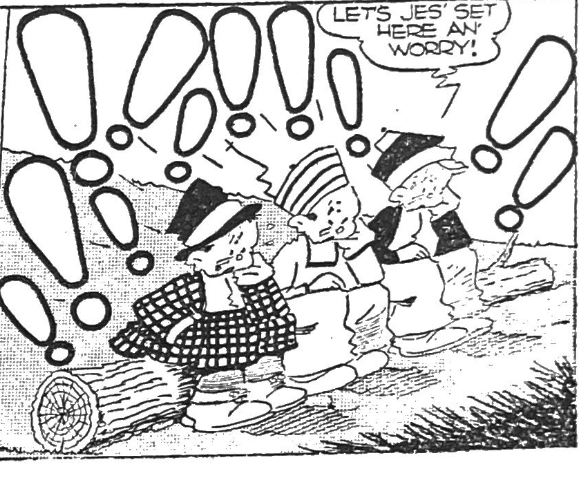
Not quite as adult-like and philosophical as Peanuts, the Just Kids gang had sparks of disarming maturity and complex feeling, insight and woe. One strip ends with the trio sitting on a log surrounded by inflated exclamation marks, Mush saying, “Let’s just sit here and worry.” In the next strip his mother asks him what he seems so worried about and he replies in a voice that clearly foreshadows Charlie Brown himself by more than a decade, “I guess I’m jes’ worried about LIFE IN GENERAL!”

Not a widely or prominently distributed strip, you can see in Ad Carter’s Just Kids a tone and insight about childhood that bridged the toughs of early comics with the gentle suburban Peanuts after the war. He used short story arcs in the way Schulz did and moved his kid characters towards more adult voices. Schulz, of course, had the brilliantly understood that eliminating adults entirely was key to depicting the maturity of his kid characters, but Carter seems to be on a similar path.

Just Kids had an engaging visual voice. It was more precise than big foot comic style, and had some of the deco stylings of 20s illustration. It looks a bit like Cliff Sterritt (Polly and Her Pals) and Chic Young (Blondie) as if done with straighter lines. He gives his characters an angularity, stooped posture that is established in just a few thin lines. Visually, it feels more refined and light than many of the comics that would have surrounded it on the page. In that sense Carter was moving in the opposite direction from Schulz. He used visual sophistication to suggest the seriousness of child consciousness by removing it from big-foot slapstick stylings. Schulz used a less stylized palette of basic shapes and deliberate minimalism to enhance the contemplative seriousness of Peanuts.