On Oct. 4, 1931 Chester Gould’s Dick Tracy launched with the strip above. To commemorate the birthday of my personal favorite strip of all time, I am gathering some of the pieces I have written around Dick Tracy over the last couple of years.
Even 30 years into one of the most successful runs in comic strip history, Chester Gould’s Dick Tracy continued to promote itself to new newspapers that still hadn’t syndicated the iconic hero. This ad ran in Editor & Publisher, the longtime trade bible for print periodical publications. Of course, this “man of stature” led the most grisly, violent and truly weird of all American comic strips. It was also one of the most compelling. For a gallery of gruesome villain deaths, see this earlier post. On the impaling of The Brow. On the general strangeness of Gould’s imagination. On Gould and Tracy’s conservatism.
Retribution was Chester Gould and Dick Tracy’s model for justice from the beginning. The strip started in 1931 literally as a revenge narrative. Standing over the murdered body of his fiancé Tess Trueheart’s father, civilian Tracy swears vengeance on the killers. He quickly joins the police force, but the themes of retribution and conviction by poetic justice remained a hallmark of the strip across four and a half decade run. From the beginning Chester Gould unapologetically crossed the lines of good taste. By the late 1930s in criminals like The Mole, B.B. Eyes, Flattop, Pruneface and the like, Gould started using outward disfigurement as expressive of inner villainy. And the level of explicit violence and even torture in Dick Tracy was unlike anything else on the comics page, or elsewhere in pop culture for that matter.
The revenge motif was baked into the strip’s moral universe. Tracy villains didn’t just need to be sought, caught and jailed. They needed to be hounded and often tortured along the way. Many of Tracy’s prey ended up behind bars, but just as often they met poetically just ends. Gould turned the grisly, fitting deaths of villains into his own special kind of art. Here are some examples from the first two decades of the strip that highlight Gould’s dark talent for retributive justice and capital punishment Dick Tracy style. At these climactic moments we see most clearly the visual, moral and often bizarre world,
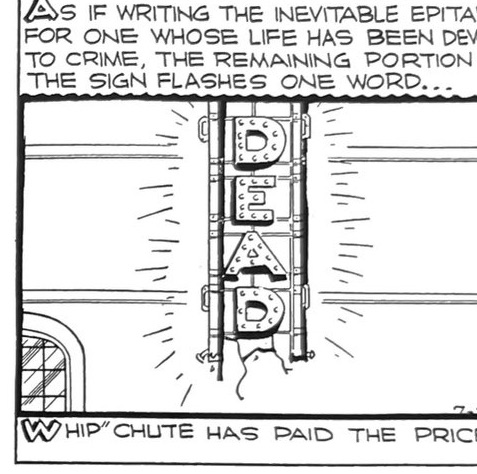
Final Curtain for Whip Chute – 1939
Subtlety was not in Chester Gould’s quiver. Here he triple underlines his irony.
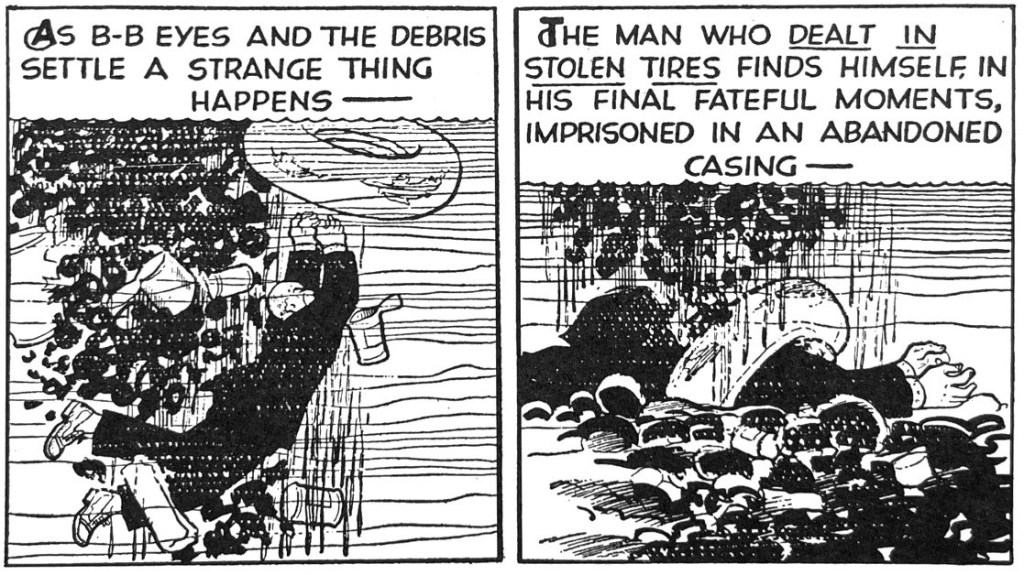
B-B Eyes Gets Dumped – 1942
More than anything, Gould loved to kill and humiliate Tracy villains in slo-mo. Here, B-B Eyes hides in a garbage barge in the final leg of a desperate flight from justice, only to get dumped, trapped and drowned. Gould had a special talent for using the panel. framing and zoom techniques to communicate feeling through his use of space. His signature tight shots on dead villains often conveyed the loneliness and claustrophobia of death itself.
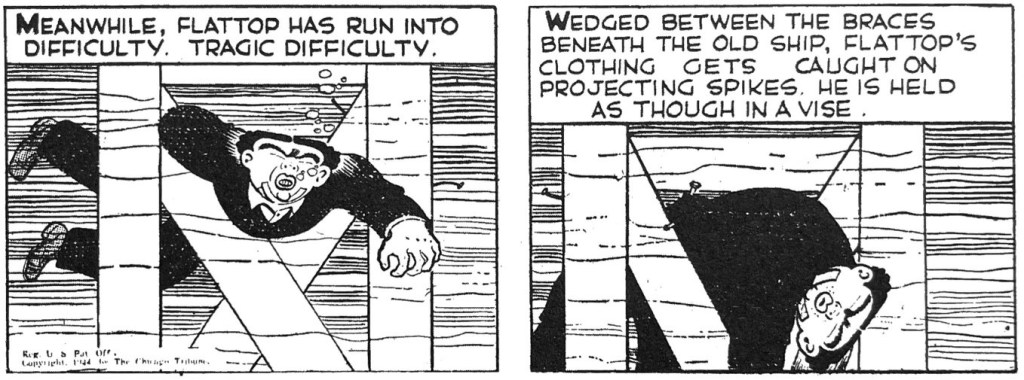
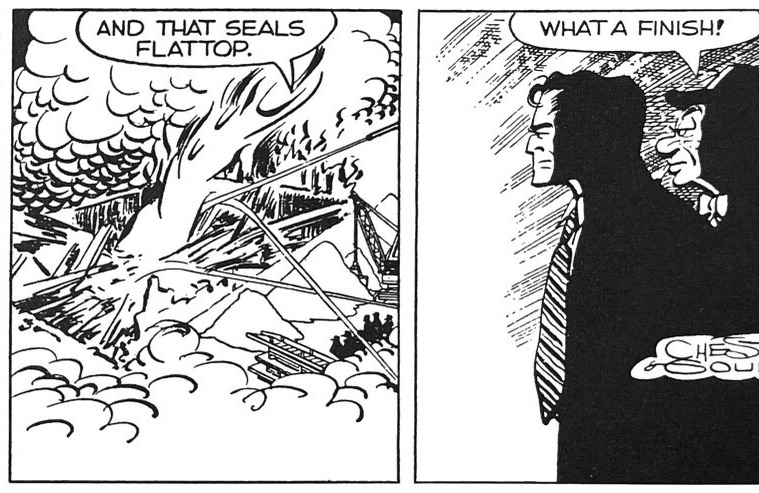
Flattop Gets Spiked – 1944
In 1944, Gould concocted two of his most venal villains. Flattop was simply psychopathic as a hit man, and he would be followed by The Brow, who was sadistic and a spy. Hiding beneath a ship being constructed, Flattop gets hung up on protruding spikes, leading to another close-up of deserving death.
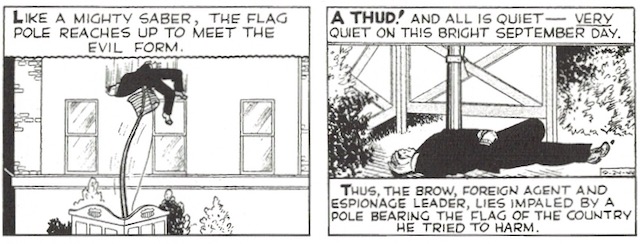
The Brow Is Killed By Patriotism – 1944
Far and away the most inventive and stomach-turning death in the first decades of Dick Tracy was the impaling of The Brow. I covered this in greater detail and with more context elsewhere. But here again is the wartime spy getting impaled on the flagpole commemorating the city’s war dead. The bending flagpole is a gruesomely brilliant touch to amplify that moment of maximal tension that will ultimately pierce the villain.
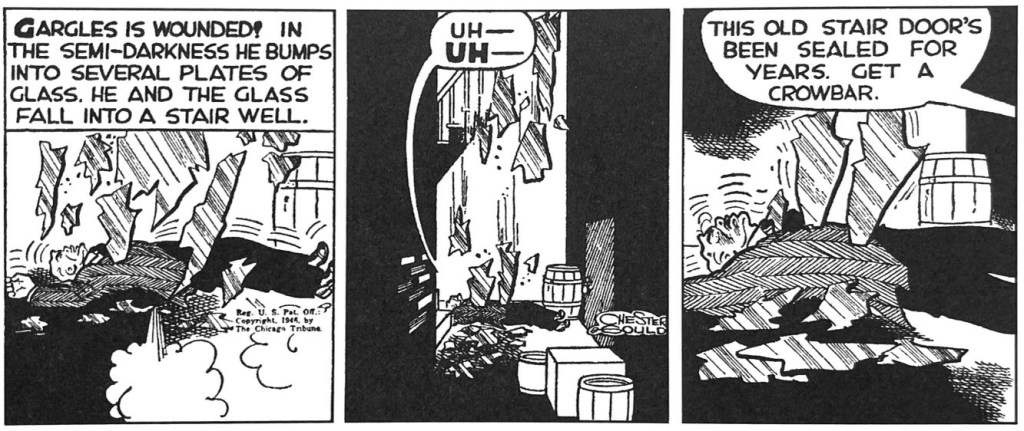
Gargles Eats Glass – 1946
Falling through a skylight, again in comic strip slo-mo, Gargles gets sliced across three panels. And Gould can’t resist giving us his final shudders. In fact Gargles hangs on until the next strip so his final words exonerate an innocent suspect just in time for Christmas. One of the hallmarks of Dick Tracy was the strip’s extremism, Gould’s penchant for balancing unmatched graphic violence and angry vindictiveness with maudlin sentimentality. This sequence leads up to a Christmas strip that celebrates the villain’s death and the joy of the season.
Mumbles’ Cry for ‘Elp’ – 1947
Making a speech impediment somehow expressive of a villain’s evil was a questionable move to begin with. But Gould doubles down on this conceit by having Mumbles frantically, futiley hail for “ELP”.
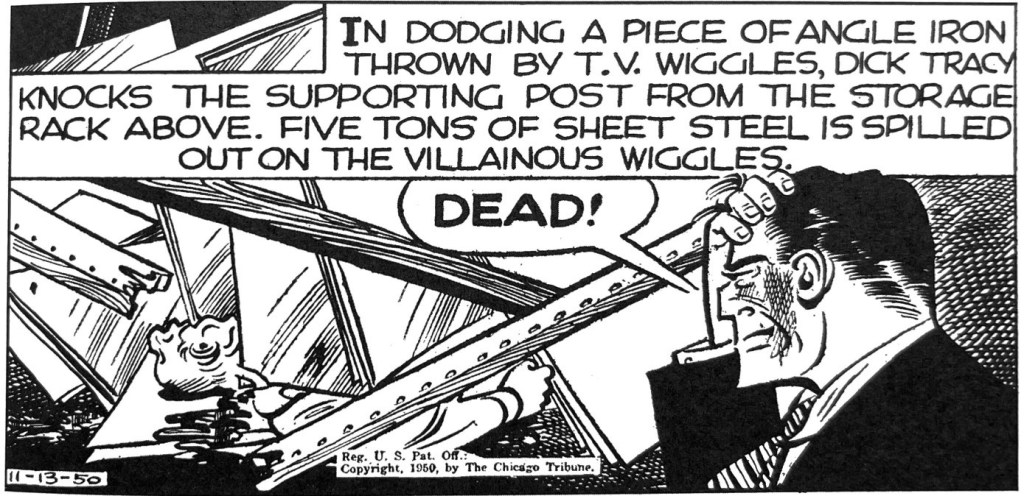
T.V. Wiggles Can’t Move – 1950
Gould loved to draw in that little bit of grisly business to convey violence. While he used a heavy, cartoonish line and unreal, expressionist style that set the strip far apart from the illustrative style of most adventure strips, Gould used other ways of communicating hard-boiled reality. He had a penchant for objects penetrating bodies. Bullets often passed through their targets in shootout sequences. And as the deaths of The Brow and Gargles showed, the impaled body has a special place in Gould’s sense of horror. The death of T.V. Wiggles comes from fallen metal sheets that form an ersatz coffin. But it is that little corner of metal piercing a flap of neck flesh that telegraphs the experience of death itself.
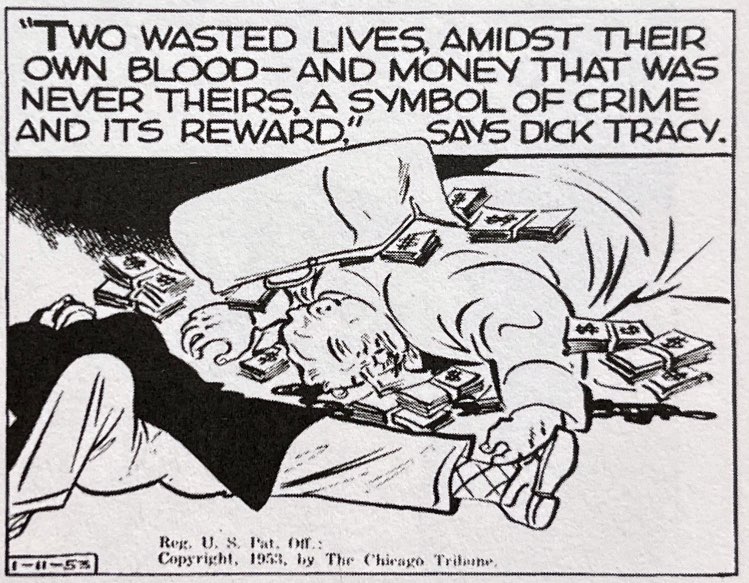
Mr. Crime and Judge Mix Blood and Money – 1953
Mr. Crime was among Tracy’s most ruthless, pitiless villains of the 50s, and in the context of the Gould moral universe I am surprised (and a bit disappointed) that he suffers a simple shootout with Tracy. In fact Gould reserves the grisliest image for Mr. Crime’s extorted dupe, Judge Ruling. When cornered, the corrupt Judge chooses suicide. But of course Gould can’t give us a gunshot sound effect heard through a closed door. We have to get an image of Judge Ruling eating the gun, complete with cheek lines to suggest how deep he has planted the barrel. But we’re not done with this duo. As is his wont, Gould closes in for a final tableaux of both villains swimming in their own blood and money.
Flattop Jr.’s Near Miss – 1956
Flattop Jr. was indeed the son of the original Flattop, but he was framed by Gould as a neglected youth who embodied the overhyped scourge of the 1950s – the juvenile delinquent. He appears to meet his end in a theater fire he himself set to cover his escape. Despite the massive explosion Gould depicts dramatically, and the presumption of having died in the inferno, Jr. turns up later where his genuine death takes place in the middle of another villain’s cycle. And so that final contemplative panel here turns out to be ironic.
Putting a full grown man in a skin-hugging bodysuit, hood and mask is bound to raise a few hints of offbeat sexuality. I have no idea if Phantom creator Lee Falk knew precisely what he was doing when he introduced the form-fitting costume to pop adventure in 1936. Some of us will never forgive him. But it is clear that the sheer eroticism of The Phantom strip was clear from the start. And “sheer” is the operative word. As I pointed out in an earlier post, the mysterious avenger was not the only one to trot about the globe in skivvies. Artist Roy Moore missed few opportunities to drape in gauze (barely) Phantom gal pal Diana and a steady line of sadistic dominatrix villainesses.
Not to put too fine a point on it, but for all of his pre-super-hero human talents, The Phantom got bound and whipped by women at a shocking rate. Sado-masochism and titillating cheesecake were hardly new to mass media in the 1930s, of course. The Phantom probably drew more from pulp magazine adventure tropes than any other strip of the time. Its eccentric masculinity and leggy, dominant women, not to mention a risible colonialism, were conventions of the print pulps. But no other daily comic strip I have seen kept an erotic sub-text so close to the surface.
The Phantom is a special case. Sex is baked into the premise and origin story. This is an extravagant revenge fantasy, reaching back 400 years, in which a nobleman swears to avenge the murder of his father at sea by the hands of “Singh pirates.” He dedicates the son of every future generation of his family to fighting piracy of every kind. And so the “the ghost that walks” takes on the mythos of immortality. Of course, the subtext of the origin story is that each generation of Phantom needs a willing wife.
The animating appeal in pulp adventure really is the male ego itself Just about all aspects of the narrative aim at buttressing an heroic male fantasy that apparently needs all the stroking it can get. But as with all pulp heroism, it starts with a two-fisted, iron-willed, he-man dripping a masculine prowess that is not only turned up to 11 but immediately apparent to any woman in the general vicinity.
The number of pulp magazine column inches spent gushing over the raw and daunting power of our hero’s fists, determination, sex appeal, endurance, brains, speed, stare, will, etc. is astonishing. Well-tuned to male adolescents (and the arrested adolescent in the rest of us) the testosterone opera of pulp adventure always seems to belie the fragility of the male ego. No amount of flattery ever seems enough.
Of course the sultry villainess falling for the sexually irresistible hero was a common trope of mid-century male adventure, and it certainly was familiar to comic strip readers. The theme was central to many of Milt Caniff’s Terry and the Pirates, and Will Eisner’s The Spirit, whose heroes had tortured relationships with a range of recurring femmes fatale. But in Caniff’s much more masterful hands, these plot twists often became opportunities for some remarkable psychologizing. Eisner used the convention as sites for clever banter, inuendo and the Spirit’s comic cummupance at the hands of famously jealous girlfriend Ellen Dolan.
In Lee Falk’s hammier hands, however, the fawning villainess and cheesecake tropes descend into high camp. Which is great for me, because if it isn’t clear by now, I am not a fan either of Lee Falk or the costumed hero. Falk’s storylines in both Mandrake and The Phantom lack inventiveness and genuine suspense. Ray Moore’s artwork in the Phantom dailies can be involving, albeit a good imitation of the Alex Raymond style that the syndicate was imposing on all of its adventures in the 1930s. I find The Phantom best sipped by the panel rather than eaten by the storyline, mainly because it heightens the campy excess that is the strip’s best feature.
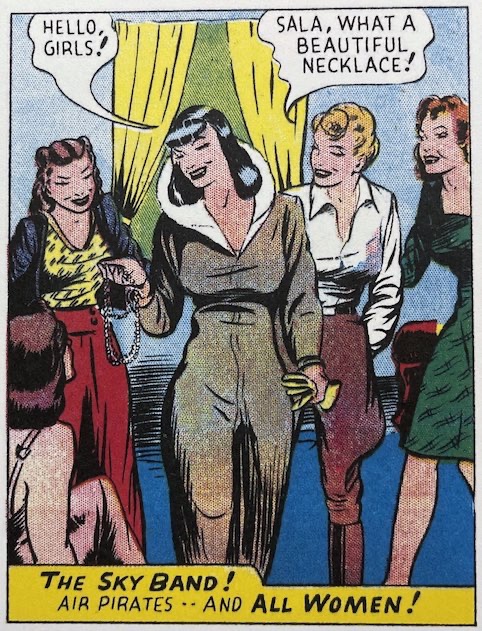
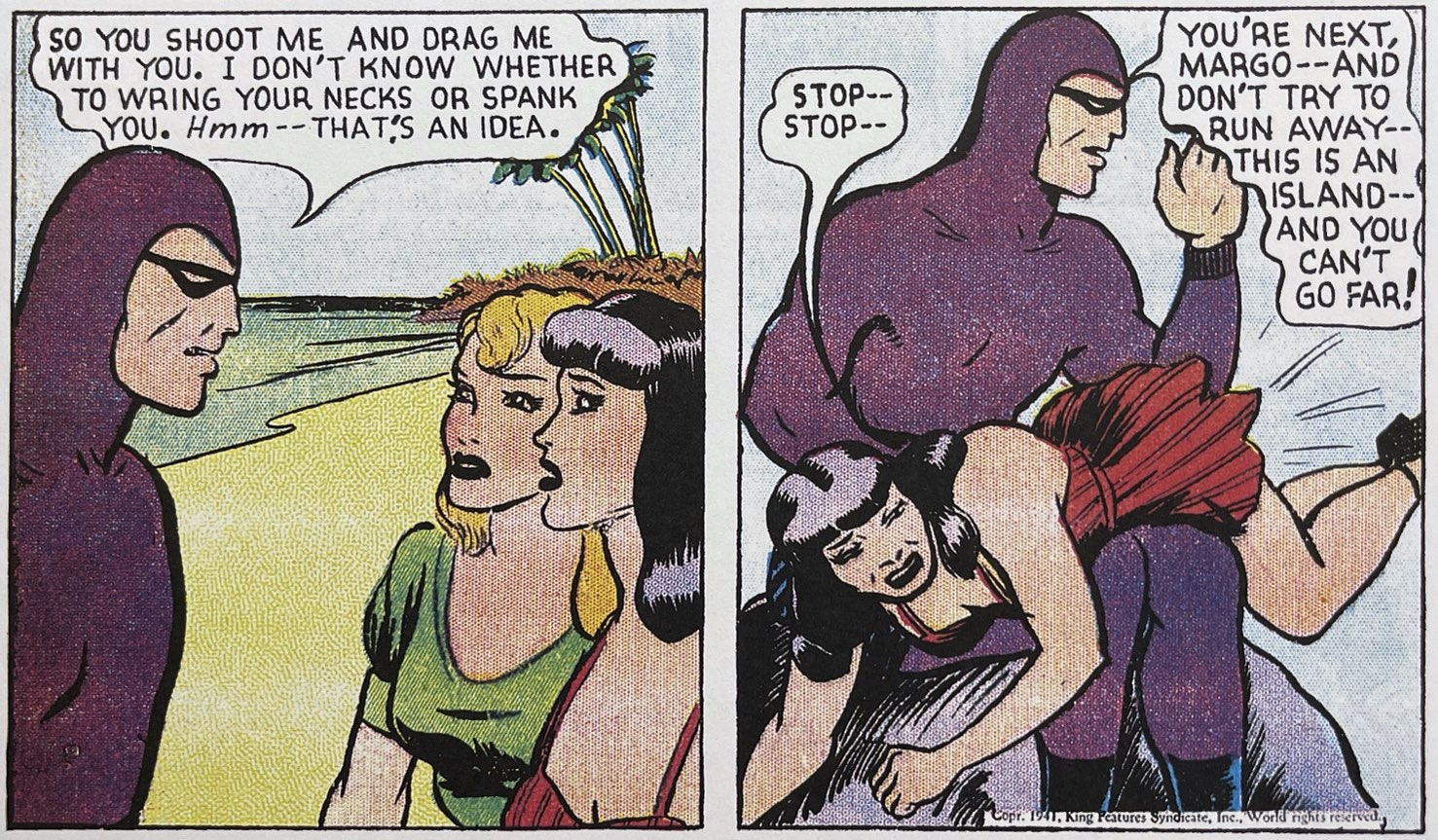
When The Phantom launched a weekly Sunday storyline in 1939, Falk revisited the Sky Band of female pirates he introduced in the dailies earlier. Led by Scala and assisted by Margo, the Band has all of the sexual elements we need: The Phantom repeatedly captured, bound, beaten and saved from certain death by besotted women pirates; villainesses falling and then competing for our hero; female deception, seduction, conniving, etc.
In the world of male pulp adventure, a hero needs to be as steel-willed as they are, if only to combat the wild incongruities of the female stereotype. The pulp villainess is at once slave to her emotion and archly plotting and manipulative.
But let the images speak for themselves. Or try to. I am not sure if Moore was using assistants for the Sunday work, but the style here is wildly uneven, usually wooden and with none of the Raymondesque brushwork and framing we see in the dailies. What we do get is a cornucopia of pubescent fantasy. The legs are long and plentiful, and somehow they manage to walk on sandy shores in stilettos. And the fetishes just keep coming: hair-dragging, cat-fighting, even spanking.
Rightfully, Falk’s Phantom is seen as an historically important transitional figure. His costumed figure and allusions to supernatural abilities bridges the male prowess of Doc Savage, The Shadow and The Spider in pulp adventure to the genuine superhero genre that Superman was soon to engrave on popular culture. But he also brought into the daily newspaper from the adult pulps a surprisingly consistent sexual subtext, if not outright fetishism. For all of the Falk and Moore’s many weaknesses, we can thank them for sexing up the comics page.
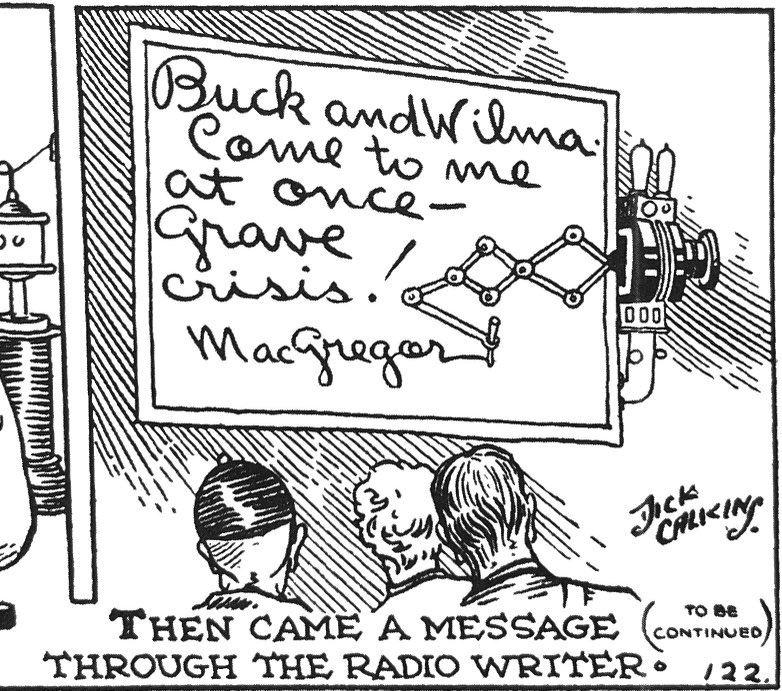
Buck Rogers’ “Radio Write” – A Steampunk Fax Machine
The hero of Buck Rogers was never Buck himself, really, so much as the future itself. And that was fortunate, because neither writer Phil Nowlan nor lead artist Dick Calkins was competent at the actual craft of the comic strip.
No one ever accused Calkins of artistic dexterity. The overall look of Buck Rogers was wooden, lacking in perspective or proportion, barren of expressiveness or even basic blocking of figures within the panel. Limbs often seemed out of scale with bodies and positioned with the naturalness of a marionette. Moreover, Calkins worked with assistants throughout the original artist’s run who reportedly popped in to do different parts of the strip, including some fetching female figures that were disorienting to a reader accustomed to the strip’s unconvincing art.
Which is to say that the limited range of Calkins’ talent pretty much matched writer Phil Nowlan’s narrow narrative reach. The adventure itself lacked character, suspense, pace or setting.
But enough Buck bashing. I’ll save my rant on Nowlan’s many storytelling and cultural sins for another time. In fact, it is the basic badness of the Buck Rogers comics strip, especially in the 1930s, that makes its chief claim on our attention stand out. While other adventure strips of the day like Little Orphan Annie, Dick Tracy, Popeye, Wash Tubbs and Capt. Easy clearly were about their eponymous protagonists and their villainous antagonists, the only compelling feature of Buck Rogers, 2429 A.D. was the future itself. To their credit, everyone concerned seemed on the same page of what the strip really was about. In the 1940s, Dill Syndicate head John Dill reflected that in the late 1920s he was looking for a strip set centuries in the future “in which theories in the test tubes and the laboratories of the scientists would be garnished up with a bit of imagination and treated as realities.”
And that is precisely where Buck Roger’s 25th Century adventure is compelling and fun, when it projects the technologies and lab experiments of 20s and 30s America into the future. And oddly, this where Nowlan and Calkins two dimensional approach to story and art excelled. The flip side of their shared weakness in depicting human depth or expression was a loving attention to detail when it came to objects without a pulse or soul. They had a catchy way of imagining gadgetry of the future. As I detail below they had a pretty good track record of anticipating technologies that would become commonplace after WWII. Many of them, like TVs, robots, and even rocket ships were either in development in some form or were part of the early science fiction ether where Nowlon got his start.
Adventure comics historian Ron Goulart suggests that Calkins’ technical drawing style was indebted to early sci-fi magazine cover artist and illustrator Frank R. Paul, who appeared often in Amazing Stories and Wonder Stories, the main pulp vehicles for early speculative fiction. The story that caught publisher Dille’s eye was Nowlan’s iteration of Buck as “Anthony Rogers” in “Armageddon – 2419 A.D.” in Amazing Stories Aug. 1928. The evolution of that story into Buck Rogers brought a niche genre into the mainstream and became most Americans’ first exposure to the science fiction genre’s ability to imagine a far future. And today it comes off as a captivating steampunk melange of retro stylings for aspirational technology.
When it came to gadgetry, Calkins showed an appreciation for rendering the details of mechanism, materials and surfaces. His horizontal and vertical hatch work across metal surfaces became a signature of most Buck Rogers technology. But his thick line work and flat perspective leant a cartoonish quality to the machine, a touch of Rube Goldberg’s contraption aesthetic that made this future tech feel more imagined than precise.
Drones
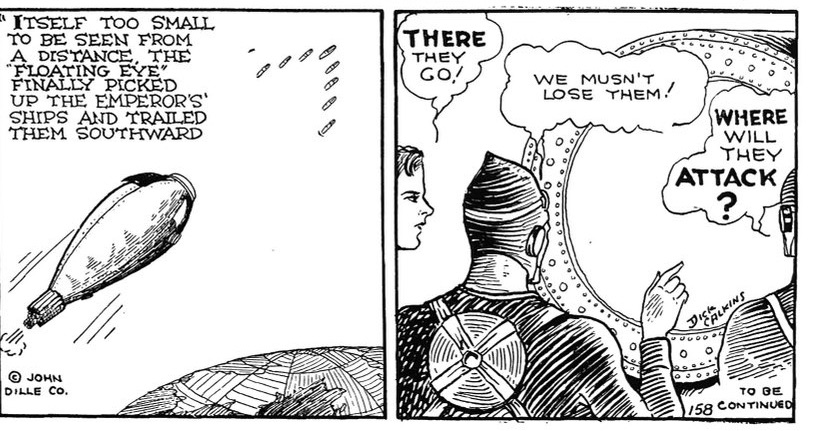
It was not too much of a stretch for 1929 Americans to envision a future where wireless communication, TV tech, flight and visual surveillance would merge. But Nowlan and Calkins were pretty spot on in expecting a drone-like device
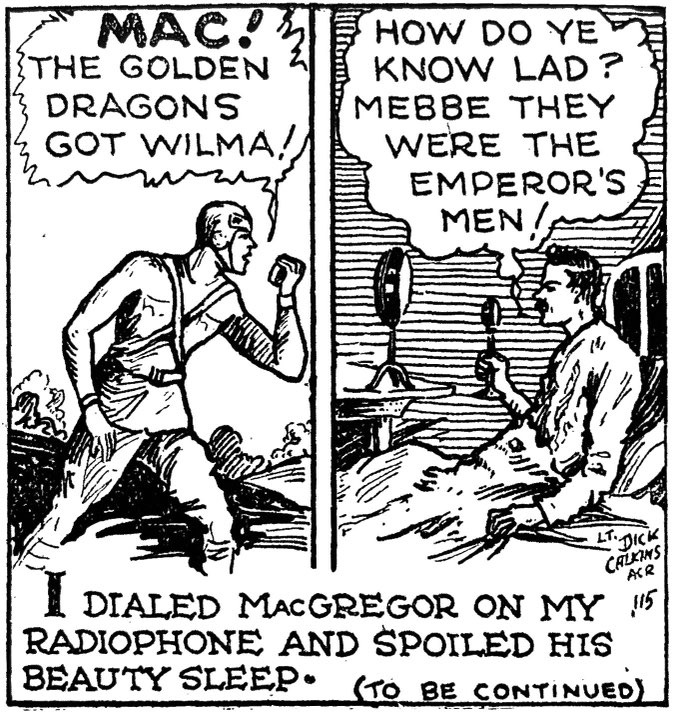
Buck Rogers, Early Brick Phone Adopter
Buck might be rocking a pre-iPhone Nokia hand brick there. Nevertheless, the 2049 (via 1929) “Radiophone” seems to sense how the two chief inventions of the modern world – radio and the phone – were destined to merge.
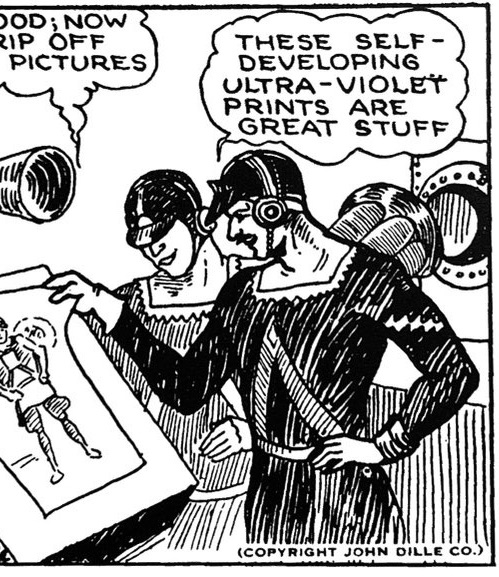
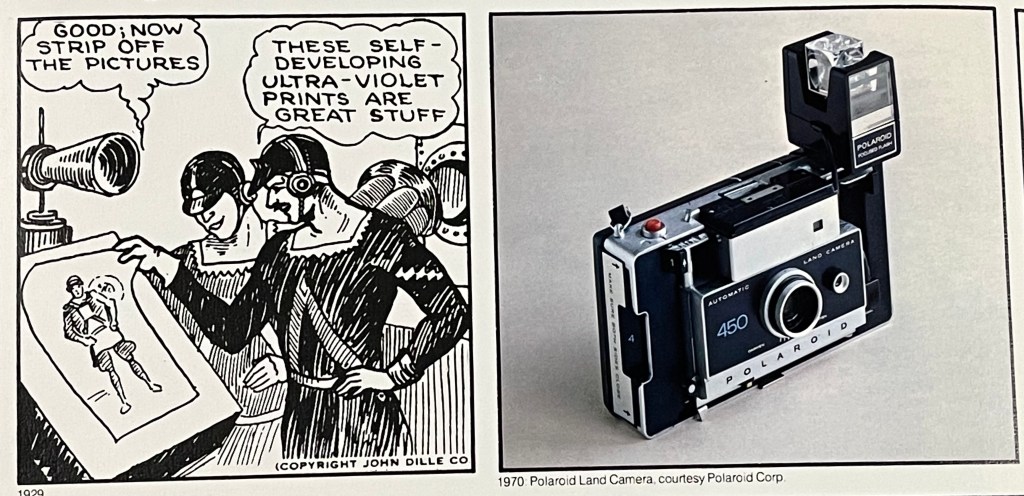
Buck Rogers was especially good at understanding how multiple technologies would complement one another and find new uses over time. Here the vision of high def televisual transmission blends with a self-developing photo process that anticipated the first Land camera in 1948 that introduced consumers to the concept of self-developing photos. The basic idea of instant images, had been developed in more cumbersome formats as early as 1928.
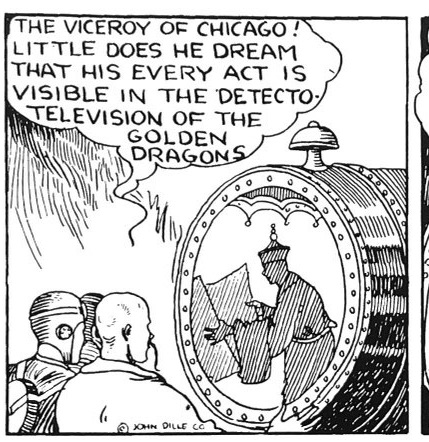
Surveillance Video and TV
Surveillance via TV technology is a major element of the Buck Rogers future. In this case Detecto Television uses hidden cameras across the Mongol empire to help a rebel faction plot insurrection.
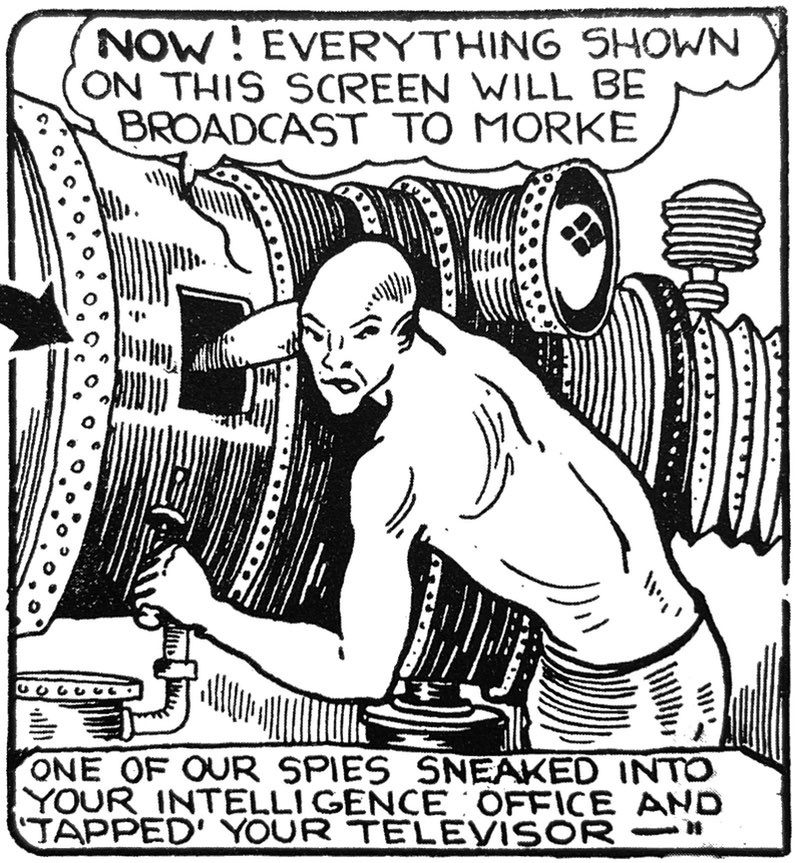
Spyware
Nowlan seemed to understand that as all technology gained more power through wireless communication they would become subject to hacking and spying. Phone wiretapping was invented in the 1890s and became a common law enforcement tool during the Prohibition era of the 1920s. Nowlan simply projected the basic concept onto the communications mainstay of 2049 – the Televisor.
Steampunk Military Industrial Complex
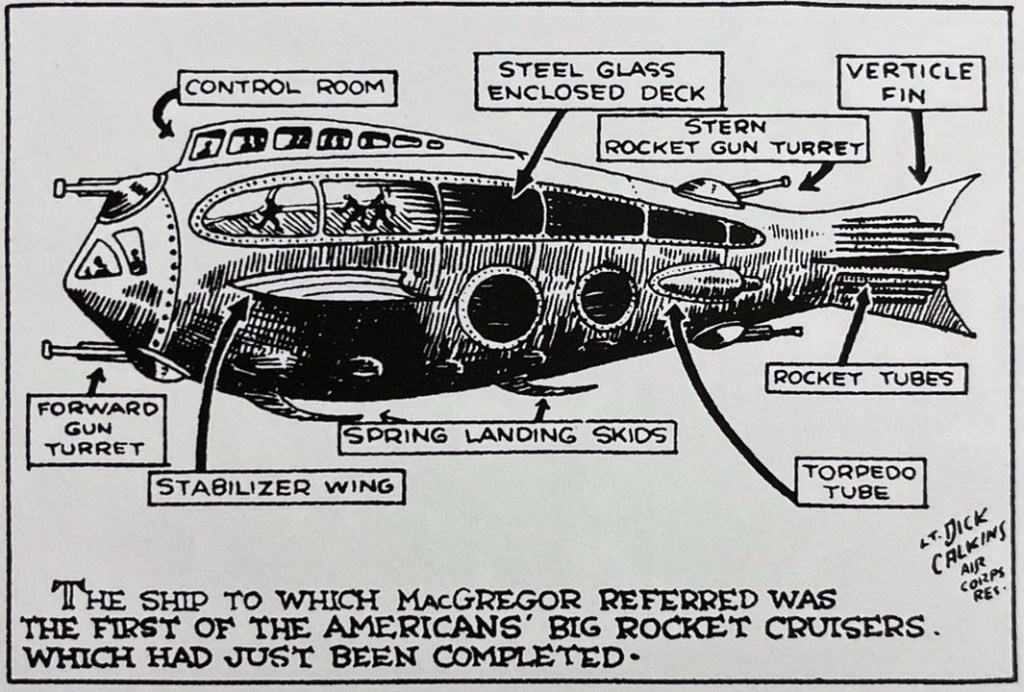
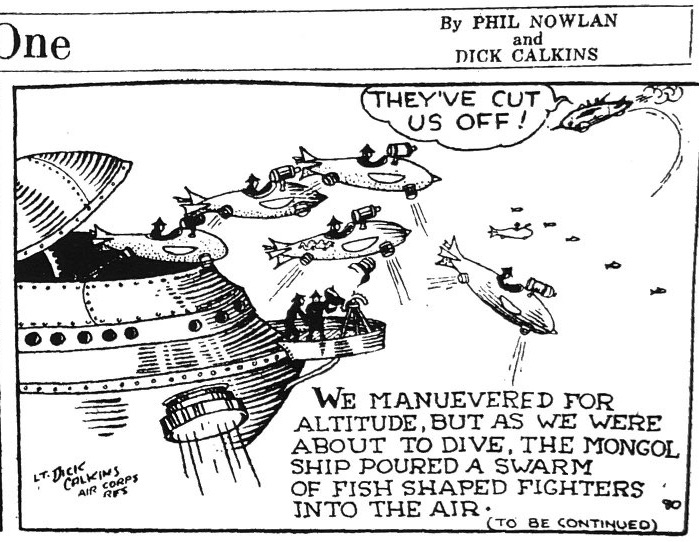
Nowlan and Calkins were most captivating when the former dug into his sci-fi toolbox and the latter married cartoon illustration with futuristic blueprints. They loved to stop the action, blow apart typical panel breakdown and just ogle over the spec sheets of tomorrow. Above, they outline the rebel Americans’ rocket ship cruiser, complete with functional details like “spring landing skids“ that helped us imagine the blueprint brought to life. Nowlan and Calkins’ vision of rocketry seemed effective enough to inform the designs we meet in the movie serial versions of Buck Rogers. Fish-shaped cruisers skidding to a stop on their bellies were a mainstay of the sci-fi serials of the 1930s.
Calkins seemed to take special personal pride in these illustrations, which reflect much greater care and attention to detail than he showed elsewhere. This respect for machinery may have held over from the artist’s WWI experience. He often reverted to signing the strip “Lt. Dick Calkins” and at times adding “Air Corps Res.”
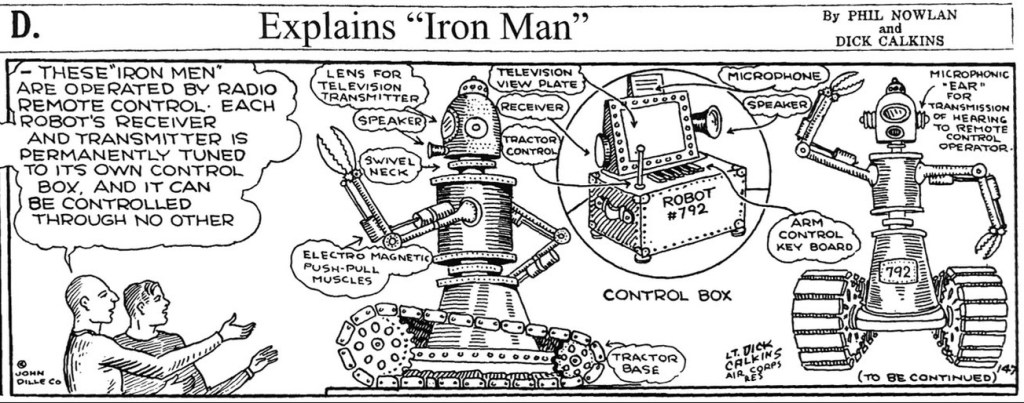
“Iron Man” Origin Story
Perhaps the finest Calkins and Nowlan geek out comes with “Iron Man,” their remote controlled robot soldier. They devote what would have been a three panel progression to a panoramic illustration of the device’s specs and functionality.
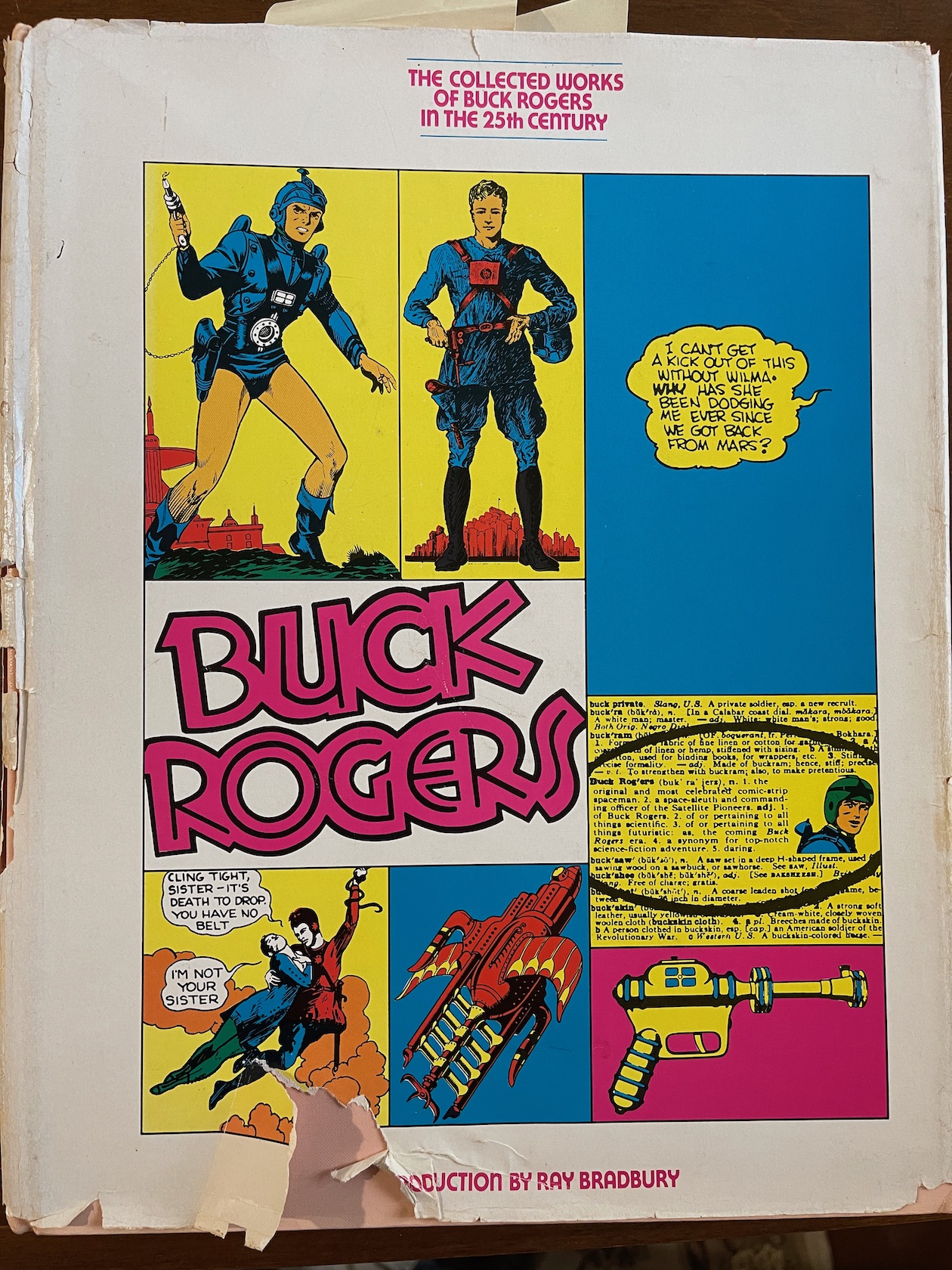
The 1969 moonwalk sparked both a wider interest and new respect for the science-fiction genre and tons of reflection on the ways speculative fiction anticipated contemporary tech. References to our realizing a “Buck Rogers” future flooded the media zone, and Chelsea House published in late ’69 one of the earliest oversized reprints of classic comics, The Collected Works of Buck Rogers in the 25th Century, introduced by Ray Bradbury writing about “Buck Rogers in Apollo Year 1.”
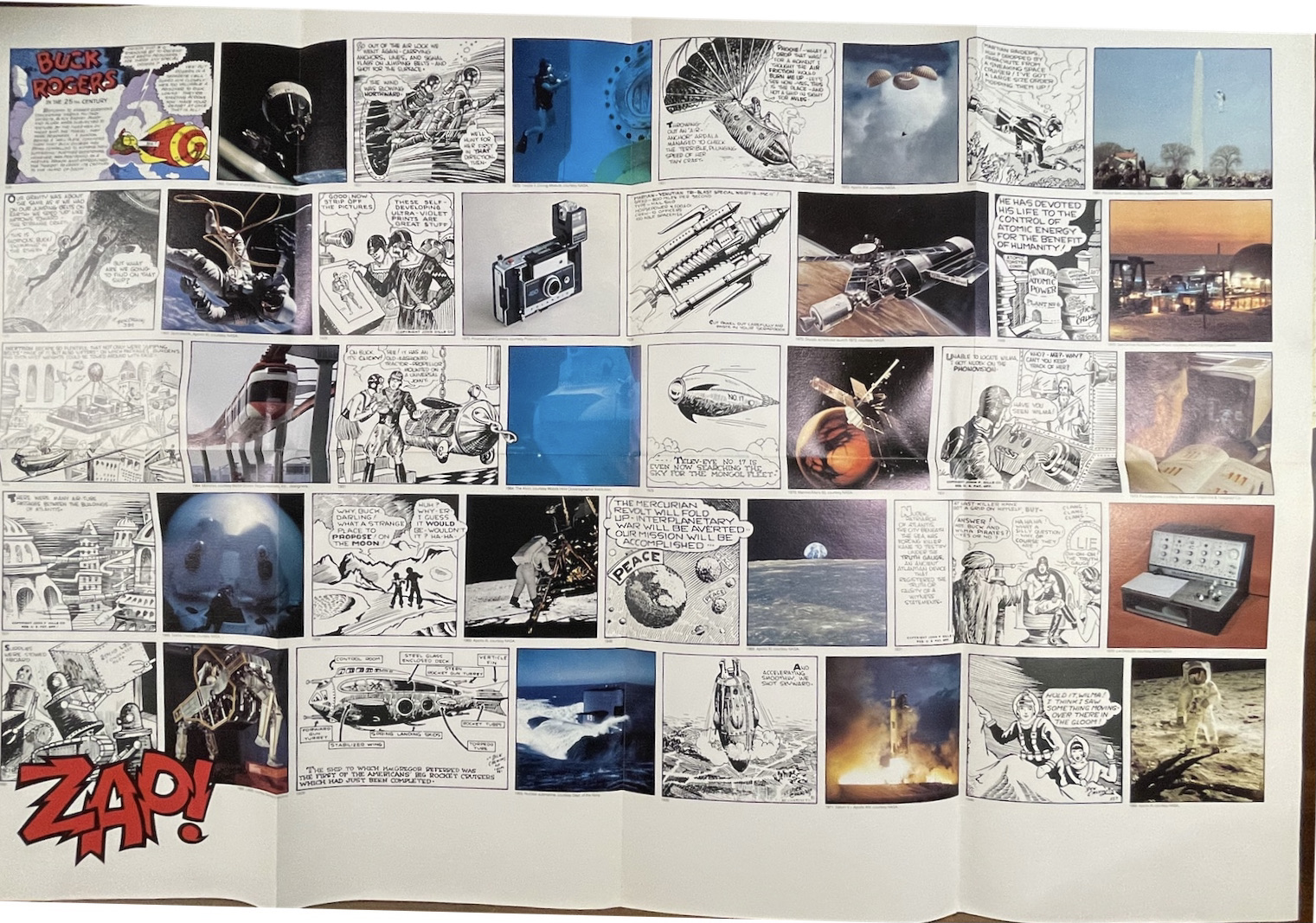
I was age 11 at the time, and had my own fleeting dalliance with sci-fi that drew me to this Chelsea volume at the local library and helped start a much deeper, longer love affair with newspaper comic strips. But an unusual source of comics fandom came into my house at the same time – a trade advertisement for high quality paper stock from the Warren Paper company. Some background. My father was a commercial artist with his own small ad agency in Northern New Jersey. We received at the home office a ton of trade magazines and ads. The S.D. Warren Paper Company promotions were far and away the smartest, most alluring trade marketing I have seen, then or since. To demo the print effect of their premium paper stocks, they created these lush, deeply researched pieces of content marketing that dug into topics like magic or the history of the circus, etc. I recently came upon the one Warren promote that remains etched in my memory – the 1970 celebration of how the Buck Rogers strip imagined accurately the gadgetry and transformative technology of the future.
The one-piece fold-out opened first onto that gorgeous splash above, with the classic Dick Calkins portrait of Buck in mid battle. These are the kinds of magnified newspaper comics images that helped the 12-year-old me into a love of the form. The line art of Calkns, Chester Gould, Will Eisner are among the first classic artists to captivate me. The art style of Buck Rogers felt at once primitive and technical. Calkins did not have a strong of perspective or even anatomy. Most of his figure positions look stiff rather than dynamic. And yet he brought to ray guns and flying ships a dreamy precision that made them live, perhaps even more than his humans.
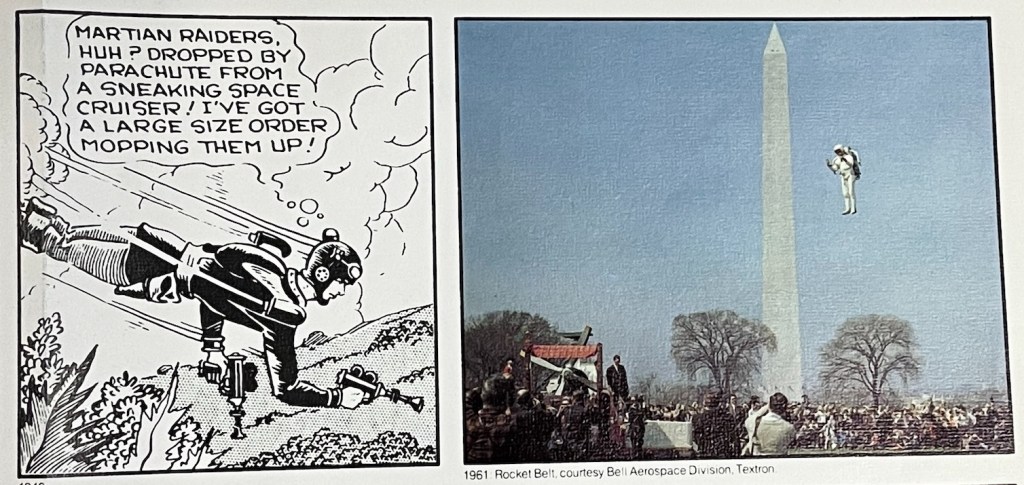
The Warren promo folds out above to a panorama of comparing old Rogers panels to modern innovations like instant cameras, jet packs, surveillance satellites, monorails and more.
This wonderful look back to how the past imagined its future was all in the service of showing off S.D. Warren’s “Lustro Offset Enamel” paper stock, a product name that itself sounded a bit like a cartoon invention. Still, you can’t argue with a content marketing campaign so well done that an 11-year-old remembers it fondly 50 years later.
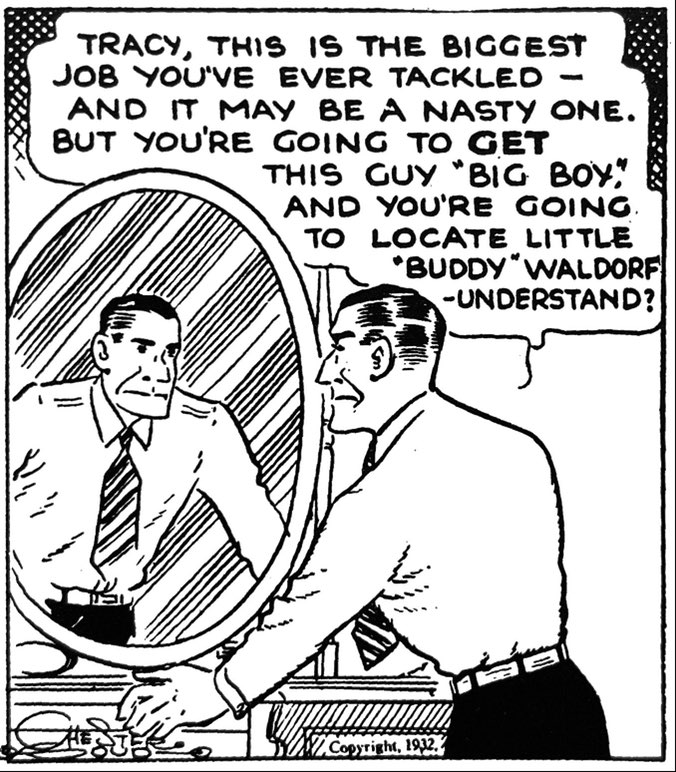
A rare moment of Tracy self-reflection, bracing himself for action
Chester Gould’s imagination was as relentless as it was strange and even strangely mundane. His four decade run of Dick Tracy was distinguished by his signature villain grotesques, striking graphic violence and often arch-conservative politics. Reviewing Tracy’s first year of strips lately, I was struck by a few scenes that both veered from the strip’s eventual form but also practiced many of its regular notes. In the image above, for instance, Tracy pumps himself up for the coming challenge of bringing down his first major nemesis, Big Boy, and rescuing a kidnapped boy. The later Tracy would of course become a rock of resolve that wouldn’t have admitted even this kind of self-encouragement. At this point, even for Gould, Tracy is still human and not yet iconic.
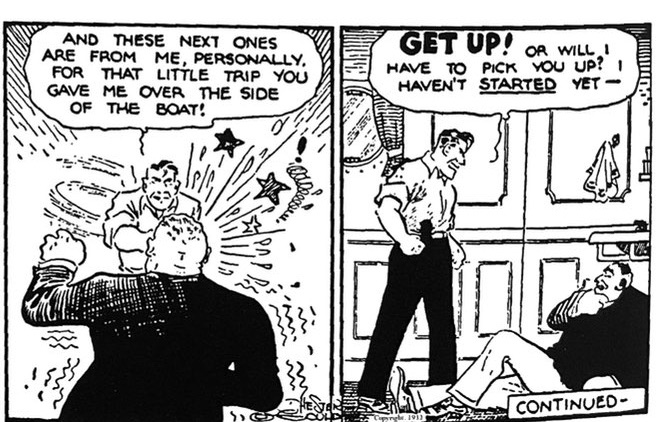
And yet the two-fisted and eccentric manliness of Tracy and many of his pulp fiction counterparts was central to the character from the beginning. And Gould’s politics clearly were already set as early as 1932. Tracy was conceived as a lawman who necessarily had one foot outside police institutions. In fact, before the murder of fiancee Tess Trueheart’s father Emil, Dick was a civilian who had not yet found his calling. He swears upon Emil’s dead body that he will avenge the murder, which sets him on a quick path to becoming a leader among the “plainclothes” unit of the city police department. But his impatience with the bureaucracy is apparent in his unconventional methods and capacity for personal revenge and violence upon his villains. When he finally corners Big Boy, we get a crescendo of police brutality that stretches across several days. It ends with Tracy sending Big Boy crashing through a ships’ cabin door.
The twisted genius of Gould was in having it both ways with Tracy. He professed a deep respect for the law, and Tracy’s straight-backed uprightness was a feature of the strip’s characterization as well as it’s blocky noir style. And yet vigilante justice was meted out both by Tracy and Gould alike. Indeed, his colleagues in the force like Pat Patton and subsequent colleagues are seen as relatively timid and even feminized by their institution in a way that the indomitable masculinity of Dick is not. And the overall violence of the strip is clearly an extension of Tracy’s own vengefulness. The protracted chase of villains on the lam became a part of the Dick Tracy formula, and it was punctuated by the villain’s gruesome torture by nature along the way, often ending in grisly death. Violence for Gould always seemed to be the ultimate social purifier.
By Gould’s own admission, he often made it up as he went along, rarely knowing where his plots were headed and how he would get Tracy out of a jam. And so from its early days the plotting and devices often feel ham-handed, implausible or genuinely weird. His pursuit of Big Boy onto an ocean liner leads Tracy to knock out an innocent staffer to don his uniform and to dress in drag just to get onto the boat and get close to the kidnappers. Less tortured paths clearly are available to his characters, but Gould’s love of novel, unlikely story paths usually wins out.
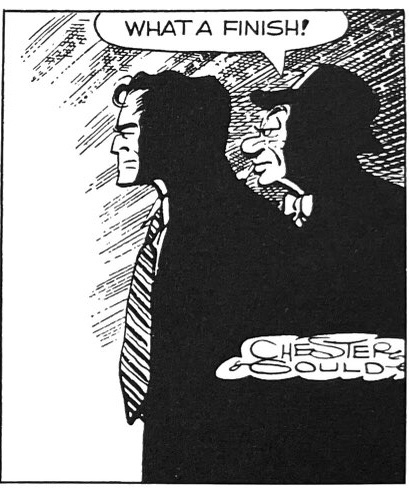
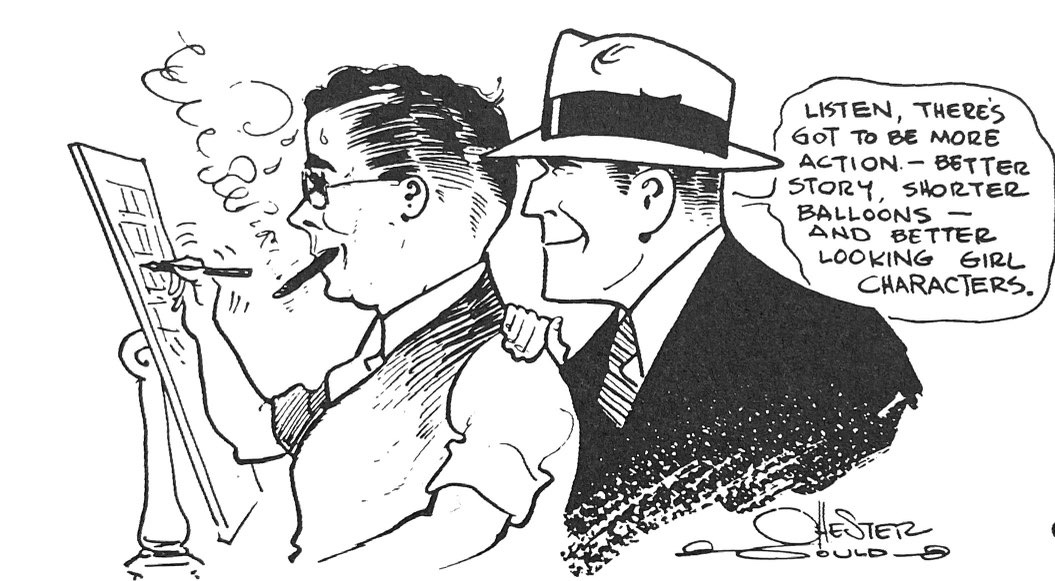
By 1942, a decade after its launch, Gould’s visual signature for Tracy is fully established. His hawklike nose, perpendicular chin and straight lips are as much a statue as a figure, more chiseled from stone than drawn in ink. And in this self-portrait Gould himself sweats under Tracy’s command. He has created a caricature of law and order, authority and masculinity that would become a lodestone. Al Capp soon would mock his violence and surreal story and villainy. His love of authority and violence, impatience with countercultural trends would make him seem a relic by the end of the run. Yet, as much as Gould himself seemed a straight arrow defender of formal institutions, Dick Tracy itself was grounded in a surreal imagination that eschewed simple realism, broke violently with the propriety of the comics page and took us into very strange places.










 Panels & Prose