By the end of his career in 1977, Dick Tracy creator Chester Gould was notoriously reactionary. His disdain for the counter-cultural forces at play in the 1960s and 70s, for liberal explanations of criminal behavior, were clear in the strip itself. In fact, his resistance to leniency in America’s legal system, and progressivism in general, had been baked into his epic since its roots n the gangster era of 1931. From the start, Dick Tray was an exploration of individual valor and evil rather than institutional or social forces. Gould’s take on the 50s moral panic around “juvenile delinquency” via Flattop Jr. is an excellent example. And the moral universe of Dick Tracy hinged on the personal evil of villains(usually embodied in physical abnormalities) and the poetic symmetry of their deaths via some kind of retributive justice.
Even 30 years into one of the most successful runs in comic strip history, Chester Gould’s Dick Tracy continued to promote itself to new newspapers that still hadn’t syndicated the iconic hero. This ad ran in Editor & Publisher, the longtime trade bible for print periodical publications. Of course, this “man of stature” led the most grisly, violent and truly weird of all American comic strips. It was also one of the most compelling. For a gallery of gruesome villain deaths, see this earlier post. On the impaling of The Brow. On the general strangeness of Gould’s imagination. On Gould and Tracy’s conservatism.
Putting a full grown man in a skin-hugging bodysuit, hood and mask is bound to raise a few hints of offbeat sexuality. I have no idea if Phantom creator Lee Falk knew precisely what he was doing when he introduced the form-fitting costume to pop adventure in 1936. Some of us will never forgive him. But it is clear that the sheer eroticism of The Phantom strip was clear from the start. And “sheer” is the operative word. As I pointed out in an earlier post, the mysterious avenger was not the only one to trot about the globe in skivvies. Artist Roy Moore missed few opportunities to drape in gauze (barely) Phantom gal pal Diana and a steady line of sadistic dominatrix villainesses.
Not to put too fine a point on it, but for all of his pre-super-hero human talents, The Phantom got bound and whipped by women at a shocking rate. Sado-masochism and titillating cheesecake were hardly new to mass media in the 1930s, of course. The Phantom probably drew more from pulp magazine adventure tropes than any other strip of the time. Its eccentric masculinity and leggy, dominant women, not to mention a risible colonialism, were conventions of the print pulps. But no other daily comic strip I have seen kept an erotic sub-text so close to the surface.
The Phantom is a special case. Sex is baked into the premise and origin story. This is an extravagant revenge fantasy, reaching back 400 years, in which a nobleman swears to avenge the murder of his father at sea by the hands of “Singh pirates.” He dedicates the son of every future generation of his family to fighting piracy of every kind. And so the “the ghost that walks” takes on the mythos of immortality. Of course, the subtext of the origin story is that each generation of Phantom needs a willing wife.
The animating appeal in pulp adventure really is the male ego itself Just about all aspects of the narrative aim at buttressing an heroic male fantasy that apparently needs all the stroking it can get. But as with all pulp heroism, it starts with a two-fisted, iron-willed, he-man dripping a masculine prowess that is not only turned up to 11 but immediately apparent to any woman in the general vicinity.
The number of pulp magazine column inches spent gushing over the raw and daunting power of our hero’s fists, determination, sex appeal, endurance, brains, speed, stare, will, etc. is astonishing. Well-tuned to male adolescents (and the arrested adolescent in the rest of us) the testosterone opera of pulp adventure always seems to belie the fragility of the male ego. No amount of flattery ever seems enough.
Of course the sultry villainess falling for the sexually irresistible hero was a common trope of mid-century male adventure, and it certainly was familiar to comic strip readers. The theme was central to many of Milt Caniff’s Terry and the Pirates, and Will Eisner’s The Spirit, whose heroes had tortured relationships with a range of recurring femmes fatale. But in Caniff’s much more masterful hands, these plot twists often became opportunities for some remarkable psychologizing. Eisner used the convention as sites for clever banter, inuendo and the Spirit’s comic cummupance at the hands of famously jealous girlfriend Ellen Dolan.
In Lee Falk’s hammier hands, however, the fawning villainess and cheesecake tropes descend into high camp. Which is great for me, because if it isn’t clear by now, I am not a fan either of Lee Falk or the costumed hero. Falk’s storylines in both Mandrake and The Phantom lack inventiveness and genuine suspense. Ray Moore’s artwork in the Phantom dailies can be involving, albeit a good imitation of the Alex Raymond style that the syndicate was imposing on all of its adventures in the 1930s. I find The Phantom best sipped by the panel rather than eaten by the storyline, mainly because it heightens the campy excess that is the strip’s best feature.
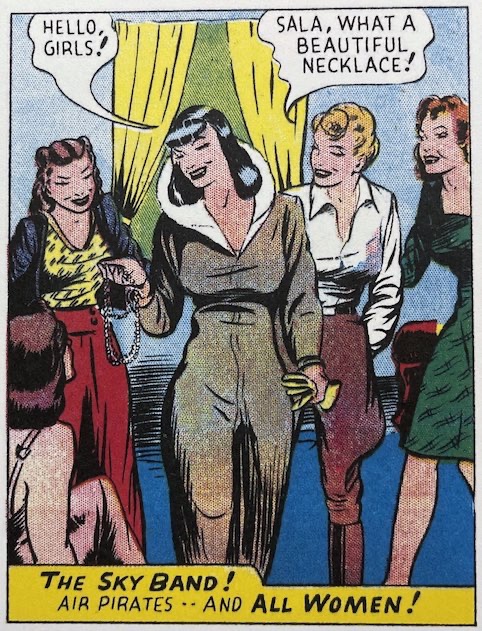
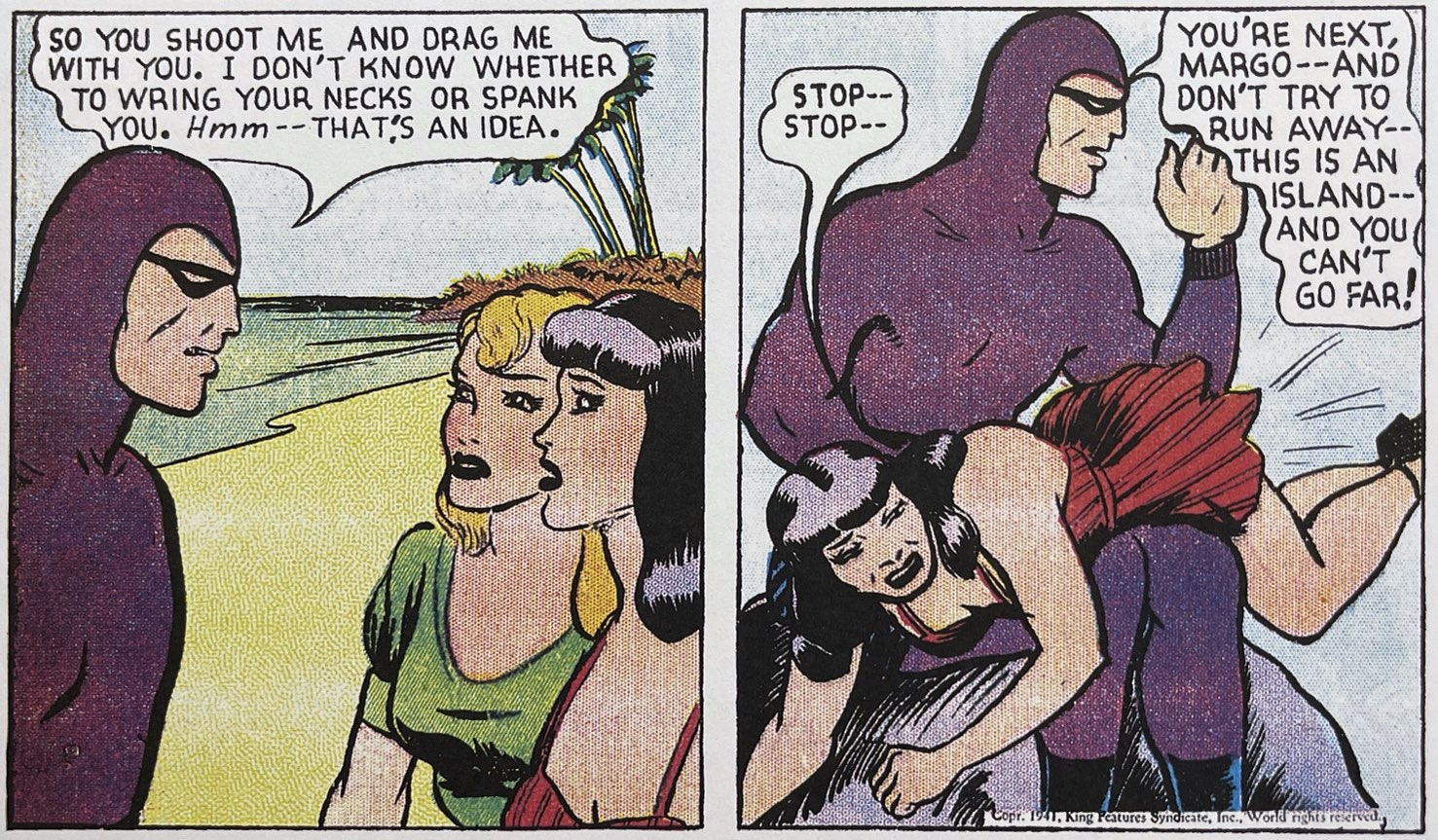
When The Phantom launched a weekly Sunday storyline in 1939, Falk revisited the Sky Band of female pirates he introduced in the dailies earlier. Led by Scala and assisted by Margo, the Band has all of the sexual elements we need: The Phantom repeatedly captured, bound, beaten and saved from certain death by besotted women pirates; villainesses falling and then competing for our hero; female deception, seduction, conniving, etc.
In the world of male pulp adventure, a hero needs to be as steel-willed as they are, if only to combat the wild incongruities of the female stereotype. The pulp villainess is at once slave to her emotion and archly plotting and manipulative.
But let the images speak for themselves. Or try to. I am not sure if Moore was using assistants for the Sunday work, but the style here is wildly uneven, usually wooden and with none of the Raymondesque brushwork and framing we see in the dailies. What we do get is a cornucopia of pubescent fantasy. The legs are long and plentiful, and somehow they manage to walk on sandy shores in stilettos. And the fetishes just keep coming: hair-dragging, cat-fighting, even spanking.
Rightfully, Falk’s Phantom is seen as an historically important transitional figure. His costumed figure and allusions to supernatural abilities bridges the male prowess of Doc Savage, The Shadow and The Spider in pulp adventure to the genuine superhero genre that Superman was soon to engrave on popular culture. But he also brought into the daily newspaper from the adult pulps a surprisingly consistent sexual subtext, if not outright fetishism. For all of the Falk and Moore’s many weaknesses, we can thank them for sexing up the comics page.
We revere Milt Caniff’s Terry and the Pirates quite rightfully as the apex of the adventure strips. His evocative use of frame, staging, rhythms, ink and line (or blobs), setting, landscape, story arc – all set new and high standards for comic art in the 1930s and 40s that define the form. But as I read through the strip from its beginning I am struck by the pop psychological dimension of the strip. So much time is spent on characters musing on one another’s motives, gaming one another’s psychology, and especially mapping the contours of ideal manhood and the war of the sexes.
Terry the amateur psychologist – decoding adult relationships and the male ego in the first adventure with eternal Pat Ryan love interest Normandie Drake.
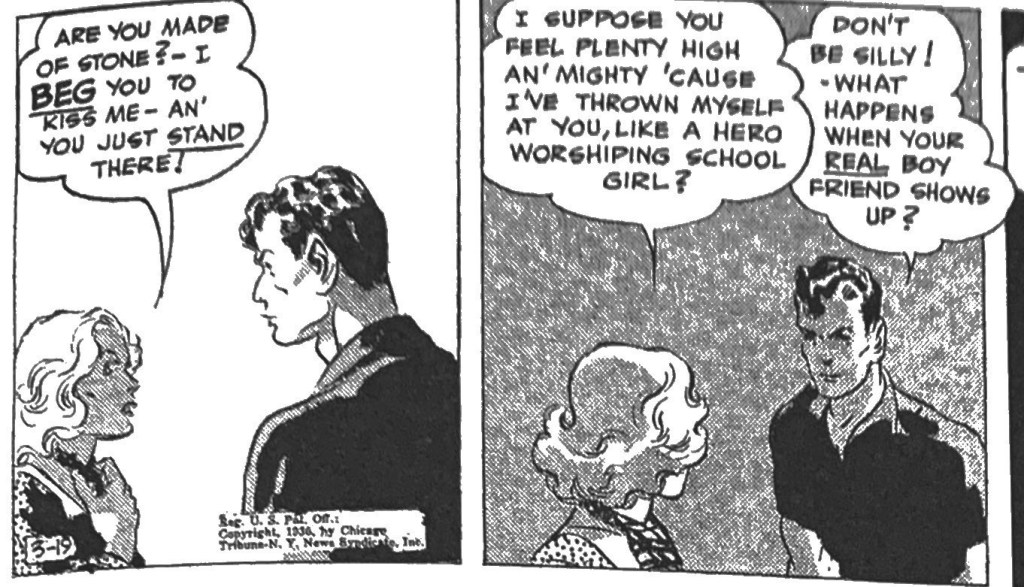
The basic psychological dynamic of Terry and the Pirates is father and son. In most places we are taking the perspective of teen Terry Lee who follows and tries to decipher ersatz dad vagabond Pat Ryan as his model male. In the very first story arch of the daily strip society gal Normandie Drake draws Pat’s eye. Here we get the first of many male/female cat and mouse games between Pat and a love interest. At one point Pat leaves Normandie because he doesn’t feel he could fit into her high society. She tries to retrieve him by falsely charging Pat with forgery. And the game is on.
Terry Lee is in the role of son actively trying to decipher the male role that stand-in father Pat is modeling. Connie is his sounding board, which lets Terry voice his readings of Pat without breaking the fourth wall and talking directly to us. And for all of the terrible stereotyping Connie himself endures at Caniff’s hand, he too engages in the pop psychologizing of men and women that quickly becomes one of the sub-themes of the strip.
For his part, Pat is less often an interpreter of human emotional signals than the classic American stoic, the isolato who spends more time silently staring out windows and having his actions and unspoken gestures read by others.
And Caniff’s world of men and women is one of deception, scheming and misdirection. As Terry understands above, a man or woman’s words or actions often run opposite their real meaning. Pat and romantic interests like Normandie, Burma and the Dragon Lady snub and reject one another regularly as ploys to intrigue and attract the other. Per below, Burma rages at Pat labeling him a coward to successfully challenge their stoic to declare his passion for her.
In a rare moment of vocalized reflection, Pat ponders the motives of Burma and his own worthiness as a suitor.
Pat often takes the paternal role to Terry, filling in the blanks on this great mystery that seems to be woman. Heart-to-hearts abound in this strip. Above Caniff invokes the familiar father/son exchange over “Dad” shaving. Caniff portrays the scheming and counter-scheming between men and women with the pointed curiosity of a boy’s view. The interpersonal plots in TATP take up at least as much panel time as the unfolding adventures as the two conceits of the strip run in parallel. And character introspection plays a large role in the day to day content of the strip. Typically the pulp adventure genre is about action, heroic characters who are fully externalized and use violence to express usually male emotion. In TATP, almost every character is capable of being at turns self-deprecating, introspective, analytical.
For and adventure genre usually focused on externalization, Terry and the Pirates uses character introspection to a remarkable degree. Here, Burma reflects own her own motives.
In putting Caniff’s masterpiece in its context of the 30s and 40s, we would do well to understand this dimension to the strip’s appeal. As pure adventure and graphic storytelling, the strip is unmatched. But Caniff clearly is also exploring with his readers human behavior, psychology, the layers of motive and delusion in human interaction. The basic insight of modern psychology, that humans are not always fully aware of their own motives and that actions are not always clear reflections of thought and feeling, are remarkably featured in this strip. It may be Caniff’s unique blend of external physical action with internal introspection that made the strip so rich and appealing during its very popular run.
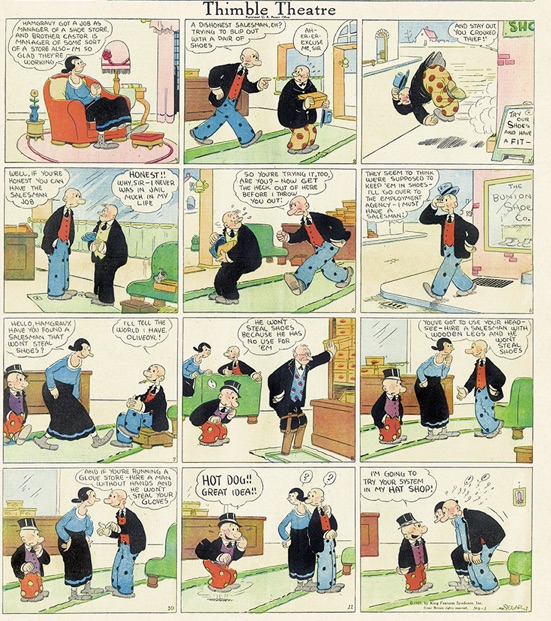
#4 Thimble Theatre and the Pre-Popeye Cartoons of E. C. Segar, by E. C. Segar (Peter Maresca, ed.), Sunday Press, $85
Technically a late 2018 publication, I didn’t get to it until the new year. Peter Maresca’s Sunday Press doesn’t just reprint lost episodes of comic strip history. They think hard about them. Before Popeye’s famous arrival to Segar’s Oyl family saga, Thimble Theatre was a hard-nosed satire of modern American acquisitiveness and family relations, with a big dose of surrealism tossed in. This oversized and impeccably restored selection of Sunday pages shows Segar growing his chops for long story arcs and vicious rogues who somehow succeed in making us root for the otherwise unlikeable Oyls. As usual with Sunday Press productions, this has insightful background material, this time from screwball comics expert Paul Tumey and historian Jeet Heer.







 Panels & Prose