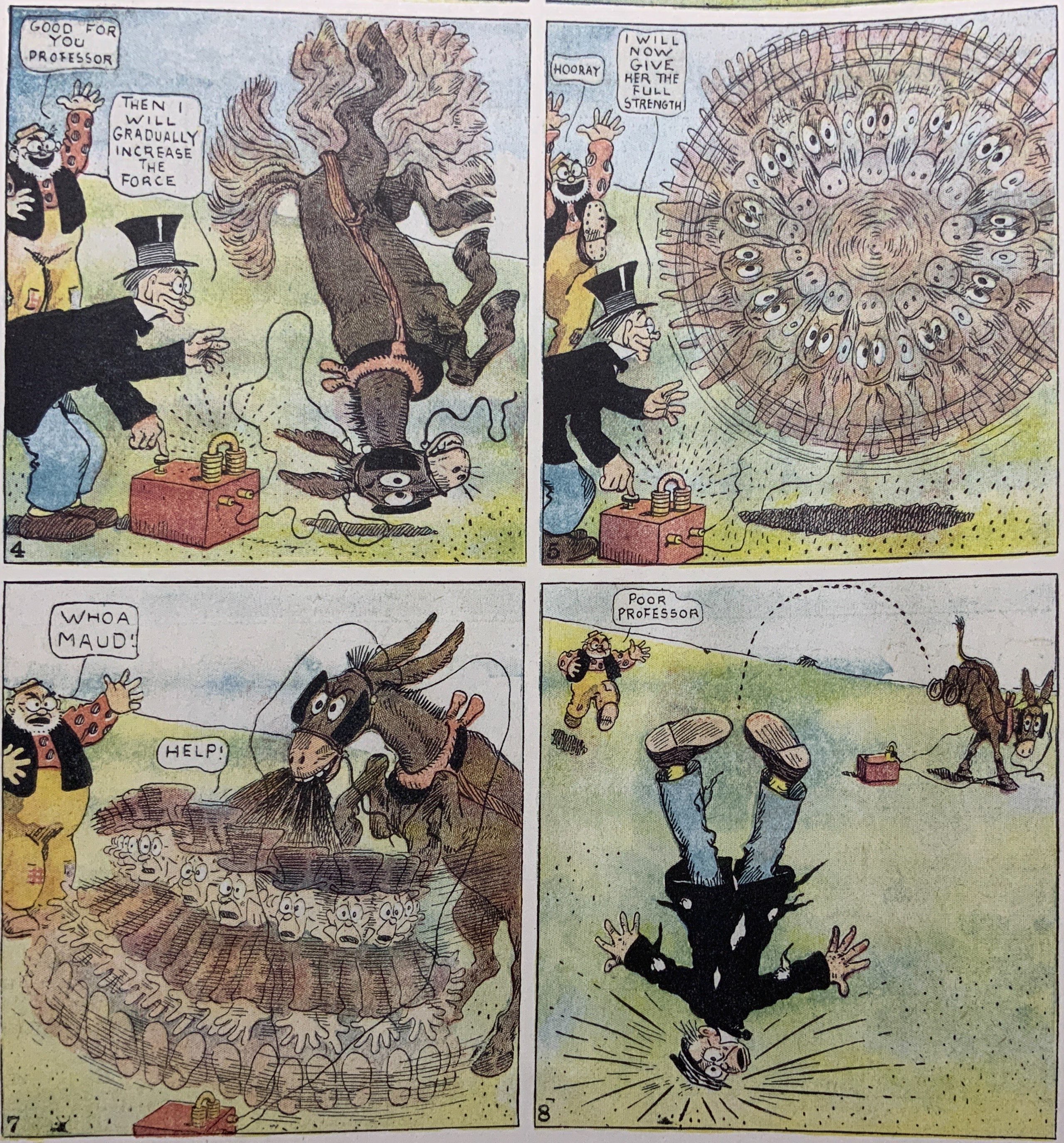
Rube Goldberg (1883-1970) is best remembered for his cartoon inventions, ridiculously intricate mechanical solutions for common activities. These send-ups of modern technology and the romance of engineering appeared under multiple titles and formats across his career, but took most regular form in Collier’s Weekly between 1929 and 1931 as The Inventions of Professor Lucifer Gorgonzola Butts, A.K. His Foolish Question panels ran from the teens in various forms for decades. And his best-known continuous character strip of hapless failure Boob McNutt ran for more than a decade in the 1920a.
But it is in his forgotten small masterpiece Bobo Baxter (1927-1928() that I think we see Goldberg’s array of talents for satirizing the modern world come together into a persistent and satisfying whole. And at the same time Bobo shows how a sad note of alienation often lurks beneath the surface of many slapstick characters.
As godfather of comics historians Bill Blackbeard points pout in the intro to a 1970s reprint of the complete (Hyperion Press, 1977) run of strips, Bobo Baxter represented Goldberg moving (or being forced by trends) away from the gag-a-day format to the continuous characters and situations of other 20s strips like Little Orphan Annie, Bringing Up Father, The Gumps, Polly and Her Pals, etc. He had already made his Boob McNutt Sunday strip into a major hit by introducing recurring characters and continuing storylines. In 1927 he sent the form into a daily new creation, Bobo Baxter.
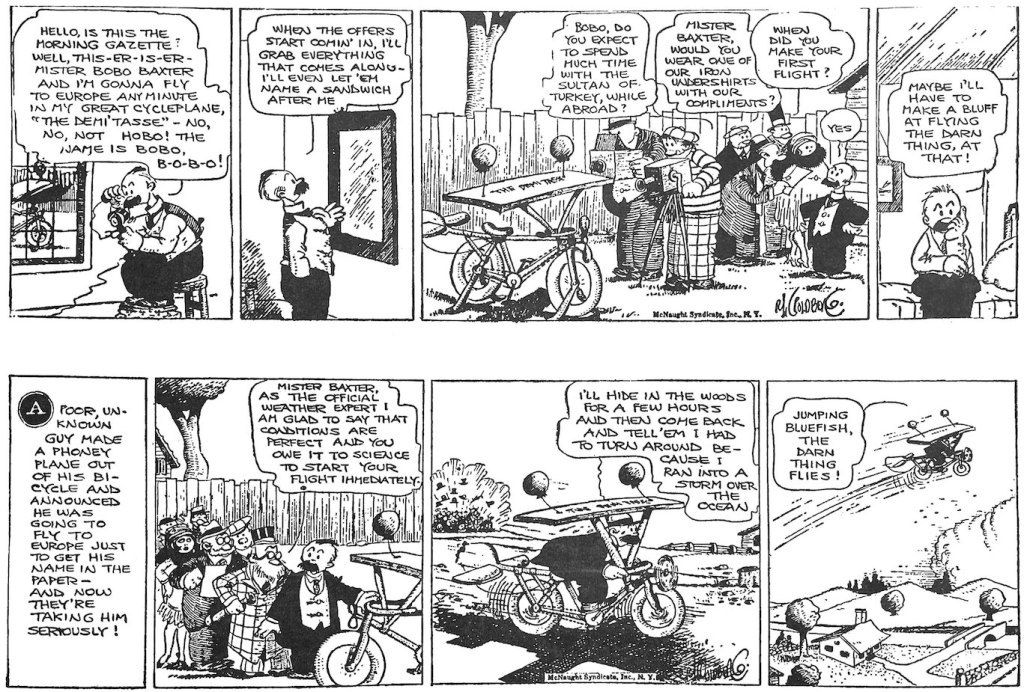
We meet Bobo as an unsuccessful dreamer, envious of the fame and fortune of well-publicized explorers like Admiral Byrd and aviator Charles Lindbergh. So he builds a flying machine out of a two-seater bicycle, prop, wing and some balloons. He seems as surprised as anyone that it flies, and he dubs the contraption “The Demi’Tasse”, bound for glory by flying across the Canadian border.
Bobo’s fixation on fame, celebrity and the press course through the strip. He is forever courting journalists and dreaming for the headlines he thinks his oddball journey will merit.
The discipline of storyline and continuity seemed to inspire Goldberg’s satiric sensibilities. In many ways the story becomes a picaresque journey through modern American social types and institutions – all of from which Bobo himself seems woefully alienated.
Bobo himself is pathetically friendless, and a bit of a comic nebbish. At one point early in the strip he mistakenly reserves a table for his entourage at the pricey Cafe Du high Hat. When Bobo can’t recruit anyone to come with him, he ends up animating a group of mannequins.
Likewise, Bobo spends the first months of the strip simply in search of a passenger to bring with him. But it is the haplessness of Bobo’s plan that brings him into contact with a pastiche of American types. There is the desperate henpecked husband who would do anything to escape his onerous wife. There is the jewelry thief who is looking to escape with a pilfered pearl necklace. And there is Bobo’s own assistant Nosedive Kelly who is both too obese and anxious to make the flight but proves to be a self-promoting braggart.
Bobo’s encounters with a cast of American characters produces some wonderful moments where Goldberg’s native visual silliness, satiric eye, and critique of mechanisms both technical and social merge beautifully. Among my favorite moments comes when a Nosedive goes for an insurance checkup. “Your blood pressure is 5 pounds over the legal limit,” “Your ears a very badly designed” and “the hinges of your backbone squeak” he is told.
This is prime Rube. “Goldberg is a satirist not of fads and fanciest of rationality,” wrote Gerald W. Johnson in his 1958 review of political cartooning between the World Wars.
The hapless comic outsider is a feature of modern comedy that deserves further thought. We see this anti-hero (and it is almost always male) in vaudeville, certainly the silent film clowns and in comic duos like Laurel and Hardy, Abbott and Costello.
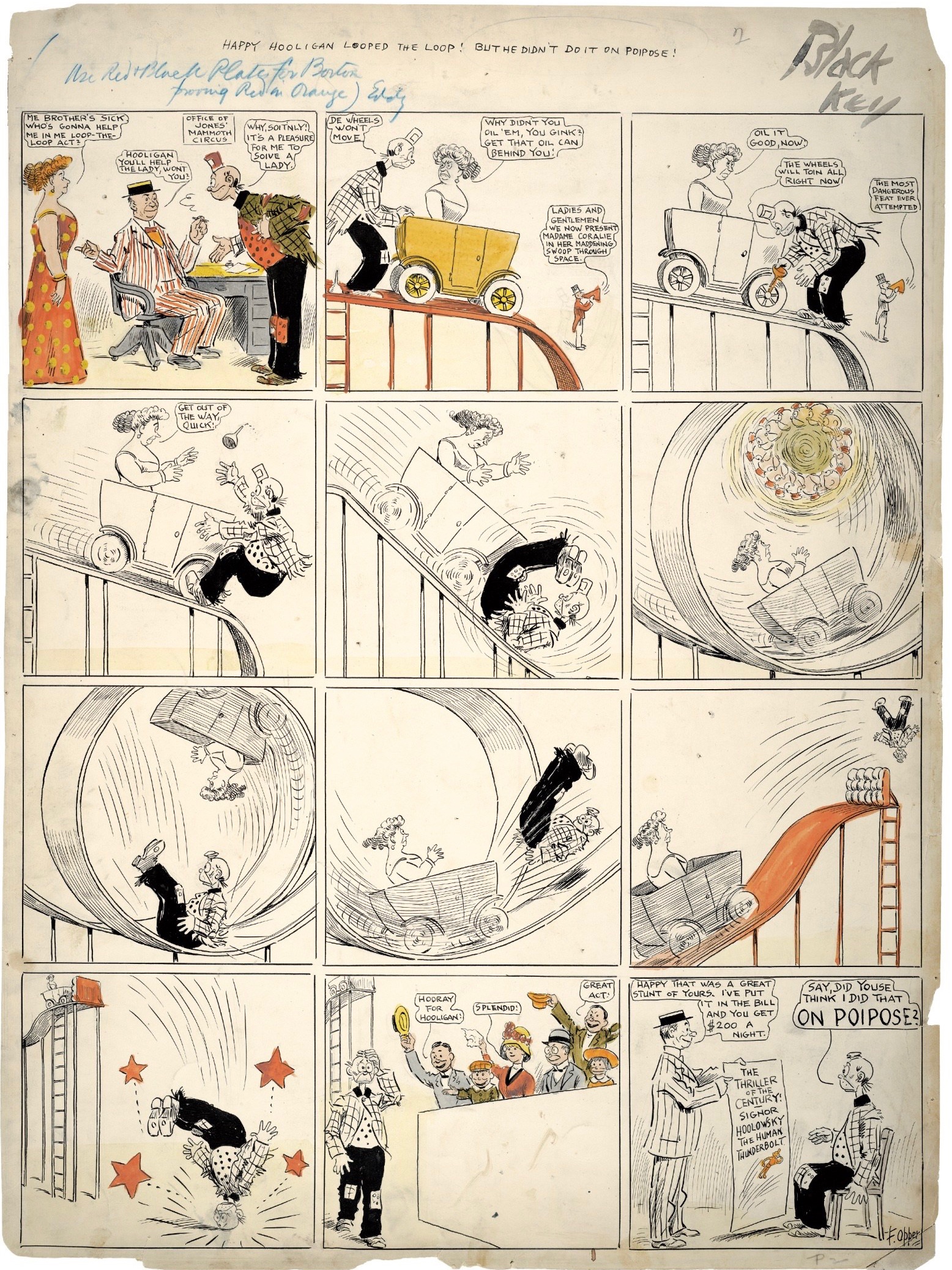
But the comic strip turns the figure into a genre. Consider Happy Hooligan, Simon Simple, Moon Mullins, Jiggs, Andy Gump, A. Mutt, Baron Bean, Boob McNutt, among others.
In fact for the first two years of Goldberg’s Boob McN tut, each Sunday strip finds Boob trying to off himself
In his recent, indispensable history of screwball comics, Paul Tumey characterizes Boob McNutt’s early years as black humor that reflected the post-WWI disillusionment of 20s America.
Maybe. I am more inclined to put Boob’s suicidal comedy and Bobo’s desperation for modern celebrity part of a longer tradition of modern comedy and especially the comic strip – the alienated clown. So many of the comic strip’s comedy fops feel themselves somehow on the curb as the great parade of American life goes by.
Indeed it is arguable that the comic strip itself carves this curbside role for us. On a daily basis, we are invited to look over the shoulder of Jiggs, Happy, Boob, Barney, Jeff, Popeye, Abner, et.al at a main cast of characters of which we are bemused – part of but slightly apart from.
In future posts I hope to explore further this idea that the daily comic strip often created for us a light satire of modern American life and styles, types and trends that registered and leveraged a sense of middle class alienation from the very world they were creating.






 Panels & Prose