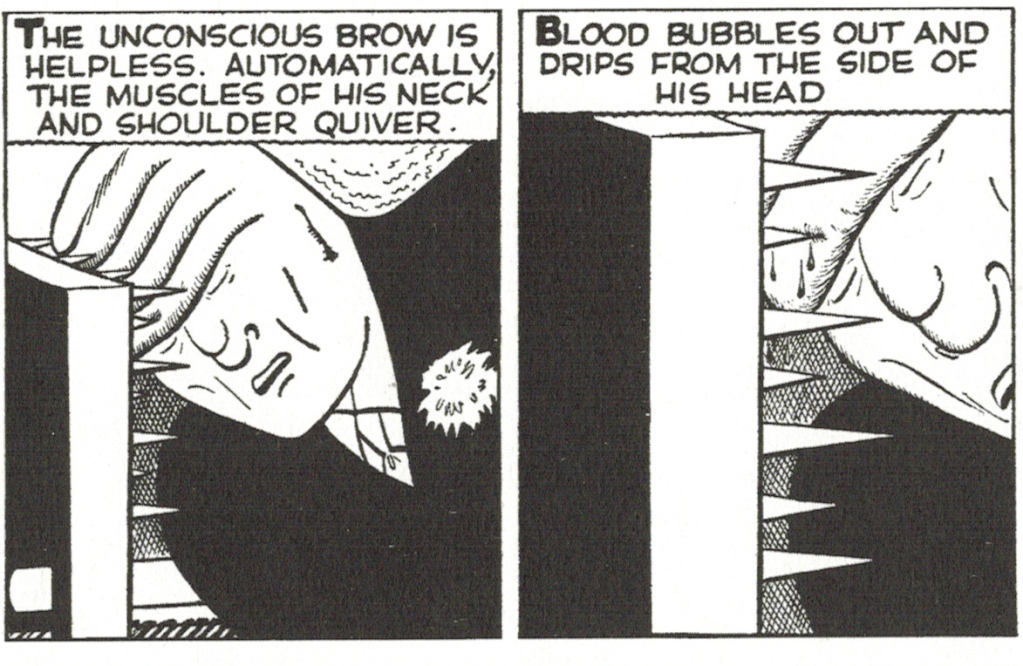
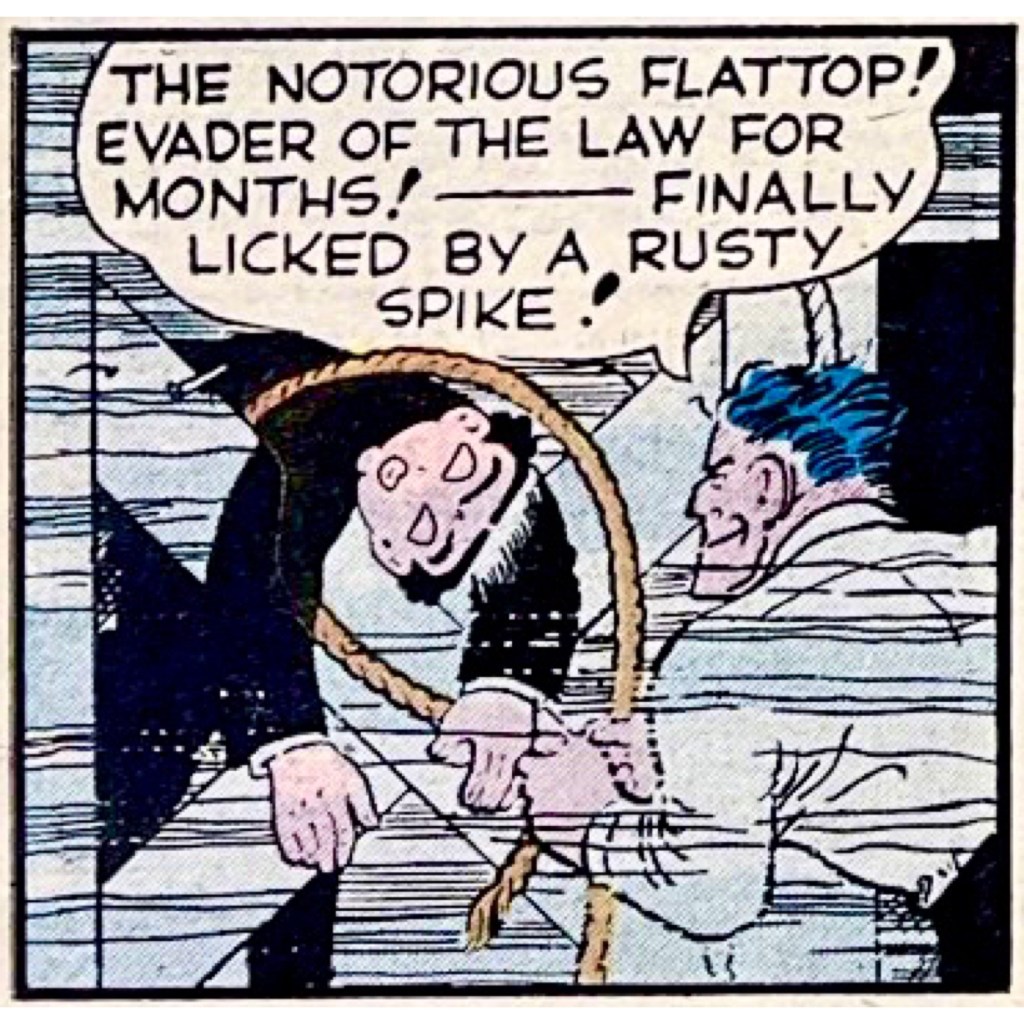
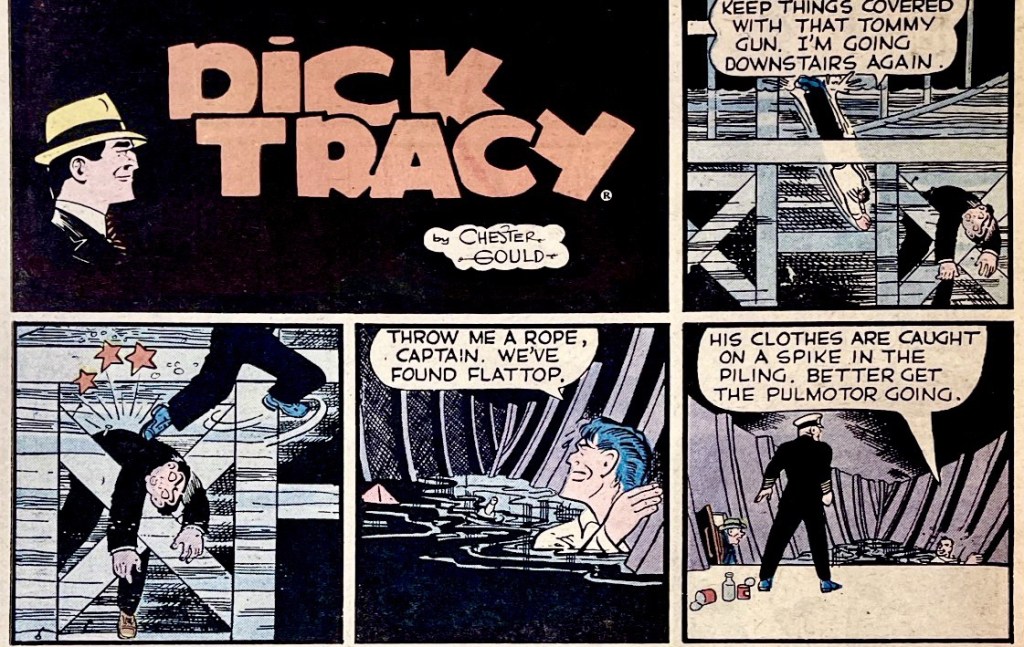
The hallmark of Chester Gould’s Dick Tracy is its surreal villains. Flattop, Pruneface, Mole, Mumbles, et. al. But Gould wasn’t satisfied expressing inner evil with outward disfigurement. He also loved to torture and kill them in equally grotesque ways during the prolonged hunt and chase sequences that were central to every Dick Tracy storyline. Gould wanted more than justice against evil. He wanted revenge and sometime literal pounds of flesh.
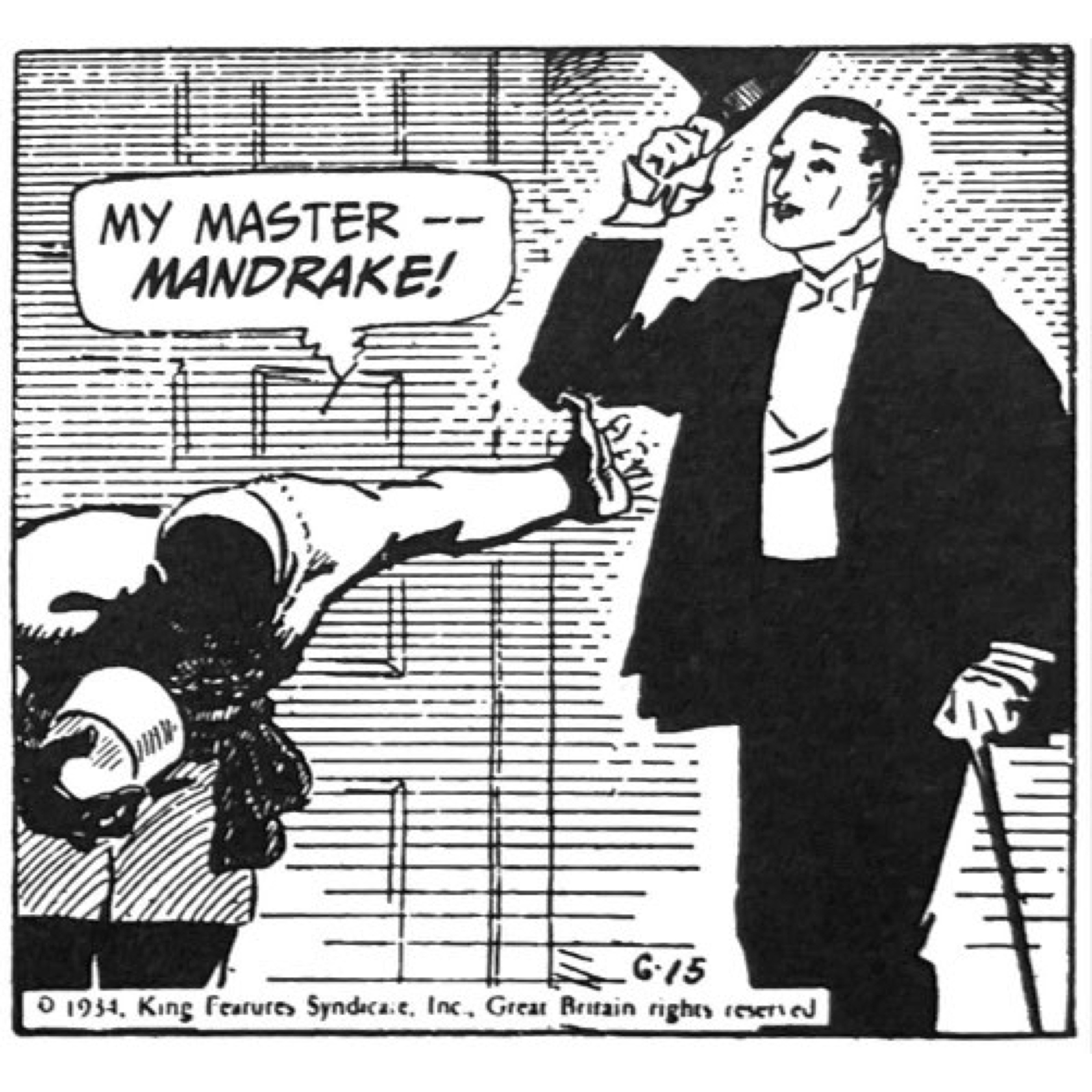
It took a full week of strips for the eponymous hero of Lee Falk’s Mandrake the Magician strip to make his grand entrance. June 11, 1934 was the first strip, which evokes some of the feel of a classic mystery wind-up. But on June 15, in what has to stand as one of the most unambiguously racist intros in pop culture history, Mandrake’s “servant” Lothar heralds the coming of his “master.” One doesn’t even know where to start here. Falk’s full bore colonialism is more fully and relentlessly explored in his later The Phantom series whose origin we covered here and whose fetishes we covered here.
For all of its weaknesses, Mandrake remains important both to comic strip and comic book history in that his is the first strip to move towards a super-powered hero. Mandrake’s “magic” is only nominally super-natural, in that it is based on the power of suggestion and influence over others’ minds. But it precedes the appearance of Superman by 5 years and aldo nods towards costumed heroism, which would be more fully introduced in Falk’s The Phantom.
One of the longest lasting marriages in comic strip history began on March 27, 1908 when Bud Fisher’s wildly popular A. Mutt comic strip anti-hero meets a character who soon became his companion until the strip finally sputtered to an end in 1983.
As told by Jeffrey Lindenblatt in the NBM reprint of early strips, A.Mutt had a whirlwind start in the five months from its brilliant inception to the introduction of Jeff. Bud Fisher was a self-taught artist who talked his way onto the the San Francisco Chronicle in 1906. He worked his way up from layouts in the art department to spot illustrations around news stories to regular caricatures in the sports section. Here is where Fisher sold editors on an idea for a daily strip that would top the sports section with betting neophyte A. (Augustus) Mutt’s uninformed picks to win one of that day’s horse races. The next day’s strip would include Mutt’s winnings, losings and mood after the real world results.
First A. Mutt Strip, San Francisco Chronicle, Nov. 1907
A.Mutt was an instant hit, but its Chronicle run lasted only 26 days. The strip attracted the attention of no less than notorious newspaper staff raider William Randolph Hearst, whose rival San Francisco Examiner battled the Chronicle for circulation. As he had done so many times in his “Yellow” newspaper war with Joseph Pulitzer in New York a decade before, Hearst drowned Fisher in cash and the promise of national syndication to lure him to the Examiner less than a month after A.Mutt launched. Eventually Fisher would leave Hearst too for a much more lucrative syndication deal that became a model for decades of lavishly paid cartoonists.
Final S.F. Chronicle A.Mutt, Copyrighted by H.C. Fisher
Fisher’s final A.Mutt for the Chronicle appeared on Dec. 10, 1907, but that last iteration had one very important (and lucrative) addition – “Copyright 1907 by H.C. Fisher.” In Lindenblatt’s telling, Fisher accompanied the artwork to the printing department that day and before the printing plate was struck added that copyright note that led to his being one of the wealthiest cartoonists of his and subsequent decades. Until his death in 1953, Fisher benefited from gushers of revenue from licensing, theatrical and syndication deals that saw Mutt and Jeff on just about anything willing to pay Fisher royalties. There were a number comic strip millionaires during the golden era of newspaper circ wars, but few were as showy and press savvy about that’s wealth than Fisher.
It is under Hearst’s banner that A.Mutt moved quickly away from racing track picks, added Jeff and because a buddy strip that also introduced extended continuities. Alas, the sad anachronistic later decades of Mutt and Jeff strips obscured its earlier, genuinely witty, edgy slapstick years.
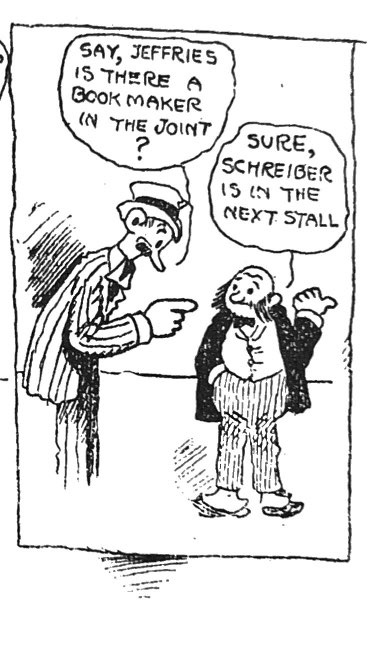
But in its early years the strip was indeed gritty. In fact, Mutt meets Jeff in an asylum, one of many incarcerations for him. This time he meets up with multiple cases of delusional inmates, including a diminutive fellow who fancies himself boxer Jeff Jeffries.
While the strip soon evolved beyond its origin as a sports cartoon, it carried with it to mainstream comics pages the sharp-tongued banter, slang, and snide irreverence that typified much of sport page cartooning. Mutt and Jeff took on politics, lampooned public figures, poked at social pomposity, and even ventured down to Mexico in the 1910s to engage with Pancho Villa.
Mutt was also among the first of a staple for the comics pages – the hapless schemer. Always looking for a buck, failing at the serial jobs he tries, the early Mutt conspires with Jeff (who is usually more flush) just to score a much-needed meal. Well evolved from the early simpletons of comics like F.O. Opper’s Happy Hooligan’ and Ed Carey’s Simon Simple, Mutt was like Harriman’s Baron Bean and Goldberg’s Boob, the American always on the make but falling short, working the angles unsuccessfully at the margins of America’s booming modern economy. The rising middle classes at whom 20th Century newspapers generally were aimed seemed to delight in the misfired ambitions of characters like Baron and Mutt, later Moon Mullins, Bobo Baxter and to some degree Andy Gump. It is a figure that extends into Laurel and Hardy, Abbott and Costello, Chester Riley and Ralph Kramden. Failed ambition is often leavened ironically with empty bravado and inflated self-confidence. It is light satire of America’s core tropes: social and economic ambition, masculinity, mobility, looking for the main chance.
The candor of Mutt and Jeff is in full display in 1918 when the duo scheme to dodge the draft.
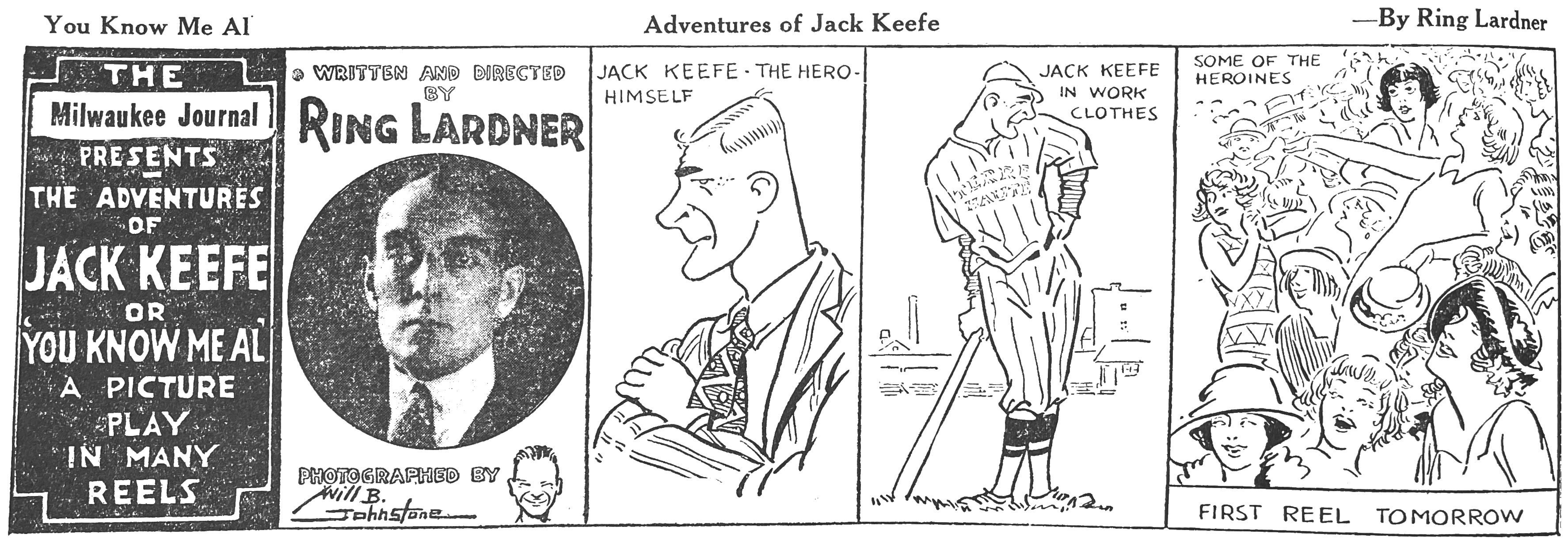
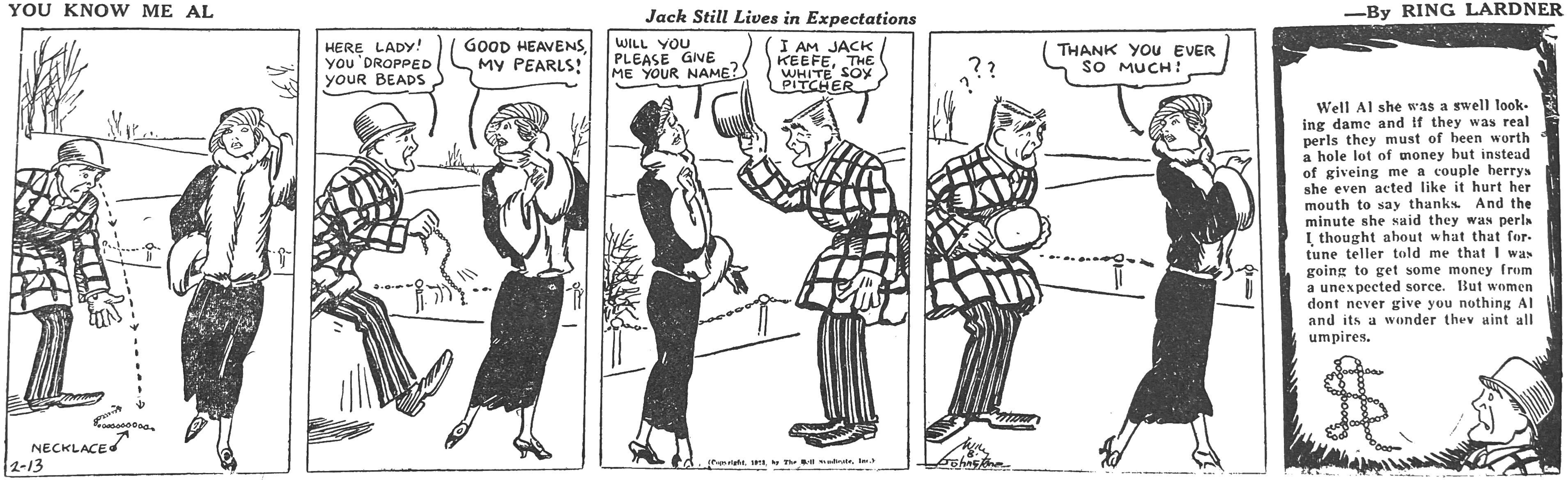
American humorist, sportswriter, magazine columnist Ring Lardner had already been writing the “You Know Me, Al” series of humor pieces for The Saturday Evening Post since 1914 when a comic strip version launched in 1922. The format was epistolary, ongoing letters that bush league pitcher Jack Keefe wrote to his friend Al back in his old small town. Keefe is a rube in the city, often clueless in the face of urban pretensions and jaded attitudes.
Keefe is dropped into the real life Chicago White Sox organization, called up from the minors as the team was struggling back from the infamous Black Sox scandal of the previous decade. Real life owner Charles Comiskey is off stage but forever keeping Keefe in his place. Larder makes reference to a host of actual sports figures and rivalries throughout the strip, but baseball play itself is only occasionally depicted.
The basic action of the strips are Keefer’s everyday interactions with the women who often pursue him, sportswriters who cover him, and team owner Comiskey. The humor of the strip came from Jack’s mildly inflated sense of his own talent and attractiveness.
The country vs. city meme had been central to American comic strips since its earliest years. The transformation of American society and culture from an agrarian, rural sensibility to an urban, industrial one was still echoing throughout mass media and literature in the American 20s. More so than most cartoonists, who tended to lionize the plain spoken, morally upright mythology of small town America, Lardner poked fun at Keefer’s naïveté both to the world and to himself. He is forever fooled or easily outsmarted by city ladies, competing suitors and Comiskey. Keefe goes into the main office pumped up to demand a $500 advance, quickly retreats to $50 and then leaves satisfied when told to come back for his “advance” on pay day.
The strip continuities were outlined by Lardner, who was overworked at the time with magazine articles, columns, and even dramas bearing his name. The artwork was done by popular sports illustrator Dick Dorgan, who lived near Lardner in the New York suburbs and had been illustrating Lardner books and columns for years. Dorgan was also brother to more famous cartoonist TAD. After a few years, Lardner stopped writing for the strip, though it retained his name for a while.
I find Dorgan’s drawing style attractive in its looseness. The lines seem ready to fall apart at any moment, and yet they communicate character more through posture than expression. He keeps most frames visually interesting by working with angles, body leanings, competing head hangs and positions. In some of the best strips it feels as if there is a storyline apparent just in body attitudes. Perhaps this is the attribute of a good sports illustrator, always sensitive to the physicality of character, momentum, stance.







 Panels & Prose