The Plunder Island sequence of Thimble Theatre Sundays that ran from December 1933 to July 1934 was E.C. Segar’s signature epic. It concentrated most of this master’s diverse talents and blended the many genres Thimble Theatre traversed into the strips most impressive run. Fabulism, farce, adventure, sentiment, venality, romance, screwball — all and more are here. And along the way, Segar even fleshes out and distinguishes among his key characters.
E.C. Segar seemed to love the screwball monarchy set piece that captivated 1930s comedy. He used the premise of the madcap cartoon kingdom at least three times: once in the early 30s defending Nazilia, later in the 30s when he installed Swee’Pea as a king, and most notably in the sailor man’s founding of his own kingdom of Spinachova in 1935. Starting on April 22, 1935 with Popeye’s decision to build an ark and ending with him abandoning the utopian venture in defeat and disgust on March 19, 1936, Popeye’s act of radical escape from Depression-Era America was among the longest continuities in the history of Thimble Theatre. But the Spinachova epic was important in a number of ways. It was the closest Segar came to political satire. The tension between “dictipator” Popeye and his “sheep” (the people) is basically a political one that turns the trendy populism and folk romanticism of the day on its head. It was also a saga of defeat for Segar’s hero, an extended example of our otherwise heroic, even super-powered folk moralist showing all manner of very human weaknesses. And finally, most importantly perhaps, the episode was Segar at his absurdist peak, a tour de force of relentless zany side trips, inane situations and surreal resolutions that were the cartoonist’s hallmark. While Thimble Theatre’s Plunder Island storyline was likely Segar’s most successful continuity in developing character, plot and comic suspense, he was using the roomier canvas of Sunday pages for deeper, more immersive sequences. The Spinachova saga was executed across nearly a year of dailies, which may give us the fullest picture of this artist’s range within the truncated cadences of this format.
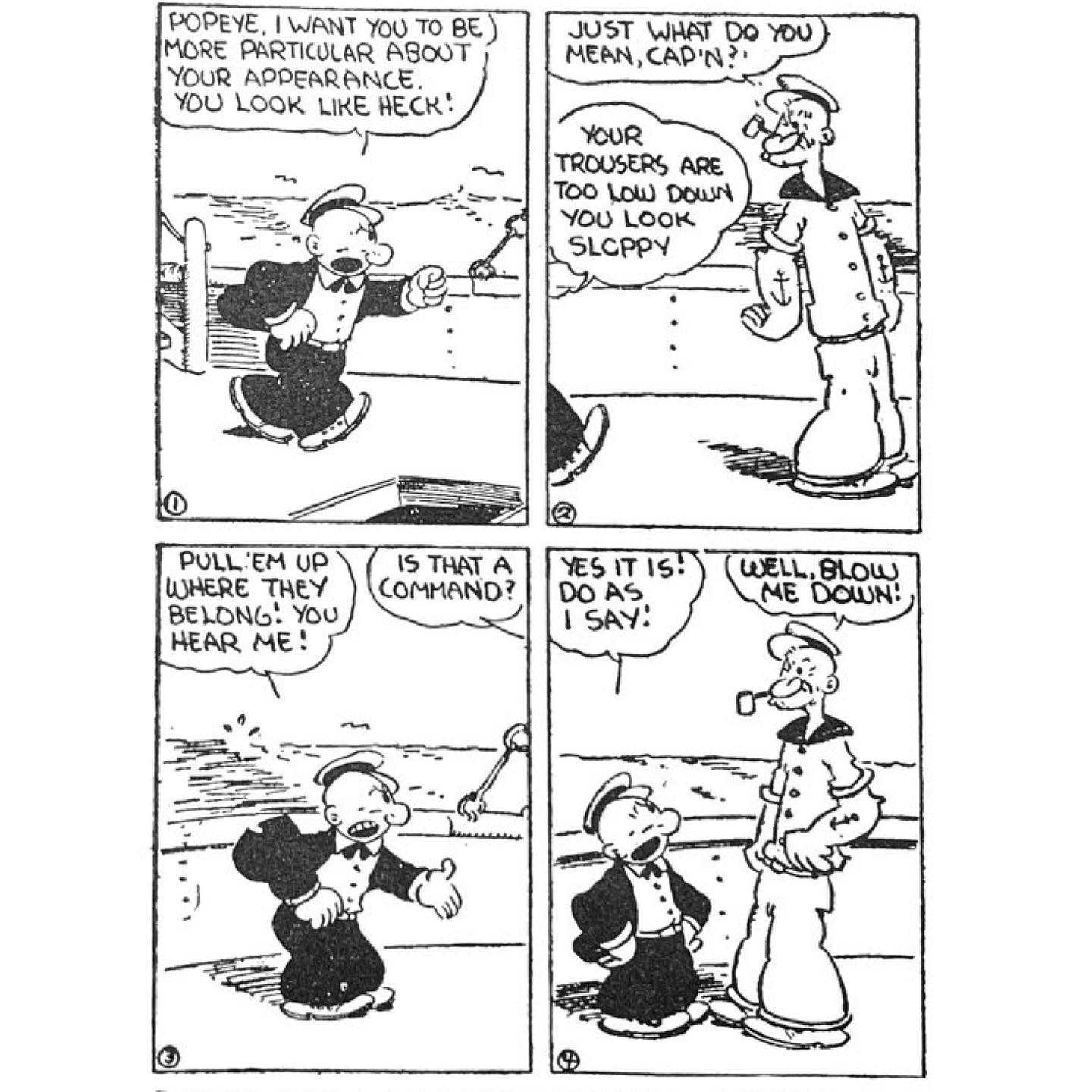
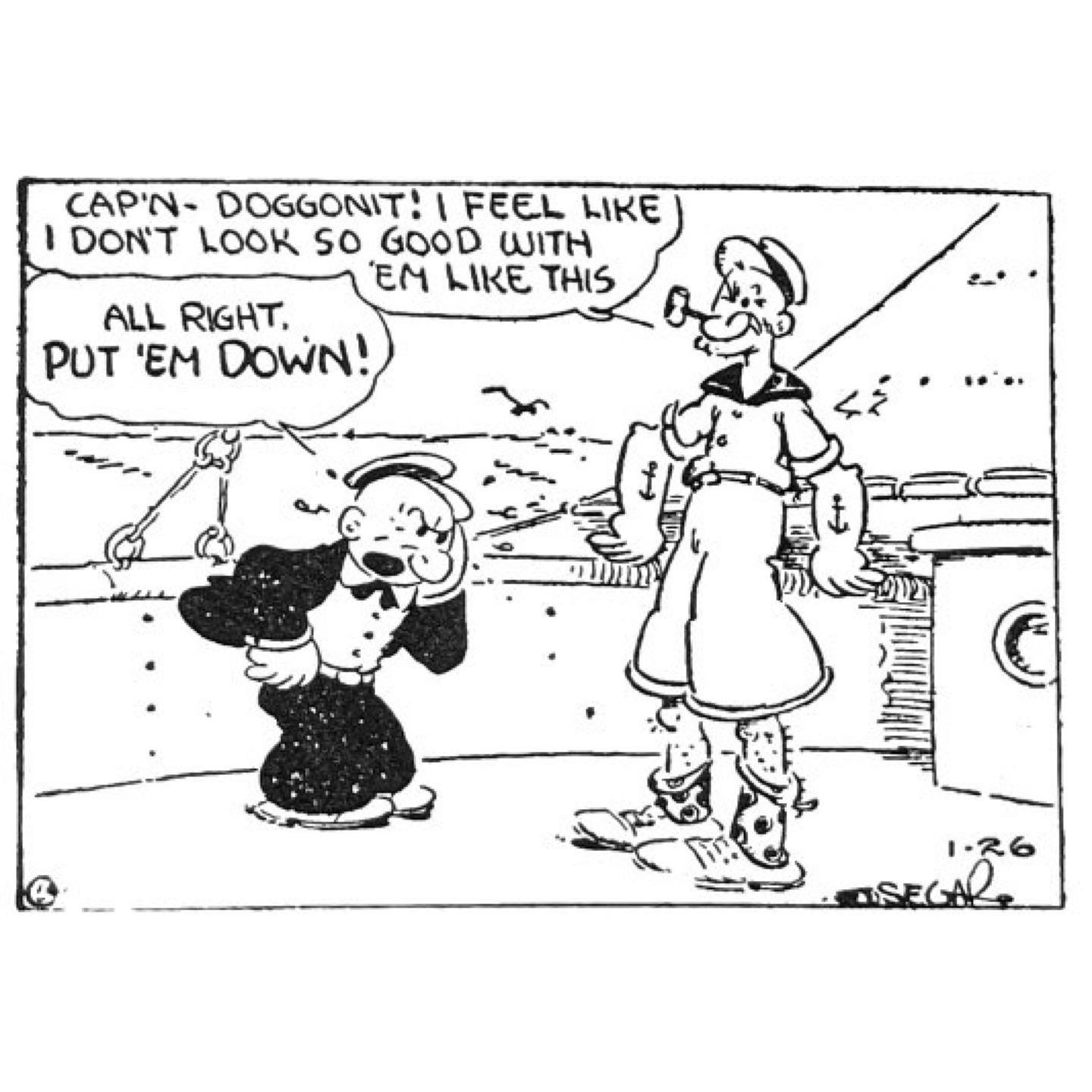
In early 20th Century theater and film, the “sissy” was the dreaded antithesis of two-fisted pulp hyper-masculinity, at best, and at worst was a stereotypical euphemism for what was unspoken in general culture, homosexuality. Wimpy, the dandyish, appetite-driven counterpoint to Popeye’s principled violence, is of course Popeye’s best tutor for all things “sissy.” To make this sexual dynamic even weirder we have Popeye’s Pappy bewildered by his prancing progeny. It reads like an unintended burlesque of Popeye “coming out”. Per a previous post, These dailies precede Popeye deceiving the underground demons to come up and fight.
It is important to note that this gender-bending sequence was followed immediately by another adventure cycle involving Popeye getting the crap beaten out of him in a land of highly muscled women. And this is all happening right after E.C. Segar’s death in October 1938. The strip was being continued unsigned by assistants for the time being.
Where do we even start to highlight the wicked strangeness of Winsor McCay’s “Dream of the Rarebit Fiend?” The master comics artist drew over 800 nightmares in the first decade of the 20th Century, and… Read more: Random Nightmares: Winsor McCay Gets Rarebit
Along with chaos, mayhem and violence, obsessive behavior was a core theme of early newspaper cartooning. Consider the many titular anti-heroes of these years, like Hungry Henrietta, Superstitious Sam, Jingling Johnson, Sammy Sneeze. Or the… Read more: Dingbat Calls In the Klan: Herriman’s Bourgeois Obsessive
The authoritarian strain in modern democracies has only heightened since I first posted this bit of cartoon wisdom several years ago. In 1937, H.T. Webster’s Casper Milquetoast (The Timid Soul) responds to Italy’s Benito Mussolini… Read more: The Timid Soul Toys With Fascism
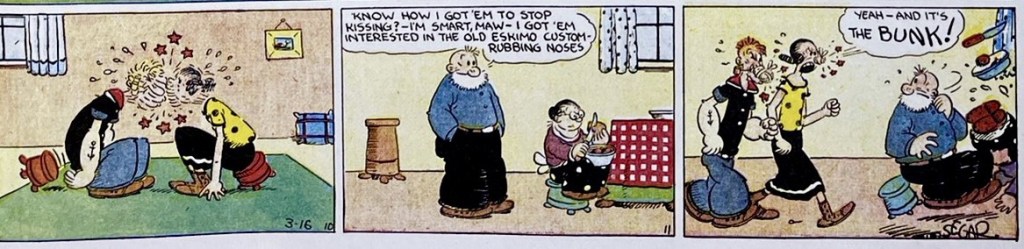
It didn’t take long for Popeye and Olive to hook up after the pugnacious sailor joined the Thimble Theatre in 1929. Popeye because part of the Sunday Theatre in 1930, which is now being reprinted by Fantagraphics. E.C. Segar’s characters had a special kind of grittiness and irascible repartee. And here we see how Thimble Theatre could get remarkably raw. Popeye and Olive’s noisy smooching gets under Mr. Oyl’s skin. The sexuality of the younger generation in 1920s America had been an important topic of discussion across media. WWI had exposed an entire generation to less inhibited European attitudes towards sexuality. The arrival of the automobile especially created a way for boys and girls to escape the scrutiny of their parents. Moral arbiters worried publicly about this new wave of “petting parties” where youth explored their bodies in troubling ways. Apparently, Olive Oyl and Popeye used the Oyl living room for their own personal petting party.



 Panels & Prose