Why don’t we hear more of the marvelously talented, witty, prolific American cartoonist Gladys Parker (1908-1966)? She was the mother of the long running strip and comic book character Mopsy. More than that, Parker was among the better-known cartoonists of the day, in part because she was also a fashion designer to both the general public as well as Hollywood stars. Meanwhile, Parker was a frequent item in the celebrity gossip columns of the 1940s as she dated a noted boxer and character actor.
Why don’t we know more about Gladys Parker? Well, obviously for the same reasons we don’t know more about Nell Brinkley or Ethel Hays or Jackie Ormes, despite the high quality of their work and substantial public profile in their own day? Not only has the comics field itself been overwhelmingly male dominated, but its history has been written almost entirely by men. And yet, as I myself encounter these overlooked artists as I make my way through comics history, I am struck by their singular visions, how different their aesthetic and social perspective were from their male brethren. To miss these women in our history of the medium is to narrow our understanding of the rich creative range the comic strip reached in the last century. Brinkley used color, facial and emotional expression, line, the contours of the Sunday comics page in ways no other artist did in the 1910s and 1920s. Ormes’ racial satire was sharp and blunt at a time when American needed it desperately. And Parker brought the feminine wit of Hollywood romantic comedy into the comics page and merged the aesthetics of fashion with those of the comic strip into a drawing style that was unlike any other on the comics page.
What made me think harder or differently about the comics medium in the last year or so? That is my main criterion for these occasional roundups of books mainly on comic strips but also about early comics. Some of the titles here are filling in holes in our understanding about the history of the comics forms. Others are calling attention to artists or patterns in comics history that I think bear more thought. And many were just plain fun. Feel free to comment on the books you found most enlightening or entertaining about the comics history.
The Metaphysics (Huh?) of Alex Raymond’s Death
Dave Sim’s (with an assist by Carson Grubaugh) The Strange Death of Alex Raymond (Living the Line) is crazy like a fox. Sim’s ostensible exploration of the tragic death of the highly influential artist behind Flash Gordon and Rip Kirby uses a batshit conceit that some “metaphysics of comics” somehow connects everything from Margaret “Gone With the Wind” Mitchell, Milt Caniff’s quiet envy of Raymond, the wives and lovers of multiple comics artists of the 50s, a few B-movies, and whatever the hell else you can imagine to car crash that killed Raymond in 1956. It is also batshit brilliant. It gives Sim the frame in which to recall (and even redraw) a vast swathe of American pop culture and artists that drove the changing styles of 1950s comic strips. At its most lucid, the book delineates the different realisms of Hal Foster, Caniff and Raymond, the development of the photorealistic style, even the nuts ad bolts of brush and pen work. Along the way, forced me to contextualize and appreciate strips like Big Ben Bolt, Twin Earths, and the post-Raymond Kirby years. He brilliantly injects a whining Charlie Brown into the history as Schulz’s aesthetic counterforce to the short-lived photo-realist era of American comics. An he forces us to think harder about the rise and fall of different comics styles. As others like Jerry Robinson and Scott McCloud before Sim have shown, there is nothing like a fellow craftsman dissecting his colleague’s work to deepen a viewer’s appreciation of the artistry and decisions that go into those four panels on any given day. Whether you can track Sim’s idea of metaphysics connecting all of these shards and rabbit holes is beside the point. It sets him up for some deft and truly illuminating rumination on the aesthetics of comics in their historic context.
EC At Scale
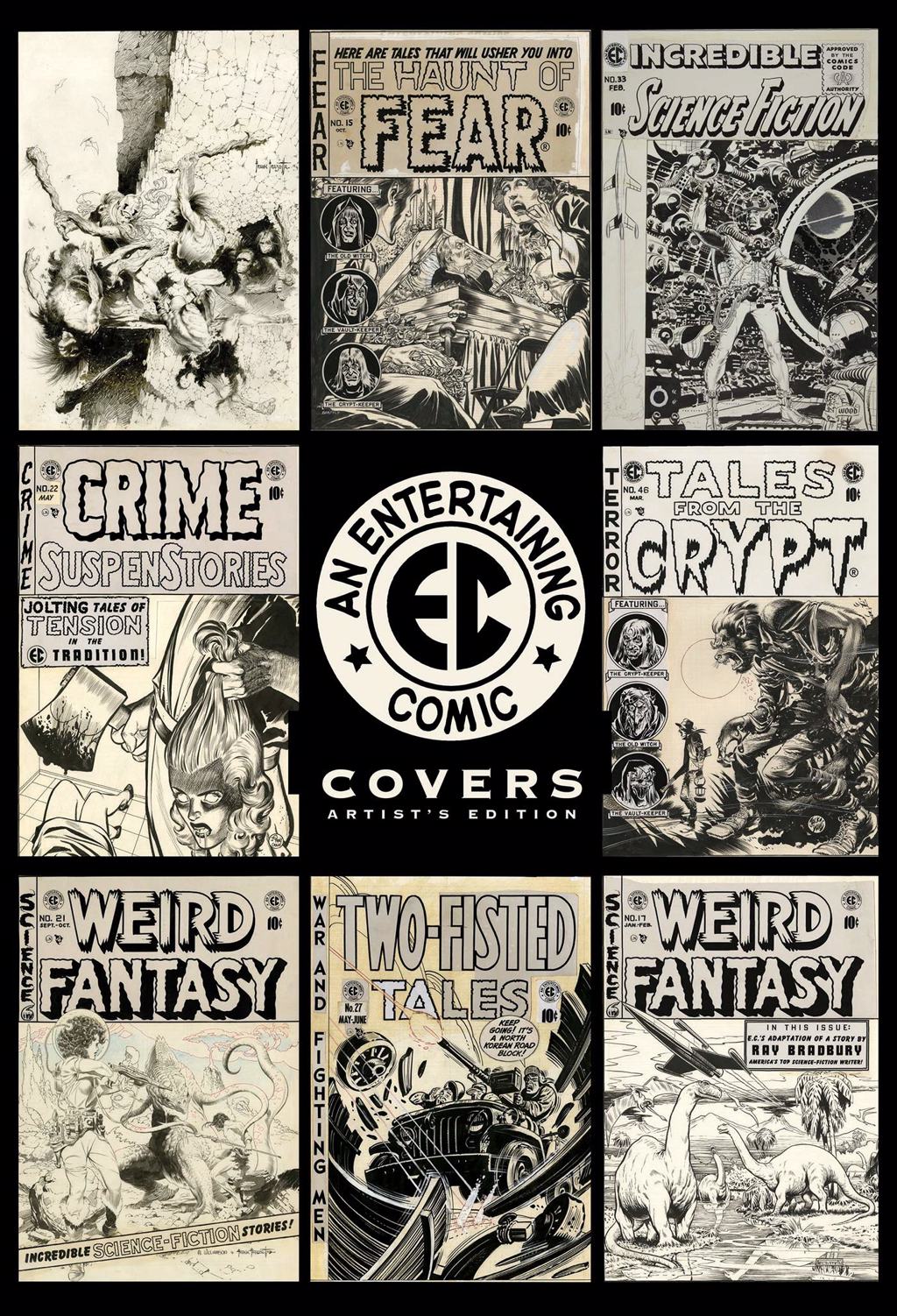
I am almost embarrassed to admit how many of IDW’s massive and pricey Artist’s Editions I own. How does one justify parting with $150 for each, even though they reprint in full detail and at original scale the actual final art from some of the great craftsmen in the field? And yet I never regretted investing in Artist’s Editions of early MAD issues, Will Eisner’s The Spirit, and the EC stories of Graham Ingels. This way-oversized scale and hi-def color images of black and white line art and marginal proofing notes seem to put you on the other end of the artists’ pens and brushes. This is even more true of the EC Covers Artists Editiion (IDW), which organizes the cover art of the famed EC comics stable by artist: Johnny Craig, Graham Ingels, Wally Wood, Harvey Kurtzman, Jack Davis and more. The covers of course were meant to be expansive, immersive teases of issue content, and so we get a single image splashed across the 15X22 page. Every bit of detail feels more like a deliberate, conscious decision, forcing us to think harder about the artist’s process. This is not just another trophy for collectors (or hoarders). It is a valuable experience for anyone who wants to deepen their understanding of the art.
The Golden Age of Wolverton
Fans of the grotesque pointillism of Basil Wolverton have been treated in recent years by Greg Sadowski’s exhaustive two-volume biography and reprinting in Creeping Death from Neptune and Brain Bats of Venus (both Fantagraphics). While those two volumes focused more on Wolverton’s horror and sci-fi work, this year’s Scoop Scuttle and His Pals: The Crackpot Comics of Basil Wolverton (Fantagraphics) is a retrospective of the artist at his madcap best. Ironically, many of these screwball and slapstick series were the fruits of failure. Wolverton conceived of Scoop Scuttle, Bingeing Buster and Jumpin’ Jupiter as daily comics and repurposed them for the skyrocketing (and imaginatively less constrained) comic book industry of the late 1940s and early 50s. In each case, however, Wolverton was satirizing many of the serious genres that dominated pulp magazines, B-movies, radio and comic books themselves. Wolverton clearly is channeling the screwball tradition of Milt Gross, Rube Goldberg and Bill Holman. The zany physical antics propel the action, the wisecracking asides and slang fill most panels and the cultural stereotypes rain in hot and heavy. The foreshadowing of MAD magazine’s satirical approach is unmistakeable. This volume also has excellent annotations adding context to each reprint as well as an outrageous article by Wolverton himself on sound effects in the comics. This one is a treat.
But Is It Art?: Comic Art in Museums
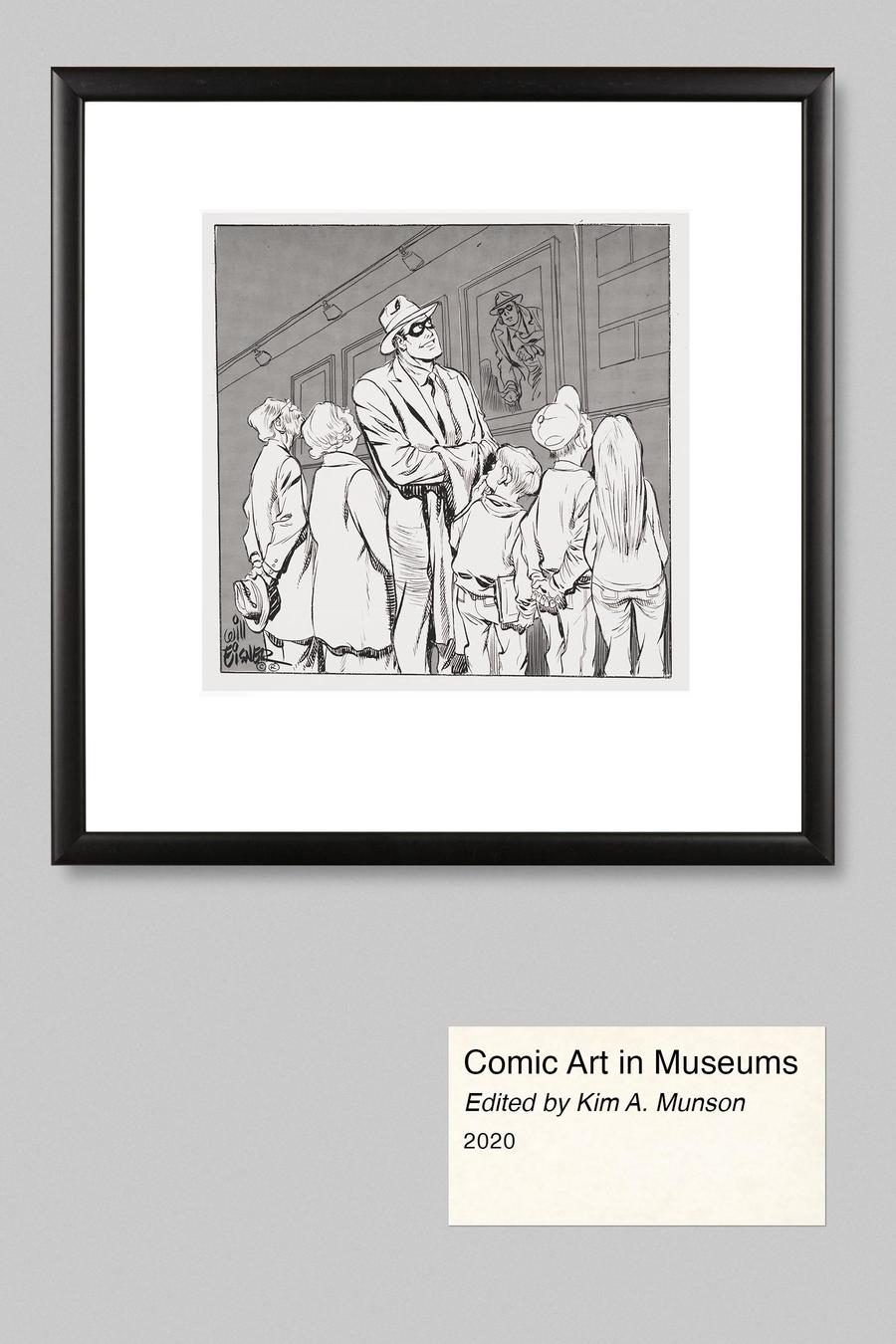
How “seriously” should thoughtful critics and audiences take the comic arts? That question seems to have dogged the cartoon arts since its earliest decades when pioneering pop culturists like Gilbert Seldes wrote extravagant defenses of the new medium. I confess that at this point in my five-decade run writing about mass media of all sorts, I find the relentless defensive justifications of pop culture criticism tiresome. And yet, that story of begrudging acceptance of the popular arts as “art” is its own important subject. One entryway to comic strip history is how the form has been regarded critically over the generations. Kim A. Munson’s Comic Art in Museums (University Press of Mississippi) is not as narrowly focused as its title suggests. While Muson provides a chronological framework and extensive introductory and connective matter, the book is really an anthology of writings by everyone from M.C. Gaines in 1942 to Denis Kitchen, Brian Walker, as well as multiple academics reflecting on the evolving reputation of the medium. I am still making my way through the densely packed book, but can already recommend it as a trove of insight and historical anecdote.
Johnny Hazard Sundays: Caniff Lite
All due respect to Johnny Hazard fans, it is hard to recommend Frank Robbins’ 33-year run as more than competent, middle-list comic strip fare. All of the luminaries also working at its height, Raymond, Caniff, Drake are considerably more interesting in their basic artistry, composition, storytelling. That said, this first oversized volume of Johnny Hazard Sundays does make the case for Robbins’s talents, even though his more mature work of the 1950s was obviously better. He had a strong sense of characterization, especially through facial expression. The moody use of coloring comes through even though some of the copies restored here were mediocre newsprint. And honestly I would have liked more background on Robbins and the thinking behind the strip rather than the intro pieces on his later DC Comics art. Still, Johnny Hazard Sundays Archive 1944-1946 (Hermes Press) gives us a 12X17 supersized reproduction of the Sunday adventure comics experience that is always welcome.
Kurtzman’s Wry Eye
Fantagraphics’ EC Library comes at the often-reprinted EC Comics of the early 1950s in black and white volumes organized by artist. Al the previous volumes have applied a lens onto the evolution of Wally Wood, John Severin, Johnny Craig, Al Feldstein, et. al. But this Man and Superman and Other Stories featuring Harvey Kurtzman before he took over the war titles and pioneered MAD really stands out for increasing our appreciation of this seminal comics artist. Kurtzman is among a handful of comics artists who were not just seminal within the medium but also to the general culture. The pop culture satire he codified in MAD magazine in the early 1950s applied a lens to post-WWII American mass culture that shaped generations of artists and even activists. This volume includes his earliest work for EC’s sci-fi, crime and horror stories. And they all show Kurtzman’s parodic attitude towards each of those genres. Tales like “Man and Superman,” “The Time Machine and the Schmoe!” and “Television Terror” took a light-hearted, even satirical take on the sci-fi and horror staples that drove the rest of the pages of these books. Most of these stories are written by the artist and so less wordy than over scripted tales the Feldstein foisted on most of the EC stable. These embody Kurtzman’s growing understanding of the relationship between word and text in the medium. He loves for high-minded science to go comically awry, along with the petty ambitions of everyman. The wry view of human foibles and hubris, which would inform the morality of his war stories and the satire of MAD, are all being rehearsed in these stories. Already sharp is Kurtzman’s mastery of of the comic form. He thought in panel progressions and the arc of a full page in ways far ahead of most artists. His compositions, use of foreground and background, the sense of motion as the eye moves across the panels, all are as fresh today as they were more than a half century ago.
Chester Gould Takes a Bow
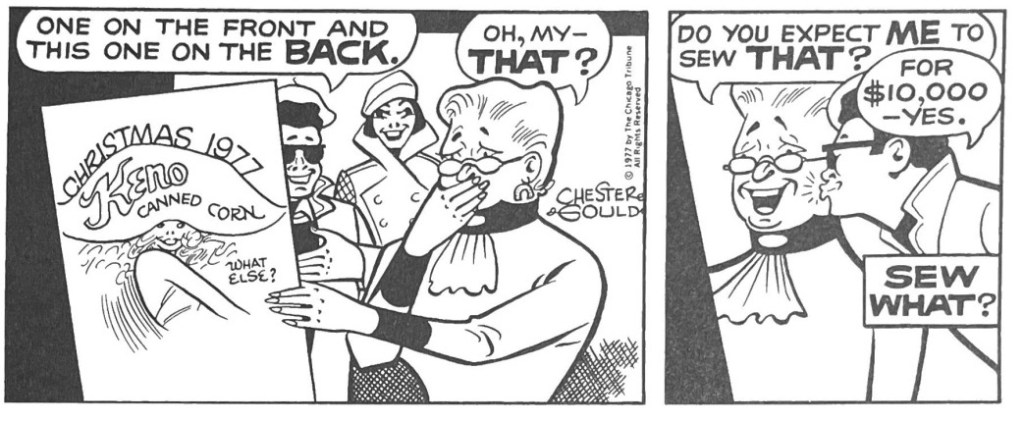
A number of ongoing reprint series had notable additions in the last year or so that call attention to the great work some publishers have been doing to keep the history of comic arts alive. In 2006 the Library of American Comics started an ambitious project to reprint Chester Gould’s full 1931-1977 run of Dick Tracy. With Volume 29 of The Complete Dick Tracy, LOAC finished one of the largest, complete comic strip reprint project, second only perhaps to Fantagraphics’ Peanuts project. I already reflected on Gould’s run and the way he ended the strip. The final volume speaks to what a canny master of comic strip art and business Gould really was. As newspapers shrank the canvas, he adjusted and rethought his signature style accordingly. And while the later years of the strip are remarkably different in look and feel than its first decade, the wild imagination, bizarre villainy, wonderfully improbable chases and escape remained central to a Dick Tracy story arc.
Many have said before me that we are enjoying the golden era of comics reprints. Perhaps. My default position is from a broader historical perspective, and myself having gathered many volumes since the early 1970s. As I look over the shelves here at decades of accumulation in the Panels and Prose library, it seems to me we are in the latest surge of publishing activity that goes back at least five decades. I still have some of the early retrospectives of Dick Tracy, Buck Rogers, EC Comics, Pogo, Bill Mauldin, Winsor McCay, Happy Hooligan, Flash Gordon and more going back many decades. In my recollection, the underground comic artists of the late 1960s helped spark more serious consideration of comic strip history, leading to many of the 70s and 80s reprints. And, of course, we can’t overstate the importance of Bill Blackbeard’s personal effort to rescue that history and kindle so much interest in his landmark 1977 Smithsonian Collection of Newspaper Comics. Publishers like Hyperion, Bonanza, NBM, Nostalgia Press, Blackthorne, Pacific and others pioneered the extensive reprinting of comics greats.
But we are enjoying an embarrassment of riches from the likes of IDW/Library of American Comics, Fantagraphics, Drawn & Quarterly, Hermes and Titan, to name just some. It is hard to keep up, and I can’t pretend being able to track, let alone, afford all that is available in the market. The curation policy here at P&P Library is to collect more in breadth than depth. I try to collect enough samples across the many comics eras and genres so that as a cultural critic I can write responsibly about select artists and capture wider trends. But every year I try to highlight the books that I feel added most to my understanding of the comics field and industry. Here are my picks for the last year…or so.
Rebirth of The English Comic Strip
Arguably the most substantial historical contribution of the last year is David Kunzle’s majestic Rebirth of the English Comic Strip: A Kaleidoscope, 1847-1870 (University Press of Mississippi). He unearths some of the great and under appreciated cartoonists of the UK humor magazines during that genre’s heyday in the mid-Nineteenth Century. In some ways an historical follow-up to his book on the previous age’s great caricaturist Rodolphe Topffer, the University of California art history scholar argues that this mid-century period represented a rebirth and establishment of the modern cartoon arts in the pages of Punch and elsewhere. He gives us both the rich context of British humor magazines in the era and their emerging lower-middle-class readers. He then does closer readings of about a half dozen exemplars like George Cruikshank, John Tenniel, John Leech and Richard Doyle (above). Kunzle’s writing is uneven. His penchant for long sentences, commas, clauses and asides, can be trying. His knowledge of the field and this historical context of the rise of comic strips is boundless, however. But best of all, this exceptionally produced tome bulges with extensive reprints. The paper and print quality are up to the task of rendering the era’s finely engraved line work in sharp relief. Kunzel’s is the indispensible comic history book of the past year.
About Time: Rediscovering Black Cartoonists
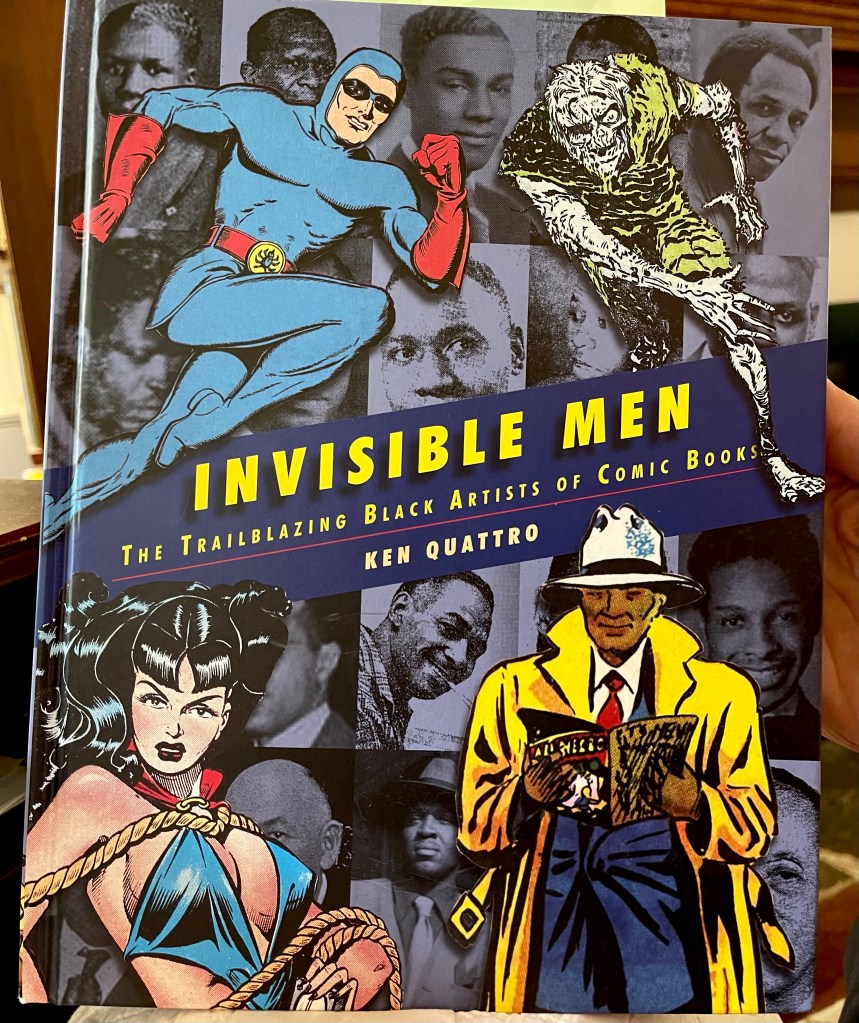
An invaluable trio of books this year started to address a woeful blind spot in American comics history, the contributions of Black artists to the growth of the field. Ken Quattro’s Invisible Men: The Trailblazing Black Artists of Comic Books (Yoe Books), Dan Nadel’s It’s Life As I See It: Black Cartoonists in Chicago, 1940-1980 (New York Review Comics) and Rebecca Wanzo’s The Content of Our Caricature: African American Comic Art and Political Belonging (NYU Press) each fill in different aspects of this ignored history. I covered Quattro’s book in my previous roundup. He focuses on unrecognized comic book artists, but a number of his cast, like Jay (Bungleton Green) Jackson and Adolphe (Sally the Sleuth) Barreax had their roots in Black newspapers and the pulp magazines.
Wanzo’s is an academic exploration of the uses of Black caricature going back to slave depictions through superheroes. She pulls apart in detail the ways in which visual tropes emerged for Black men, women, children and families that served to marginalize them politically and socially in both subtle and grotesquely obvious ways. She spends much of her time focusing on Black artists and the ways some appropriated and perpetuated these visual themes, while others took creative control of them. The book is especially effective at thinking differently about the topic of stereotype and seeing it as both a bludgeon and a tool.
For comic strip reprint fans, however, Nadel’s collection is the must-get in this welcome trio. He gives us some of the biggest tranches of work from the great Black newspapers and magazines ever reprinted. Jackson’s wildly provocative time travel episode of Bungleton Green is mind boggling. The Jackie Ormes episodes of Patt-Jo ‘n’ Ginger really underscore her wit. And the reprinted selections from Tom Floyd’s 1969 workplace send up of white notions of “integration” (“Integration Is a Bitch!” above) really drive home how much of American cultural history we missed by overlooking this history for so long. My hope is that this is just a start. Nancy Goldstein’s bio of Jackie Ormes is now out in paperback and has a generous selection from the First Lady of Black cartoonists. But I would love to see a retrospective of Bungleton Green sometime soon.
Trots and Bonnie/The Appletons
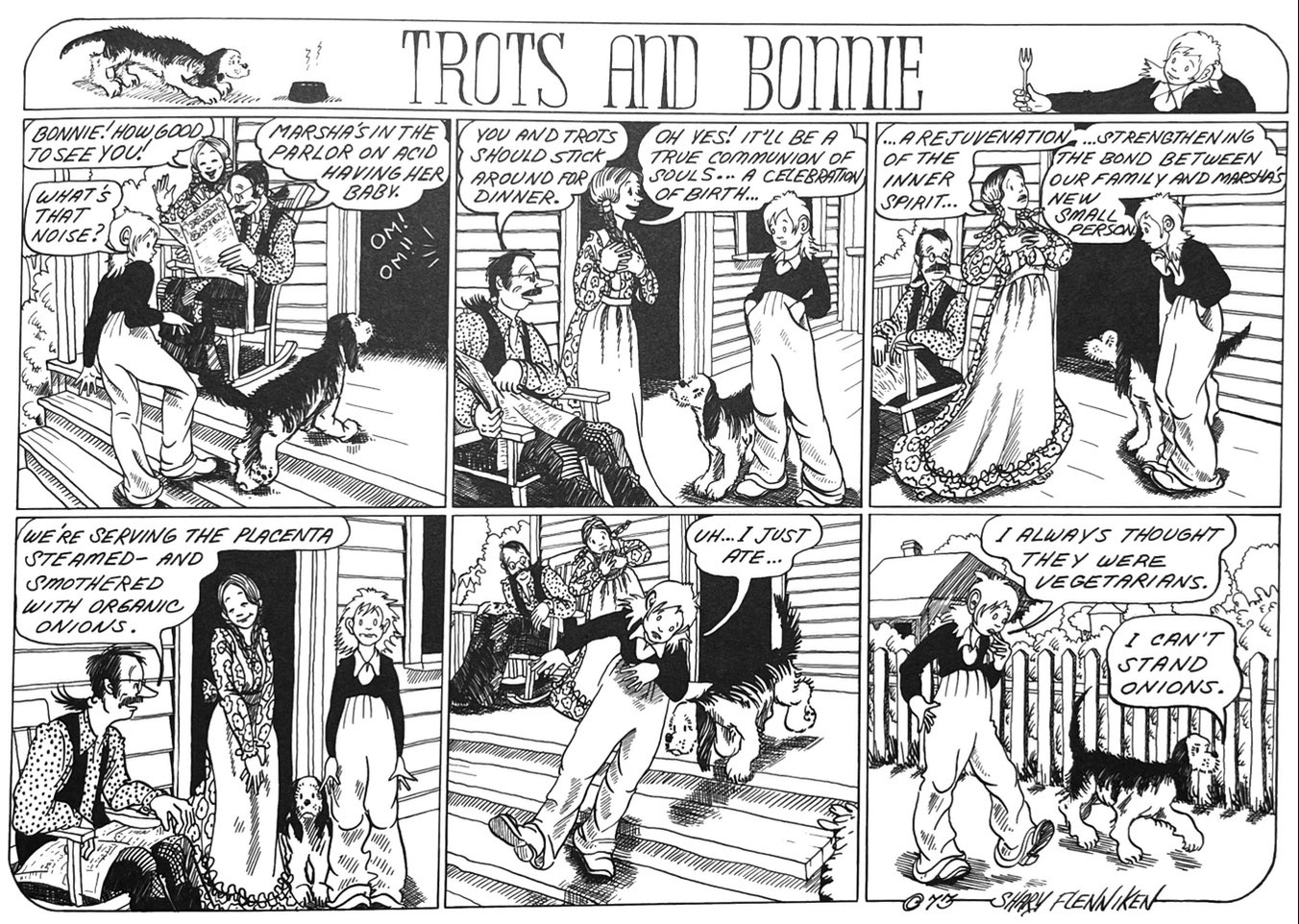
In my formative years of comics appreciation (early 1970s) National Lampoon’s comics section was nothing less than a revelation. Gahan Wilson’s Nuts, Vaughn Bode’s Cheech Wizard, Bobby London’s Dirty Duck, B. K. Taylor’s The Appletons, and anything by Rick Geary, Stan Mack and Charles Rodrigues truly blew this kid’s mind wide open to the possibilities of the form. But no one jangled my adolescent male sensibilities as much as Shary Flenniken’s truly pioneering Trots and Bonnie. The adolescent innocent Bonnie, her wry and ironic pup Trots and totally liberated friend Pepsi decimated my suburban 70s notion of feminine propriety, in the best ways. Flenniken’s candor about the female body, resentment of the patriarchy, and dark, dark sense of humor put nothing off limits. And her fine, controlled line work, thoughtful panel compositions only amplified the satire through contrast. A scathing humorous sensibility had the look and feel of children’s book illustrations and it is finally collected with the size and precision it deserves in New York Review Comics’ Trots and Bonnie. B.K. Taylor’s Appletons and Timberland Tales followed a similar rule of contrasts. He cloaked his descent into the perverse, murderous, incestuous vision of American family in cartoony stylings of apple-cheeked, smiley happy characters. Think Mark Trail meets… . Well, hell, I am not sure I can come up with an analogue for Taylor’s ink black perversity. Buckle up, because this year’s I Think He’s Crazy: The Comics of B.K. Taylor (Fantagraphics) is a twisted ride.
Popeye…Again
Like Krazy Kat, Little Nemo, Terry and the Pirates, Dick Tracy and Li’l Abner, E.C. Segar’s Popeye/Thimble Theatre has long been recognized among the pantheon, and so it has been reprinted several times over the last decades. A decade ago, Fantagraphics finished a six volume compendium of all Popeye-era dailies and Sundays in oversized formats with generous supporting material. With Popeye Volume 1: Olive Oyl and Her Sweety (Fantagraphics) the publisher shrinks the format, scope and price into a manageable paperback of just the Sundays. It has an imaginative slipcase design with cutout. But most of all it makes those wonderful color weeklies more accessible. Segar maintained a separate storyline in the Sundays, which usually used larger panels and more action. In this first volume we get both the early romance between Popeye and Olive as well as an extended story about Popeye’s short boxing career. Whether with words, schemes or fists, Segar had a pugilistic vision of human relations that comes through no matter the scenario. For those who already have the last reprinting, this series is unnecessary. But it is well worth the affordable price to anyone else.
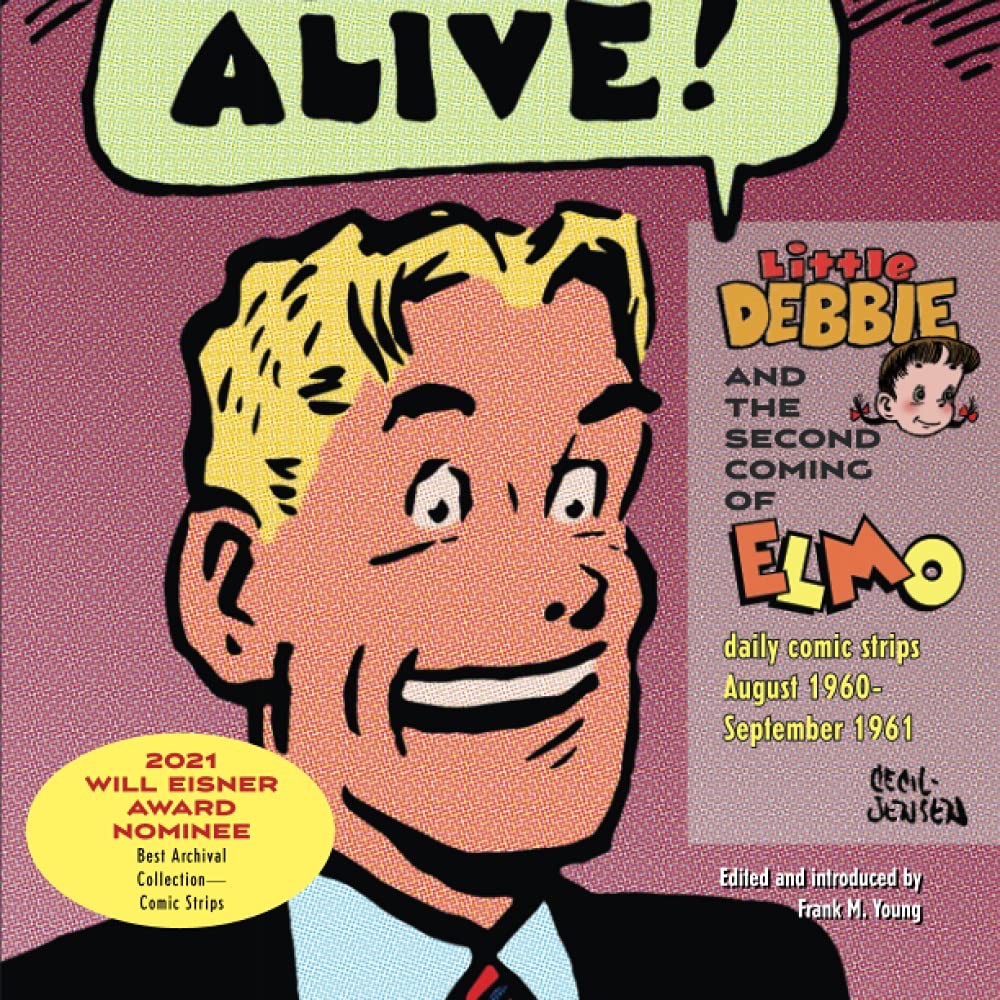
One of the wildest comic strip excavations of the last few years is Frank M. Young’s project to resurface Cecil Jensen’s wildly imaginative, dark satire of the late 1940s, Elmo. Jensen was principally B-list editorial cartoonist for the Chicago Daily News during much of the 1930s through 1960s. But his truly bizarre Elmo, launched after WWII, crafted a hapless Li’l Abner-like rube facing the crazy excesses of modern culture of corporatism, advertising and consumerism. The strip proved too strange for many readers and newspapers, as Young chronicled in his excellent 2019 volume Elmo: An American Experiment, which we cited as a notable book that year.
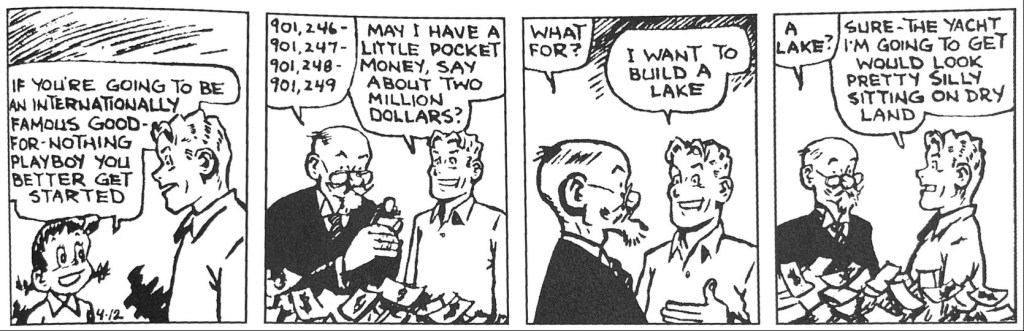
The Elmo saga gets only stranger in Young’s follow up book, Little Debbie and the Second Coming of Elmo: Daily Comic Strips, August 1960-September 1961. It turns out that by 1949 Elmo had been fully kidnapped by the diminutive, precocious Little Debbie Jensen had introduced as an ancillary character a couple of years before. Readers and editors preferred Debbie’s more conventional kid antics, even if laced occasionally with Jensen’s arch humor and surreal situations. For a decade, Elmo disappeared from the strip and the renamed Little Debbie stripped chugged along unevenly and with an unremarkable following. But as Jensen started thinking about retirement, and the strip’s syndication flagged, he took an unprecedented move – reintroducing a forgotten character, Elmo, for a final madcap flurry.
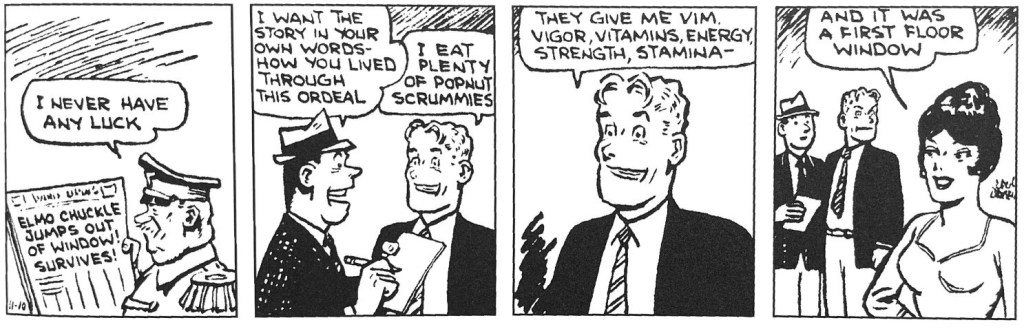
Things get marvelously bonkers in the strip’s last gasp. Elmo engages with corporate inanities, survives an assassination attempt as well as a suicide attempt (jumping from a first floor window). We get an authoritarian snowman, a talking robot, and final extended parody of Schulz’s Peanuts. Jensen’s sense of humor is not uproarious, pointed, screwball or even deeply satiric. It is just relentlessly offbeat and odd.
In reprinting and chronicling these bizarre episodes of Elmo in Debbie-land, Young is a critic not a cheerleader. In a deft and insightful long intro, he recognizes the unevenness of Jensen’s work and the true inscrutability of his imagination. But as he notes throughout this project, Cecil Jensens left us with one of those rare instances where the otherwise buttoned-down mass medium of 50s comic strips produced a true rara avis.
Invisible Men: The Trailblazing Black Artists of the Comic Book
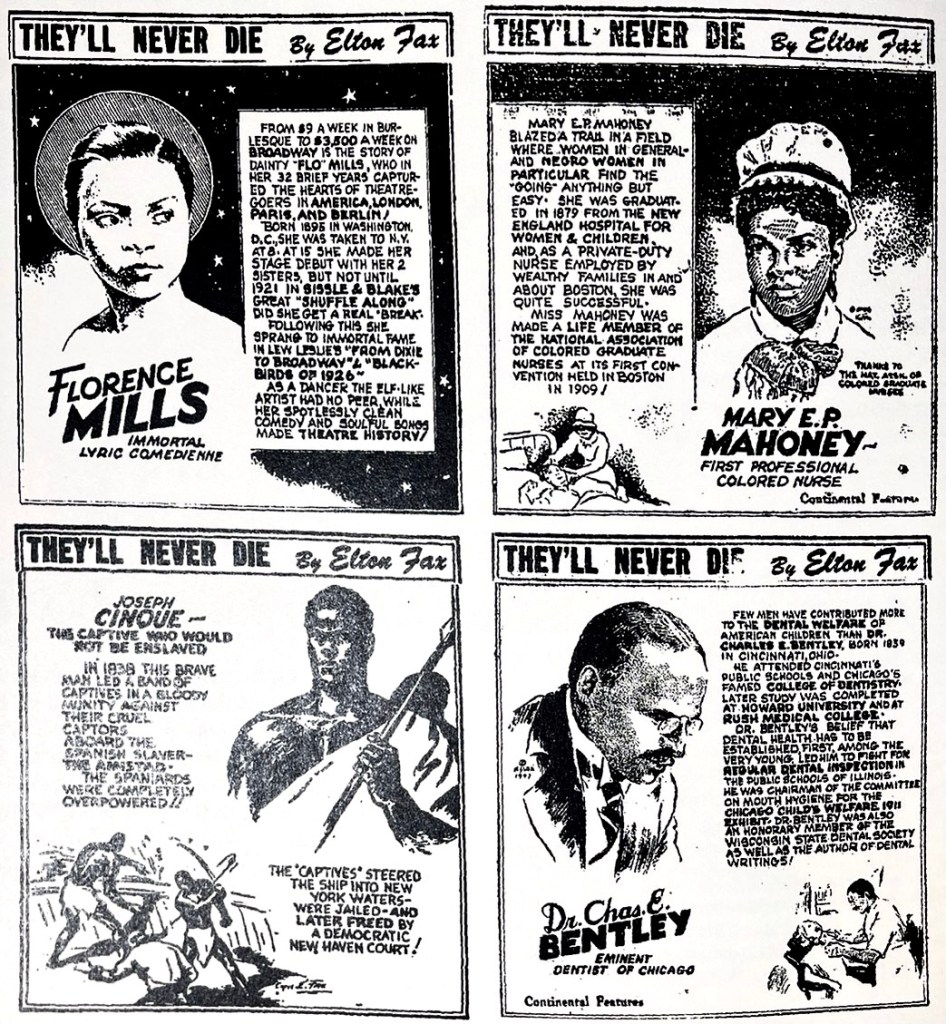
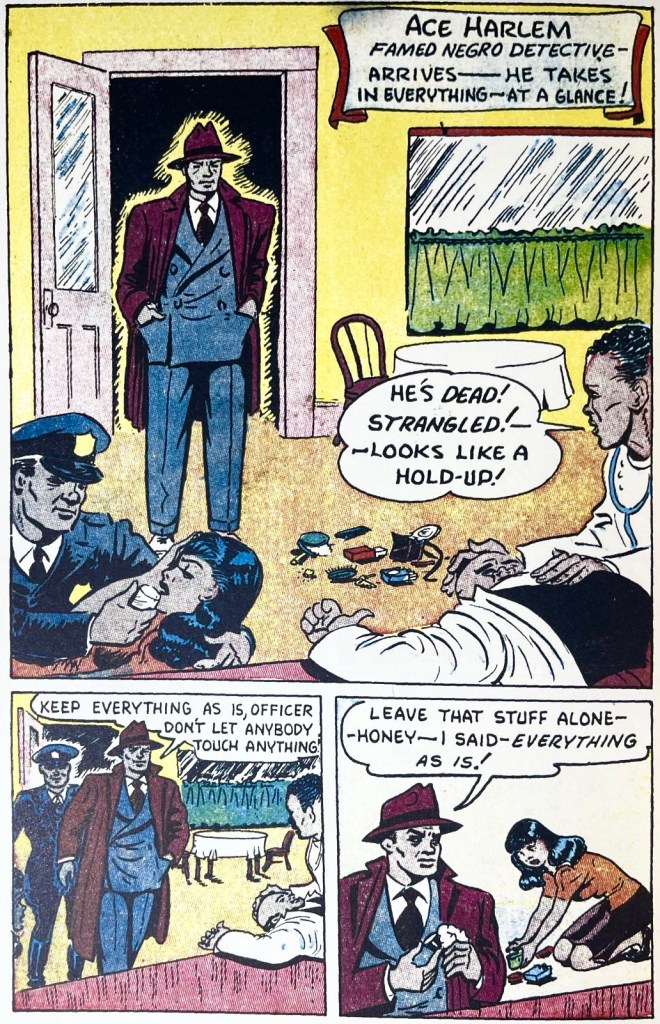
This well produced overview of over a dozen pioneering Black comics artists surfaces a hidden history that is eye-opening on so many levels. Many of these artists were well-known within their own communities and Black newspapers in many of the major cities across the US but “invisible” to the larger world of comics readers. Mainstream comics history often highlights Matt Baker who developed sexy heroines like Phantom Lady and Flamingo and is well represented here. But author Ken Quattro does an excellent job taking a biographical approach that digs into Adolph Barreaux (Sally the Sleuth), Elmer Stoner ( Phantasmo), John Paul Jackson (Tisha Minga and Bungleton Green), the collaborations of Elton Flay Fax and George Dewey Lipscomb, Alvin Hollingsworth’s horror comics, and a dozen more that differentiates the styles, personalities and career paths of an incredibly diverse group of artists.
Invisible Men tends to focus on these artists’ eventual contributions to the mainstream comic book field, and so each biographical section usually ends with a full story, full color reprint. Ironically, this work often represents the least expressive and talented examples of what many of these artists had to offer. Their careers generally were more interesting outside of a comic book industry that paid poorly and demanded little. In fact, as Quattro himself recognizes, unlike most early comic book artists, almost all of the Black artists he explores were formally trained fine artists who took on this work just for the money.
In each of these biographies I found their supporting and prior careers much more interesting, as does the author. Quattro cautions that he is not a formal historian, but he ably sketches in a blind spot for comic strip history – the Black newspaper, as well as the vagaries of freelancing for early comic book and pulp magazine companies and how it allowed many of these “invisible men” sustained careers. In taking a biographical approach to this cast, Quattro defies generalization about these artists’ perspectives and backgrounds. We enter a range of highly individual contexts, especially Black middle-class enclaves in cities like Oberlin, Charleston, Baltimore and more. We get glimpses of how Black newspapers, communities, artist groups lent support and connections for many of these men as they cobbled together artistic careers that moved across Black newspaper comics and editorial, community pamphlets, posters and fine art exhibits in addition to the burgeoning comic book industry.
Valuable as Invisible Men may be, it begs for more…more history of Black artist communities, of the Black newspapers that nurtured so much talent, of artists that fall outside of Quattro’s comic book lens. We need at long last a modern report in of strips like Bungleton Green, the syndicates that distributed Black comics artists, an entire history of editorial cartoons that took a decidedly different take on current events.
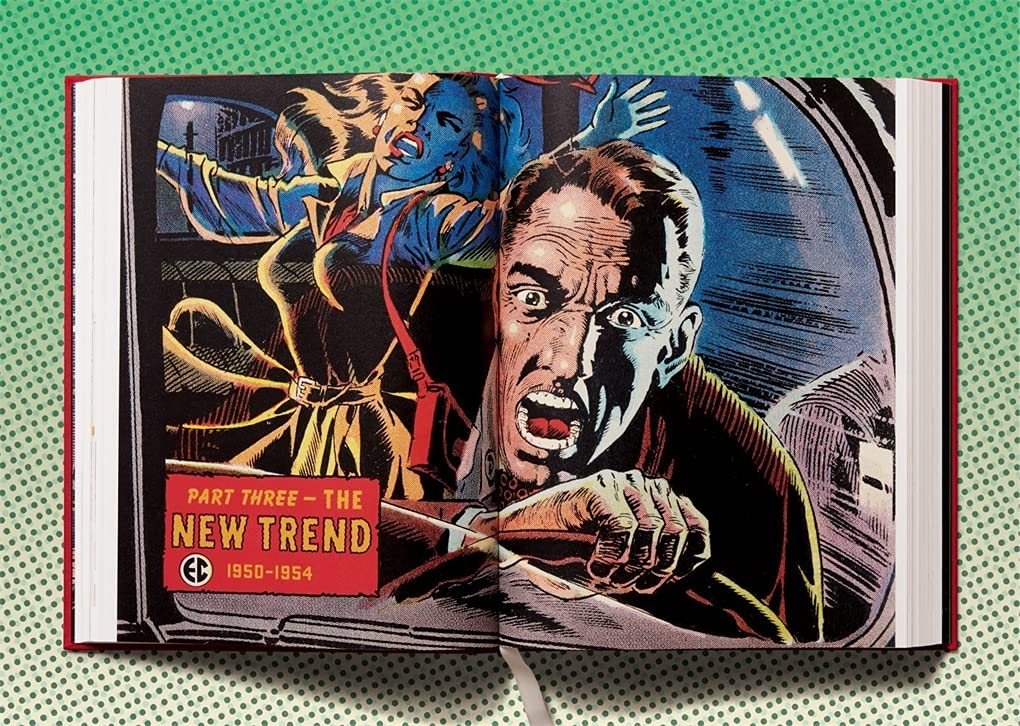
It is way past time to review and highlight some of the noteworthy books for comic strip mavens in the last year. For nearly a decade, as an editor at media trades Media Industry Newsletter and then Folio magazine, I did annual roundups of books of special interest to print media professionals. Historically significant comics reprints always played in my mix. Following the diminishing fortunes of the magazine industry in recent years, MIN merged with Folio, which itself folded into oblivion in late 2019. And so I moved the 2019 roundup here to Panels & Prose. I never got around to doing a 2020 edition, because, well, 2020. So over the next week or so I will be calling out my faves from last year and so far this year that I think furthered our understanding of comics history. Today we start with the one title in the bunch that nudges beyond the usual focus of this site on newspaper and magazine comics. But the magnificent legacy of EC is too important a milestone in the American comic arts to exclude.
The History of EC Comics
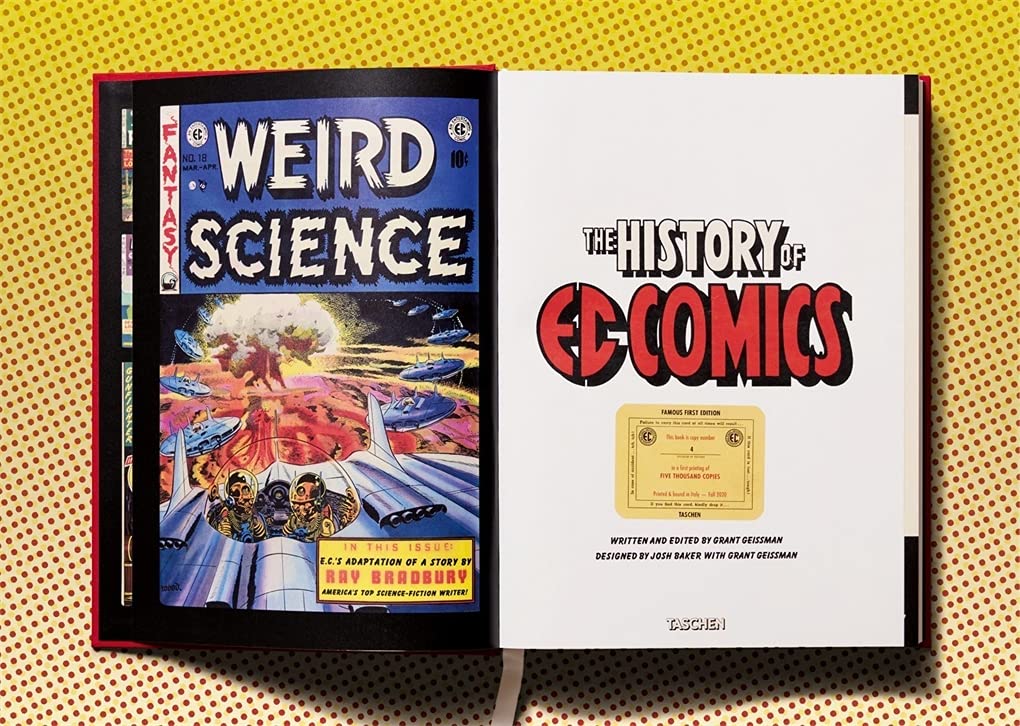
The annual cinder block from Taschen for comics fans is Grant Geissman’s The History of EC Comics, a massive reflection on and reprinting of the greatest collection of comics artists in history. William Gaines’ EC horror, war and crime comics was the home of Tales from the Crypt, Weird Science and Frontline Combat. Like all Taschen books the sheer scale allows Geissman to pour in full story reprints, some in original art, memos, office photos, even contracts that help bring to life the familiar history of this incredible stable of talent. It is hard to go wrong with a book brimming with Jack Davis, Wally Wood, Harvey Kurtzman, Johnny Craig, Al Feldstein, Will Elder, just to name-drop a few. Falling into these artists at 14×18 scale is a revelation, even to lifelong fans like me. The book also has an end section reproducing every EC cover where many of these artists hit their peak. Kudos to Geissman’s curatorial skill.
The text history is not as compelling. I think Geissman’s rendering of Bill Gaines’s father, comic book pioneer Max Gaines, is quite good. It has telling detail and foreshadows the psychic burden Bill carried. Otherwise, however, Geissman defers to others for the scant aesthetic evaluations of all this great artistry he has assembled here. Nor is there much about the tropes, themes, attitudes and visual conceits that a more curious and creative interpreter might tie to the zeitgeist. Tashen’s other recent XXL titles on Krazy Kat and Little Nemo, both benefitted greatly by Alexander Braun’s critical acumen. Appreciating and distinguishing among comics styles was central to EC’s success, because publisher Gaines and editor/writer Feldstein meted out the freelance work according to whose style fit the story. This layer of interpretation is missing here. Instead, the history and ancillary images are guided by a collector’s penchant for later market value and rarity rather than aesthetic or cultural significance.
Nit Picky? Not for a tome that is priced and positioned as definitive. Sure, one wishes that such a visually generous and lush, let alone expensive, book on EC was a full-throated celebration and genuine interpretation of its artistry. We’ll settle for this.









 Panels & Prose