The Plunder Island sequence of Thimble Theatre Sundays that ran from December 1933 to July 1934 was E.C. Segar’s signature epic. It concentrated most of this master’s diverse talents and blended the many genres Thimble Theatre traversed into the strips most impressive run. Fabulism, farce, adventure, sentiment, venality, romance, screwball — all and more are here. And along the way, Segar even fleshes out and distinguishes among his key characters.
The running gag in Gus Mager’s 1911-1912 small wonder Sherlocko the Monk is that this send-up of Sir Arthur Conan Doyle’s famous detective rarely uncovers a crime. Mager’s parody sleuth usually unravels “mysteries” around a henpecked husband’s scheme to avoid his wife, an absent-minded fop forgetting where he left the missing object, a neurotic too scared to show up for work. The mystery is really around character and behavior more than around misdeeds. And this is why Sherlocko the Monk is such a satisfying but under-appreciated relic of the first decades of the American comic. Sherlocko pulled together into a coherent narrative whole, themes and narrative conceits that had been germinating in a more haphazard way across many artists and strips since 1895. Sherlocko is the apotheosis of early comics’ preoccupation with social and character types, traits and obsessions. he took that trope and developed it into coherent theater. And along the way Sherlocko maps out where the comic strip had been by 1911 and where it was headed as an American popular art.
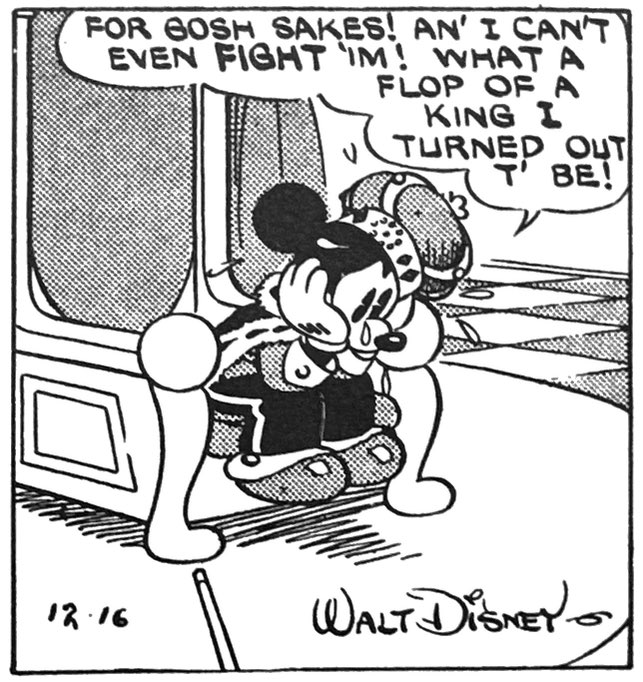
American popular culture took a number of odd turns in response to the trauma of the Great Depression in the 1930s. A fascination with pre-modern civilization, lost ancient worlds, aboriginal tribalism was one of the most pronounced that fueled comic strip fantasy. From Tarzan and Jungle Jim, to The Phantom, Prince Valiant and even Terry and the Pirates, Wash Tubbs and Captain Easy and Flash Gordon, the connection is obvious. At a time when most contemporary institutions were failing, Americans were understandably fixated on pre-modern, anti-modern, prehistoric and fable-like alternative worlds. One of the oddest subsets to this pop anti-modernism was the motif of fantasy monarchy, especially as a setting for comedy and satire.
In early 20th Century theater and film, the “sissy” was the dreaded antithesis of two-fisted pulp hyper-masculinity, at best, and at worst was a stereotypical euphemism for what was unspoken in general culture, homosexuality. Wimpy, the dandyish, appetite-driven counterpoint to Popeye’s principled violence, is of course Popeye’s best tutor for all things “sissy.” To make this sexual dynamic even weirder we have Popeye’s Pappy bewildered by his prancing progeny. It reads like an unintended burlesque of Popeye “coming out”. Per a previous post, These dailies precede Popeye deceiving the underground demons to come up and fight.
It is important to note that this gender-bending sequence was followed immediately by another adventure cycle involving Popeye getting the crap beaten out of him in a land of highly muscled women. And this is all happening right after E.C. Segar’s death in October 1938. The strip was being continued unsigned by assistants for the time being.
Where do we even start to highlight the wicked strangeness of Winsor McCay’s “Dream of the Rarebit Fiend?” The master comics artist drew over 800 nightmares in the first decade of the 20th Century, and… Read more: Random Nightmares: Winsor McCay Gets Rarebit
Along with chaos, mayhem and violence, obsessive behavior was a core theme of early newspaper cartooning. Consider the many titular anti-heroes of these years, like Hungry Henrietta, Superstitious Sam, Jingling Johnson, Sammy Sneeze. Or the… Read more: Dingbat Calls In the Klan: Herriman’s Bourgeois Obsessive
The authoritarian strain in modern democracies has only heightened since I first posted this bit of cartoon wisdom several years ago. In 1937, H.T. Webster’s Casper Milquetoast (The Timid Soul) responds to Italy’s Benito Mussolini… Read more: The Timid Soul Toys With Fascism
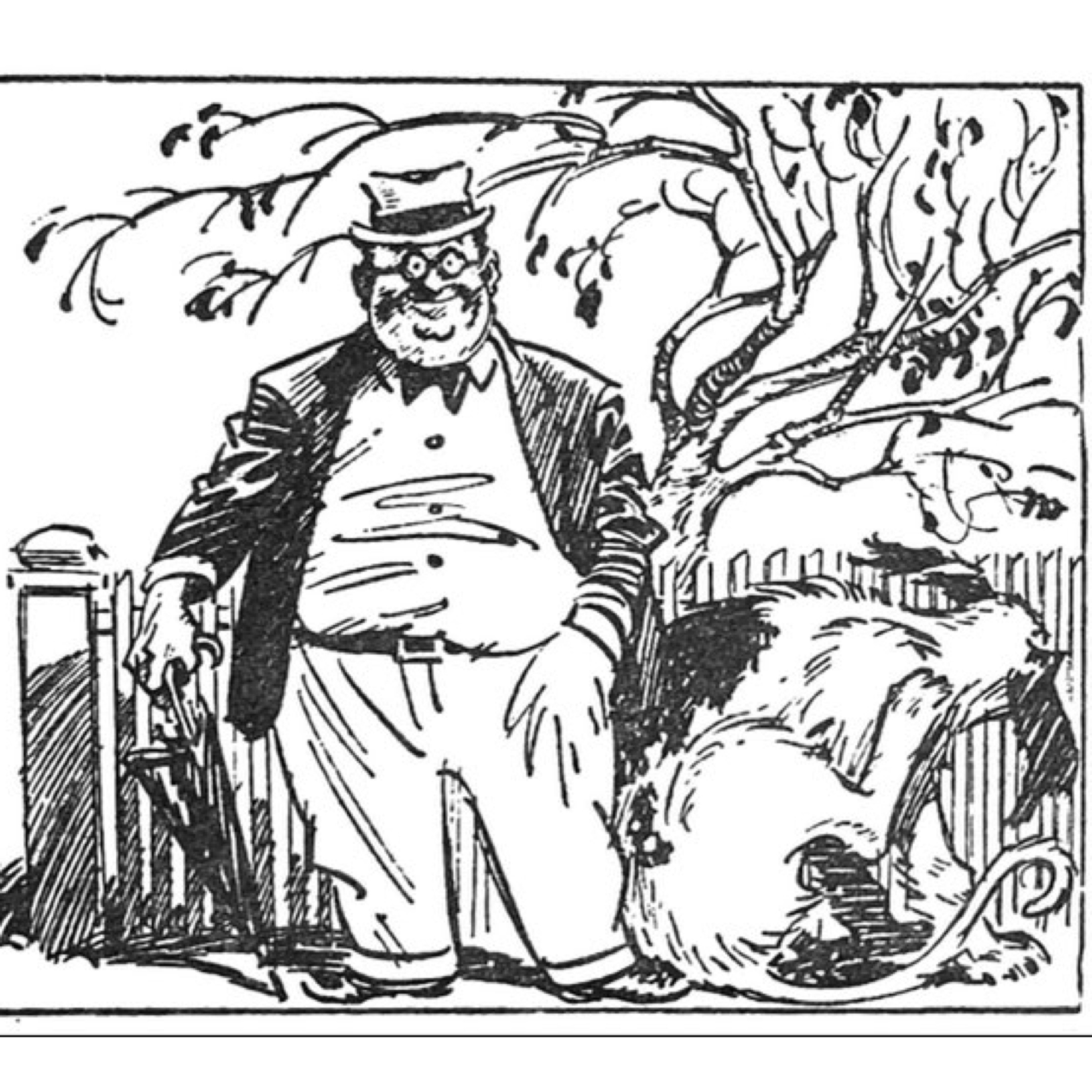
Clifford McBride’s portrait of the affable, accident-prone and corpulent Uncle Elby and his puckish oversized dog Napoleon is one of those great American comic strips that are about nothing. There is no adventure or much of an ongoing storyline to the Napoleon and Uncle Elby strip. Nor are there gags, verbal or physical, really. It is more a strip about everyday mishaps. Uncle Elby is proud of his new white suit, which an affectionate Napoleon meets at the the front door with muddy paws. Constructing a simple tent results in a tangled mess. Napoleon chases a fleeing rabbit, chicken, cat or whatnot (it’s a frequent theme), only to be chased by his prey in the end. Elby mows over one of his dog’s hidden bones, which conks him on the bean. Elby gets out of his car to open the garage door only to have it slam shut before he can drive through.
No, really, the action in the Napoleon strip is that banal and trifling…relentlessly…and apparently by design.
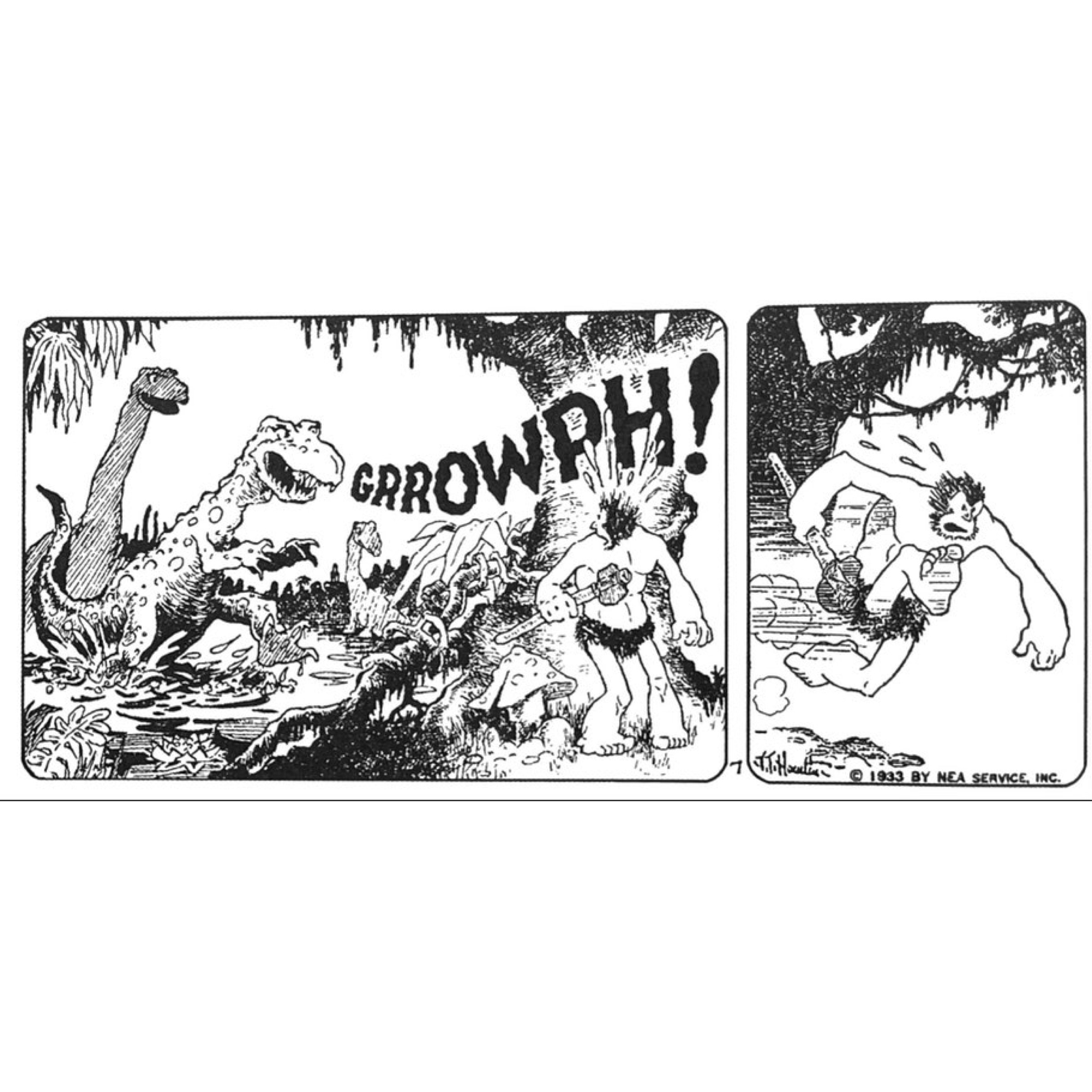
“Off to a Flying Start” is how V.T. Hamlin titled his introduction to the Alley Oop character and world in late 1932. And in fact Hamlin’s eponymous hero cries for help in the opening panel…only to be chased by the prehistoric dinosaurs of this fantastic “Bone Age.” For the next six or seven years, Hamlin’s art and story were at their best when his furry-crowned, thick-limbed everyman scurried at the center of screwball mayhem. We now have a great opportunity to review and reconsider Alley, as the small press Acoustic Learning recently launched reprint series of both Hamlin’s early adventures and later work by his successor Dave Graue.
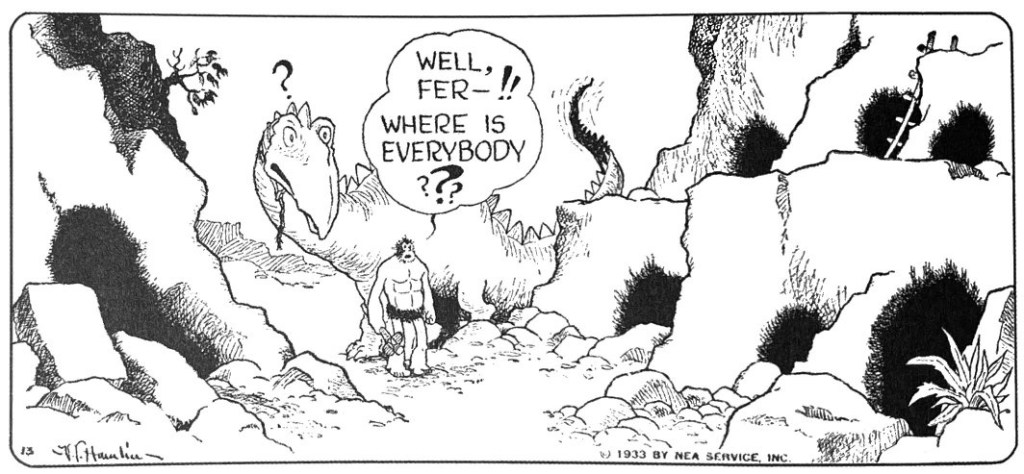
My first impression diving into Alley Oop is Hamlin’s strong feel for set, background and character design Hamlin had from the beginning. Unlike Segar’s Thimble Theatre, Capp’s L’il Abner and certainly Gould’s Dick Tracy, Alley Oop doesn’t begin in a crude style that only finds its signature style over months and years. Hamlin goes into Alley Oop knowing he wanted to contrast fine-lined, simple but polished characters with detailed and accurate scenery and dinosaurs. Hamlin had a cultivated curiosity about prehistoric creatures in one of his many jobs as an illustrator in the Texas oil industry. He well knew the historical fantasty at the center of Alley Oop. The age of dinosaurs long preceded any human ancestors. But he was dedicated to drawing, naming and animating his Bone Age dinos as accurately as he could.
By contrast, his cast of cartoon humans, the males at least, are carefully built with a bit of the era’s deco minimalism. Oop, his rhyming buddy Foozy, Guz, the King of the Moos and the tribes of cave men are small of head, with enviable four-pack abs, and forearms and calves shaped like bowling pins. He builds his characters in order to animate them. Those bottom-heavy limbs become wonderful devices when fleeing, fighting or rioting. The action poses, freeze-frames of punches thrown and received, crowds of cave men imploding or exploding, all have an expressiveness that sits between cartoon abstraction and naturalism. This fine-lined, controlled art style is served very well in this reprint. The strips fully render Hamlin’s thin line shading of background flora and the dinosaurs.
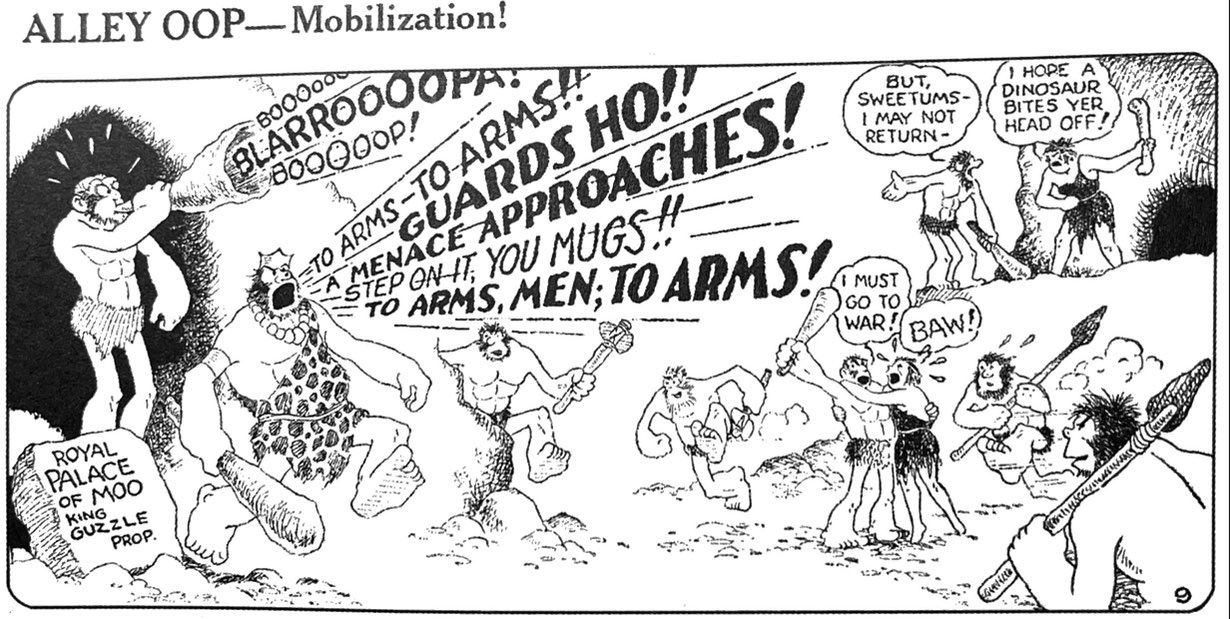
Alley Oop is also one of those rare strips, along with Walt Kelly’s later Pogo, that renders the words as part of the art. From the strip’s first panel, Hamlin shows his distinct deco styling for characters shouting. They move from small to larger type sizes, megaphone-like, into the air. And Hamlin plays with bolding, differing type styles and sizes, words moving in and out of word baloons, to express tones, crowd murmerings, sound effects. In some ways he was bringing to his comic strip layers that mimiced the early days of the talking motion picture, still in its infancy when Oop appears in 1932/33.
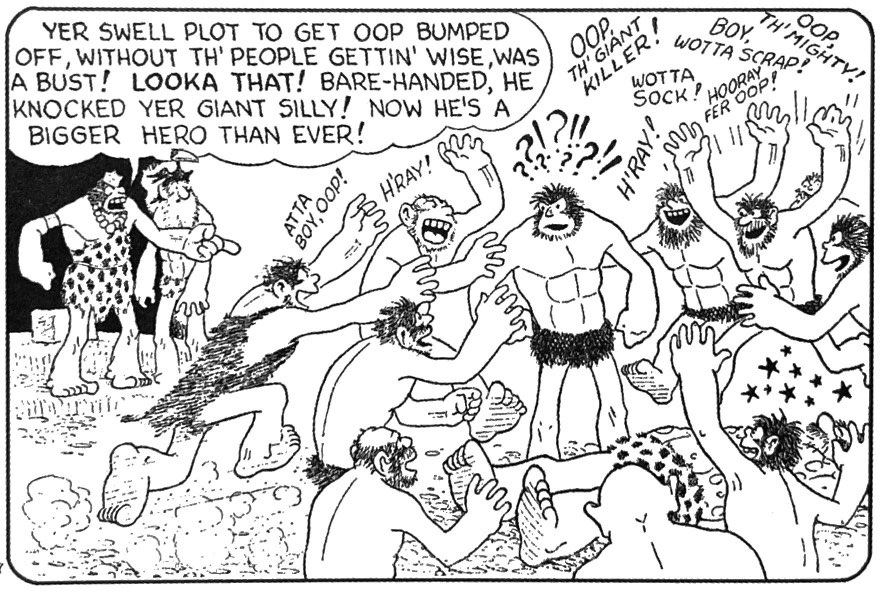
And much like Segar’s approach to Popeye, even Gray’s Annie, Hamlin brings a populist sensibility to the strip. Conventional wisdom suggests that Alley Oop becomes more interesting and a genuine adventure strip in 1939 when he introduced a time travel device that brought Oop and girlfireind Ooola across major historical ages. But from the start, Oop is an everyman hero, good of heart, who is less of an adventurer than a victim of circumstance. He quickly becomes the unintentional antagonist to King Guz, the insecure and thin-skinned leader of the Moos. Guz envies Oop’s popularity when the cave man returns to the tribe astride his tamed pet dinosaur Dinny. Guz’s machinations to retain prestige and diminish Oop is the driving force of the strip’s first year. Oop fits neatly within the pantheon of Depression-era common many heroes. Prohibition, which didn’t end until the December 1933, and a deepening Depression had already undermined public trust in institutional authority, the purity and wisdom of legal and political institutions. Popular culture registered a generalized distaste for authority in everything from the romanticization of gangsters in the press to images of kings, politicians, policemen and bosses as either hapless or imperious. We usually come upon common men like Popeye, Tom Joad, Micky Mouse and Mr. Oop just trying to go about their business, only to become heroic in the face of the moral duplicity (or just stupidity).
As simple and familiar as these everyman heroes may seem, the idea of the inherently moral, simple and unpretentious “nature’s nobleman” runs deep and long in American culture, extending back to the tales of James Fennimore Cooper’s frontier hero Natty Bumppo and Jacksonian politics of the 1840s. American popular literature is filled with examples of the naturally ethical, American individualist asserting basic common sense and morality against both little human and big insitutional corruptions. Cast as he may be in the Bone Age, Oop was certainly in that tradition, one that had special valence to Depression-Era.
Billy DeBeck described his own comic anti-hero as a “low-life” with a heart, but it took a few years from Barney Google’s introduction in 1919 for DeBeck to find his real character. Barney started as yet another henpecked husband, a servile schemer whose daily antics focused on outflanking his overbearing wife. From the start, however, DeBeck’s imagination veered towards outlandish solutions to everyday slights and oppression, At one point the early Barney plots to avoid his wife’s wrath by getting beat up to garner sympathy. Barney was DeBeck’s man on the margins, bouncing from job to job, always broke, forever buffeted by wife, bosses, circumstances or dumb bad luck.
As DeBeck came to understand his own character, Barney literally shrank in stature, from a tall but stooped supplicant to a figure half that original size, now more crushed than stooped, a compact underling of life whose famously oversized “google eyes” always seems to be looking up at other characters. With so little space between Barney’s nose, mouth, torso and legs, he looks like a crumpled ball of formerly human features, the visual embodiment of a man pressed down into a diminutive stature.
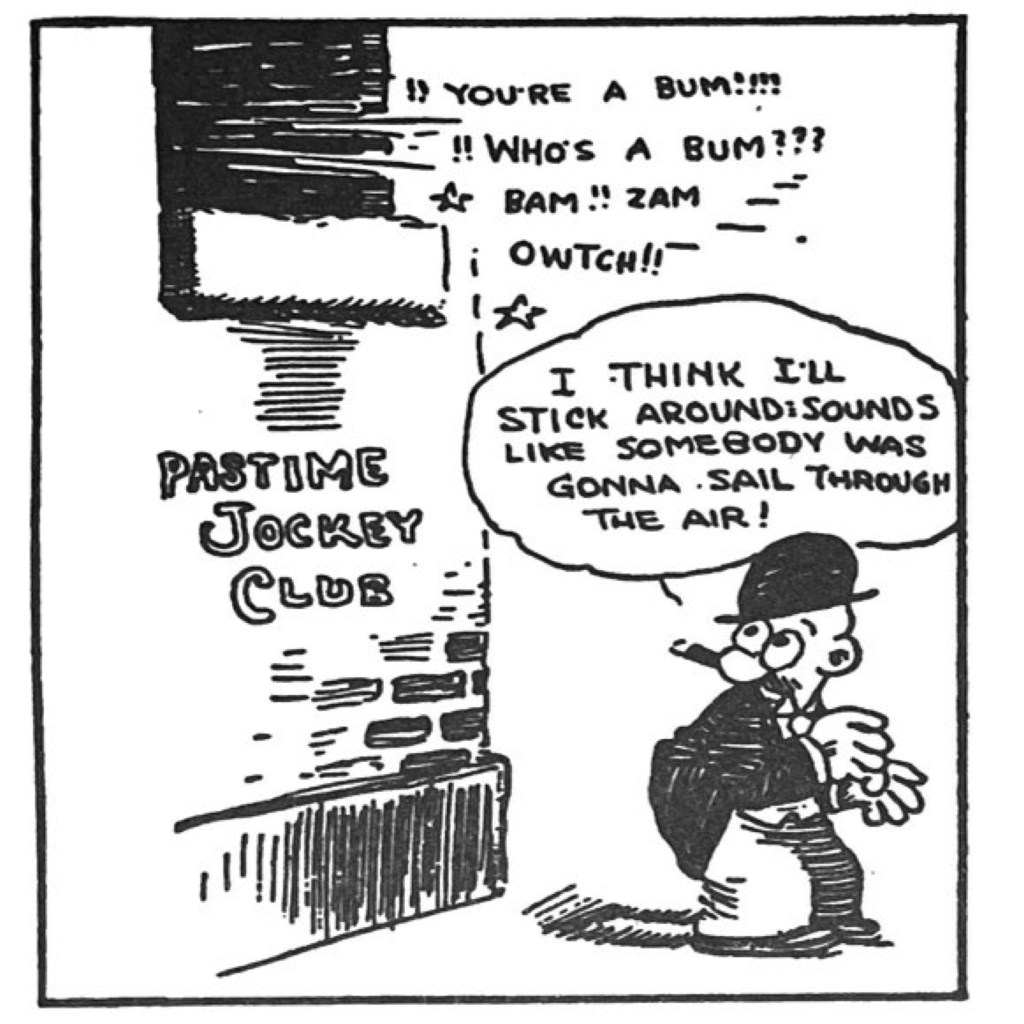
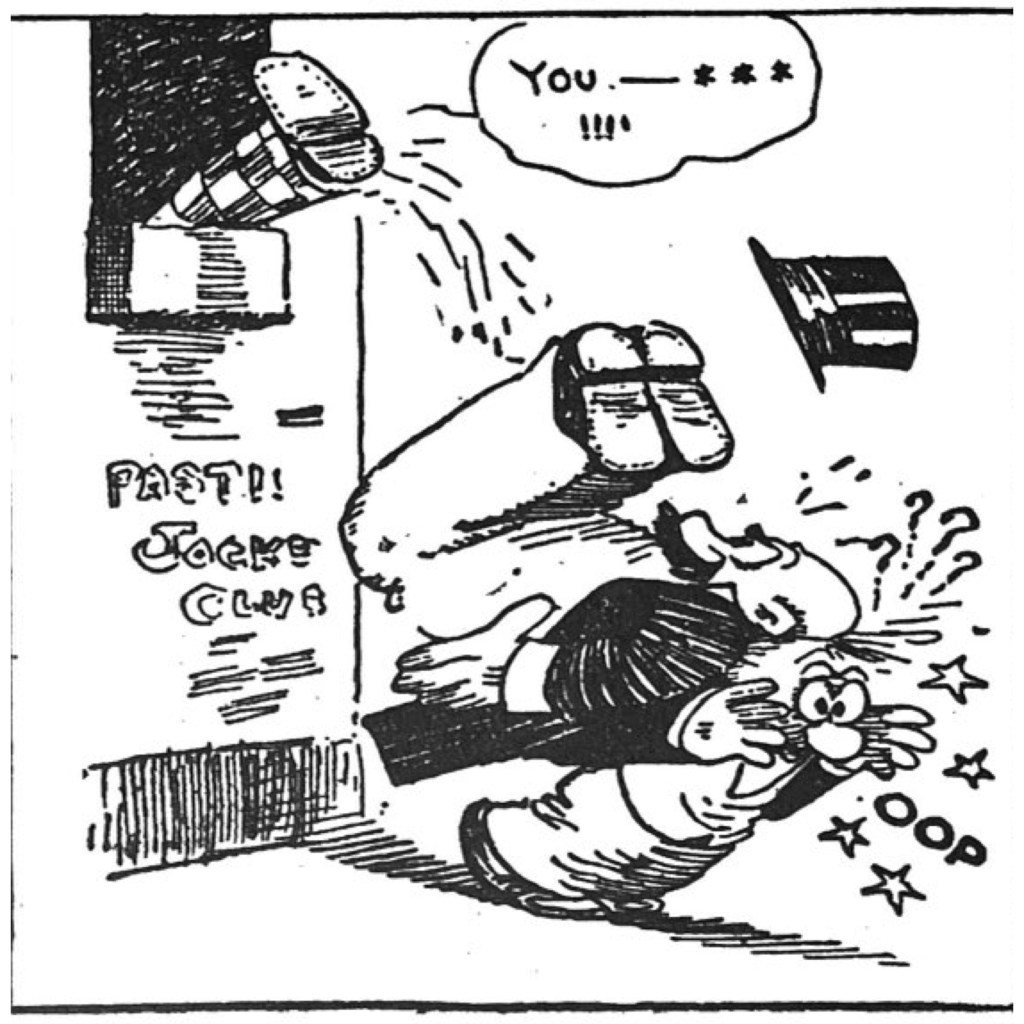
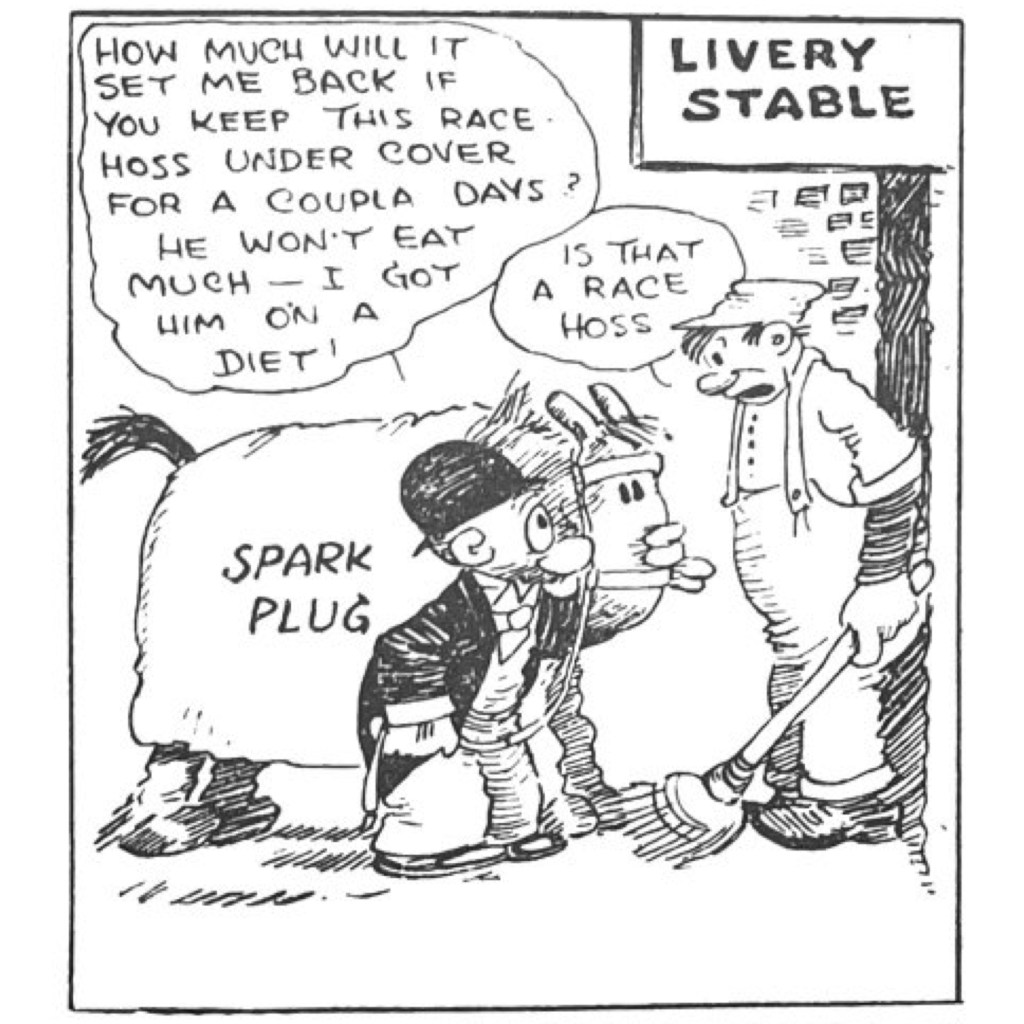
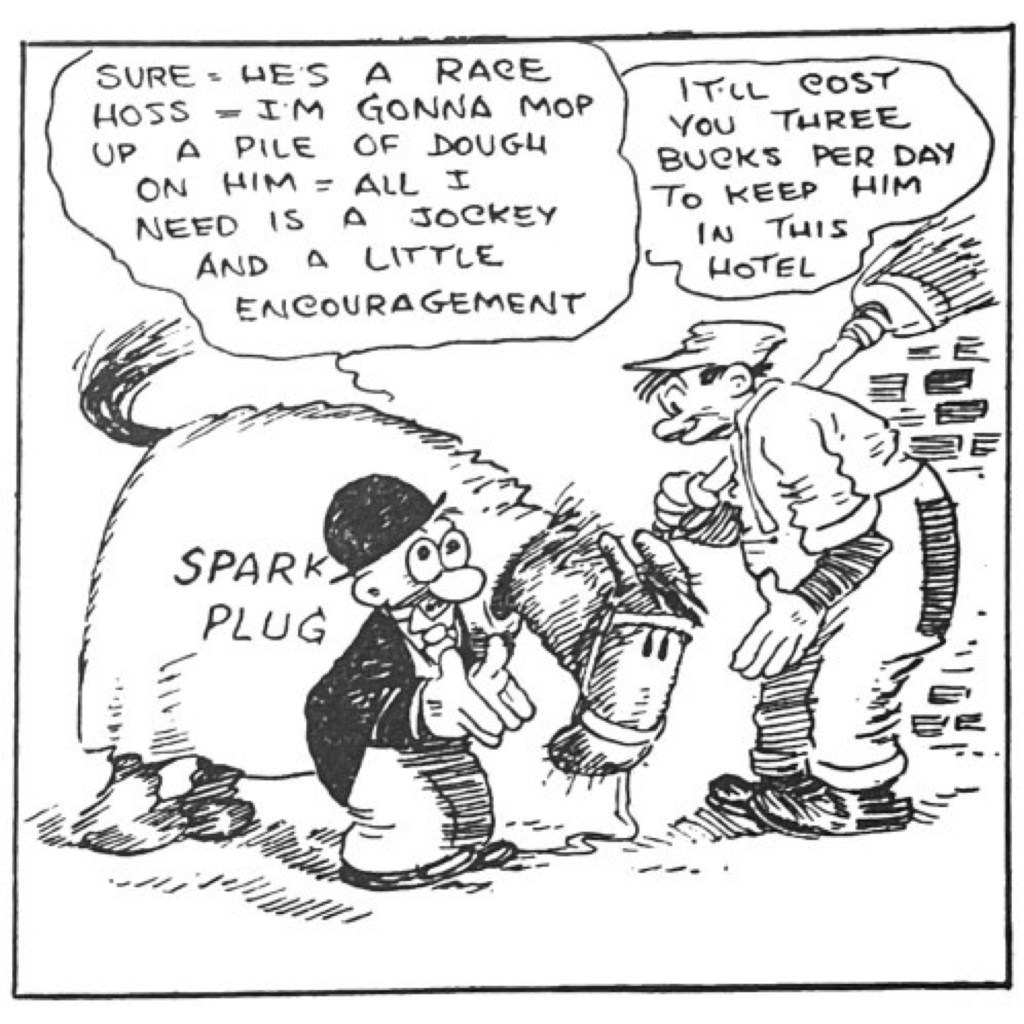
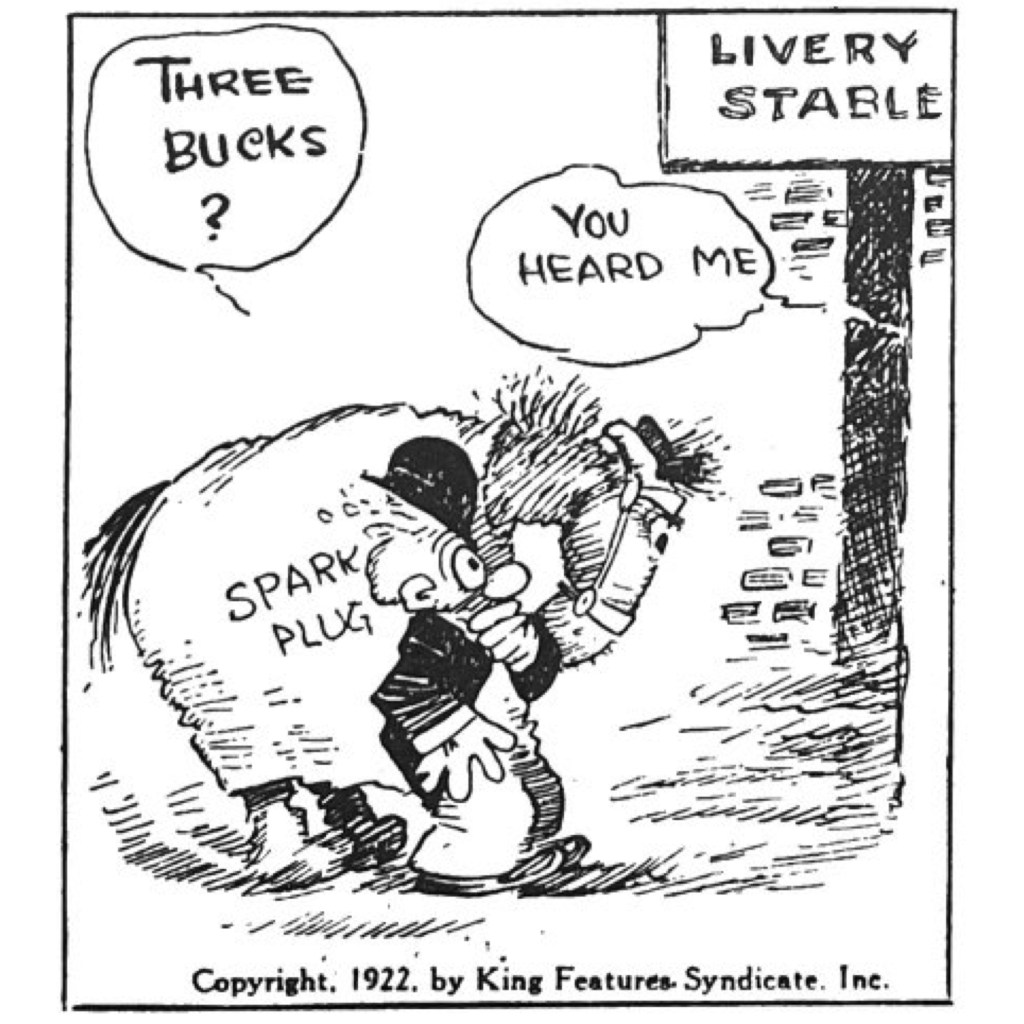
But the real heart of Barney Google comes out when he connects with Spark Plug, the horse that would win and lose countless races over the next decade. See above the first strip in 1922 introducing Sparky. In many ways, the horse replaced Barney’s wife as his love-hate interest. Barney raged whenever his nag lost a race but never could bring himself to stay mad for long. There was real romance here. It is not surprising that Spark Plug became a merchandising hit in the 1920s. One later comics historian compared the nag to Snoopy in the level of his fame.
But the coming of Spark Plug also literally raised the stakes for Barney’s conniving. Now he is on a larger stage, traversing the country with Sparky, plotting to get race entry fees, looking for shortcuts. And his fortunes rise and fall radically, from wealthy purses Sparky wins to big bets that come cup a cropper. And Barney starts looking the part, now donning a top hat and formal coat. He has evolved from petty existential haplessness to riding up and down the rollercoaster of American pluck and luck. Barney Google becomes both a celebration and satire of American ambition. He is always on the make, looking for the big chance, and a universe of pitiless institutions, authorities and chance bounce this compressed ball of a character up and down fortune’s wheel. DeBeck is working in a grand tradition of American comic archetypes and echoing some of the tropes that were driving the great slapstick silent clowns of the same decade. Chaplin, Lloyd and Keaton also explored the marginal man, luckless but big-hearted and managing an absurd cosmos with clever survival skills.
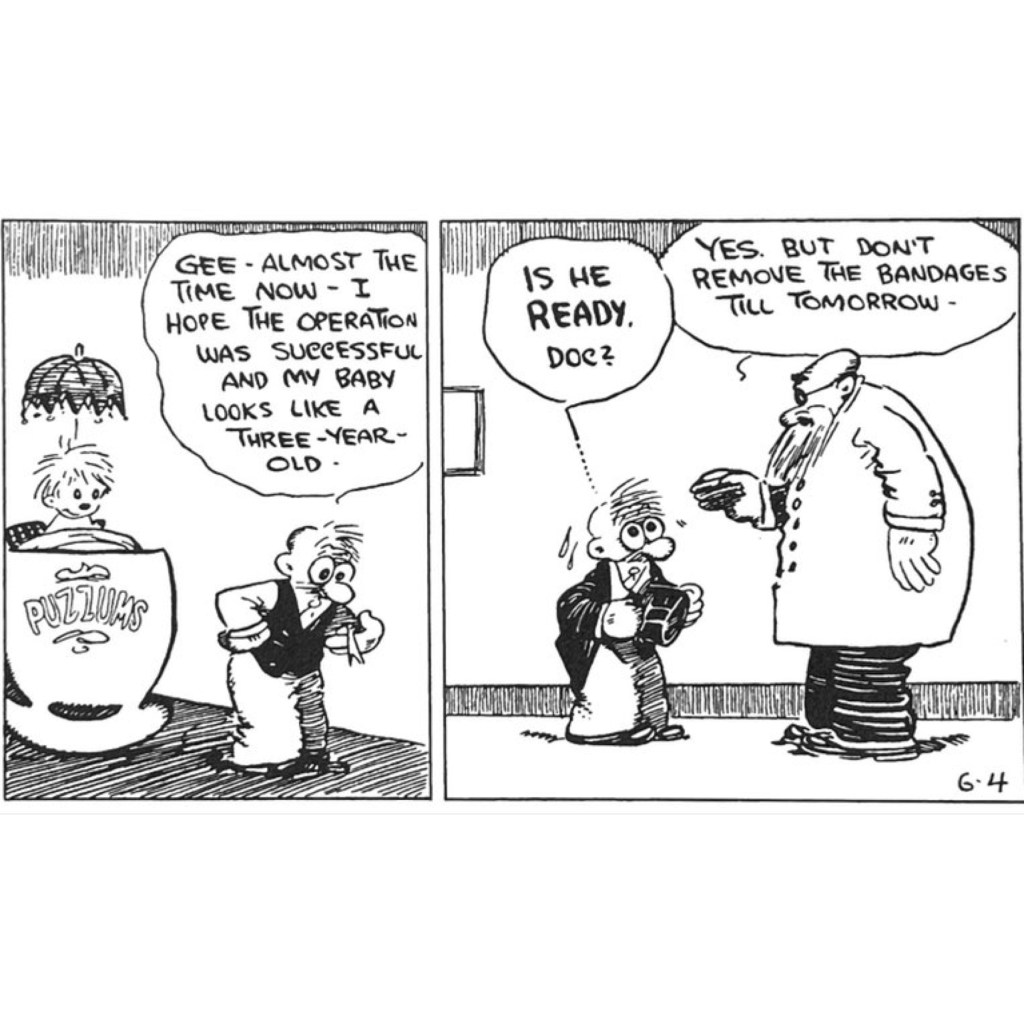
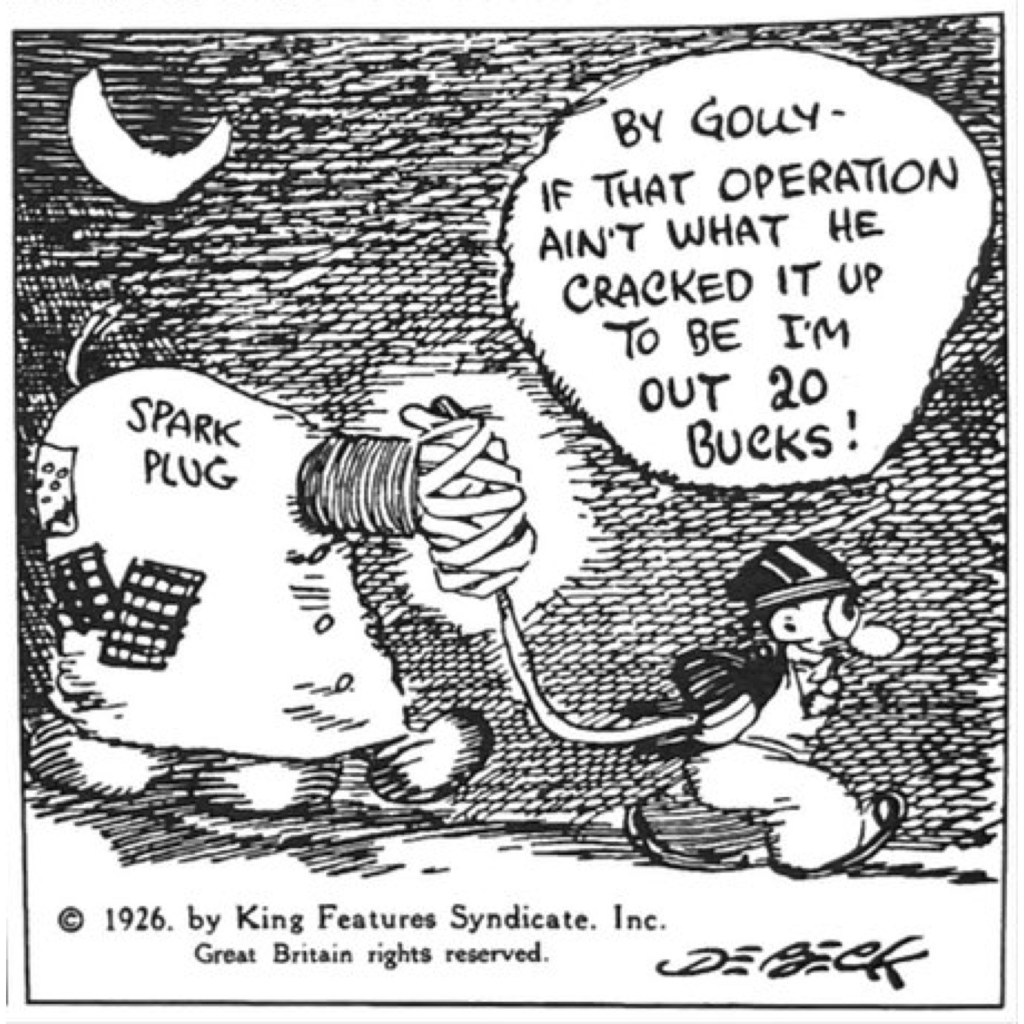
And there was relentless scheming, DeBeck knew no bounds in dreaming up ways that Barney could make money, thwart rules, fool race officials, or just cheat to help Spark Plug win. In the strip above he gets Sparky a facelift in order to convince the race judges that his horse is a genuine three-year-old.
DeBeck’s plotting of Barney Google’s machinations to succeed were so convoluted that he became famous for recap strips that just reminded readers what his little schemer was up to. And it is this low-level conniving that is the beating heart of Barney Google. Barney is a hapless creature in the comic strip tradition of Happy Hooligan, Slim Jim, Mutt and Jeff, Boob McNutt, Boob Baxter and even Baron Bean. The lovable loser was a particular hero of the American comic strip. It begs so many questions about the role of this art form in Americans’ everyday lives. There was a special kind of social satire going on here, under cover of clever banter, situation comedy and screwball antics. At heart, many of the comic strip figures of the 1920s – Google, Andy Gump, Boob McNutt, Moon Mullins — were more victim than victor.










 Panels & Prose