


It has been a minute – or maybe a year? – since I rounded up my favorite books that revive or explore the great American comic strip or pre-code comics. I don’t know why we are experiencing such a torrent of good reprints from major publishers as well as a number of small enthusiast presses rediscovering artists. My hope is that a new generation of graphic storytellers are being inspired by their predecessors. The graphic novel genre has gone mainstream, and that means our respect for visual storytelling has evolved. And so in various ways the history of the modern comics medium has become important to help fuel the imaginations of a new generation of artists. Let’s dig in.


The Calvin and Hobbes Portable Compendium, Set 1. Along with Gary Larson’s The Far Side, Bill Watterson’s Calvin and Hobbes is the last of the truly great newspaper comic strips, in my mind. It has been reprinted multiple times, including wonderful oversized boxed sets by Andrews McMeel. This much more manageable reprint series will come in a regular series of two boxed 6×9 inch softcover volumes. Dailies are reprinted two to a page in comfortable size, while the full page Sundays are necessarily cramped. This first set, at a very reasonable $19.99, covers the strip’s premier in November 1985 through March 1987. Look for the next set in March 2024. What is remarkable about Watterson is how quickly he hit his stride both in visual style and humor. Many legendary strips have warm up years where the style evolves noticeably, while the story and characters find their enduring through lines. Not so much here. Watterson seems to have known what he was doing from the outset.

Walt Disney’s Silly Symphonies 1932-1935: Starring Bucky Bug and Donald Duck. Disney’s initial instinct was to use the newspaper comic as a brand extension and promotion for its film shorts in the 1930s. But the Mickey Mouse, Donald Duck and Silly Symphonies strips took on lives of their own in newspapers. Silly Symphonies even generated its own cast of bugs, led by Bucky. The great thing about this series is that in story and art it captured some of the most surreal and imaginative qualities of the early Disney shorts. These color Sundays show the studio at the height of its creative power and thoughtfulness. These artists really tried to understand the newspaper strip as a discrete form of art- cadence, scale, appearance on a page of competing styles. The ways in which the scale of the insect world fills the panels with microscopic views, awash in planes of color are mesmerizing. And Fantagraphics brings to this series the same rich contextual background material it brought to the Mickey Mouse and Donald Duck reprints.
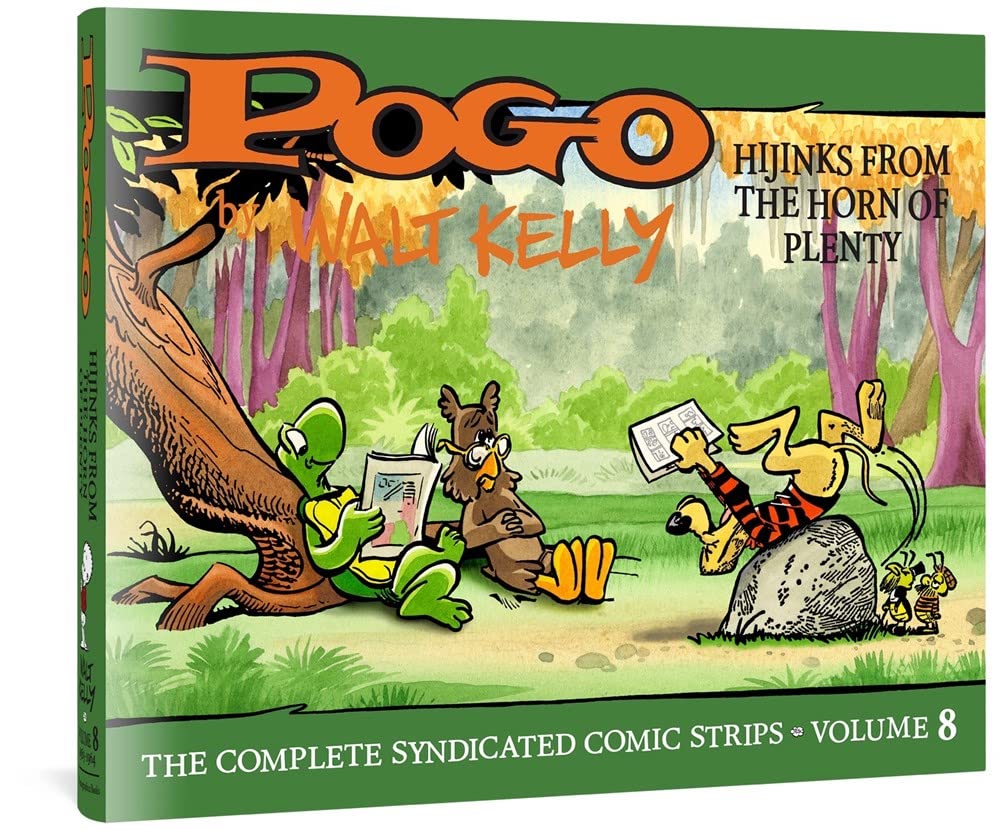
Pogo: Hijinks from the Horn of Plenty, Vol. 8. 1963-64. Enthusiasm for long, complete reprint runs of legendary strips tends to wane as years go on, and certainly many legendary artists spent their creative energy as decades went on. But, Walt Kelly rarely flagged. And if you need convincing about buying into Fantagraphics’ complete Pogo, what the hell are you even doing here? Kelly’s light, funny animal style is a disguise for adult satire, rich language play and relentless punnery. And as America’s Cold War sense of political and moral righteousness reached dangerous heights in the 1960s, Kelly brought a profound humanism to his worldview that was much needed. This indispensable complete reprint series comes into Presidential election season of 1963-64, so of course a Barry Goldwater figure pops in. As in previous volumes the late R.C. Harvey annotates the volume with historical and behind the scenes info. The dailies are sharp and generously sized, while the Sundays are colored beautifully and big enough.
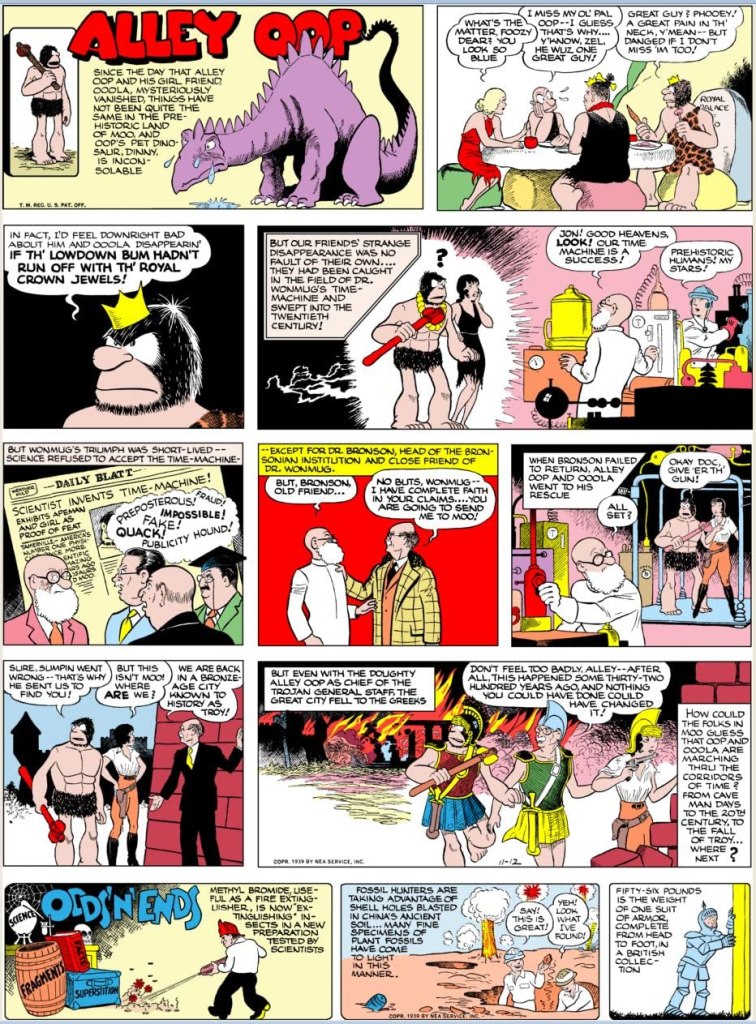
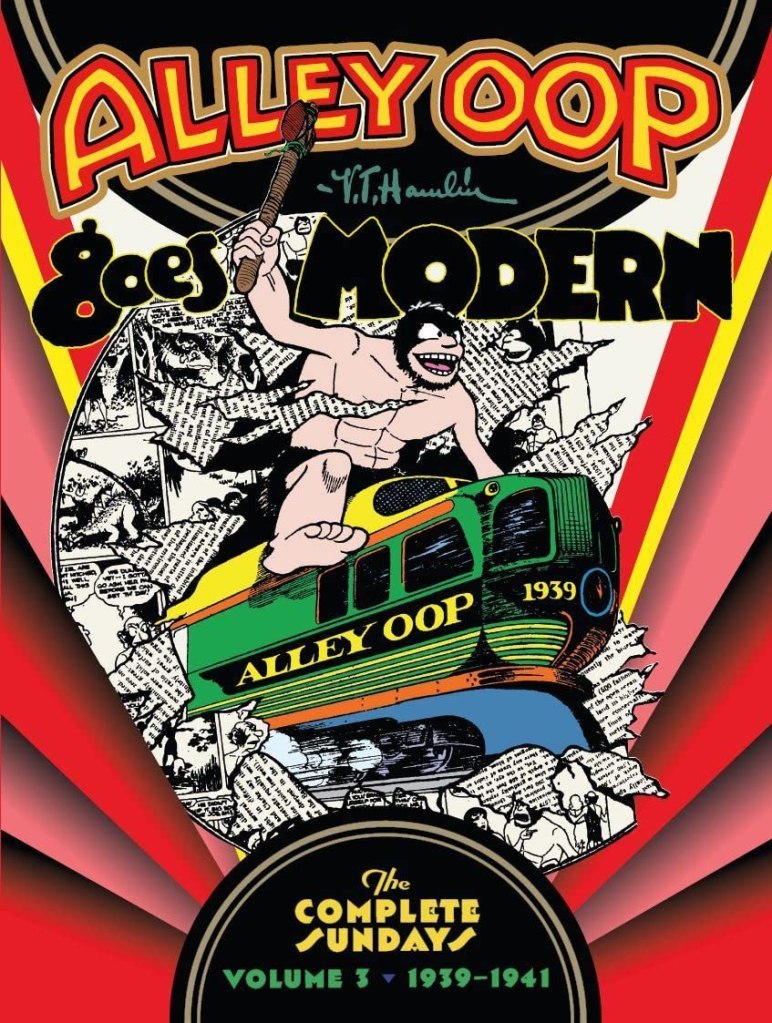
Alley Oop: The Complete Sundays Volume 3 (Alley Oop Goes Modern, 1939–1941) Alley Oop Races Blarney Goldfield Alley Oop and the Tiger Tail Transplant and Dave Graue Alley Oop Meets Draculina Alley Oop Versus the Black Knight. While most comic strip aficionados are well-acquainted with Pogo, Alley Oop was probably better known than fully appreciated. V.T. Hamlin’s prehistoric everyman is being generously and pristinely reprinted by Acoustic Learning on a very regular schedule. In parallel, they are reprinting with the later era of the 1970s when Dave Graue took over. In the latest volumes, Acoustic picks up the discontinued oversized Sundays reprints and follows Alley into his time-traveling during the 1950s. Hamlin’s Oop has a wry, populist sensibility in the guise of caveman ignorance that remains relevant and very American. This is a wonderful labor of love by Chris Aruffo. To support Chris more directly, you can buy direct from the publisher here.
Bungleton Green and the Mystic Commandos. Most comic strip reprints are fun and useful to comics fans, but this New York Review Comics revival of Jay Jackson’s Bungleton Green is genuinely important. Formerly a gag strip in many Black newspapers during the 1930s, Jackson converted it into a seria adventure and expanded the cast to a multiethnic Mystic Commandos troupe for 1940s wartime. This crew of Nazi-hunting kid warriors became of the center of sci-fi storylines that time travel to fight racism past, present and future. It is quite a trip, and it foreshadows some of the Black sci-fi genre that is surging today. Surfacing the comics of overlooked minority newspapers is the next big project in comics history, and this reprint is a great example of how the comics could become fertile ground for important literary themes that flourished later.

Dayenu Dayenu Speaking of minority newspaper comics finally seeing the light of day…. . Written by Rabbi Henry Rabin and drawn by artist Leonard Pritikin – working together under the name “Henry Leonard”, this strip was a staple of Jewish newspapers in the 1950s and 60s. This one-panel series of inside jokes were even too inside for some readers. The reprints that this About Comics volume collects into one volume even come with glossaries of Hebrew and Yiddish terms. In addition to filling in yet another blind spot of past comics histories, ethnic/minority newspapers, the comics themselves provide wonderful insight about a perennial American theme, the anxiety of cultural assimilation.
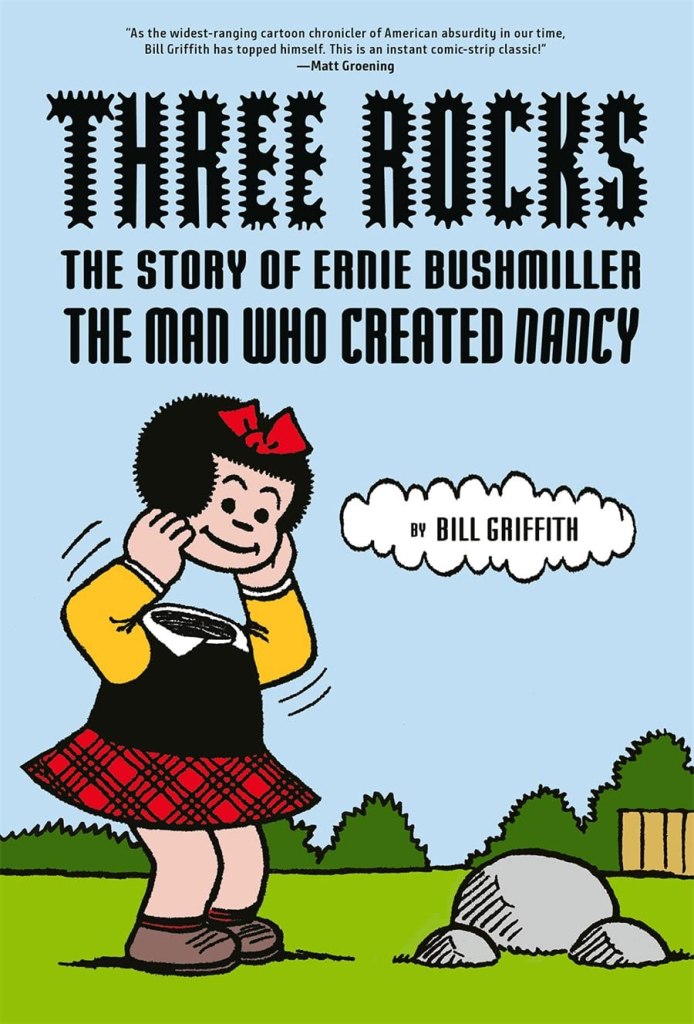

Three Rocks: The Story of Ernie Bushmiller: The Man Who Created Nancy Rick Griffith. The father of Nancy gets the graphic biography he deserves from the pen of famed Zippy creator and founding member of the 60s underground comics movement, Rick Griffith. Beautifully drawn but also insightful not just about Bushmiller but the Nancy strip as well.

Dirty Little Comics: The Complete Collection: A Pictorial History of Tijuana Bibles and Underground Adult Comics of the 1920s – 1950s, ed. Jack Norton. I have already written recently about the importance of so-called “Tijuana Bibles” of the 30s and 40s to comics and cultural history. These underground porn send-ups of comics, film and political figures were a vulgar strain of American social satire that needs to be integrated into any credible pop culture history. This volume puts into a single larger paperback a series of smaller paperback reprints of these pearls of porn. There is a very good range of satirized genres and figures represented here, and it deserves a place in any reprint library.

How the Other Half Laughs: The Comic Sensibility in American Culture, 1895-1920, Jean Lee Cole. In principle, it is great to see more academic attention spent on the comics medium. In practice, too many of these books sink under their own grad school syntax and jargon, servile genuflections to theory and bibliographic bloat. Jean Lee Cole’s book commits every one of these sins, but it is a worthwhile read despite its academic overkill. At heart, she makes a good case for setting the comics and a “comic sensibility” against realist style of literature and art and using that “transgression” as a contribution to our understanding of early modern American culture. Most other cultural treatments of comics simply overlay onto the comics popular theory about consumerist hegemony, and simply use the medium to reiterate what we already know about history. I am sure I am partial to Cole’s book because it aligns with my own sensibilities about the comics as a cultural artifact. They don’t just “reflect” culture. They have to be understood as a part of the conversation that makes a culture, and so they can surface ideas and tensions that aren’t apparent in other parts of historical knowledge.


Rocky and Bullwinkle: The Complete Newspaper Comic Strip Collection Vol. 1 covers 1962-63 and Vol. 2 Al Kilgore had already been porting the Rocky and Bullwinkle TV series to comic books when the McClure syndicate licensed the strip rights. He succeeded in bringing to the daily cadence of the form a faithful extension of the cartoon. Topical references, slapstick espionage, reflexive humor, Cold War shenanigans – they are all here. Dahlinks, get “moose and squirrel!”

Hoo-Hah! Inventions and Machinery Edition. Editors Ron Evry and Bruce Simon are on a two-man crusade to keep the talents of golden age cartoonist J.R. Williams alive. He was best known for this Out Our Way series as well as Born Thirty Years Too Soon, among others. Williams brought to all of them an authenticity based on his own experiences on the road in multiple hard-scrabble careers. This latest volume features Williams’ cartoons based on factory workplace dynamics but also embraces other artists like Rube Goldberg. The theme of the book captures the fetish for gadgetry and mechanics held by many artists in cartooning and animation. Williams is compared to Twain and Rogers for his homespun, low-key humor. Emphasis on low-key. I find him an acquired taste that I haven’t fully developed. But ther eis no doubt he is an essential part of comic strip history.

The George Herriman Library: Krazy & Ignatz 1925-1927 As with Popeye, Fantagraphics revisits a strip yet again. but this time in a larger, more satisfying format than its last big paperback run. Dubbed “The George Herriman Library,” this hardbound series has strong paper and repro qualities. My hope is that the “Library” moniker is promising an even wider project than the Krazy Sundays. Far be it from me to diminish any Herriman reprint anywhere anytime. But this masterpiece is so widely available already, I would find more valuable at this point an earnest attempt to reprint the Krazy dailies in full, at last, some of The Family Upstairs/Dingbats and Stumble Inn. Here’s hoping.
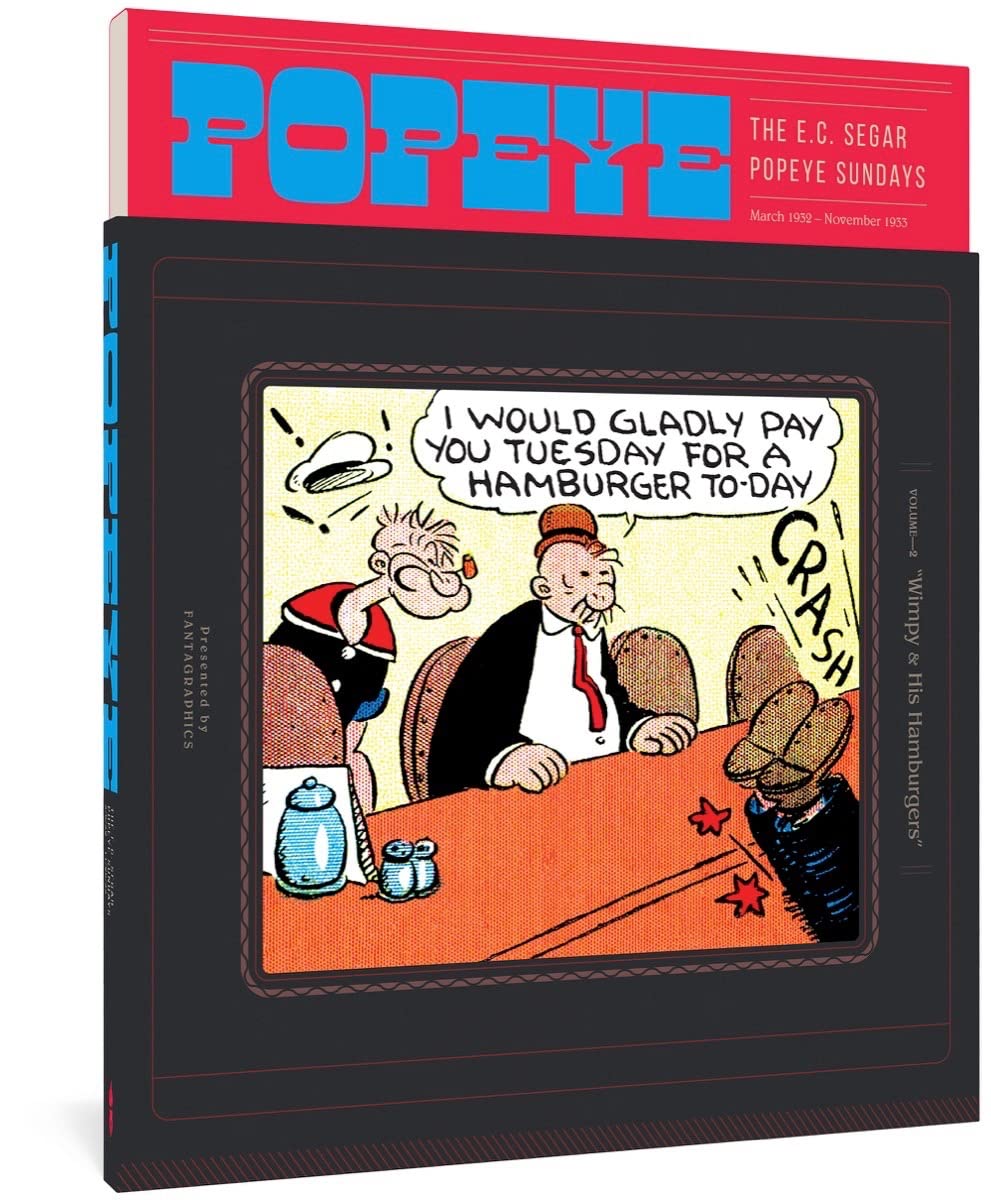
Popeye Volume 2: Wimpy & His Hamburgers (The E. C. Segar Popeye Sundays) After issuing the complete Segar Popeye in pricey, unwieldy editions that are now hard to find, Fantagraphics is trying to make the thirties Thimble Theatre strips more accessible. These boxed paperback reprints of the Sundays are much cheaper and more manageable. We lose the Sappo topper strips from the larger volumes, but retain the Sunday strips at the same size. Personally I find the surrounding box design gimmicky and of no added value. But what are you going to do with a strip that has already been reprinted multiple times by the same publisher?

The Cisco Kid, Volume 6 The Classic Comics Press reprint run of this gorgeously illustrated daily covers late 1961 to early 1964. The scripting by Rod Reed is nominally more sophisticated than the flood of Westerns then in market. But Jose Luis Salinas’s etch-like style seems to put you back into an era of engraving and frontier illustration that is totally absorbing. He is channeling some of Raymond’s pre-war style of feathering, but it is rougher and more nostalgic in this strip. One imagines, Cisco Kid made a welcome contrast to the more photo-realistic style that dominated the rest of the post-WWII adventure strips.
That is it for now. I will be writing about some of the books coming out this season. The highlight I am sure will be the Sunday Press/Fantagraphics’ Dauntless Dames, in which Trina Robbins and Peter Maresca compile some of the pioneering hard-boiled and adventurous women of 1930s-1950s comic strips. If there are other recently published reprints or commentary on the American comic strip or pre-code comics you think I should include, please mention them in the comments and I will try to do a follow up.
UPDATE: The wonderful Dauntless Dames is every bit as good as I expected. My review is up.
Discover more from Panels & Prose
Subscribe to get the latest posts sent to your email.
 Panels & Prose
Calvin and Hobbs is the last great strip.
Pingback: More Holiday ’23 Books for Comics Nerds – Panels & Prose