
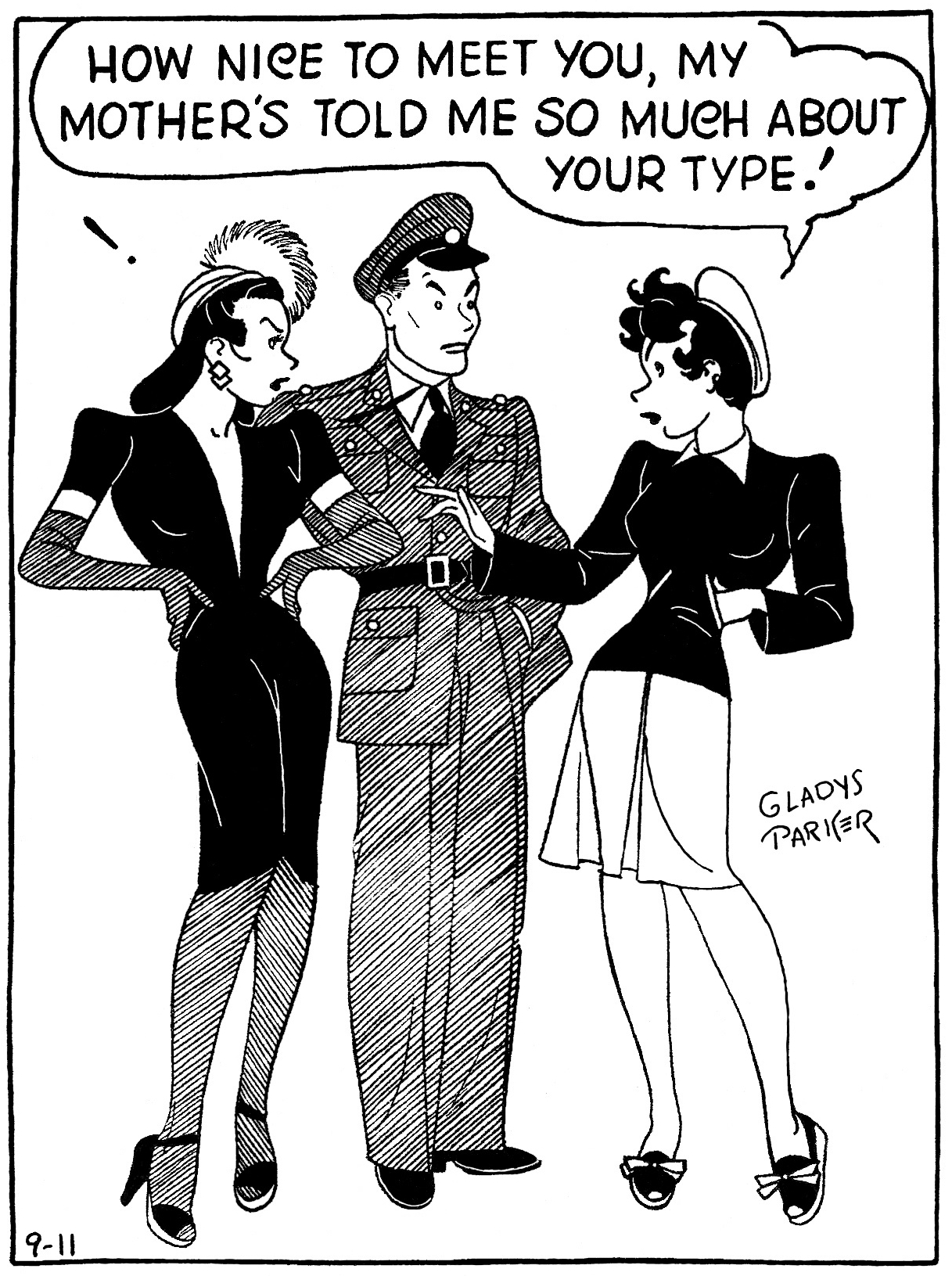
Gladys Parker was among the most recognizable and well-reported cartoonists of the 1930s and 40s. It was hard to miss her. She was the spit-curl image of her avatar Mopsy, the sharp-tongued and stylish star of her own single-panel comic (1937-1966). It is hard to say which came first, Parker’s cartoonish look or Mopsy’s, but they shared the same shock of black curlicues, sharply lined brows and eyes, and a precisely “sticked” set of lips. And since Parker was also a noted, audacious clothes designer, Mopsy was a working girl with a seemingly endless closet of ultra-modern fashions.
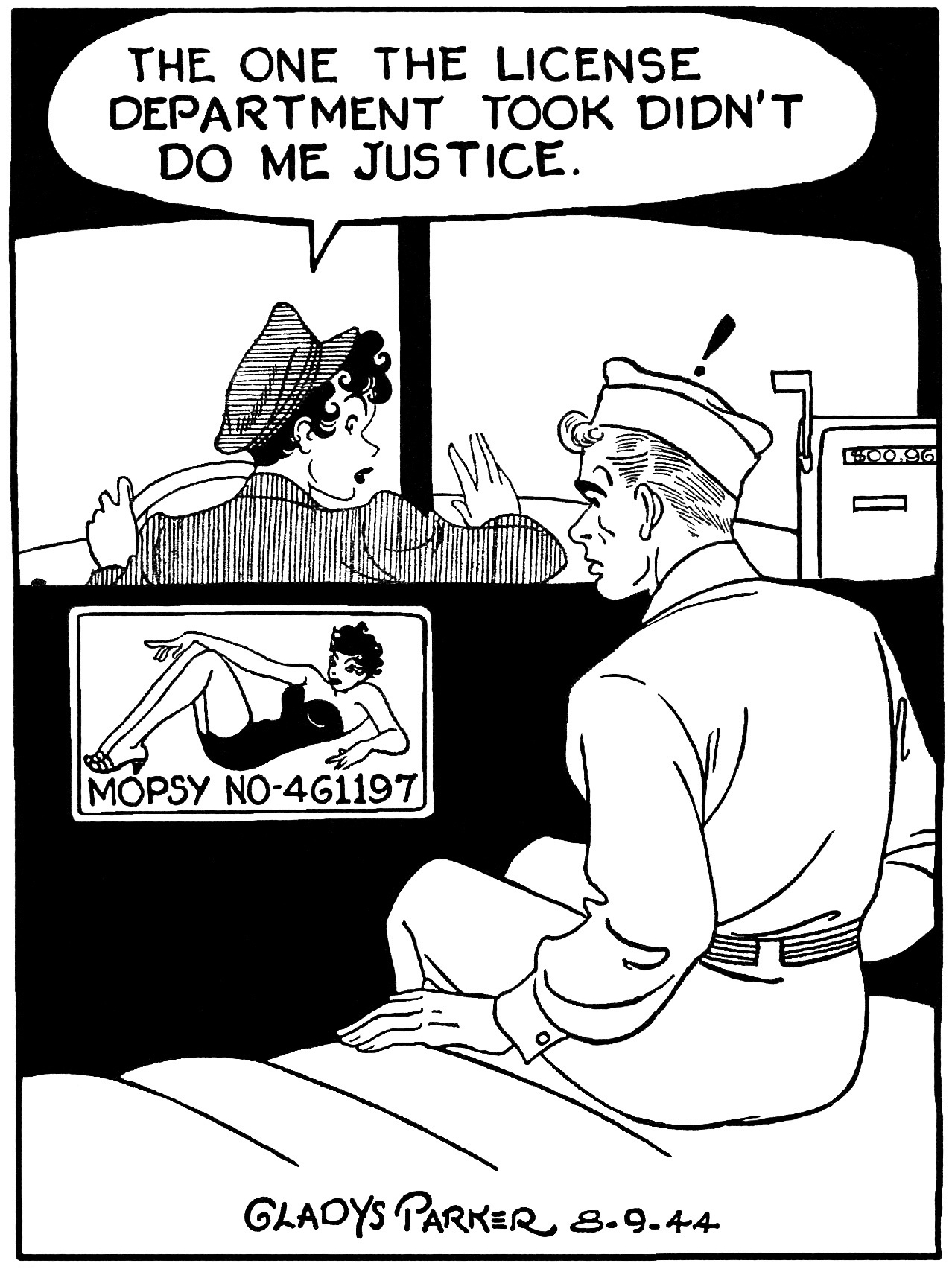
We covered Parker at greater length a while back when a lavishly illustrated biography and reprint finally gave the artist her due. She was a fixture in New York social and fashion circles, frequently appearing in newspaper columns. And her fashion shows drew attention for her wild and daring designs. Jim Davidson’s JD Press gives us the welcome opportunity to revisit Parker with his restored and reissued Mopsy: The Maid Who Makes You Laugh. The original 1945 compilation covered the late WWII years, when the strip looked and sounded its best.
In many ways, Mopsy was the next iteration of the “New Woman” that had evolved through the comics pages since Charles Dana Gibson’s “Gibson Girls” defined post-Victorian femininity at the turn-of-the-century. Fluffy Ruffles was the first breakout working girl heroine of comics in 1907, followed by Nell Brinkley’s adventurous and well-styled “Brinkley Girls” during and after World War I. And then the fun-loving, gold-digging 20s flapper reigned until the Great Depression spoiled the party in the 1930s. Parker was part of that transition, since she succeeded Ethel Hays as Flapper Fanny’s artist in the early 1930s. She credited Rube Goldberg with inspiring her next comic character when he chided the artist for a head of hair that resembled a mop.
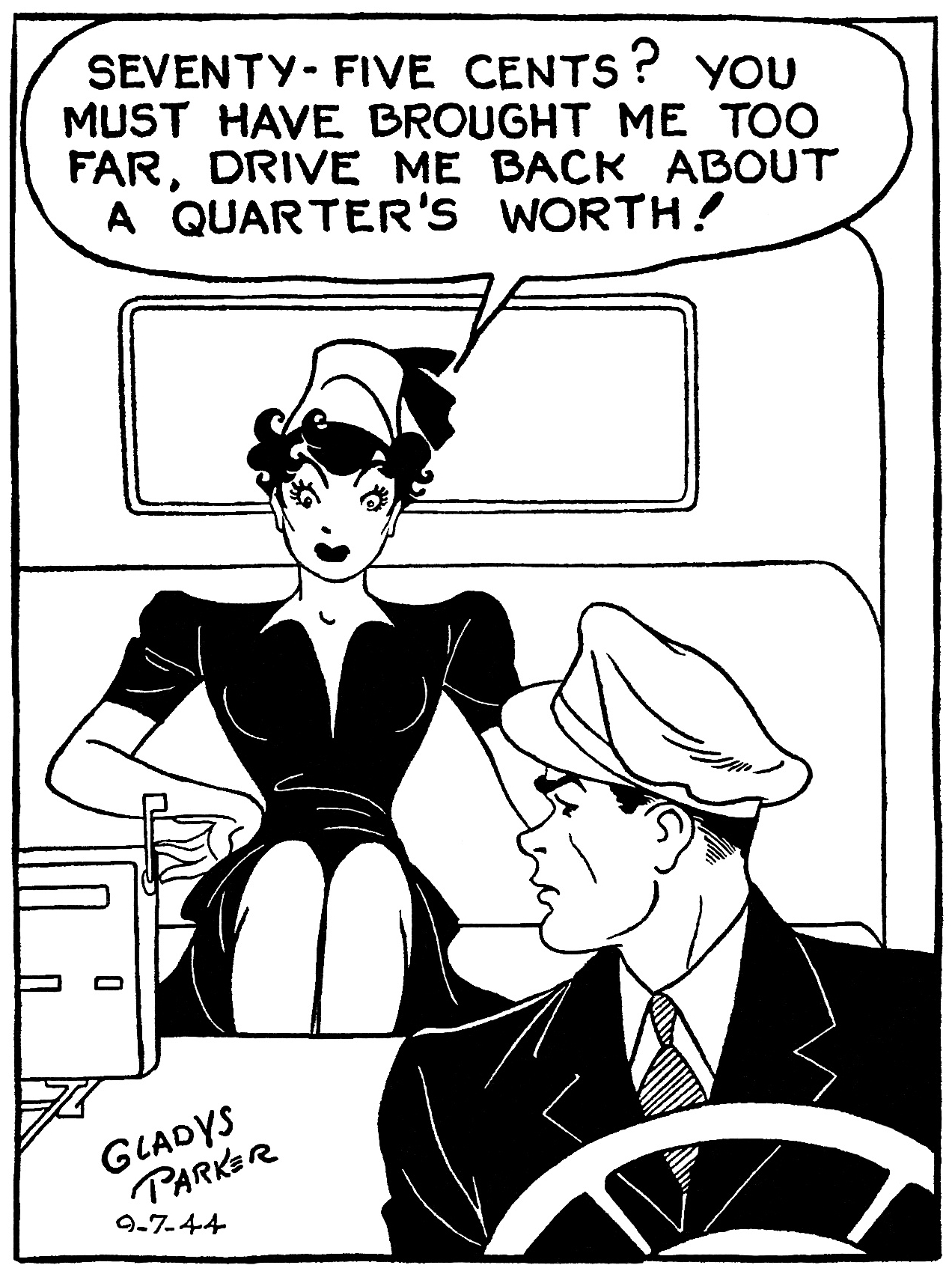
Despite the book’s original title, Mopsy was anything but another wise-cracking “maid.” In fact she was a kind of wry everywoman whose profession and role in life seemed to change daily. She could be a shop clerk one day, a salon assistant the next, or an Army nurse the next. But she had a quip for every station and occasion. “Just bring me a wishbone” she tells a restaurant waiter while eyeing the handsome soldier nearby. “Let’s hurry and get ahead of those two soldiers so they can follow us,” she says to a gal pal. “But this is the same way you taught me to swim, golf and play tennis” she quips at her handsy boyfriend during a ski lesson.
It is all light wise-acre stuff that makes Mopsy at once jaded, sophisticated, air-headed and man-hungry. Which is to say that Parker understood the ways that forceful female characters had to navigate multiple gender stereotypes to be both interesting and non-threatening.
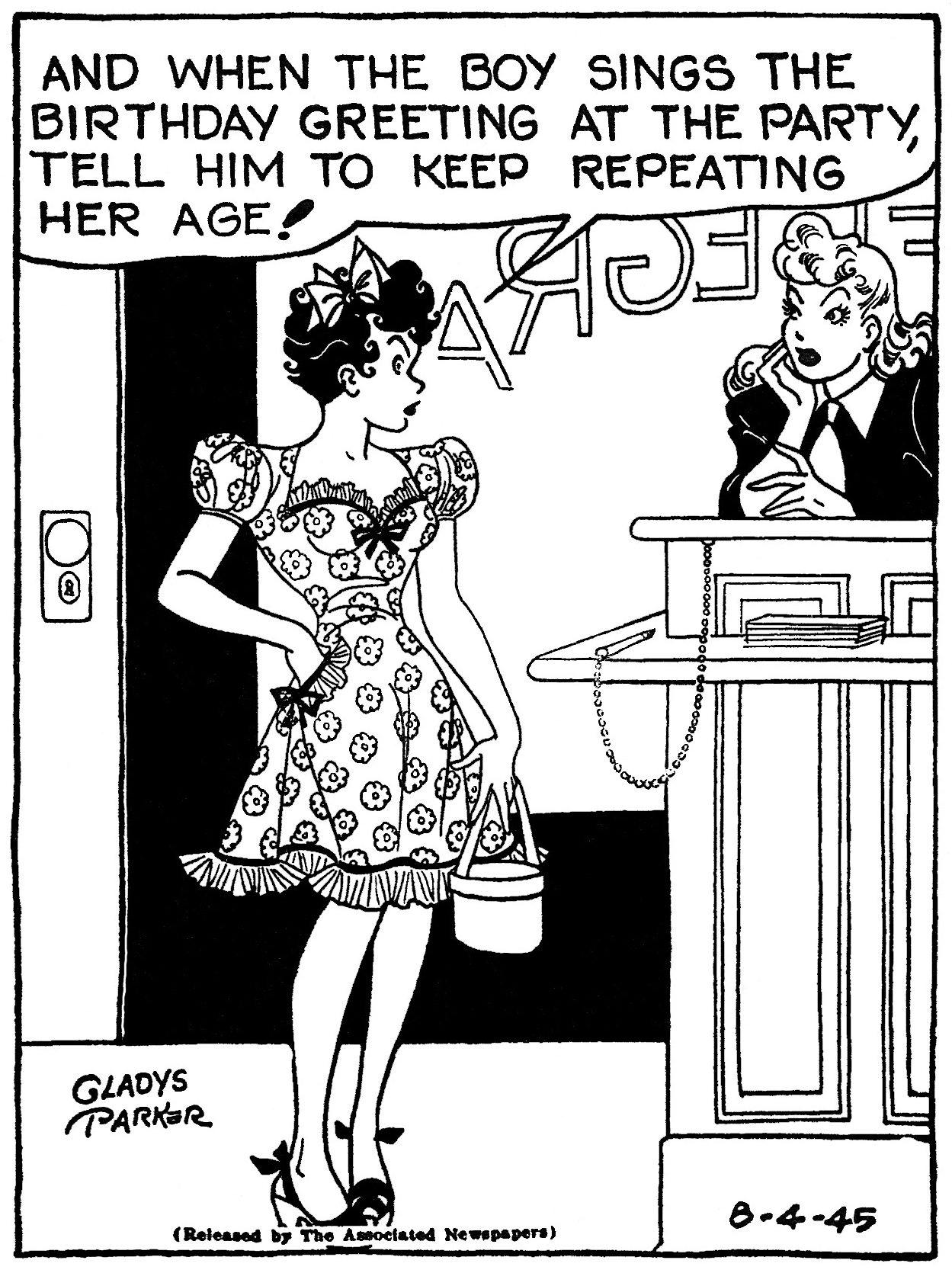
While merely light and cute as humor, Mopsy is a stunner strip to behold. Channeling some of the Deco and streamlining of Machine Age style, Parker has a clean, even line that creates such pristine, evenly weighted bodies and objects. The ever-present feminine calves perfectly express that wartime ideal of solid, sexy, can-do American womanhood. The fashions of both men and women are always eye-catching, elegantly draped, artfully patterned. Parker was a highly imaginative clothes designer, and watching her dress Mopsy and co. is itself a visual treat. She has a symmetrical style of cross-hatching or adding patterns that makes any frock pop from the page. And then there is that signature black “mop” of hair that always centers our view. Those sharply crafted curlicues seem to express an edginess to the lady.
There is nothing sketchy, mussed, uneven or rough in a Parker drawing. The style lives somewhere between illustration and diagram. You spend more time admiring the precision of the art than reading the joke. Mopsy is a testament to the power of the cartoonist’s pen to build visually a comforting, refreshing world that we fall into for a few seconds a day.
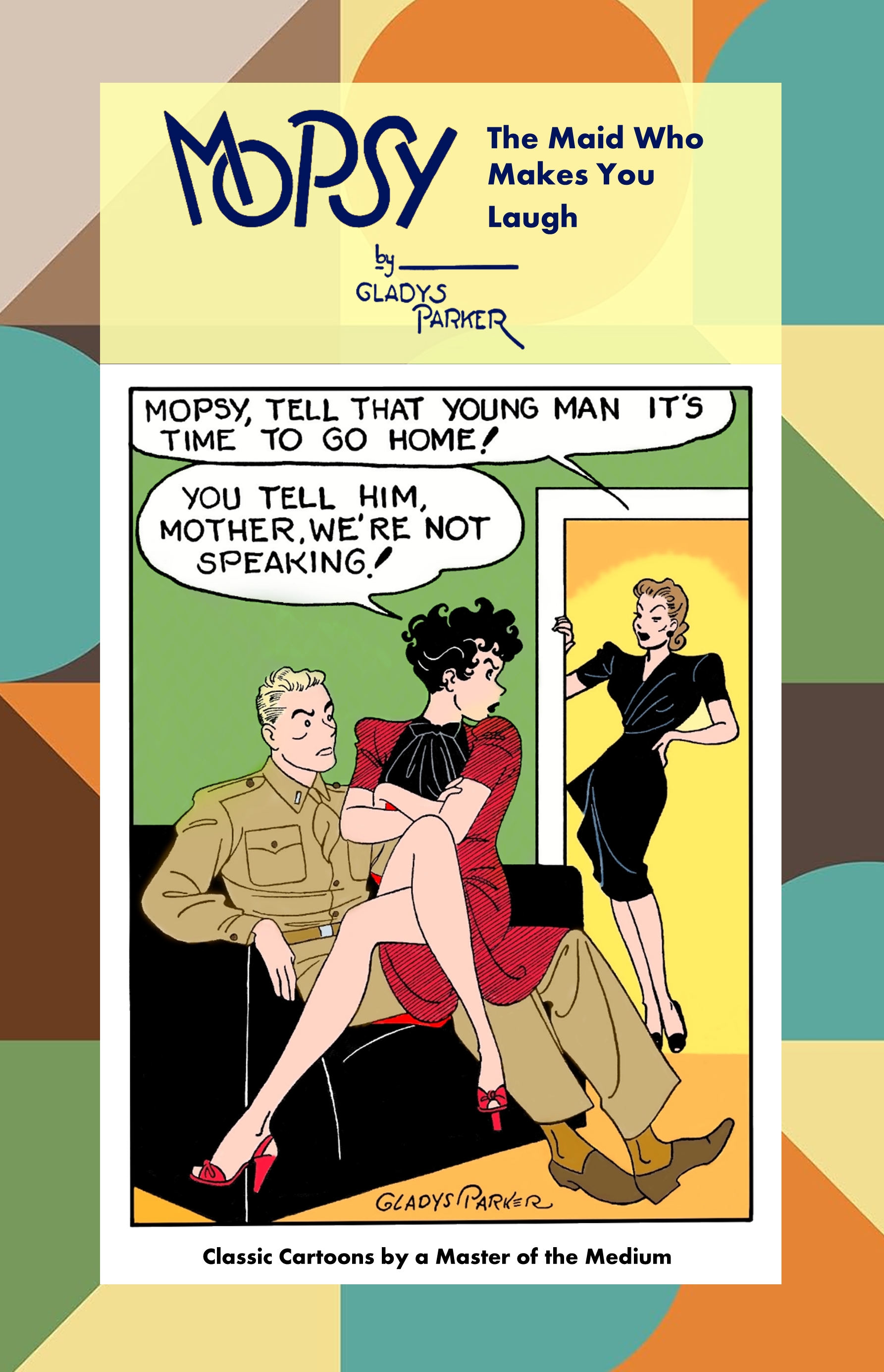
And to Davidson’s credit, the reprint is up to the quality of that art. The book is very cleanly, sharply rendered with the kind of inky blacks and high resolution on crisp white paper that make Mopsy’s precision line work shine. I guess this art looks better here than it did in the original book. Parker would approve. The 102 page, 5.5×8-inch paperback is a bargain at $9.99 from the Lulu books-on-demand platform.
Discover more from Panels & Prose
Subscribe to get the latest posts sent to your email.
 Panels & Prose