Gray Goes Dark: Survival of the Fightingest

By 1937, Harold Gray seemed to have fallen into an especially foul mood. It was several years into his nemesis F.D.R.’s “New Deal,” which Gray felt represented everything he and his “Little Orphan Annie” disdained: social uplift, misguided do-gooders, institutional authority. From the start, Gray was never shy about voicing his populist perspectives and what he saw as core agrarian values of self-reliance, individualism, and deep suspicion of government bureaucracy of all sorts. His chief scholar, Jeet Heer, has done a much better job than I can here outlining Gray’s vein of Populism and how it ran much deeper than knee-jerk reactionary conservatism. And I have argued in these posts how Gray’s cultural politics were grounded in familiar mid-western traditions and a tension between 19th Century values of “character” and 20th Century notions of “personality. But it is clear that in response to FDR and the popularity of the New Deal Gray got more radical and vocal about his views. And perhaps not coincidentally, the strip grew even darker in the later 1930s.

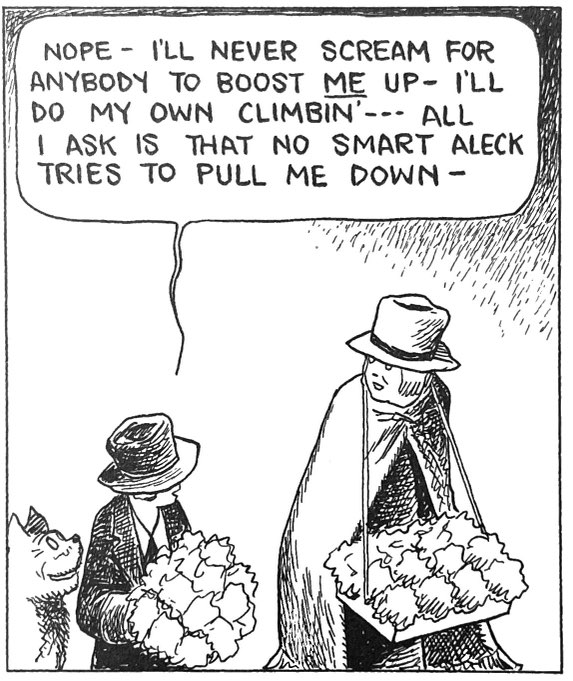
As Here argues in the introduction of the 7th volume of the Library of American Comics reprint series, Annie was always a gritty, street-smart tale, but Gray usually kept physical violence off-panel. Yet, as the strip approached its creative height in 1936-38, that violence started moving into frame. Heer argues that Gray likely was responding to world conflicts, a greater personal sense of mortality as well as competition from more action-oriented strips that dominated the 1930s. I think Gray may also just have been growing angrier and more resentful towards a culture from which he felt ever more alienated. Gray’s moral vision was always as as simple and plainspoken as his drawing style – venal villainy countered by saccharine sentimentality. But it is clear, Gray was getting darker and seeing the world in starker ways by 1936. In fact the lead-up to one of the most jarring bits of in-panel violence in Little Orphan Annie begins with a remarkable Sunday strip on Oct. 8, 1936 that maps the modern world as a perennial “jungle” of predators and good-hearted strivers. As Annie’s newfound friend and flower-seller Ginger, reflects, “But the rules are still jungle – the survival of the fightingest.”

In the coming weeks, Gray uses Ginger as his populist mouthpiece. Annie had always been a chatty strip to begin with, but in these months the moral bromides, punditry and snide asides crowded most panels. Gray clearly had a lot to get off of his chest…about the corruption of politicians and lawyers and their collusion with thugs…about the mixed motives of “uplifters”…about the productivity and generosity of earned wealth…the moral hazard of handouts and unearned wealth. Gray was not a simplistic or sentimental reactionary. He had relatively progressive racial views. And as he outlined through Ginger in these months, his sense of individualism was a principled rejection of the sociological generalizations he saw driving a lot of reformist uplift and welfare. His populist sociology rejects environment as determinative of behavior.
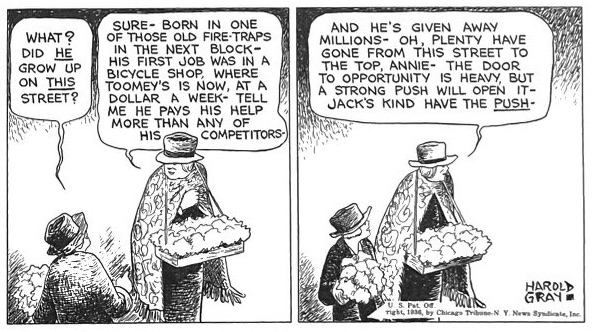
No one ever accused Harold Gray of subtlety. Annie was as much folk punditry as it was an adventure. But he was artful, albeit dogged, in creating opportunities for his avatars to voice another homily. A street fight triggers bromides on rising out of the “hard kindergarten” of the streets. Passersby making an offhanded comment on these city kids not getting a chance in life set up Ginger’s counter-argument about the dangers of unearned advantage. Meeting an old friend lets her reflect on the morality and generosity of earned wealth. And all of this in just three strips.

Gray’s wordiness can divert us from his considerable and evocative graphic skills. He visualizes his principles and arguments that are as clear and un-subtle as his ideology. The street scenes in the Oct. 26 strip above illustrate the teeming diversity, the danger, raw violence of the city as well as the individuality of the humanity he sees there. That third panel depicting the “rushing tide of life” expresses at once a suffocating crowdedness and individuation.

Gray’s visual voice was singular and somehow it succeeded in establishing his mixed view of humanity, society and the cosmos. His laudable human figures were usually solid, husky and well-planted. Annie herself has tree trunk legs that look and feel organically rooted in much the way his friend Chester Gould like to plant Dick Tracy in the frame. It is the visual embodiment of self-reliance and resilience. The infamous hollow eyes of Gray’s cast underscore how little he and many other daily cartoonists relied less on facial expression and more on words, composition and action in a frame to express feeling. Much like Frank King and Gasoline Alley, Annie visualized the plain spoken style of its creator.

While they were very different artists, to be sure, Gould, King and Gray had visual voices that helped define the worlds we were in for those three or four daily frames. That to me is one of the comic strips’ singular aesthetic qualities, to establish diverse and distinct fictional worlds through these signature styles. For Gray it took the shape of bulky, pillowy figures that lived in a 2D world of little forced perspective or even movement. Gray’s characteristic hatch work helped communicate a grimness to his worldview – the persistence of shadows. Arguably, he did not have the stylistic talent or range of many peers. King had a great sense of panel pacing and rhythm, a feel for place and landscapes, he used relentlessly. Gould leaned heavily on his penchant for muscular action, grotesque violence, forced perspective and those vast planes of inky blacks.

Gray flexed his style sparingly. But he was capable of great visual power. In the run up to the tragic violent death of flower lade Ginger, we get this gorgeous showcase of crosshatched planes, light-source, and cross-cut pace that feels like German Expressionist film.
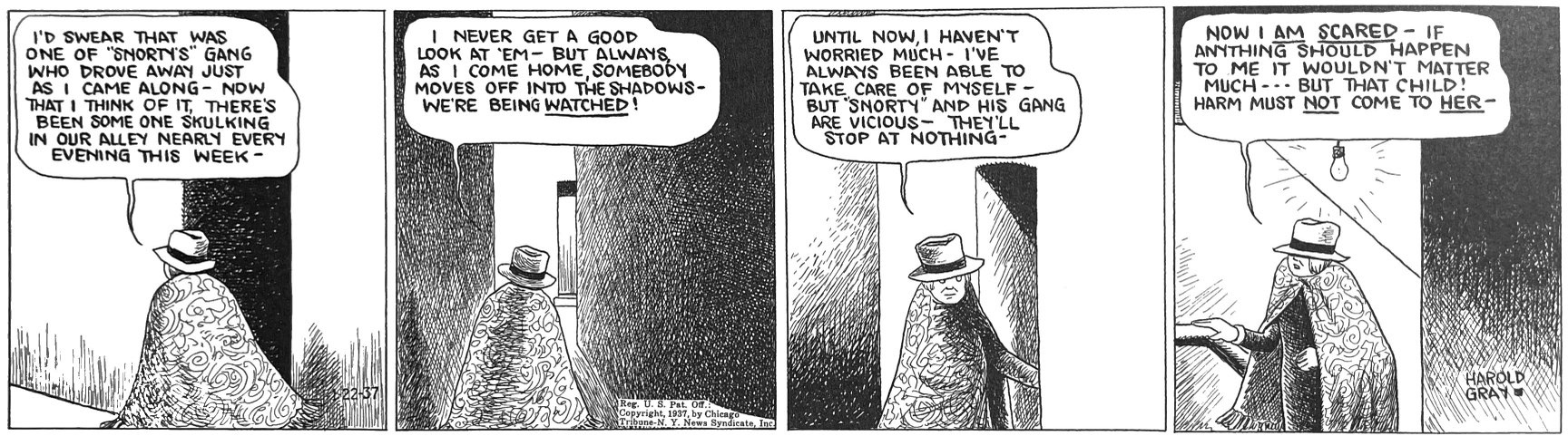
The local gang of hoods target Ginger because she refuses to pay into their protection racket. Her graphic murder that comes days after the foreboding strip above is a rare instance of a Gray panel exploding in explicit violence.

It is probably best that Gray depicted violence so sparingly. He wasn’t very good at it. But this moment is of a piece with the months of the strip’s immersion in the modern city and its many musings on the modern “jungle.” And it embodied the emotional energy, perhaps even the anger and pessimism that seemed to drive what many comics historians regard as his creative peak in the storylines and characters in the last half of the 1930s.
Pogo Bids Adieu To A Swamp Buddy

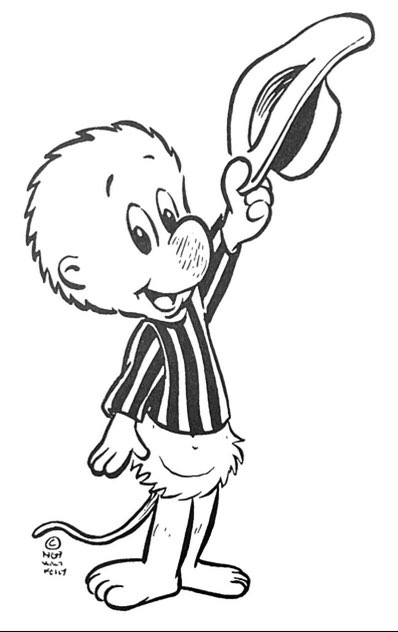
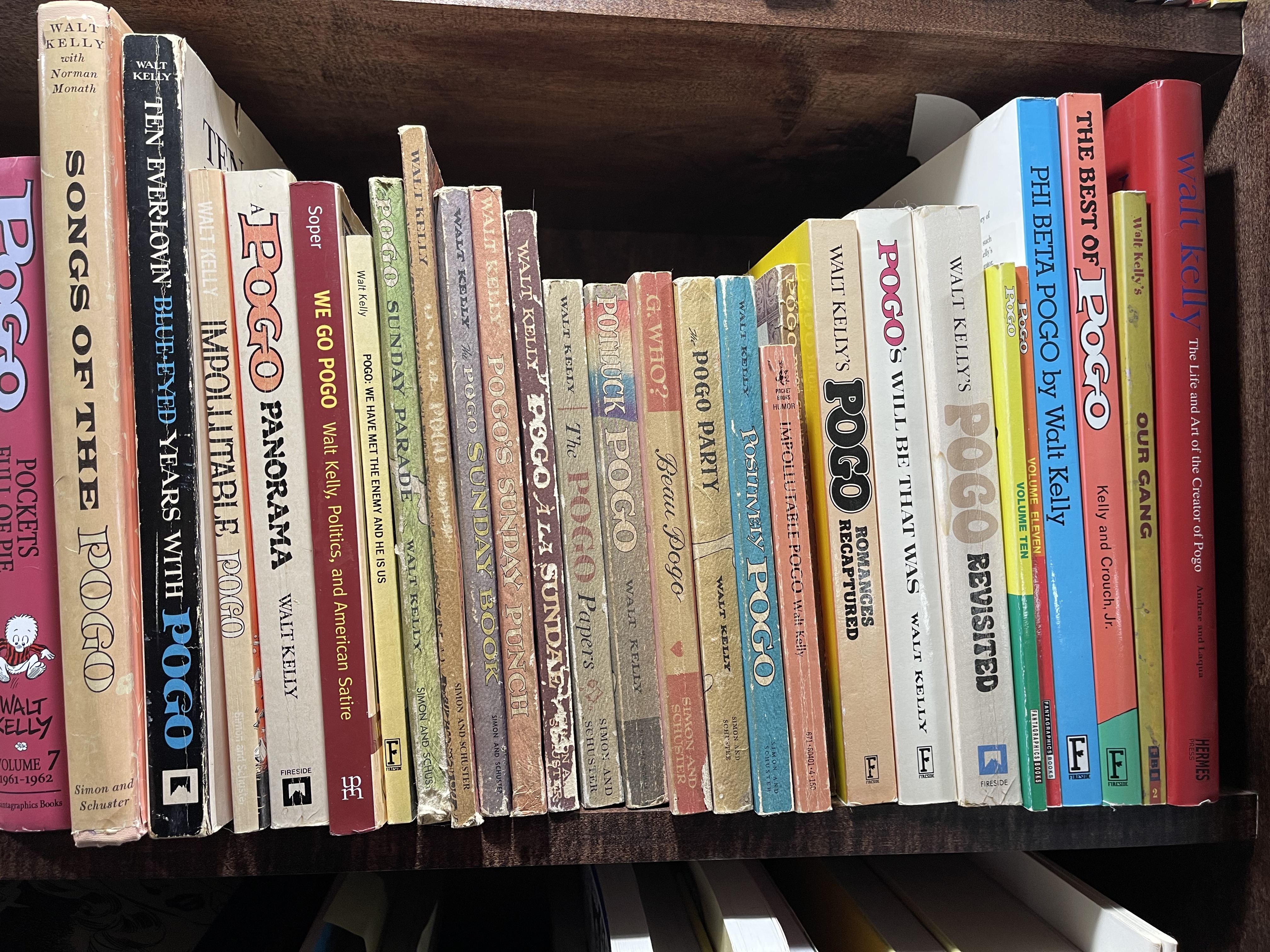
One of Pogo Possum’s best swamp buddies, Robert Yarrington, my friend and father-in-law, passed this weekend. Bob had been reading Walt Kelly’s masterpiece in all its comic book and strip forms from the time “Pogo and Albert” first appeared in Dell comics years before that small world was revived and expanded as the Pogo strip in 1948. He amassed a small library of the familiar old Pogo reprints over the years that he bequeathed to me when his grew unable to enjoy them, and we both worked through the recent Fantagraphics complete reprint together. Bob’s steel trap memory for the books and comic strips he read even decades ago always left me aghast and humbled. I barely recall characters and endings I read last week let alone when I was 20. One of my joys over the last decade has been bringing Bob new reprints of Pogo, Little Orphan Annie, Prince Valiant (one of his particular faves) and some of the pulps he loved like Erle Stanley Garner’s A.A. Fair series. His eyes widened as his memory kicked in and I knew he was about to recite some piece of minutiae from a strip or potboiler he had read six decades ago. It was a treat to see someone who lived and relished pop culture so deeply. Comics helped him learn to read, and he repaid the favor with lifetime devotion to the medium.

Bob’s Pogo collection remains enshrined on its own shelf in the Panels and Prose Library.

Here are just a few Pogo passages to remember Bob I think he would like.

Bob was especially fond of the Pogo songbook and Kelly’s artfully fractured versions of familiar standards. The joke at the core of “Deck Us All With Boston Charlie” is that none of us remembers the full lyrics to Christmas Carols. Kelly’s crew, however, have trouble remembering their own wrong version of the song. And so in Okefenokee Swamp, during every year’s run-up to Christmas, Kelly comes at the same joke in different ways.

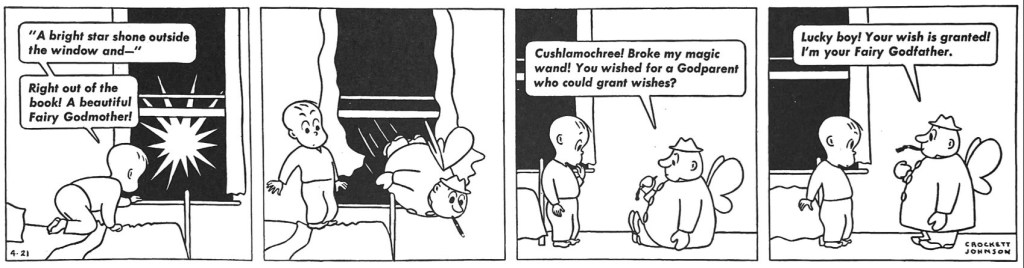
Bob had excellent taste in comics. He was thrilled that Fantagraphics was reprinting one of his youthful favorites, Crockett Johnson’s Barnaby. Starting in 1942, this wild tale of a boy, Barnaby, and his cagey, cigar-smoking, scallawag Fairy Godfather Mr. O’Malley is a singular American classic Bob pushed me to appreciate. I didn’t warm to it immediately but have come to appreciate this wry take on parenting, childhood and modern American life.

In his last days with us, and after he could enjoy the stream of volumes we sent him from the Library, he did enjoy the company of our English Setter Nicky, who is a bit of a cartoon himself.

Panel Premiere: From Old Doc Yak to Jawless Gump

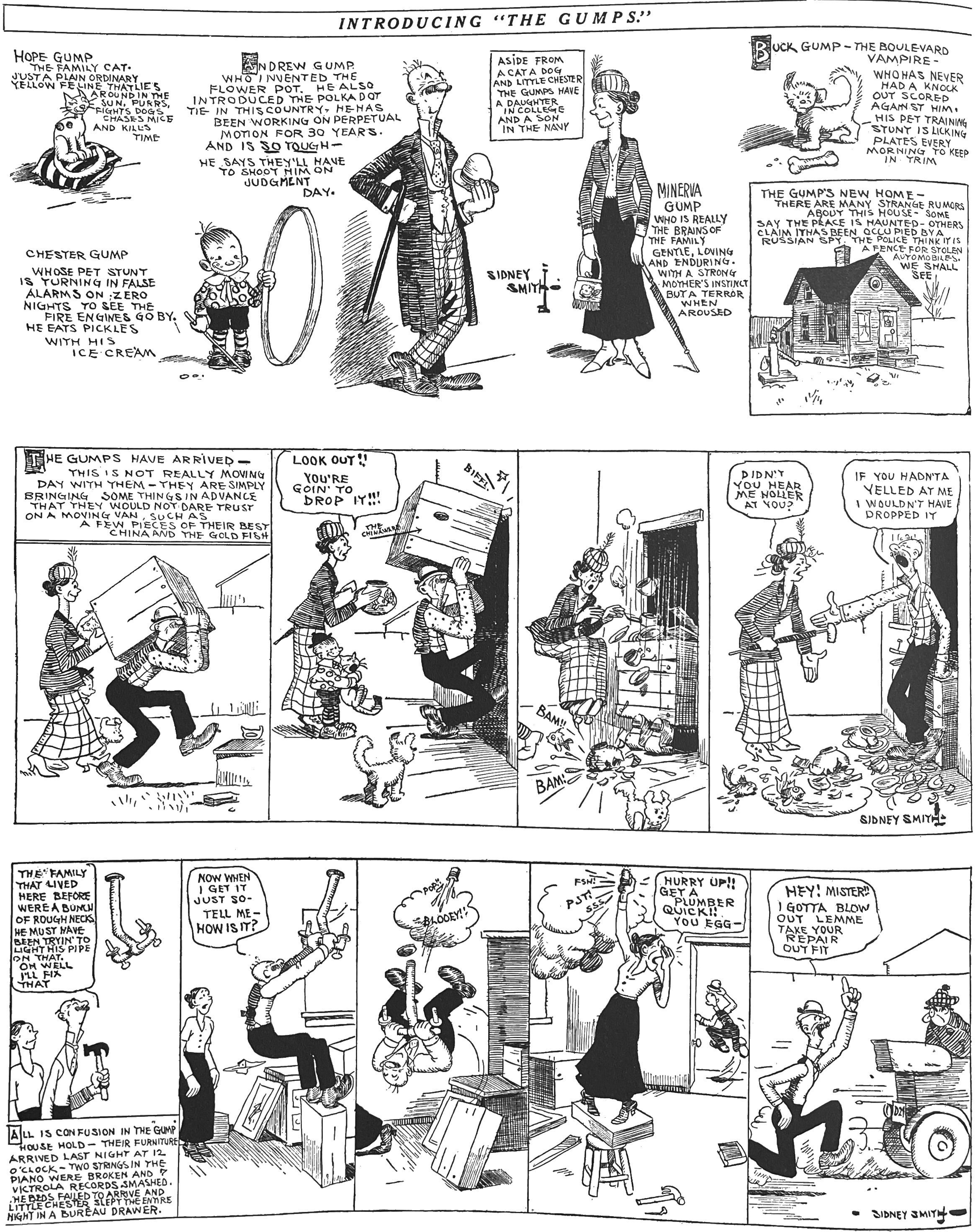
One of the singular comic strip launches must be the artful transition from Sidney Smith’s relatively short-lived (1912-1917) Old Doc Yak to one of the great runs of inter-war family strips, The Gumps (1917-1959). Doc Yak was a goat and centerpiece of an early sitcom daily. Smith ended the Yak run to start his Gumps series by literally evicting his hard-luck goat from the premises. In the early days of 1917, Yak’s landlord threatens to toss his deadbeat tenant unless he pays up. Failing to raise the back rent, Yak takes a powder, leaving the landlord with a taunting note (never likes the place anyway) and an empty property. In the final panel of Feb. 10, 1917, the landlord announces that new tenants will be moving into the property and the strip on Monday.

And on that following Monday, indeed, the eerily jawless Andy Gump and the Gump clan are introduced. The strip was quite literally vacated by one character and occupied by a new one. in fact, in the closing day of the Yak series Smith tells the reader “Doc has but one day left to raise the rent or be thrown off this page.”

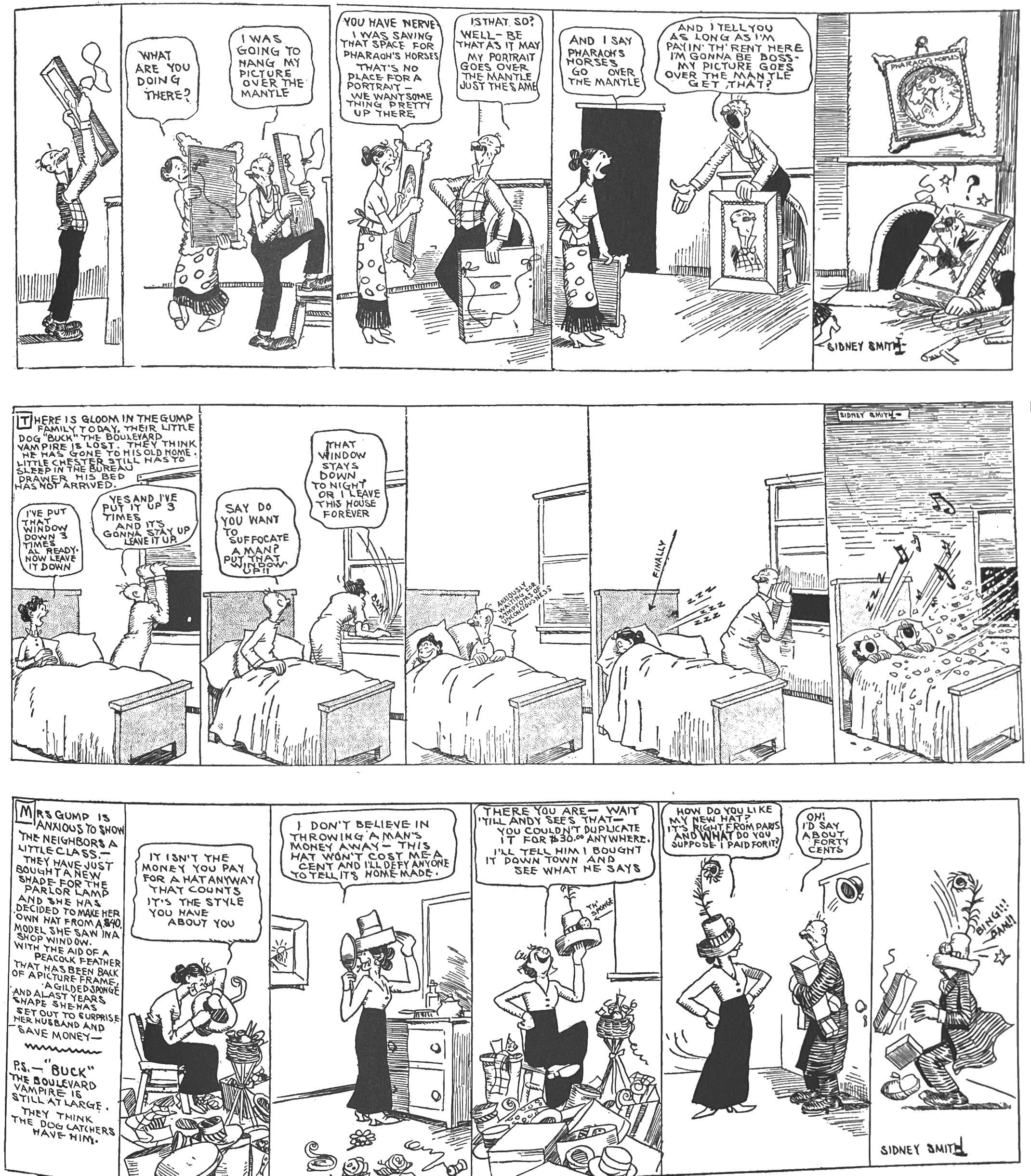
Andy Gump himself would go on to become one of the most recognizable and seminal sitcom dads in the early decades of century. The besieged and aggrieved comic father figure had been foreshadowed already in the Dingbat Family, Bringing Up Father and Smith’s own Old Doc Yak. But Andy helped crystallize and propel the sitcom formula. Overconfident of his knowledge, skills and savvy, Andy was the kind of oafish but ineffectual blowhard that would become the bedrock of radio and TV family comedy for, well, forever. His patient wife Min is understood as the quiet “brains of the family” as well as its heart. Life of Riley, The Honeymooners, The Jeffersons (and pick any 2000s famcom) rode the same formula. Which is to say that America has been laughing about the middle and working class father figure pretty much since they were invented. But the formula really seems to have taken shape in the comic strips of the 10s and 20s.

Alley Oop: Off To A Flying Start

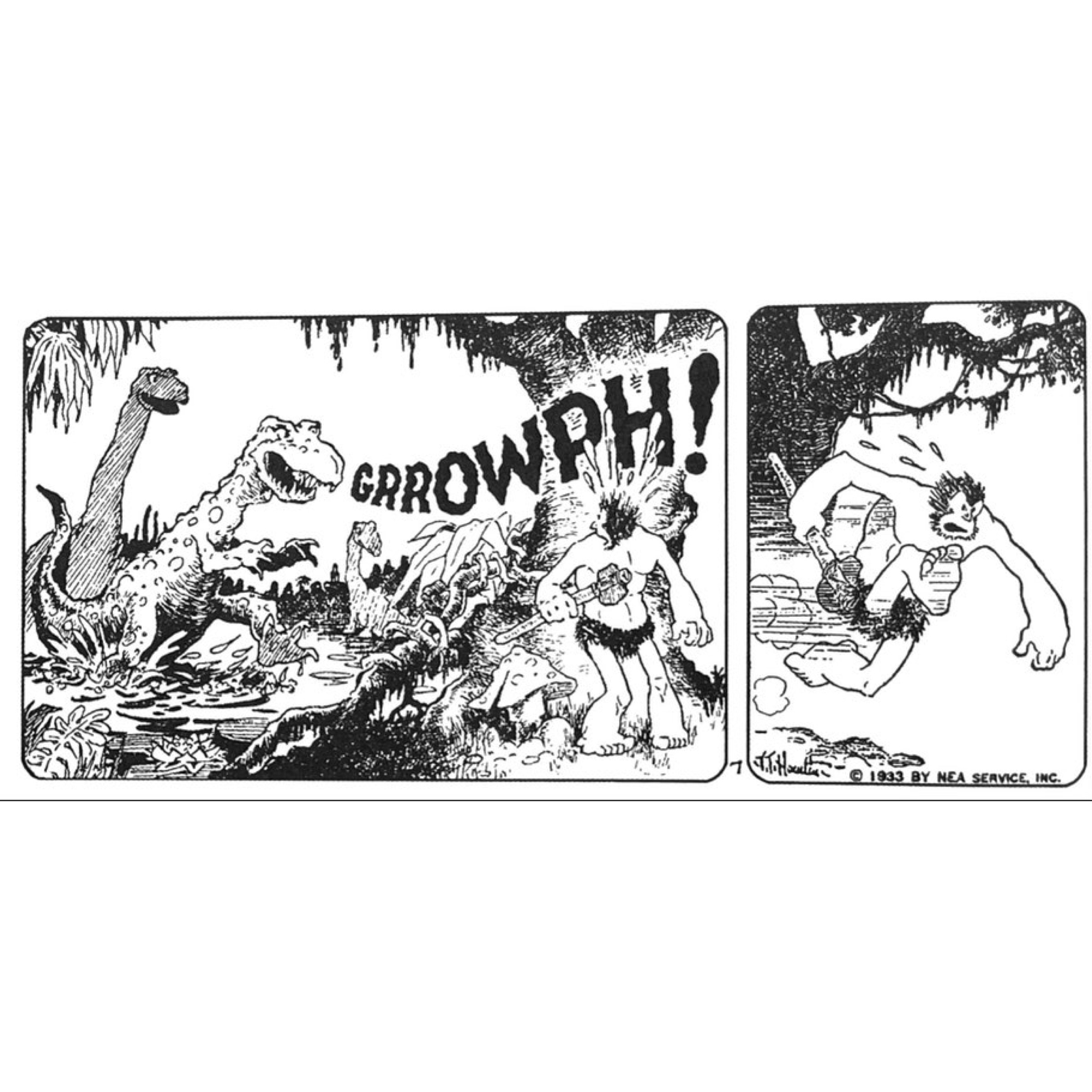
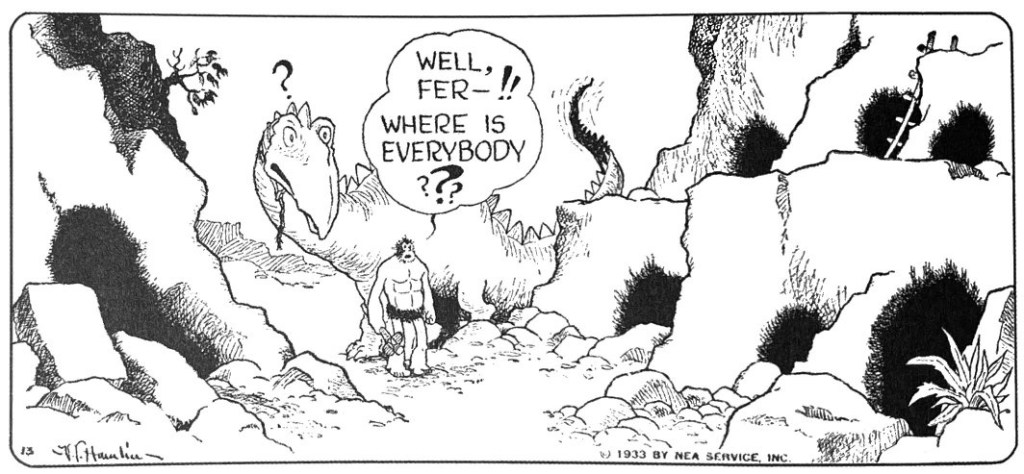
“Off to a Flying Start” is how V.T. Hamlin titled his introduction to the Alley Oop character and world in late 1932. And in fact Hamlin’s eponymous hero cries for help in the opening panel…only to be chased by the prehistoric dinosaurs of this fantastic “Bone Age.” For the next six or seven years, Hamlin’s art and story were at their best when his furry-crowned, thick-limbed everyman scurried at the center of screwball mayhem. We now have a great opportunity to review and reconsider Alley, as the small press Acoustic Learning recently launched reprint series of both Hamlin’s early adventures and later work by his successor Dave Graue.

My first impression diving into Alley Oop is Hamlin’s strong feel for set, background and character design Hamlin had from the beginning. Unlike Segar’s Thimble Theatre, Capp’s L’il Abner and certainly Gould’s Dick Tracy, Alley Oop doesn’t begin in a crude style that only finds its signature style over months and years. Hamlin goes into Alley Oop knowing he wanted to contrast fine-lined, simple but polished characters with detailed and accurate scenery and dinosaurs. Hamlin had a cultivated curiosity about prehistoric creatures in one of his many jobs as an illustrator in the Texas oil industry. He well knew the historical fantasty at the center of Alley Oop. The age of dinosaurs long preceded any human ancestors. But he was dedicated to drawing, naming and animating his Bone Age dinos as accurately as he could.

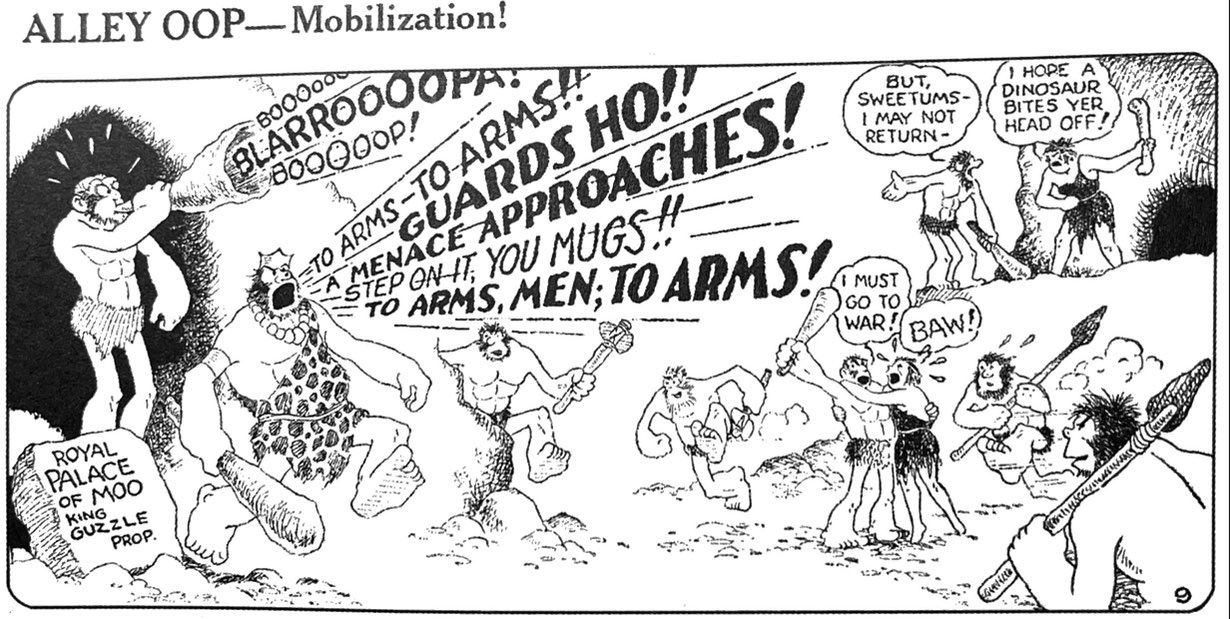
By contrast, his cast of cartoon humans, the males at least, are carefully built with a bit of the era’s deco minimalism. Oop, his rhyming buddy Foozy, Guz, the King of the Moos and the tribes of cave men are small of head, with enviable four-pack abs, and forearms and calves shaped like bowling pins. He builds his characters in order to animate them. Those bottom-heavy limbs become wonderful devices when fleeing, fighting or rioting. The action poses, freeze-frames of punches thrown and received, crowds of cave men imploding or exploding, all have an expressiveness that sits between cartoon abstraction and naturalism. This fine-lined, controlled art style is served very well in this reprint. The strips fully render Hamlin’s thin line shading of background flora and the dinosaurs.

Alley Oop is also one of those rare strips, along with Walt Kelly’s later Pogo, that renders the words as part of the art. From the strip’s first panel, Hamlin shows his distinct deco styling for characters shouting. They move from small to larger type sizes, megaphone-like, into the air. And Hamlin plays with bolding, differing type styles and sizes, words moving in and out of word baloons, to express tones, crowd murmerings, sound effects. In some ways he was bringing to his comic strip layers that mimiced the early days of the talking motion picture, still in its infancy when Oop appears in 1932/33.

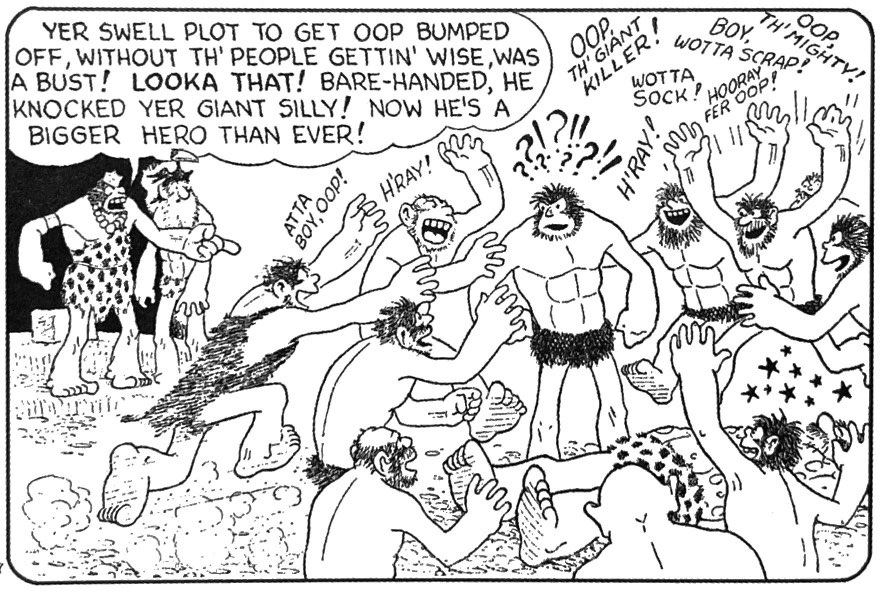
And much like Segar’s approach to Popeye, even Gray’s Annie, Hamlin brings a populist sensibility to the strip. Conventional wisdom suggests that Alley Oop becomes more interesting and a genuine adventure strip in 1939 when he introduced a time travel device that brought Oop and girlfireind Ooola across major historical ages. But from the start, Oop is an everyman hero, good of heart, who is less of an adventurer than a victim of circumstance. He quickly becomes the unintentional antagonist to King Guz, the insecure and thin-skinned leader of the Moos. Guz envies Oop’s popularity when the cave man returns to the tribe astride his tamed pet dinosaur Dinny. Guz’s machinations to retain prestige and diminish Oop is the driving force of the strip’s first year. Oop fits neatly within the pantheon of Depression-era common many heroes. Prohibition, which didn’t end until the December 1933, and a deepening Depression had already undermined public trust in institutional authority, the purity and wisdom of legal and political institutions. Popular culture registered a generalized distaste for authority in everything from the romanticization of gangsters in the press to images of kings, politicians, policemen and bosses as either hapless or imperious. We usually come upon common men like Popeye, Tom Joad, Micky Mouse and Mr. Oop just trying to go about their business, only to become heroic in the face of the moral duplicity (or just stupidity).

As simple and familiar as these everyman heroes may seem, the idea of the inherently moral, simple and unpretentious “nature’s nobleman” runs deep and long in American culture, extending back to the tales of James Fennimore Cooper’s frontier hero Natty Bumppo and Jacksonian politics of the 1840s. American popular literature is filled with examples of the naturally ethical, American individualist asserting basic common sense and morality against both little human and big insitutional corruptions. Cast as he may be in the Bone Age, Oop was certainly in that tradition, one that had special valence to Depression-Era.

Premiere Panel: Who’s That Stowaway?

October 2, 1955 saw the first Sunday entry for a strip that had been running all week from the Chicago Tribune syndicate. Written by Gus Edson, who also had taken over legendary strip The Gumps, and drawn by former comic book cover artist Irwin Haden, Dondi follows the adventures of of a refugee orphaned by WWII.

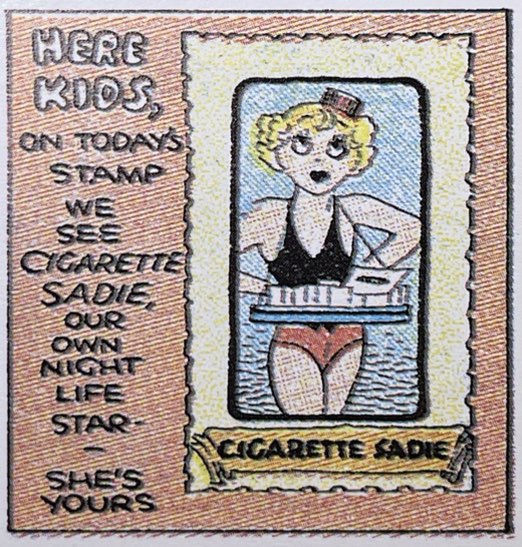
Who Is Cigarette Sadie?

This wise-cracking cigarette girl, seemingly working in an underground speakeasy was an odd “topper” strip for this wildly popular strip. The signature on the fourth panel is the giveaway, of course.

Cigarette Sadie was the filler strip for the Sunday Dick Tracy episodes. Considering the the straight-laced righteousness of Tracy, this was a bit of a counterpoint to the strip’s buttoned-down sensibility. adie is the featured collectable “stamp” in this edition, but in other weeks the collectible usually involved a character from the Tracy strip.

Notable Books on Comics, 2021…ish (Part 2)

What made me think harder or differently about the comics medium in the last year or so? That is my main criterion for these occasional roundups of books mainly on comic strips but also about early comics. Some of the titles here are filling in holes in our understanding about the history of the comics forms. Others are calling attention to artists or patterns in comics history that I think bear more thought. And many were just plain fun. Feel free to comment on the books you found most enlightening or entertaining about the comics history.

The Metaphysics (Huh?) of Alex Raymond’s Death

Dave Sim’s (with an assist by Carson Grubaugh) The Strange Death of Alex Raymond (Living the Line) is crazy like a fox. Sim’s ostensible exploration of the tragic death of the highly influential artist behind Flash Gordon and Rip Kirby uses a batshit conceit that some “metaphysics of comics” somehow connects everything from Margaret “Gone With the Wind” Mitchell, Milt Caniff’s quiet envy of Raymond, the wives and lovers of multiple comics artists of the 50s, a few B-movies, and whatever the hell else you can imagine to car crash that killed Raymond in 1956. It is also batshit brilliant. It gives Sim the frame in which to recall (and even redraw) a vast swathe of American pop culture and artists that drove the changing styles of 1950s comic strips. At its most lucid, the book delineates the different realisms of Hal Foster, Caniff and Raymond, the development of the photorealistic style, even the nuts ad bolts of brush and pen work. Along the way, forced me to contextualize and appreciate strips like Big Ben Bolt, Twin Earths, and the post-Raymond Kirby years. He brilliantly injects a whining Charlie Brown into the history as Schulz’s aesthetic counterforce to the short-lived photo-realist era of American comics. An he forces us to think harder about the rise and fall of different comics styles. As others like Jerry Robinson and Scott McCloud before Sim have shown, there is nothing like a fellow craftsman dissecting his colleague’s work to deepen a viewer’s appreciation of the artistry and decisions that go into those four panels on any given day. Whether you can track Sim’s idea of metaphysics connecting all of these shards and rabbit holes is beside the point. It sets him up for some deft and truly illuminating rumination on the aesthetics of comics in their historic context.

EC At Scale

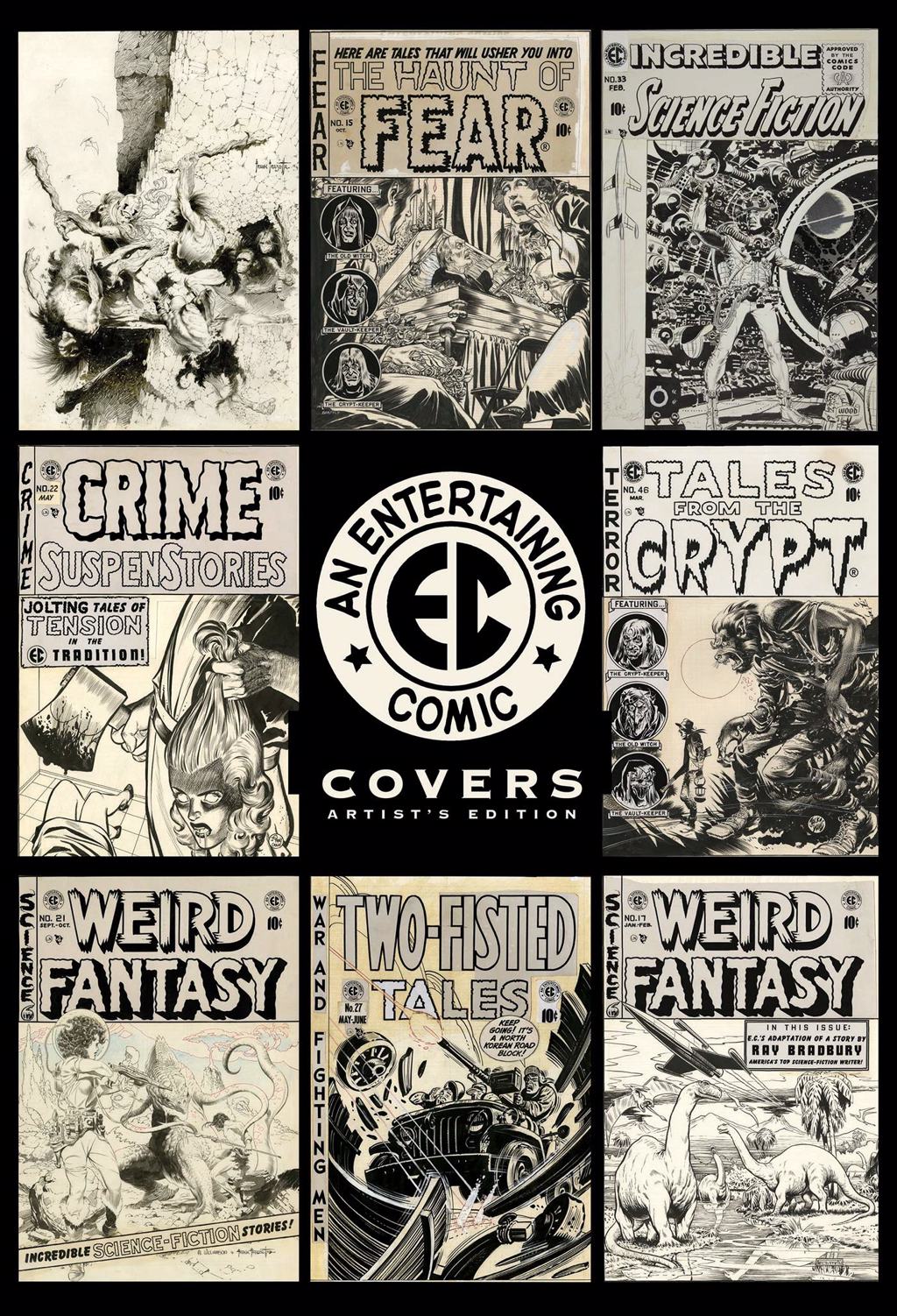
I am almost embarrassed to admit how many of IDW’s massive and pricey Artist’s Editions I own. How does one justify parting with $150 for each, even though they reprint in full detail and at original scale the actual final art from some of the great craftsmen in the field? And yet I never regretted investing in Artist’s Editions of early MAD issues, Will Eisner’s The Spirit, and the EC stories of Graham Ingels. This way-oversized scale and hi-def color images of black and white line art and marginal proofing notes seem to put you on the other end of the artists’ pens and brushes. This is even more true of the EC Covers Artists Editiion (IDW), which organizes the cover art of the famed EC comics stable by artist: Johnny Craig, Graham Ingels, Wally Wood, Harvey Kurtzman, Jack Davis and more. The covers of course were meant to be expansive, immersive teases of issue content, and so we get a single image splashed across the 15X22 page. Every bit of detail feels more like a deliberate, conscious decision, forcing us to think harder about the artist’s process. This is not just another trophy for collectors (or hoarders). It is a valuable experience for anyone who wants to deepen their understanding of the art.

The Golden Age of Wolverton

Fans of the grotesque pointillism of Basil Wolverton have been treated in recent years by Greg Sadowski’s exhaustive two-volume biography and reprinting in Creeping Death from Neptune and Brain Bats of Venus (both Fantagraphics). While those two volumes focused more on Wolverton’s horror and sci-fi work, this year’s Scoop Scuttle and His Pals: The Crackpot Comics of Basil Wolverton (Fantagraphics) is a retrospective of the artist at his madcap best. Ironically, many of these screwball and slapstick series were the fruits of failure. Wolverton conceived of Scoop Scuttle, Bingeing Buster and Jumpin’ Jupiter as daily comics and repurposed them for the skyrocketing (and imaginatively less constrained) comic book industry of the late 1940s and early 50s. In each case, however, Wolverton was satirizing many of the serious genres that dominated pulp magazines, B-movies, radio and comic books themselves. Wolverton clearly is channeling the screwball tradition of Milt Gross, Rube Goldberg and Bill Holman. The zany physical antics propel the action, the wisecracking asides and slang fill most panels and the cultural stereotypes rain in hot and heavy. The foreshadowing of MAD magazine’s satirical approach is unmistakeable. This volume also has excellent annotations adding context to each reprint as well as an outrageous article by Wolverton himself on sound effects in the comics. This one is a treat.

But Is It Art?: Comic Art in Museums

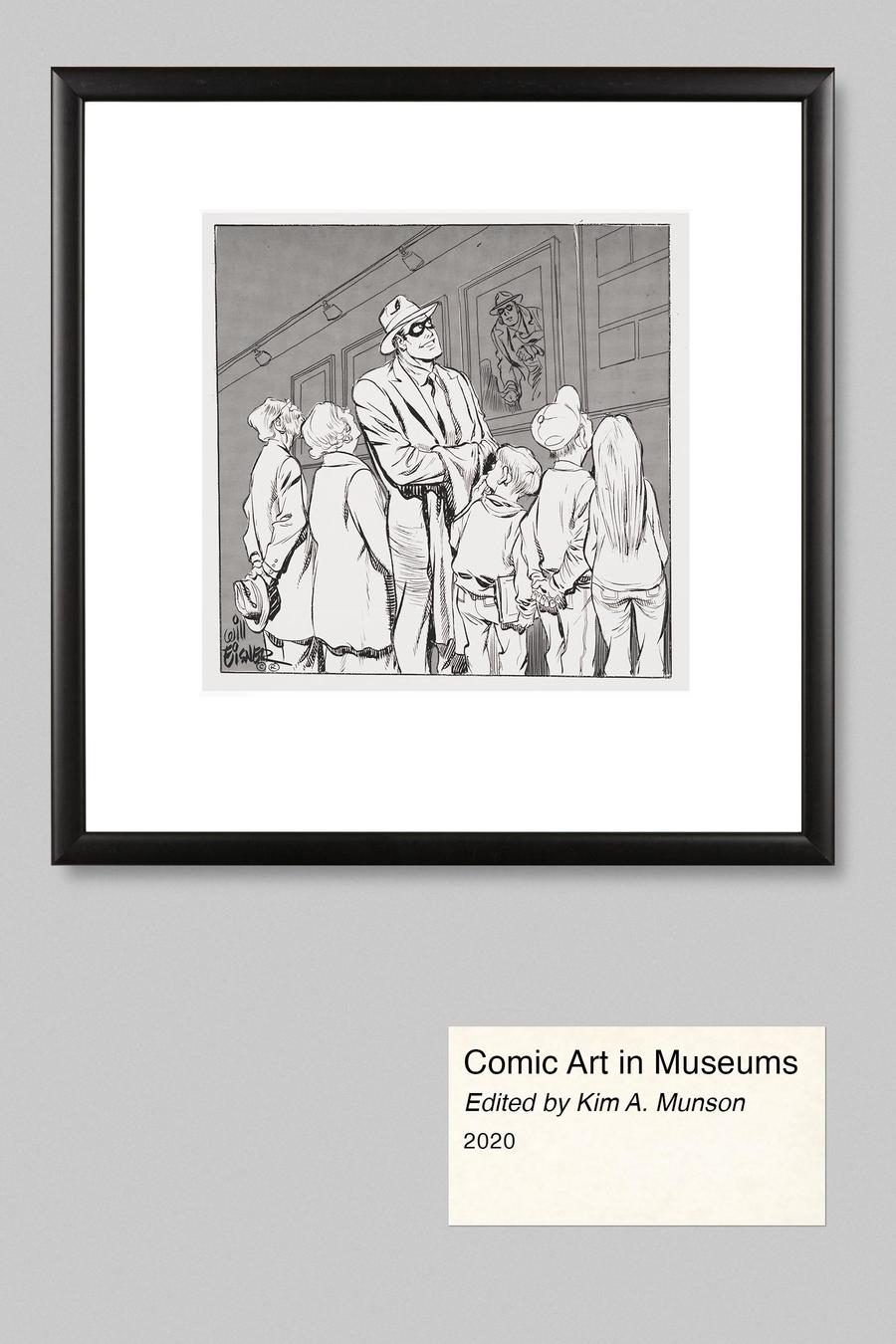
How “seriously” should thoughtful critics and audiences take the comic arts? That question seems to have dogged the cartoon arts since its earliest decades when pioneering pop culturists like Gilbert Seldes wrote extravagant defenses of the new medium. I confess that at this point in my five-decade run writing about mass media of all sorts, I find the relentless defensive justifications of pop culture criticism tiresome. And yet, that story of begrudging acceptance of the popular arts as “art” is its own important subject. One entryway to comic strip history is how the form has been regarded critically over the generations. Kim A. Munson’s Comic Art in Museums (University Press of Mississippi) is not as narrowly focused as its title suggests. While Muson provides a chronological framework and extensive introductory and connective matter, the book is really an anthology of writings by everyone from M.C. Gaines in 1942 to Denis Kitchen, Brian Walker, as well as multiple academics reflecting on the evolving reputation of the medium. I am still making my way through the densely packed book, but can already recommend it as a trove of insight and historical anecdote.

Johnny Hazard Sundays: Caniff Lite

All due respect to Johnny Hazard fans, it is hard to recommend Frank Robbins’ 33-year run as more than competent, middle-list comic strip fare. All of the luminaries also working at its height, Raymond, Caniff, Drake are considerably more interesting in their basic artistry, composition, storytelling. That said, this first oversized volume of Johnny Hazard Sundays does make the case for Robbins’s talents, even though his more mature work of the 1950s was obviously better. He had a strong sense of characterization, especially through facial expression. The moody use of coloring comes through even though some of the copies restored here were mediocre newsprint. And honestly I would have liked more background on Robbins and the thinking behind the strip rather than the intro pieces on his later DC Comics art. Still, Johnny Hazard Sundays Archive 1944-1946 (Hermes Press) gives us a 12X17 supersized reproduction of the Sunday adventure comics experience that is always welcome.

Kurtzman’s Wry Eye

Fantagraphics’ EC Library comes at the often-reprinted EC Comics of the early 1950s in black and white volumes organized by artist. Al the previous volumes have applied a lens onto the evolution of Wally Wood, John Severin, Johnny Craig, Al Feldstein, et. al. But this Man and Superman and Other Stories featuring Harvey Kurtzman before he took over the war titles and pioneered MAD really stands out for increasing our appreciation of this seminal comics artist. Kurtzman is among a handful of comics artists who were not just seminal within the medium but also to the general culture. The pop culture satire he codified in MAD magazine in the early 1950s applied a lens to post-WWII American mass culture that shaped generations of artists and even activists. This volume includes his earliest work for EC’s sci-fi, crime and horror stories. And they all show Kurtzman’s parodic attitude towards each of those genres. Tales like “Man and Superman,” “The Time Machine and the Schmoe!” and “Television Terror” took a light-hearted, even satirical take on the sci-fi and horror staples that drove the rest of the pages of these books. Most of these stories are written by the artist and so less wordy than over scripted tales the Feldstein foisted on most of the EC stable. These embody Kurtzman’s growing understanding of the relationship between word and text in the medium. He loves for high-minded science to go comically awry, along with the petty ambitions of everyman. The wry view of human foibles and hubris, which would inform the morality of his war stories and the satire of MAD, are all being rehearsed in these stories. Already sharp is Kurtzman’s mastery of of the comic form. He thought in panel progressions and the arc of a full page in ways far ahead of most artists. His compositions, use of foreground and background, the sense of motion as the eye moves across the panels, all are as fresh today as they were more than a half century ago.

Chester Gould Takes a Bow

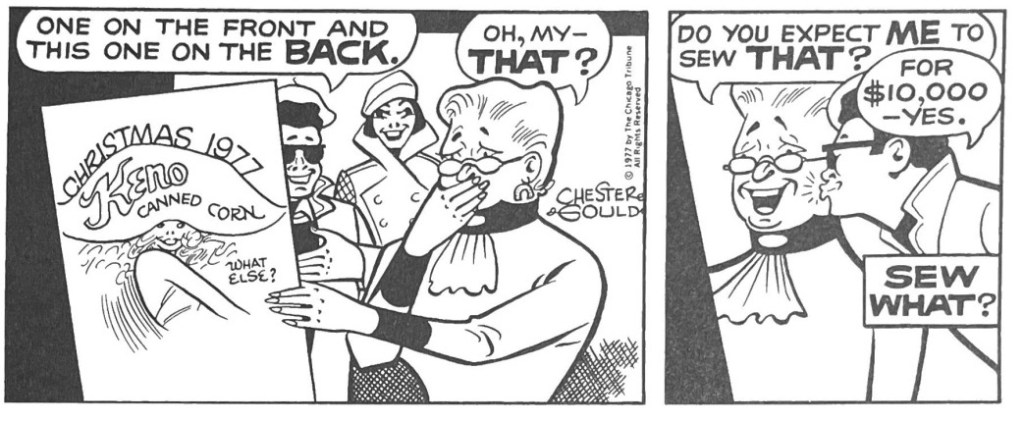
A number of ongoing reprint series had notable additions in the last year or so that call attention to the great work some publishers have been doing to keep the history of comic arts alive. In 2006 the Library of American Comics started an ambitious project to reprint Chester Gould’s full 1931-1977 run of Dick Tracy. With Volume 29 of The Complete Dick Tracy, LOAC finished one of the largest, complete comic strip reprint project, second only perhaps to Fantagraphics’ Peanuts project. I already reflected on Gould’s run and the way he ended the strip. The final volume speaks to what a canny master of comic strip art and business Gould really was. As newspapers shrank the canvas, he adjusted and rethought his signature style accordingly. And while the later years of the strip are remarkably different in look and feel than its first decade, the wild imagination, bizarre villainy, wonderfully improbable chases and escape remained central to a Dick Tracy story arc.