Notable Books on Comics, 2021…ish (Part 2)

What made me think harder or differently about the comics medium in the last year or so? That is my main criterion for these occasional roundups of books mainly on comic strips but also about early comics. Some of the titles here are filling in holes in our understanding about the history of the comics forms. Others are calling attention to artists or patterns in comics history that I think bear more thought. And many were just plain fun. Feel free to comment on the books you found most enlightening or entertaining about the comics history.

The Metaphysics (Huh?) of Alex Raymond’s Death

Dave Sim’s (with an assist by Carson Grubaugh) The Strange Death of Alex Raymond (Living the Line) is crazy like a fox. Sim’s ostensible exploration of the tragic death of the highly influential artist behind Flash Gordon and Rip Kirby uses a batshit conceit that some “metaphysics of comics” somehow connects everything from Margaret “Gone With the Wind” Mitchell, Milt Caniff’s quiet envy of Raymond, the wives and lovers of multiple comics artists of the 50s, a few B-movies, and whatever the hell else you can imagine to car crash that killed Raymond in 1956. It is also batshit brilliant. It gives Sim the frame in which to recall (and even redraw) a vast swathe of American pop culture and artists that drove the changing styles of 1950s comic strips. At its most lucid, the book delineates the different realisms of Hal Foster, Caniff and Raymond, the development of the photorealistic style, even the nuts ad bolts of brush and pen work. Along the way, forced me to contextualize and appreciate strips like Big Ben Bolt, Twin Earths, and the post-Raymond Kirby years. He brilliantly injects a whining Charlie Brown into the history as Schulz’s aesthetic counterforce to the short-lived photo-realist era of American comics. An he forces us to think harder about the rise and fall of different comics styles. As others like Jerry Robinson and Scott McCloud before Sim have shown, there is nothing like a fellow craftsman dissecting his colleague’s work to deepen a viewer’s appreciation of the artistry and decisions that go into those four panels on any given day. Whether you can track Sim’s idea of metaphysics connecting all of these shards and rabbit holes is beside the point. It sets him up for some deft and truly illuminating rumination on the aesthetics of comics in their historic context.

EC At Scale
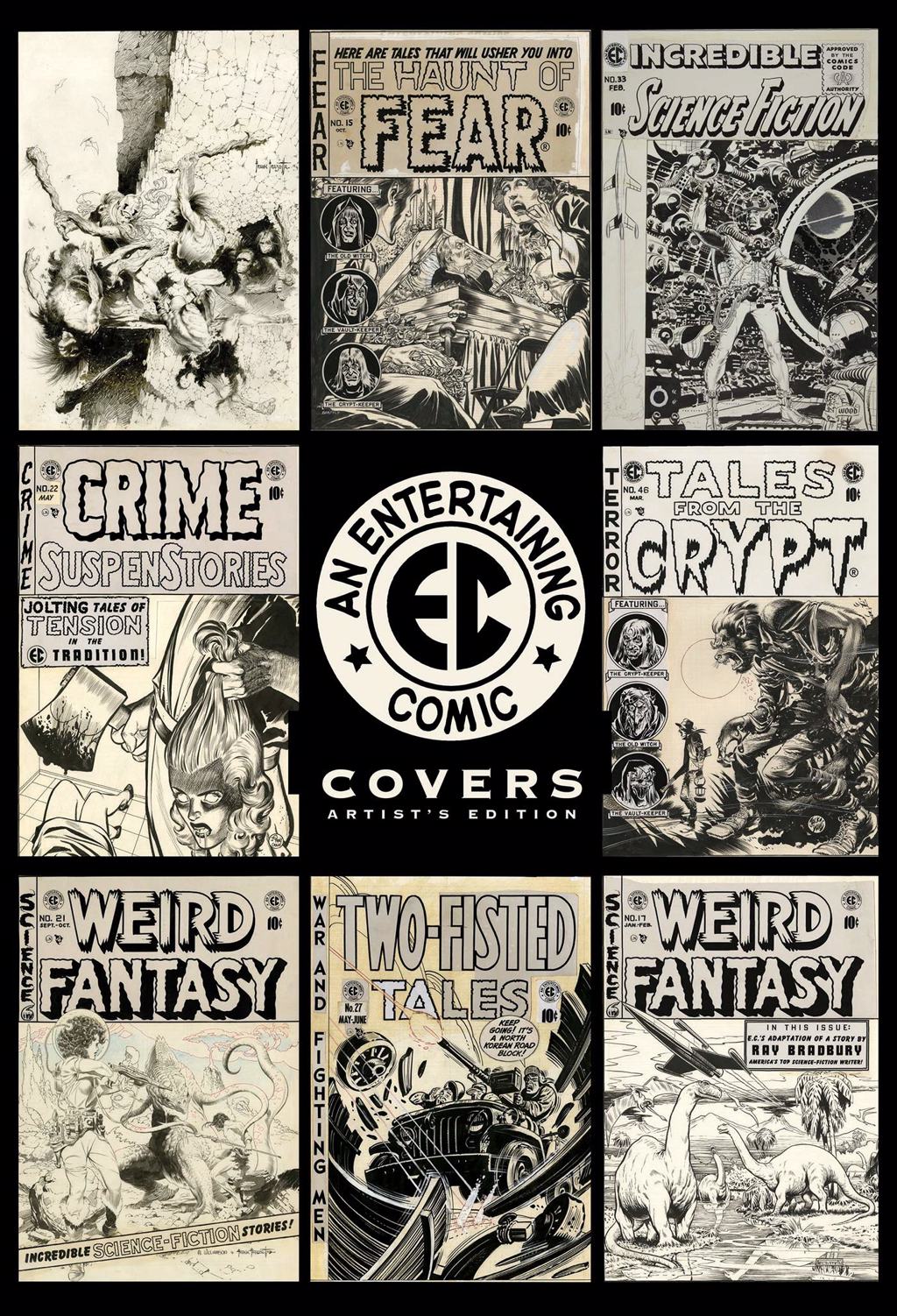
I am almost embarrassed to admit how many of IDW’s massive and pricey Artist’s Editions I own. How does one justify parting with $150 for each, even though they reprint in full detail and at original scale the actual final art from some of the great craftsmen in the field? And yet I never regretted investing in Artist’s Editions of early MAD issues, Will Eisner’s The Spirit, and the EC stories of Graham Ingels. This way-oversized scale and hi-def color images of black and white line art and marginal proofing notes seem to put you on the other end of the artists’ pens and brushes. This is even more true of the EC Covers Artists Editiion (IDW), which organizes the cover art of the famed EC comics stable by artist: Johnny Craig, Graham Ingels, Wally Wood, Harvey Kurtzman, Jack Davis and more. The covers of course were meant to be expansive, immersive teases of issue content, and so we get a single image splashed across the 15X22 page. Every bit of detail feels more like a deliberate, conscious decision, forcing us to think harder about the artist’s process. This is not just another trophy for collectors (or hoarders). It is a valuable experience for anyone who wants to deepen their understanding of the art.

The Golden Age of Wolverton

Fans of the grotesque pointillism of Basil Wolverton have been treated in recent years by Greg Sadowski’s exhaustive two-volume biography and reprinting in Creeping Death from Neptune and Brain Bats of Venus (both Fantagraphics). While those two volumes focused more on Wolverton’s horror and sci-fi work, this year’s Scoop Scuttle and His Pals: The Crackpot Comics of Basil Wolverton (Fantagraphics) is a retrospective of the artist at his madcap best. Ironically, many of these screwball and slapstick series were the fruits of failure. Wolverton conceived of Scoop Scuttle, Bingeing Buster and Jumpin’ Jupiter as daily comics and repurposed them for the skyrocketing (and imaginatively less constrained) comic book industry of the late 1940s and early 50s. In each case, however, Wolverton was satirizing many of the serious genres that dominated pulp magazines, B-movies, radio and comic books themselves. Wolverton clearly is channeling the screwball tradition of Milt Gross, Rube Goldberg and Bill Holman. The zany physical antics propel the action, the wisecracking asides and slang fill most panels and the cultural stereotypes rain in hot and heavy. The foreshadowing of MAD magazine’s satirical approach is unmistakeable. This volume also has excellent annotations adding context to each reprint as well as an outrageous article by Wolverton himself on sound effects in the comics. This one is a treat.

But Is It Art?: Comic Art in Museums
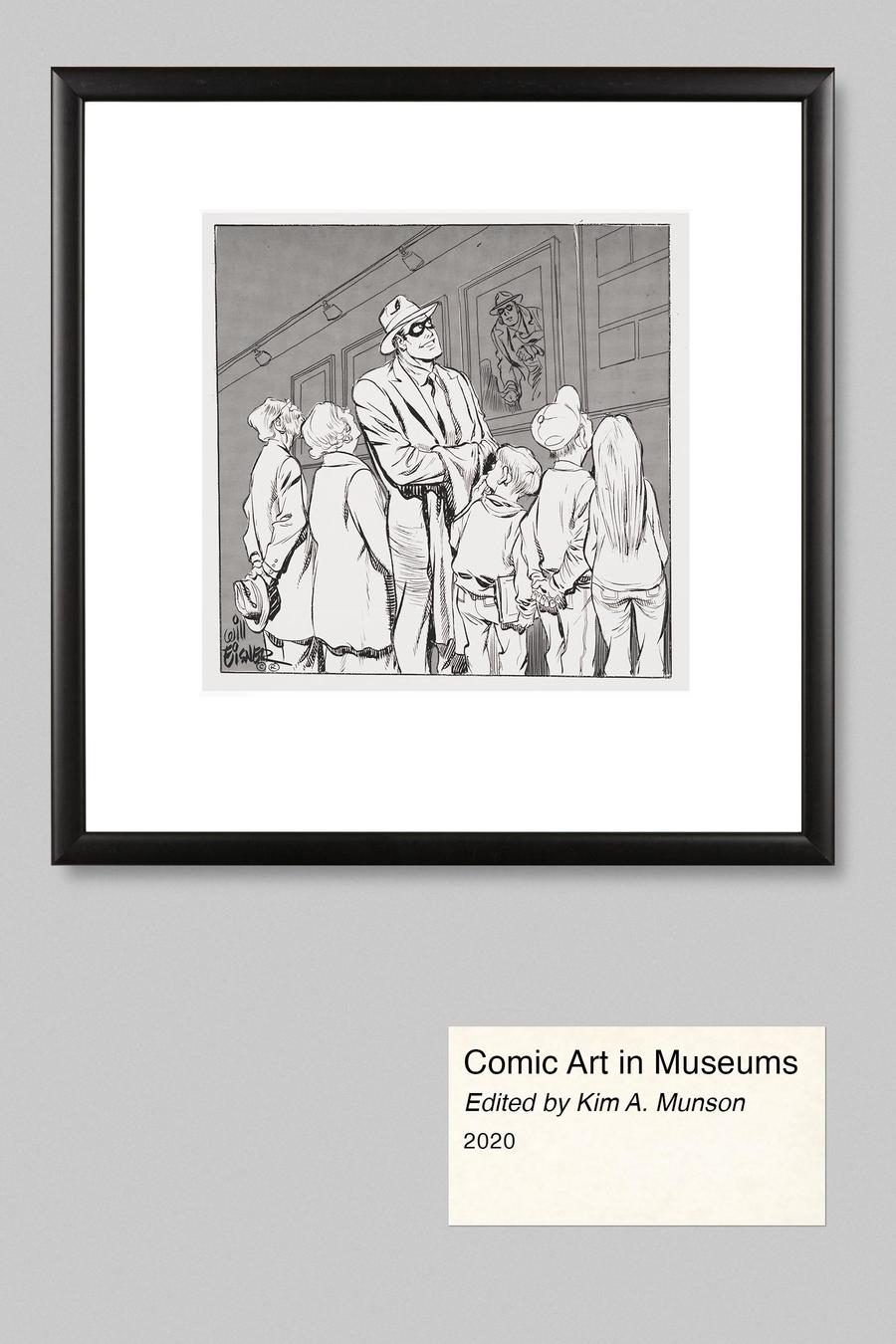
How “seriously” should thoughtful critics and audiences take the comic arts? That question seems to have dogged the cartoon arts since its earliest decades when pioneering pop culturists like Gilbert Seldes wrote extravagant defenses of the new medium. I confess that at this point in my five-decade run writing about mass media of all sorts, I find the relentless defensive justifications of pop culture criticism tiresome. And yet, that story of begrudging acceptance of the popular arts as “art” is its own important subject. One entryway to comic strip history is how the form has been regarded critically over the generations. Kim A. Munson’s Comic Art in Museums (University Press of Mississippi) is not as narrowly focused as its title suggests. While Muson provides a chronological framework and extensive introductory and connective matter, the book is really an anthology of writings by everyone from M.C. Gaines in 1942 to Denis Kitchen, Brian Walker, as well as multiple academics reflecting on the evolving reputation of the medium. I am still making my way through the densely packed book, but can already recommend it as a trove of insight and historical anecdote.

Johnny Hazard Sundays: Caniff Lite

All due respect to Johnny Hazard fans, it is hard to recommend Frank Robbins’ 33-year run as more than competent, middle-list comic strip fare. All of the luminaries also working at its height, Raymond, Caniff, Drake are considerably more interesting in their basic artistry, composition, storytelling. That said, this first oversized volume of Johnny Hazard Sundays does make the case for Robbins’s talents, even though his more mature work of the 1950s was obviously better. He had a strong sense of characterization, especially through facial expression. The moody use of coloring comes through even though some of the copies restored here were mediocre newsprint. And honestly I would have liked more background on Robbins and the thinking behind the strip rather than the intro pieces on his later DC Comics art. Still, Johnny Hazard Sundays Archive 1944-1946 (Hermes Press) gives us a 12X17 supersized reproduction of the Sunday adventure comics experience that is always welcome.

Kurtzman’s Wry Eye

Fantagraphics’ EC Library comes at the often-reprinted EC Comics of the early 1950s in black and white volumes organized by artist. Al the previous volumes have applied a lens onto the evolution of Wally Wood, John Severin, Johnny Craig, Al Feldstein, et. al. But this Man and Superman and Other Stories featuring Harvey Kurtzman before he took over the war titles and pioneered MAD really stands out for increasing our appreciation of this seminal comics artist. Kurtzman is among a handful of comics artists who were not just seminal within the medium but also to the general culture. The pop culture satire he codified in MAD magazine in the early 1950s applied a lens to post-WWII American mass culture that shaped generations of artists and even activists. This volume includes his earliest work for EC’s sci-fi, crime and horror stories. And they all show Kurtzman’s parodic attitude towards each of those genres. Tales like “Man and Superman,” “The Time Machine and the Schmoe!” and “Television Terror” took a light-hearted, even satirical take on the sci-fi and horror staples that drove the rest of the pages of these books. Most of these stories are written by the artist and so less wordy than over scripted tales the Feldstein foisted on most of the EC stable. These embody Kurtzman’s growing understanding of the relationship between word and text in the medium. He loves for high-minded science to go comically awry, along with the petty ambitions of everyman. The wry view of human foibles and hubris, which would inform the morality of his war stories and the satire of MAD, are all being rehearsed in these stories. Already sharp is Kurtzman’s mastery of of the comic form. He thought in panel progressions and the arc of a full page in ways far ahead of most artists. His compositions, use of foreground and background, the sense of motion as the eye moves across the panels, all are as fresh today as they were more than a half century ago.

Chester Gould Takes a Bow
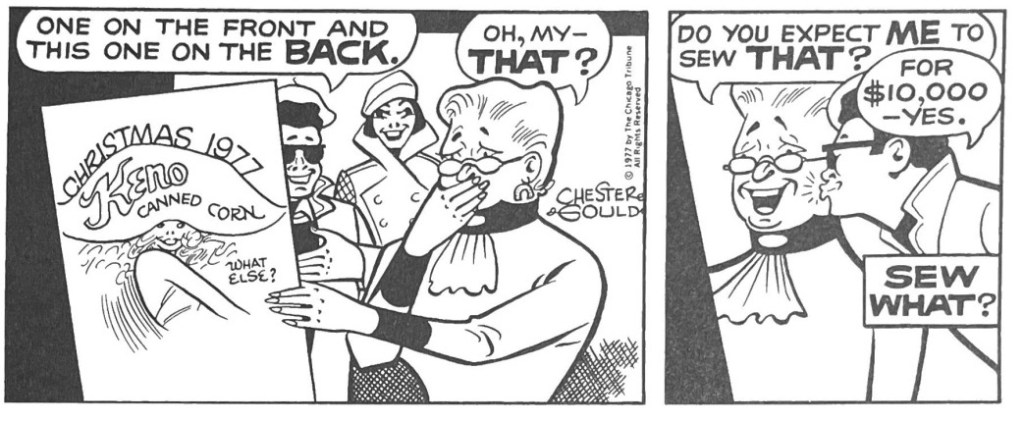
A number of ongoing reprint series had notable additions in the last year or so that call attention to the great work some publishers have been doing to keep the history of comic arts alive. In 2006 the Library of American Comics started an ambitious project to reprint Chester Gould’s full 1931-1977 run of Dick Tracy. With Volume 29 of The Complete Dick Tracy, LOAC finished one of the largest, complete comic strip reprint project, second only perhaps to Fantagraphics’ Peanuts project. I already reflected on Gould’s run and the way he ended the strip. The final volume speaks to what a canny master of comic strip art and business Gould really was. As newspapers shrank the canvas, he adjusted and rethought his signature style accordingly. And while the later years of the strip are remarkably different in look and feel than its first decade, the wild imagination, bizarre villainy, wonderfully improbable chases and escape remained central to a Dick Tracy story arc.

Favorite Books on Comics, 2021…ish (Part 1)

Many have said before me that we are enjoying the golden era of comics reprints.
Perhaps. My default position is from a broader historical perspective, and myself having gathered many volumes since the early 1970s. As I look over the shelves here at decades of accumulation in the Panels and Prose library, it seems to me we are in the latest surge of publishing activity that goes back at least five decades. I still have some of the early retrospectives of Dick Tracy, Buck Rogers, EC Comics, Pogo, Bill Mauldin, Winsor McCay, Happy Hooligan, Flash Gordon and more going back many decades. In my recollection, the underground comic artists of the late 1960s helped spark more serious consideration of comic strip history, leading to many of the 70s and 80s reprints. And, of course, we can’t overstate the importance of Bill Blackbeard’s personal effort to rescue that history and kindle so much interest in his landmark 1977 Smithsonian Collection of Newspaper Comics. Publishers like Hyperion, Bonanza, NBM, Nostalgia Press, Blackthorne, Pacific and others pioneered the extensive reprinting of comics greats.

But we are enjoying an embarrassment of riches from the likes of IDW/Library of American Comics, Fantagraphics, Drawn & Quarterly, Hermes and Titan, to name just some. It is hard to keep up, and I can’t pretend being able to track, let alone, afford all that is available in the market. The curation policy here at P&P Library is to collect more in breadth than depth. I try to collect enough samples across the many comics eras and genres so that as a cultural critic I can write responsibly about select artists and capture wider trends. But every year I try to highlight the books that I feel added most to my understanding of the comics field and industry. Here are my picks for the last year…or so.

Rebirth of The English Comic Strip

Arguably the most substantial historical contribution of the last year is David Kunzle’s majestic Rebirth of the English Comic Strip: A Kaleidoscope, 1847-1870 (University Press of Mississippi). He unearths some of the great and under appreciated cartoonists of the UK humor magazines during that genre’s heyday in the mid-Nineteenth Century. In some ways an historical follow-up to his book on the previous age’s great caricaturist Rodolphe Topffer, the University of California art history scholar argues that this mid-century period represented a rebirth and establishment of the modern cartoon arts in the pages of Punch and elsewhere. He gives us both the rich context of British humor magazines in the era and their emerging lower-middle-class readers. He then does closer readings of about a half dozen exemplars like George Cruikshank, John Tenniel, John Leech and Richard Doyle (above). Kunzle’s writing is uneven. His penchant for long sentences, commas, clauses and asides, can be trying. His knowledge of the field and this historical context of the rise of comic strips is boundless, however. But best of all, this exceptionally produced tome bulges with extensive reprints. The paper and print quality are up to the task of rendering the era’s finely engraved line work in sharp relief. Kunzel’s is the indispensible comic history book of the past year.

About Time: Rediscovering Black Cartoonists

An invaluable trio of books this year started to address a woeful blind spot in American comics history, the contributions of Black artists to the growth of the field. Ken Quattro’s Invisible Men: The Trailblazing Black Artists of Comic Books (Yoe Books), Dan Nadel’s It’s Life As I See It: Black Cartoonists in Chicago, 1940-1980 (New York Review Comics) and Rebecca Wanzo’s The Content of Our Caricature: African American Comic Art and Political Belonging (NYU Press) each fill in different aspects of this ignored history. I covered Quattro’s book in my previous roundup. He focuses on unrecognized comic book artists, but a number of his cast, like Jay (Bungleton Green) Jackson and Adolphe (Sally the Sleuth) Barreax had their roots in Black newspapers and the pulp magazines.

Wanzo’s is an academic exploration of the uses of Black caricature going back to slave depictions through superheroes. She pulls apart in detail the ways in which visual tropes emerged for Black men, women, children and families that served to marginalize them politically and socially in both subtle and grotesquely obvious ways. She spends much of her time focusing on Black artists and the ways some appropriated and perpetuated these visual themes, while others took creative control of them. The book is especially effective at thinking differently about the topic of stereotype and seeing it as both a bludgeon and a tool.

For comic strip reprint fans, however, Nadel’s collection is the must-get in this welcome trio. He gives us some of the biggest tranches of work from the great Black newspapers and magazines ever reprinted. Jackson’s wildly provocative time travel episode of Bungleton Green is mind boggling. The Jackie Ormes episodes of Patt-Jo ‘n’ Ginger really underscore her wit. And the reprinted selections from Tom Floyd’s 1969 workplace send up of white notions of “integration” (“Integration Is a Bitch!” above) really drive home how much of American cultural history we missed by overlooking this history for so long. My hope is that this is just a start. Nancy Goldstein’s bio of Jackie Ormes is now out in paperback and has a generous selection from the First Lady of Black cartoonists. But I would love to see a retrospective of Bungleton Green sometime soon.

Trots and Bonnie/The Appletons

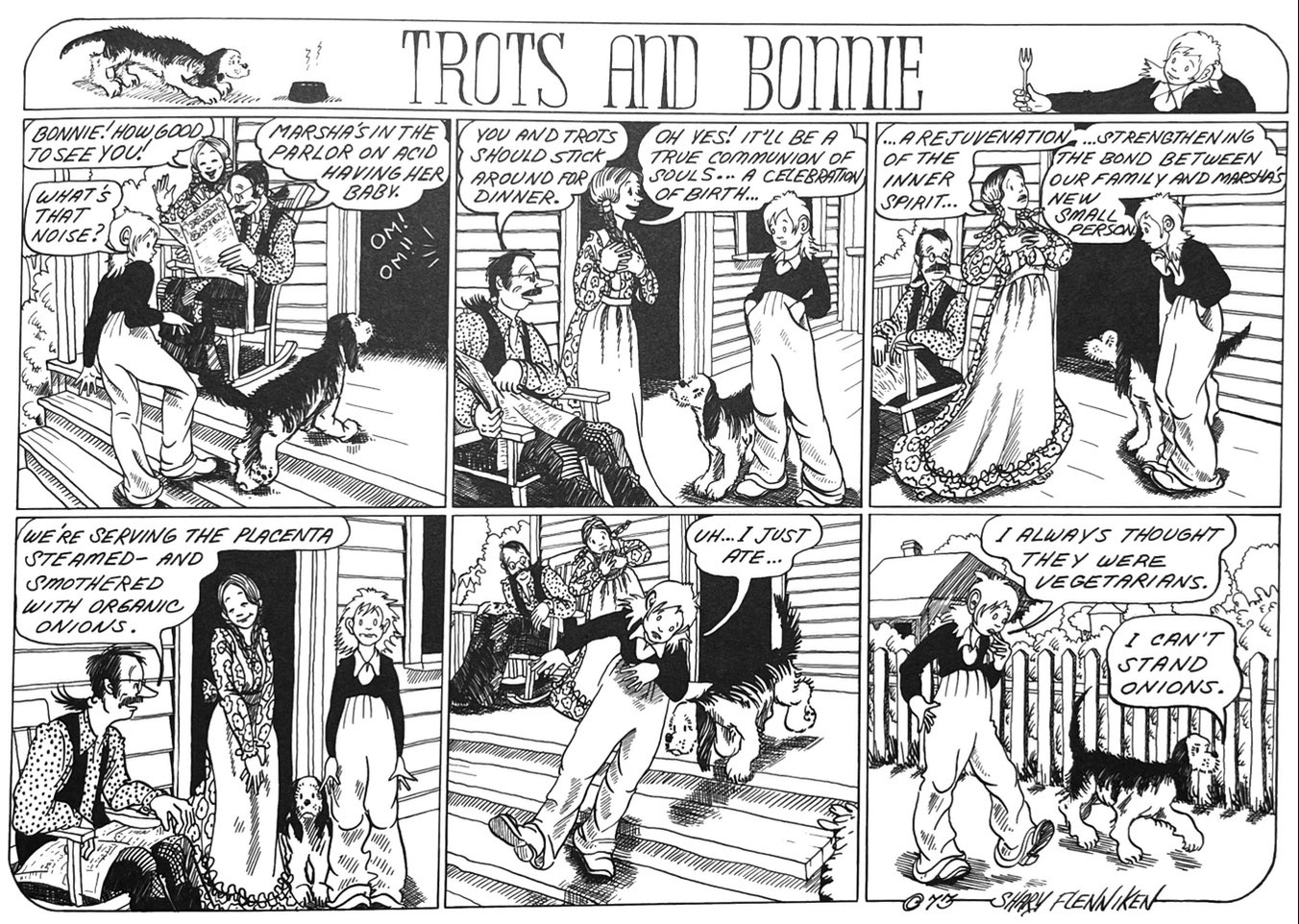
In my formative years of comics appreciation (early 1970s) National Lampoon’s comics section was nothing less than a revelation. Gahan Wilson’s Nuts, Vaughn Bode’s Cheech Wizard, Bobby London’s Dirty Duck, B. K. Taylor’s The Appletons, and anything by Rick Geary, Stan Mack and Charles Rodrigues truly blew this kid’s mind wide open to the possibilities of the form. But no one jangled my adolescent male sensibilities as much as Shary Flenniken’s truly pioneering Trots and Bonnie. The adolescent innocent Bonnie, her wry and ironic pup Trots and totally liberated friend Pepsi decimated my suburban 70s notion of feminine propriety, in the best ways. Flenniken’s candor about the female body, resentment of the patriarchy, and dark, dark sense of humor put nothing off limits. And her fine, controlled line work, thoughtful panel compositions only amplified the satire through contrast. A scathing humorous sensibility had the look and feel of children’s book illustrations and it is finally collected with the size and precision it deserves in New York Review Comics’ Trots and Bonnie. B.K. Taylor’s Appletons and Timberland Tales followed a similar rule of contrasts. He cloaked his descent into the perverse, murderous, incestuous vision of American family in cartoony stylings of apple-cheeked, smiley happy characters. Think Mark Trail meets… . Well, hell, I am not sure I can come up with an analogue for Taylor’s ink black perversity. Buckle up, because this year’s I Think He’s Crazy: The Comics of B.K. Taylor (Fantagraphics) is a twisted ride.

Popeye…Again

Like Krazy Kat, Little Nemo, Terry and the Pirates, Dick Tracy and Li’l Abner, E.C. Segar’s Popeye/Thimble Theatre has long been recognized among the pantheon, and so it has been reprinted several times over the last decades. A decade ago, Fantagraphics finished a six volume compendium of all Popeye-era dailies and Sundays in oversized formats with generous supporting material. With Popeye Volume 1: Olive Oyl and Her Sweety (Fantagraphics) the publisher shrinks the format, scope and price into a manageable paperback of just the Sundays. It has an imaginative slipcase design with cutout. But most of all it makes those wonderful color weeklies more accessible. Segar maintained a separate storyline in the Sundays, which usually used larger panels and more action. In this first volume we get both the early romance between Popeye and Olive as well as an extended story about Popeye’s short boxing career. Whether with words, schemes or fists, Segar had a pugilistic vision of human relations that comes through no matter the scenario. For those who already have the last reprinting, this series is unnecessary. But it is well worth the affordable price to anyone else.

Hank Ketcham and The Art of Dennis

Hank Ketcham made it look so easy…and that was the trick. His loose, thick cartoony line seemed to skate across the page. A Dennis the Menace daily feels so comfortable and easy to take in at a glance, as if we are in the flow of Ketcham’s relaxed line. And his imagery is equally easy, almost as abstract as a UPA cartoon (Gerald McBoing Boing, Mr. MaGoo). But unlike the jazzy cartoon aesthetic of the 50s, Dennis the Menace was firmly situated, perhaps petrified, in the iconography post-WWII white suburbia. And Ketcham himself said he aspired for his art not to call attention to itself and almost look not there.

But of course, this kind of easy transparent style was the result of tremendous skill and care. Take for instance this otherwise anodyne daily of Dennis making yet another disastrous assault on his perennial target, the cookie jar. Ketchum’s loose, flowing pen line was much admired by fellow cartoonists because it was at once light in spirit and cartoony but also controlled and precise. He credits Noel Sickles with teaching him how to use a pen more like a brush and relax his line so it seemed to flow so effortlessly.

Consider the sheer economy of this scene, how so few lines establish his figures and setting. He establishes his modern suburban kitchen setting with such selective specificity – refrigerator and cabinet handles are sparse and abstract, but the three storage jars on the counter embody the post-war mid-century modern style. And yet the broken cookie jar is detailed and minute, pulling the eye to the center of the chaos.

I have read some fellow artists praise Ketcham’s mastery of drapery, and here is a great example of using that detail to carry the weight of mother Alice’s reaction. Henry and Alice Mitchell only speak for themselves on occasion in Dennisworld. Most often they are reacting graphically to Dennis’s transgressions in minute details – the positioning of an eyebrow line, body posture, slightly splayed feet. In this panel, we don’t even need Alice’s facial expression to complete the scene. Ketcham positions us at kid level and uses the drape of her skirt and flying kerchief to render the reaction shot.

Hank Ketcham mapped mid-century American suburbia so simply and beautifully. He was a perfectionist with establishing perspective that made you part of the scene. In this early 50s panel, his composition and staging of characters is everything. It establishes the dynamic among characters and separates Dennis from the group in just the way he is emotionally. And Ketcham’s Disney training comes through in the ways each of the adults is animated and characterized individually. Every person in the scene is laughing in a particular way that suggests their own character and backstory. And it was all told visually with that signature loose and flowing pen work that makes a well-planned panel feel effortless. No wonder so many of his contemporaries envied his artistry.

Perspective was critical to Ketcham. He often finds ways to place us in the scene that also involves us in the flow of the action or in relation to a character’s perspective. The panel above underscores his thoughtful use of point of view to heighten meaning. Here Dennis and the gang’s boyish conspiracy feels more intense, intimate, secretive by being set back from the action.

The aesthetic of Dennis the Menace is centered in the brilliant design of Dennis himself of course. First it is important note that Dennis is impossibly small. Compared to the adults around him, this five-year-old is considerably smaller than his age, barely reaches the knees of his distinctly lanky parents. His bunched, oversized coveralls keep him even more grounded and often give him the appearance of a cannonball in motion.. Dennis rarely trips, falls or loses control. It is the physical and human world around Dennis that loses its footing. Adults grimace, recoil in shock or just scatter and lie akimbo in his wake. Ketcham describes Dennis as innocent. But the power of this strip is the way Ketcham embodies that innocence visually. Dennis is pure innocent determination embodied in physics. Either his low center of gravity keeps him steadfast in his attitude or momentum expresses the conviction of his chase or escape.

In earlier stints at the Lantz and Disney animation studios, Ketcham absorbed his strong sense of animated motion and rich characterization. But he also found at Disney and his work on many Donald Duck shorts the visual model for Dennis himself. With his butt sticking out, legs angled back to balance a cantilevered belly out front, Ketcham describes Dennis in one of his model sheets as “not unlike D. Duck.”  

Nudism is one of Dennis’s favored modes of expression…and Kaetcham’s. He flees his dreaded bath by careening bare-assed and in flight into the neighborhood. He is not just unselfconscious but truly free. When he stands principled against clothing, butt to the viewer, the open arms and declarative mouth dramatize obliviousness, not shame. The otherwise buttoned down Ketcham somehow finds in nude Dennis a way to celebrate visually a sense of liberation in nakedness that in an unlikely way anticipates counter-cultural ideas a decade in advance.

Which is to say that Dennis the Menace exemplifies what makes the comic strip medium distinct. In its best hands, cartooning is not just an illustrated or dramatized punch line. The artwork embodies and deepens the meaning of the idea.

Torchy, Patty-Jo and the Indispensable Jackie Ormes

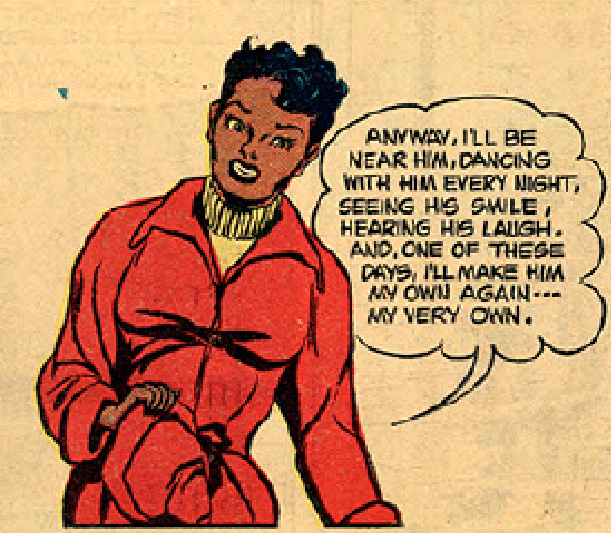
Pioneering cartoonist Jackie Ormes did not suffer fools, and neither did her heroines. Her Torchy Brown, an ambitious Mississippi gal, migrates North (“From Dixie to Harlem”) in the late 1930s to become an accomplished Cotton Club entertainer who navigates the hard-boiled city. By the time of the second iteration of Torchy In the Sunday Pittsburgh Courier section we reprinted earlier) she romances and supports some of the movers and shakers of her community. The even more famous and long-lived Patty-Jo (“Patty-Jo ‘n’ Ginger”) was a sharp-tonged tike who shot barbs at the pretensions of adulthood and especially the petty bigotries of others and the larger structural racism of 40s and 50s America.

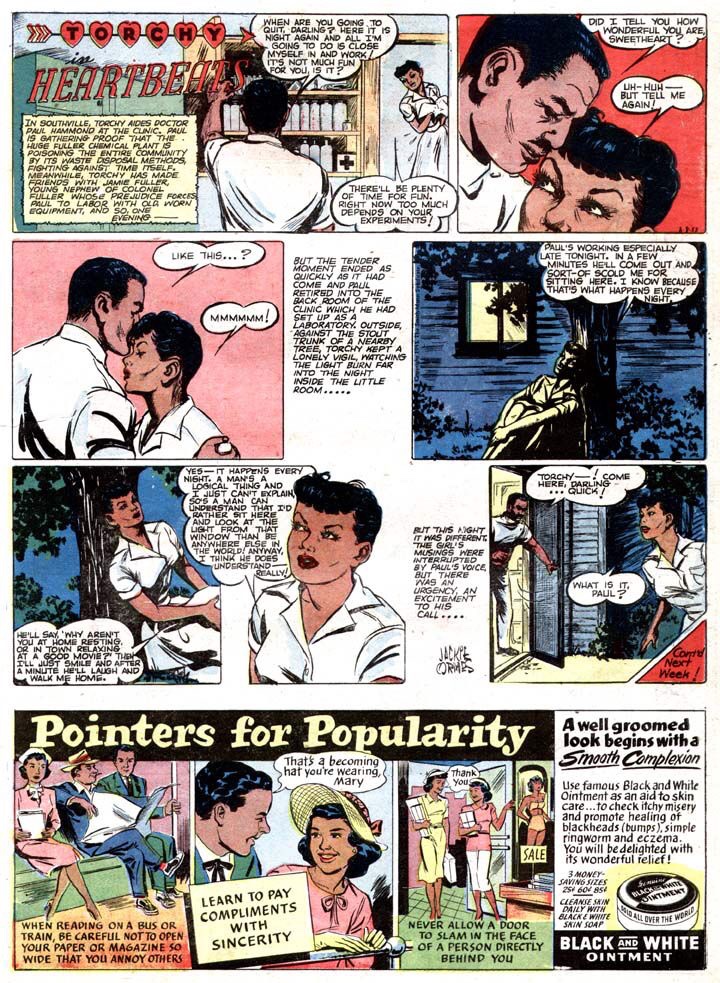
Jackie Ormes (1911-1985) is finally getting the attention she deserves with a full-length biography and a further reprinting of some of her work in this year’s indispensable It’s Life As I See It compilation of Black cartoonists of Chicago. She was the first Black woman to work in the comic strip medium, and spent her career addressing both race and gender in mid-Century America. Her political and cultural activism attracted the FBI enough to earn her a 200+ page dossier. While a cartoonist since childhood, she started as a journalist in the 1930s writing for her hometown Pittsburgh Courier, one of the major American newspapers serving Black communities. She got a shot at a comic strip for the Courier in 1937 and invented nightclub singer Torchy. The strip lasted only a couple of years, as Ormes followed her husband to Chicago. Torchy would be revived in 1950 as “Torchy in Heartbeats” to the romance genre role in the color comics section syndicated by Smith-Mann to the Courier and likely other Black newspapers.

Torchy parallels Ormes herself in some essential ways. Ormes lost her father at a young age to an accident and was raised principally by relatives as her mother pursued career and re-marriage. Ormes/Torchy’s devotion to fashion becomes central to the art and some of the best moments of the strip involve her depiction of feminine curves, sharp attire and bodies in motion.

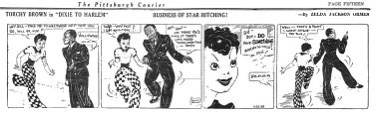
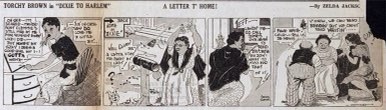
Ormes’s art had its contradictions. Visually, it could be inconsistent. In the “Business of Star Hitching” episode above her use of clothing and dance has wonderful energy. And her fashion drawing is quite precise. And yet her juxtaposition of figures, sense of mass and perspective (especially in the Torchy in Heartbeats Sundays) feel wooden and inanimate. On the one hand she portrayed ambitious, self-possessed and whip-smart women characters, who she often disrobed into sheer cheesecake allure. And fundamentally, Ormes’s work was a deliberate counterpoint to ethnic stereotyping in rejecting any use of dialect or caricature in any of her Black characters. And yet in “A Letter ‘T Home” above she projects both dialect and illiteracy on her former caretakers, perhaps signaling Ormes and Torchy distancing themselves from humble pasts.

In the 1950 revival pf Torchy. Ormes recasts Torchy as supporting player to successful Black professional men. She was deliberately filling a genre slot for Smith-Mann, the romance comic that by 1950 was a bestselling comic book market segment already pioneered by Joe Simon and Jack Kirby. But Heartbeats advances the form, as Torchy shows exceptional psychological insight into her romantic interests. In the case of the disabled pianist Earl, romance is less the object than is navigating his bitterness. Her job here is both personal and political, to rekindle his ambition so that this talented lover can assert himself again into an America that traditionally prefers to infantilize and undermine Black manhood.

Even a perfunctory dive into the Black cartoonists of the 30s through 50s shows how the concept of institutional racism, which seems revelatory to many white Americans today, was a common insight of Black newspapers decades ago. In one Heartbeats storyline, Torchy’s boyfriend is a doctor investigating the environmental poisoning of their community by a nearby manufacturing plant. It would take half a century for the rest of America to recognize the ways in which toxic dumping has always disproportionately endangered America’s disadvantaged and disempowered minority geographies.

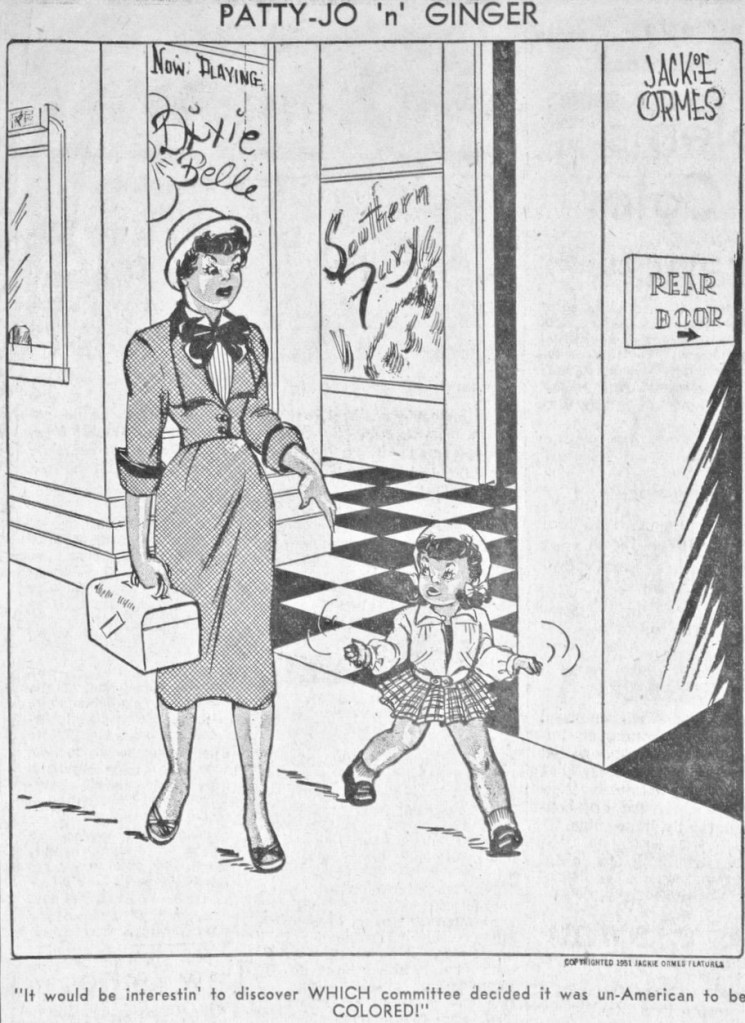
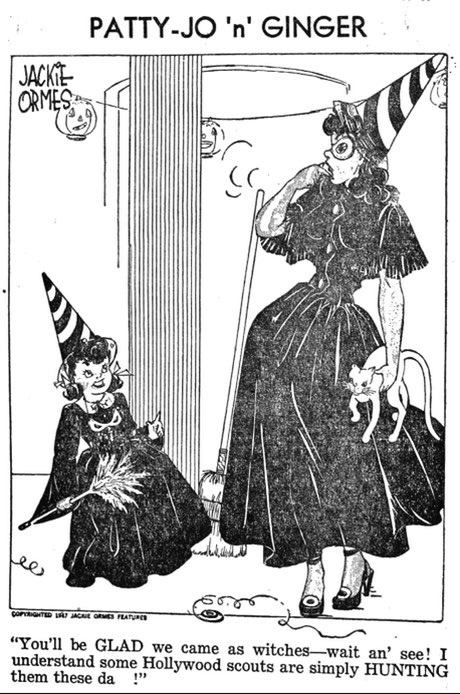
Her biggest hit came in 1945 when she returned to cartooning for the Courier with “Patty-Jo ‘n’ Ginger,” a one-panel cartoon that paired the wise-cracking and politically knowing child Patty-Jo with the curvaceous big sister Ginger, who remains mute and reactive throughout the series. But Patty-Jo went far beyond the typical precocious kid’s-eye-view. She was a jaded and informed social critic, making references to everything from Southern racism to the Truman Doctrine, Sen. Joe McCarthy and the House Un-American Activities Committee.

As in all of her work, in Patty-Jo ‘n’ Ginger Ormes combines upscale images of Black middle-class style with political awareness, social and racial justice principles and sex appeal. Ginger is effectively a mannequin for Ormes’s talent for drawing fashion and sexuality. In fact in one of the strip’s meta moment Patty-Jo chides big sister for her mute role in the strip, announcing she has been named “Miss Yummy Dummy of 1947.”

The real triumph of the Patty-Jo strip is the imp’s wry irony. She is on to the performative terrorism of Joe McCarthy by characterizing his dominance of early TV as “Cinnamacarthy.” She questions whether appeals to an “American way of life” refer to New York or Georgia’s version of the ideal. Through her Ormes takes aim at the subtleties of racial exclusion from official discourse. Patty-Jo reassures a tenement room of impoverished children not to worry because Uncle Sam is spending his treasure on a nuclear arsenal, so that they are poor but “protected.”

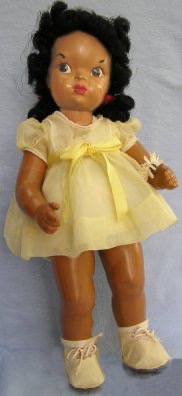
It is even more ironic that Ormes’s acerbic social critic would become the most mainstream of all her creations, a child’s doll. Produced between 1947 and 1949 by the Terri Lee doll company, the Patty Jo hard plastic toy was the first widely distributed Black character doll to dispense with “mammy” and “pickaninny” stereotypes. Few American cartoonists can claim to have blazed as many new cultural trails, upended so artfully the visual tropes of American culture and had a such genuine impact on her community than Ormes. A fuller reprint of her work is long overdue.

Morning Meta: Winsor McCay’s Fabulist Realism

Just a reminder of Winsor McCay’s genius, this wondrous episode from Dream of the Rarebit Fiend. In other hands the simple furling of the panel would be enough of an inspired use of form. But McCay runs with the creative move to play through the possibilities of reimagining the comic strip frame as an object in the story. And as with all of McCay, the aesthetic innovation is laid atop the journalistic awareness of the real turn-of-the-century world. His middle class characters are just a few steps ahead of the debt collector. McCay’s special talent was for anchoring a fabulist imagination in a draughtsman’s respect for physics and a journalist’s awareness of the world changing around him.

The Zen of Walt: The Plain Spoken American Masterpiece That is Gasoline Alley

Gasoline Alley may be a singular American masterpiece. It was unlike any other cultural utterance of its day. In it, creator Frank King exposed aspects of modernizing American culture other cultural sources overlooked. 

The remarkable gentleness of Frank King’s Gasoline Alley is its signature distinction from much of the comic strip universe of the 1920s and 30s. It has no henpecked husbands, no nagging wives, no snarky kids, no withering repartee among supposed friends. All of the familiar domestic and small town tensions are there, but King’s is a sweeter, gentler version of the tropes his fellow cartoonists deployed in The Gumps, The Bungles, Moon Mullins, Barney Google, Mr. and Mrs., Thimble Theatre or Bringing Up Father. These strips were the heart of the medium’s move in the late 1910s and 1920s into the suburban and family sphere. But King’s take on this world was distinct for what it was not. Husbands don’t suffer flying rolling pins or eviction from their homes at the hands of jealous spouses in Gasoline Alley America. In the narrow confines of this alley, wives get mildly peeved when their husbands do too many favors for the new single woman in town, and they follow her lead in bobbing their hair. Walt’s garage tribe, Avery, Doc and Bill, gently chide one another without ever truly straining their eternal friendship. So far in my reading of King, I have yet to see a character get angry enough with a friend or spouse even to stop talking to them.

King’s talents ran deeper. The little gestures and moments of emotional significance were his terrain. And he created a perspective for the reader that was more giving and loving than the grumpy, shallow nostalgia and easy irony effected by rest of the comic page. In the Thanksgiving 1921 image above we see the classic gender divide that fuels much of comicdom. But in King’s hands it is rendered as separate but mutually respectful spheres. During a road trip to National Parks, King creates a strip of panels depicting passersby waving hello to the travelers. It is a quiet testament to quiet human connection.

Frank King (1883-1969) himself may not have understood how the title for his Gasoline Alley strip suited his own aesthetic ambitions for his decades-long novel. The strip was named after the the back alleys of early 20th Century American cities, where pioneering car owners erected the first backyard garages to house and maintain the first romanticized gadgets of the modern age, the car. But his frame was quite narrow, with the feel and composition of a small town, much like the  Tomah, Wisconsin of his own childhood. His initial focus was a tightly woven group of friends, Walt Wallet, his fellow car enthusiasts Avery, Bill and Doc and to a lesser degree their wives. That world expanded slowly, organically in real time with the introduction of the foundling Skeezix on Walt’s doorstep in 1921. It was indeed an alley of American life. But King was not crafting the usual “slice of life” comic we find in J.R. Williams Out Our Way, Gene Ahern’s Our Boarding House or the many Clare Briggs series like Real Folks at Home, even though King apprenticed under many of these strips and artists. defined by immediate family, small town sensibilities, friends who know each other subtly and deeply.  

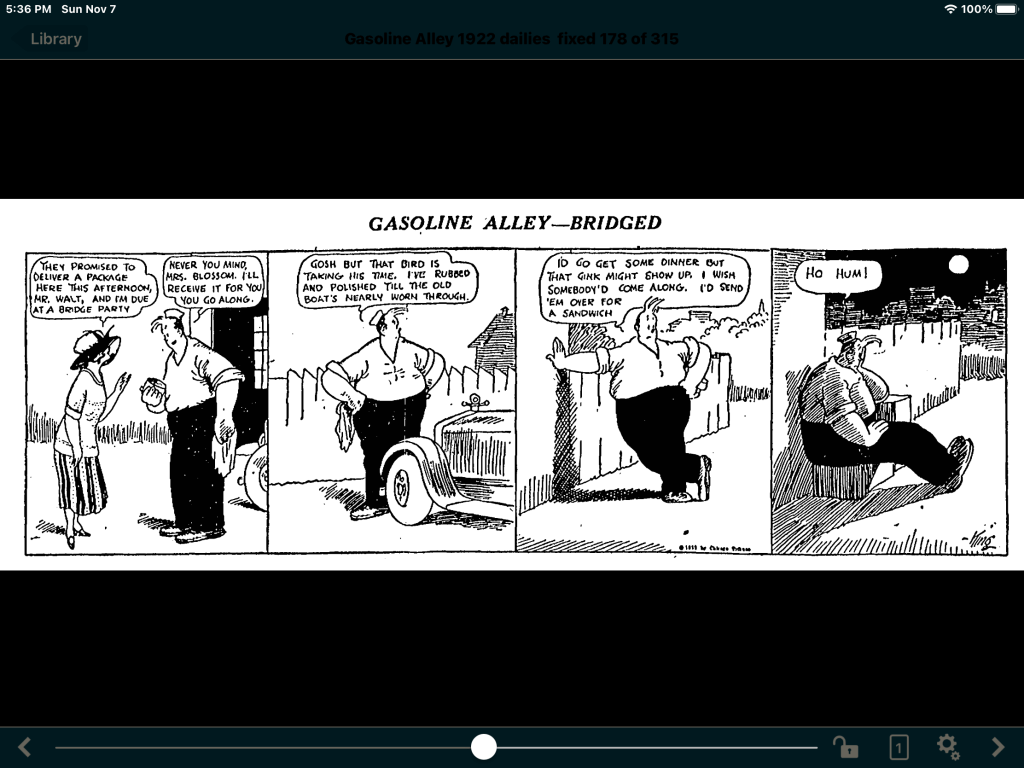
Often it is hard to grasp what any given Gasoline Alley strip is about or what was accomplished by that day’s four panels. There is rarely an obvious gag or punch line, and if there are they feel weak. Skeezix gets sand in his pants from playing in the sandbox. Walt comes upon his evolving love interest Mrs. Blossom sewing Skeezix’s drawers and decides not to intrude. Walt agrees to wait for a package coming to Mrs. Blossom, only to sit all day in vain. During a road trip to National Parks, King creates a strip of panels devoted solely to wordless images of passersby waving hello to the travelers. “Ho Hum” a frustrated Walt says in the final panel, a feeling a reader might share at the end of many Gasoline Alley dailies. Nothing happens. 

And yet, everything happens. In the unique cadence and focus of Frank King’s comic strip world a little and a lot are going on at once. These little glimpses of Skeezix, without gag or storyline, mark his development for us and help put us into the everyday world of the Alley and its commonplaces. And as the only major strip to watch its characters age in real time, King is mimicking the incremental changes much the way King himself was observing and marking his own son’s childhood. King peppers these little checkins with Skeezix every few weeks. In one we see him favoring Walt or Mrs. Blossom, all according to who last gave him a piece of candy. And each is mildly hurt by feeling snubbed. Yes. The little protean, irrational responses of a toddler can tug at our personal insecurities and self-worth in emotionally piercing ways. In another daily, the family maid Rachel wonders who is ringing the front door bell, only to find it is little Skeezix. Yes. A small moment tells Rachel and us shows without telling how a child grows into self-consciousness, power over things and people. It uses the unique cadence of the everyday strip and pantomime to pull us into the vision of a young parent watching the subtle ways a human being develops. And it uses a plainspoken, very Midwestern, show, don’t tell, visual voice to do it. There is a reverence for the small, everyday expressions of inner feeling and emotional exchange, done without mawkish sentiment. As Donald Phelps put it expansively in his Reading the Funnies, “the function of his art seemed not to impose the folksy haberdashery and cosmetics of Norman Rockwell, not yet to yoke with his interpretation of their lives, but to convey, by pooling his craft with theirs, and by rendering their corporate style as a way of life itself (p. 198).”

Gasoline Alley’s special place in modern American culture, its genius really, is in counterpoint to the modern aesthetic sensibilities around it both on and off the comics section.

Start with the visual center and emotional heart of the strip – the doughy, roly-poly Walt Wallet. Visually, Walt is the opposite of the typical bigfoot characters around him on the comics page. His is not the squash, big-headed figure of Fisher’s Jeff (Mutt and Jeff), McManus’s Jiggs (Bringing Up Father), Milt Gross’s Pop (Nize Baby) or DeBeck’s Barney Google. Walt is the inverse bigfoot – massive, but impossibly small-headed and relatively small-footed. King usually depicts him as a mass divided by ink black trousers and white button-down shirt. He is often canting forward and seems ready to teeter. He is all-heart, all pillowy comfort. And while he dominates most panels in form he never dominates in spirit. With the arrival of Skeezix in 1921, Walt becomes the most unlikely of pop culture males – the sensitive man-nurturer – perhaps the only one in American pop and literary culture at the time. And like his visual contrast to other strips, Walt is apart from the bloviating, scheming satirized fathers like Andy Gump, Barney Google, Moon Mullins. And Perhaps King meant this Walt’s weight problem is baked into the character from the start.

In the newly domesticated comic strips of the 1920s, most artists were inventing the tropes of modern situation comedy that grounded radio, romantic comedy and television: disempowered, scheming but hapless husbands; domestic disharmony borne of miscommunication; gender politics; wives manipulating husbands; husbands’ misfired jealousies. It lacks the withering, distrustful repartee of Mr. and Mrs. and Moon Mullins, let along the flying rolling pins and plates of Maggie and Jiggs. Gasoline Alley dallies on occasion with these sit-com elements but at heart was onto something else. It was a gentler vision of domestic and neighborly relations, a daily idyllic respite from the the knowing, ironic and sharp-tongued tone of 1920s American culture. 

While Gasoline Alley was inspired by and originally set in the urban alleyways and walkups of 1910s Chicago, where King conceived of the strip, it looks and feels more like a small town. In fact, there is little visual evidence of urban life here, and King generally was leaning on his memories of his boyhood rural home and people in Wisconsin. More to the point, Gasoline Alley embraced the village ethose that Sinclair Lewis, Sherwood Anderson, Edgar Lee Masters, H.L. Mencken’s and F. Scott Fitzgerald’s smart set were fleeing, mocking and condemning. Much of American letters of the time engaged in a “revolt from the village” that rejected the sentimental regionalism of William Dean Howells, Sarah Orne Jewett, Hamlin Garland, Charles Chestnutt that tended to locate the spriritual heart of the nation in the small town idyll. 

King was extending the dwindling traditions of American Regionalism, the tone of Hamlin Garland, Edward Egglesten, Willa Cather. Like many of these authors, King envisions the village as self-contained, comfortably insular and defined by its limited populace. Outside developments like the auto, bobbed hair and clothing styles and radio technology are engaged, even embraced, as alien intrusions that are absorbed through the sensibilities of the town. Walt’s eventual love interest Mrs. Blossom introduces the bobbed hair style to the wives of Gasoline Alley, but it is a curio that gets quickly dropped. The car itself, a model of modern tech and mass production, is recast as a locus of male bonding and a vehicle for engaging natural landscapes. Gasoline Alley is the inverse of modernization. Its world changes and shapes modernity at least as much as modernity changes them. 

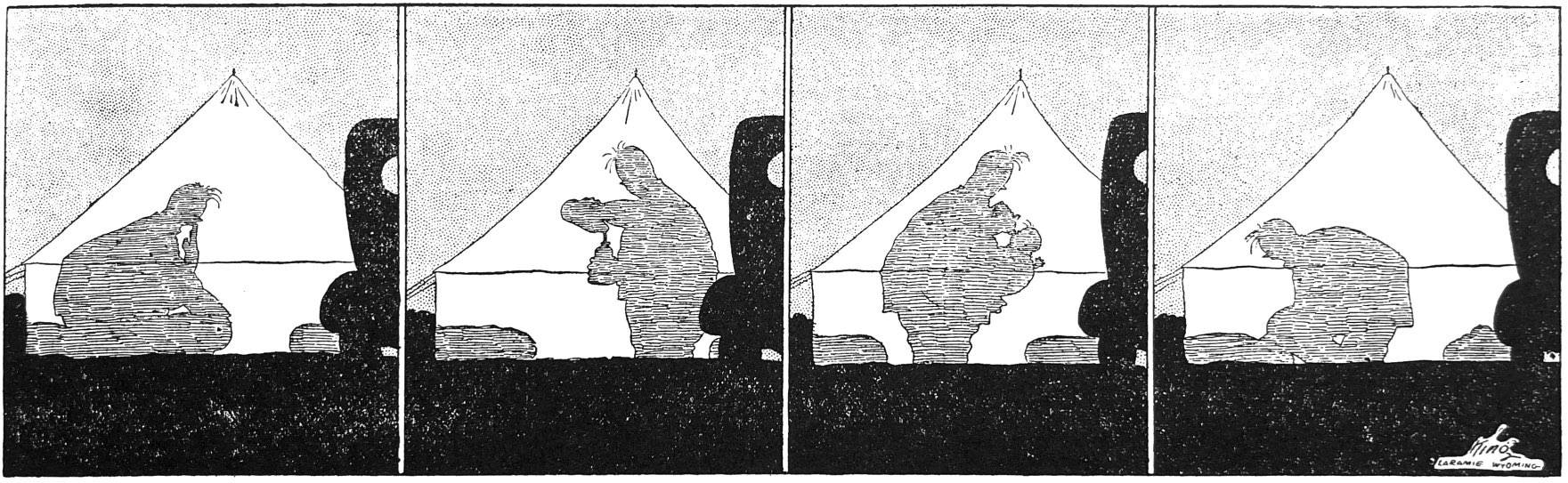
Frank King had nothing but understanding and curiosity about the small town American. And just as importantly he had no reverence for them either. There is no mawkish sentimentality to Gasoline Alley. King depicts many touching moments of small human connection and kindness among his cast. A day’s strip shows Walt and co. on vacation touring the country, depicted as three wordless panels of locals making welcoming waves at the passing car. Walt sewing Skeezix’s britches as the child is bent over his knee. Walt hugging the one person among his friends who praised his new wire car wheels rather than bemoan their downsides. Walt in silhouette in four successive panels getting up in the middle of the night to feed Skeezix and sleepily slip into bed. Most of these sequences are pantomime, and King never feels the need to underscore them with sentiment. Again, this is the embodiment of the plainspoken American style – show, don’t tell. And what King showed for the most part was an inner emotional reality with a subtlety and complexity that rivaled and perhaps exceeded the richest introspective novels. 

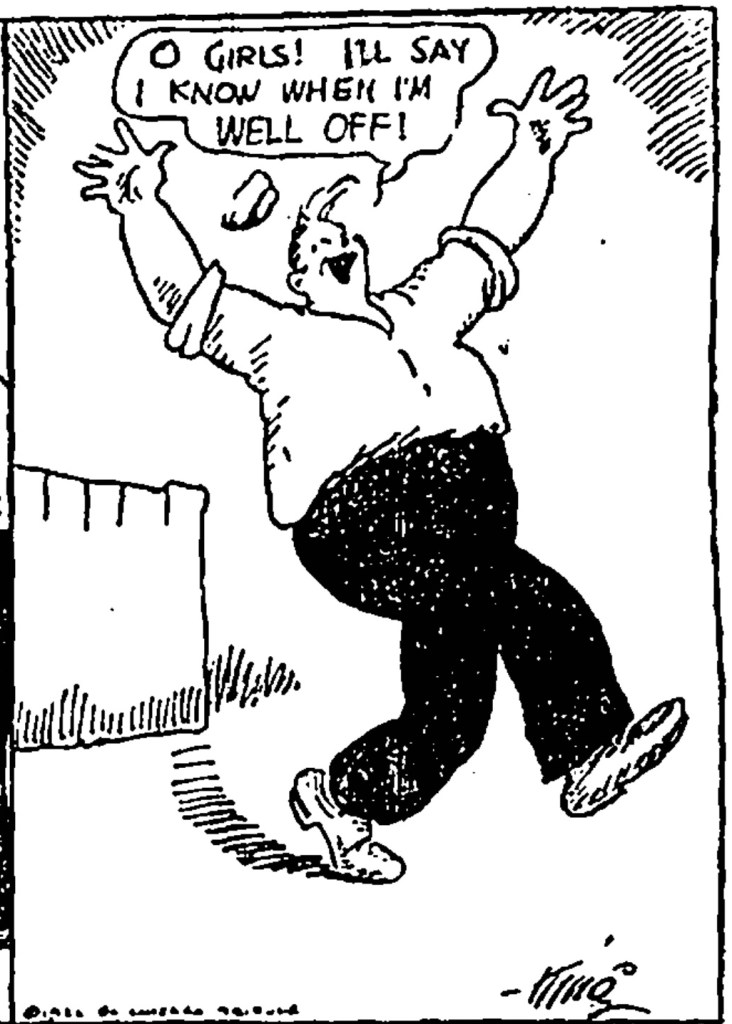
Much of 1922 is spent on a romantic slow burn of Walt coming to realize what the reader and his friends already know – that he is in love with newcomer Mrs. Blossom. Walt is a confirmed bachelor. A signature Gasoline Alley sequence shows some awkward domestic exchange among Bill, Avery or Doc and their respective wives, ending in a panel of Walt strutting away declaring how he is so “well off” being single.

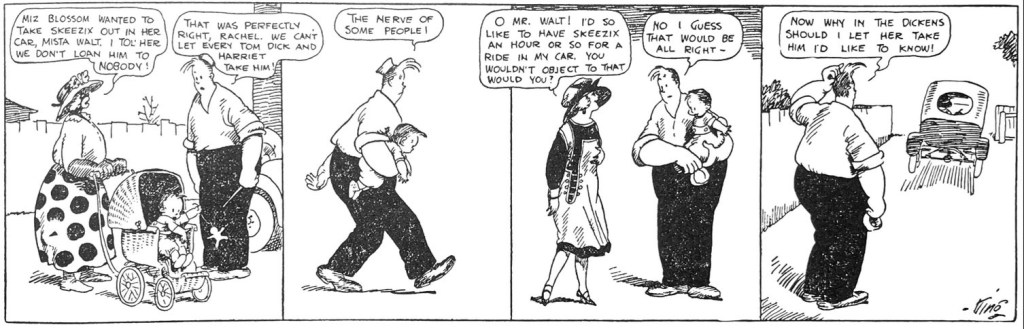
He protests too much of course. The attractive Mrs. Blossom moving into the neighborhood initiates one of the longest approach-avoidance sequences in modern literature. And here is where King uses the  iterative qualities of the daily strip to render ambivalence on a grand scale. One day finds Walt peering over fences wondering what the newcomer looks like or claiming indifference to his buddies stumbling over one another to help her tend to her car. When Mrs. Blossom starts gushing over Skeezix, Walt is overcome with mixed feelings – pride, resentment, jealousy, and more. In one memorable strip Walt marches through the first panels insisting he will firmly reject Mrs. Blossom’s offer to take baby Skeezix for a ride in her car. But upon confronting her in the final panels, he hands the tot over to her and then wonders why he just did that. King is exploring ambivalence, suppressed feeling and befuddlement over one’s own real feelings in a way only the comics strip can dramatize. Each day’s strip displays his feelings moving one way or the other, so that cumulatively we feel their depth. 

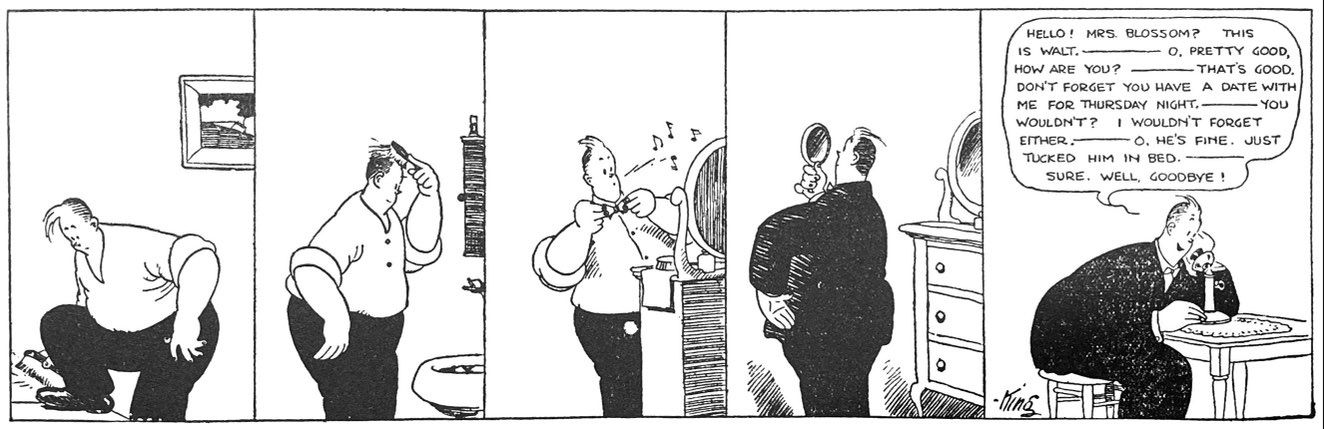
And King’s touch is so light but sublime in capturing the silly beauty of our inner lives. One strip has Walt putting on jacket and tie, brushing up his signature hair swoop in front of a mirror – primping and sprucing uncharacteristically for Walt. And in the final panel we see that all of this preparation was not to go on a date but to make the phone call to ask Mrs. Blossom out for a date.

Showing, not telling. 

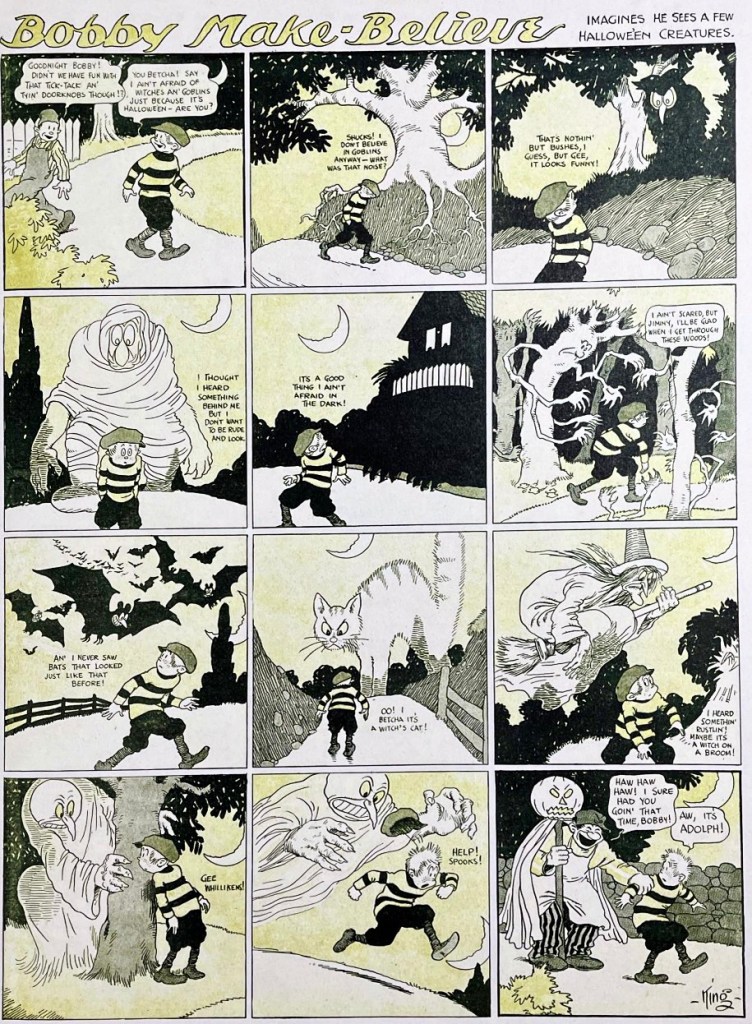
Happy Halloween From Frank King and Bobby Make-Believe – 1919

By title alone Frank King’s Bobby Make-Believe strip is compared to Winsor McCay’s Little Nemo. But King Brought to the strip richer and subtler understanding of the inner life of children than McCay. And yet, like McCay, King loved to play with nature and landscape, bringing out their surreal potential. But this strip foreshadows the gentle sensitivity to everyday emotional reality King was about to bring to Gasoline Alley.