Top 2019 Books: #6 Brain Bats of Wolverton

Lena the Hyena – Wolverton’s Winning Entry in Li’l Anber Ugliest Woman Contest

#6 Brain Bats of Venus: The Life and Comics of Basil Wolverton, Vol. 2 (1942-1952) by Greg Sadowski, Fantagraphics, $44.99

Volume 2? You have to wonder if any biographer really needs a two volume bio-reprint to cover the life and art of a single cartoonist. To be fair, Sadowsky’s treatment gives up a massive share of space to reprinting much of Basil Wolverton’s best published work and revealing sketch and spec pieces. But in fact, Wolverton was as singular and curious a character as his art. This volume focuses mostly on his horror and sci-fi work, which was often batshit imaginative. But there is also his caricature art, advertising work, and more. Also interesting and included here are his many failed attempts to break into comic strip syndication with some of his screwball comedy characters of the 1940s like Scoop Scuttle (below). And of course Wolverton leapt from obscurity to fame when his Lena the Hyena caricature won Al Capp’s contest to depict the world’s “ugliest woman.” Wolverton remains a seminal figure. His break from any previous comic art style anticipated (and was revered by) the comics underground more than a decade later.

Purchase on Amazon

Wolverton made several unsuccessful attempts to break into what every comic book artist viewed as the mother lode – newspaper comics syndication. Among his several failed attempts to break into strips, he translated his Scoop Scuttle screwball comic book character to a daily format on spec.

Top 2019 Books: #7 Mickey Mouse As Adventure Hero

7. Mickey Mouse: The Greatest Adventures, by Floyd Gottfredson, Fantagraphics, $49.99.

Fantagraphics’ complete reprinting of the Floyd Gottfredson Mickey Mouse dailies has been among the most literate and richly contextualized comics history projects in recent years. This one volume color rendering of some of Mickey’s best adventures between 1930 and 1951 is a shorter, more affordable sample. Here is Mickey evolving from scrappy, spunky adventure hero of the 30s to bland suburban everyman of the 50s. Lest we forget, Mickey’s 1930 comic strip launch places him at the advance guard of adventure strips, along with Orphan Annie and Wash Tubbs and Popeye that would bring us 30s powerhouses – Dick Tracy, Terry and the Pirates, Flash Gordon et. al. Gottfredson’s penchant for putting movement, gestures, expression and urgency into every panel is matched by his and collaborators’ mastery of story pacing and suspense. While I would quibble with some of the choices (really, no Phantom Blot?), this is a great sampling across eras for those who aren’t up for buying the enture run. 

Purchase on Amazon

The Usual Disclaimer: Panels & Prose has an affiliate relationship with linked vendors and we may receive a small commission if you purchase with them.

Top 2019 Books: #8 Elmo…No, Not That One

#8 Elmo: An American Experiment by Cecil Jenson, edited by Frank M. Young, Middletown DE, Labor of Love Press, $14.99

What a find. Young has unearthed and reprinted a darkly surreal strip from the late 1940s by the author of the later Little Debbie strip of the 1950s. It seems like a Li’l Abner knockoff, with the rural rube Elmo encountering urban caricatures. But Jenkens sends Elmo down some of the darkest urban and psychological alleyways of post-war America. Its brief run shows it was too strange for post-war audiences groping to return to normality after WWII. But Elmo suggests a kind of unease to that project that would also come out in 40s noir, crime comics and 50s horror comics. 

Purchase on Amazon

The Usual Disclaimer: Panels & Prose has an affiliate relationship with linked vendors and we may receive a small commission if you purchase with them.

Top 2019 Books: #9 Charlie Chan

#9 Charlie Chan, 1938 (LOAC Essentials Vol. 13) by Alfred Andriola. IDW, $29.99

The LOAC Essentials series highlights a full year of classic strips that may not support a full reprint series. And it uses a uniquely narrow format that displays a strip per page for a singular reading experience.  It is an inspired imprint from The Library of American Comics that makes accessible many strips that might be lost to history. Charlie Chan had decent locked-room mystery plotting that channeled the popular novels and films. Andriola, who went on to do Kerry Drake strips for years, took his visual cues from Milton Caniff, even if he lacked the master’s rich talents. Modern sensibilities will need to excuse the daily dose of stereotypical Confucian aphorisms, though.

Purchase on Amazon

Here is a little bonus I found at the Charlie Chan Family Home site, which has some samples of both the dailies and Sunday strip. The first week of dailies finds Chan and “Number One Son” on the case.

The Usual Disclaimer: Panels & Prose has an affiliate relationship with linked vendors and we may receive a small commission if you purchase with them.

Top Holiday Books for Comic Strip Lovers

Panel heads, there is cause for celebration. We are in a golden age of comic strip and comic book reprints. Some of us old-timers have been beating the drum for recognizing the art of the “funnies” for decades. But a new generation of readers was raised on graphic novels and unabashed in their love of comic books and graphic narrative of all sorts. And as much as I myself loathe the rise of superhero genres as mainstream adult fare, even I have to admit that it is helping to increase general respect for the full range of comic storytelling. 

And so we are getting an embarrassment of comic strip reprint riches in recent years. Here are some of my favorite comic strip archives from this past year as well as some secondary material and a few crossovers into the world of early comic book history. Over the next couple of weeks I will be counting down my ten favorite books on comics and reprints of the year.

#10 The Peanuts Papers: Writers and Cartoonists on Charlie Brown, Snoopy & the Gang, and the Meaning of Life, edited by Andrew Blauner. NY: Library of America, 2019. $24.95

Peanuts has become the Krazy Kat of the last half of the 20th Century. Its light and barely guised philosophical musings, mildly depressed tone and angst-ridden protagonist naturally attract hosannas from the dignified set. It feels like half the masthead of The New Yorker magazine got recruited for this one (Jonathan Lethem, Adam Gopnik, Jonathan Franzen, George Saunders, Ann Patchett, Maxine Hong Kingston, Joe Queenan and of course Chris Ware). Generally I am suspicious when branded intellectuals congregate to lend their imprimatur on pop culture. Who needs ‘em, I say. But there really are some nice insights here that can give even Peanuts fans fresh ways into the strip. 

Purchase from Amazon

The Usual Disclaimer: Panels & Prose has an affiliate relationship with linked vendors and we may receive a small commission if you purchase with them.

Buried Treasure: Cecil Jensen’s “Elmo”

Thanks to Frank M. Young a long-forgotten Strip of the latter 1940s, Elmo, has been unearthed and reprinted. The strip’s author Cecil Jensen was an editor at the Chicago Daily News, editorial cartoonist and author of the longer-lived Little Debbie strip of the 1950s. 

But Elmo was a singular creation that seemed on the surface an Al Capp Li’l Abner knock-off. A rube from the sticks comes to the city and seems to use his half-wit to outwit a cast of broadly drawn types (corporate CEO “Commodore Bluster”, femme fatale and stripper Sultry Lebair, political boss Mr. Hoodlum). Even the visual style feels like a less talented Capp – thick inking, wild hand and body postures, short and sparse blobby lines to craft facial caricatures.

But the plotlines venture further off the rails and more deeply into dark areas of the American soul than Capp ever imagined. In just the first few months I have already read, Elmo saves a rich tycoon from suicide, is rewarded with controlling interest in a cereal company, is hypnotized into thinking he is a skunk, who he lives amongst at the zoo, is kidnapped by Mr. Hoodlum, and force fed breakfast cereal, which grows so much hair on his head it drowns his kidnappers in his tresses. 

This is truly weird but also very critical view of a sinister post-WW II America. Everyone has an angle; every conspiracy contains a double-cross, and death and violence are real and present possibilities always.

The book, published by Labor of Love Press, was issued last summer. A second volume is out that includes samples from the longer Little Debbie run into which Elmo evolved as well the end run of the strip that saw the wild return of Elmo. This is a genuine find.

Merry Ironic Christmas From Hogan’s Alley

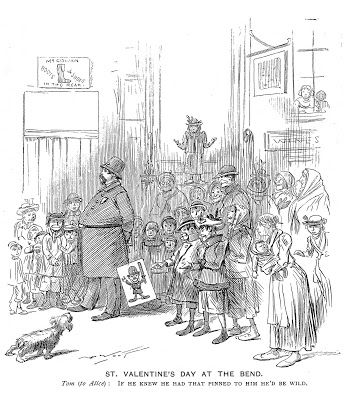
Class conflict and tensions in The Yellow Kid ranged from the grim to satires of the middle classes to pokes at violence and pretension among the emigre classes themselves. As I work through his strips I am impressed by the range of his sympathies and diverse perspectives on the city, poverty, violence, race and social class. The Dec. 15 1896 “Merry Christmas Morning in Hogan’s Alley” is a painfully ironic depiction of the holiday among Alley-ites. A “Deer Santy Klaws” letter on the fire escape instructs Santa to use the nearby ladder because there is no chimney. Another chortling boy holds his Merry Christmas sign above a drunk passed out at the foot of a tenement. Somber faces stare into the mayhem of the street. Two mothers shake their fists at each other in the background, a child taunts a foreign missionary asking for donations and handing out tracts. A ruffian uses a pea shooter on another child trying to celebrate in paper hat and drum. The one child in the scene with a gift is an obviously middle class child (in Lord Fauntleroy haircut) hugging her dolly tight as street children look on, some numb-faced, others smirking. The entire scene is framed in the foreground by a cherubic girl holding her hand out to the viewer in search of alms. 

It is a biting, scolding view of class disparity and how some commonplaces of the growing middle class are out of reach of Outcault’s urchins.

Credit: From Blackbeard, Bill, R. F. Outcault’s The Yellow Kid: A Centennial Celebration of the Kid Who Started the Comics. Northampton, Mass.: Kitchen Sink Press, 1995. Located at UVA xRoads