While it goes without saying that Hal Foster was a much more buttoned down, stiff and restrained adventure artist than the ebullient Alex Raymond, he had his moments of gratuitous cheesecake. Here, from some 1939 sequences, Prince Valiant strips down for some manly bathing.
Hal Foster was never shy about pouring on the bloody swords, celebrations of battle, corpse-coated fields of war. In fact some foreign markets censored the strip when they felt Prince Val’s love of war crossed the line. But showing skin? Not so much.
Even comics aficionados barely recall the very popular aviation adventure strips of the late 1920s and 1930s, perhaps because, well, they just weren’t very memorable. Tailspin Tommy, Scorchy Smith, Smilin’ Jack, Flyin’ Jenny, and Skyroads, to name a few, were definitely of their time, tapping into the most romantic technology of early 20th Century – aviation. The wild tales of WWI air battles, the triumph of machine and human endurance in Charles Lindbergh’s solo crossing of the Atlantic, the mystery of Amelia Earhart’s disappearance fueled film, pulp magazines, and even popular science journals with an admixture of human spirit, adventure to far off lands and technical jargon that many audiences, especially boys, ate up. The strips captured that blend. Many of them were created by pilots who brought their love and knowledge of flight to the strips. Much of the art was unremarkable. Noel Sickles’ work on Scorchy Smith was a legendary exception, and Russell Keaton had a polished and breezy style in Flyin’ Jenny. For the most part, however, aviation cartoonists were more in love with the planes than their own characters, and they tended to focus effort and attention on the planes themselves.
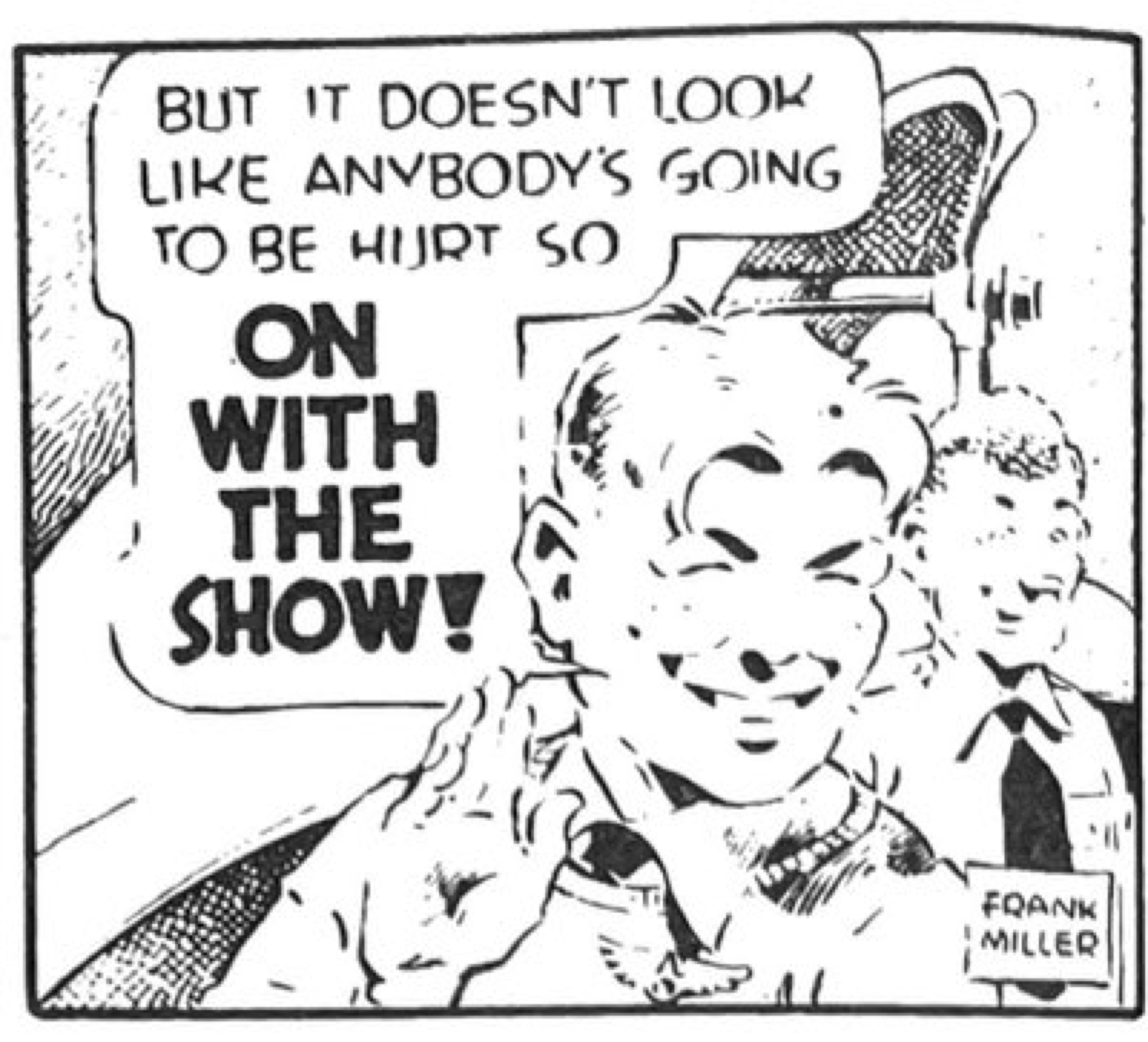
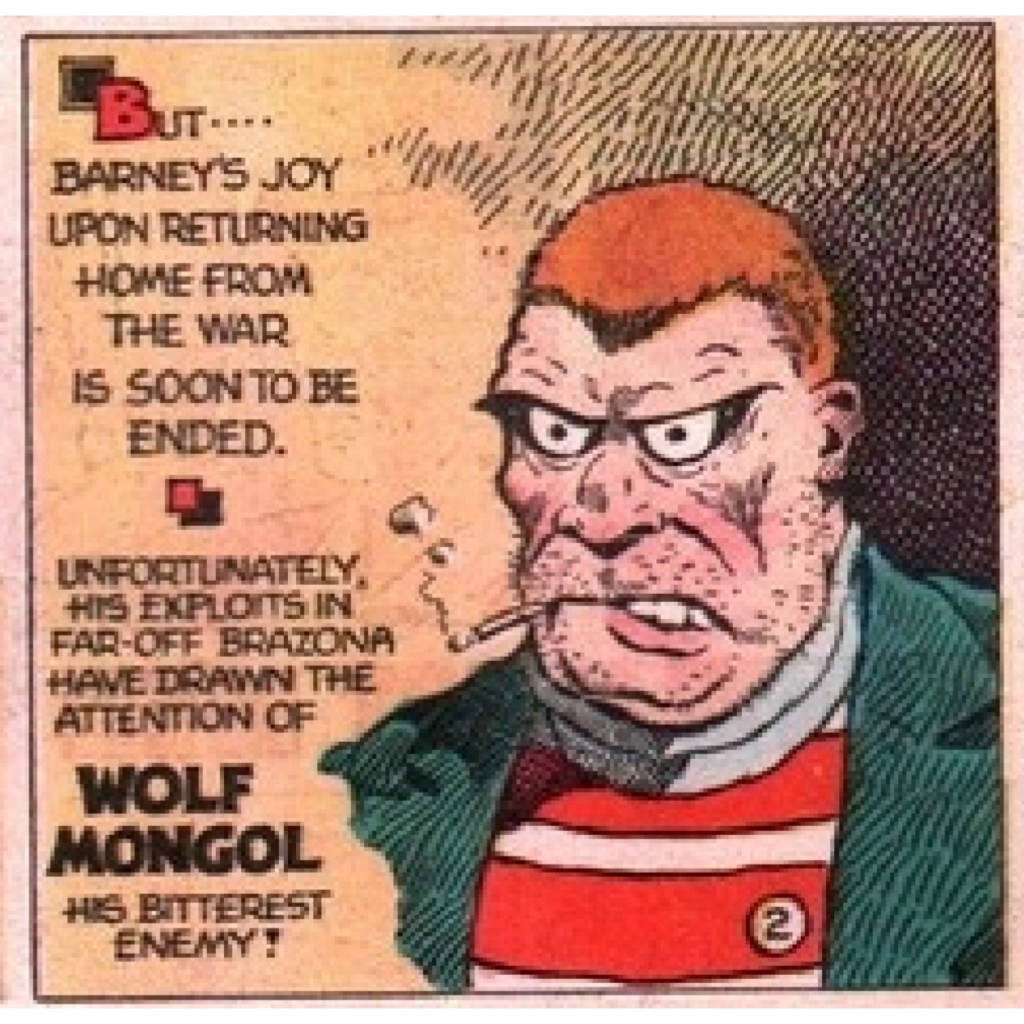
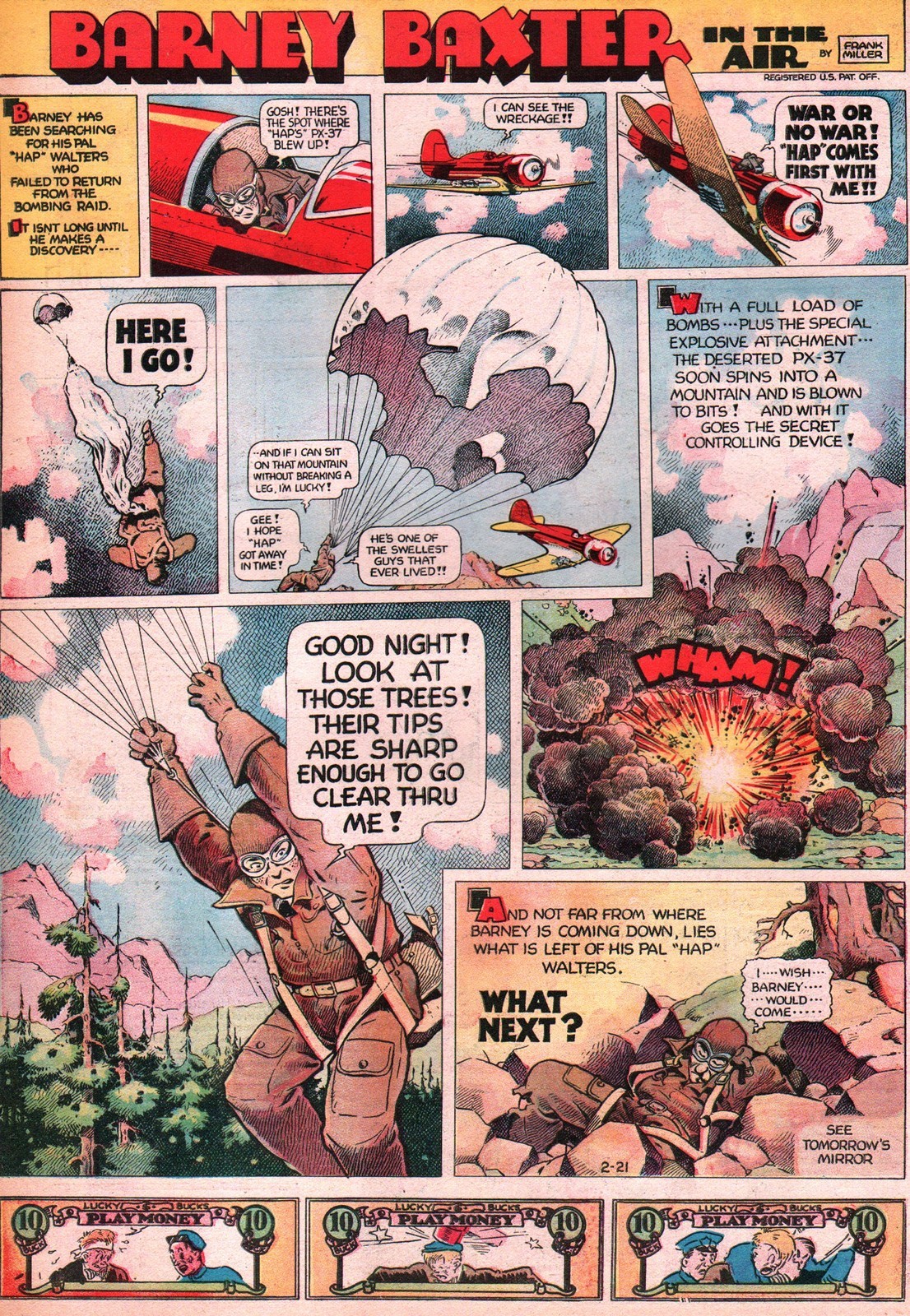
Frank Miller, however, brought Barney Baxter in the Air (1935-1949) a special whimsy to the genre both in his characterizations and line work. From the Art Deco/Machine Age feel of his lettering to the rounded nature of his figures, everything about this strip feels sophisticated, considered, modern . His faces are comprised of a few deft dabs of ink. The upholstered texture of his people and objects are somewhere between big foot cartooning and classic adventure realism. And this allows him to bring his style to either extreme as it fits the scene. It reminds me of (or foreshadows) Rick Geary, whose style I also love. Miller is adept at using a variety of panel framings to keep the eye energized across the progression. His narrower close-up panels call out important moments of gesture or expression. And he has such a stylized way of rendering shadows in a pointillist style. It all adds up to a visual signature that light, witty, and yet functional as a vehicle for adventure. The feel is similar to Capp’s Li’l Abner.
His skills often came together in some truly creepy villains.
Miller lavishes attention and invention on his Sunday pages. He is breaking frame, manipulating panel shapes and sizes with the kind of energy we usually associate with McCay, King or Sterrett. The detail and color in his rocky backgrounds are just wonderful for establishing setting. He maneuvers our point of view radically from panel to panel to bring us into the scene by circling us around it. And just look at that open parachute as the visual centerpiece of the whole layout. If that isn’t an homage to McCay, I don’t know what is.
Frank Miller, obviously not the Frank Miller of later comic book fame, ran the strip throughout its 15 year span and until his premature death in 1949.
In early 20th Century theater and film, the “sissy” was the dreaded antithesis of two-fisted pulp hyper-masculinity, at best, and at worst was a stereotypical euphemism for what was unspoken in general culture, homosexuality. Wimpy, the dandyish, appetite-driven counterpoint to Popeye’s principled violence, is of course Popeye’s best tutor for all things “sissy.” To make this sexual dynamic even weirder we have Popeye’s Pappy bewildered by his prancing progeny. It reads like an unintended burlesque of Popeye “coming out”. Per a previous post, These dailies precede Popeye deceiving the underground demons to come up and fight.
It is important to note that this gender-bending sequence was followed immediately by another adventure cycle involving Popeye getting the crap beaten out of him in a land of highly muscled women. And this is all happening right after E.C. Segar’s death in October 1938. The strip was being continued unsigned by assistants for the time being.
Where do we even start to highlight the wicked strangeness of Winsor McCay’s “Dream of the Rarebit Fiend?” The master comics artist drew over 800 nightmares in the first decade of the 20th Century, and… Read more: Random Nightmares: Winsor McCay Gets Rarebit
Along with chaos, mayhem and violence, obsessive behavior was a core theme of early newspaper cartooning. Consider the many titular anti-heroes of these years, like Hungry Henrietta, Superstitious Sam, Jingling Johnson, Sammy Sneeze. Or the… Read more: Dingbat Calls In the Klan: Herriman’s Bourgeois Obsessive
The authoritarian strain in modern democracies has only heightened since I first posted this bit of cartoon wisdom several years ago. In 1937, H.T. Webster’s Casper Milquetoast (The Timid Soul) responds to Italy’s Benito Mussolini… Read more: The Timid Soul Toys With Fascism
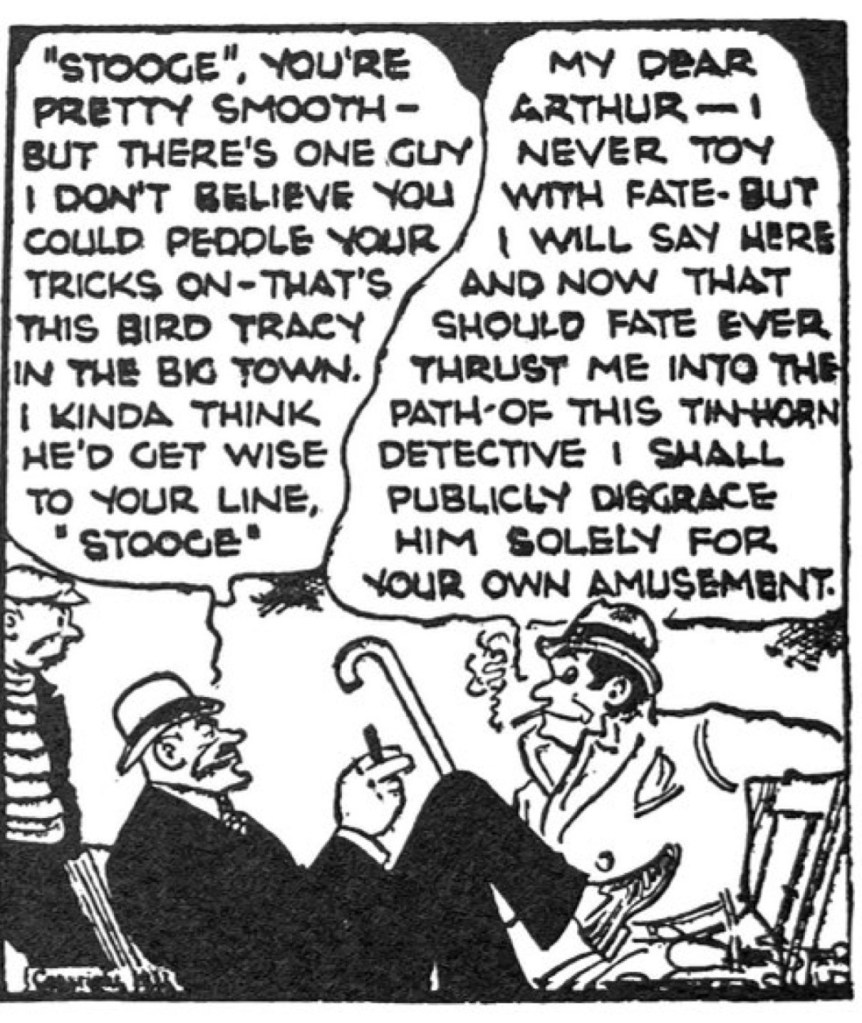
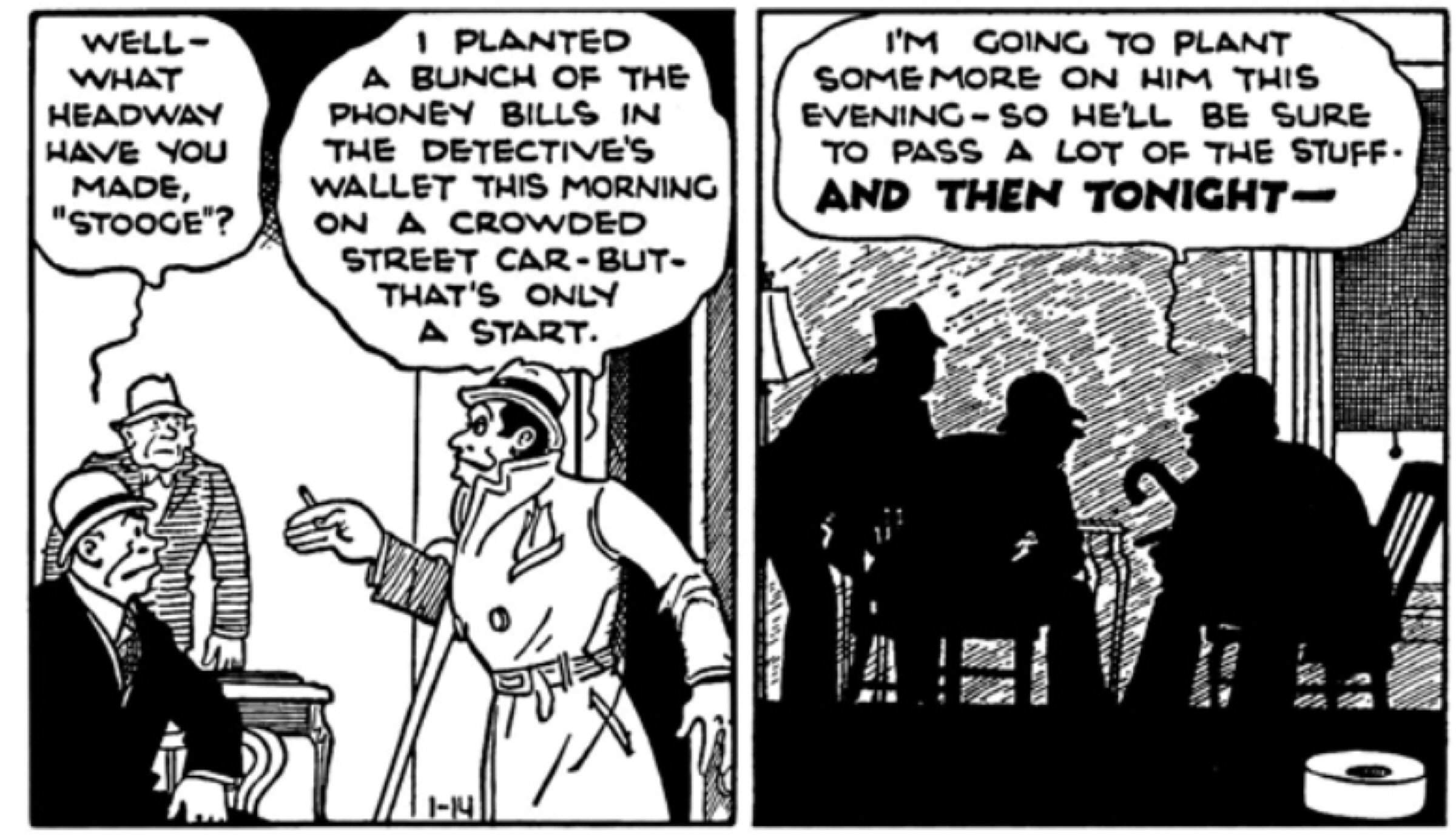
Foreshadowing some of the more colorful arch-villains in the 40s and beyond, Dick Tracy’s early 1933 encounter with Stooge Viller was a standout as Chester Gould developed his style and focus. Stooge is imported to the city by a broken crime ring to discredit the now-famous gangbuster Dick Tracy. He is a master pickpocket and a bit of an effete dandy. He successfully frames Tracy and even causes Tess Trueheart to fall out with the love of her life.
Here we get our introduction to Stooge.
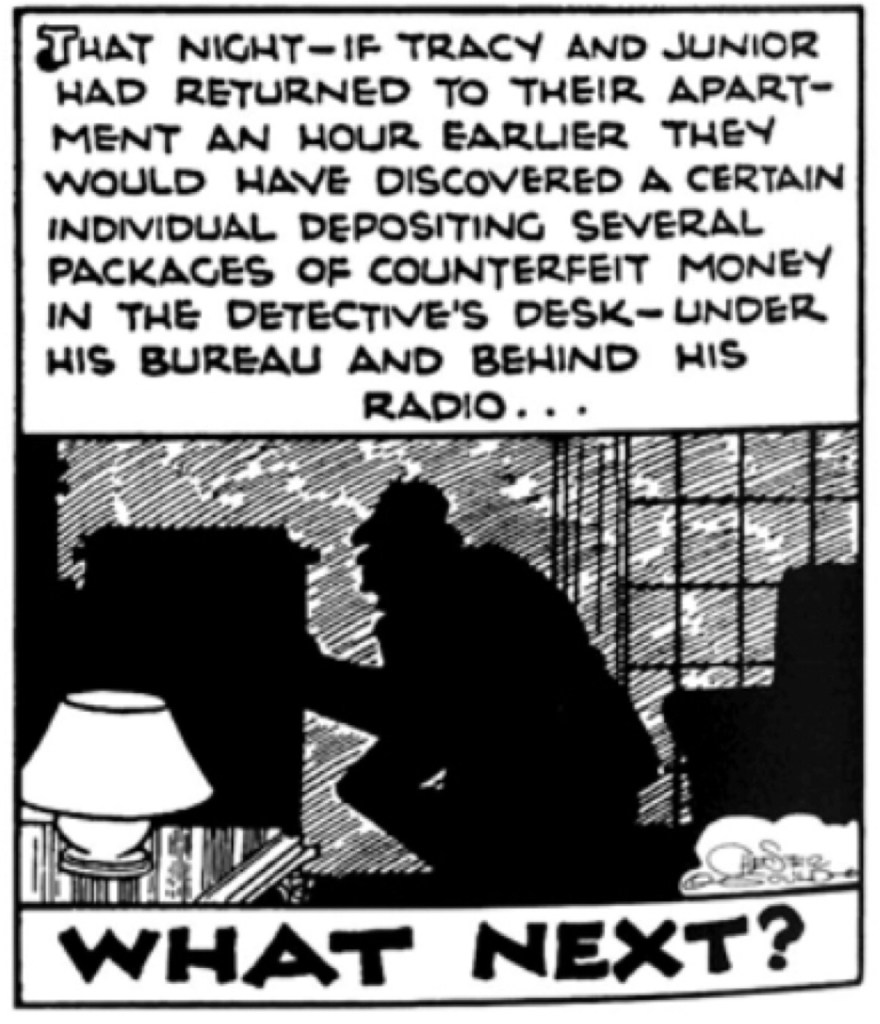
Stooge plants counterfeit bills on Tracy, who eventually is confronted and accused.
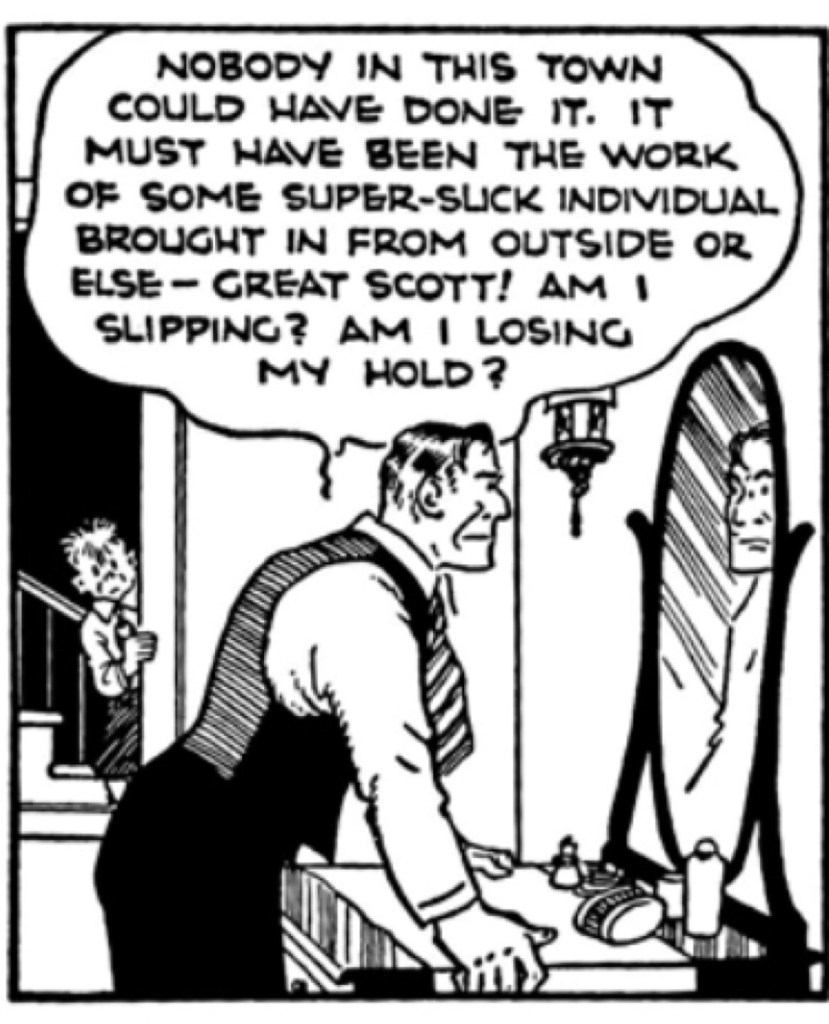
Our hero feels the world collapsing around him and descends into the bane of masculine mythos – self-doubt.
By 1933, Chester Gould ‘s overall style is gelling around those signature thick lines and dense bodies, those wonderful masses of black. But he is also experimenting with evocative design ideas. Here Dick’s emotional nadir, Tess Trueheart’s rejection, is depicted as a full-on silhouette strip.
And adding insult to male ego injury, Stooge moves in on the disillusioned Tess. In the strip’s early years especially, Gould deployed a range of female stereotyping on poor Tess. Often flighty or naive, she was a gender foil for the dripping masculinity of Dick Tracy. As we covered in an earlier post, neither Gould nor his avatar Tracy were progressive feminists by any means.
While Gould’s style and design sense evolved mightily throughout the 30s, and his imagination just got zanier, one thing never evolved – his reliance on unlikely plot contrivances. Viller’s scheme and Tracy’s innocence are revealed to Tess when she finds a draft of Stooge’s wire to Eastern gangsters that conveniently narrates his entire plot against her estranged boyfriend.
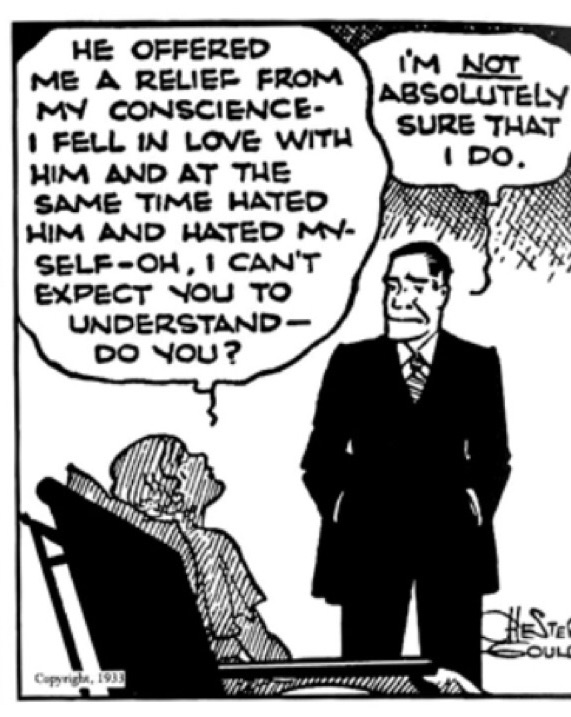
When Tess ends up getting shot in the course of her misadventure with Stooge, we have to wonder if this is Gould himself expressing some resentment towards her loss of faith in Dick. The panel in which she declares herself a fool is a wonderful composition that frames her frail, swooning, naive femininity against the burly expanse of the Chief’s grimace, perhaps voicing Gould’s own disappointment in her.
When Dick and Tess do finally reunite and reconcile, Gould exercises what would become a signature move for him, a radical juxtaposition of mood and action from one panel to the next. Gould had a talent for using the panel structure to jar the reader, to interrupt a mood in one panel with a surprising twist in the next. In this case a romantic interlude is upset by the capture Stooge inexplicably trying to slit his own throat.
It goes without saying that in a strip focused mainly on dramatizing the masculine prowess of his hero Chester Gould showed no understanding or sympathy for his female characters. Not surprisingly, he is equally inept even at drawing human intimacy. Tess and Dick’s kiss has all of the romance and finesse of a fender bender.
And yet we wee in the Stooge Viller episode Gould clearly expanding his palette and moving towards more stylized approach to depicting character and capturing mood and emotion especially through shadows and literally dimming the lights on scenes that try to dramatize deeper emotion.
Stooge Viller would be among a small handful of Tracy villains to recur over many years. He proves to be a deft nemesis in the detective’s early years. He is a clever schemer who seems smarter than the glorified thugs of the earliest strips. At Stooge’s hands, Tracy is put out to the physical and psychological wilderness. Stooge not only frames Tracy as a counterfeiter and gets this beloved cop drummed from the force, but he steals Tess’s affections. Tracy’s career, reputation and girl are taken from him all at once, a true trifecta of masculine humiliation.
The hero of pulp adventure seemed compelled to enshrine masculinity by having it beaten down. In order to triumph, heroes must be bound, trapped, tortured, emasculated or simply ruined by villainy before emerging from humiliation to assert their power. This eccentric opera of masculinity in pop fiction has always led to weird homo-erotic depictions of S&M, bondage, dominatrix encounters, subjugation, and banishment of all sorts. The classic heroes of myth had to suffer taxing encounters with nature and monsters to complete their quest or rescue the land. But the peculiarly American style of pulp heroism often required male humiliation of some sort in order for our hero to assert the righteousness of his masculine power.
Most media, cultural and certainly women’s studies historians have long understood that the post-WWII era represented a twisted nadir for the representations of women in American popular culture. During wartime, women famously took on more prominent, responsible and even strenuous roles in the workforce than ever before. And once the war ended and the male troops returned, these same women upon whom the home front depended were explicitly urged by ever quarter of American society to surrender these gains for the sake of passing these jobs back to the traditional male breadwinners. There was nothing subtle to this process either. Many women were badgered back into domesticity, often accused of “stealing” livelihoods from returning veterans. Other aspects of popular culture like the the rise of the femme fatale trope in noir and crime fiction, the ditzy blonde bombshell, the irrational, imbalanced feminine figure in thriller genre – all helped undermine the legitimacy of women taking more powerful roles in the post-war “man’s world.”
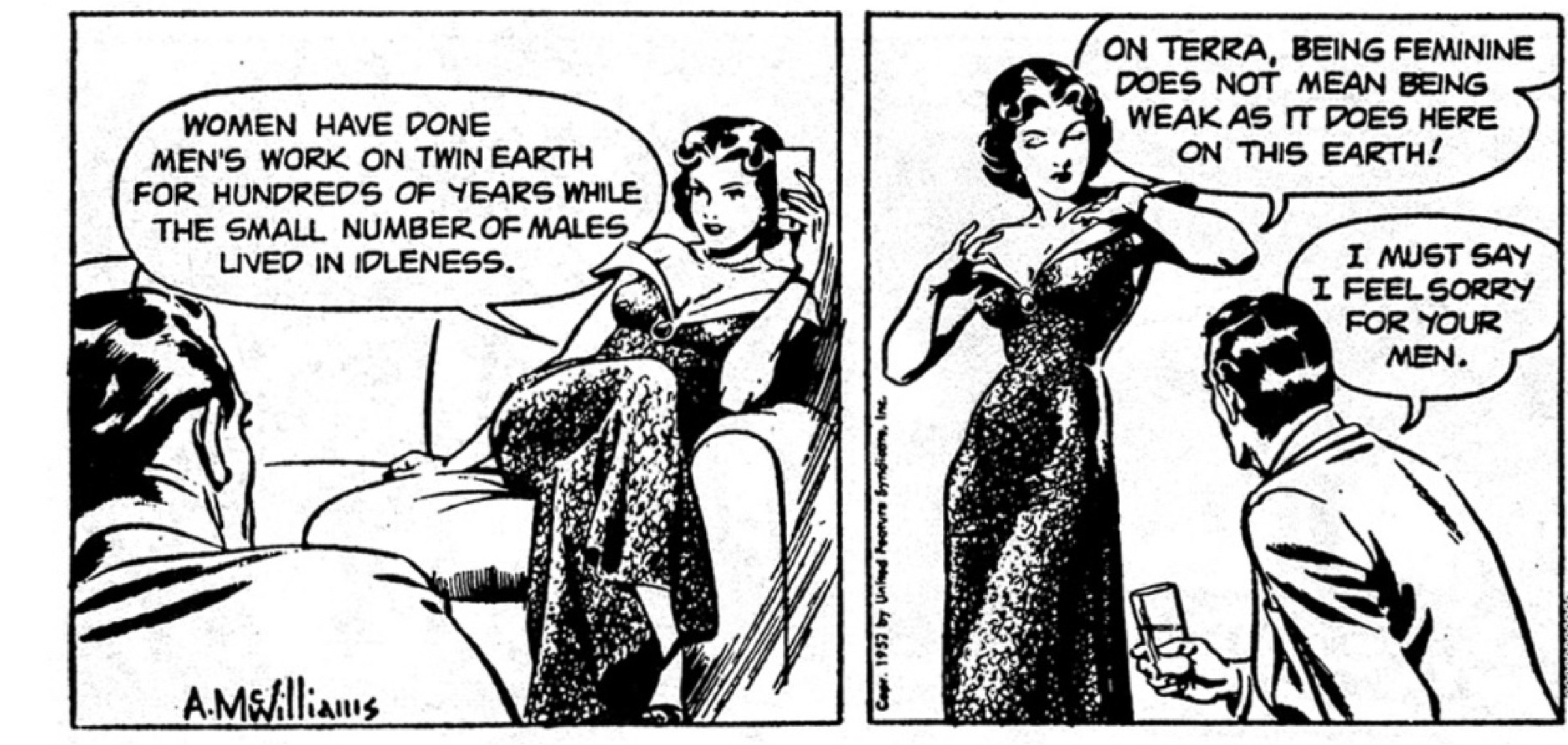
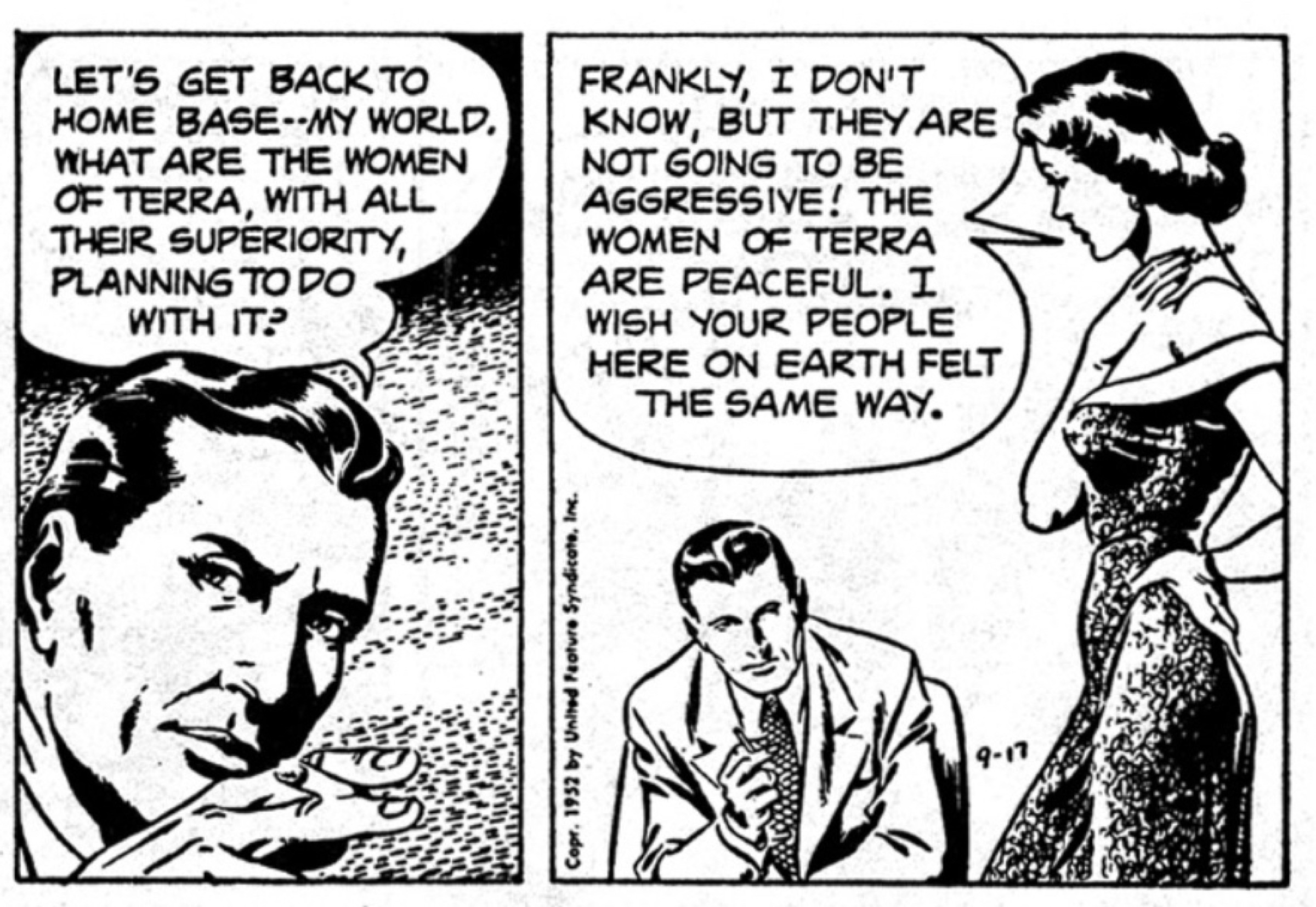
This context makes the premise of the Twin Earths sci-fi strip all the more curious and fascinating. Running from the middle of 1952 to 1963 in dailies and 1953-1958 in a separate storyline in Sundays. When the overlooked strip is remembered at all, it is for some prescient gadgetry that anticipated later everyday tech. To be sure, the writing by comic book illustrator and editor Oskar Lebeck and drawn by comics veteran Al McWilliams was often leaden and unexciting. But Twin Earths was home to some genuinely intriguing and thoughtful futurism that echoed literary science fiction. And as I make my way through the strip’s early years, it is the basic premise of Twin Earths’ divergent social organizations that is most striking. The twin Earth (Terra) is a female-dominated society where a diminishing population of males is retained mainly as idle breeders. The Terran spy Vala infiltrates our earth to ensure this male-dominated planet is not developing its technology towards destructive ends. She pairs up with FBI agent Gary Verth to avoid Communist spies and assassins from her own host planet. The banter between the two, especially Vala’s accusations of masculine aggression (an early take on male “toxicity”?) is a remarkable standout at a cultural moment when most popular culture sought to diffuse, defeat and mock women aspiring to power.
By 1937, Harold Gray seemed to have fallen into an especially foul mood. It was several years into his nemesis F.D.R.’s “New Deal,” which Gray felt represented everything he and his “Little Orphan Annie” disdained: social uplift, misguided do-gooders, institutional authority. From the start, Gray was never shy about voicing his populist perspectives and what he saw as core agrarian values of self-reliance, individualism, and deep suspicion of government bureaucracy of all sorts. His chief scholar, Jeet Heer, has done a much better job than I can here outlining Gray’s vein of Populism and how it ran much deeper than knee-jerk reactionary conservatism. And I have argued in these posts how Gray’s cultural politics were grounded in familiar mid-western traditions and a tension between 19th Century values of “character” and 20th Century notions of “personality. But it is clear that in response to FDR and the popularity of the New Deal Gray got more radical and vocal about his views. And perhaps not coincidentally, the strip grew even darker in the later 1930s.
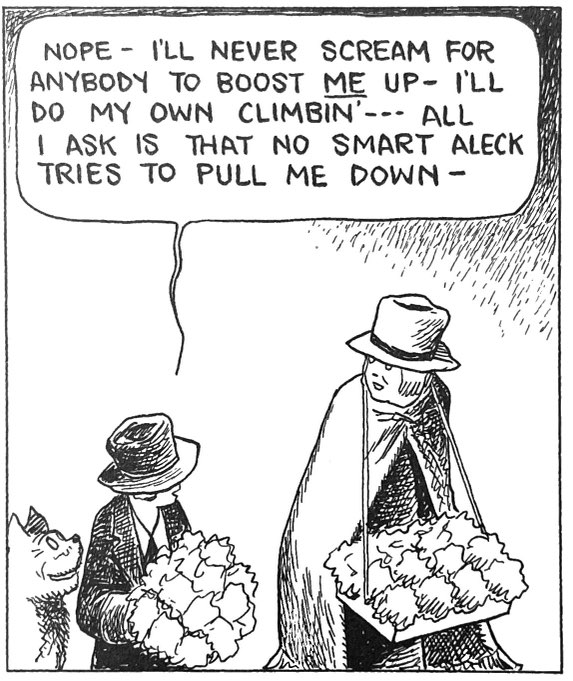
As Here argues in the introduction of the 7th volume of the Library of American Comics reprint series, Annie was always a gritty, street-smart tale, but Gray usually kept physical violence off-panel. Yet, as the strip approached its creative height in 1936-38, that violence started moving into frame. Heer argues that Gray likely was responding to world conflicts, a greater personal sense of mortality as well as competition from more action-oriented strips that dominated the 1930s. I think Gray may also just have been growing angrier and more resentful towards a culture from which he felt ever more alienated. Gray’s moral vision was always as as simple and plainspoken as his drawing style – venal villainy countered by saccharine sentimentality. But it is clear, Gray was getting darker and seeing the world in starker ways by 1936. In fact the lead-up to one of the most jarring bits of in-panel violence in Little Orphan Annie begins with a remarkable Sunday strip on Oct. 8, 1936 that maps the modern world as a perennial “jungle” of predators and good-hearted strivers. As Annie’s newfound friend and flower-seller Ginger, reflects, “But the rules are still jungle – the survival of the fightingest.”
In the coming weeks, Gray uses Ginger as his populist mouthpiece. Annie had always been a chatty strip to begin with, but in these months the moral bromides, punditry and snide asides crowded most panels. Gray clearly had a lot to get off of his chest…about the corruption of politicians and lawyers and their collusion with thugs…about the mixed motives of “uplifters”…about the productivity and generosity of earned wealth…the moral hazard of handouts and unearned wealth. Gray was not a simplistic or sentimental reactionary. He had relatively progressive racial views. And as he outlined through Ginger in these months, his sense of individualism was a principled rejection of the sociological generalizations he saw driving a lot of reformist uplift and welfare. His populist sociology rejects environment as determinative of behavior.
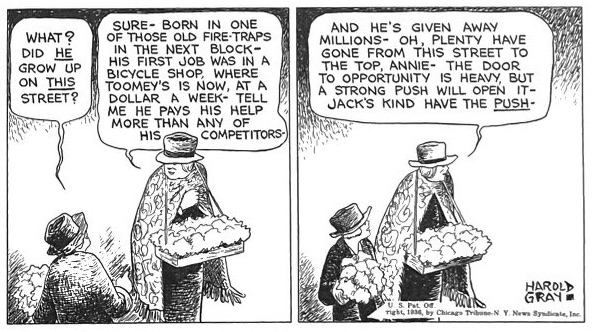
No one ever accused Harold Gray of subtlety. Annie was as much folk punditry as it was an adventure. But he was artful, albeit dogged, in creating opportunities for his avatars to voice another homily. A street fight triggers bromides on rising out of the “hard kindergarten” of the streets. Passersby making an offhanded comment on these city kids not getting a chance in life set up Ginger’s counter-argument about the dangers of unearned advantage. Meeting an old friend lets her reflect on the morality and generosity of earned wealth. And all of this in just three strips.
Gray’s wordiness can divert us from his considerable and evocative graphic skills. He visualizes his principles and arguments that are as clear and un-subtle as his ideology. The street scenes in the Oct. 26 strip above illustrate the teeming diversity, the danger, raw violence of the city as well as the individuality of the humanity he sees there. That third panel depicting the “rushing tide of life” expresses at once a suffocating crowdedness and individuation.
Gray’s visual voice was singular and somehow it succeeded in establishing his mixed view of humanity, society and the cosmos. His laudable human figures were usually solid, husky and well-planted. Annie herself has tree trunk legs that look and feel organically rooted in much the way his friend Chester Gould like to plant Dick Tracy in the frame. It is the visual embodiment of self-reliance and resilience. The infamous hollow eyes of Gray’s cast underscore how little he and many other daily cartoonists relied less on facial expression and more on words, composition and action in a frame to express feeling. Much like Frank King and Gasoline Alley, Annie visualized the plain spoken style of its creator.
While they were very different artists, to be sure, Gould, King and Gray had visual voices that helped define the worlds we were in for those three or four daily frames. That to me is one of the comic strips’ singular aesthetic qualities, to establish diverse and distinct fictional worlds through these signature styles. For Gray it took the shape of bulky, pillowy figures that lived in a 2D world of little forced perspective or even movement. Gray’s characteristic hatch work helped communicate a grimness to his worldview – the persistence of shadows. Arguably, he did not have the stylistic talent or range of many peers. King had a great sense of panel pacing and rhythm, a feel for place and landscapes, he used relentlessly. Gould leaned heavily on his penchant for muscular action, grotesque violence, forced perspective and those vast planes of inky blacks.
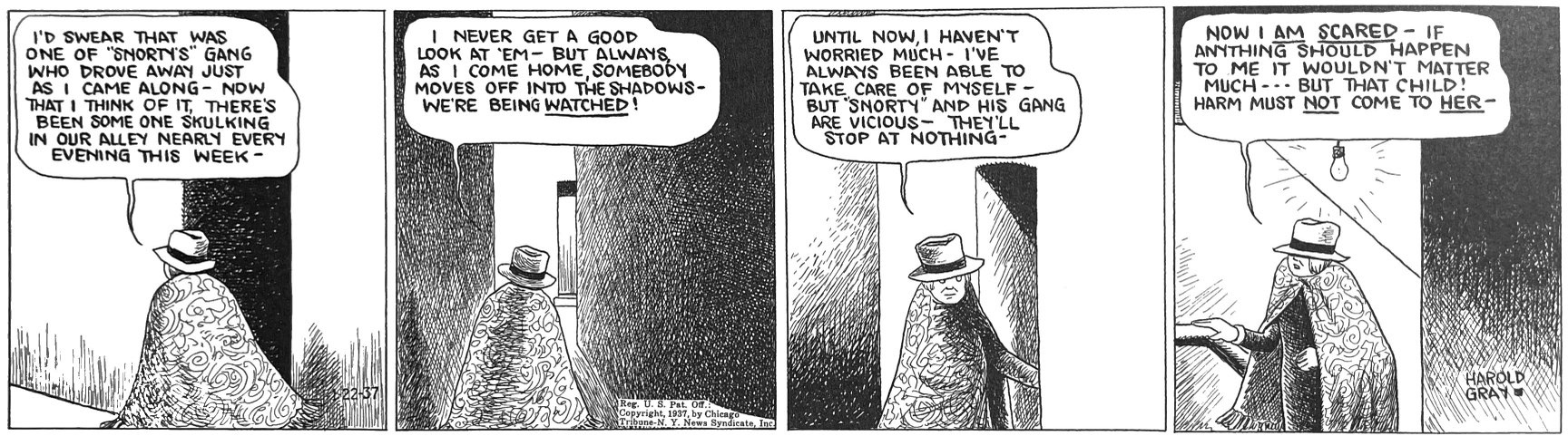
Gray flexed his style sparingly. But he was capable of great visual power. In the run up to the tragic violent death of flower lade Ginger, we get this gorgeous showcase of crosshatched planes, light-source, and cross-cut pace that feels like German Expressionist film.
The local gang of hoods target Ginger because she refuses to pay into their protection racket. Her graphic murder that comes days after the foreboding strip above is a rare instance of a Gray panel exploding in explicit violence.
It is probably best that Gray depicted violence so sparingly. He wasn’t very good at it. But this moment is of a piece with the months of the strip’s immersion in the modern city and its many musings on the modern “jungle.” And it embodied the emotional energy, perhaps even the anger and pessimism that seemed to drive what many comics historians regard as his creative peak in the storylines and characters in the last half of the 1930s.
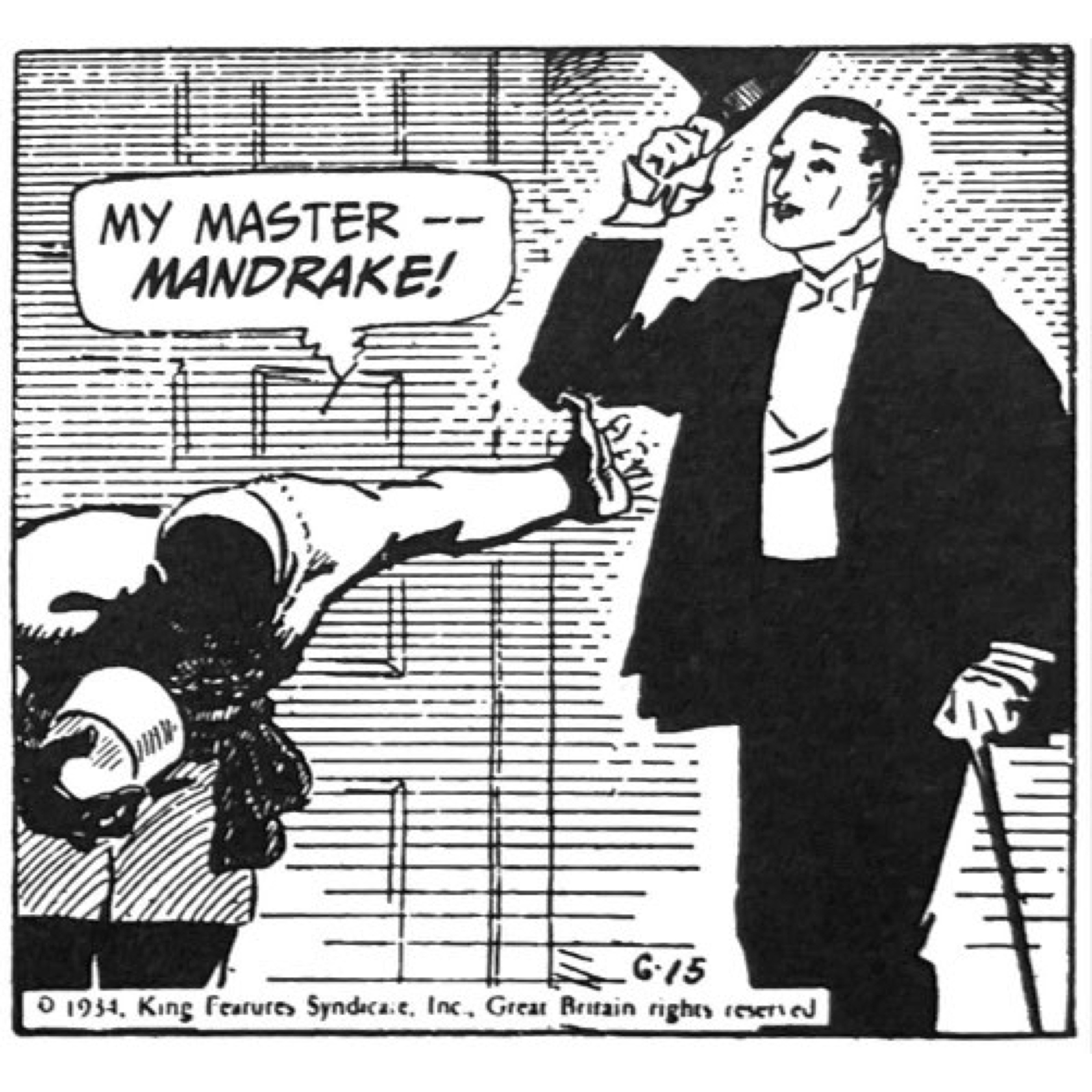
It took a full week of strips for the eponymous hero of Lee Falk’s Mandrake the Magician strip to make his grand entrance. June 11, 1934 was the first strip, which evokes some of the feel of a classic mystery wind-up. But on June 15, in what has to stand as one of the most unambiguously racist intros in pop culture history, Mandrake’s “servant” Lothar heralds the coming of his “master.” One doesn’t even know where to start here. Falk’s full bore colonialism is more fully and relentlessly explored in his later The Phantom series whose origin we covered here and whose fetishes we covered here.
For all of its weaknesses, Mandrake remains important both to comic strip and comic book history in that his is the first strip to move towards a super-powered hero. Mandrake’s “magic” is only nominally super-natural, in that it is based on the power of suggestion and influence over others’ minds. But it precedes the appearance of Superman by 5 years and aldo nods towards costumed heroism, which would be more fully introduced in Falk’s The Phantom.

















 Panels & Prose