

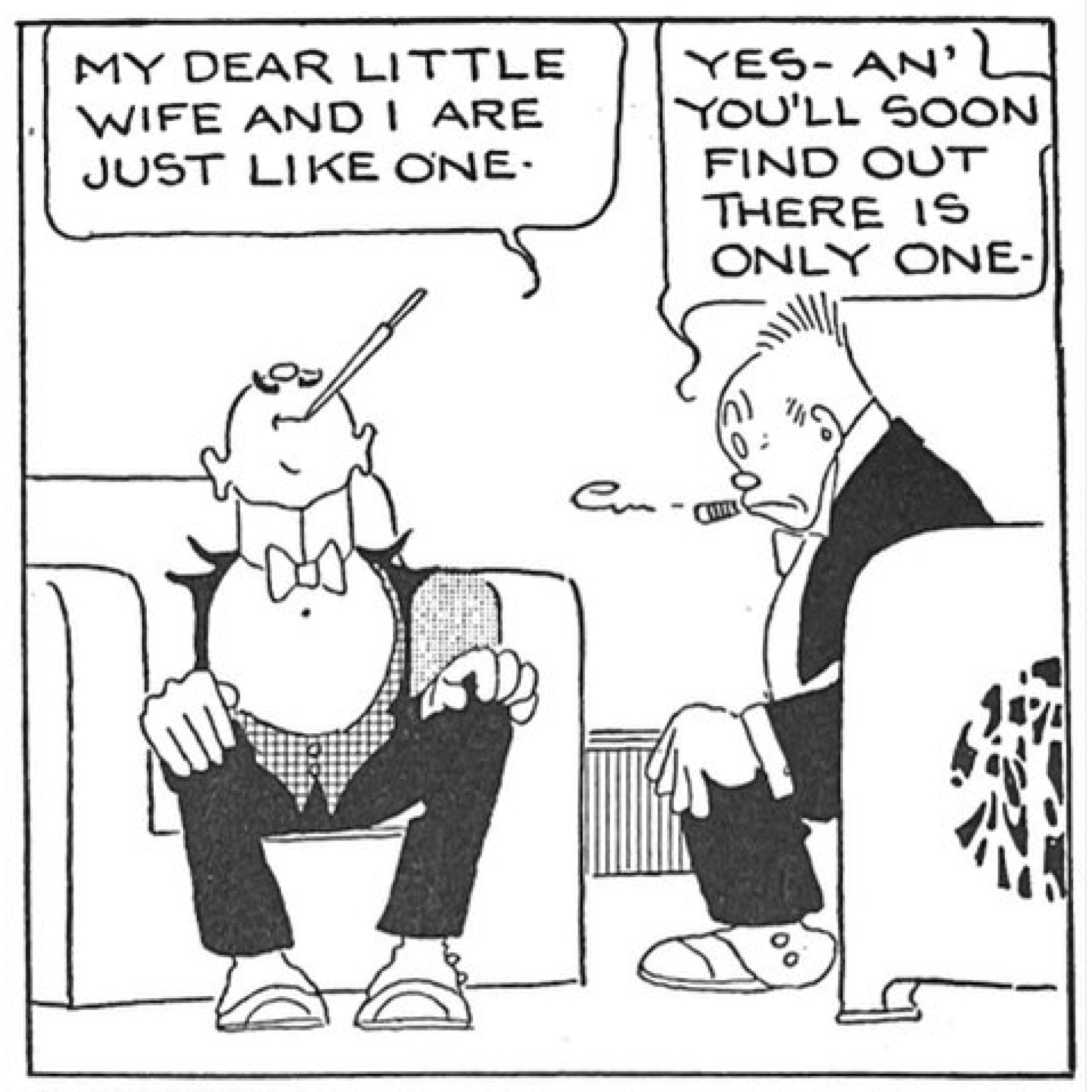

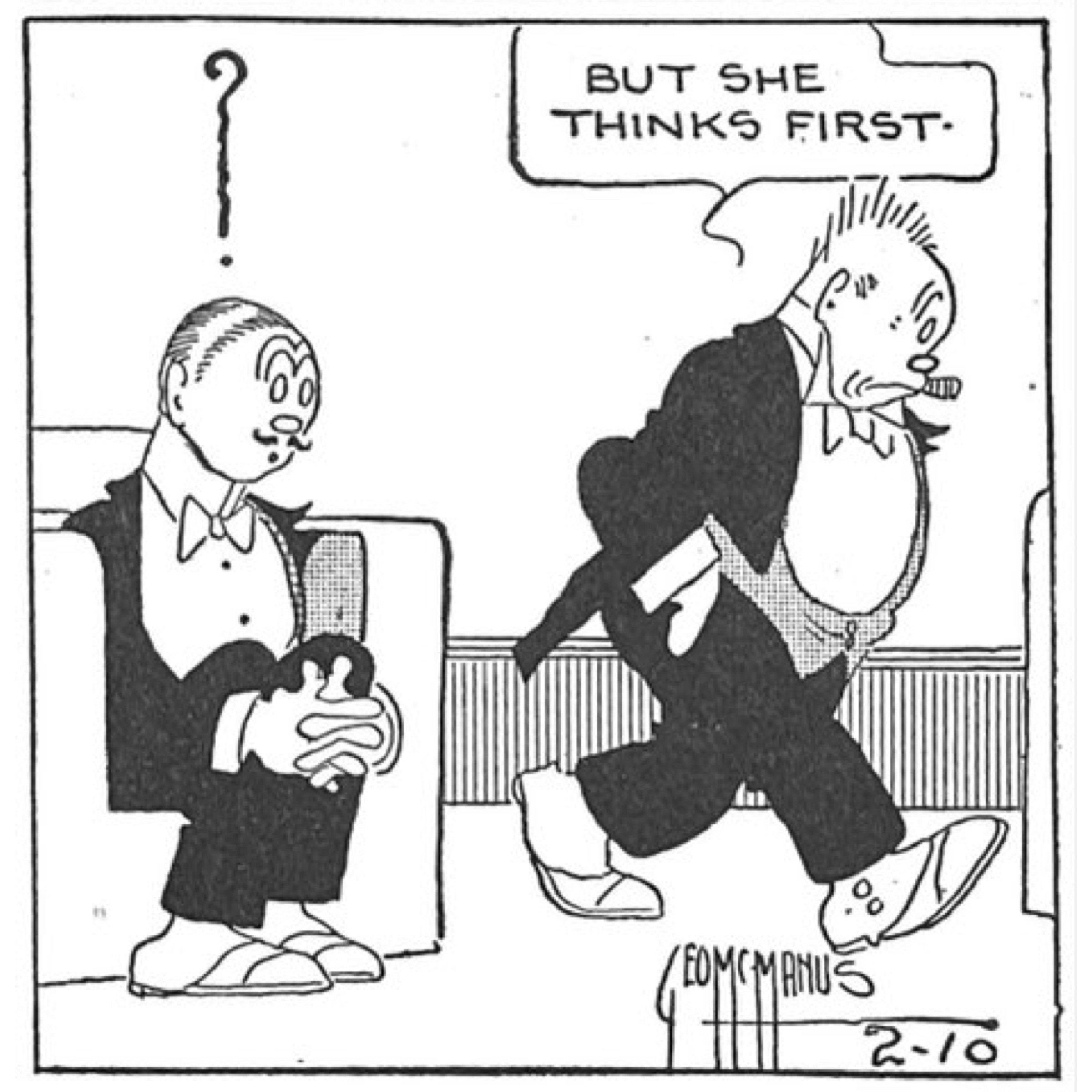
Comic disharmony between Jiggs and Maggie over their social climb was the central joke of George McManus’s Bringing Up Father for over four decades. For all of McManus’s fine sense of humor, he banged that one note across four panels six days a week and a full page every Sunday. To be sure, he layered in nuances of class and generational conflict. Jiggs was a hod carrier who struck it rich, never adjusted to his own ascent, and clashed with wife Maggie and daughter’s ambitions to join the social elite. The dynamic was rich with potential and embodied the experience of millions of American emigrees moving into the modern middle class. But many of the daily strips tediously replayed Jiggs’s sneaking out to his former watering hole Dinty Moore’s, embarrassing his family with etiquette transgressions or ducking Maggie’s thrown dishes. These were conventions that American newspaper readers enjoyed hearing for a handful of panels and 30 seconds a day over its 87-year run. McManus, however, was especially adept at maintaining reader interest in the familiar with his mastery of visual style, panel sequencing and timing.
Continue readingTag Archives: comics and culture
Can This Villain Destroy Dick Tracy?

Foreshadowing some of the more colorful arch-villains in the 40s and beyond, Dick Tracy’s early 1933 encounter with Stooge Viller was a standout as Chester Gould developed his style and focus. Stooge is imported to the city by a broken crime ring to discredit the now-famous gangbuster Dick Tracy. He is a master pickpocket and a bit of an effete dandy. He successfully frames Tracy and even causes Tess Trueheart to fall out with the love of her life.
Here we get our introduction to Stooge.
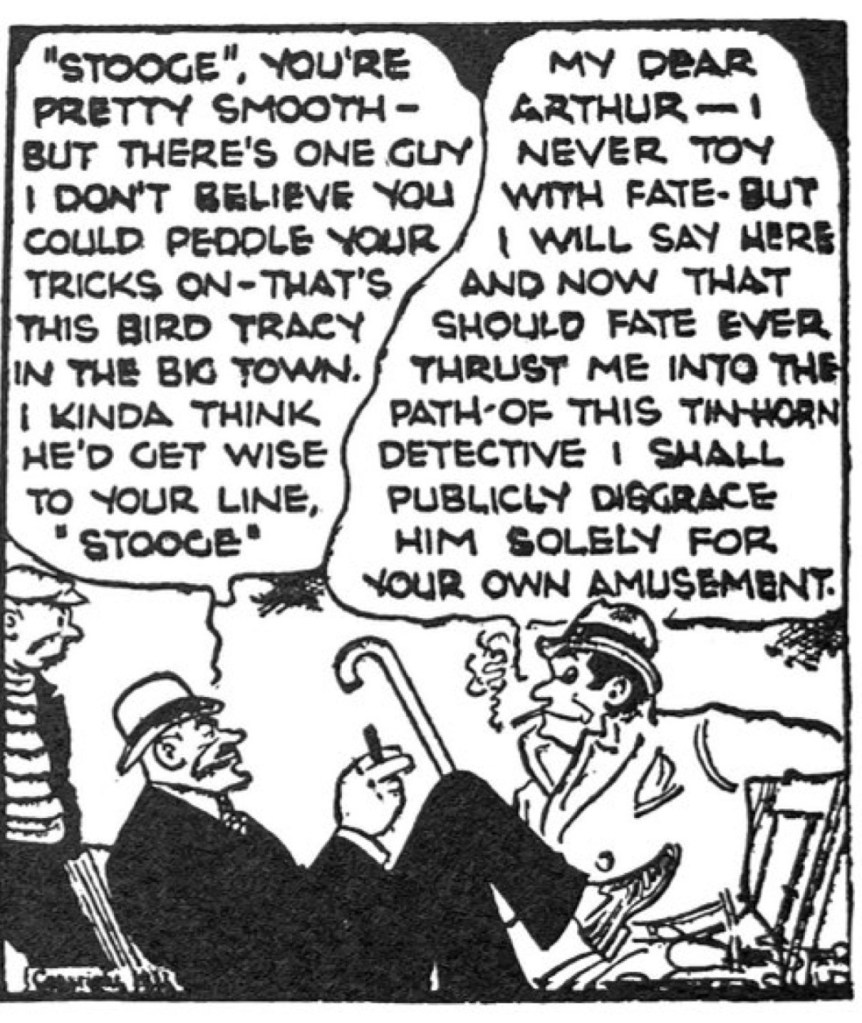
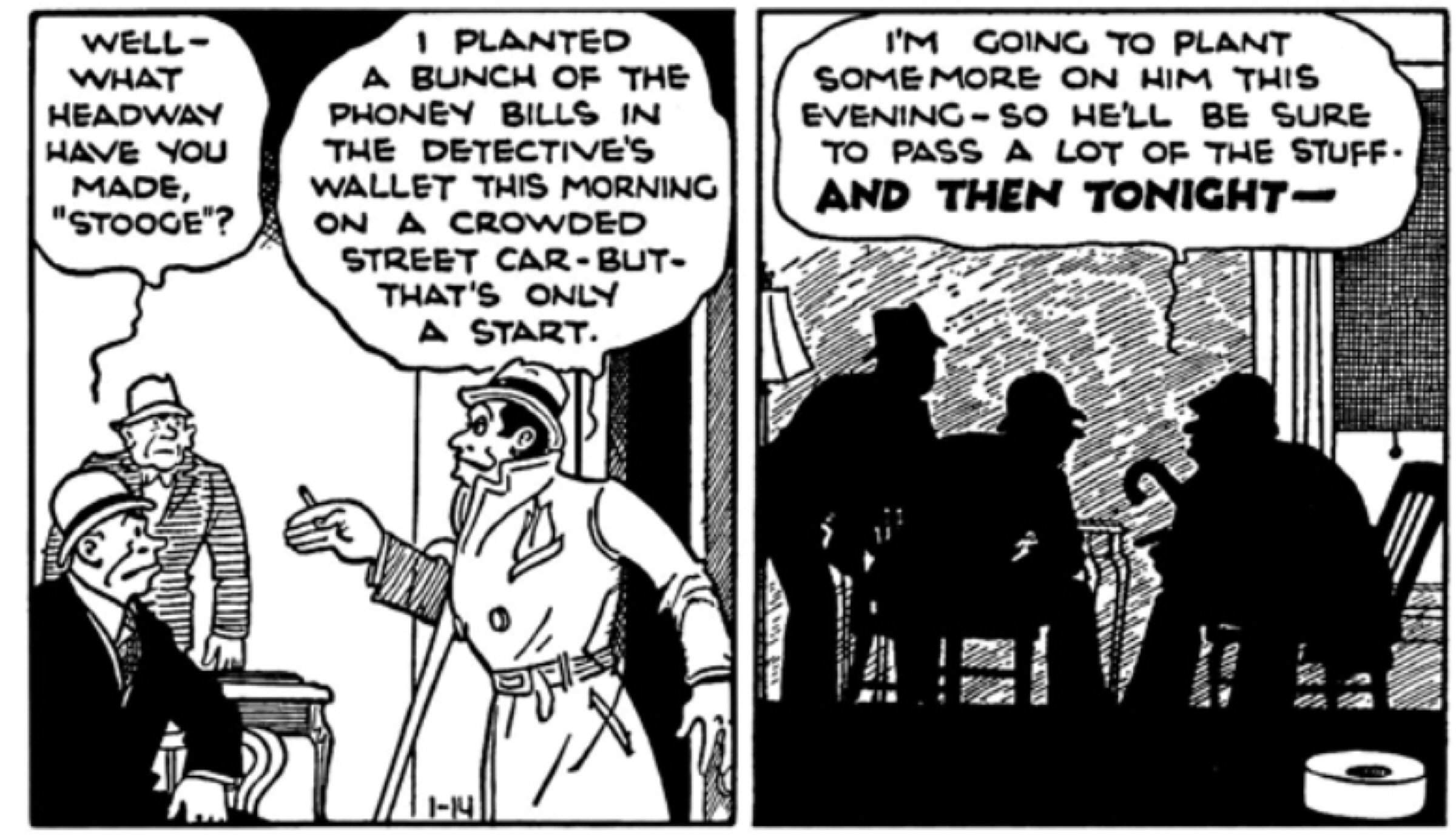

Stooge plants counterfeit bills on Tracy, who eventually is confronted and accused.
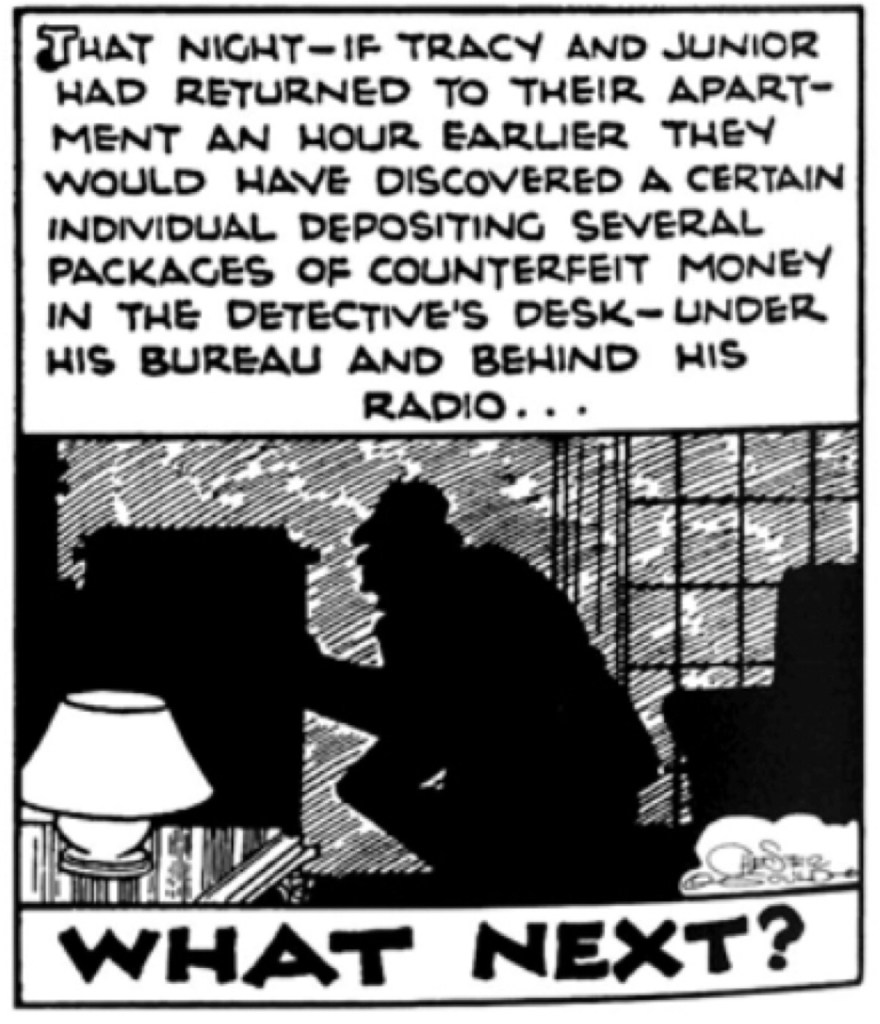
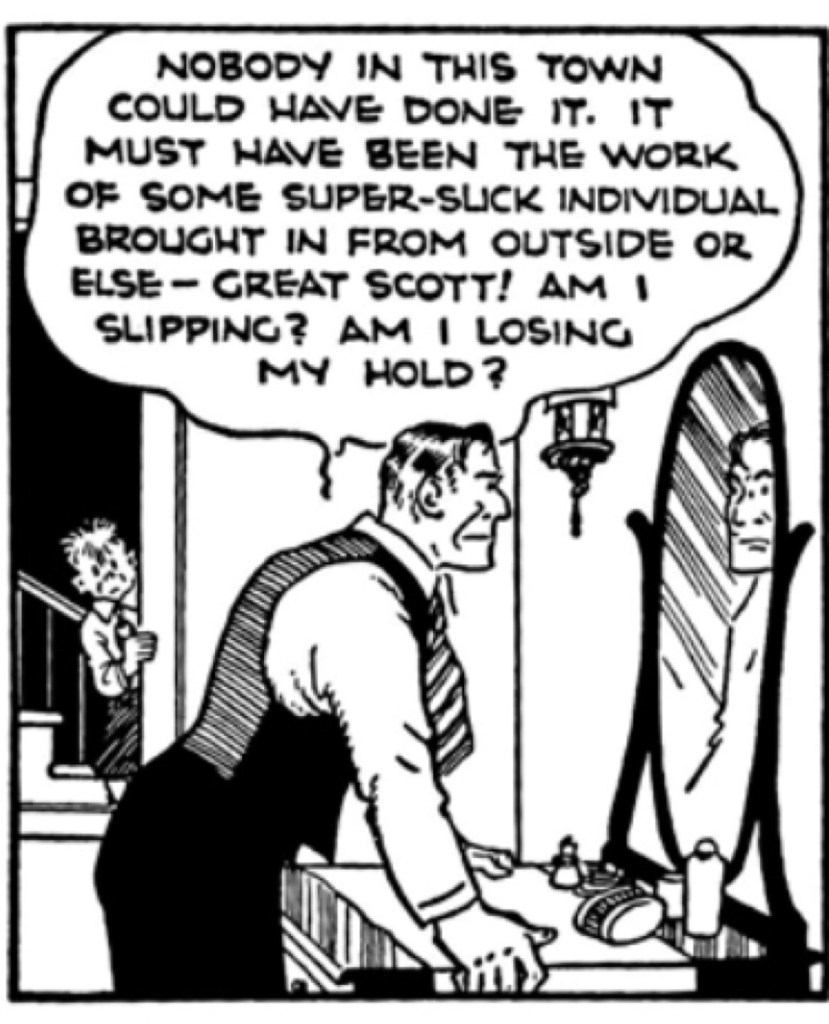
Our hero feels the world collapsing around him and descends into the bane of masculine mythos – self-doubt.
By 1933, Chester Gould ‘s overall style is gelling around those signature thick lines and dense bodies, those wonderful masses of black. But he is also experimenting with evocative design ideas. Here Dick’s emotional nadir, Tess Trueheart’s rejection, is depicted as a full-on silhouette strip.


And adding insult to male ego injury, Stooge moves in on the disillusioned Tess. In the strip’s early years especially, Gould deployed a range of female stereotyping on poor Tess. Often flighty or naive, she was a gender foil for the dripping masculinity of Dick Tracy. As we covered in an earlier post, neither Gould nor his avatar Tracy were progressive feminists by any means.


While Gould’s style and design sense evolved mightily throughout the 30s, and his imagination just got zanier, one thing never evolved – his reliance on unlikely plot contrivances. Viller’s scheme and Tracy’s innocence are revealed to Tess when she finds a draft of Stooge’s wire to Eastern gangsters that conveniently narrates his entire plot against her estranged boyfriend.
When Tess ends up getting shot in the course of her misadventure with Stooge, we have to wonder if this is Gould himself expressing some resentment towards her loss of faith in Dick. The panel in which she declares herself a fool is a wonderful composition that frames her frail, swooning, naive femininity against the burly expanse of the Chief’s grimace, perhaps voicing Gould’s own disappointment in her.
When Dick and Tess do finally reunite and reconcile, Gould exercises what would become a signature move for him, a radical juxtaposition of mood and action from one panel to the next. Gould had a talent for using the panel structure to jar the reader, to interrupt a mood in one panel with a surprising twist in the next. In this case a romantic interlude is upset by the capture Stooge inexplicably trying to slit his own throat.
It goes without saying that in a strip focused mainly on dramatizing the masculine prowess of his hero Chester Gould showed no understanding or sympathy for his female characters. Not surprisingly, he is equally inept even at drawing human intimacy. Tess and Dick’s kiss has all of the romance and finesse of a fender bender.

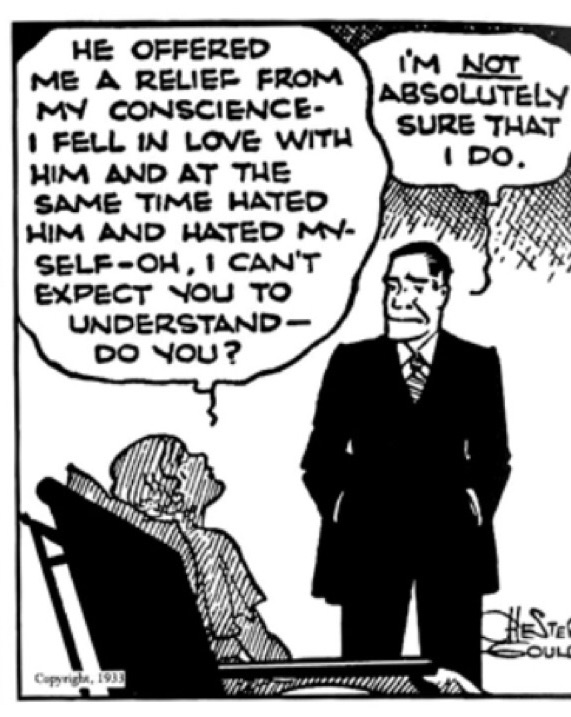
And yet we wee in the Stooge Viller episode Gould clearly expanding his palette and moving towards more stylized approach to depicting character and capturing mood and emotion especially through shadows and literally dimming the lights on scenes that try to dramatize deeper emotion.
Stooge Viller would be among a small handful of Tracy villains to recur over many years. He proves to be a deft nemesis in the detective’s early years. He is a clever schemer who seems smarter than the glorified thugs of the earliest strips. At Stooge’s hands, Tracy is put out to the physical and psychological wilderness. Stooge not only frames Tracy as a counterfeiter and gets this beloved cop drummed from the force, but he steals Tess’s affections. Tracy’s career, reputation and girl are taken from him all at once, a true trifecta of masculine humiliation.
The hero of pulp adventure seemed compelled to enshrine masculinity by having it beaten down. In order to triumph, heroes must be bound, trapped, tortured, emasculated or simply ruined by villainy before emerging from humiliation to assert their power. This eccentric opera of masculinity in pop fiction has always led to weird homo-erotic depictions of S&M, bondage, dominatrix encounters, subjugation, and banishment of all sorts. The classic heroes of myth had to suffer taxing encounters with nature and monsters to complete their quest or rescue the land. But the peculiarly American style of pulp heroism often required male humiliation of some sort in order for our hero to assert the righteousness of his masculine power.
Twin Earths: Matriarchy Meets Patriarchy…In 1952

Most media, cultural and certainly women’s studies historians have long understood that the post-WWII era represented a twisted nadir for the representations of women in American popular culture. During wartime, women famously took on more prominent, responsible and even strenuous roles in the workforce than ever before. And once the war ended and the male troops returned, these same women upon whom the home front depended were explicitly urged by ever quarter of American society to surrender these gains for the sake of passing these jobs back to the traditional male breadwinners. There was nothing subtle to this process either. Many women were badgered back into domesticity, often accused of “stealing” livelihoods from returning veterans. Other aspects of popular culture like the the rise of the femme fatale trope in noir and crime fiction, the ditzy blonde bombshell, the irrational, imbalanced feminine figure in thriller genre – all helped undermine the legitimacy of women taking more powerful roles in the post-war “man’s world.”
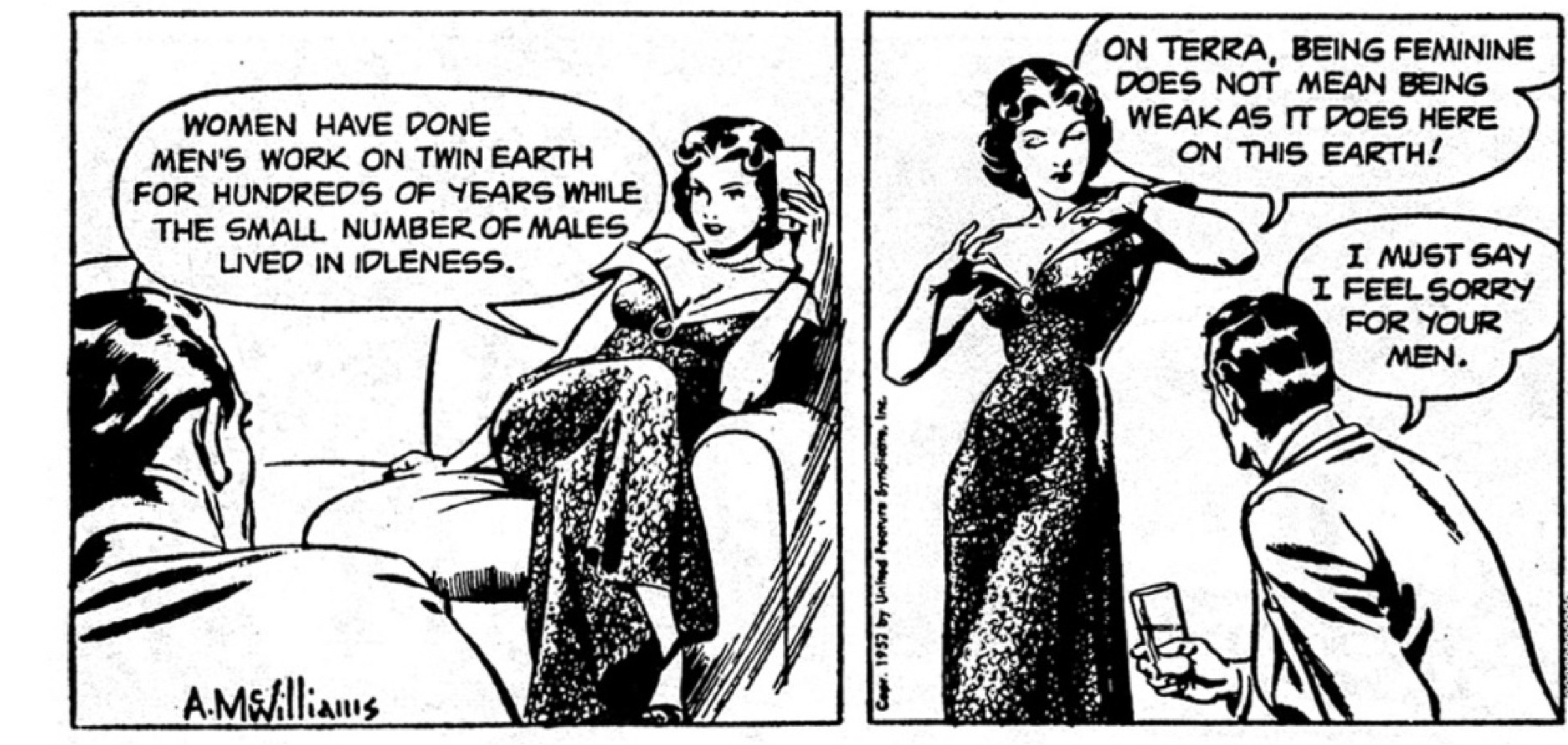
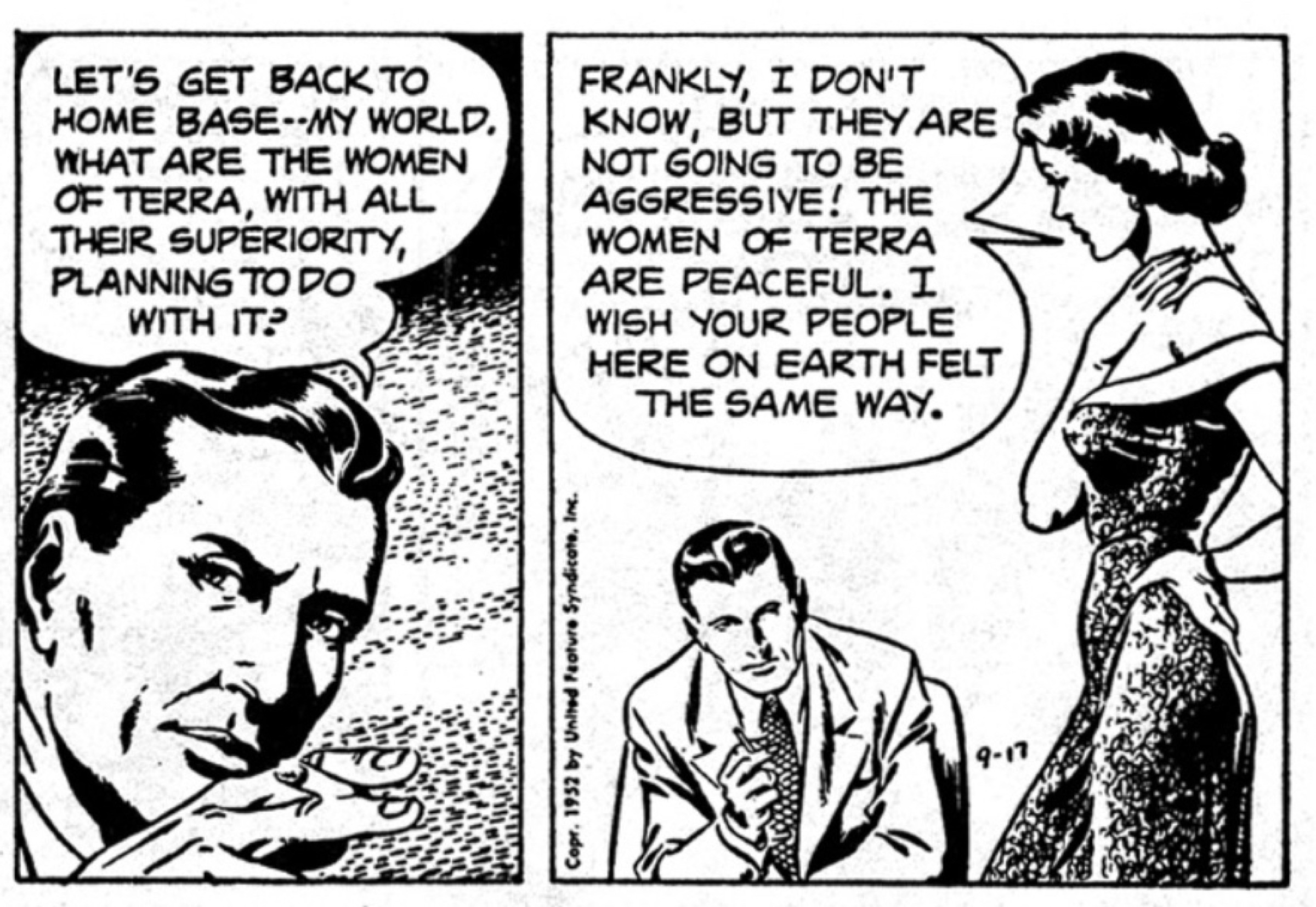
This context makes the premise of the Twin Earths sci-fi strip all the more curious and fascinating. Running from the middle of 1952 to 1963 in dailies and 1953-1958 in a separate storyline in Sundays. When the overlooked strip is remembered at all, it is for some prescient gadgetry that anticipated later everyday tech. To be sure, the writing by comic book illustrator and editor Oskar Lebeck and drawn by comics veteran Al McWilliams was often leaden and unexciting. But Twin Earths was home to some genuinely intriguing and thoughtful futurism that echoed literary science fiction. And as I make my way through the strip’s early years, it is the basic premise of Twin Earths’ divergent social organizations that is most striking. The twin Earth (Terra) is a female-dominated society where a diminishing population of males is retained mainly as idle breeders. The Terran spy Vala infiltrates our earth to ensure this male-dominated planet is not developing its technology towards destructive ends. She pairs up with FBI agent Gary Verth to avoid Communist spies and assassins from her own host planet. The banter between the two, especially Vala’s accusations of masculine aggression (an early take on male “toxicity”?) is a remarkable standout at a cultural moment when most popular culture sought to diffuse, defeat and mock women aspiring to power.


Alley Oop: Off To A Flying Start

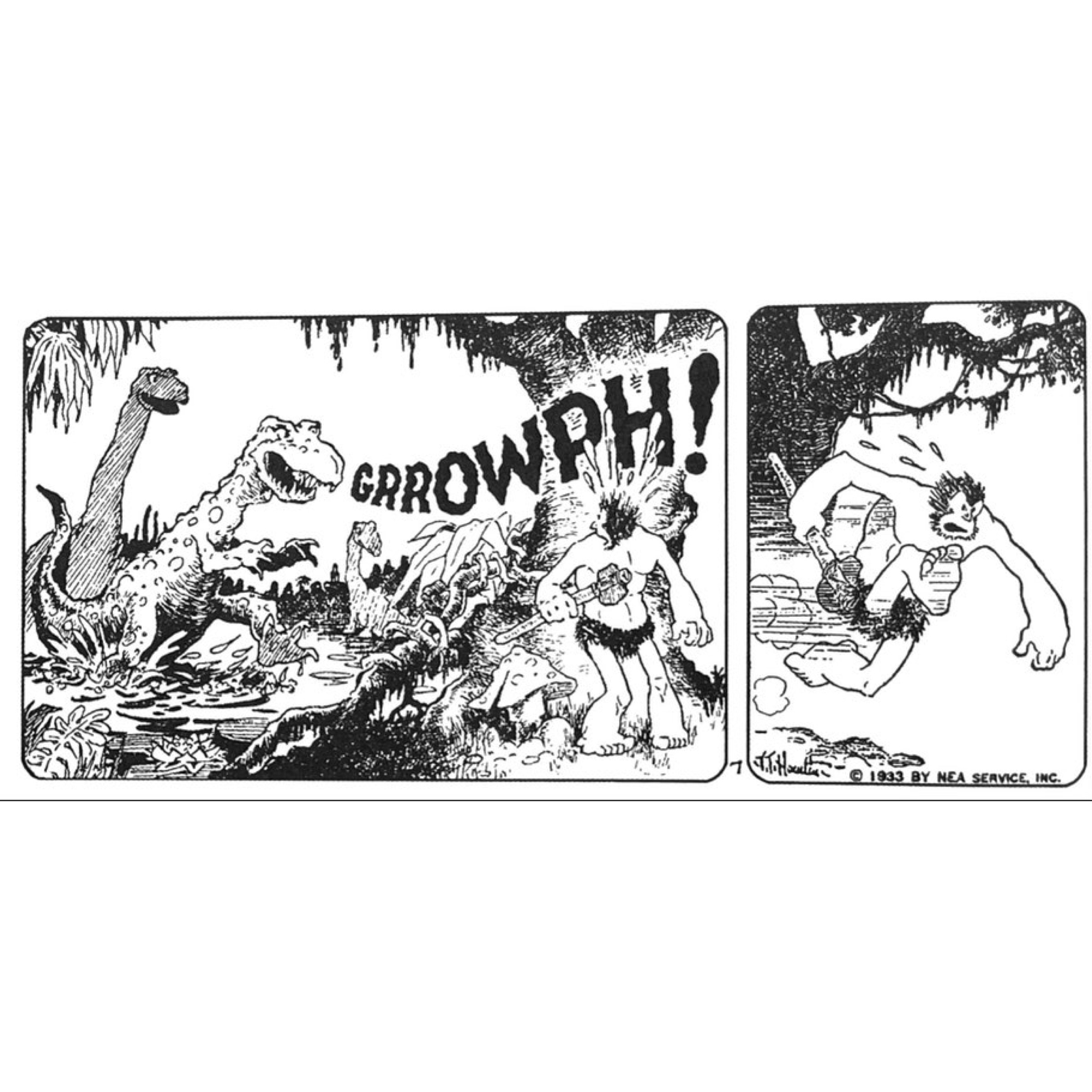
“Off to a Flying Start” is how V.T. Hamlin titled his introduction to the Alley Oop character and world in late 1932. And in fact Hamlin’s eponymous hero cries for help in the opening panel…only to be chased by the prehistoric dinosaurs of this fantastic “Bone Age.” For the next six or seven years, Hamlin’s art and story were at their best when his furry-crowned, thick-limbed everyman scurried at the center of screwball mayhem. We now have a great opportunity to review and reconsider Alley, as the small press Acoustic Learning recently launched reprint series of both Hamlin’s early adventures and later work by his successor Dave Graue.
My first impression diving into Alley Oop is Hamlin’s strong feel for set, background and character design Hamlin had from the beginning. Unlike Segar’s Thimble Theatre, Capp’s L’il Abner and certainly Gould’s Dick Tracy, Alley Oop doesn’t begin in a crude style that only finds its signature style over months and years. Hamlin goes into Alley Oop knowing he wanted to contrast fine-lined, simple but polished characters with detailed and accurate scenery and dinosaurs. Hamlin had a cultivated curiosity about prehistoric creatures in one of his many jobs as an illustrator in the Texas oil industry. He well knew the historical fantasty at the center of Alley Oop. The age of dinosaurs long preceded any human ancestors. But he was dedicated to drawing, naming and animating his Bone Age dinos as accurately as he could.
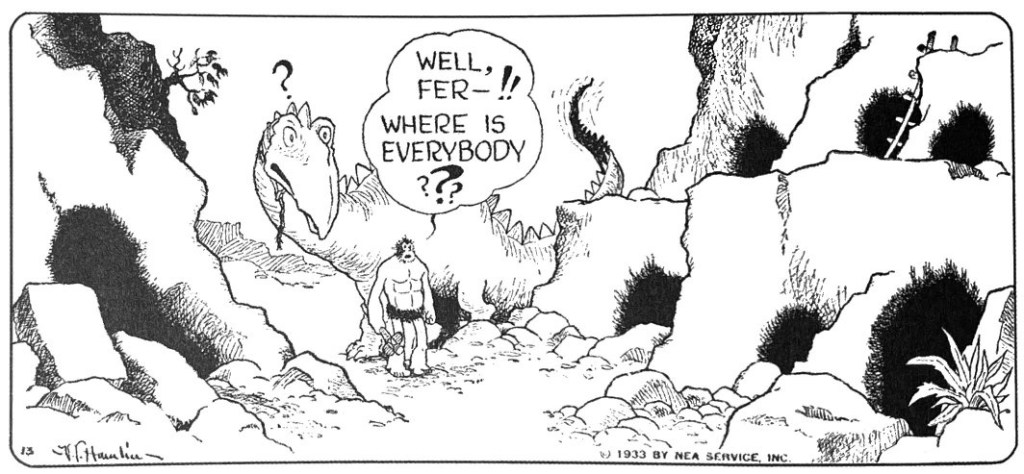
By contrast, his cast of cartoon humans, the males at least, are carefully built with a bit of the era’s deco minimalism. Oop, his rhyming buddy Foozy, Guz, the King of the Moos and the tribes of cave men are small of head, with enviable four-pack abs, and forearms and calves shaped like bowling pins. He builds his characters in order to animate them. Those bottom-heavy limbs become wonderful devices when fleeing, fighting or rioting. The action poses, freeze-frames of punches thrown and received, crowds of cave men imploding or exploding, all have an expressiveness that sits between cartoon abstraction and naturalism. This fine-lined, controlled art style is served very well in this reprint. The strips fully render Hamlin’s thin line shading of background flora and the dinosaurs.
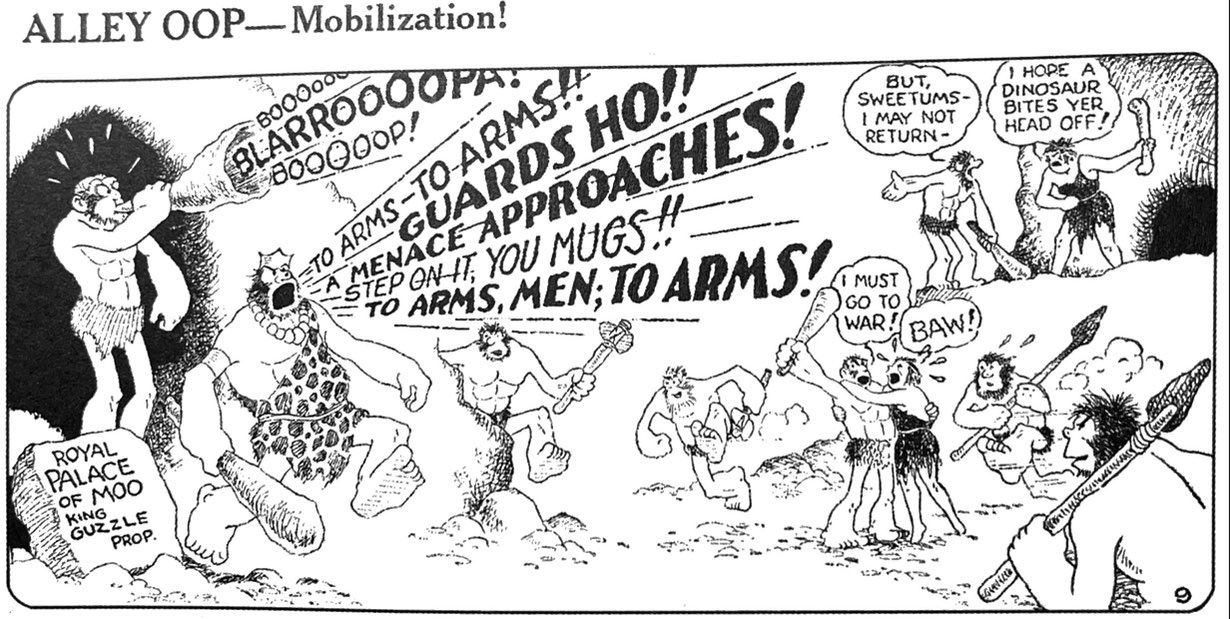
Alley Oop is also one of those rare strips, along with Walt Kelly’s later Pogo, that renders the words as part of the art. From the strip’s first panel, Hamlin shows his distinct deco styling for characters shouting. They move from small to larger type sizes, megaphone-like, into the air. And Hamlin plays with bolding, differing type styles and sizes, words moving in and out of word baloons, to express tones, crowd murmerings, sound effects. In some ways he was bringing to his comic strip layers that mimiced the early days of the talking motion picture, still in its infancy when Oop appears in 1932/33.
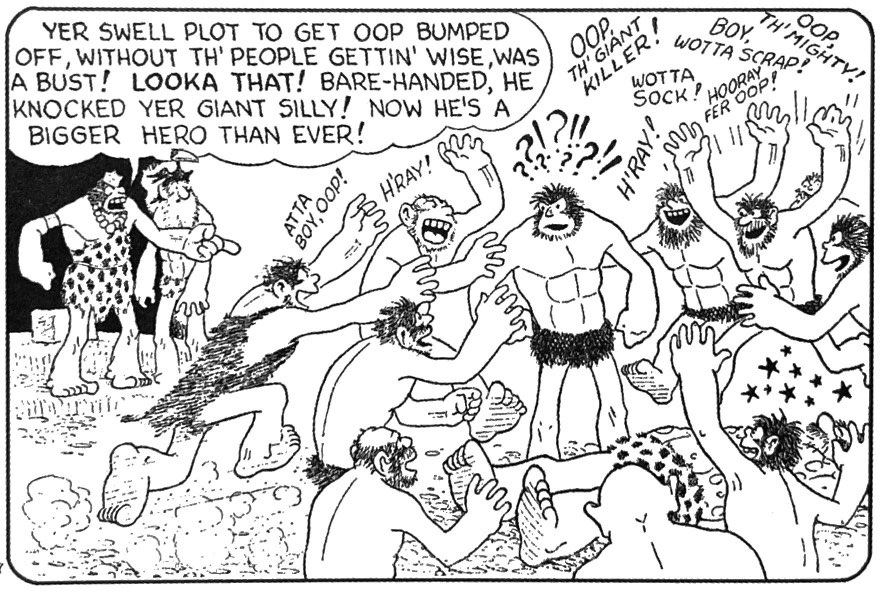
And much like Segar’s approach to Popeye, even Gray’s Annie, Hamlin brings a populist sensibility to the strip. Conventional wisdom suggests that Alley Oop becomes more interesting and a genuine adventure strip in 1939 when he introduced a time travel device that brought Oop and girlfireind Ooola across major historical ages. But from the start, Oop is an everyman hero, good of heart, who is less of an adventurer than a victim of circumstance. He quickly becomes the unintentional antagonist to King Guz, the insecure and thin-skinned leader of the Moos. Guz envies Oop’s popularity when the cave man returns to the tribe astride his tamed pet dinosaur Dinny. Guz’s machinations to retain prestige and diminish Oop is the driving force of the strip’s first year. Oop fits neatly within the pantheon of Depression-era common many heroes. Prohibition, which didn’t end until the December 1933, and a deepening Depression had already undermined public trust in institutional authority, the purity and wisdom of legal and political institutions. Popular culture registered a generalized distaste for authority in everything from the romanticization of gangsters in the press to images of kings, politicians, policemen and bosses as either hapless or imperious. We usually come upon common men like Popeye, Tom Joad, Micky Mouse and Mr. Oop just trying to go about their business, only to become heroic in the face of the moral duplicity (or just stupidity).
As simple and familiar as these everyman heroes may seem, the idea of the inherently moral, simple and unpretentious “nature’s nobleman” runs deep and long in American culture, extending back to the tales of James Fennimore Cooper’s frontier hero Natty Bumppo and Jacksonian politics of the 1840s. American popular literature is filled with examples of the naturally ethical, American individualist asserting basic common sense and morality against both little human and big insitutional corruptions. Cast as he may be in the Bone Age, Oop was certainly in that tradition, one that had special valence to Depression-Era.
Notable Books on Comics, 2021…ish (Part 2)

What made me think harder or differently about the comics medium in the last year or so? That is my main criterion for these occasional roundups of books mainly on comic strips but also about early comics. Some of the titles here are filling in holes in our understanding about the history of the comics forms. Others are calling attention to artists or patterns in comics history that I think bear more thought. And many were just plain fun. Feel free to comment on the books you found most enlightening or entertaining about the comics history.

The Metaphysics (Huh?) of Alex Raymond’s Death
Dave Sim’s (with an assist by Carson Grubaugh) The Strange Death of Alex Raymond (Living the Line) is crazy like a fox. Sim’s ostensible exploration of the tragic death of the highly influential artist behind Flash Gordon and Rip Kirby uses a batshit conceit that some “metaphysics of comics” somehow connects everything from Margaret “Gone With the Wind” Mitchell, Milt Caniff’s quiet envy of Raymond, the wives and lovers of multiple comics artists of the 50s, a few B-movies, and whatever the hell else you can imagine to car crash that killed Raymond in 1956. It is also batshit brilliant. It gives Sim the frame in which to recall (and even redraw) a vast swathe of American pop culture and artists that drove the changing styles of 1950s comic strips. At its most lucid, the book delineates the different realisms of Hal Foster, Caniff and Raymond, the development of the photorealistic style, even the nuts ad bolts of brush and pen work. Along the way, forced me to contextualize and appreciate strips like Big Ben Bolt, Twin Earths, and the post-Raymond Kirby years. He brilliantly injects a whining Charlie Brown into the history as Schulz’s aesthetic counterforce to the short-lived photo-realist era of American comics. An he forces us to think harder about the rise and fall of different comics styles. As others like Jerry Robinson and Scott McCloud before Sim have shown, there is nothing like a fellow craftsman dissecting his colleague’s work to deepen a viewer’s appreciation of the artistry and decisions that go into those four panels on any given day. Whether you can track Sim’s idea of metaphysics connecting all of these shards and rabbit holes is beside the point. It sets him up for some deft and truly illuminating rumination on the aesthetics of comics in their historic context.
EC At Scale
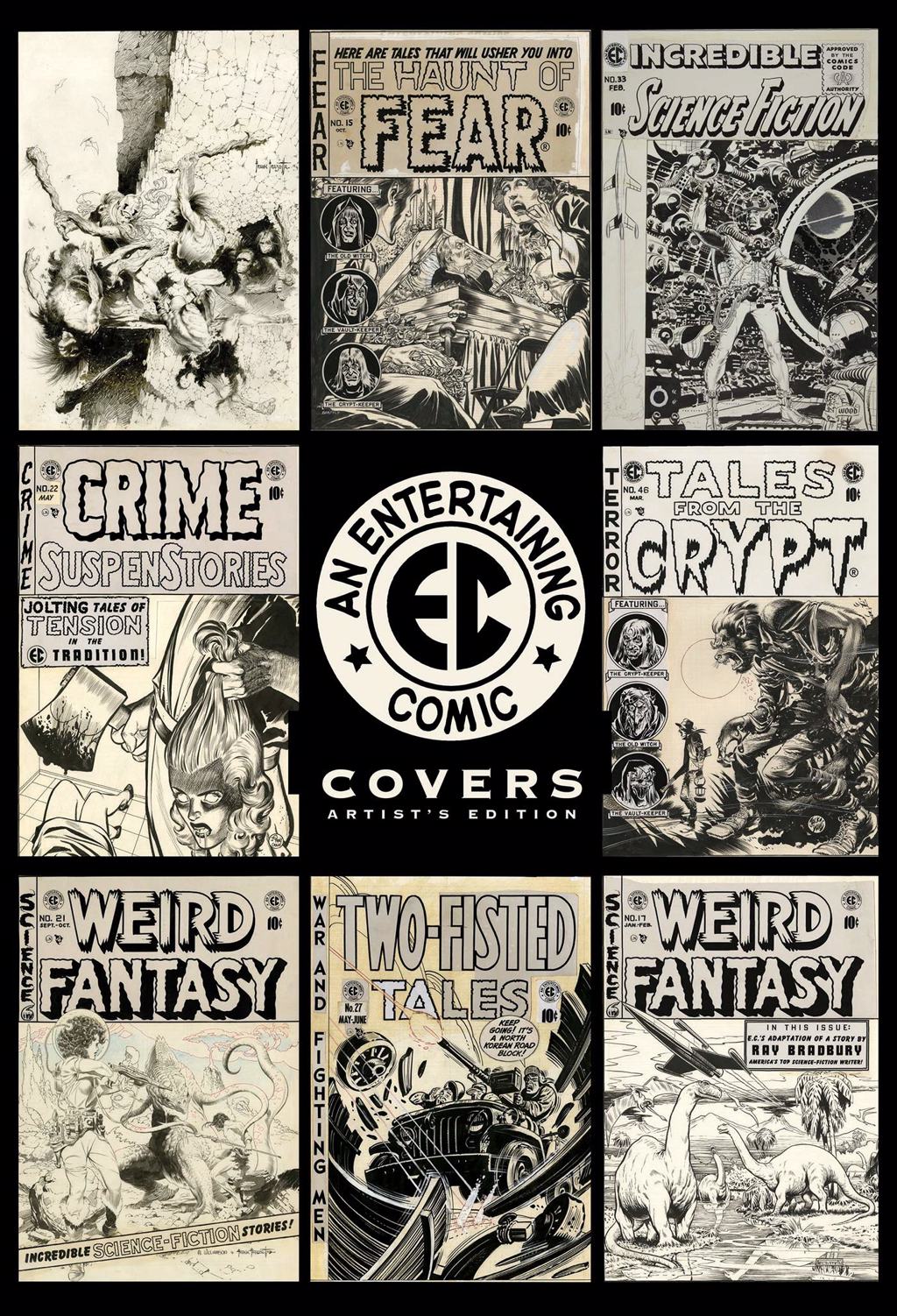
I am almost embarrassed to admit how many of IDW’s massive and pricey Artist’s Editions I own. How does one justify parting with $150 for each, even though they reprint in full detail and at original scale the actual final art from some of the great craftsmen in the field? And yet I never regretted investing in Artist’s Editions of early MAD issues, Will Eisner’s The Spirit, and the EC stories of Graham Ingels. This way-oversized scale and hi-def color images of black and white line art and marginal proofing notes seem to put you on the other end of the artists’ pens and brushes. This is even more true of the EC Covers Artists Editiion (IDW), which organizes the cover art of the famed EC comics stable by artist: Johnny Craig, Graham Ingels, Wally Wood, Harvey Kurtzman, Jack Davis and more. The covers of course were meant to be expansive, immersive teases of issue content, and so we get a single image splashed across the 15X22 page. Every bit of detail feels more like a deliberate, conscious decision, forcing us to think harder about the artist’s process. This is not just another trophy for collectors (or hoarders). It is a valuable experience for anyone who wants to deepen their understanding of the art.
The Golden Age of Wolverton

Fans of the grotesque pointillism of Basil Wolverton have been treated in recent years by Greg Sadowski’s exhaustive two-volume biography and reprinting in Creeping Death from Neptune and Brain Bats of Venus (both Fantagraphics). While those two volumes focused more on Wolverton’s horror and sci-fi work, this year’s Scoop Scuttle and His Pals: The Crackpot Comics of Basil Wolverton (Fantagraphics) is a retrospective of the artist at his madcap best. Ironically, many of these screwball and slapstick series were the fruits of failure. Wolverton conceived of Scoop Scuttle, Bingeing Buster and Jumpin’ Jupiter as daily comics and repurposed them for the skyrocketing (and imaginatively less constrained) comic book industry of the late 1940s and early 50s. In each case, however, Wolverton was satirizing many of the serious genres that dominated pulp magazines, B-movies, radio and comic books themselves. Wolverton clearly is channeling the screwball tradition of Milt Gross, Rube Goldberg and Bill Holman. The zany physical antics propel the action, the wisecracking asides and slang fill most panels and the cultural stereotypes rain in hot and heavy. The foreshadowing of MAD magazine’s satirical approach is unmistakeable. This volume also has excellent annotations adding context to each reprint as well as an outrageous article by Wolverton himself on sound effects in the comics. This one is a treat.
But Is It Art?: Comic Art in Museums
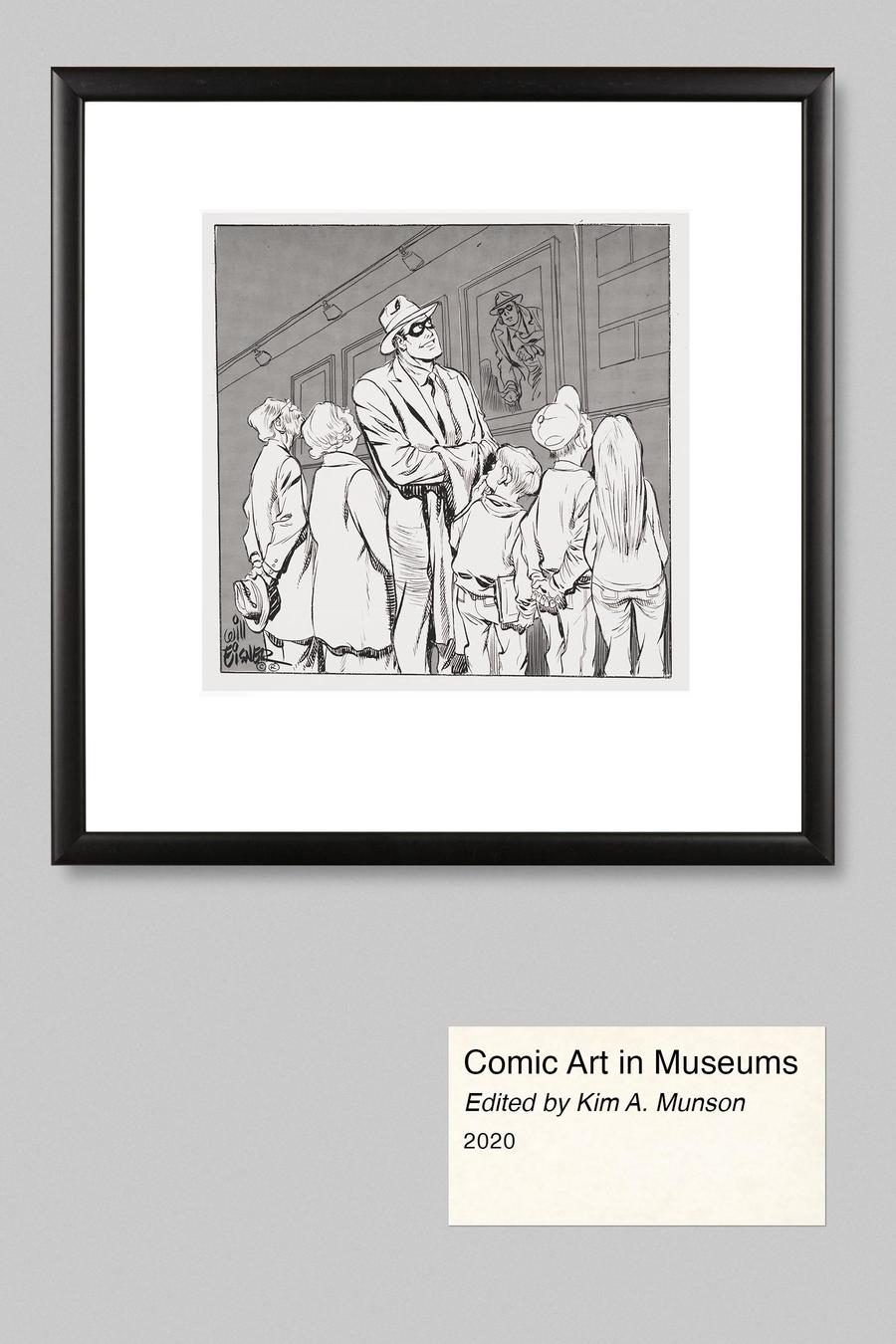
How “seriously” should thoughtful critics and audiences take the comic arts? That question seems to have dogged the cartoon arts since its earliest decades when pioneering pop culturists like Gilbert Seldes wrote extravagant defenses of the new medium. I confess that at this point in my five-decade run writing about mass media of all sorts, I find the relentless defensive justifications of pop culture criticism tiresome. And yet, that story of begrudging acceptance of the popular arts as “art” is its own important subject. One entryway to comic strip history is how the form has been regarded critically over the generations. Kim A. Munson’s Comic Art in Museums (University Press of Mississippi) is not as narrowly focused as its title suggests. While Muson provides a chronological framework and extensive introductory and connective matter, the book is really an anthology of writings by everyone from M.C. Gaines in 1942 to Denis Kitchen, Brian Walker, as well as multiple academics reflecting on the evolving reputation of the medium. I am still making my way through the densely packed book, but can already recommend it as a trove of insight and historical anecdote.
Johnny Hazard Sundays: Caniff Lite

All due respect to Johnny Hazard fans, it is hard to recommend Frank Robbins’ 33-year run as more than competent, middle-list comic strip fare. All of the luminaries also working at its height, Raymond, Caniff, Drake are considerably more interesting in their basic artistry, composition, storytelling. That said, this first oversized volume of Johnny Hazard Sundays does make the case for Robbins’s talents, even though his more mature work of the 1950s was obviously better. He had a strong sense of characterization, especially through facial expression. The moody use of coloring comes through even though some of the copies restored here were mediocre newsprint. And honestly I would have liked more background on Robbins and the thinking behind the strip rather than the intro pieces on his later DC Comics art. Still, Johnny Hazard Sundays Archive 1944-1946 (Hermes Press) gives us a 12X17 supersized reproduction of the Sunday adventure comics experience that is always welcome.
Kurtzman’s Wry Eye

Fantagraphics’ EC Library comes at the often-reprinted EC Comics of the early 1950s in black and white volumes organized by artist. Al the previous volumes have applied a lens onto the evolution of Wally Wood, John Severin, Johnny Craig, Al Feldstein, et. al. But this Man and Superman and Other Stories featuring Harvey Kurtzman before he took over the war titles and pioneered MAD really stands out for increasing our appreciation of this seminal comics artist. Kurtzman is among a handful of comics artists who were not just seminal within the medium but also to the general culture. The pop culture satire he codified in MAD magazine in the early 1950s applied a lens to post-WWII American mass culture that shaped generations of artists and even activists. This volume includes his earliest work for EC’s sci-fi, crime and horror stories. And they all show Kurtzman’s parodic attitude towards each of those genres. Tales like “Man and Superman,” “The Time Machine and the Schmoe!” and “Television Terror” took a light-hearted, even satirical take on the sci-fi and horror staples that drove the rest of the pages of these books. Most of these stories are written by the artist and so less wordy than over scripted tales the Feldstein foisted on most of the EC stable. These embody Kurtzman’s growing understanding of the relationship between word and text in the medium. He loves for high-minded science to go comically awry, along with the petty ambitions of everyman. The wry view of human foibles and hubris, which would inform the morality of his war stories and the satire of MAD, are all being rehearsed in these stories. Already sharp is Kurtzman’s mastery of of the comic form. He thought in panel progressions and the arc of a full page in ways far ahead of most artists. His compositions, use of foreground and background, the sense of motion as the eye moves across the panels, all are as fresh today as they were more than a half century ago.
Chester Gould Takes a Bow
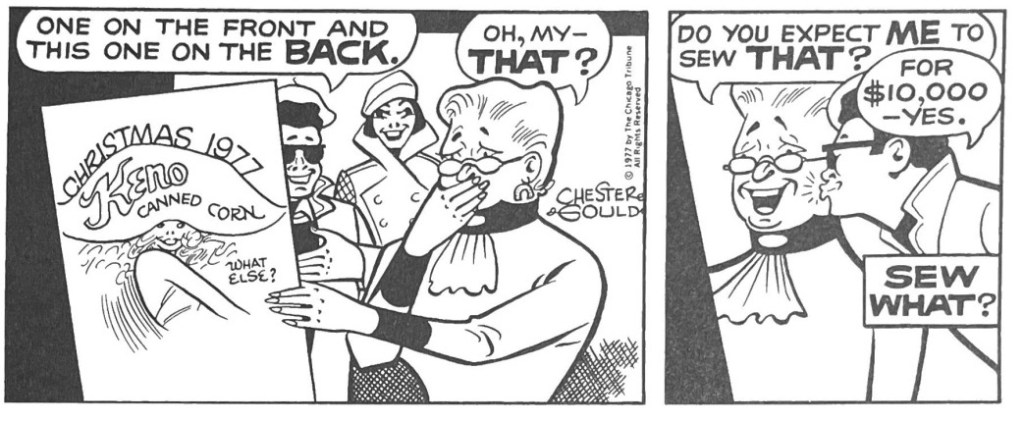
A number of ongoing reprint series had notable additions in the last year or so that call attention to the great work some publishers have been doing to keep the history of comic arts alive. In 2006 the Library of American Comics started an ambitious project to reprint Chester Gould’s full 1931-1977 run of Dick Tracy. With Volume 29 of The Complete Dick Tracy, LOAC finished one of the largest, complete comic strip reprint project, second only perhaps to Fantagraphics’ Peanuts project. I already reflected on Gould’s run and the way he ended the strip. The final volume speaks to what a canny master of comic strip art and business Gould really was. As newspapers shrank the canvas, he adjusted and rethought his signature style accordingly. And while the later years of the strip are remarkably different in look and feel than its first decade, the wild imagination, bizarre villainy, wonderfully improbable chases and escape remained central to a Dick Tracy story arc.
Hank Ketcham and The Art of Dennis
Hank Ketcham made it look so easy…and that was the trick. His loose, thick cartoony line seemed to skate across the page. A Dennis the Menace daily feels so comfortable and easy to take in at a glance, as if we are in the flow of Ketcham’s relaxed line. And his imagery is equally easy, almost as abstract as a UPA cartoon (Gerald McBoing Boing, Mr. MaGoo). But unlike the jazzy cartoon aesthetic of the 50s, Dennis the Menace was firmly situated, perhaps petrified, in the iconography post-WWII white suburbia. And Ketcham himself said he aspired for his art not to call attention to itself and almost look not there.

But of course, this kind of easy transparent style was the result of tremendous skill and care. Take for instance this otherwise anodyne daily of Dennis making yet another disastrous assault on his perennial target, the cookie jar. Ketchum’s loose, flowing pen line was much admired by fellow cartoonists because it was at once light in spirit and cartoony but also controlled and precise. He credits Noel Sickles with teaching him how to use a pen more like a brush and relax his line so it seemed to flow so effortlessly.
Consider the sheer economy of this scene, how so few lines establish his figures and setting. He establishes his modern suburban kitchen setting with such selective specificity – refrigerator and cabinet handles are sparse and abstract, but the three storage jars on the counter embody the post-war mid-century modern style. And yet the broken cookie jar is detailed and minute, pulling the eye to the center of the chaos.
I have read some fellow artists praise Ketcham’s mastery of drapery, and here is a great example of using that detail to carry the weight of mother Alice’s reaction. Henry and Alice Mitchell only speak for themselves on occasion in Dennisworld. Most often they are reacting graphically to Dennis’s transgressions in minute details – the positioning of an eyebrow line, body posture, slightly splayed feet. In this panel, we don’t even need Alice’s facial expression to complete the scene. Ketcham positions us at kid level and uses the drape of her skirt and flying kerchief to render the reaction shot.

Hank Ketcham mapped mid-century American suburbia so simply and beautifully. He was a perfectionist with establishing perspective that made you part of the scene. In this early 50s panel, his composition and staging of characters is everything. It establishes the dynamic among characters and separates Dennis from the group in just the way he is emotionally. And Ketcham’s Disney training comes through in the ways each of the adults is animated and characterized individually. Every person in the scene is laughing in a particular way that suggests their own character and backstory. And it was all told visually with that signature loose and flowing pen work that makes a well-planned panel feel effortless. No wonder so many of his contemporaries envied his artistry.

Perspective was critical to Ketcham. He often finds ways to place us in the scene that also involves us in the flow of the action or in relation to a character’s perspective. The panel above underscores his thoughtful use of point of view to heighten meaning. Here Dennis and the gang’s boyish conspiracy feels more intense, intimate, secretive by being set back from the action.
The aesthetic of Dennis the Menace is centered in the brilliant design of Dennis himself of course. First it is important note that Dennis is impossibly small. Compared to the adults around him, this five-year-old is considerably smaller than his age, barely reaches the knees of his distinctly lanky parents. His bunched, oversized coveralls keep him even more grounded and often give him the appearance of a cannonball in motion.. Dennis rarely trips, falls or loses control. It is the physical and human world around Dennis that loses its footing. Adults grimace, recoil in shock or just scatter and lie akimbo in his wake. Ketcham describes Dennis as innocent. But the power of this strip is the way Ketcham embodies that innocence visually. Dennis is pure innocent determination embodied in physics. Either his low center of gravity keeps him steadfast in his attitude or momentum expresses the conviction of his chase or escape.

In earlier stints at the Lantz and Disney animation studios, Ketcham absorbed his strong sense of animated motion and rich characterization. But he also found at Disney and his work on many Donald Duck shorts the visual model for Dennis himself. With his butt sticking out, legs angled back to balance a cantilevered belly out front, Ketcham describes Dennis in one of his model sheets as “not unlike D. Duck.”


Nudism is one of Dennis’s favored modes of expression…and Kaetcham’s. He flees his dreaded bath by careening bare-assed and in flight into the neighborhood. He is not just unselfconscious but truly free. When he stands principled against clothing, butt to the viewer, the open arms and declarative mouth dramatize obliviousness, not shame. The otherwise buttoned down Ketcham somehow finds in nude Dennis a way to celebrate visually a sense of liberation in nakedness that in an unlikely way anticipates counter-cultural ideas a decade in advance.
Which is to say that Dennis the Menace exemplifies what makes the comic strip medium distinct. In its best hands, cartooning is not just an illustrated or dramatized punch line. The artwork embodies and deepens the meaning of the idea.
Dennis the Menace on Silly Ol’ Girls
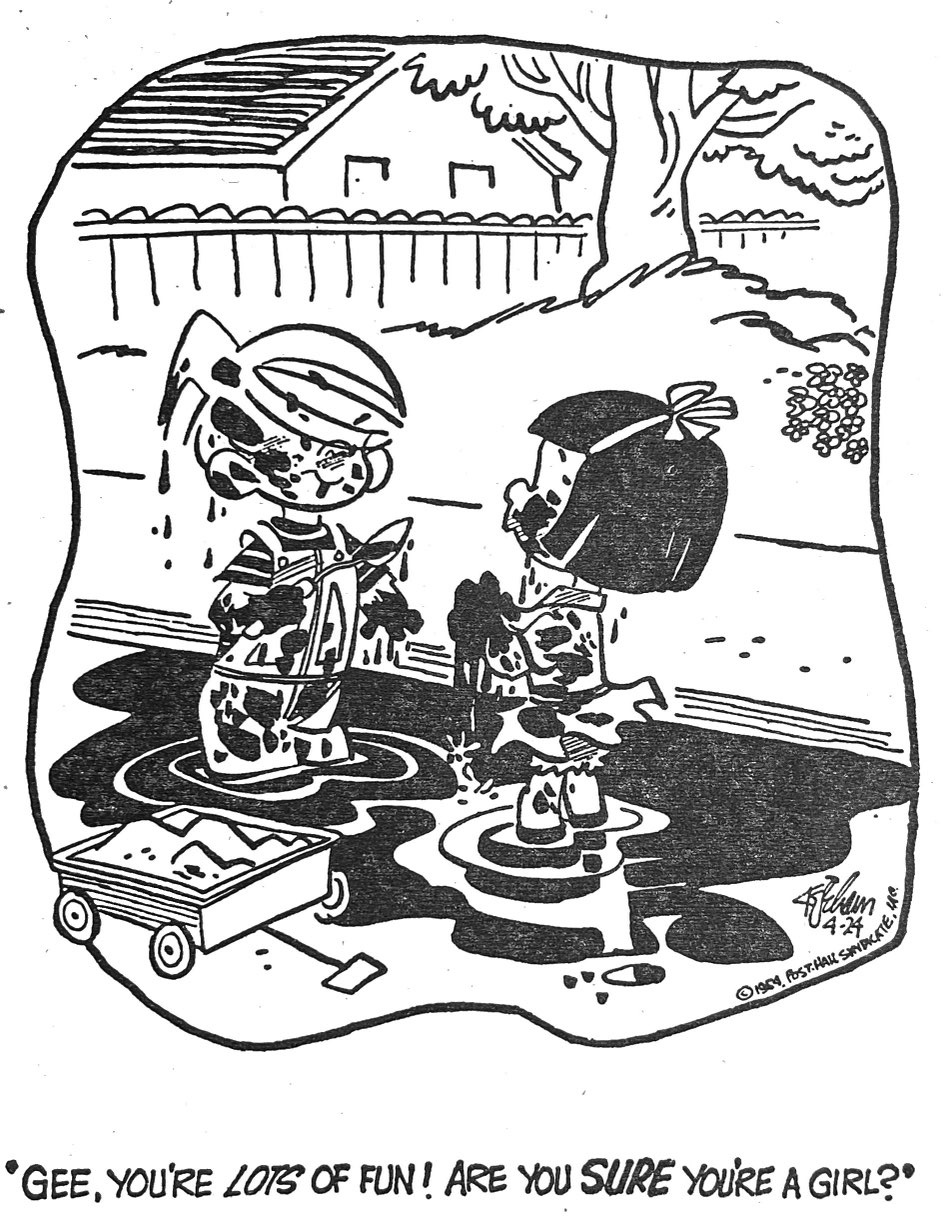
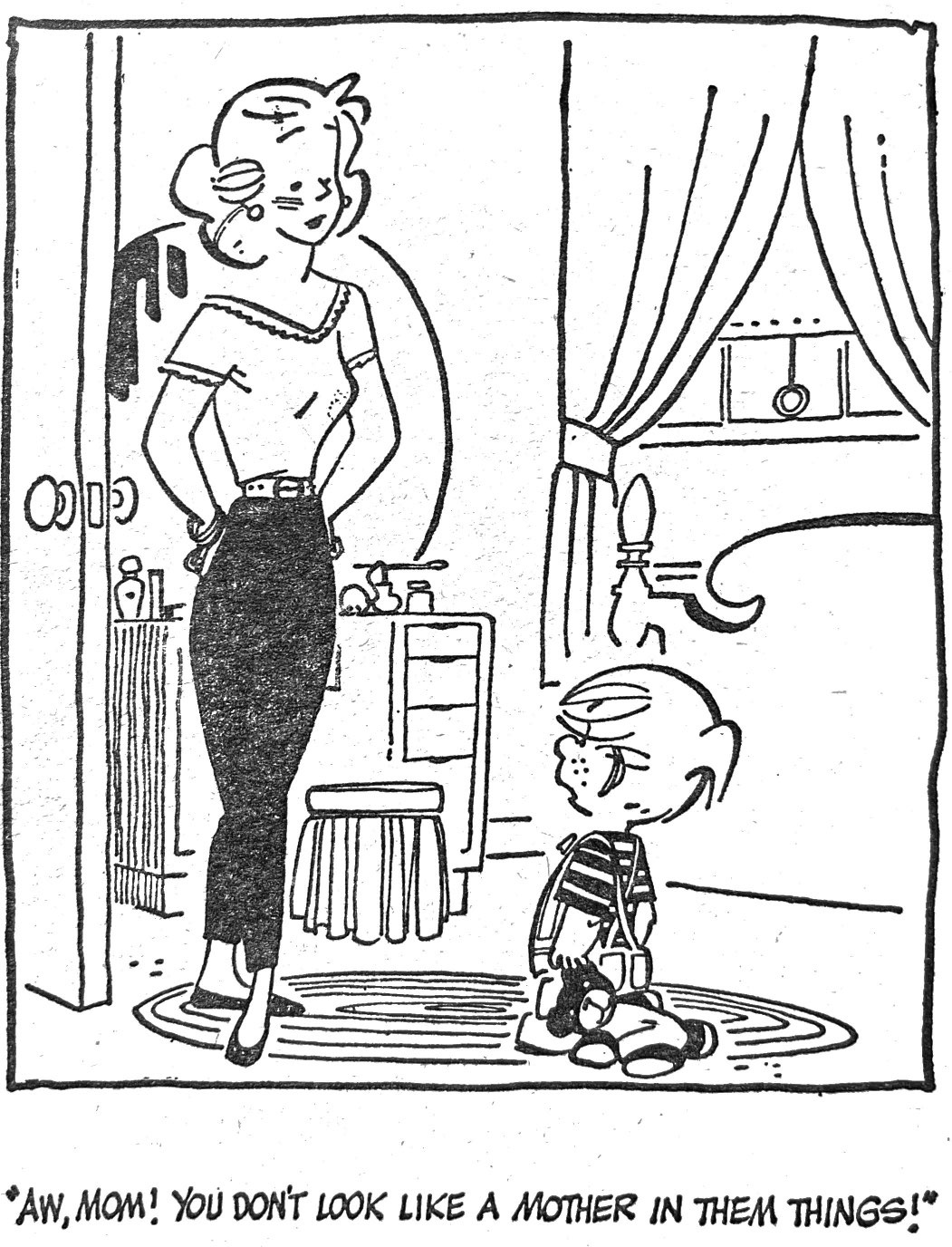
Hank Ketcham says he always found it odd that he spent his life in service to a five year old. But of course Dennis the Menace was never for kids, really. At his best, Ketcham used Dennis as a device for poking gently – ever so gently- at the straitjacket of post-WWII suburban repression and painful social self-consciousness. And Ketcham himself was as straight laced, conventional and revenant as we imagine the Mitchells and their world to be. How else could such a pint-sized hellion find so many lines of propriety to transgress so habitually?
Ketcham’s breathtaking tone deafness to the songs of change singing around him in the 60s especially would surface in a famous episode we will save for another post. But for now let’s enjoy Ketcham at his cleverest, usually in the 1950s, using Dennis as a wry observer of pre-feminist gender typing.
 Panels & Prose