
We have already reviewed some of the major 2025 comic reprint releases from major publishers: the reissue of Sunday Press’s Society is Nix, the anniversary celebrations of Peanuts, Hagar and Beetle Bailey as well as Cathy, and the resurfacing if Rea Irvin’s The Smythes. But this year saw a number of self-publishers bring back everything from Sky Masters of the Space Patrol to Milt Gross. I wanted to devote one round-up that highlights these laudable efforts and the often-obscure treasures they have unearthed.
Gross Me Out

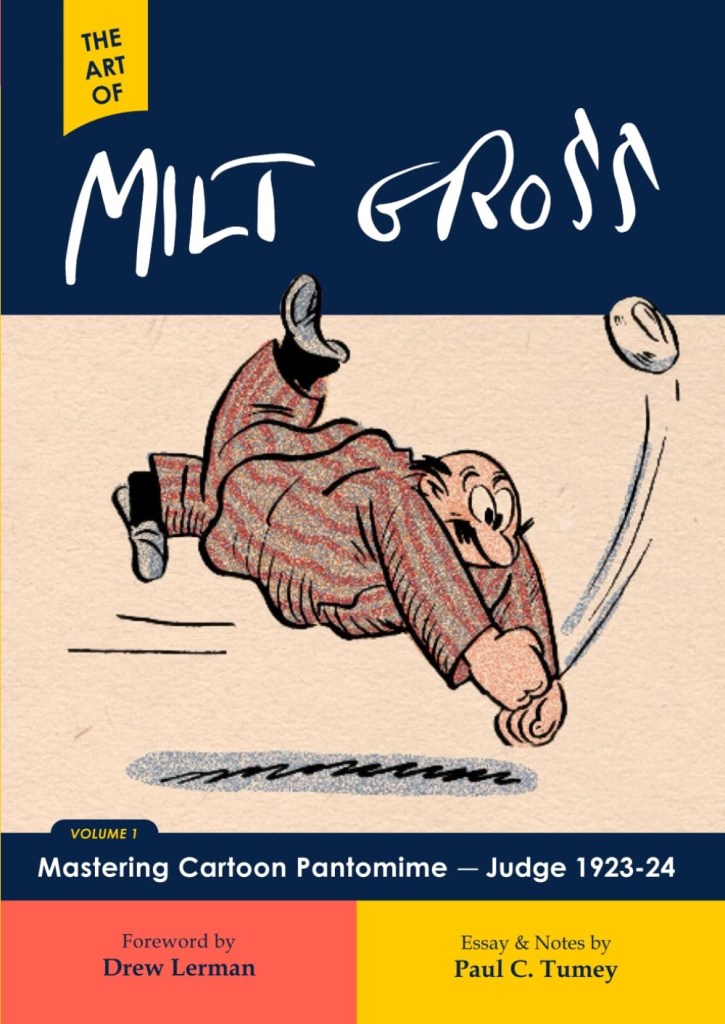
As much as you like. Milt Gross’s close-up is long overdue. The zany screwballer of Nize Baby and Count Screwloose was widely known as a humor columnist, screenwriter, pioneer of the graphic novel and animator during the 1920s and 30s. And yet as the antic, slapstick genre he mastered went out of style, Gross was almost forgotten. Several years ago Sunday Press gave us a sample of Gross’s cartooning in Gross Exagerrations, which we reviewed here. And as some serious scholars have also argued, Gross was an important figure in Jewish-American cultural history. His use of Yiddish dialect and humor traditions in syndicated comic strips provided a bridge from immigrant culture to the post-WWII boom in Jewish-American comedy. Tumey starts here a multi-volume Art of Milt Gross project to reprint hefty portions of his comic and written work. Volume 1, “Mastering Cartoon Pantomime” collects and analyzes his 1923-24 cartoons for the humor magazine Judge. As Tumey argues, Gross here hones not only his pantomime technique but new ways of depicting extreme motion, the slow burn of frustrated everymen wrestling with mundane tasks. It is a fascinating close-up of a master developing a visual language for comedy and storytelling. In addition to the newspaper comics like Nize Baby, these skills drove some of the first genuine graphic novels like Gross’s wordless epic He Done Her Wrong (1930).
The great thing about this collection is Tumey’s role as tour guide rather than simple curator. Opposite many of the cartoons, he provides cultural context, explains historic references, guides our eye to appreciate the artistry better. By the way, this is no small thing. There was a time when the role of art and literary critic was to help us perceive a work more deeply, enhance our experience.
Even better Tumey calls out the lessons in pantomime, timing, style and character Gross seems to be learning in these Judge pieces that he will apply to future newspaper strips or even swipe to use again. In some cases he does side by side comparisons with later cartoons. This is a much more impactful and readable approach than merely slapping an intro on a fat section of cartoons. This feels more like an annotated Milt Gross than a standard reprint.
Adios Cisco

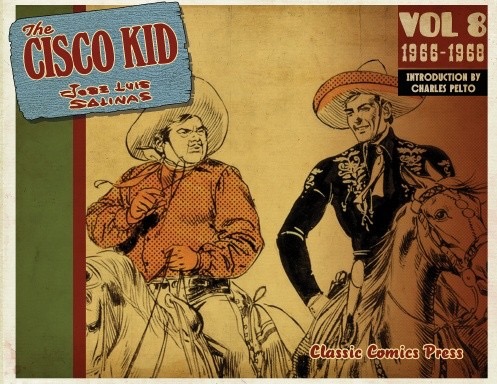
Classic Comics Press laudably finished its 8-volume run of the complete Cisco Kid recently. The detailed realism of Jose Luis Salinas comes through in these books, restored by CCP publisher Charles Pelto. Salinas was a master of the expressive close-up. By this point in the strip (1966-68) he usually has one panel each day that registers the pain, anger, conniving, desperation, fear, etc. of a key character in high detail, rich shadows and emotive hashlines. They remind me of Hal Foster’s penchant for close-up villainy. It is good that Salinas captures light melodrama so well, because that is about all his scripter Ron Reed gave him to illustrate. The Cisco Kid is not a compelling adventure, but shines mainly in the artist’s photo-realism and staging of fistfights, chases and tense stand-offs. Salinas used each panel to capture key moments and emotions for peak impact. He made each day feel dramatic. And man could he draw backgrounds and landscapes to give you a specific sense of place.
CCP has been moving to the lulu platform and reissuing some of their hard-to-find back numbers, including the full run of Cisco Kid. Chris Pelto tells us that soon he will be rolling out dailies for Frank Godwin’s Connie and Rusty Riley. He also will be adding volumes two and three to the wonderful Warren Tufts Casey Ruggles western and reprinting Leonard Starr’s Cannonball Carmody.
And Hello, Again, Carol
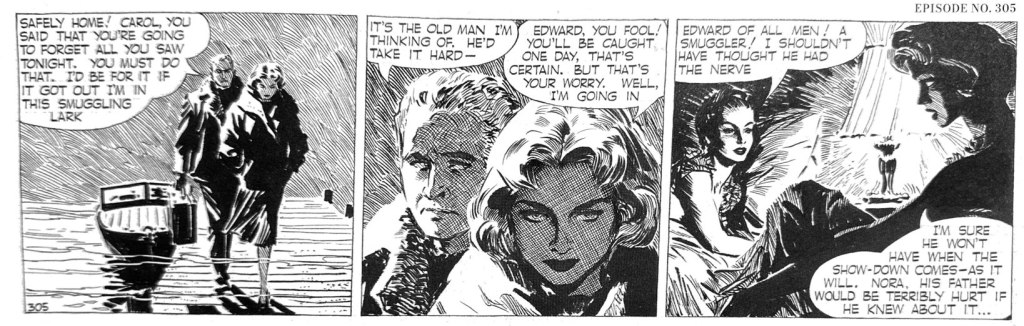

Speaking of photo-realists, the great gang at The Slingsby Bros. Ink have been on a crusade to resurface the wonderful Carol Day soaper by the enormously talented David Wright. We already dug into the massive and expensive inaugural volume reprinting original art of one story arc at 1:1 scale. Barely known in the U.S., the UK strip ran in the 1950s and 60s followed fashion model Carol Day through the rich and stylish environs of England and Europe when those world were establishing modern style. Wright, who had been a very successful print ad illustrator and favorite pin-up artist during the war, made the most of this world in what must be counted among the most beautifully illustrated strips of the post-WWII period.
Until the release in recent months of the David Wright’s Carol Day Showcase, the print reprints of specific storylines have been as expensive as they are gorgeously done. This “Showcase” feels like a comic strip movie trailer of sorts. It samples a handful of key strips from most of the major story sequences across Carol Day’s ten year run from 1957-1967. We get highlight Wright’s comic strip style evolving, from its detailed precision to a looser, sketchier approach. The pristine reproduction of this fine line work in two strips per 9 x 12-inch page make the art sparkle. Like Salinas, Wright loved the close-up, but his palette ran much deeper, with mood-setting perspectives, sharp word-play, and just subtler stories, characters and emotions. Editor Roger Clark does a very smart job curating from a decade of dailies 80 pages of samples that also offer substance from each story. It is an interesting approach to reprints. Obviously, it really focuses on the artwork, but Clark’s strip choice and captioning also give us a thumbnail of Carol’s adventurous career.
Hey Babe, Drift Marlo is Back
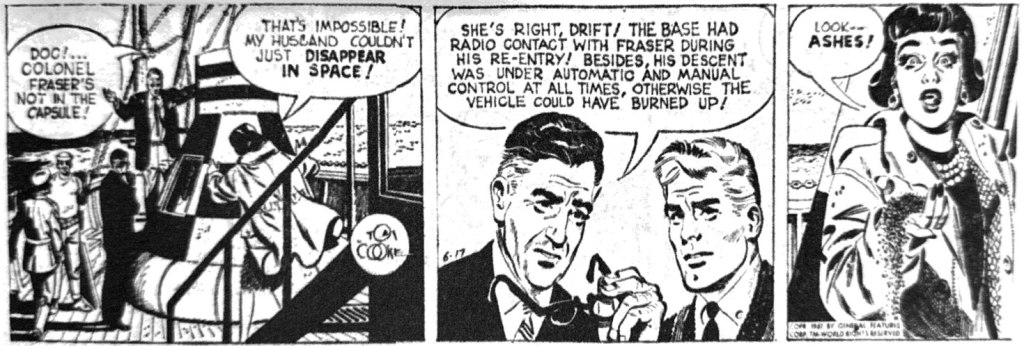

One doesn’t usually picture a government security officer as an adventure heartthrob, but the post WWII era of corporate and governmental authority could reimagine organization men into heroes. The short-lived (1961-1964) Drift Marlo cashed in on the US/USSR “space race” even though most of its action was standard detective/espionage fare that happened to revolve around a rocket base. The blonde, square-jawed Adonis Drift shares more with Peter Gunn and James Bond than he does with Sky Masters of the Space Force. He calls women “babe” and “beautiful” more than a grown man should, but the Phil Evans scripting is as shallow as our hero. Not to mention that artist Tom Cooke was no Jack Kirby or Wally Wood. The art is of the era’s no-nonsense realist style, serviceable to advance the story and only interesting when it lingers on a pretty woman’s face. But kudos to About Comics’ publisher Nat Gertler, for resurfacing this one at an affordable $15 to include several full story arcs. It is a good example of a light-noirish style of that moment in pop culture.
Space Masters

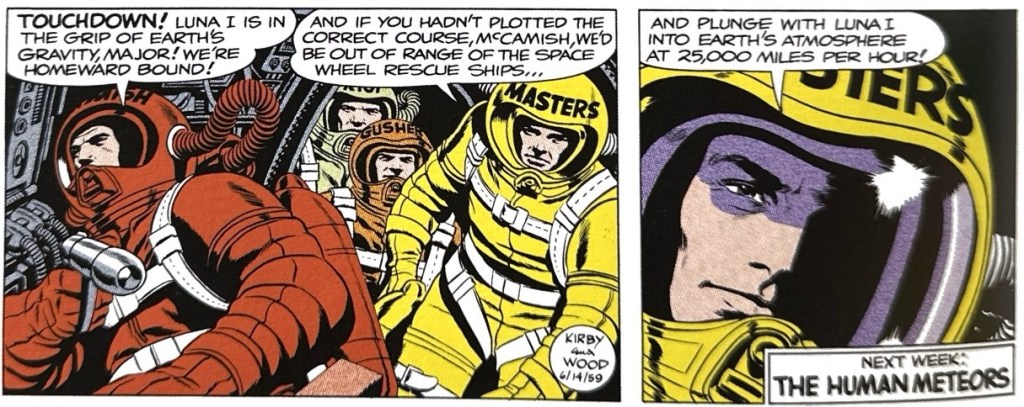
Now, this is the Space Race we imagined. For about a year of its two and a half year run as a daily strip between 1958 and 1961, The Kirby and Wood Sky Masters of the Space Force had a standalone Sunday storyline. The result was exactly as gorgeously penned and inked as you would expect from this team. Masters is an astronaut adventurer in a near-future of routine multi-manned space orbits and moon landings and a lot of intrigue. All of Kirby’s dynamic compositions, his ability to make every utterance look like a heart-stopping climax, is on show here. And Wood’s signature inking, his spaceship interiors and looming planets will bring you back to the EC Sci-Fi days. A European publisher had issued a limited run reprint of these Sundays with blaring color “remastering” a few years ago. Luckily, the Kirby Museum reissued this project in a slightly larger and expanded version that is a must have for strip fans. The restorer admits he took an “aggressive” approach to recoloring these Sundays in order to match the printer proofs, and I am not entirely sure I like the very comic book feel to this restoration. But the bok is filled with extras, which includes the original color guides, panels that were discarded in many Sunday formats, some reproductions of original art, and a look into the ways Wood and Kirby collaborated. We also get instructive editorial captions on many pages, even QR code links, that provide background on the strip and the era. Having this in an affordable and accessible version again was one of the treats this year.


Finally, we just recently discovered a digital-only reprint library at The Comic Strip Appreciation Group. The site has collected a massive number of scans across classic and more obscure strips, many of which have been formatted into downloadable PDFs for purchase. These are no frills compilations that come from a range of online archives like Newspapers.com, so the quality of these touched up strips are dependent on highly variable sources. And don’t look for introductions and contextual material here – just the strips, ma’am. Still, what we get are a lot of titles otherwise lost to memory (Ollie of the Movies, Vic Flint, Cop Shop) as well some extended and later runs of classics like Happy Hooligan and Polly and Her Pals. This is a great find. The review copy of Flyin’ Jenny strips I sampled had serviceable, if not pristine, versions of fine cartoony line art that typified this series both when creator Russell Keaton and later Gladys Parker were at the helm. It is not quite as sharp and detailed as the reproductions in the wonderful Kitchen Sink edition of Aviation Art of Russell Keaton. But in this case the Comic Strip Appreciation Group version has the full 1939-46 run. Of course this makes for a hefty 3GB+ file, which might choke some of your file transfers and comics readers. But over 1,000 pages of Jenny at $30 is a bargain no matter how you cut it.
Our annual holiday roundups of notable books for comics hounds continues as more books arrive almost daily here at the Panels and Prose Library here in the woods of Southern Pennsylvania. Look for upcoming roundups of pre-Code comics reprints and books on comics history.
Discover more from Panels & Prose
Subscribe to get the latest posts sent to your email.
 Panels & Prose