
Women-led “Amazon” worlds popped up in a ranges of comic strips during the 1930s and 40s, and they voiced a range of ideas about the prospects for matriarchal rule. In an earlier article we explored otherworldy femtopias in Buck Rogers 25th Century, the Connie strip’s vision of the 30th Century and even in the “Bone Age” of caveman Alley Oop. More muscular he-men heroes like The Phantom and Tarzan, however, found the prospect of matriarchy a bit more, well, shall we say, threatening?
“These Women, Who Can Figure Them Out?”
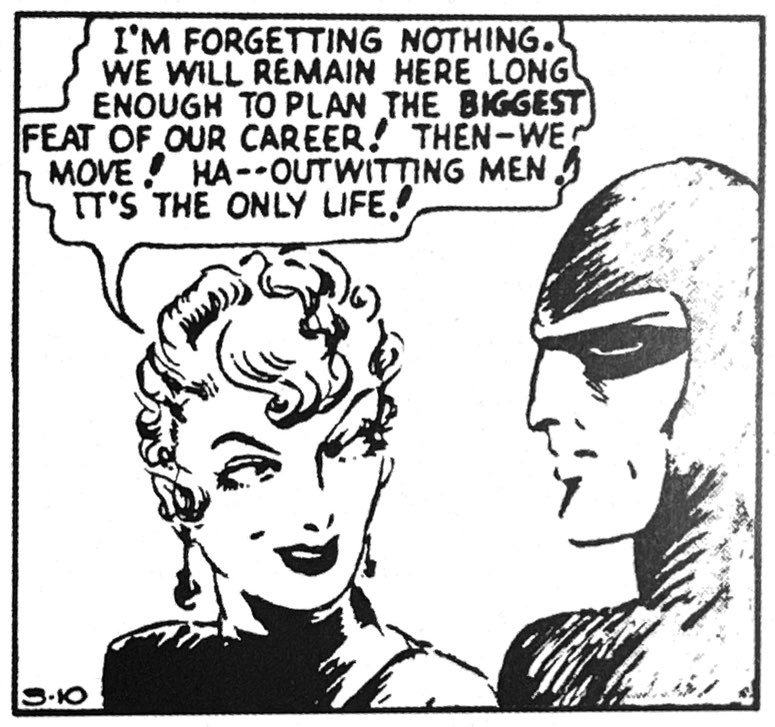
Lee Falk’s The Phantom was not only the first costumed comics hero, but among the kinkiest. Falk never missed an opportunity to bind, whip and otherwise torture “The Ghost who Walks.” And if a dominatrix is involved, all the better. In fact, the second major storyline of the strip (11/9/36 – 4/10/37) exposes the all-woman “Sky Band” of air pirates, and in short order we are in a psychosexual soup of jealousy, feminine rivalry, manipulated affections, man-hating and domination.
In basic outline, this convoluted tale is about a Sky Band of female pilots hijacking cargo from air and sea lanes. Led by the bored aristocrat The Baroness and assisted by ongoing Phantom nemesis Sala, the Band works from a hidden underground lair. The Phantom is captured upon penetrating the hideout, and so begins a soapy opera of rivalry over the Phantom (Baroness vs. Sala), The Phantom exploiting this contest with false affections, and our hero’s real girlfriend (Diana Palmer) thinking that The Phantom is in league with Band (which sends her into a rival’s arms).
In contrast to the fem-topias we saw in Buck Rogers, Alley Oop and Connie strips, it is unsurprising that the more testosterone-dripping hero strips like Phantom and Tarzan see in fantasy matriarchy only disorder and disaster. All of the misogynist tropes crowd in. The unkempt emotional conflicts within the Baroness come out as contempt, sadism and passion for our hero: “Ha! Outwitting men! It’s the only life.” The jealousy between she and Sala grows so intense that Sala claims she would rather see The Phantom dead than in her rival’s arms. In turn, The Baroness double-crosses Sala into getting arrested, and she returns the favor by betraying the Sky Band.
The subtext is unmistakable. Matriarchy’s fata flaw is femininity itself. Every assertion of feminine power seems conflicted and self-defeating. It all ends symbolically with The Baroness’s suicide. The Phantom ends the episode reflecting on “the most ruthless piracy I have ever known… . And all women! It’s very strange. Only a woman could have maintained the band as she did. And yet, by double-crossing Sala, she betrayed the Band and destroyed herself – because she was a woman – with a woman’s heart and hate – and jealousy.”
In 1941-42 Falk revisited The Sky Band and how feminine nature undermines matriarchy. This time Sala revives the Band, which now has a leggy wartime pin-up vibe.
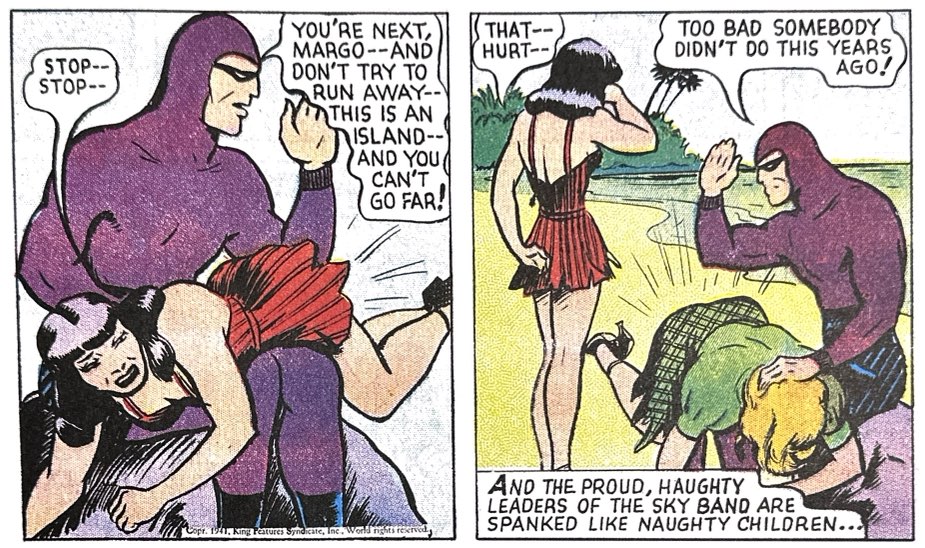
The fatal feminine flaws remain the same, however: contempt, competitiveness and love. Even as she carries the torch for The Phantom, Sala declares, “I’ve always hated most men. They’re weak, stupid, dull – most of them are cowards and fools.” And again, girl-on-girl connivance unravels the Band as second-in-command Margo undermines Sala even as she too falls for the guy in purple tights. Long story short, the love/hate triangle ends up stranded together on an island where the ladies have a catfight and The Phantom gives them both a spanking.
We can’t deal seriously with the matriarchal motif in Depression-era comics without also recognizing its most obvious attraction – sheer cheesecake. Whether it is armored, bottomless stormtroopers of Venus, the barely-veiled contours of The Baroness, or Sala and Margo catfighting in short-shorts, the soft-core porn of it all was overt. Women in disciplined ranks, and women asserting disciple were the visual tropes here. The cartoon dominatrix was everywhere. While Alex Raymond and Milton Caniff never explored the matriarchal motif themselves, they had many long-legged, bare-shouldered Queen Bees humiliating men throughout the 1930s. Ruthless queens regularly love/hated Flash Gordon and Pat Ryan. Bondage was an occupational hazard of heroism.
“The Handsome One is Mine”
Burne Hogarth was among the best at visualizing the dynamics of women in charge. In a two month run of Sundays in 1939, Tarzan and gal pal Linda are saved from hatchet-hurling half-men, the Lingoos, by Kuleeah and her tribe of “Tree-Women.” “The handsome one is mine,” she warns, and tosses the unconscious Tarzan over her muscular shoulder.
Like Falk’s Sky Band, Hogarth and writer Don Moore’s Tree-Women are rivalrous vipers who can’t decide if they love or loathe men. Their “Captive Husbands,” the subject of an entire Sunday page, are fully emasculated. Indeed, Hogarth has a blast visualizing this tree-top dystopia, contrasting sinewy, masculinized women against their waiflike, terrified men. Pappy Yokem looks downright heroic compared to these cowed house-husbands.
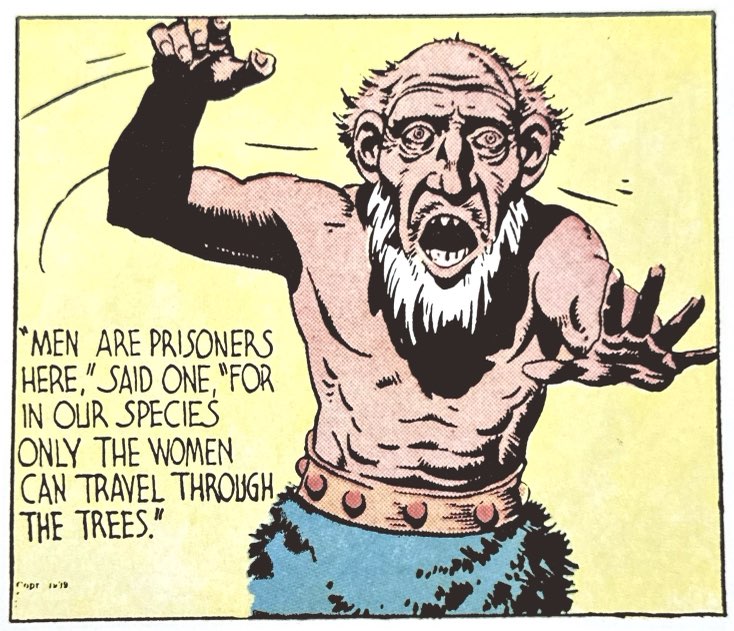
This matriarchy seems to be a powder keg of resentments and connivance, as the tribeswomen taunt their own leader for her boasts about dominating Tarzan. They even root against “the imperious Kuleeah” in her eventual duel with Tarzan. “You have captured him but he is master” they snipe, even as they fantasize about Tarzan dominating them. Hogarth’s imagery seems to express the conflicted politics and weird dynamics of matriarchy. Kuleeah is the most masculinized of the tribe, boasting of her ability to subdue men, while her more comely, feminized tribe seems ambivalent about male dominance. There is also a good lesson here about the unique “art” of the comic. Hogarth’s visual delineations among masculinized female leader and more feminized subjects, the sharpness of Kuleeah’s expressions, the sexuality and power of her vs. Tarzan’s body, are nuanced and ambivalent in ways that the script never touches.
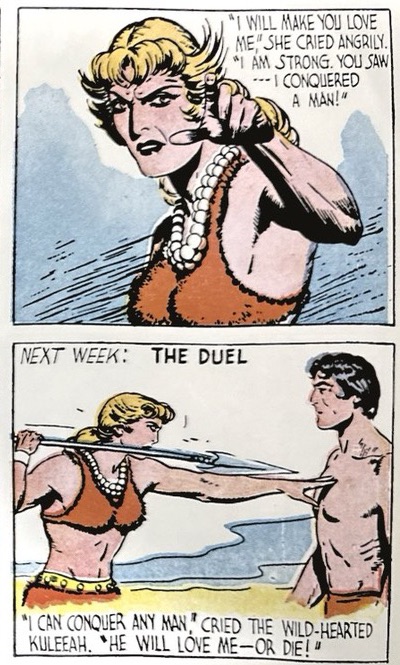
But to be clear, there is nothing subtextual about Hogarth and Moore’s take on dystopian matriarchy. As the plot evolves, Tarzan is compelled to save Kuleeah from a lion pack and so assert his more level-headed masculine nature. “Though she had tried to kill him, he bore no ill will. These wild women of the forest, he concluded, were no more accountable than their civilized sister.s” (Tarzan, 7/2/39). While Hogarth reveled in the sexy muscularity of the Tree-Women, the story reduces their power to common feminine stereotyping: jealousy, competitiveness over men, in-fighting and secret desires to be dominated.
And, honestly, when adventurers like The Phantom and Tarzan have brushes with matriarchy, the real subtext involves masculinity and patriarchy. The pulp heroes of the 1930s, which helped inspire the adventure genre in comics, was pop culture’s response to the psychic impact of hard times. Among many other things, the Great Depression was a blow to the male ego. At times a quarter of the adult population, mainly working men, were unemployed. Many historians have addressed the challenge this posed to family dynamics, especially as many women filled more menial but reliable jobs to support their families. John Steinbeck’s Ma Joad in Grapes of Wrath (1939) voiced it most famously. Pa had “lost his place” as the head of the family. The domestic patriarchy had flipped because in hard times, “Woman can change better’n a man.” Even New Deal attempts to address the problem through welfare and jobs programs struck many American men as further assaults on their self-worth.1
The hyper-masculine hero had been a cultural response to fears about the “feminized” modern world since at least the turn of the 20th Century. Tarzan, after all, was a sensation since Edgar Rice Burroughs launched him in 1912.2 But in the 1930s, this persistent modern fear of diminishing manhood became acute when so many husbands lost their role as providers. In Americans’ fictional lives, even our two-fisted adventure heroes start overcompensating with superheroic qualities. The Shadow (1931) Doc Savage (1933), The Shadow (1933) push previous limits of human prowess just when American manhood most needed these fantasies. These stories used extravagant purply prose to celebrate the hero’s unmatched strength, inhuman reflexes, withering glance, lightning quick minds. And the pulps needed to raise the stakes of heroism, too. Such specimens of manhood could hardly be wasted battling everyday crimes when the whole world needed saving from secret societies, mad scientists and super-villains. But within the context of the pulp adventures, Amazon matriarchies antagonize that hero myth and so need to be unraveled.
Interestingly, the sci-fi and comic genres were more open to the positive qualities of their fictional Amazons than Tarzan or Phantom. Buck Rogers’s 25th Century gave women wartime shooting roles and even parsed them out as superior sharpshooters and sailors. The only problem with the woman-led 30th Century in Frank Godwin’s Connie strip was pacifism; they had forgotten how to wage war. And even the comic Wild Women of Alley Oop prove to be keen observers of male goofiness. They have a lot to teach the prehistoric Trad wives of Moo. But up against the hyper-masculine heroism of Tarzan and The Phantom, matriarchies needs to be delegitimized entirely.
The matriarchy trope in Depression-era comics is just the most explicit expression of a larger discussion waiting to be had about women in male adventure strips of the 30s. Villainesses, queen bees and femmes fatales are rife across a range of strips like Terry and the Pirates, Flash Gordon and The Spirit.
The Amazon motif of the 30s and early 40s suggests how even a minor strain in the funny pages engaged real world tensions about challenges to traditional institutions and gender roles. The comics were not a monolithic, simple “reflection” of the surrounding culture. They voiced a range of conflicts, anxieties, ideas, even imaginative resolutions to tensions that occupied a larger cultural conversation about change in America.
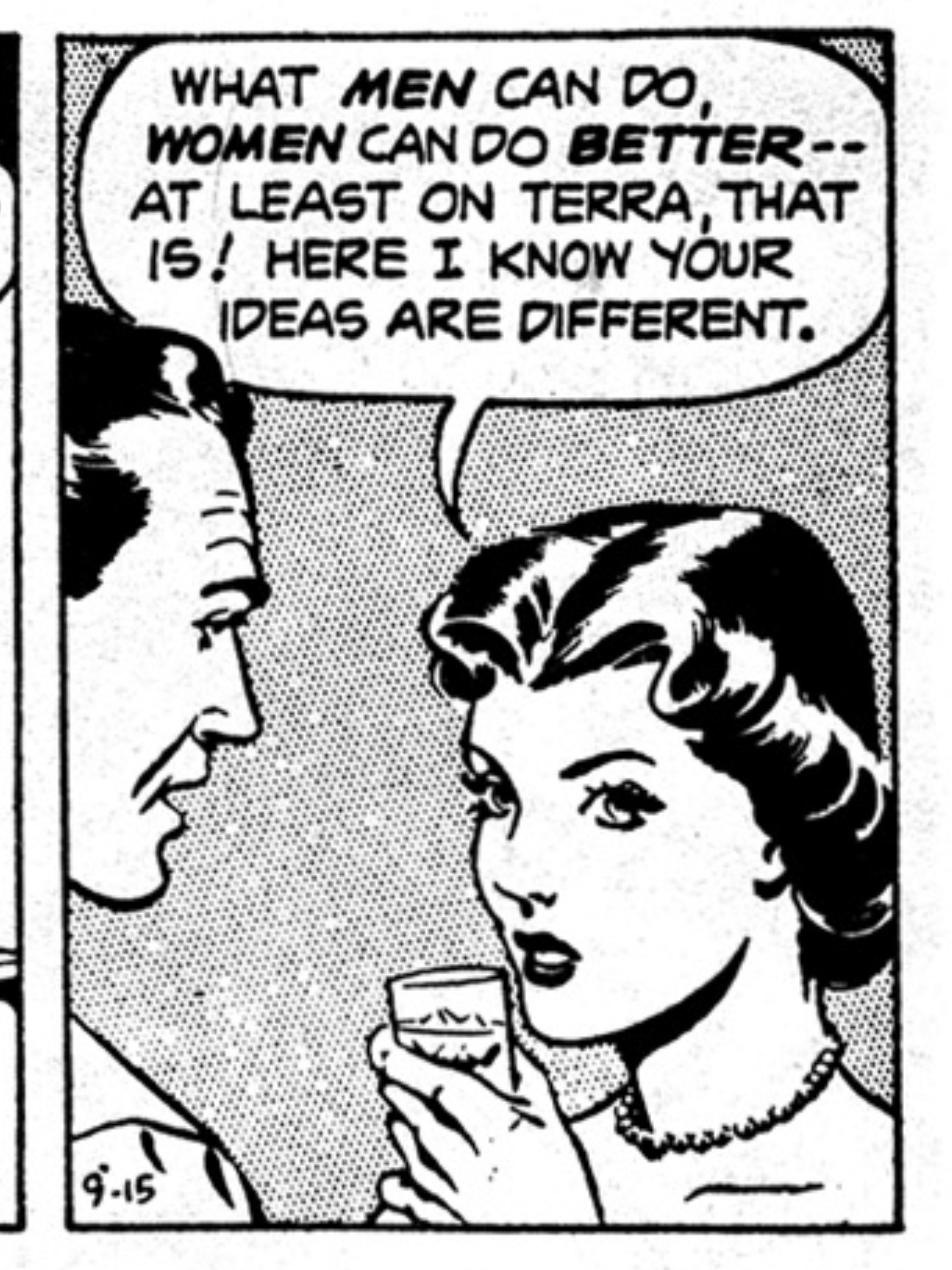
The Amazon theme would culminate of course in the 1941 launch of William Moulton Marsden’s Wonder Woman character. Harvard historian Jill Lepore has chronicled thoroughly how Marsden’s character and her Paradise Island femtopia were rooted deliberately in Marsden’s idiosyncratic feminist ideology.3 But Wonder Woman was herself coming at the end of a decade where adventure comics had explored ideas of matriarchy from multiple perspectives. And it would not end there. The 1952-1963 Twin Earths comic strip envisioned a hidden, parallel Earth, Terra, which women had run for centuries. Their pacifism was a counterpoint to Atomic Age Cold War tensions.
- Morris Dickson, Dancing in the Dark: A Cultural History of the Great Depression, New York: W.W. Norto, 2009, p. 226. ↩︎
- The best studies of modern pop heroism and changing concepts of manhood include John Kasson, Houdini, Tarzan and the Perfect Man, New York: Hill & Wang, 2001 and Gail Bederman, Manliness & Civilization: A Cultural History of Gender and Race in the United States, 1880-1917, Chicago: University of Chicago Press, 1995. ↩︎
- Jill Lepore, The Secret History of Wonder Woman, New York: Vintage, 2014. ↩︎
Discover more from Panels & Prose
Subscribe to get the latest posts sent to your email.

