
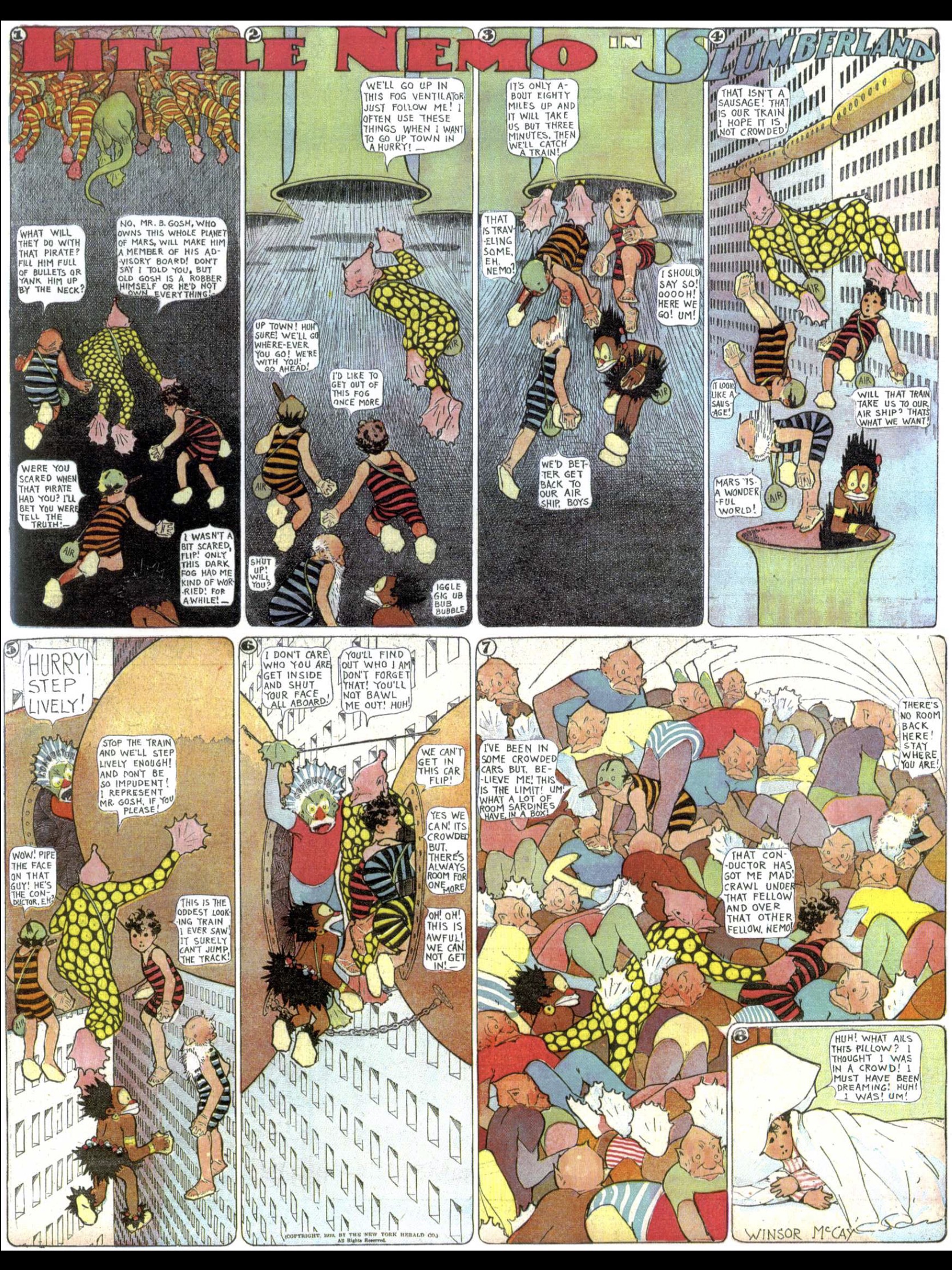
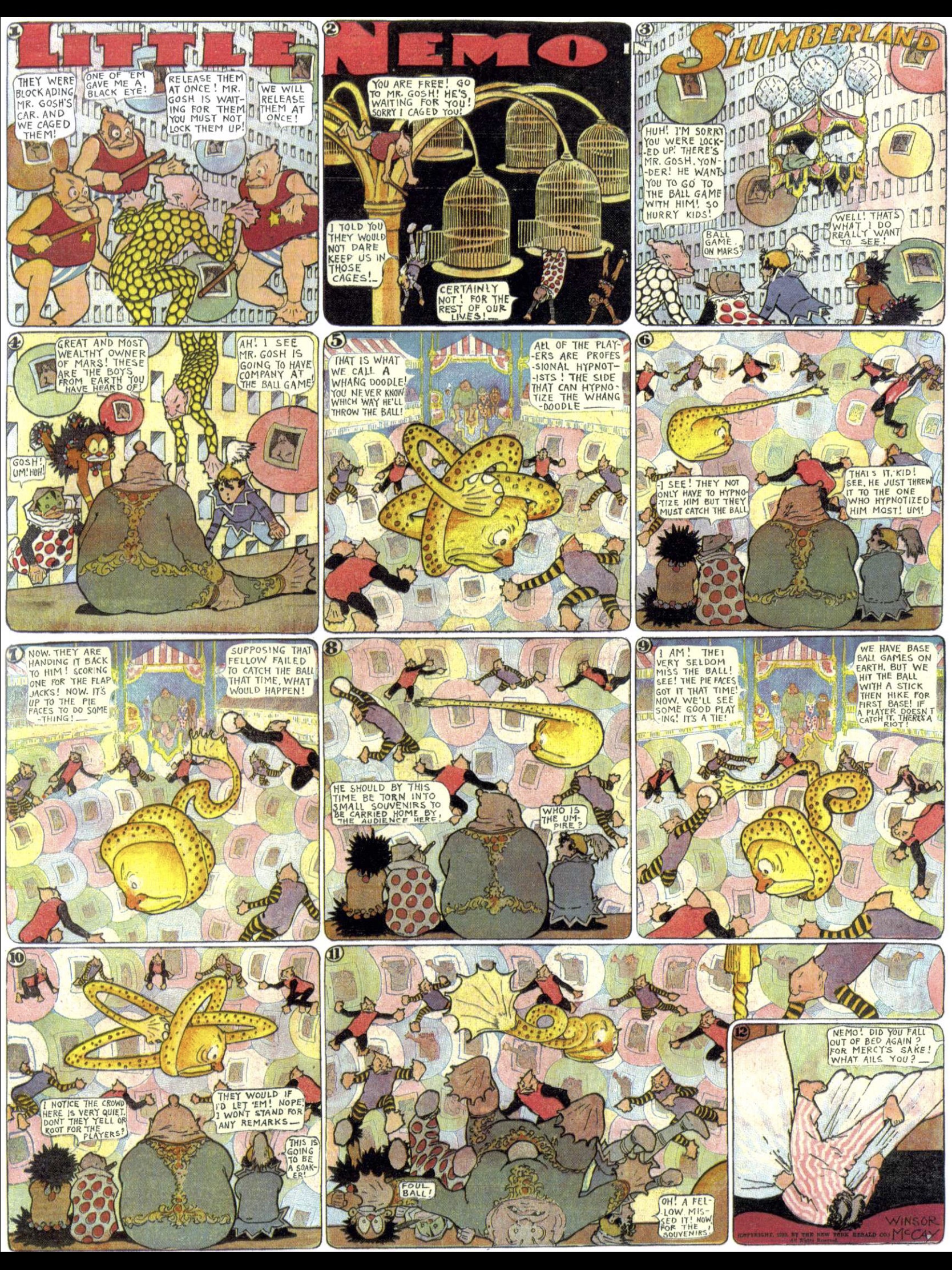
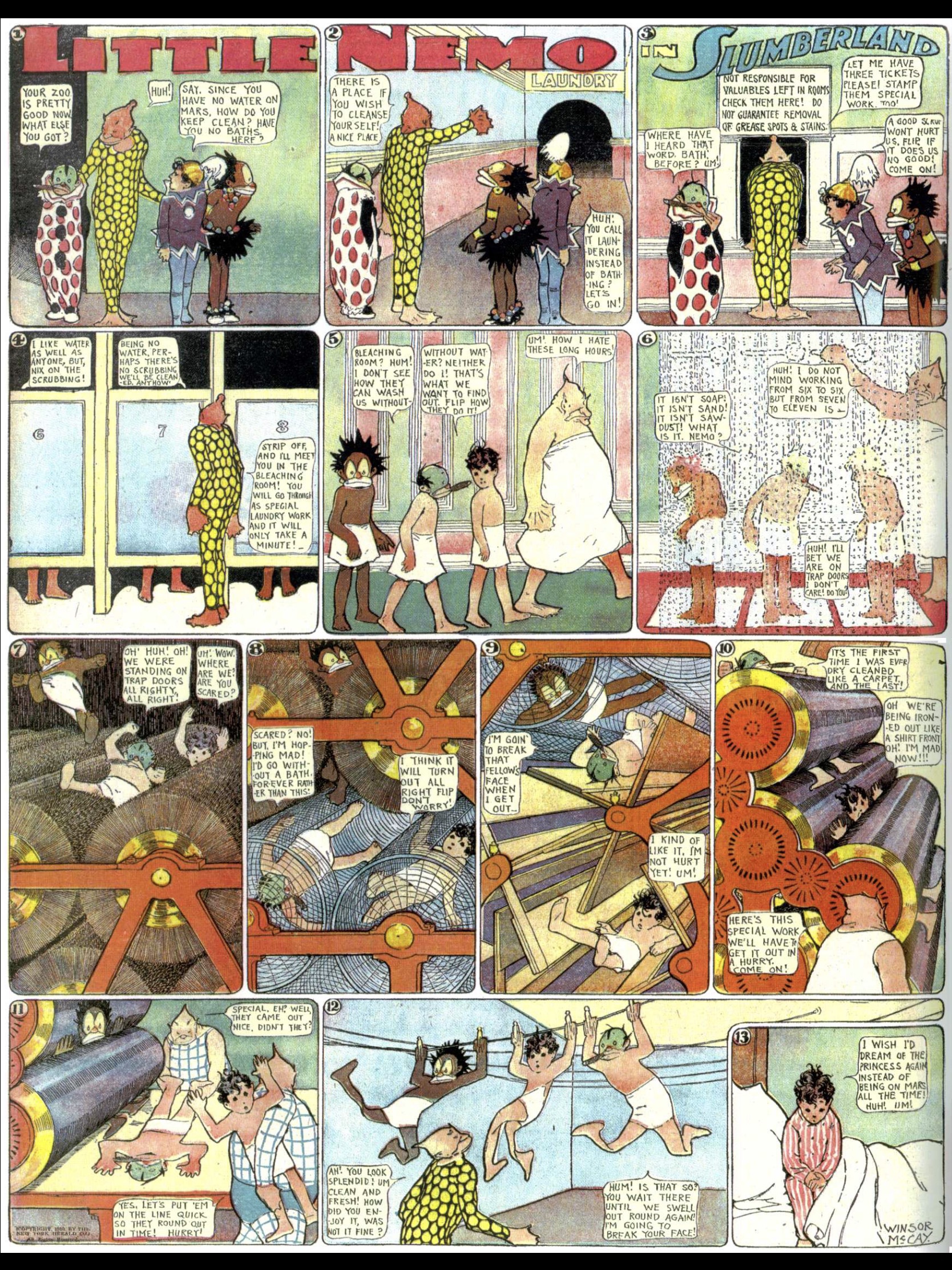
Between April 24 and Aug 23 1910 Winsor McCay sent Little Nemo and his wise-ass sidekick Flip to Mars, making for one of the longest and most politically pointed of the Little Nemo in Slumberland adventures. Mars was a dystopia of cement canyons and urban overgrowth, clots of faceless worker bodies rushing to thankless jobs. The landscape, with endless skyscrapers and spherical flying cars was as technologically wondrous as its lived reality seemed dismal. Mars is overtly Dante-esque. As the archway to the main city declares, “Abandon Hope All Ye Who Try to Enter Here Without the Price.” Unlike the classic Inferno, there is only one main sin driving the despair – greed. Even as the modern age of consumer capitalism was just taking shape, McCay satirized its logical extreme. Everything, from air to words, comes at a cost.
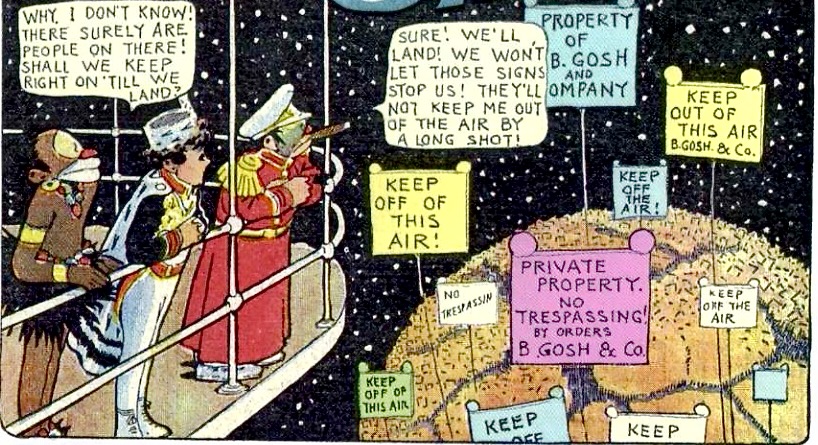
The full episode, reprinted at the end of this piece, begins with the gang’s airship approaching a Mars that is overwhelmed by advertising – billboards barking, “Private Property,” “Keep Off Of This Air,” and “Lots for Sale.” McCay is burlesquing a frequent complaint of his fellow New Yorkers at the time, the garish explosion of public advertising, a cityscape choked by signs and come-ons.
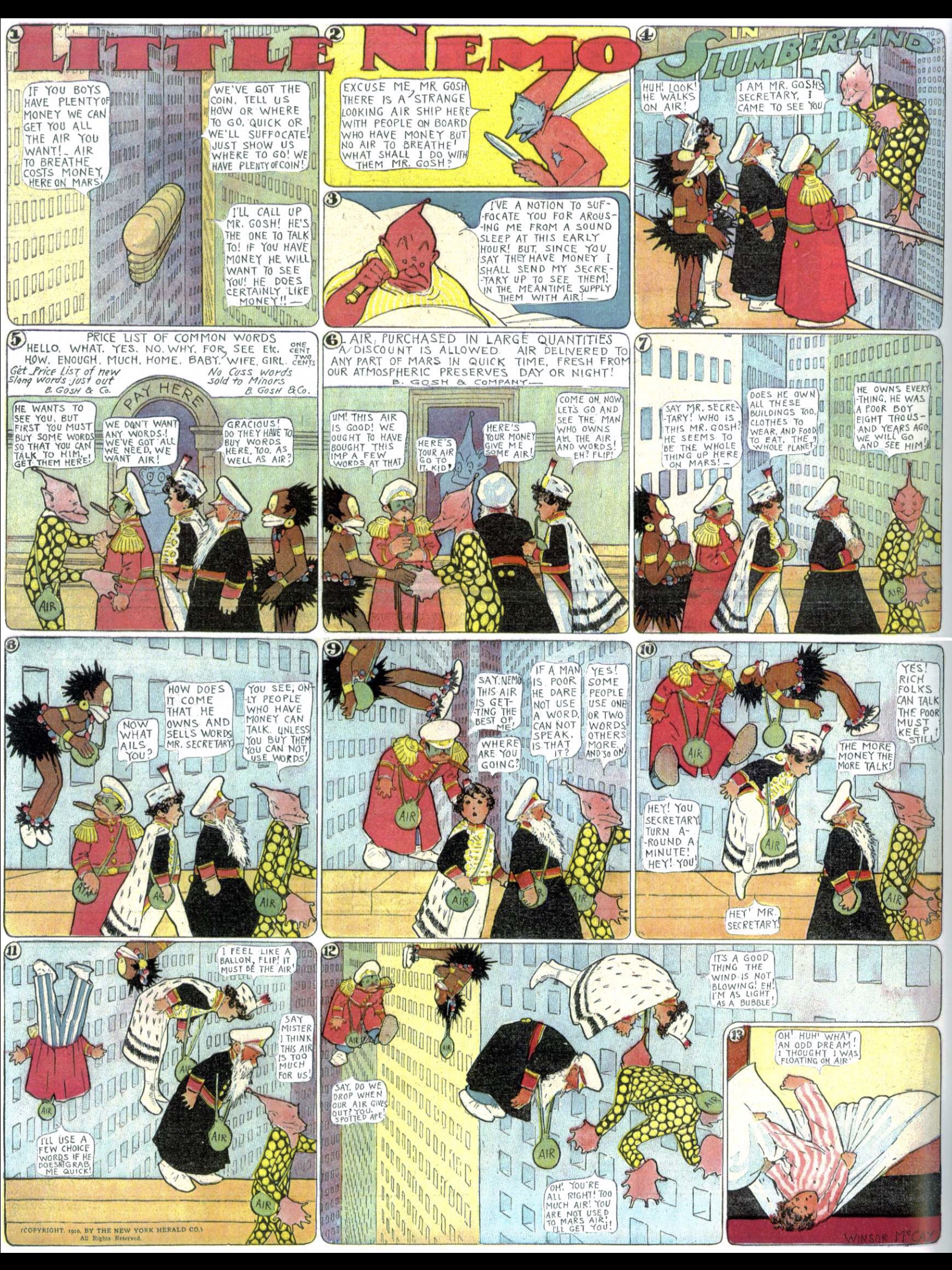
Mars and even its most basic elements were under the sole proprietorship of one B. Gosh and Co. In America of 1910, “monopolistic trusts” and “robber barons” like the John D. Rockefeller and Andrew Carnegie were familiar emblems of the Gilded Age capitalist excesses that this “Progressive Era” was struggling to reform. More than cornering the market in railroads or oil, Gosh owned and resold the raw materials of discourse and survival, words and air. But McCay boils this power and control to a simple maxim. “He does certainly love money,” Nemo says. And clearly McCay, after all a newspaperman and political cartoonist, is building a critique of emerging consumerism, a growing class divide, and exploited labor in crafting B. Gosh and Co.’s Martian realm. And more than a century later, his satire has an eerie prescience. Our contemporary courts have ruled that money is speech, but on McCay’s Mars, speech is a cash only commodity. “You see only people who have money can talk. Unless you buy them you cannot use them,” the Martians explain.
McCay’s dystopia takes to satiric excess the key trends of early 20th Century America, consumer capitalism, monopoly and centralized control and urban scale. While he did thousands of pointed editorial cartoons in other pages of the newspaper, the Mars episode is one of the few instances where you catch the artist making an extended satiric vision of America’s turn-of the-century “progress” in his otherwise fantastic Little Nemo opus.
But here, McCay deploys his artistic genius to illustrating the sense of suffocation, anonymity, despair among a people oppressed rather than liberated by modern “progress.” The caverns of Mars skyscrapers are so tall that sunlight must be shipped in. Workers are punished for trying to access genuine sunlight, and they are not allowed to cheer during sporting events. B. Gosh himself is a robber baron in the classic mold, rarely seen but ever-present in name. The dystopia is narrated through his assistant, with Gosh himself occasionally barking in commands from off stage. When rebellious pirates kidnap Nemo, Gosh defeats and captures them. But Gosh’s assistant admits the boss will most likely turn the rebel chief into a personal advisor. “Old Gosh is a robber himself or he’d not own everything,” his assistant tells Nemo.
This is a remarkably insightful episode in McCay’s Nemo run, and it reminds us how this milestone of wild fantasy and surrealism got much of its impact from the way McCay manipulated and exagerrated the experience of a rapidly changing 20th Century America. The Progressive Era was one in which Americans were imagining both light and dark results from “progress.” Hopeful and bleak projections into America’s future were not exclusive to the fantasies of the comics page. One of the best selling novels of the late 19th Century had been Edward Bellamy’s Looking Backward, which imagined a utopian socialist future. But just prior to McCay’s Mars sojourn, we saw a number of dystopian rejoinders to Bellamy. authors like Jack London (The Iron Heel, 1907) and Hugh Benson (Lord of the World, 1908) as well as E.M. Forster (The Machine Stops, 1909). They warned that aggregated power corrupted governments and corporations and that technology fed social alienation.
America in the 1890-1915 period, when comics themselves matured into a mass art and business, was at a pivotal moment. In what one famous historian called “The Search for Order,” almost all national institutions were actively trying to reimagine themselves to manage a modern world of massive urban growth, a move to an industrial economy, a more diversified population of immigrants, new forms of labor and living. In such a milieu, the fantastic becomes imaginable and flights of fancy can feel more potent. Comics historians are quick to frame the wild imaginative experimentation of McCay, Opper, Feininger, Outcault, et. al. as a function of a new art form’s formless early stages. Well, yes, to a degree. But the experimentation in form was not confined to comics in the America of 1896-1915. We also see it in art (Ashcan School). photography (Steiglitz), film (Edwin S. Porter, D.W. Griffith, Emile Cohl). An openness to wildly imagined other worlds is obvious is the massive popularity of L.Frank Baum’s Oz series or Maxfield Parrish’s fairyland visions. All of which is to remind us that the comic strip evolved within, out of, and in response to a rich cultural context where change and imagination permeated everything.
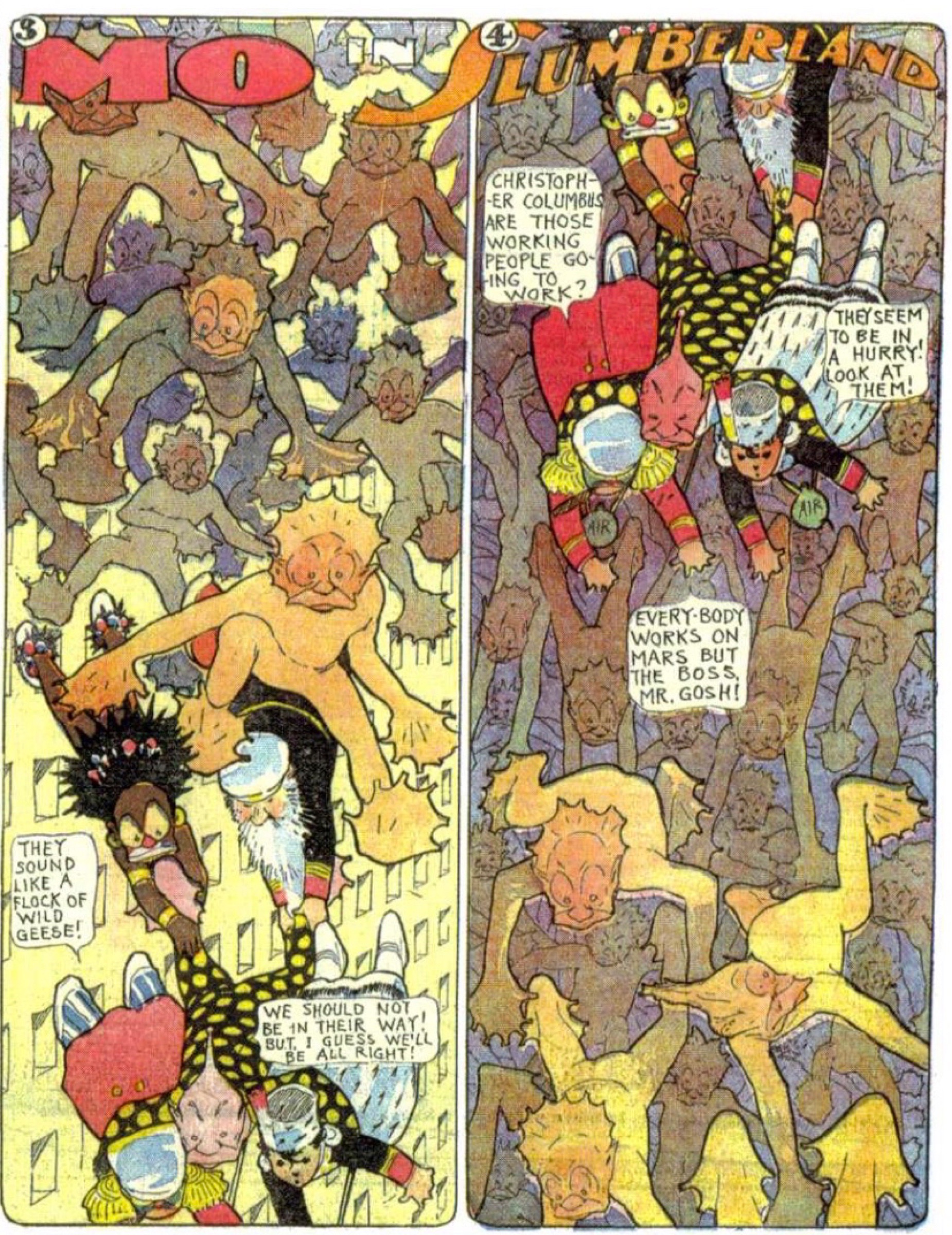
Little Nemo’s Mars episode not only fits within the dystopian mode of some contemporaries, but it enhances it in ways only the comic arts can. McCay visualizes the anonymity and dehumanization of the crowd just as effectively as other comics artists of the day were trying to humanize the urban “masses.” McCay, who was himself a rural transplant to the big city, often drew the reality of the modern crowd in troubling ways. In both his editorial cartooning and his Sunday fantasies, he tended to render crowds as hordes or a mass rather a collective. While other artists like Outcault, Luks and Swinnerton enjoyed depicting the city in tableaux that broke the crowd down into individuated clusters of conversants, McCay usually imagined crowds as dehumanized organisms. Which is to say that even in its earliest stages, the comics offered diverse visualizations of who Americans were and what they could be. Often lost in the celebration of McCay’s stunning artistry and surreal fantasy is that among this generation of artists, his was among the darkest visions of progress.
Perhaps I become tiresome, but one of the themes of this blog and my take on the cultural history of the comic strips is that this medium brought to a rapidly changing 20th Century America unique perspectives on the experience of social change. The best and most popular of these artists were in conversation both with their readers and with their times in ways that were unavailable to the other great mass media of radio, film and TV. In his Martian episode, McCay is building some of the basic iconography of modernist dystopia: architectures whose scale chokes nature itself; human organization and clustering that defies humanity; technology that enslaves rather than empowers; order and repetition that may be pleasing to the eye but empty of spirit.
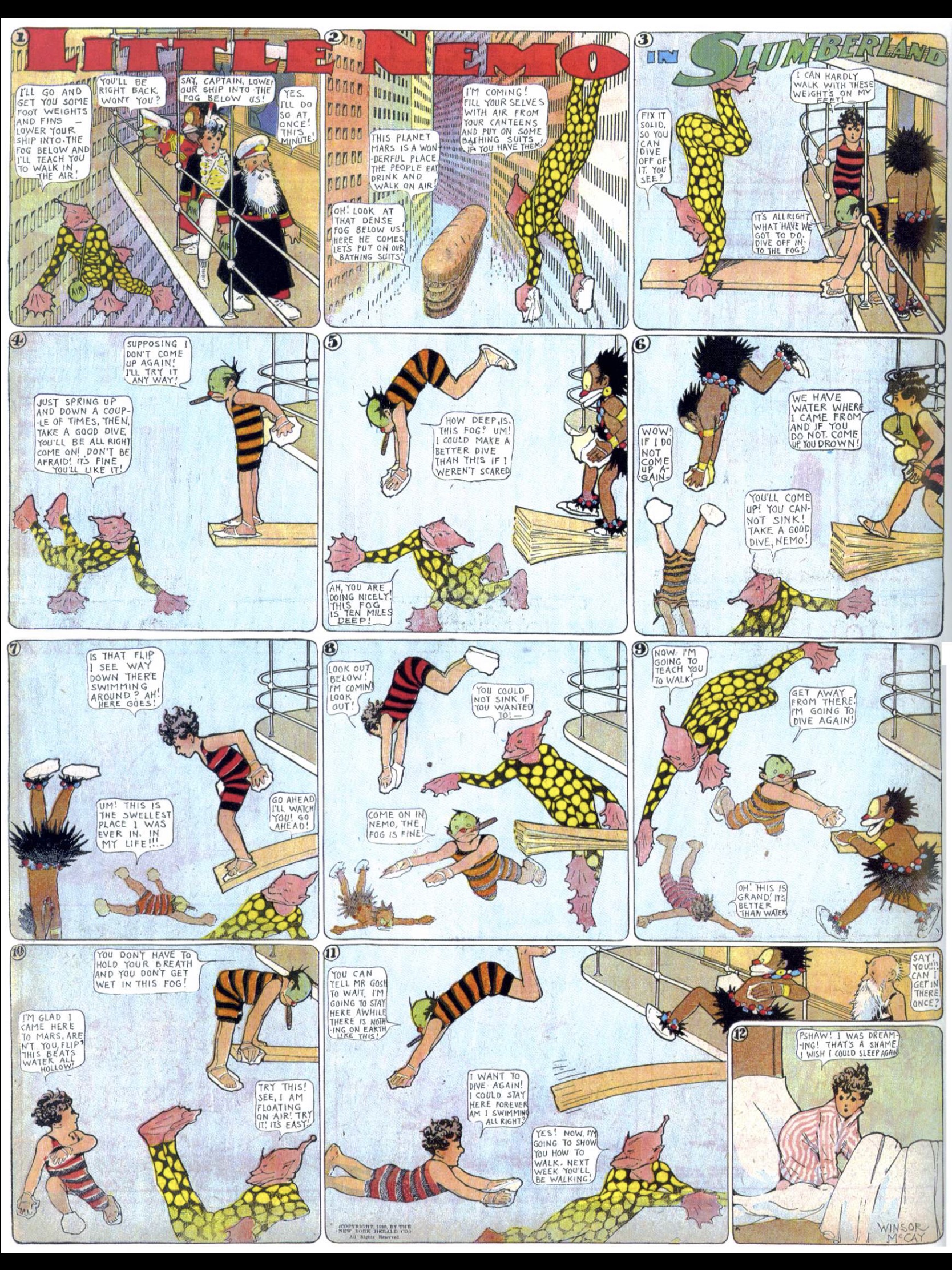
The entire run of Nemo on Mars is reprinted below. Pardon any long load times but I wanted to preserve the resolution so readers could zoom for detail.









Discover more from Panels & Prose
Subscribe to get the latest posts sent to your email.

