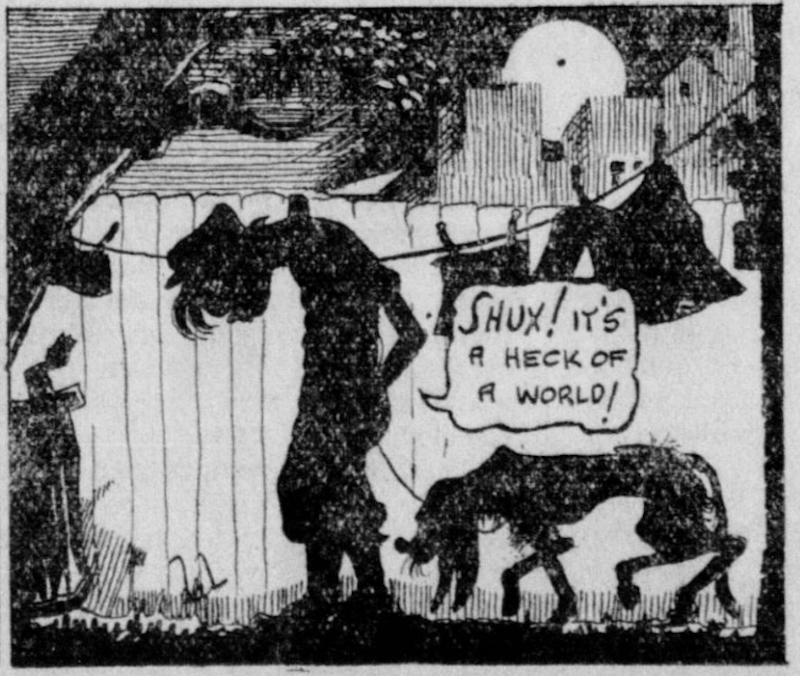
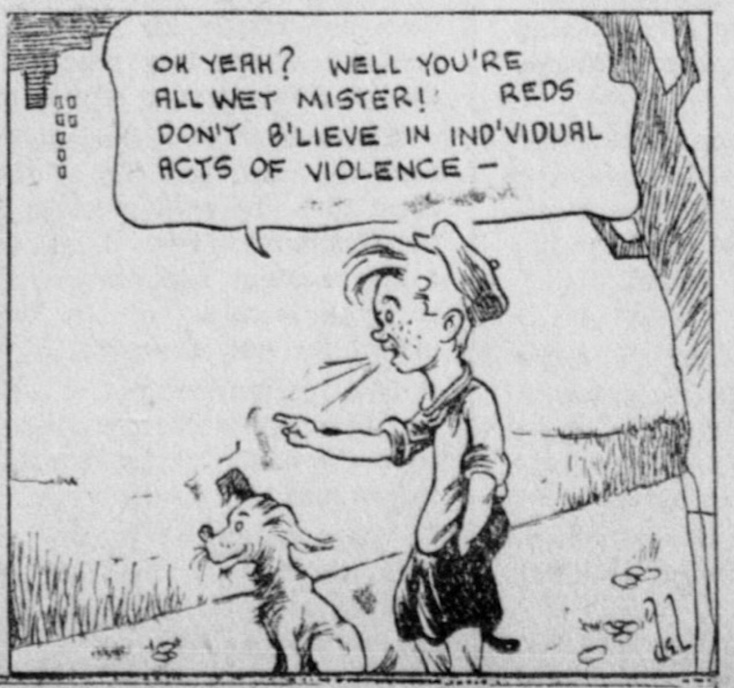
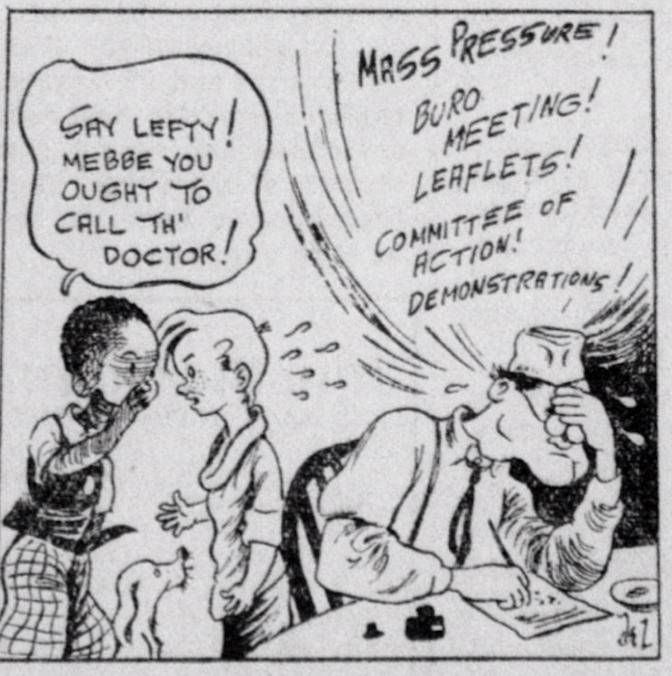
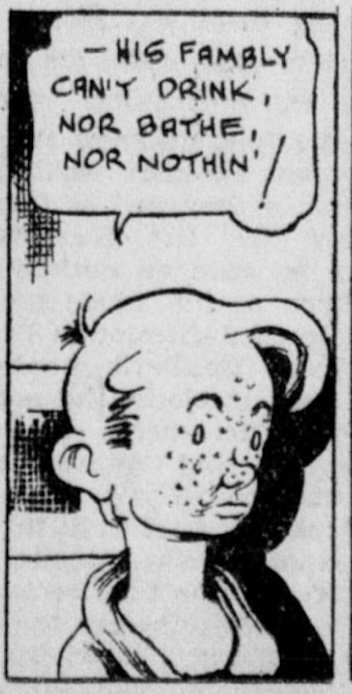
As we found with Coulton Waugh’s lost gem Hank, the radical comic her Little Lefty is often mentioned in comics history but rarely read. This mainstay of the Daily work through much of the 1930s deserves more than a footnote. Like Waugh’s Hank, and the later Pinky Rankin by Dick Briefer, Little Lefty was a genuine and sustained attempt to leverage the conventions of the comics genre towards specific political ends. And it was part of a legacy of leftist cartooning that was already decades old.
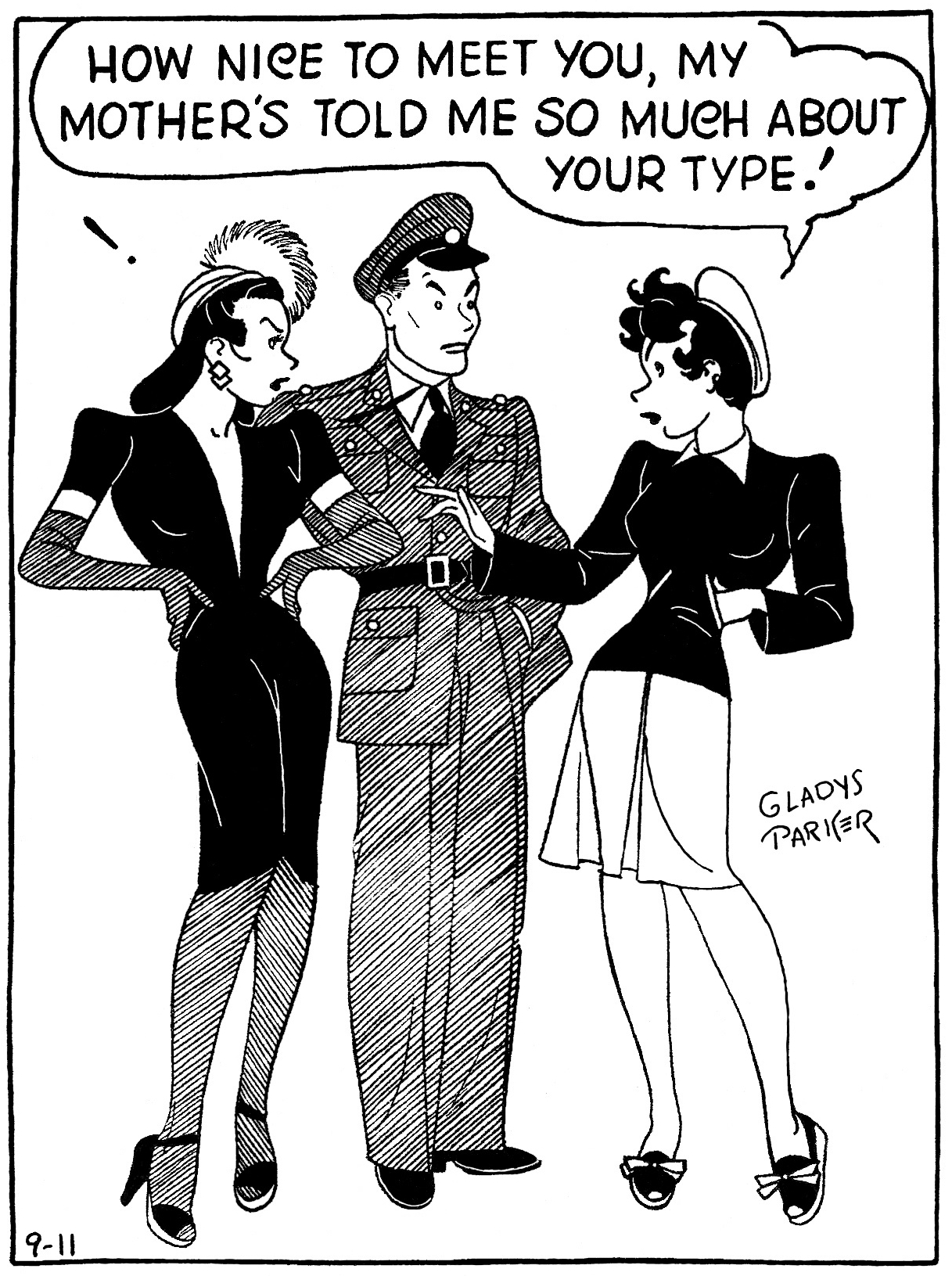
Gladys Parker was among the most recognizable and well-reported cartoonists of the 1930s and 40s. It was hard to miss her. She was the spit-curl image of her avatar Mopsy, the sharp-tongued and stylish star of her own single-panel comic (1937-1966). It is hard to say which came first, Parker’s cartoonish look or Mopsy’s, but they shared the same shock of black curlicues, sharply lined brows and eyes, and a precisely “sticked” set of lips. And since Parker was also a noted, audacious clothes designer, Mopsy was a working girl with a seemingly endless closet of ultra-modern fashions.
Where do we even start to highlight the wicked strangeness of Winsor McCay’s “Dream of the Rarebit Fiend?” The master comics artist drew over 800 nightmares in the first decade of the 20th Century, and most of them include startling examples of his surrealist imagination like the above. The conceit was simple. A normal scene in the opening panel quickly devolves into some bent reality: giant insects sucking a man’s forehead; a gent sneezing his head into the street; various limbs expanding to absurd sizes; people exploding willy nilly; or the characters themselves dissembling or penetrating the cartoon panels themselves. And it all ends in a final panel of the man or woman involved waking up and cursing the rich melted cheese dish (“Rarebit”) that prompted the nightmare.
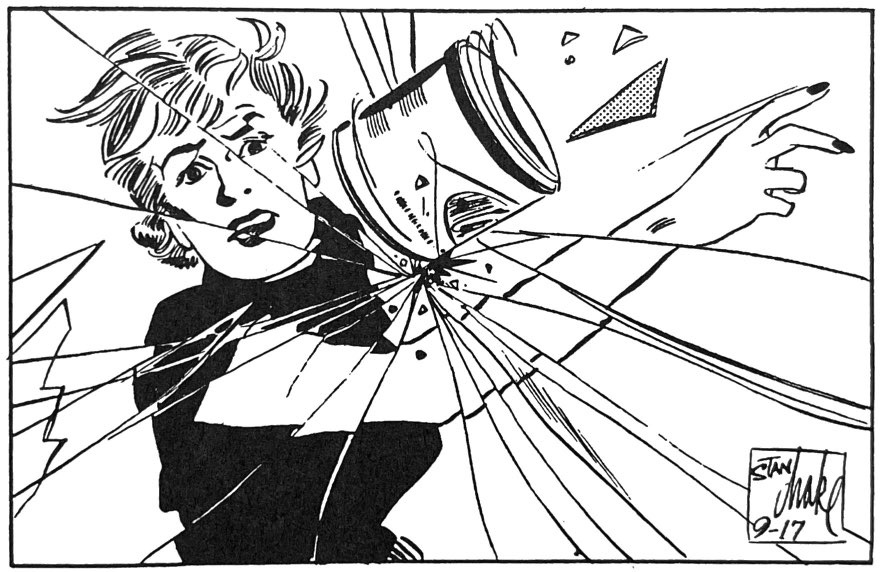
The turn to photo-realism in the adventure comics after WWII is well-documented and obvious in any review of the major strips. Alex Raymond’s Rip Kirby, Warren Tufts’ Casey Ruggles and Lance, Leonard Starr’s On Stage, Stan Drake’s Heart of Juliet Jones, John Cullen Murphy’s Big Ben Bolt are just some of the clearest examples. The stylistic foundation had already been set in the 1930s, of course by Noel Sickles (Scorchy Smith), Milton Caniff (Terry and the Pirates) and Hal Foster (Prince Valiant). They moved adventure strips away from the more expressionist modes of Gould and Gray, or the cartoonish remnants of Roy Crane (Wash Tubbs and Capt. Easy) or the sketchy illustrator style of a Frank Godwin (Connie). .But it is really in the post-war period that we see a clear ramping up of fine line, visual detailing, naturalist figure modeling and movement, as well as full adoption of cinematic techniques.
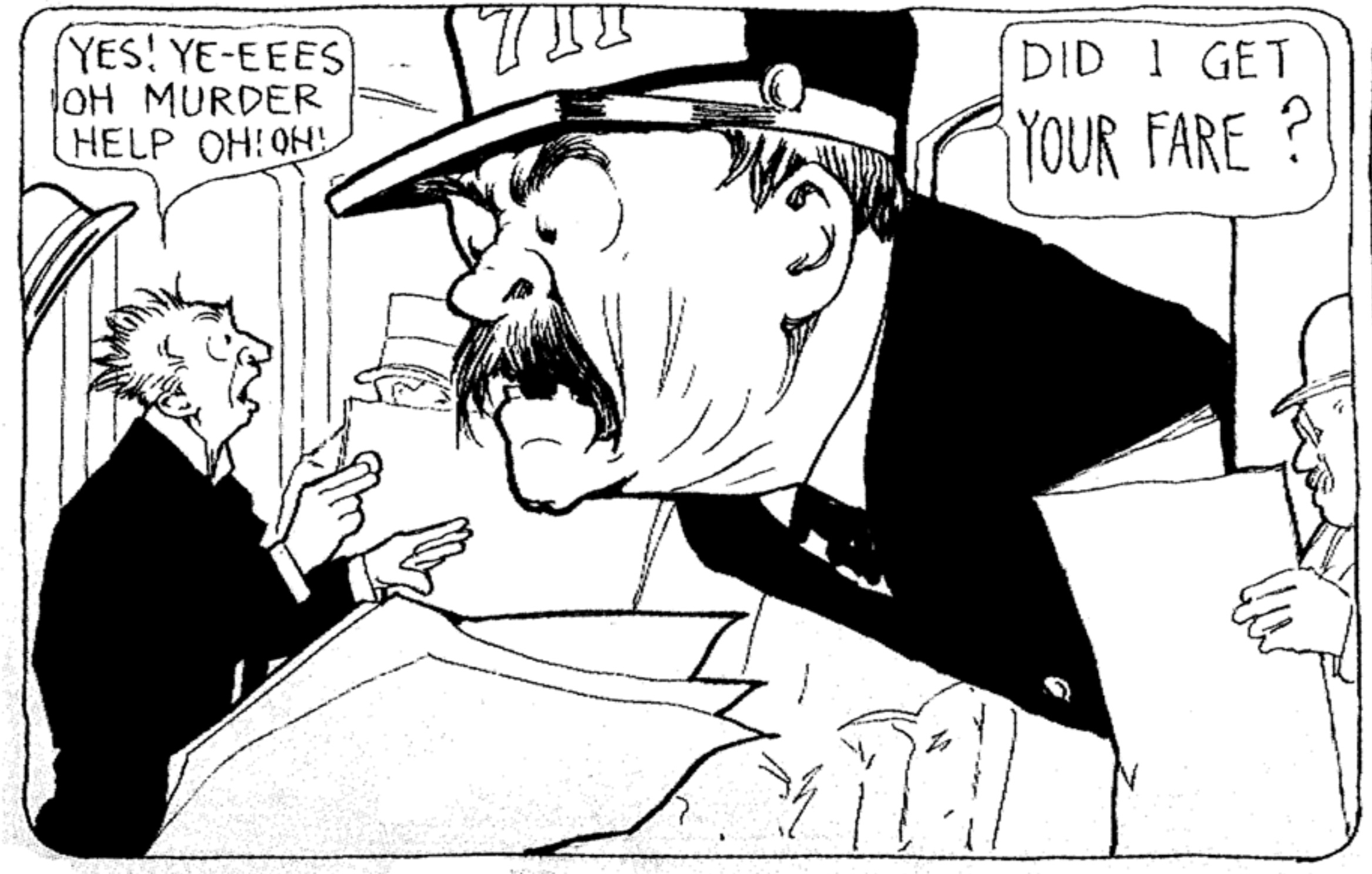
Along with chaos, mayhem and violence, obsessive behavior was a core theme of early newspaper cartooning. Consider the many titular anti-heroes of these years, like Hungry Henrietta, Superstitious Sam, Jingling Johnson, Sammy Sneeze. Or the irrepressible raging “Outbursts of Everett True,” the sex addiction of Mr. Jack, the insufferable politeness of Alfonse and Gaston, or the numerous strips about absent-minded codgers or irrepressible pranksters. Seen through the lens of early 20th Century comics, the new American cityscape was characterized by obsessive behaviors, idiosyncratic personalities, uncontrollable ticks – compulsions of every sort. The annoying monomaniacs in our midst formed the heart of early comics. It was an art well-suited to the daily newspaper: a comedy of everyday frustrations and observations.
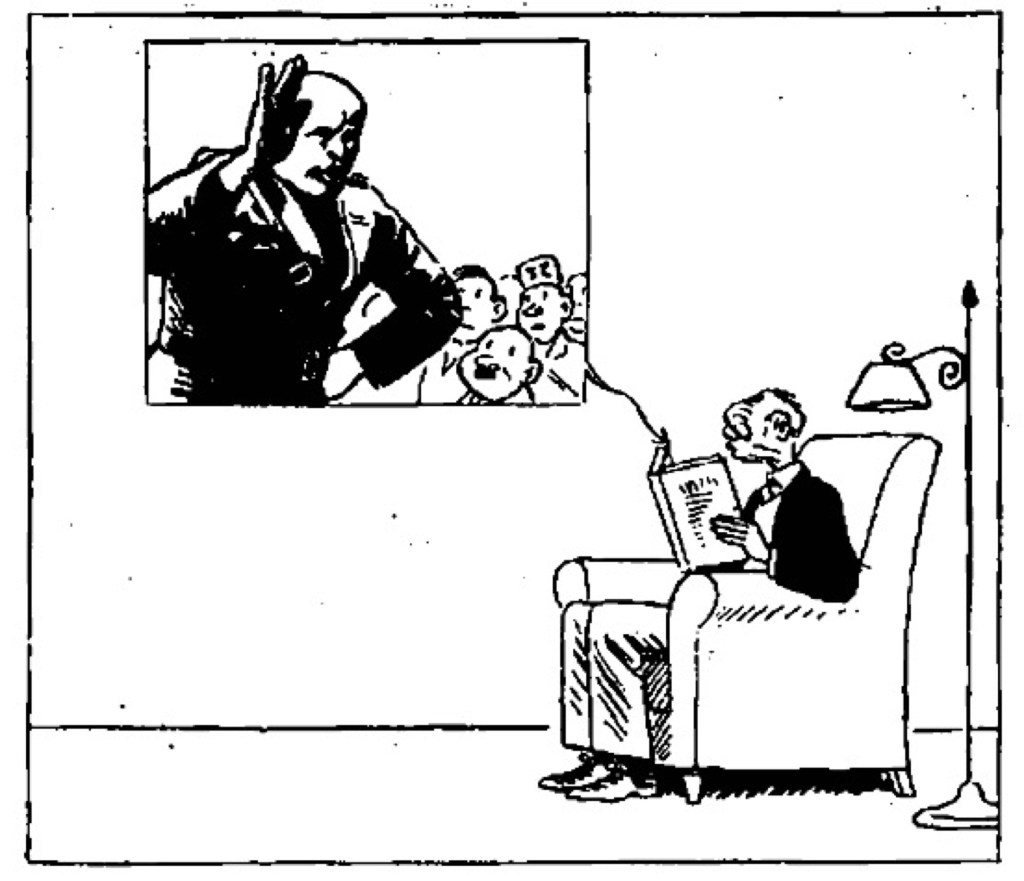
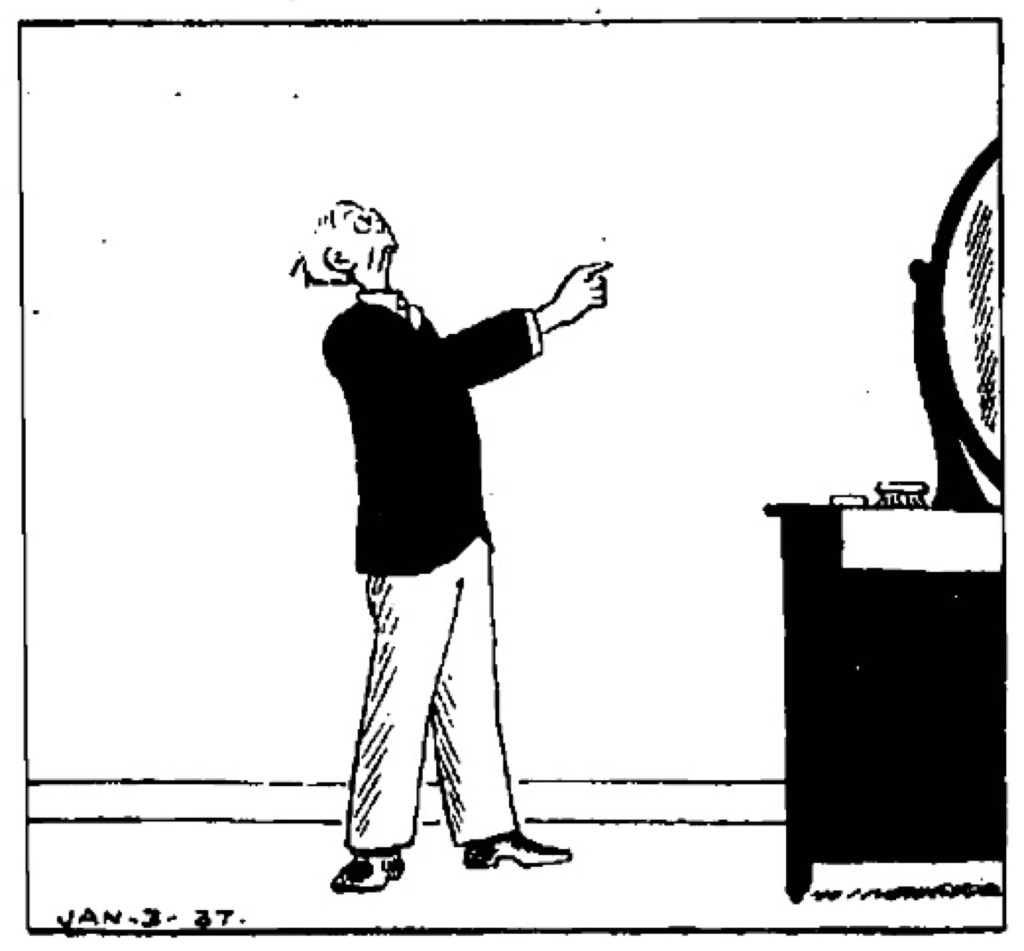
The authoritarian strain in modern democracies has only heightened since I first posted this bit of cartoon wisdom several years ago. In 1937, H.T. Webster’s Casper Milquetoast (The Timid Soul) responds to Italy’s Benito Mussolini and Germany’s Adolph Hitler with his own fantasy of assertiveness. This 1937 vision of fascism’s psychological appeal to feelings of personal disempowerment is eerily relevant to the current ethos. Webster perceptively understands how the personal and political entwine around identity. And through Casper he renders it as a will to power that is at once frightening but also silly and petty. Webster even seems to understand something American liberals are only now grasping: the most effective response to bro-viating fascist cosplay is ridicule.
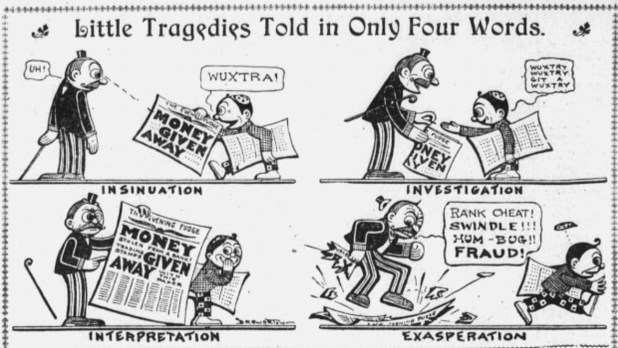
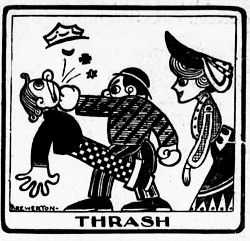
There were no firm rules for comic artists during that first 10 or 15 years of newspaper strips. Formats, aesthetic conventions, even panel shapes and limits hadn’t been fully established. The medium was still elastic. And so we see in these years wild experiments in artistic styles, unfettered explorations of page and the panel structures, even testing different interactions of words and image. Little Tragedies Strikingly Told in Four Words contains that spirit in its own title. It frames itself as an experiment. Crafted by the otherwise forgettable Alfred W. Brewerton for the New York Evening World between Oct. 1903 and June 1904, it was an unusually long-lived title to appear several times a week. True to its title, the strip is indeed striking because it blends pantomime and text in a novel way that is also compact, highly stylized, even wry.It recalls that famous quip about Ernie Bushmiller’s Nancy being easier not to read than to read. And like Nancy, the strip gets at something elemental about how comics work.






 Panels & Prose