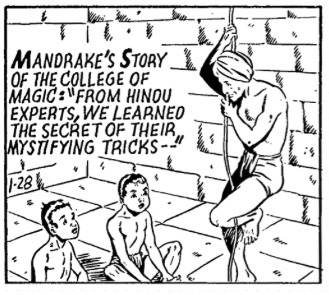
Lee Falk’s tux-clad adventure hero Mandrake the Magician was among the strangest characters on the comic page since his mid-30s launch. As we have covered here before, some of his strips were downright surreal. And so you just know that his origin story must be wild. According to a 1949 flashback sequence, orphaned twins Mandrake and Derek are raised by an island school of monk-like magicians. The boys learn ancient mystic secrets like “Instant Hypnosis, the art of making things appear to be what really aren’t — the art of the seemingly impossible.” But Derek shows his evil nature early and resurfaces in a 1949 story that threatens Mandrake’s reputation. Dig the signature slicked back hair on those toddler tops.
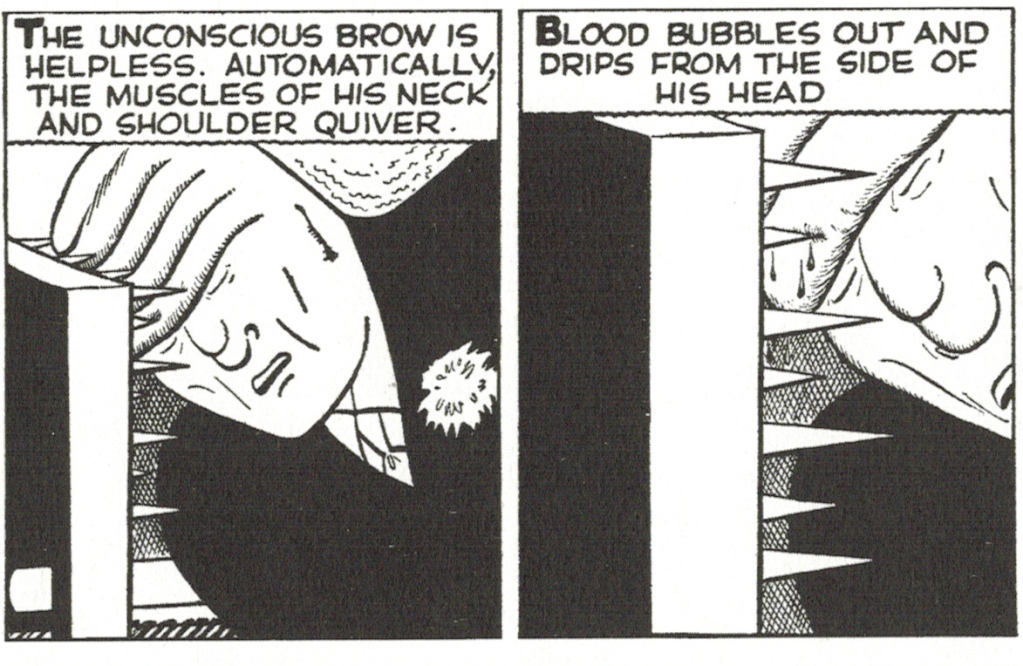
The hallmark of Chester Gould’s Dick Tracy is its surreal villains. Flattop, Pruneface, Mole, Mumbles, et. al. But Gould wasn’t satisfied expressing inner evil with outward disfigurement. He also loved to torture and kill them in equally grotesque ways during the prolonged hunt and chase sequences that were central to every Dick Tracy storyline. Gould wanted more than justice against evil. He wanted revenge and sometime literal pounds of flesh.
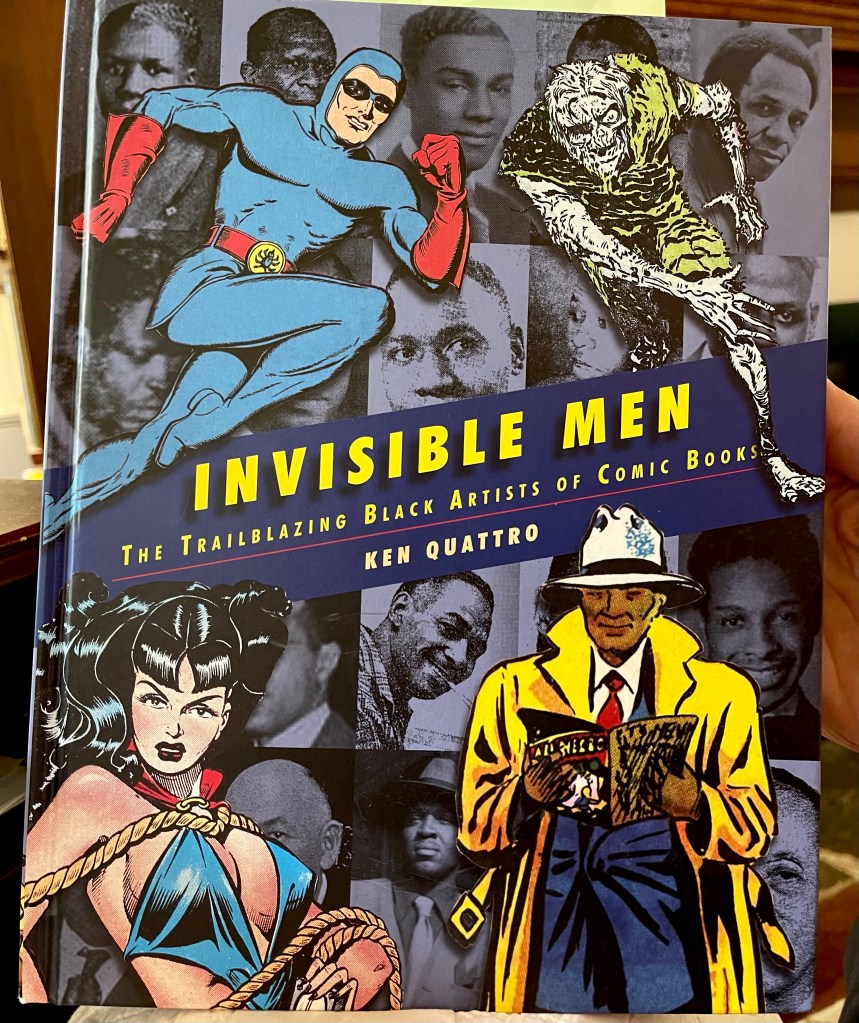
Invisible Men: The Trailblazing Black Artists of the Comic Book
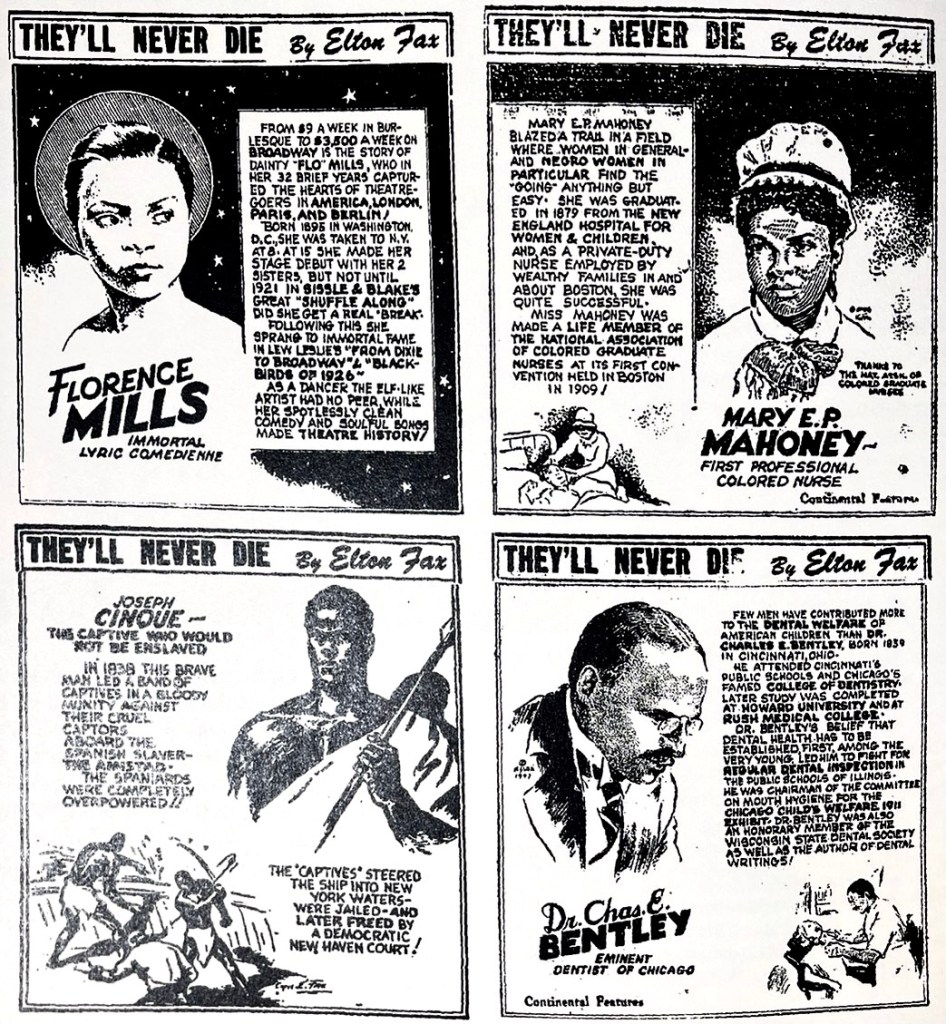
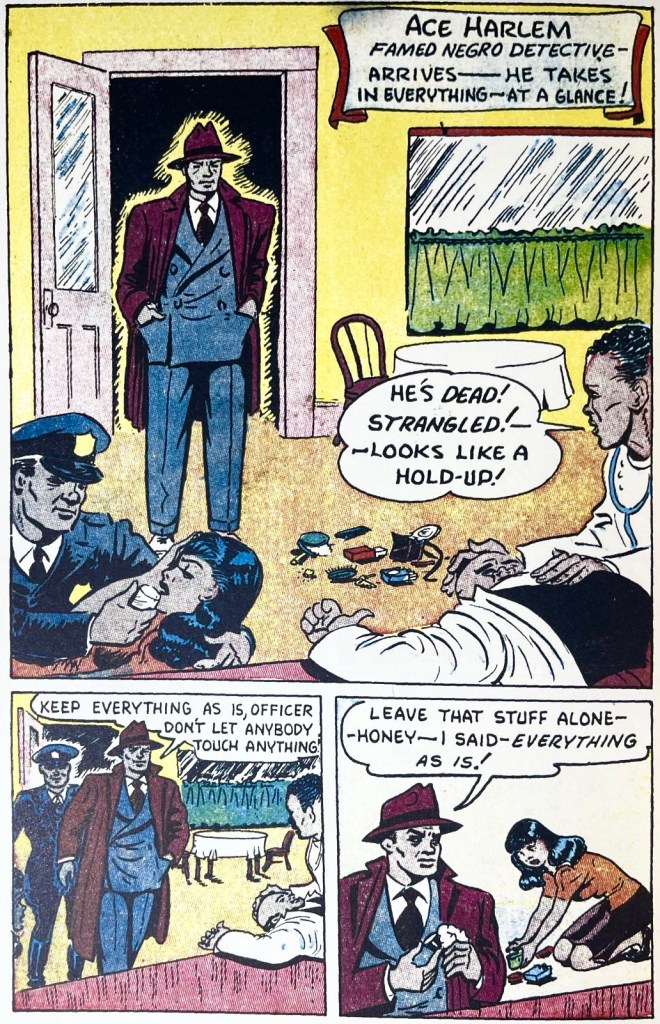
This well produced overview of over a dozen pioneering Black comics artists surfaces a hidden history that is eye-opening on so many levels. Many of these artists were well-known within their own communities and Black newspapers in many of the major cities across the US but “invisible” to the larger world of comics readers. Mainstream comics history often highlights Matt Baker who developed sexy heroines like Phantom Lady and Flamingo and is well represented here. But author Ken Quattro does an excellent job taking a biographical approach that digs into Adolph Barreaux (Sally the Sleuth), Elmer Stoner ( Phantasmo), John Paul Jackson (Tisha Minga and Bungleton Green), the collaborations of Elton Flay Fax and George Dewey Lipscomb, Alvin Hollingsworth’s horror comics, and a dozen more that differentiates the styles, personalities and career paths of an incredibly diverse group of artists.
Invisible Men tends to focus on these artists’ eventual contributions to the mainstream comic book field, and so each biographical section usually ends with a full story, full color reprint. Ironically, this work often represents the least expressive and talented examples of what many of these artists had to offer. Their careers generally were more interesting outside of a comic book industry that paid poorly and demanded little. In fact, as Quattro himself recognizes, unlike most early comic book artists, almost all of the Black artists he explores were formally trained fine artists who took on this work just for the money.
In each of these biographies I found their supporting and prior careers much more interesting, as does the author. Quattro cautions that he is not a formal historian, but he ably sketches in a blind spot for comic strip history – the Black newspaper, as well as the vagaries of freelancing for early comic book and pulp magazine companies and how it allowed many of these “invisible men” sustained careers. In taking a biographical approach to this cast, Quattro defies generalization about these artists’ perspectives and backgrounds. We enter a range of highly individual contexts, especially Black middle-class enclaves in cities like Oberlin, Charleston, Baltimore and more. We get glimpses of how Black newspapers, communities, artist groups lent support and connections for many of these men as they cobbled together artistic careers that moved across Black newspaper comics and editorial, community pamphlets, posters and fine art exhibits in addition to the burgeoning comic book industry.
Valuable as Invisible Men may be, it begs for more…more history of Black artist communities, of the Black newspapers that nurtured so much talent, of artists that fall outside of Quattro’s comic book lens. We need at long last a modern report in of strips like Bungleton Green, the syndicates that distributed Black comics artists, an entire history of editorial cartoons that took a decidedly different take on current events.
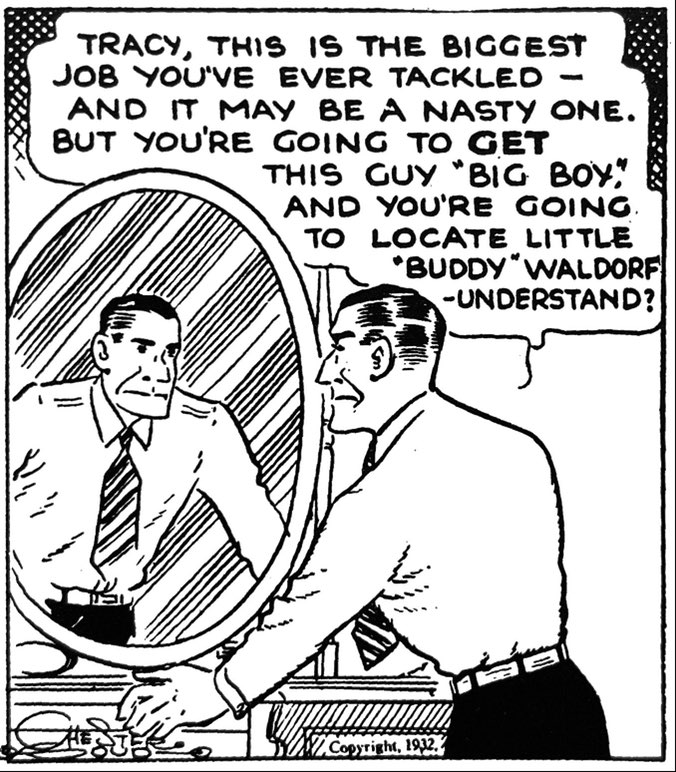
A rare moment of Tracy self-reflection, bracing himself for action
Chester Gould’s imagination was as relentless as it was strange and even strangely mundane. His four decade run of Dick Tracy was distinguished by his signature villain grotesques, striking graphic violence and often arch-conservative politics. Reviewing Tracy’s first year of strips lately, I was struck by a few scenes that both veered from the strip’s eventual form but also practiced many of its regular notes. In the image above, for instance, Tracy pumps himself up for the coming challenge of bringing down his first major nemesis, Big Boy, and rescuing a kidnapped boy. The later Tracy would of course become a rock of resolve that wouldn’t have admitted even this kind of self-encouragement. At this point, even for Gould, Tracy is still human and not yet iconic.
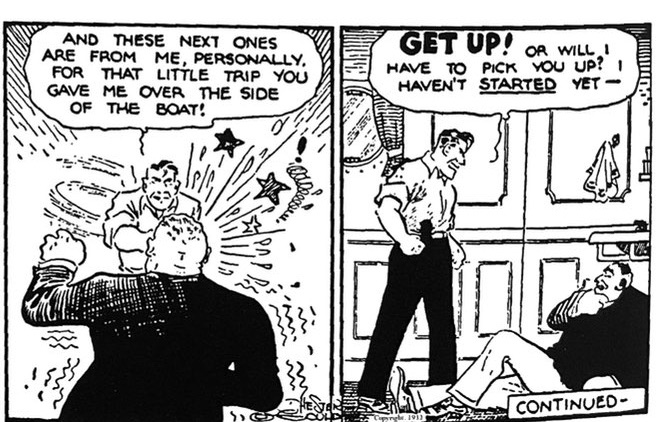
And yet the two-fisted and eccentric manliness of Tracy and many of his pulp fiction counterparts was central to the character from the beginning. And Gould’s politics clearly were already set as early as 1932. Tracy was conceived as a lawman who necessarily had one foot outside police institutions. In fact, before the murder of fiancee Tess Trueheart’s father Emil, Dick was a civilian who had not yet found his calling. He swears upon Emil’s dead body that he will avenge the murder, which sets him on a quick path to becoming a leader among the “plainclothes” unit of the city police department. But his impatience with the bureaucracy is apparent in his unconventional methods and capacity for personal revenge and violence upon his villains. When he finally corners Big Boy, we get a crescendo of police brutality that stretches across several days. It ends with Tracy sending Big Boy crashing through a ships’ cabin door.
The twisted genius of Gould was in having it both ways with Tracy. He professed a deep respect for the law, and Tracy’s straight-backed uprightness was a feature of the strip’s characterization as well as it’s blocky noir style. And yet vigilante justice was meted out both by Tracy and Gould alike. Indeed, his colleagues in the force like Pat Patton and subsequent colleagues are seen as relatively timid and even feminized by their institution in a way that the indomitable masculinity of Dick is not. And the overall violence of the strip is clearly an extension of Tracy’s own vengefulness. The protracted chase of villains on the lam became a part of the Dick Tracy formula, and it was punctuated by the villain’s gruesome torture by nature along the way, often ending in grisly death. Violence for Gould always seemed to be the ultimate social purifier.
By Gould’s own admission, he often made it up as he went along, rarely knowing where his plots were headed and how he would get Tracy out of a jam. And so from its early days the plotting and devices often feel ham-handed, implausible or genuinely weird. His pursuit of Big Boy onto an ocean liner leads Tracy to knock out an innocent staffer to don his uniform and to dress in drag just to get onto the boat and get close to the kidnappers. Less tortured paths clearly are available to his characters, but Gould’s love of novel, unlikely story paths usually wins out.
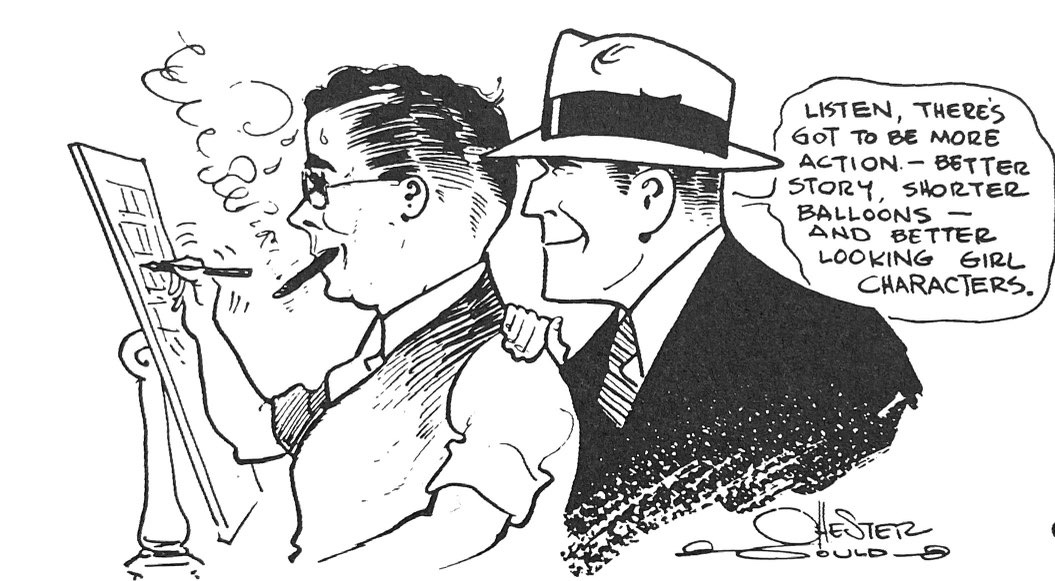
By 1942, a decade after its launch, Gould’s visual signature for Tracy is fully established. His hawklike nose, perpendicular chin and straight lips are as much a statue as a figure, more chiseled from stone than drawn in ink. And in this self-portrait Gould himself sweats under Tracy’s command. He has created a caricature of law and order, authority and masculinity that would become a lodestone. Al Capp soon would mock his violence and surreal story and villainy. His love of authority and violence, impatience with countercultural trends would make him seem a relic by the end of the run. Yet, as much as Gould himself seemed a straight arrow defender of formal institutions, Dick Tracy itself was grounded in a surreal imagination that eschewed simple realism, broke violently with the propriety of the comics page and took us into very strange places.
Lena the Hyena – Wolverton’s Winning Entry in Li’l Anber Ugliest Woman Contest
#6 Brain Bats of Venus: The Life and Comics of Basil Wolverton, Vol. 2 (1942-1952) by Greg Sadowski, Fantagraphics, $44.99
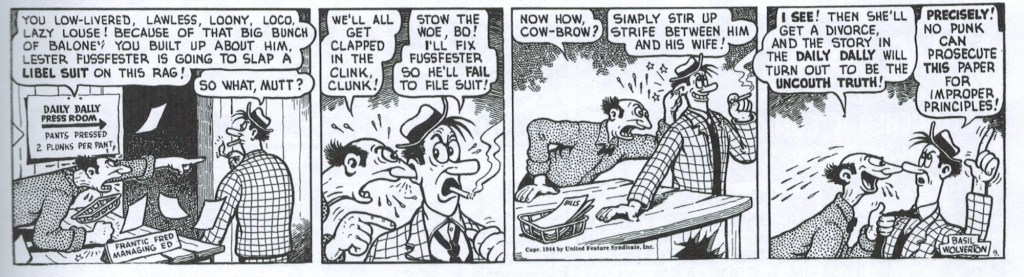
Volume 2? You have to wonder if any biographer really needs a two volume bio-reprint to cover the life and art of a single cartoonist. To be fair, Sadowsky’s treatment gives up a massive share of space to reprinting much of Basil Wolverton’s best published work and revealing sketch and spec pieces. But in fact, Wolverton was as singular and curious a character as his art. This volume focuses mostly on his horror and sci-fi work, which was often batshit imaginative. But there is also his caricature art, advertising work, and more. Also interesting and included here are his many failed attempts to break into comic strip syndication with some of his screwball comedy characters of the 1940s like Scoop Scuttle (below). And of course Wolverton leapt from obscurity to fame when his Lena the Hyena caricature won Al Capp’s contest to depict the world’s “ugliest woman.” Wolverton remains a seminal figure. His break from any previous comic art style anticipated (and was revered by) the comics underground more than a decade later.
Wolverton made several unsuccessful attempts to break into what every comic book artist viewed as the mother lode – newspaper comics syndication. Among his several failed attempts to break into strips, he translated his Scoop Scuttle screwball comic book character to a daily format on spec.
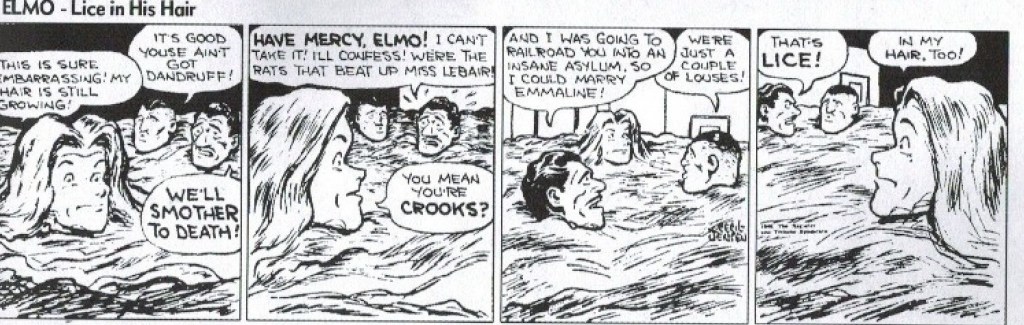
#8 Elmo: An American Experiment by Cecil Jenson, edited by Frank M. Young, Middletown DE, Labor of Love Press, $14.99
What a find. Young has unearthed and reprinted a darkly surreal strip from the late 1940s by the author of the later Little Debbie strip of the 1950s. It seems like a Li’l Abner knockoff, with the rural rube Elmo encountering urban caricatures. But Jenkens sends Elmo down some of the darkest urban and psychological alleyways of post-war America. Its brief run shows it was too strange for post-war audiences groping to return to normality after WWII. But Elmo suggests a kind of unease to that project that would also come out in 40s noir, crime comics and 50s horror comics.




 Panels & Prose