

Many have said before me that we are enjoying the golden era of comics reprints.
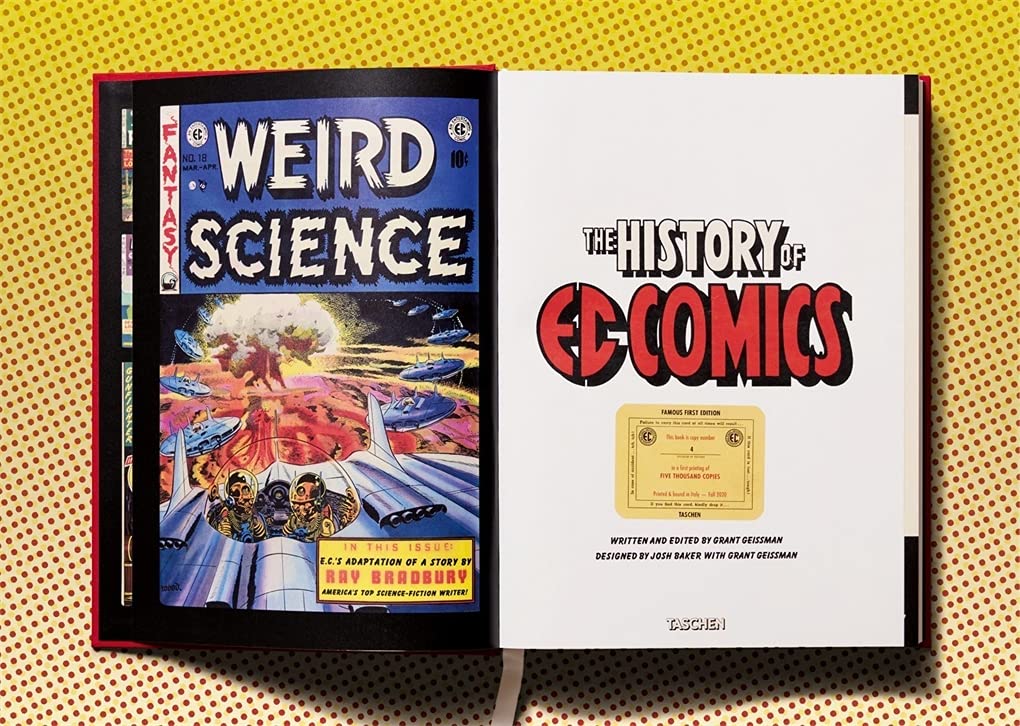
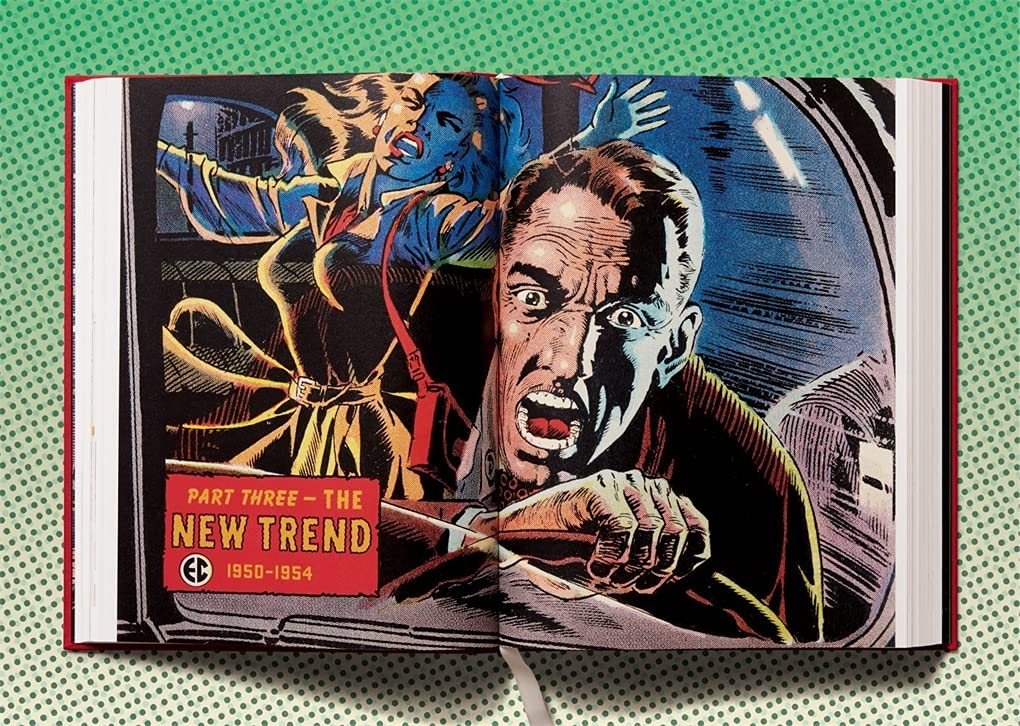
Perhaps. My default position is from a broader historical perspective, and myself having gathered many volumes since the early 1970s. As I look over the shelves here at decades of accumulation in the Panels and Prose library, it seems to me we are in the latest surge of publishing activity that goes back at least five decades. I still have some of the early retrospectives of Dick Tracy, Buck Rogers, EC Comics, Pogo, Bill Mauldin, Winsor McCay, Happy Hooligan, Flash Gordon and more going back many decades. In my recollection, the underground comic artists of the late 1960s helped spark more serious consideration of comic strip history, leading to many of the 70s and 80s reprints. And, of course, we can’t overstate the importance of Bill Blackbeard’s personal effort to rescue that history and kindle so much interest in his landmark 1977 Smithsonian Collection of Newspaper Comics. Publishers like Hyperion, Bonanza, NBM, Nostalgia Press, Blackthorne, Pacific and others pioneered the extensive reprinting of comics greats.
But we are enjoying an embarrassment of riches from the likes of IDW/Library of American Comics, Fantagraphics, Drawn & Quarterly, Hermes and Titan, to name just some. It is hard to keep up, and I can’t pretend being able to track, let alone, afford all that is available in the market. The curation policy here at P&P Library is to collect more in breadth than depth. I try to collect enough samples across the many comics eras and genres so that as a cultural critic I can write responsibly about select artists and capture wider trends. But every year I try to highlight the books that I feel added most to my understanding of the comics field and industry. Here are my picks for the last year…or so.
Rebirth of The English Comic Strip

Arguably the most substantial historical contribution of the last year is David Kunzle’s majestic Rebirth of the English Comic Strip: A Kaleidoscope, 1847-1870 (University Press of Mississippi). He unearths some of the great and under appreciated cartoonists of the UK humor magazines during that genre’s heyday in the mid-Nineteenth Century. In some ways an historical follow-up to his book on the previous age’s great caricaturist Rodolphe Topffer, the University of California art history scholar argues that this mid-century period represented a rebirth and establishment of the modern cartoon arts in the pages of Punch and elsewhere. He gives us both the rich context of British humor magazines in the era and their emerging lower-middle-class readers. He then does closer readings of about a half dozen exemplars like George Cruikshank, John Tenniel, John Leech and Richard Doyle (above). Kunzle’s writing is uneven. His penchant for long sentences, commas, clauses and asides, can be trying. His knowledge of the field and this historical context of the rise of comic strips is boundless, however. But best of all, this exceptionally produced tome bulges with extensive reprints. The paper and print quality are up to the task of rendering the era’s finely engraved line work in sharp relief. Kunzel’s is the indispensible comic history book of the past year.
About Time: Rediscovering Black Cartoonists

An invaluable trio of books this year started to address a woeful blind spot in American comics history, the contributions of Black artists to the growth of the field. Ken Quattro’s Invisible Men: The Trailblazing Black Artists of Comic Books (Yoe Books), Dan Nadel’s It’s Life As I See It: Black Cartoonists in Chicago, 1940-1980 (New York Review Comics) and Rebecca Wanzo’s The Content of Our Caricature: African American Comic Art and Political Belonging (NYU Press) each fill in different aspects of this ignored history. I covered Quattro’s book in my previous roundup. He focuses on unrecognized comic book artists, but a number of his cast, like Jay (Bungleton Green) Jackson and Adolphe (Sally the Sleuth) Barreax had their roots in Black newspapers and the pulp magazines.
Wanzo’s is an academic exploration of the uses of Black caricature going back to slave depictions through superheroes. She pulls apart in detail the ways in which visual tropes emerged for Black men, women, children and families that served to marginalize them politically and socially in both subtle and grotesquely obvious ways. She spends much of her time focusing on Black artists and the ways some appropriated and perpetuated these visual themes, while others took creative control of them. The book is especially effective at thinking differently about the topic of stereotype and seeing it as both a bludgeon and a tool.
For comic strip reprint fans, however, Nadel’s collection is the must-get in this welcome trio. He gives us some of the biggest tranches of work from the great Black newspapers and magazines ever reprinted. Jackson’s wildly provocative time travel episode of Bungleton Green is mind boggling. The Jackie Ormes episodes of Patt-Jo ‘n’ Ginger really underscore her wit. And the reprinted selections from Tom Floyd’s 1969 workplace send up of white notions of “integration” (“Integration Is a Bitch!” above) really drive home how much of American cultural history we missed by overlooking this history for so long. My hope is that this is just a start. Nancy Goldstein’s bio of Jackie Ormes is now out in paperback and has a generous selection from the First Lady of Black cartoonists. But I would love to see a retrospective of Bungleton Green sometime soon.
Trots and Bonnie/The Appletons
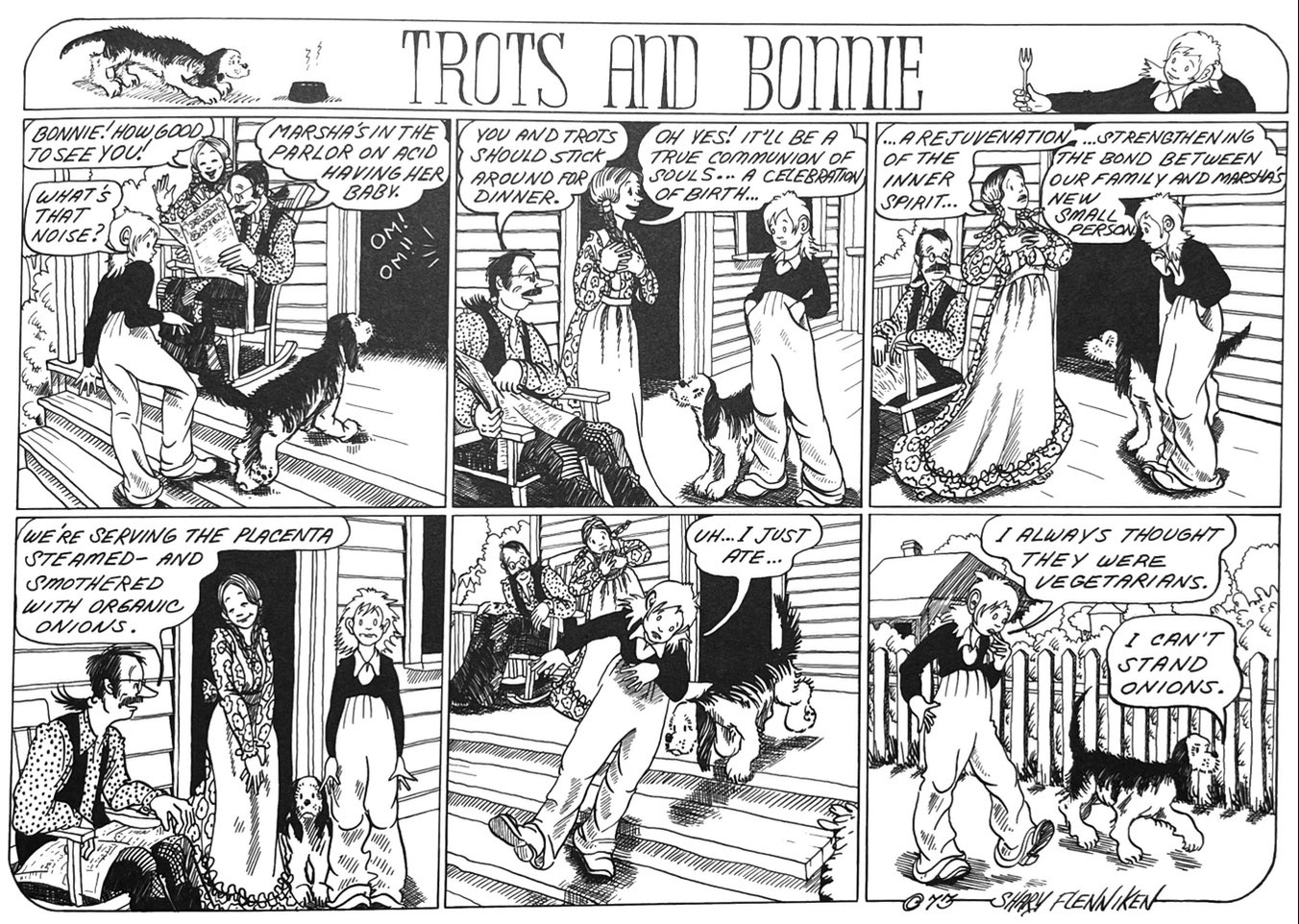
In my formative years of comics appreciation (early 1970s) National Lampoon’s comics section was nothing less than a revelation. Gahan Wilson’s Nuts, Vaughn Bode’s Cheech Wizard, Bobby London’s Dirty Duck, B. K. Taylor’s The Appletons, and anything by Rick Geary, Stan Mack and Charles Rodrigues truly blew this kid’s mind wide open to the possibilities of the form. But no one jangled my adolescent male sensibilities as much as Shary Flenniken’s truly pioneering Trots and Bonnie. The adolescent innocent Bonnie, her wry and ironic pup Trots and totally liberated friend Pepsi decimated my suburban 70s notion of feminine propriety, in the best ways. Flenniken’s candor about the female body, resentment of the patriarchy, and dark, dark sense of humor put nothing off limits. And her fine, controlled line work, thoughtful panel compositions only amplified the satire through contrast. A scathing humorous sensibility had the look and feel of children’s book illustrations and it is finally collected with the size and precision it deserves in New York Review Comics’ Trots and Bonnie. B.K. Taylor’s Appletons and Timberland Tales followed a similar rule of contrasts. He cloaked his descent into the perverse, murderous, incestuous vision of American family in cartoony stylings of apple-cheeked, smiley happy characters. Think Mark Trail meets… . Well, hell, I am not sure I can come up with an analogue for Taylor’s ink black perversity. Buckle up, because this year’s I Think He’s Crazy: The Comics of B.K. Taylor (Fantagraphics) is a twisted ride.
Popeye…Again

Like Krazy Kat, Little Nemo, Terry and the Pirates, Dick Tracy and Li’l Abner, E.C. Segar’s Popeye/Thimble Theatre has long been recognized among the pantheon, and so it has been reprinted several times over the last decades. A decade ago, Fantagraphics finished a six volume compendium of all Popeye-era dailies and Sundays in oversized formats with generous supporting material. With Popeye Volume 1: Olive Oyl and Her Sweety (Fantagraphics) the publisher shrinks the format, scope and price into a manageable paperback of just the Sundays. It has an imaginative slipcase design with cutout. But most of all it makes those wonderful color weeklies more accessible. Segar maintained a separate storyline in the Sundays, which usually used larger panels and more action. In this first volume we get both the early romance between Popeye and Olive as well as an extended story about Popeye’s short boxing career. Whether with words, schemes or fists, Segar had a pugilistic vision of human relations that comes through no matter the scenario. For those who already have the last reprinting, this series is unnecessary. But it is well worth the affordable price to anyone else.



 Panels & Prose