Across five decades of adulthood, every woman I have ever known was familiar, often intimately, with Cathy Guisewite’s Cathy (1976-2010). Our heroine’s struggles with new and old gender roles, the pressures of fashion and body messaging, diet trends, new tech, workplace culture…and MOM, always MOM, found their way into more diaries, onto more refrigerators and clipped into mother/daughter exchanges than any comic of its day. Tis a pity that so many of us male comics readers passed it over as “not for us” or simply unfunny. Spending a couple of days immersed in the new and most welcome 4-volume Cathy 50th Anniversary Collection ($225, Andrews McMeel) makes clear that Cathy was among the most insightful, witty and intelligent strips we had about the experience of post-counter-culture America. And I could have avoided a lot of stupid missteps with the women in my life if I had paid even glancing attention to Guisewite’s wisdom.
Continue readingTag Archives: fiction
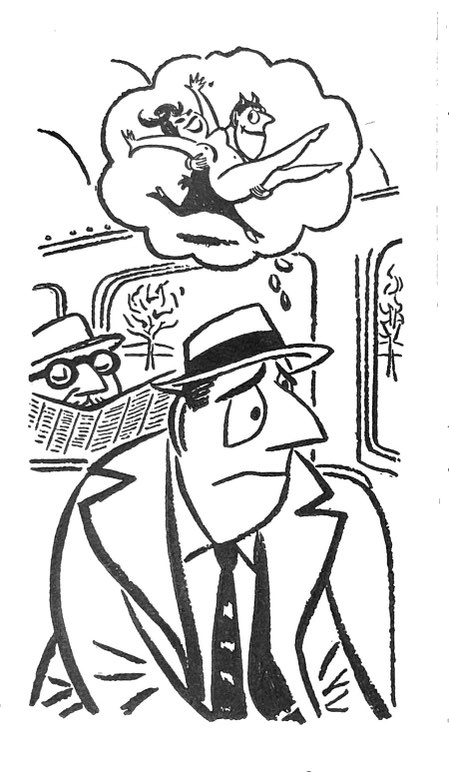
Mad Men Angst: Dedini, Shulman and Self-Hating Suburbia
You may not think you know Max Shulman and Eldon Dedini, but you have seen their stuff. Shulman was a comic novelist of the 1940s and 50s whose most famous, enduring creation was The Many Loves of Dobie Gillis, a short story collection that became an MGM musical in 1953 and a genuinely witty TV sitcom (1959-1963). But throughout those those decades, Shulman was a bestselling satirist of mid-Century suburbia. His 1943 breakout college satire Barefoot Boy With Cheek was followed by The Feather Merchants, the Dobie Gillis collection and Rally Round the Flag, Boys!. In their Bantam paperback releases, many of Shulman’s novels enjoyed cartoon complements by Eldon Dedini, best remembered as a longtime Playboy magazine regular. His cartoon style is immediately recognizable: highly abstracted balloon faces, sharp triangle noses, bright watercolor washes. His lascivious satyrs were among jhis signature series in Playboy.
Continue readingEC Sci-Fi At Scale: Taschen’s XXL Weird Science

The EC science fiction titles hold a special place in American pop culture. The books that ran from 1950 to 1955 (Weird Science, Weird Fantasy, Weird Science-Fantasy) were indispensable waystations for the still-niche genre of science-based speculative fiction. I would argue they were the crucible in which pop sci-fi as we have known it was forged. These comics not only popularized some of the foundational tropes of the genre. But EC’s stable of premiere artists then visualized many of these themes in ways that were far more sophisticated than the typically awful B- and C-level production values Hollywood applied to the sci-fi genre. Even though these comics were among the least popular of the EC titles, they likely were legitimating sci-fi in more young readers’ minds than any pulp mag or film c-lister could. And at the same time, artists like Wally Wood, Al Feldstein, Joe Orlando, Harvey Kurtzman and Jack Kamen were inventing a visual language for sci-fi themes: post-apocalyptic vistas, space travel, the romance of a starship launch, bug-eyed and fish-faced aliens. Their influence on the subsequent conceits of sci-fi fiction, art and film, as well as their look, is undeniable. From Forbidden Planet (1956) to 2001: A Space Odyssey (1968), Star Trek (1966), Star Wars (1977) and beyond, these comics were the first rough sketches of what our fantasies of the future would become.
Continue readingJungle Jim Is A Ramblin’ Man…And Quite the Charmer
No one could mistake master artist Alex Raymond for a proto-feminist. In his and scribe Don Moore’s dual successes of the 1930s, Flash Gordon and Jungle Jim, barely-clad distressed damsels abounded. To be sure, Raymond understood better than any comic strip artist the erotic potential of the formal, His male and female bodies were delicious. But it also goes almost without saying that the adventure genre has always been about male prowess and potency against forces natural, exotic, institutional and especially feminine. Comics artists like Carl Barks and Al Capp, among others, have recounted that newspaper editors often cited the 12-year old boy as the ideal target market for adventure strips. Well, yeah, sure…along with their horny Dads.
The adventure hero’s cavalier approach to women, romance, and all that icky girly stuff is clear in Jungle Jim’s caddish handling of two rival gal pals Lil and Kitty in this late 1941 interstitial between two episodes. Jim has no time for romance, and writes to Dear Jane letters, excusing himself from commitment. Lil gets the I’m-just-a-ramblin’-sorta-guy” brush off and Kitty gets the mock magnanimity ploy. “Find a nice substantial businessman… .” What a gentleman.
Continue reading


