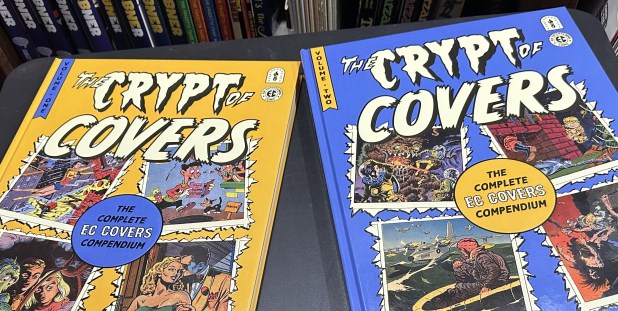
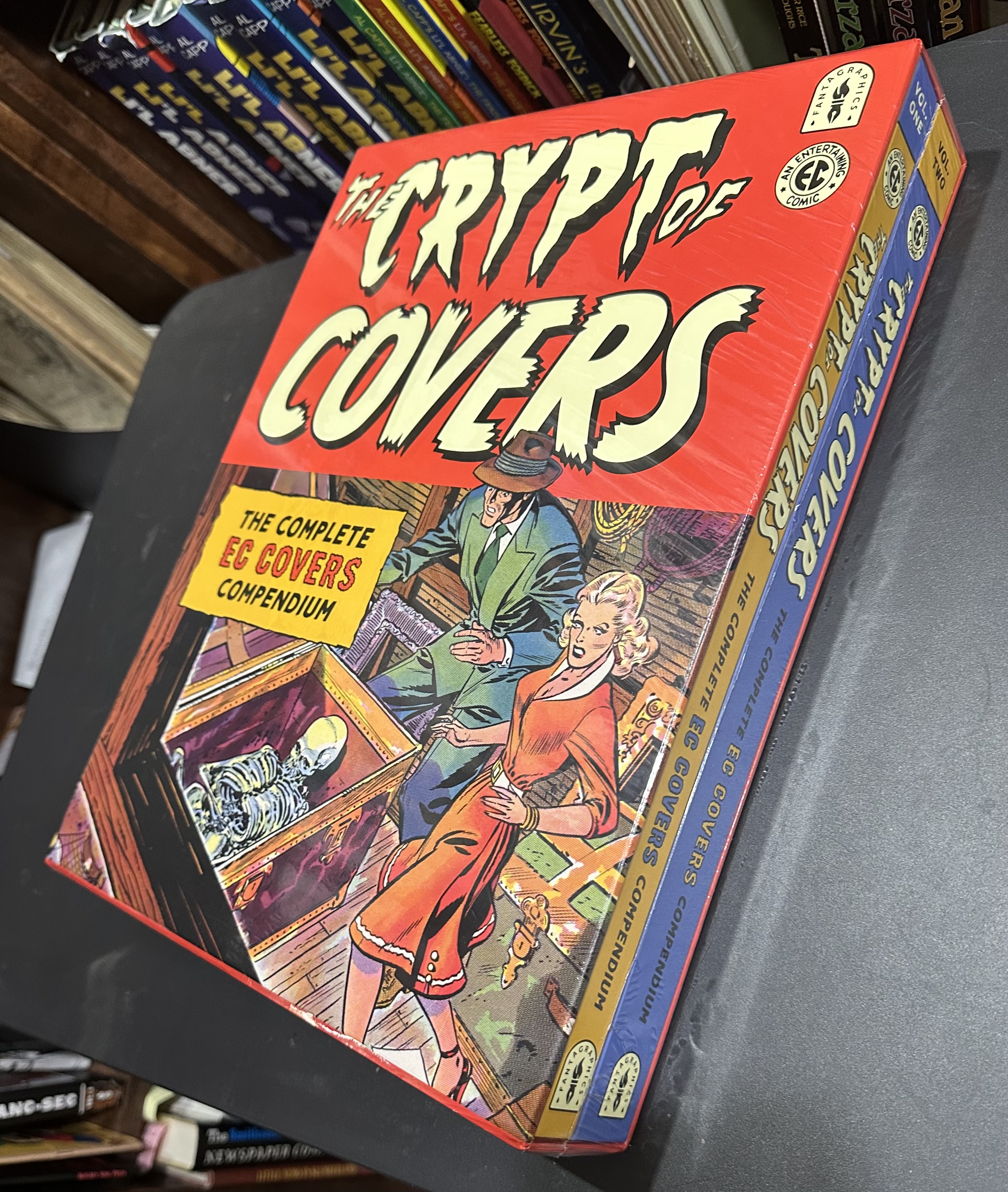
Here I was all ready to sink my teeth into the upcoming Bernie Krigstein Atlas comics reprint, when instead I got this weighty surprise at the mailbox last night. And I do mean WEIGHTY! A two-volume The Crypt of Covers: The Complete EC Covers Compendium is a monster. Over 600 11×14.6 pages in a box, this thing blows up ever EC cover to small poster size. And brace yourself when picking it up. This package is dense.
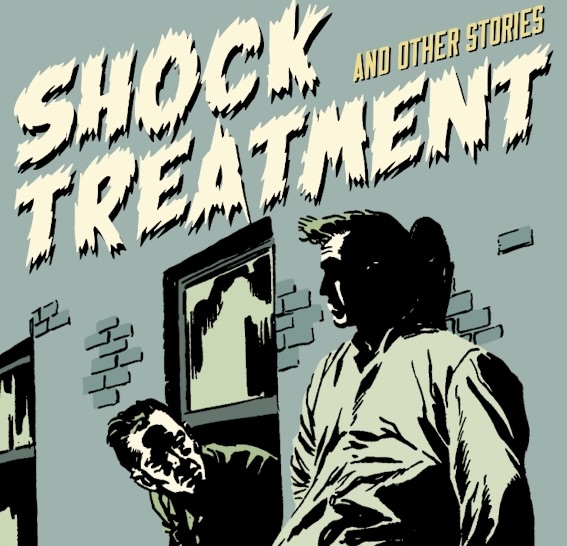
Unlike many previous reprints of EC Comics, Fantagraphics organized its “Artists’ Library” not by title but generally by artist. Better still, a black and white format highlights beautifully the line and ink work by legends like Jack Davis, Wally Wood, Graham Ingels, Johnny Craig, etc. And it shows these masters rendering some of the most suspenseful, violent, ghastly and otherworldly material across a range of stories so lurid and weird they attracted censorious government scrutiny. In other words, the Artists’ Library showcases the best cartoonists at the height of their powers and working on content that editor Al Feldstein deliberately matched to each one’s specific strengths. The project has been magnificent, especially in showing Davis, Wood, Kurtzman, Craig, Kamen and others evolve over time and respond to different material. It has been a thoughtfully designed series that makes even aficionados of EC think differently about what is in my mind the greatest run of comic book art ever. But the 40th volume in the Library, Shock Treatment, is unusual in many respects.
The EC science fiction titles hold a special place in American pop culture. The books that ran from 1950 to 1955 (Weird Science, Weird Fantasy, Weird Science-Fantasy) were indispensable waystations for the still-niche genre of science-based speculative fiction. I would argue they were the crucible in which pop sci-fi as we have known it was forged. These comics not only popularized some of the foundational tropes of the genre. But EC’s stable of premiere artists then visualized many of these themes in ways that were far more sophisticated than the typically awful B- and C-level production values Hollywood applied to the sci-fi genre. Even though these comics were among the least popular of the EC titles, they likely were legitimating sci-fi in more young readers’ minds than any pulp mag or film c-lister could. And at the same time, artists like Wally Wood, Al Feldstein, Joe Orlando, Harvey Kurtzman and Jack Kamen were inventing a visual language for sci-fi themes: post-apocalyptic vistas, space travel, the romance of a starship launch, bug-eyed and fish-faced aliens. Their influence on the subsequent conceits of sci-fi fiction, art and film, as well as their look, is undeniable. From Forbidden Planet (1956) to 2001: A Space Odyssey (1968), Star Trek (1966), Star Wars (1977) and beyond, these comics were the first rough sketches of what our fantasies of the future would become.