
Kicking off this year’s roundup reviews of notable books for comics history buffs, let’s start with the annual Taschen doorstop.
Continue reading
Kicking off this year’s roundup reviews of notable books for comics history buffs, let’s start with the annual Taschen doorstop.
Continue reading
Rockwell Kent (1882-1971) was not a cartoonist in any typical sense of the genre. He was insanely prolific across all media and seemed oblivious to formal silos that bother art critics and scholars. He worked in book and magazine illustration, painting, greeting cards and postage stamps, bookplates, murals, and, yes, comics (under the playful pseudonym, “William Hogarth, Jr.” for Vanity Fair). He was a working artist who liked to turn a buck, as entrepreneurial as he was genre agnostic. Which is to say that he was an artist in the American grain.
Continue reading
Hate is an easy sell. In the marketplace of hearts and minds, intolerance, grievance, anger are some of the most compelling product features of any cause or candidate that is new to the political shelves. Likewise, simple, high aspirations tend to market more easily. See “Hope and Change.” Appealing to base instincts or ambition and aspiration is Marketing 101 in America’s cultural economy.
Continue reading
On August 5, 1924, Harold Gray’s Little Orphan Annie premiered. Historians often remember the strip for its verbose didacticism or regressive politics. Gray famously crowded his panels with Annie’s homilies to self-reliance and in the 1930s anti-New Deal screeds. This explains historians’ interest in Little Orphan Annie, but it doesn’t account for readers’ love affair with the chatty moppet. In many ways Gray’s strip blended genres of adventure and domestic drama. It was among the earliest serial adventure strips. As much as Americans may have identified with Annie’s core self-reliant values and humane sympathies, she was forever the outsider, often overhearing key conversations or sitting in the corner of a panel as an onlooker. Annie was a picaresque figure who embodied modern Americans’ sense of social dislocation and alienation. She was both in and outside of this changing America of new cities, capitalist and government shenanigans, aggrandized power…and its victims. Gray’s Annie captured a complex relationship modern Americans felt towards their culture that was harder to articulate than it was to depict in character and situation. That is what great art, high or low, does for a culture.
Continue reading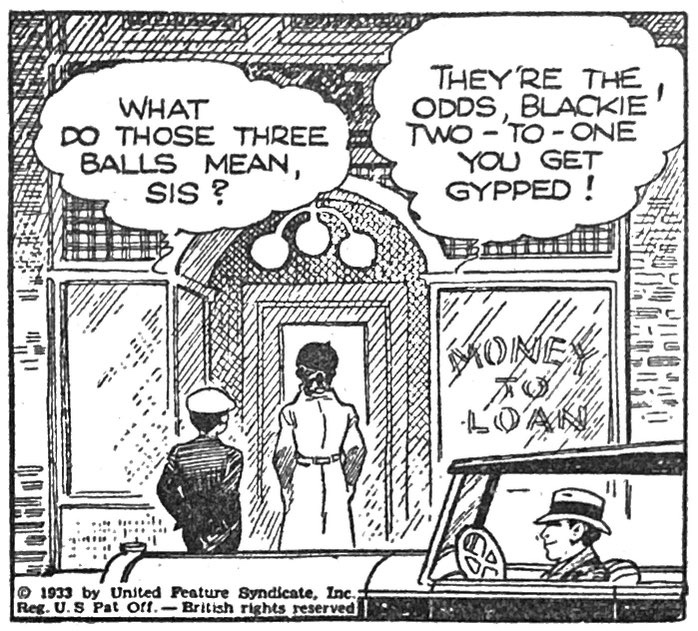
The more I read of Bill Conselman and Charlie Plumb’s Ella Cinders strip (first explored here), it is clear this spunkiest of comic strip heroines has been woefully underrepresented in pop culture history. She was at once big-hearted and hard boiled. She rode the roller coaster of 20s and 30s boom and bust, passing through pop culture fads and economic trends. And this girl took no shit. She was aiming withering barbs at cocky lovers years before Mae West, trading edgy banter a decade before Kate Hepburn, Carol Lombard and Barbara Stanwyck. Comics historians who point to Connie Kurridge, Flyin’ Jenny, Miss Fury or Brenda Starr as pioneering women in comics pages are missing one of the most interesting examples. Ella Cinders resembled Little Orphan Annie, a picaresque that was less ponderous and lighter. And the tale of a New Woman making her way through inter-war America was rendered as a unique distinct world – with its own linguistic and visual style. The panel above shows how the strip’s sharp voice and thoughtful composition could work together. Ella and brother Blackie, backs to us, framed by a predatory pawn shop, quip about getting fleeced.
Continue reading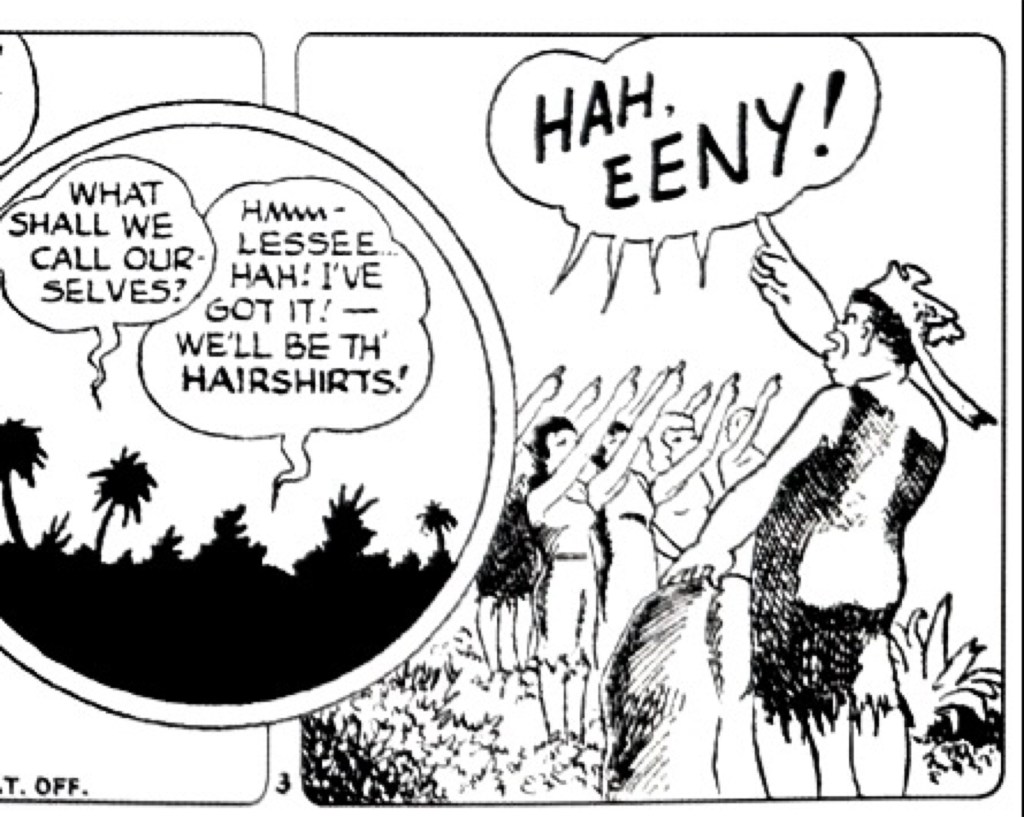
V.T. Hamlin was unambiguous about introducing to Alley Oop’s kingdom of Moo the interloping dictator Eeny in 1938. “She was Hitler,” he admitted in an interview later in life. Even three years before America’s entry into the war in Europe, Hamlin felt it was inevitable. The villainous dictator Eeny would reappear during wartime as well, but in this first episode we see Hamlin’s take on how bad leaders co-opt good people.
Continue reading
Disney’s Silly Symphonies comic strip of the 1930s would not be my go-to place for veiled references to weapons of mass destruction, hobo philosophy, trench warfare or impoverished ghettoes. Much to my surprise, the first year of this brand extension of the studio’s hit animated short series included all of those dark themes and more.
Continue reading Panels & Prose