The sheer horniness of the otherwise circumspect American newspaper comics in the 1930s is as unmistakable as it is overlooked in the usual histories. I have written about the kinkiness of 30s adventure in bits and pieces in the past. But rereading Dale Arden’s “obedience training” at the hands of the dominatrix “Witch Queen” in Flash Gordon, reminded me how much unbridled fetishism romped through the adventure comics of Depression America. Any honest history of the American comic strip really needs to have “the sex talk” about itself.
Even taking a superficial glance across Russ Manning’s introduction of Star Wars to newspaper comics and Al Williamson’s subsequent pick up of the series is a contrast in different talents. Manning, heralded for his years on the Tarzan beat, was self-conscious of how the strip had to translate the film epic into the language of strips. He launched the series deliberately with the familiar movie characters, if only so they could ease the audience into his new stories and creations. In what is literally a handoff of villainy, his “Blackhole” acts as Lord Vader’s evil extension. But Manning crafts Blackhole visually as a newspaper strip presence, a silhouette in half tone, using shape and gradients, fading in and out, to define this malevolent force. Likewise, Lucas’ Vader was graphically a screen villain. He is defined by moving reflections of light on dark glossy surfaces, the elemental stuff of film.
Williamson’s lifetime in otherworldly comics and strips also comes through when he takes the helm after Manning’’s withdrawal. Al Williamson, who had some of the most striking sci-fi and fantasy art in pre-code comics brought that aesthetic into the strip. The photo-realistic cosmos, swathes of shadows across close-up, emotive faces, could have been cut from the pages of Weird Science, with Wally Wood inking.
One of the intrinsic appeals of the comic strip medium, I suspect, is the enduring power of craft in an age of mechanical reproduction and collaborative media. Consider the deep ironies of the modern comic strip. It was distributed by the most read mass produced media -of the last century. The reporting voice, photography, and advertising too, were industrialized, usually homogenized, event anonymized. The comic strip was one of the only non-collaborative mass media of the modern age. Assistances and syndicate editors notwithstanding, the visual voice of Capp, Schulz, McManus, Caniff et. Al. , the idiosyncratic personal vision of individual strips, was unmistakeable.
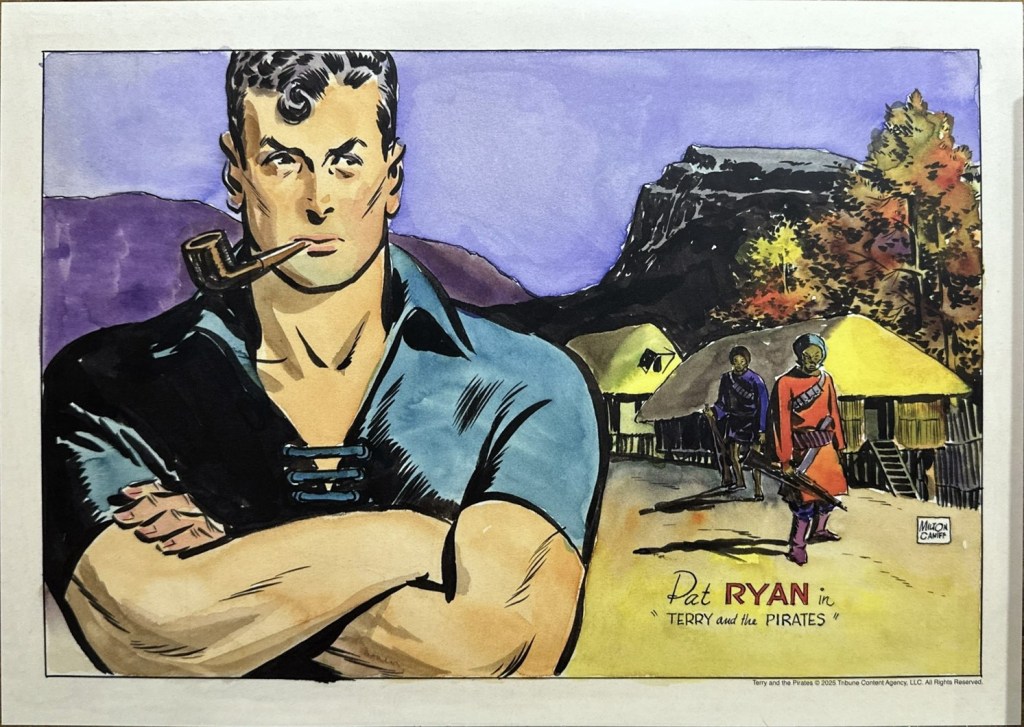
Milton Caniff’s landmark adventure Terry and the Pirates has been among the most reprinted newspaper strips of all time…and deservedly so. The artist’s fame for establishing the tone, cadence, composition and dramaturgy of the mid-century adventure genre in comics is well known. I won’t rehash it here. The latest and most ambitious reprint Terry project concluded this week when Clover Press and the Library of American Comics shipped the final three volumes in the 13 book Terry and the Pirates: The Master Collection. As I said in my initial review of the first volumes, the series is magnificent, if you don’t mind juggling oversized tomes. The sourcing of best available art, coloration and overall reproduction are the best I have seen among the many renderings of Terry over the years. This is LOAC’s second go at the strip. The imprint was launched two decades ago with a 6-volume oblong set. The first 12 volumes of the Master Collection reprint the full run from inception in 1934 through Caniff’s exit in 1946. A thirteenth volume carries new commentary, ancillary art and all of the front matter from the earlier series. Kudos to LOAC and Clover. Unlike many comic strip reprint projects that lumber for years, or peter out in mid-run, this one only took three years to complete. This final tranch of volumes also comes with a packed in bit of extra art (see above.
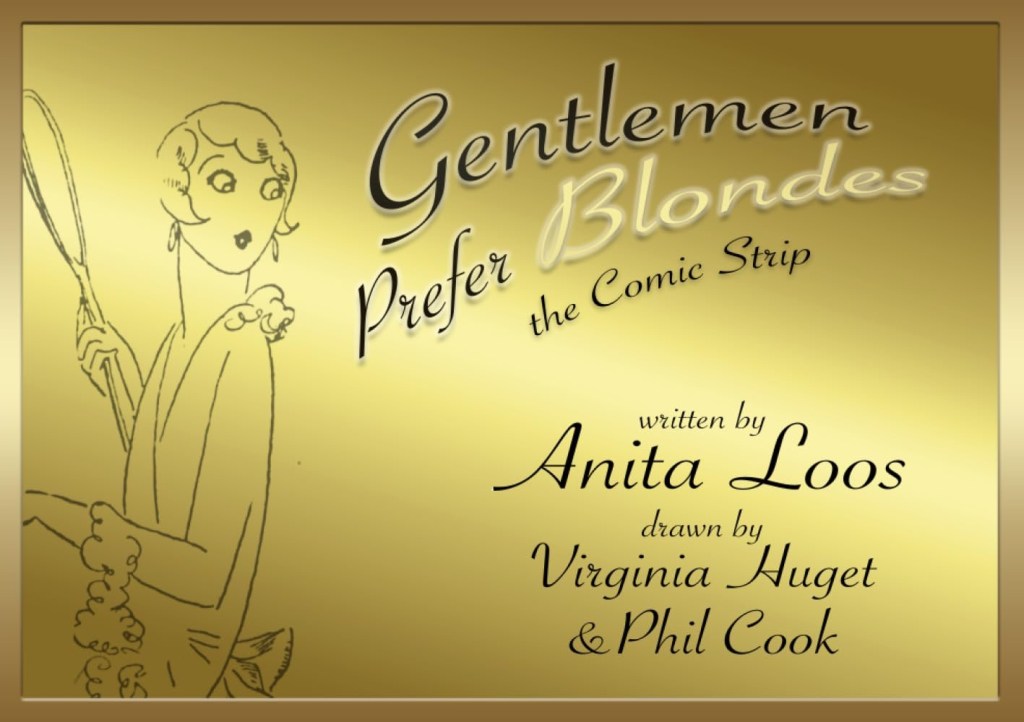
Moving through this year’s shelf of notable titles for comics aficionados, I wanted to call out several projects that revived forgotten or previously uncollected work. From a pharmacist heroine to an illustrated prayer, the ultimate 20s flapper to a pioneer of cartoon journalism, 2024 surfaced some real gems.
No one could mistake master artist Alex Raymond for a proto-feminist. In his and scribe Don Moore’s dual successes of the 1930s, Flash Gordon and Jungle Jim, barely-clad distressed damsels abounded. To be sure, Raymond understood better than any comic strip artist the erotic potential of the formal, His male and female bodies were delicious. But it also goes almost without saying that the adventure genre has always been about male prowess and potency against forces natural, exotic, institutional and especially feminine. Comics artists like Carl Barks and Al Capp, among others, have recounted that newspaper editors often cited the 12-year old boy as the ideal target market for adventure strips. Well, yeah, sure…along with their horny Dads.
The adventure hero’s cavalier approach to women, romance, and all that icky girly stuff is clear in Jungle Jim’s caddish handling of two rival gal pals Lil and Kitty in this late 1941 interstitial between two episodes. Jim has no time for romance, and writes to Dear Jane letters, excusing himself from commitment. Lil gets the I’m-just-a-ramblin’-sorta-guy” brush off and Kitty gets the mock magnanimity ploy. “Find a nice substantial businessman… .” What a gentleman.
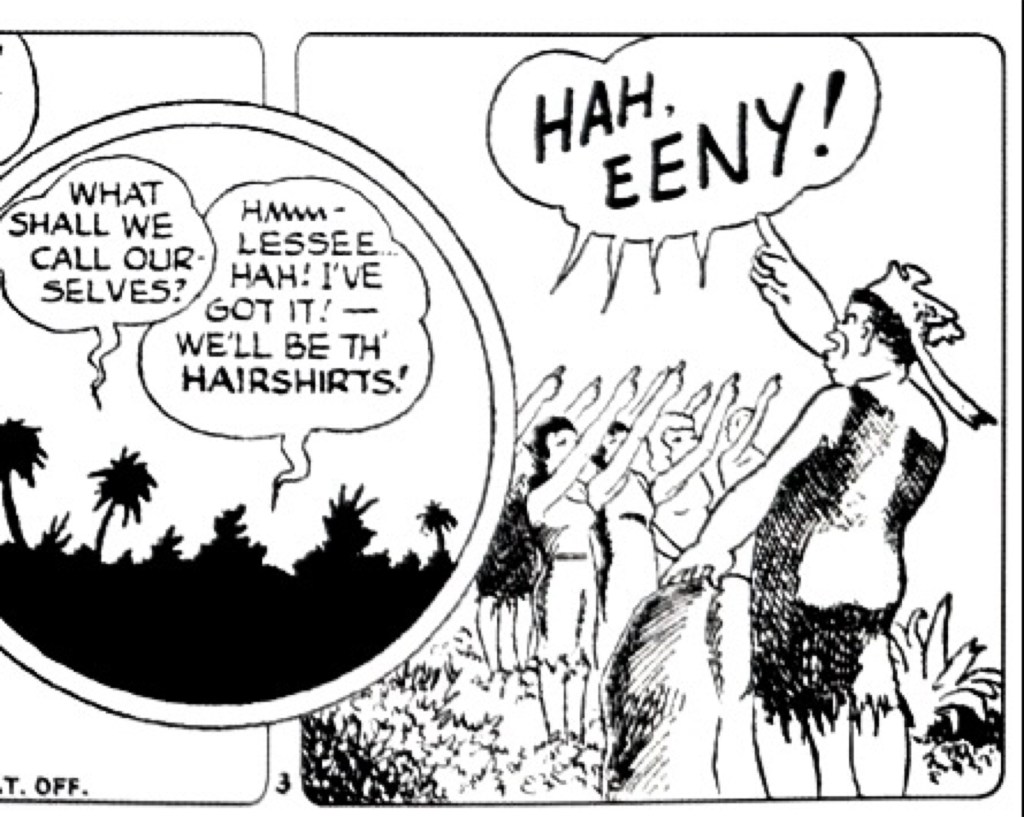
V.T. Hamlin was unambiguous about introducing to Alley Oop’s kingdom of Moo the interloping dictator Eeny in 1938. “She was Hitler,” he admitted in an interview later in life. Even three years before America’s entry into the war in Europe, Hamlin felt it was inevitable. The villainous dictator Eeny would reappear during wartime as well, but in this first episode we see Hamlin’s take on how bad leaders co-opt good people.
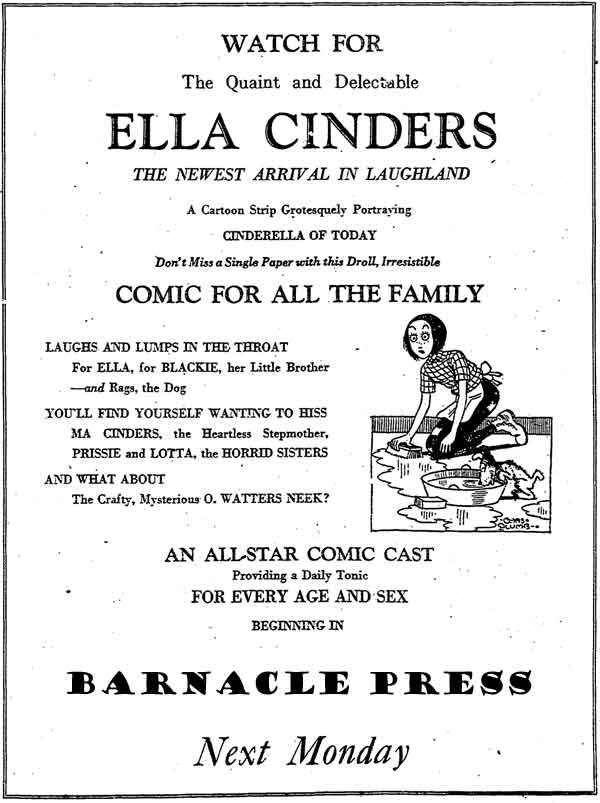
Ella Cinders (1925-61) was a female comic strip character with genuine character. And this is no small thing in an era of flappers, housewives and career girl stereotypes. While overlooked and under-appreciated, there have always been women both drawing comics and depicted in them. In the 20s and 30s alone we can point to Winnie Winkle, Tillie the Toiler, Dixie Dugan, Polly and Her Pals, Blondie, Connie, Fritzi Ritz, etc. But aside from the most visible heroine of the 20s and 30s strip, Little Orphan Annie, few of these female figures rose above bland cut-outs for the generic idea of the “New Woman.’ Even in the late 1940s, in the crop of more adventurous “Dauntless Dames,” that Trina Robbins and Peter Maresca featured in their wonderful new book, most heroines asserted their presence into the outside world more than they did assert an identifiable personality. Male helpers or wise-cracking boy sidekicks tended to provide the action and sharp banter. Aside from Annie, Dale Messick’s Brenda Starr (1940) is the first leading woman in comic strips to assert ambition and a full range of emotion.





 Panels & Prose