Moon Mullins On the Margins

He was a “banjo-eyed” former boxer whose life’s work seemed to be avoiding a life of work. Frank Willard’s Moon Mullins (b. 1923, Chicago Tribune syndicate) was a boarding house situation comedy, where Moon and his little brother Kayo schemed, loafed and tussled with a like-minded cast. But what distinguishes Moon Mullins in my mind is the authenticity, affection and artistic talent Willard brought to a strip that tugged against the middle class fantasies of 20s American culture. While much of the comics page moved towards gentler domestic comedy in the 1920s (The Gumps, Bringing Up Father, Gasoline Alley, Polly and Her Pals, et. al.) Moon’s world was an alternative America that was relentlessly mean, self-interested, devotedly unproductive.

Moon Mullins’ visual signature blended caricature nicely grounded in physical detail. He assisted Billy DeBeck, whose Barney Google was another strip about socially marginal characters, but he had a more naturalistic style. The run down neighborhoods and well-worn rooms of Moon’s world come through in cross-hatched corner, splashes of broken wall plaster, the stray broken fence slat. His characters are weightier, individualized and expressive of inner qualities. Moon’s wry, laconic approach to life lives in his usual posture, relaxed, disinterested.

The gangly, bespectacled boardinghouse owner Emmy Schmaltz is as tightly wrapped as her ever-present bun. Her figure recalls Segar’s depiction of Olive Oyl but without irony. The absence of sex-appeal is genuine, even if her hunger for a man throughout the 1920s drives her own scheming comedy.

The sloppily stout Uncle Willie and his equally massive wife Mamie are models of domestic disharmony, usually resulting in Willie taking a kitchen implement to the head and being tossed from the house.

Willard had a deft sense of comic strip cadence, with a great ability to advance an episode yet tell a complete story in just three or four daily frames. In the sequence above, part of a 1931 road trip to Florida, Emmy is trying to get Lord Plushbottom’s attention. The usual sit-com tropes ensue: miscommunication, misapprehension, confusion. Premise, activation and gag all take place within three panels.

Willard had a special talent for slapstick timing, usually on display in the Sunday gag strips. Like the best slapstick silents, he used careful panel editing and cadence to capture the flow of unintended cause and effect. The strip above is a good example of how tired tropes feel fresh and funny mainly from the way Willard times his action and layers into them the sit-com notes of misapprehension. Or, in the strip below, Willard blends some of the dark scheming of his characters, Emmy’s creepy faked suicide plot, with a beautifully rendered birdshot-to-the-ass scene – from weirdly dark to classically comic in three panels.

It was Willard’s great comic sense that gave him license to portray an unsentimental vision of marginalized America in ways that were uncommon to the hapless but good-hearted domesticity across the rest of the comics page let alone the idealizations of American life in the rest of popular culture. More on this in the next post.

Reviving Gilbert Seldes: Krazy Kat’s First BFF

The great, woefully under-appreciated American culture critic of the early 20th Century Gilbert Seldes remains my own North Star of pop culture criticism. I could go on forever about this guy, and almost did. I started researching a biography of him and his critical legacy, but Michael Kammen beat me to it with his fine 1996 evaluation of Seldes’ life and work. Still, my own appreciation of Seldes’ open, democratic spirit of criticism is a bit different from Kammen’s, even if I didn’t feel at the time that the world needed a second book-length study of the man. I explored some of those ideas in an essay Tom Heintjes kindly published in Hogan’s Alley No. 6 in 1999. It is reprinted below. I will also post soon Seldes’ original take on Krazy Kat and the comics generally from 1923’s The Seven Lively Arts. Almost a century later, I still think Seldes’ early observations about the unique aesthetic and cultural qualities of the comic strip remain indispensable to anyone trying to appreciate the form. – Ed.

The Critic That Walks By Himself

The longtime and often lonely historians of the American comic strip have enjoyed an embarrassment of riches in recent years. What with centennial exhibits, commemorative postage stamps, some truly luscious reprints of seminal work and even—God help us—occasional academic scrutiny, the comic strip form seems poised to assume a place among the “respectable” mass media. But assembling the history of any medium, including the comic strip, requires more than rediscovering its primary documents, however fun that may be. A rich chronicle of an art form must also recount how the medium integrated itself into people’s lives, how it was understood and debated. In America, such a history must begin with the first thoughtful and genuinely critical celebrant of the modern popular arts in general and of the comic strip in particular. He was more responsible than any single American for getting common readers and other intellectuals to think about the comics that they enjoyed. Gilbert Seldes (1893-1970) was the father of comic-strip criticism, and his insights about the form represent an alternative, albeit now largely overlooked, path in the serious appraisal of our national pleasure.

Continue reading

Krazy Kat Gender Reveal?

Bobo Baxter: Rube Goldberg’s Bleak Screwball

Rube Goldberg (1883-1970) is best remembered for his cartoon inventions, ridiculously intricate mechanical solutions for common activities. These send-ups of modern technology and the romance of engineering appeared under multiple titles and formats across his career, but took most regular form in Collier’s Weekly between 1929 and 1931 as The Inventions of Professor Lucifer Gorgonzola Butts, A.K. His Foolish Question panels ran from the teens in various forms for decades. And his best-known continuous character strip of hapless failure Boob McNutt ran for more than a decade in the 1920a.

But it is in his forgotten small masterpiece Bobo Baxter (1927-1928() that I think we see Goldberg’s array of talents for satirizing the modern world come together into a persistent and satisfying whole. And at the same time Bobo shows how a sad note of alienation often lurks beneath the surface of many slapstick characters.

As godfather of comics historians Bill Blackbeard points pout in the intro to a 1970s reprint of the complete (Hyperion Press, 1977) run of strips, Bobo Baxter represented Goldberg moving (or being forced by trends) away from the gag-a-day format to the continuous characters and situations of other 20s strips like Little Orphan Annie, Bringing Up Father, The Gumps, Polly and Her Pals, etc. He had already made his Boob McNutt Sunday strip into a major hit by introducing recurring characters and continuing storylines. In 1927 he sent the form into a daily new creation, Bobo Baxter. 

We meet Bobo as an unsuccessful dreamer, envious of the fame and fortune of well-publicized explorers like Admiral Byrd and aviator Charles Lindbergh. So he builds a flying machine out of a two-seater bicycle, prop,  wing and some balloons. He seems as surprised as anyone that it flies, and he dubs the contraption “The Demi’Tasse”, bound for glory by flying across the Canadian border.

Bobo’s fixation on fame, celebrity and the press course through the strip. He is forever courting journalists and dreaming for the headlines he thinks his oddball journey will merit.

The discipline of storyline and continuity seemed to inspire Goldberg’s satiric sensibilities. In many ways the story becomes a picaresque journey through modern American social types and institutions – all of from which Bobo himself seems woefully alienated. 

Bobo himself is pathetically friendless, and a bit of a comic nebbish. At one point early in the strip he mistakenly reserves a table for his entourage at  the pricey Cafe Du high Hat. When Bobo can’t recruit anyone to come with him, he ends up animating a group of mannequins. 

Likewise, Bobo spends the first months of the strip simply in search of a passenger to bring with him. But it is the haplessness of Bobo’s plan that brings him into contact with a pastiche of American types. There is the desperate henpecked husband who would do anything to escape his onerous wife. There is the jewelry thief who is looking to escape with a pilfered pearl necklace. And there is Bobo’s own assistant Nosedive Kelly who is both too obese and anxious to make the flight but proves to be a self-promoting braggart.

Bobo’s encounters with a cast of American characters produces some wonderful moments where Goldberg’s native visual silliness, satiric eye, and critique of mechanisms both technical and social merge beautifully. Among my favorite moments comes when a Nosedive goes for an insurance checkup. “Your blood pressure is 5 pounds over the legal limit,” “Your ears a very badly designed” and “the hinges of your backbone squeak” he is told.

This is prime Rube. “Goldberg is a satirist not of fads and fanciest of rationality,” wrote Gerald W. Johnson in his 1958 review of political cartooning between the World Wars. 

The hapless comic outsider is a feature of modern comedy that deserves further thought. We see this anti-hero (and it is almost always male) in vaudeville, certainly the silent film clowns and in comic duos like Laurel and Hardy, Abbott and Costello.

But the comic strip turns the figure into a genre. Consider Happy Hooligan, Simon Simple, Moon Mullins, Jiggs, Andy Gump, A. Mutt, Baron Bean, Boob McNutt, among others.

In fact for the first two years of Goldberg’s Boob McN tut, each Sunday strip finds Boob trying to off himself 

In his recent, indispensable history of screwball comics, Paul Tumey characterizes Boob McNutt’s early years as black humor that reflected the post-WWI disillusionment of 20s America.

Maybe. I am more inclined to put Boob’s suicidal comedy and Bobo’s desperation for modern celebrity part of a longer tradition of modern comedy and especially the comic strip – the alienated clown. So many of the comic strip’s comedy fops feel themselves somehow on the curb as the great parade of American life goes by.

Indeed it is arguable that the comic strip itself carves this curbside role for us. On a daily basis, we are invited to look over the shoulder of Jiggs, Happy, Boob, Barney, Jeff, Popeye, Abner, et.al at a main cast of characters of which we are bemused – part of but slightly apart from.

In future posts I hope to explore further this idea that the daily comic strip often created for us a light satire of modern American life and styles, types and trends that registered and leveraged a sense of middle class alienation from the very world they were creating.

Just Kids – A Bridge to Peanuts

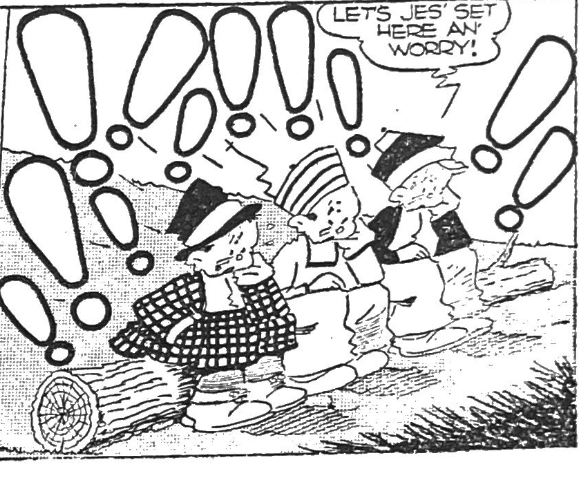
The suburban kid gang strip Just Kids by August Daniel “Ad” Carter ran 1923-1956, initially as a knock-off of Gene Byrnes’ Reg’lar Fellers. But it evolved into a more contemplative, nuanced projection of adult sensibilities into child characters that anticipated Charles Schulz’s Peanuts. Preceded by earlier iterations, Our Friend Mush, Mush Stebbins, and Just Kids in the teens, it was picked up by Hearst in the 1920s and it remained a bit of a beloved back bencher through much of its run.

Continue reading