
Getting nervous about the prospect of an AI oligarchy, a kind of anti-democratic sensibility that the Tech Bros finally say out loud? That they see in their own machines the prospects of a “post-human” future where rational engineers like themselves finally get the respect, authority and control they think they deserve? That compassion, democracy, maybe humanity itself are only for the weak willed? That this could be a better world if only pesky governments and, you know, people, would just leave them alone?
Welcome back to 1933.
During the Great Depression, the American funny pages became especially fertile ground for mad scientists. Demented docs who pervert nature or politics (usually both) had been with us for decades, of course. Mary Shelley’s Frankenstein, Jules Verne’s Nemo and “Master of the World” Robur, Robert Louis Stevenson’s Dr. Jekyll and H.G. Welles’ Dr. Moreau are the standouts across the previous century. But the 1931 success of Universal Studio’s Frankenstein and then The Invisible Man (1933) no doubt teased and accelerated a more specific fixation on mad science in American comics. Various flavors of this archetypal villain appeared everywhere from Mickey Mouse to Dick Tracy, Flash Gordon to Mandrake the Magician. But the cartoon version of this trope did more than mimic Victor Frankenstein’s God-like Promethean fantasies. The comics both modernized and politicized the mad scientist. Dr. Frankenstein may have been a deluded obsessive, but this era’s twisted lab rats were hellbent on world domination, dismissive of humane and human values as weak, and even hostile to democratic principles altogether. When aiming a “dehumanization machine” at Dale Arden, Ming the Merciless best expressed the dark vision of scientism that most mad doctors suggested to early 1930s Americans…and perhaps to us.

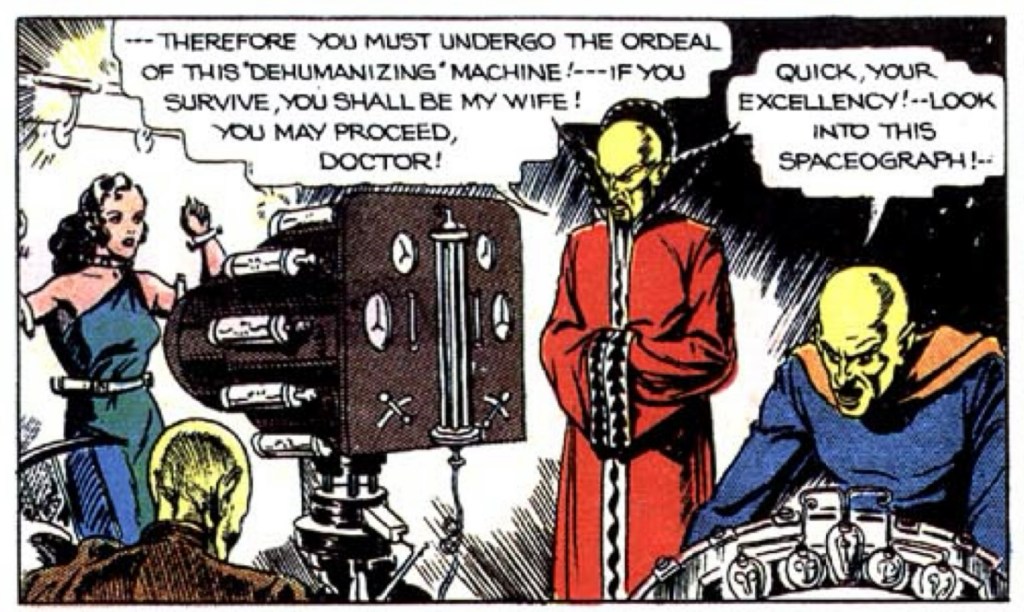
“As you know, we on this planet have progressed far beyond you Earthlings — The reason for our success is that we possess none of the human traits of kindness, mercy or pity — we are coldly scientific and ruthless.” — Ming the Merciless
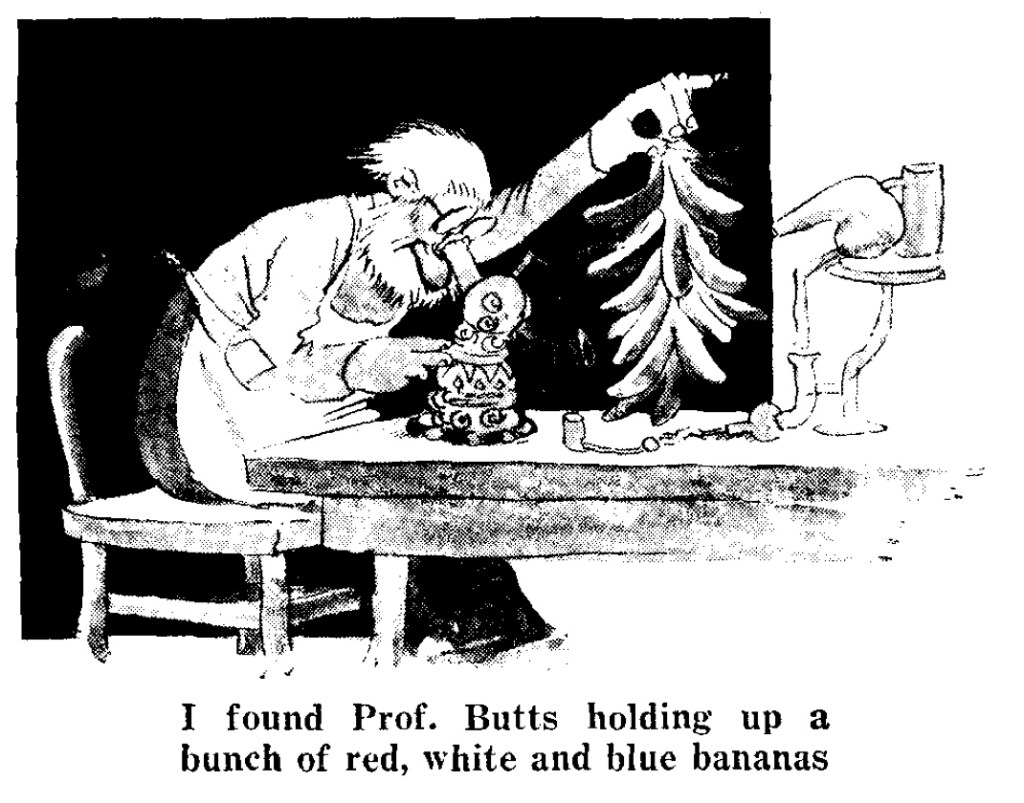
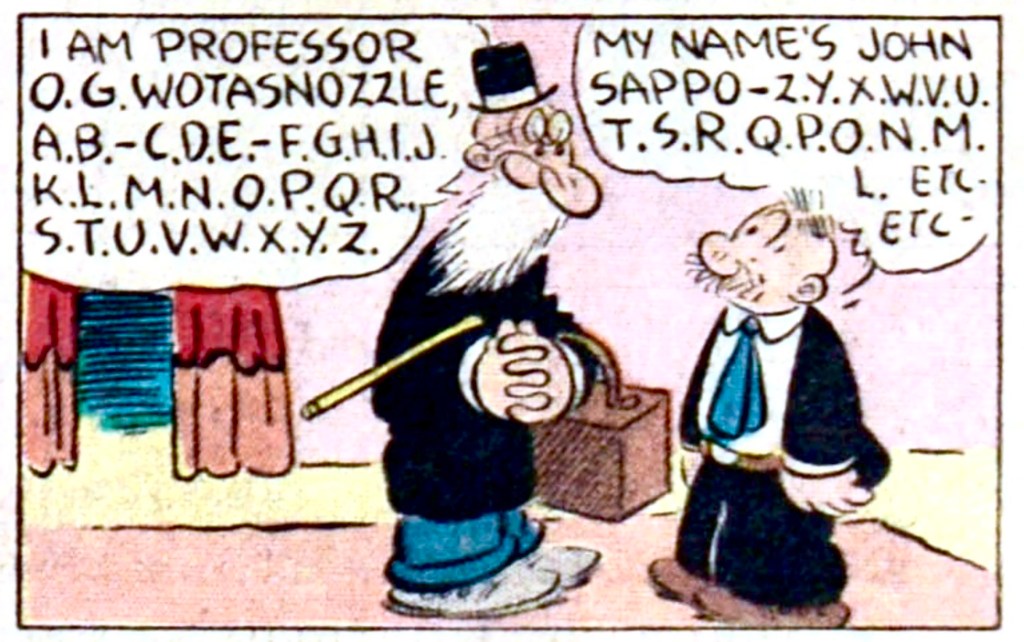
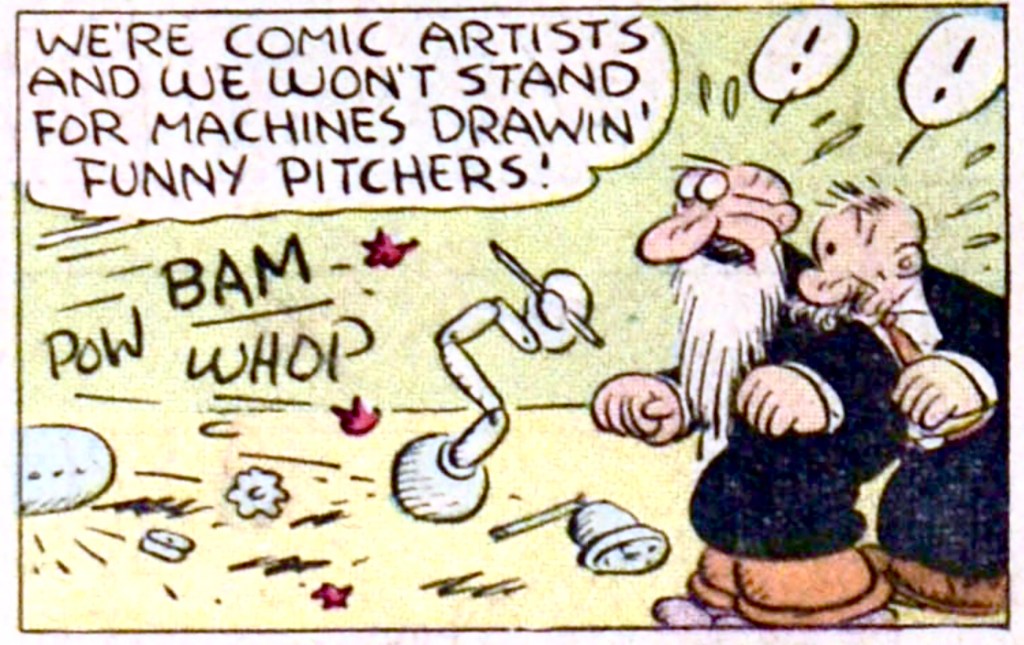
In a Depression-weary America of the early 1930s, a tech—driven, industrial, capitalist system seemed to be failing. Science, once seen as the engine of modern progress, was often reimagined going off the rails in the American funnies. Until now, comics had tended to celebrate tech, either in the aviation romances of Tailspin Tommy and Skyroads or the gadget porn of Buck Rogers. And in the light satire that typified American comics, there were send-ups of wonderfully wacky inventors like Rube Goldberg’s iconic engineer in The Inventions of Professor Lucifer Gorgonzola Butts. Even E.C. Segar got into the comic inventor game in 1932 with the introduction of Professor O.G. Wotasnozzle to the Sappo strip, which was a popular topper to his masterpiece, Thimble Theatre/Popeye. Wotasnozzle took over the strip for a while with misfiring creations like mind-reading caps, voice-activated robot guns and fish attracting pills for anglers. At one point, he even creates a mechanical artist who threatens to replace cartoonists.

The Madness of Mad Science
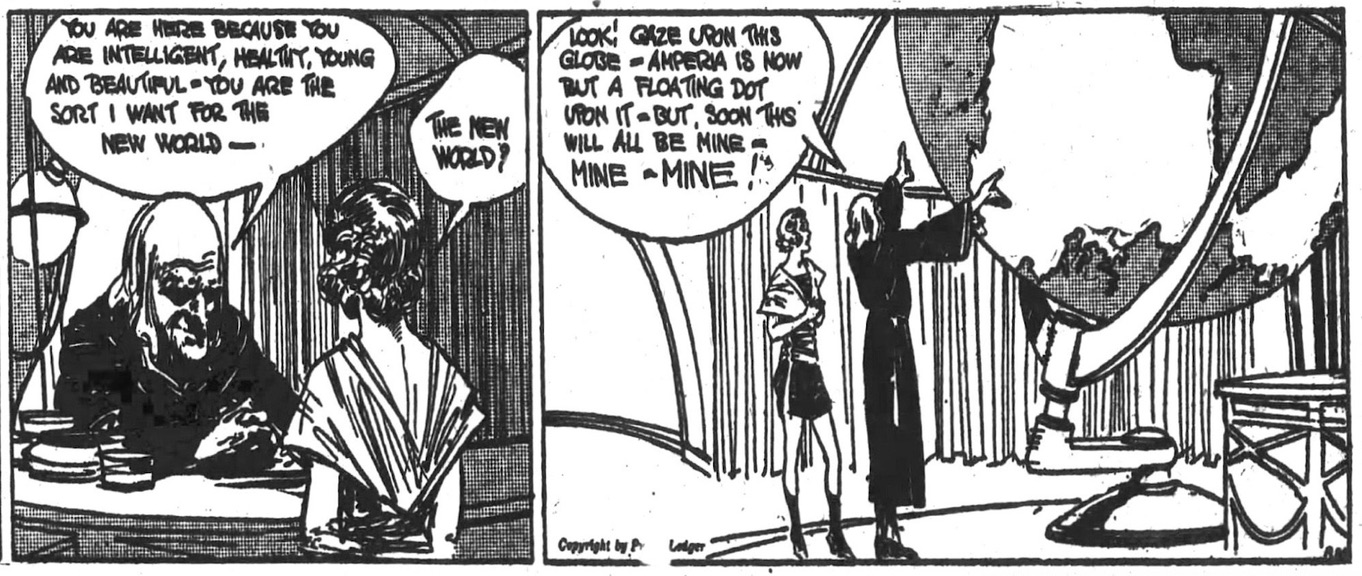
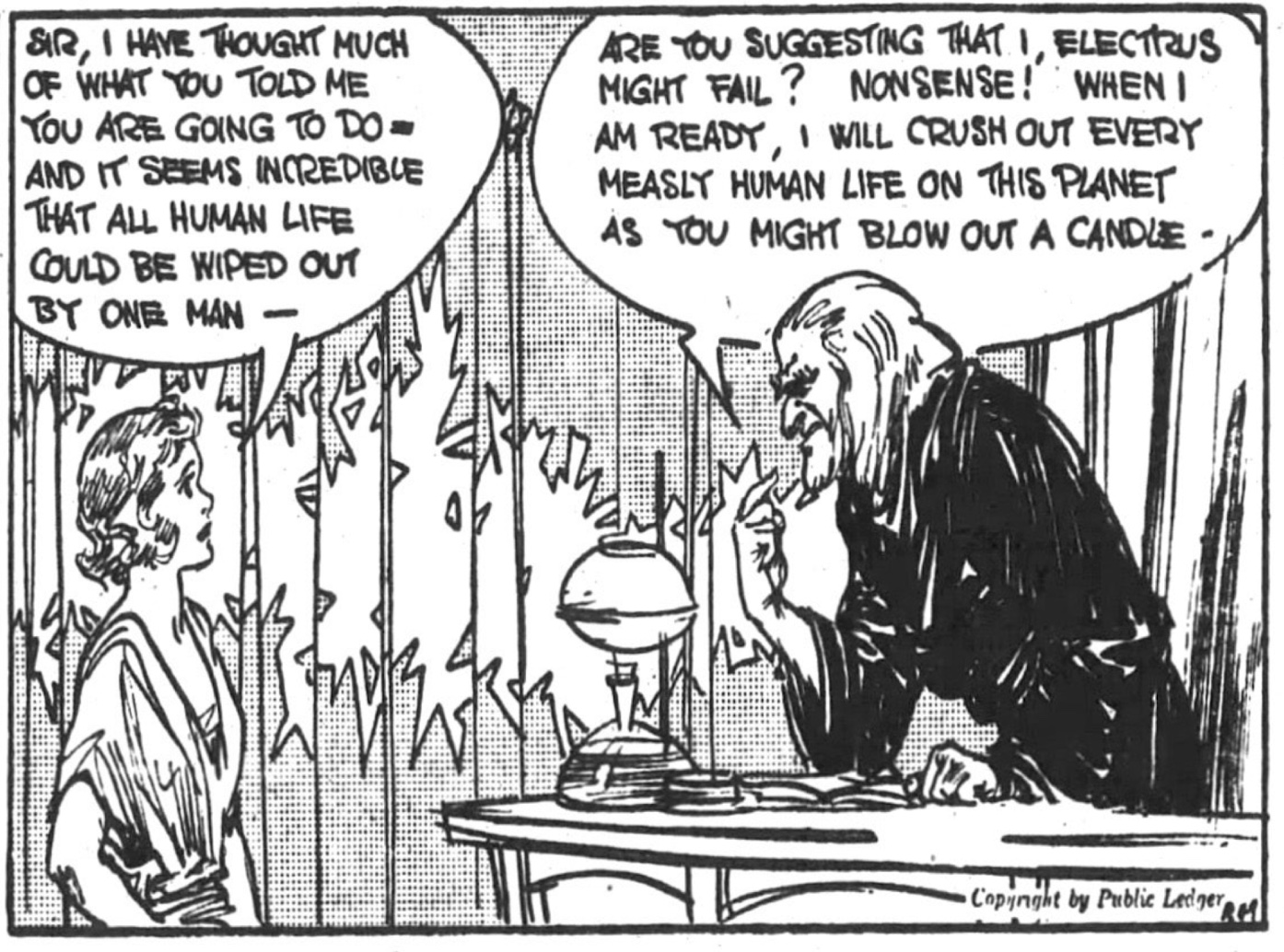
As is often the case, however, beneath satire and send-ups of zany inventors there lurks real cultural tensions. One of the earliest politicized mad doctors in adventure strips, Electrus in Frank Godwin’s Connie (1932-1933) really put the mega of megalomaniac. The grizzled, long-haired wingnut literally stands beneath an oversized globe to declare, “Soon, this all will be MINE – MINE – MINE.” Electrus is among the first archetypal super-villains who also represented a stew of cultural anxieties about the excesses both of technology and scientific hubris. He rehearses many super-villain themes of the coming decade. There is the requisite futuristic secret lair, an atomic-powered floating island Amperia. Hypnosis, or “psycho-therapeutics,” is his tool for assuring pliant underlings. Anticipating the Apple Watch (not to mention surveillance capitalism) by 90 or so years, wristbands track the locations of every Amperian in real time. Electrus even has a football-sized “atom bomb” more than a decade before The Manhattan Project. Home-brewed germs from his island labs aim to kill off Earth’s undeserving hordes, so that he can install a “new world” based in science, led by a “super-race” into which he tries to recruit our heroine Connie. “I am the new Noah,” he cackles.
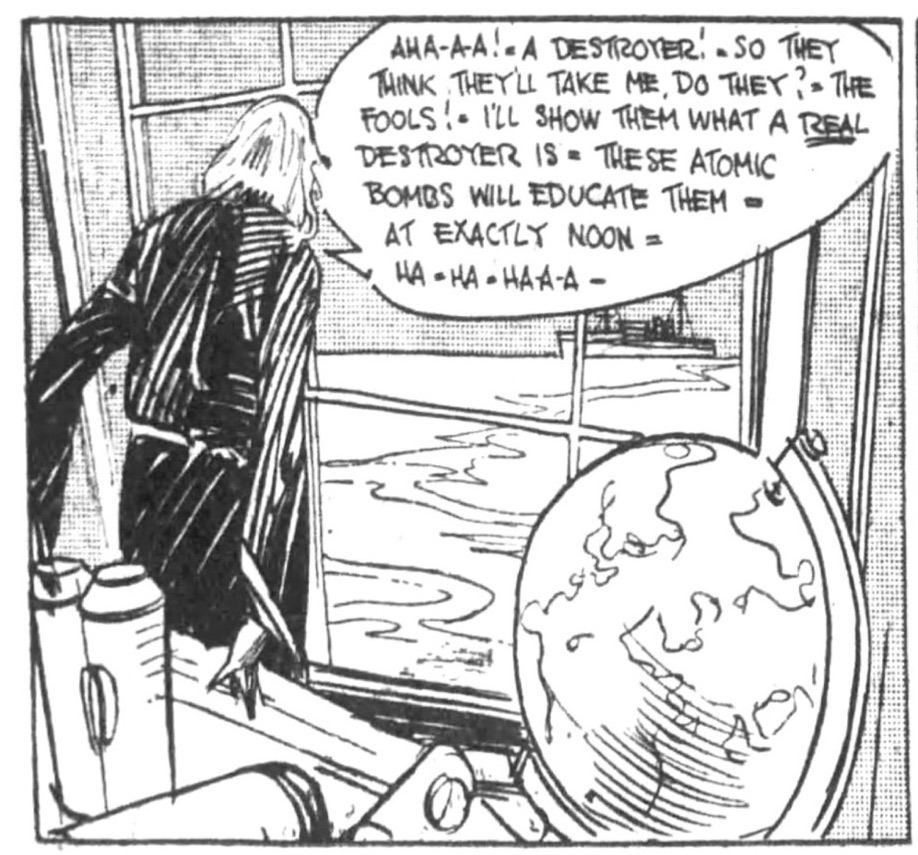
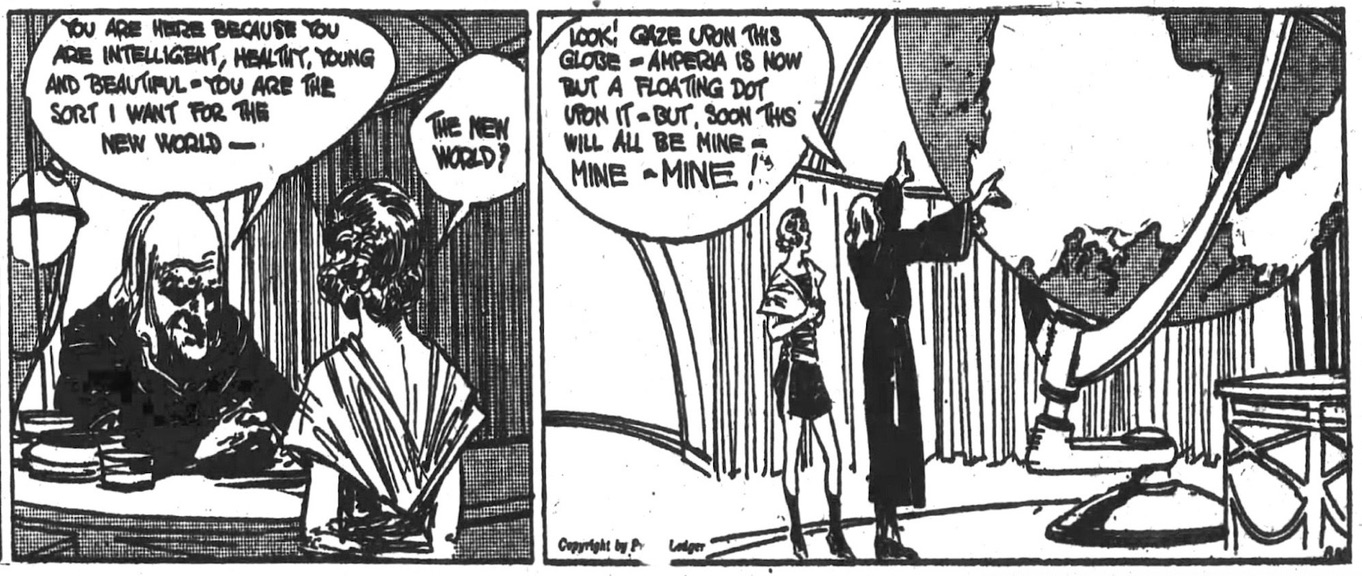
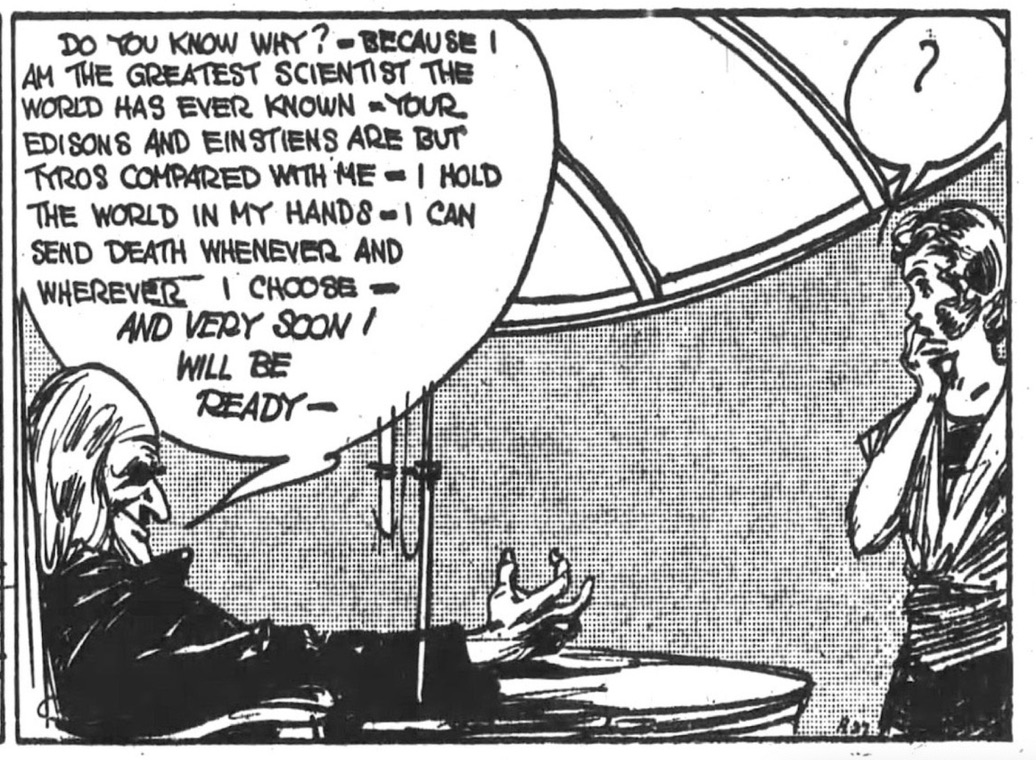
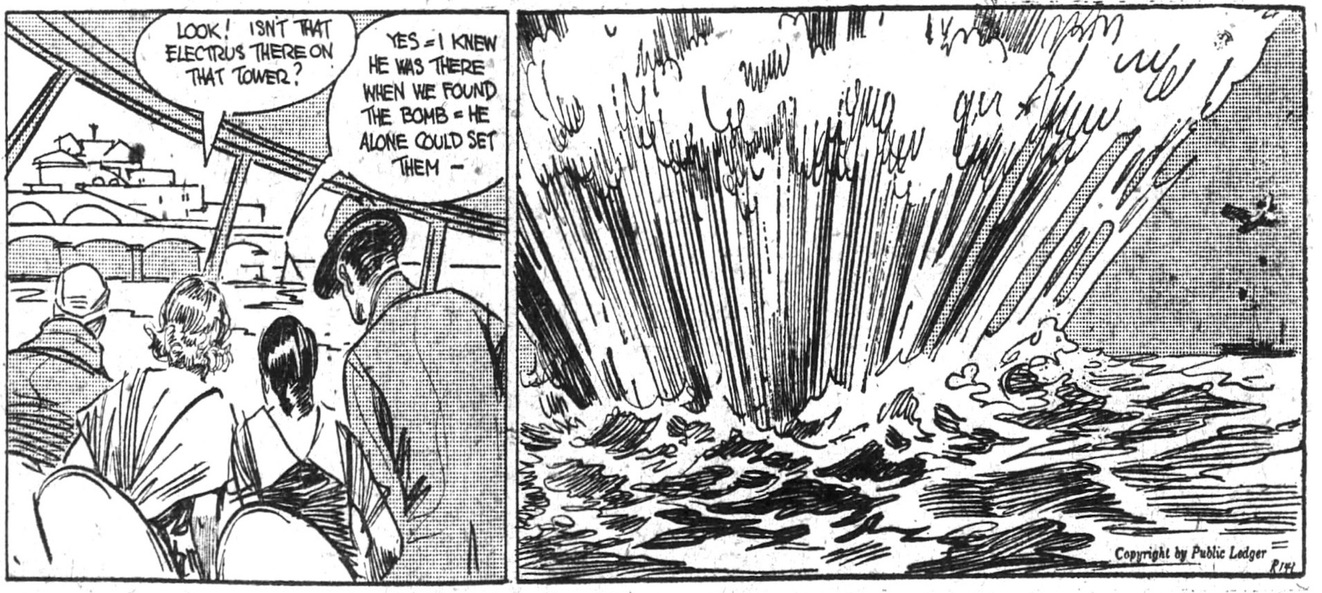
Super-creeps like Electrus and the many that followed did not emerge spontaneously and without a lot of cultural baggage. There is a trunkload of fears to unpack here, from mind control to anti-democratic techno-elitism, chemical warfare to racial engineering. And they are responding to fads and fears that occupied Americans in the early 1930s. Our own generation of Silicon Valley entrepre-prophets were not the first to mistake talent in one area of human endeavor for automatic authority in all others. In fact, the Technocrats of 1932 were the original arrogant tech bros, and they rode a wave of popularity and infamy during this explosion of comic strip mad scientists. The “Technocratic movement” was a loose confederacy of engineers, scientists and architects who thought they should be running things. They attracted a ton of press at the time with a utopian vision; engineering solutions, social engineering and centralized planning by an elite of experts could reorganize society around the values of efficiency. The ideas got a toehold in several major universities and homegrown local clubs in 1932 as a deeply depressed America often sought radical answers to economic collapse.
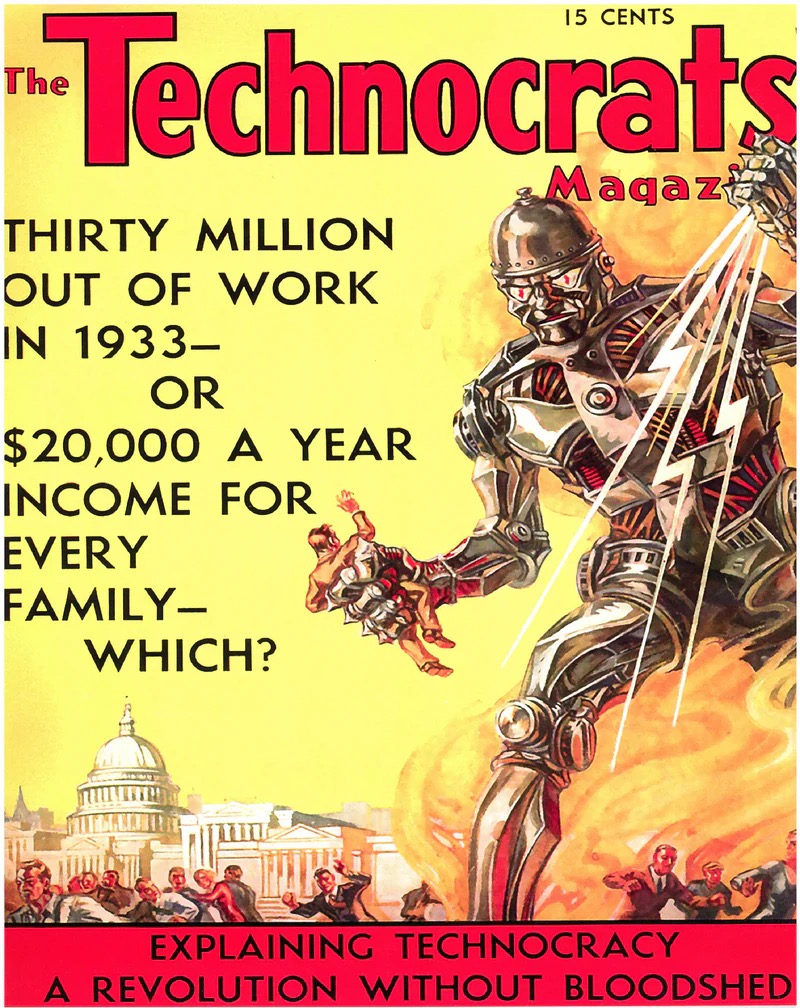
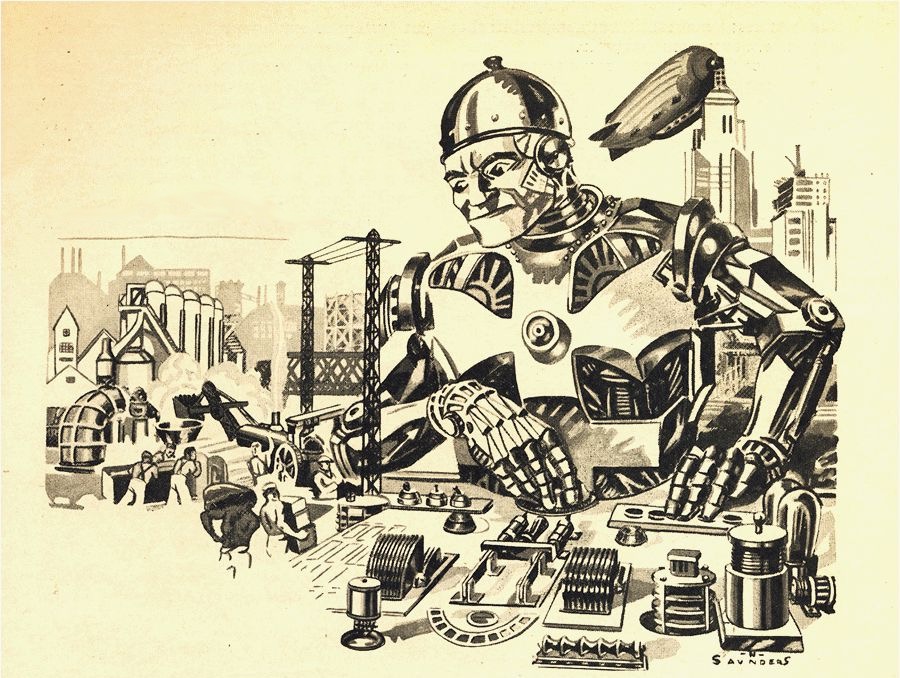
The vogue did not last long, however, as Technocracy’s fundamentally undemocratic spirit became obvious to most Americans. A fierce backlash against the Technocrats in 1933 may have been fueled by larger, growing suspicions that scientific advances did not necessarily represent “progress.” After all, the poison (“mustard”) gas and rapid fire gatling guns of WWI were among science’s first weapons of mass destruction. One of the scariestturns in early 20th Century science was the rise of “Eugenics,” a perversion of genetic research that proposed “improving” the human species through selective breeding and even sterilization policies. And then of course there was the industrialization project itself, a system of routined, mechanical human labor mass producing goods that seems to have derailed. There was by 1933 a lot to fear that science (and scientists) had gone amok.
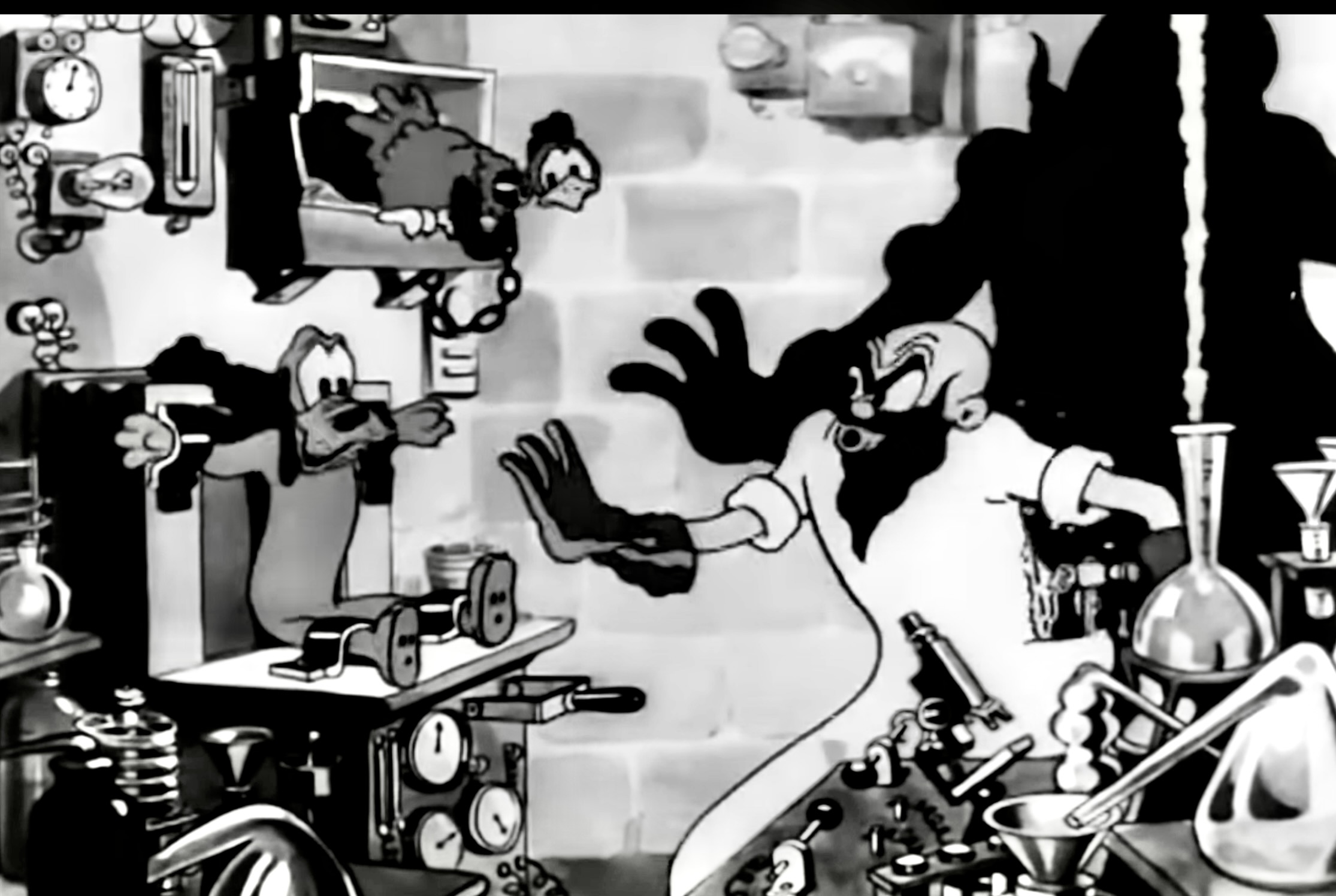
The strips helped Americans peer into genuinely chilling anxieties about science and progress through comfortably burlesque and comic lenses. In the early 1930s, Disney was already doing this kind of cultural work with a unique fabulism: softening the edges of genuinely scary folk tales and archetypes. In the Mickey Mouse short “The Mad Doctor” (1932), for instance, an evil genius kidnaps Pluto to experiment on dismembering and recombining him with other animals. We get rubbery, unreal cartoon animals enacting a grisly scenario, including Pluto strapped helplessly to a chair, allusions to bone saws and playful illustrations of mutant bodies. Even in cartoon versions, the evil doctor motif often connected mad science with primal fears of dismemberment, personal autonomy and physical freedom.
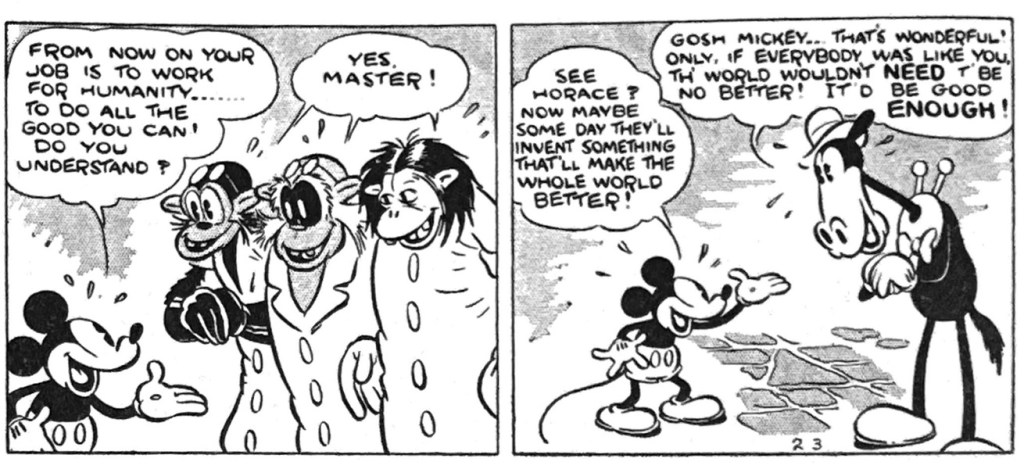
The Mickey Mouse newspaper comic in the early 30s often echoed recent theatrical shorts, and Floyd Gottfredson took some of “The Mad Doctor” vibes into the 1932-33 “Blaggard Castle” excursion. Horace Horsecollar is kidnapped and strapped down, but this time at the other end of a hypnosis cannon and the evil designs of Professors Ecks, Doublex and Triplex. Their aims are at once political (to rule the world via hypnosis), vindictively murderous (“Think of all the people we can kill”) and obsessively controlling (a “Vivixox” TV screen that surveils everywhere). While the comic strip evil genius trope teases genuine cultural anxieties about progress itself, we don’t expect ideological coherence from cartoon baddies like the Profs. X. We get instead a jumble of evil traits and intents that at best help map out the range of fears Americans attached to scientific excess. It is a dark mythology of scientism that includes anxieties that are personal (body fears, agency, privacy) and the political (democracy, tyranny, racism). And in the Disney version, even mad scientists are redeemable. The Blaggard Castle saga ends with Mickey reforming the Drs. X to turn their talents to the positive ends.


This grab bag approach to building the first evil scientists often seems Frankenstein-like itself in stitching together a quilt of cultural anxieties about politics, race, technology, progress. Common to most of these villains, however, is their assault on human agency, free will, and especially the body. Part of the terror they poke is very personal and physical. And it is important to remember that these characters are not just evil “scientists” but evil “doctors,” and they are probably activating some of the changes Americans were feeling around the ways science was transforming the everyday practice of health and medicine. The blood pressure cuff, and the quantification of health, only became commonplace in the 1920s and 30s. Antibiotics came into widespread use during these years as modern germ theory of communicable diseases took hold. X-Rays became common diagnostic tools especially in the inter-war years. Science, with all of its famously cool devotion to quantification and technology, was now part of the doctor/patient relationship. All of which is to say that the mad doctors of pop culture were given shape by a culture that was experiencing, with some discomfort, the penetration of science into everyday life and even how many of use viewed our own bodies.
Bad Science
While many of the earliest cartoon mad docs took a scattershot approach to defining their villainy, the mad scientist became more sharply focused when he fit within an artist’s well-defined world view. For instance, Alex Raymond and writer Don Moore’s Ming the Merciless in Flash Gordon (1934) specifically ties inhuman scientism to imperialism. Ming, the ultimate tech bro who touts a post-human creed (see above), never quite gets world domination right, however. His supposed domain of Planet Mongo is peppered with insurgent bands of tribal, often primitive but resilient rebels. The strip’s ambivalence about science is in stark contrast to rival sci-fi strip Buck Rogers. That strip’s artist/co-creator, Dick Calkins brought to Buck a personal love of flying machines (he was a WWI pilot) and experience drawing one of the first comic strip romances of flight, Skyroads. Technology in Buck Rogers typically is a wondrous extension of human powers, an innovative tool and solution rather than a threat. It is not surprising that 40 years later, and in the shadow of the 60s counter-culture’s deep doubts about the moral implications of scientism, George Lucas found more inspiration in Flash Gordon than in Buck Rogers in imagining his Star Wars universe.
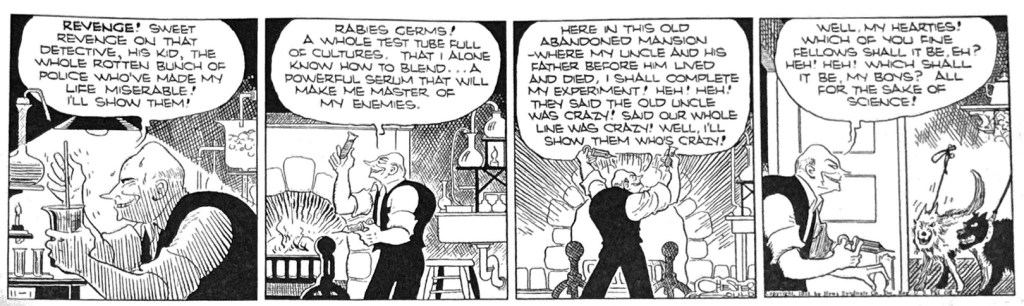
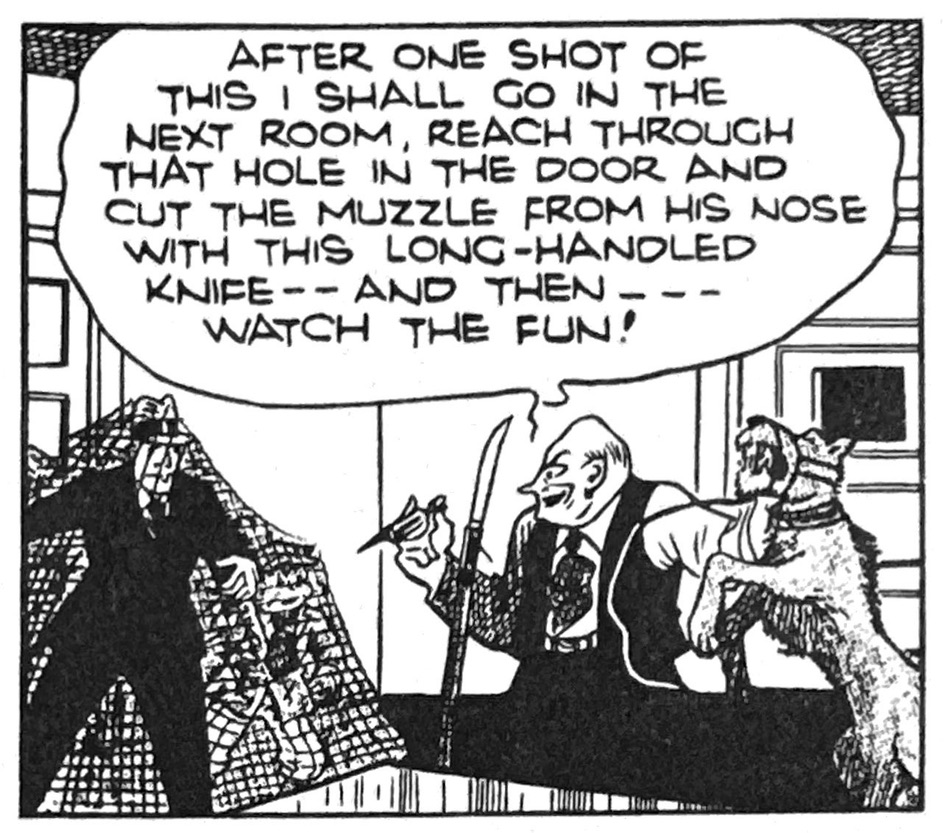
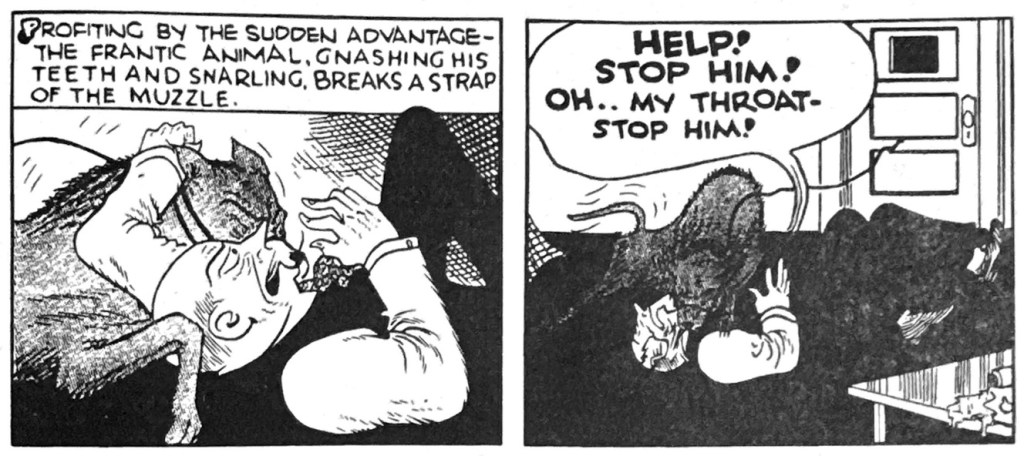
Not all mad scientists yearned to own the world, however. When a highly idiosyncratic auteur like Chester Gould drew the archetype into his peculiar world view the evil became much more local than global, more personal than political. Doc Hump first appears in a 1934 Dick Tracy story as a corrupt gangland doc who Larceny Lou calls upon to help the wounded Steve the Tramp. Jailed and then released, Hump swears vengeance on Tracy and the police. He concocts a rabies variant that kills dog-bitten victims instantly. Ultimately, he meets the classic Tracy villain’s poetic justice: mauled to death by his own attack dog. Gould does to Doc Hump what he generally sought to do with the gangster type of the 30s by robbing him of any romantic grandeur. No “mad scientist” here – just another twisted thug.

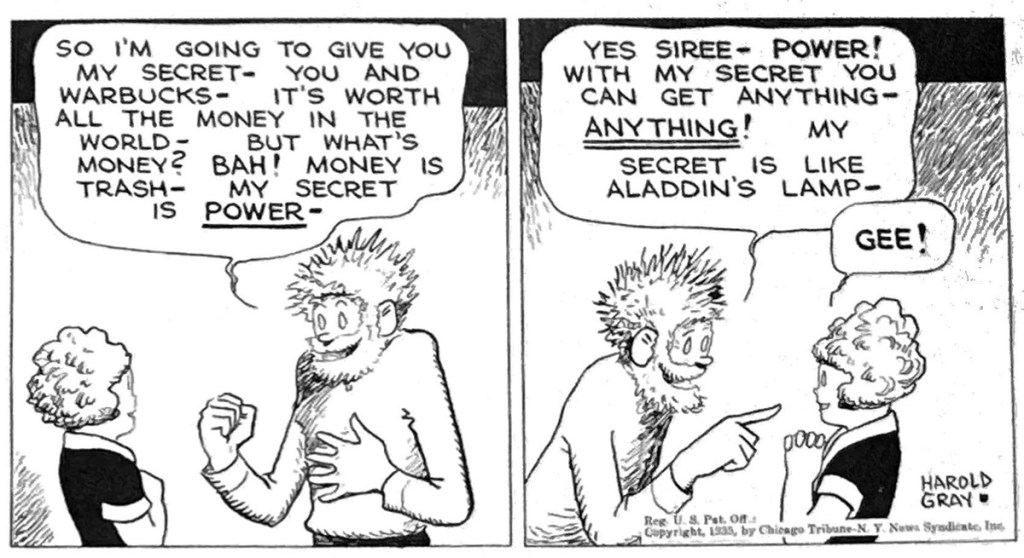
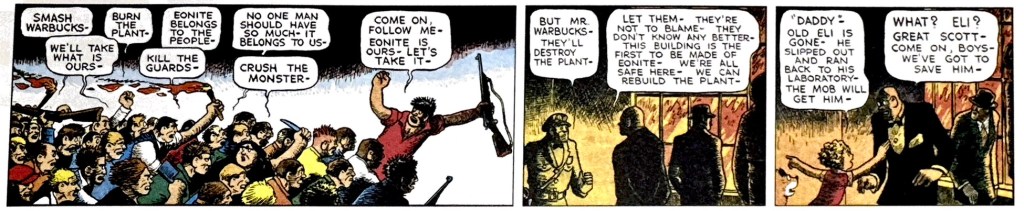
Much like Dick Tracy, the Little Orphan Annie strip tightly managed its creator’s often narrow world view and subsumed almost all social types into his grand vision. And so Harold Gray’s eccentric Dr. Eli Eon (1935-1936) was not a fully “mad” scientist but seemed imbalanced at best. At one point he tells Annie that his invention (“Eonite”) offered something better than money — “power.” Annie’s mystical buddy Punjab advises “there is a very thin line which divides insanity from genius.” Eonite becomes a pawn in a larger ideological battle between good and bad capitalism. Science, scientific thinking and scientists are not the problem, but they can’t be left to their own devices, Gray suggests. . As always, in the Annie universe, character is the main question. And in 1935, as Annie’s creator seethed about the “socialism” of F.D.R.’s New Deal, character is anchored in opposed attitudes towards big business, labor, politics and the common man.


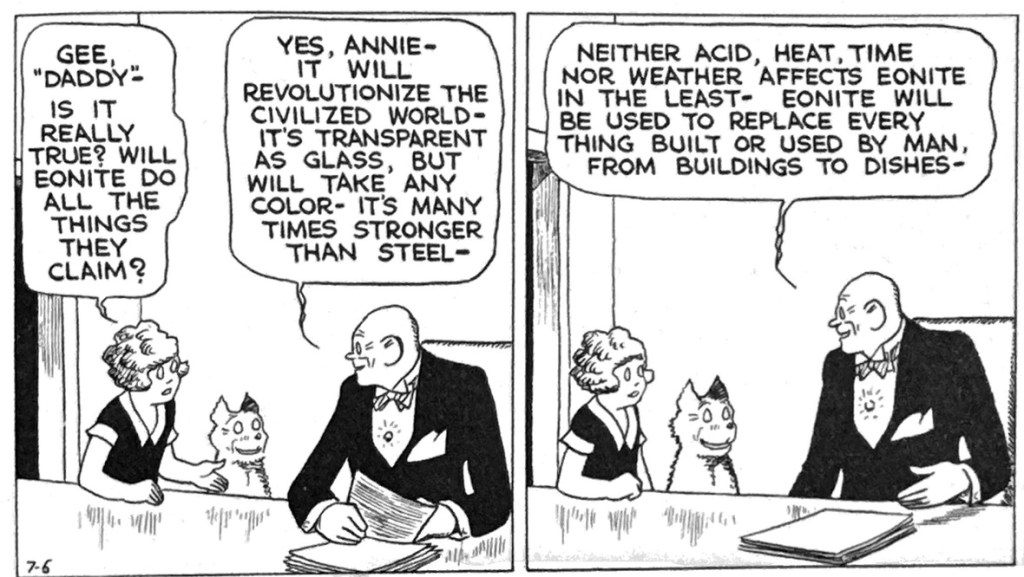
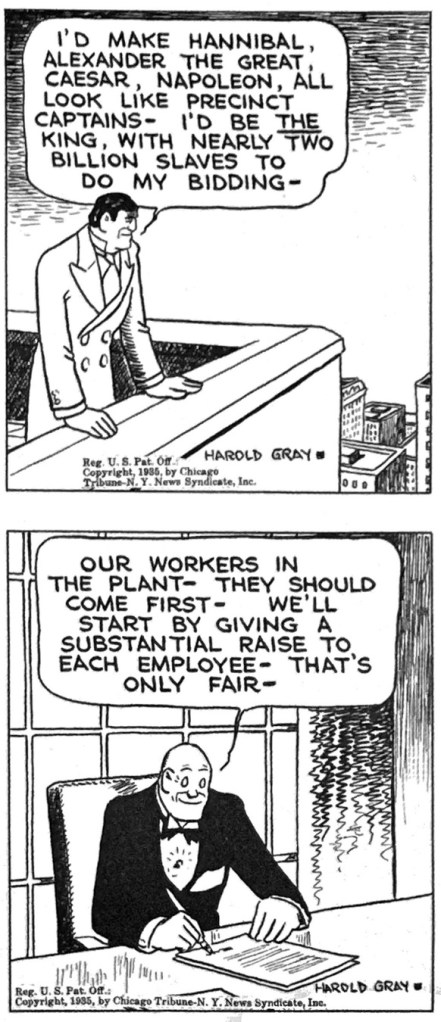
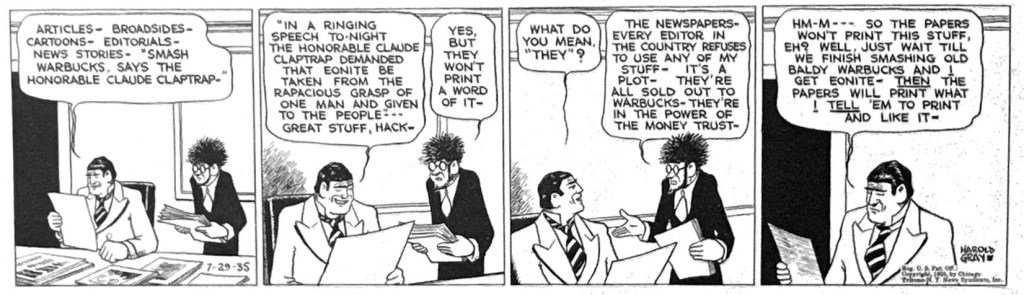
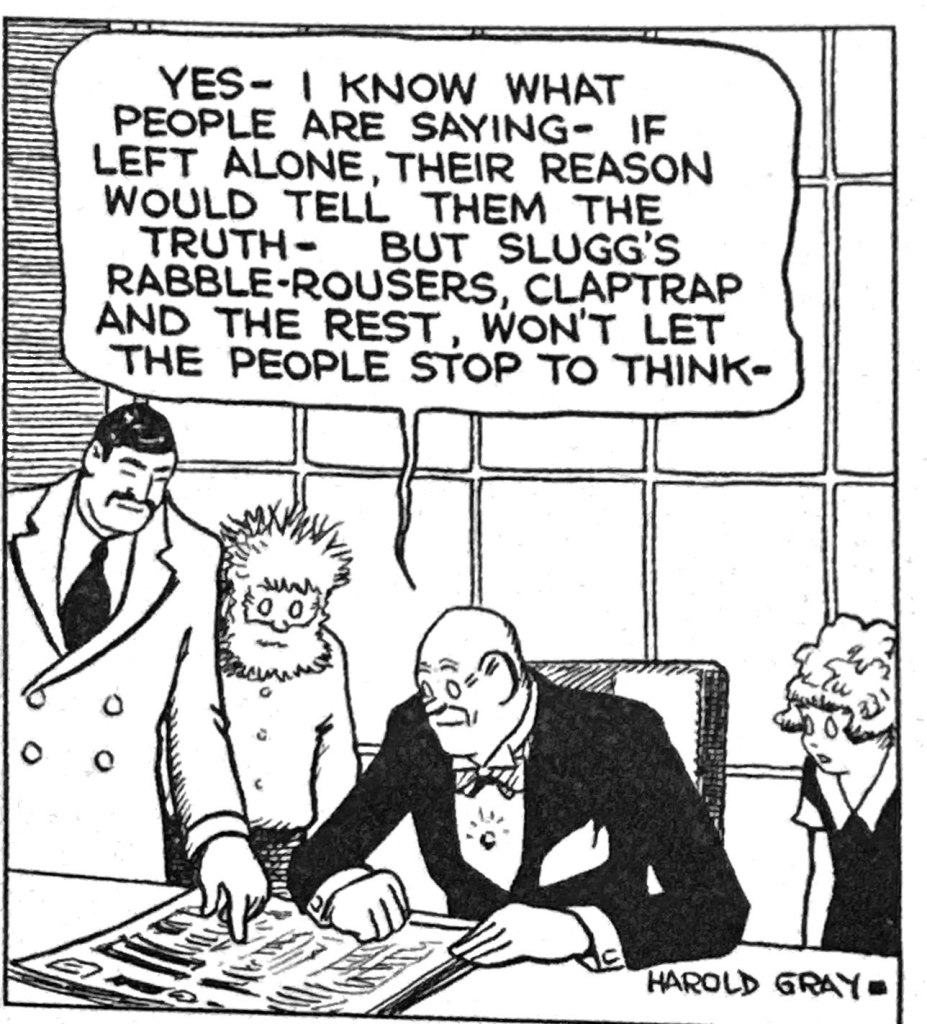
Annie finds and saves Dr. Eon after he was badly beaten by thugs pursuing his secret formula for an indestructible material. Daddy Warbucks sees in Eon’s invention both a great business opportunity as well as a boon to mankind, so he activates “Eonite” with benevolent capitalism. Meanwhile the real villain of this story arc is not a scientist but a twisted businessman who wants to misuse scientific discovery for his own dream of world domination, J. Gordon Slugg. While Daddy Warbucks marries science and capitalism to build a business that creates jobs at high wages, keeps prices low and expands leisure and wealth globally, Slugg wants Eoninte to hold the world hostage for his personal profit. Ultimately, the Eli Eon tale became Gray’s most controversial. He used the scenario to exercise his peculiar moral fantasy of capitalist populism. In his anti-New Deal vision, labor unions and liberal politicians are lazy, corrupt demagogues. They don’t really want to help “the people” so much as exploit popular resentments for their own gain. When the mob destroys the Eonite factory, and even kills Dr. Eon himself, Warbucks refuses to turn guns on them. “They’re not to blame.” he laments. “They don’t know any better,.” In Gray’s hands, the idea of the mad scientist is fully inverted in Dr. Eli Eon. In him, science is not evil so much as neutral, even naive and painfully susceptible to misuse by “mountebanks.”


Good Doctor Vs. Bad Doctor
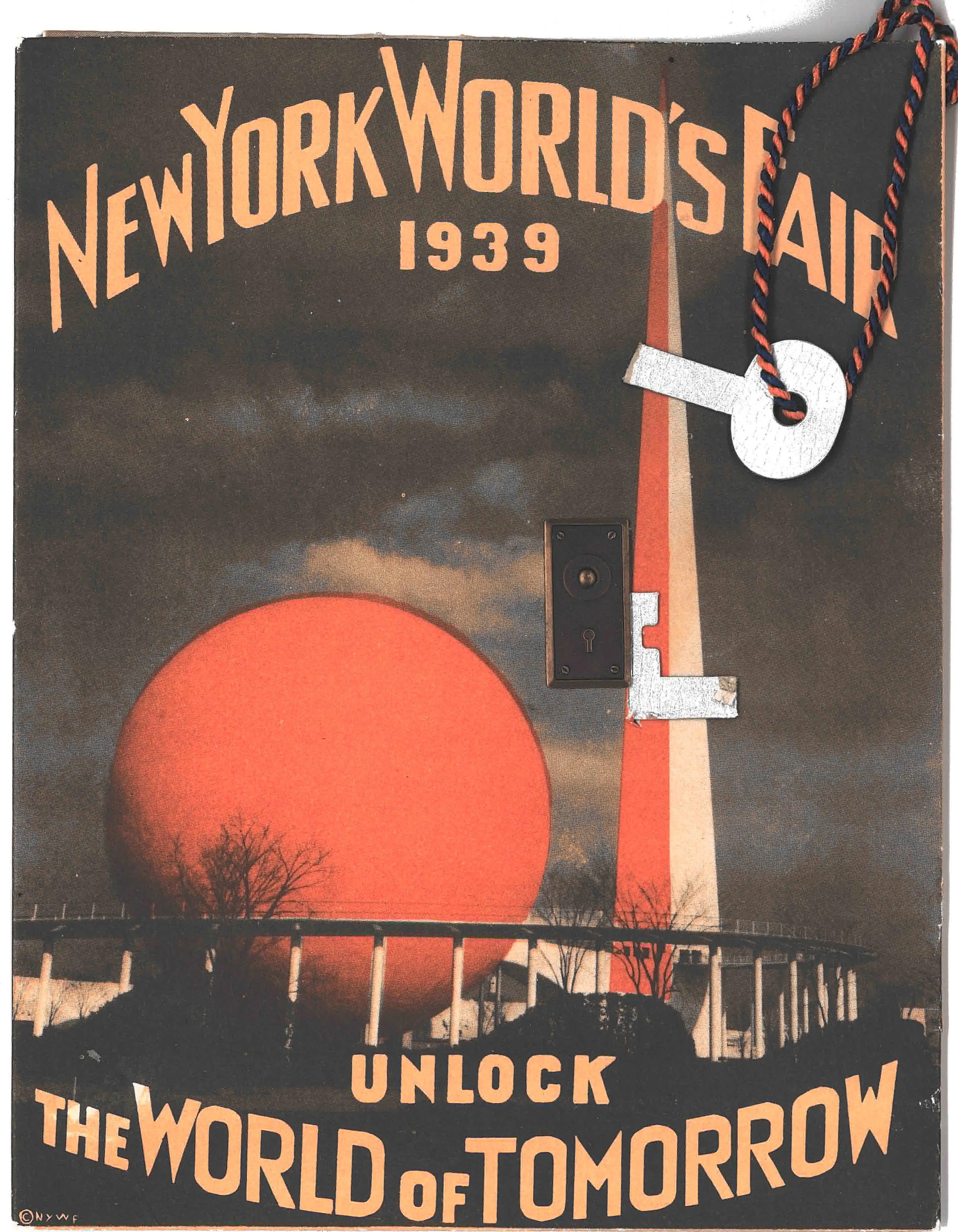
As the 1930s progressed, abstract fears about the inherent dangers of scientism and technology appeared to modulate. Even as the Depression crisis continued, a more activist government, the popularity of FDR himself, may have restored some faith in institutions and progress generally. The visual culture of the mid-1930s, especially the rise of industrial product design and streamlining everywhere, suggested a return to the romance of tech. This culminated in the techno-futurism of the legendary 1939 World’s Fair in NY. Themed as “The World of Tomorrow,” one of the Fair’s signature cultural achievements was successfully domesticating science. Rather than tout technological progress generally, the Fair showed recent innovations like television and synthetic fabrics driving new middle class lifestyles. A model “Tomorrow Town” even demoed how science and tech would drive new levels of comfort, abundance and convenience.
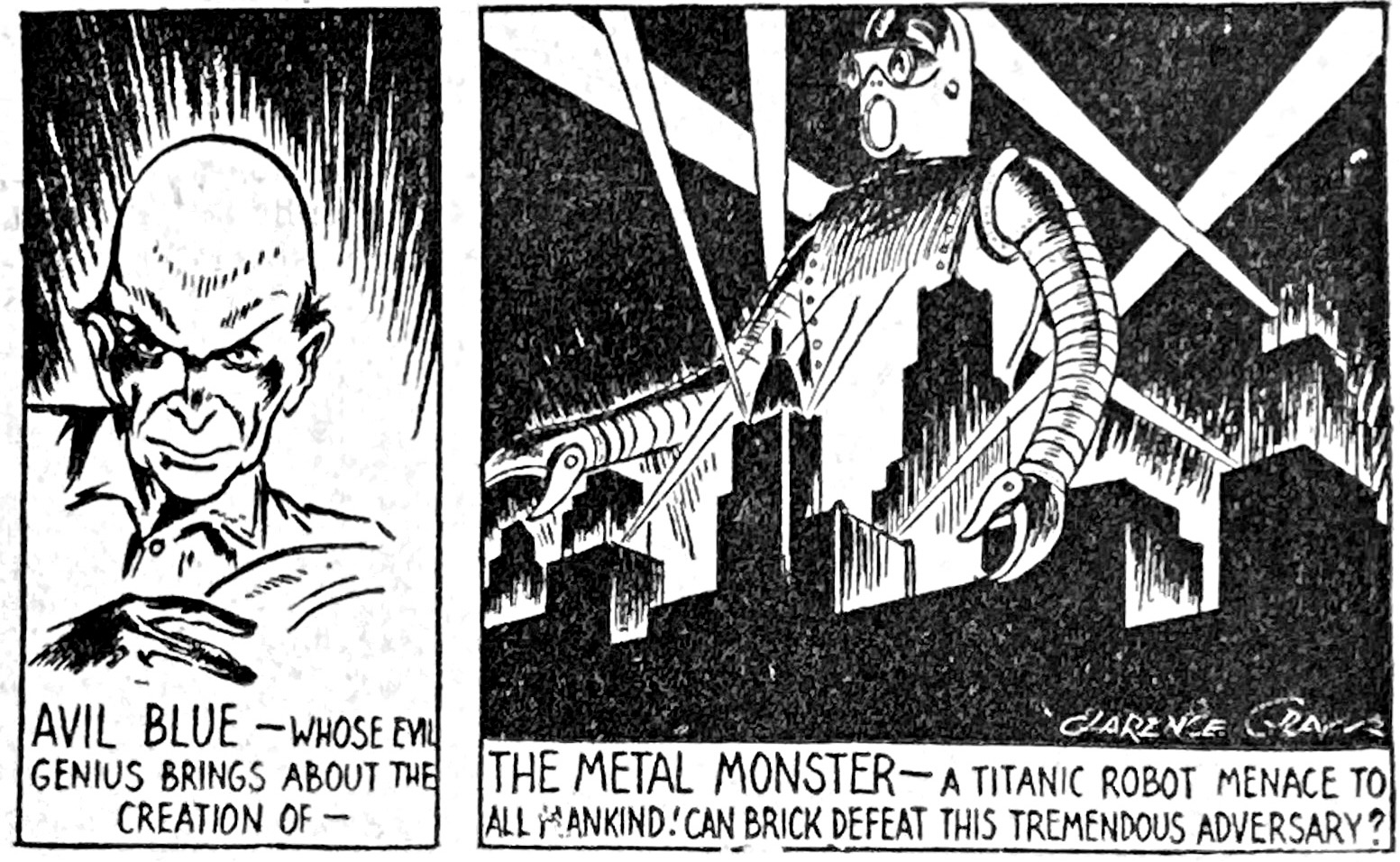
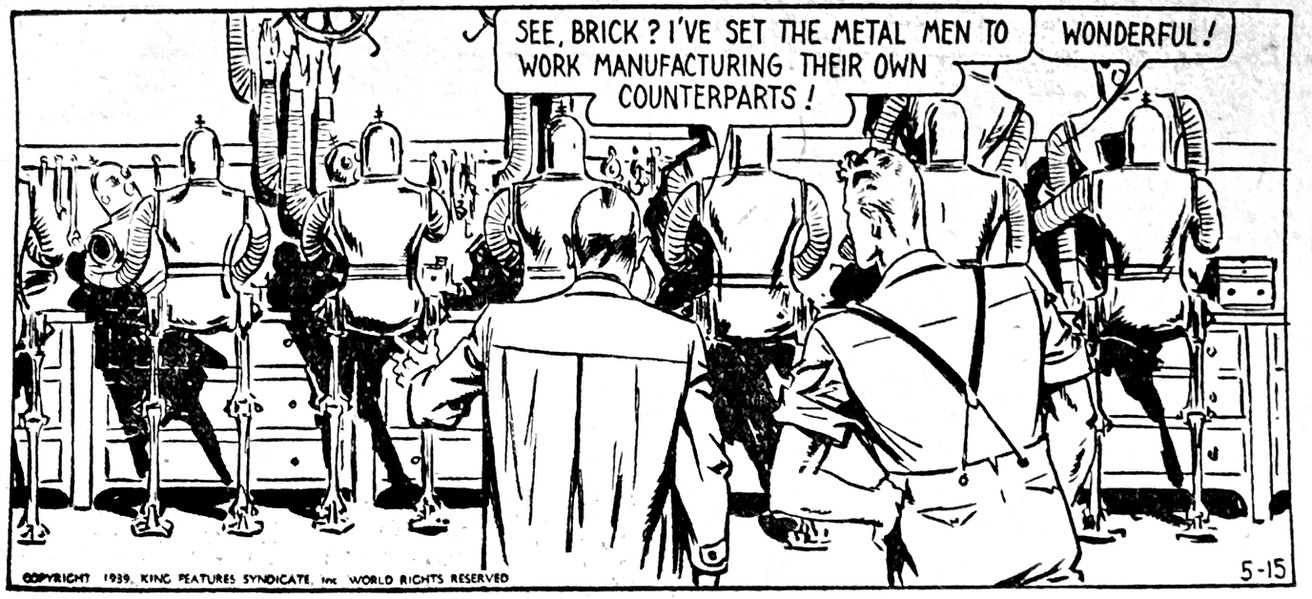
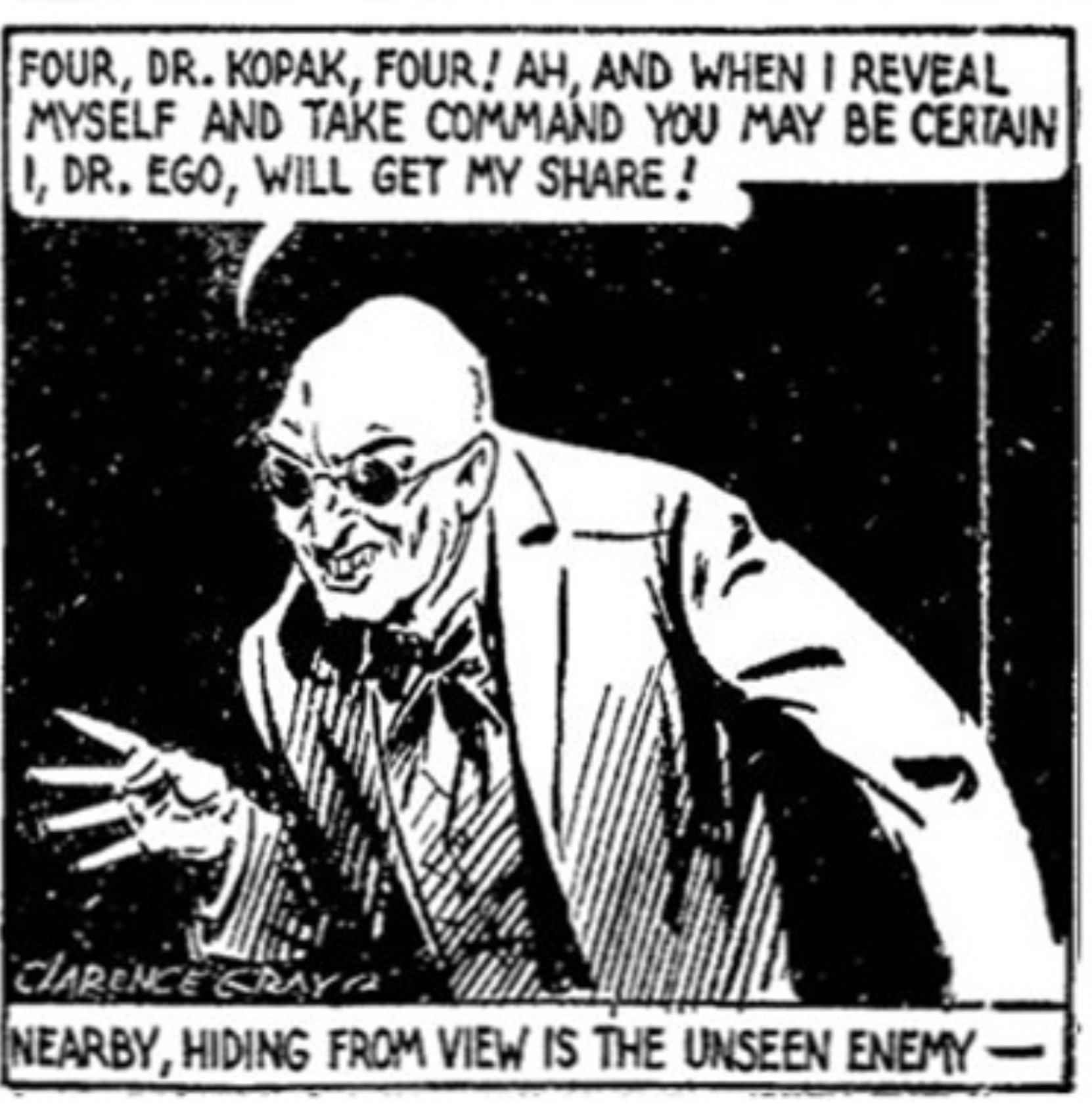
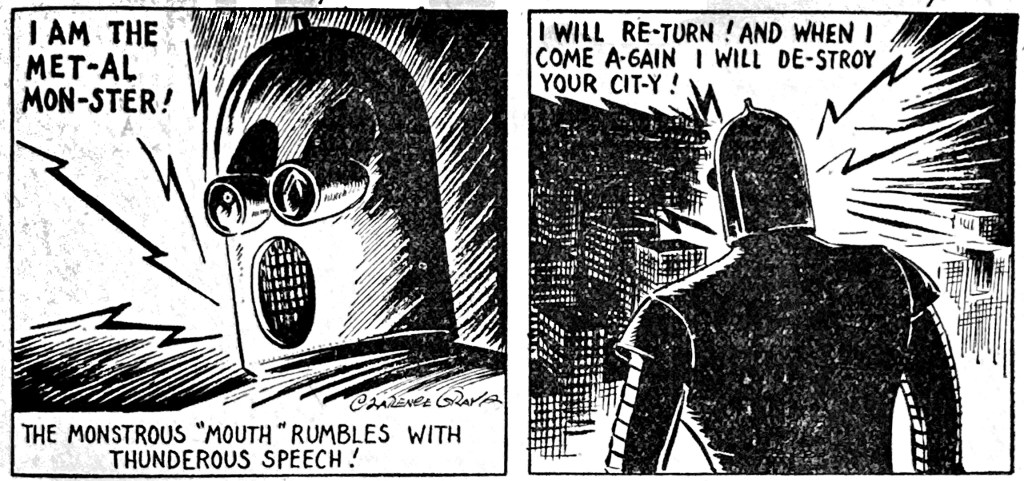
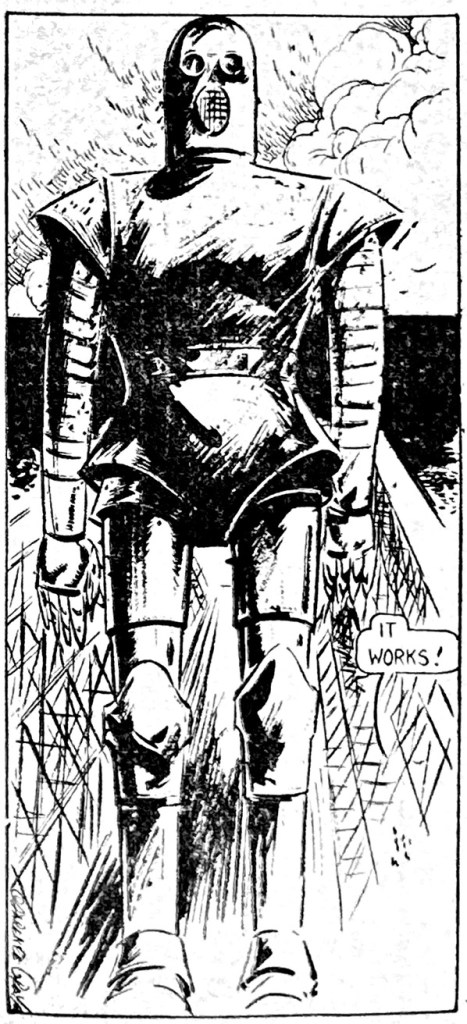
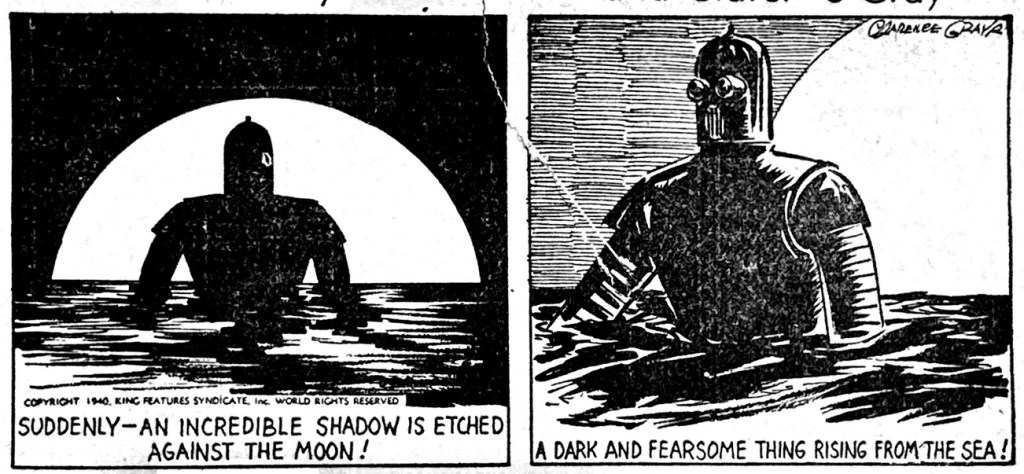
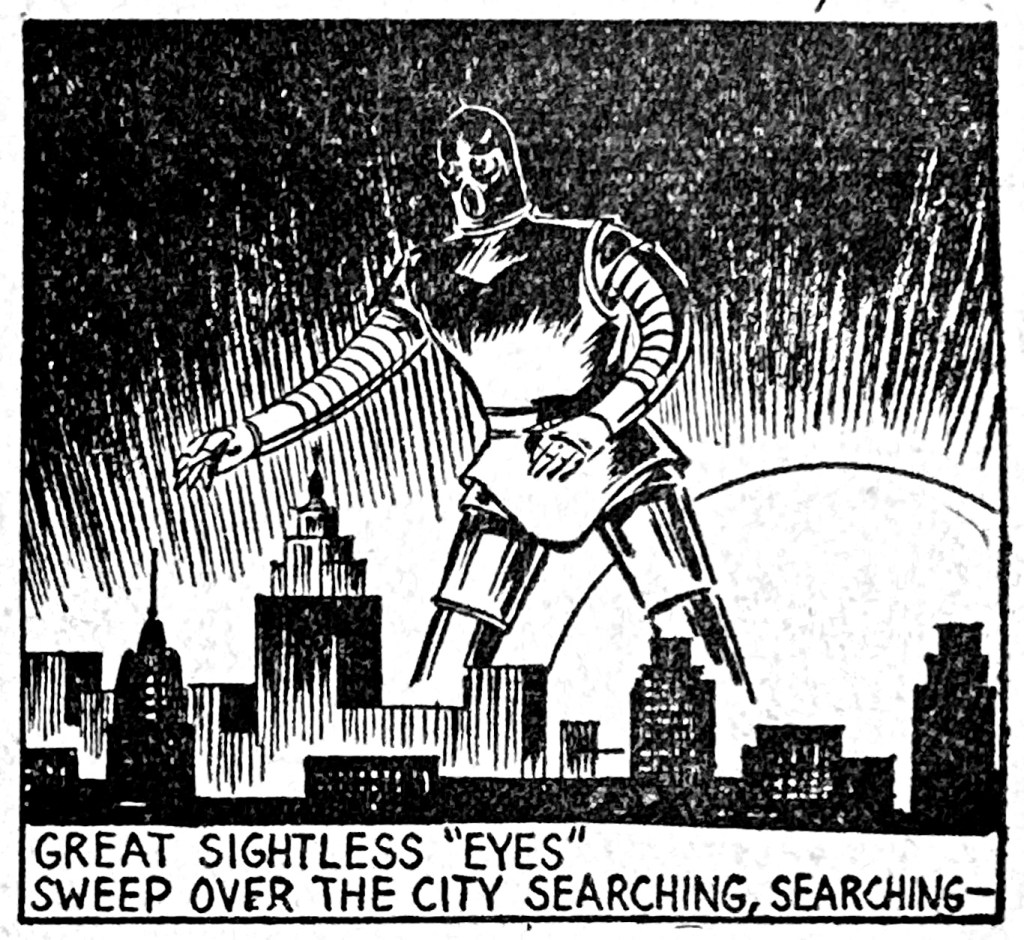
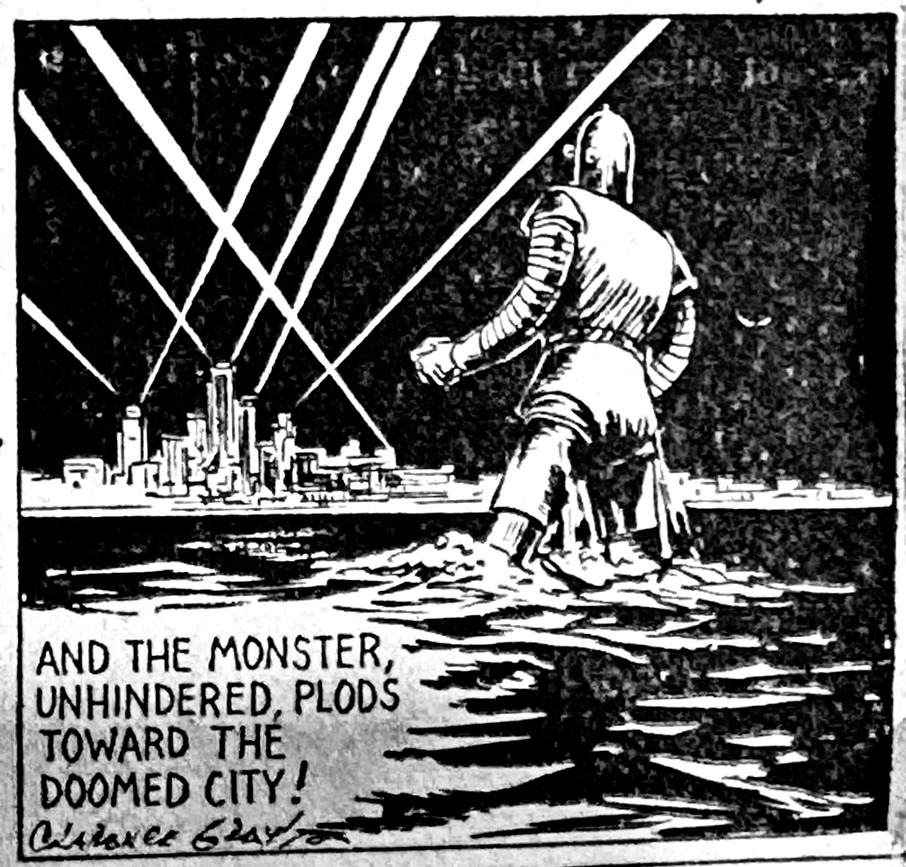
Mad scientists in pop culture remained, to be sure. But more often they were pit against good science and good scientists. We see this move repeatedly in Brick Bradford by William Ritt and Clarence Gray, a strip that has been largely forgotten but was widely popular in the US and Europe. Brick’s inventor pal Prof. Kalla Kopak pioneers revolutionary technologies like a shrinking ray (“Voyage in a Coin,” 1937), which allows exploring new sub-atomic universes, and advanced robots (“The Metal Monsters,” 1939), which promise that the “burden of labor will be lifted forever.” But Doc Kopak also seems prone to getting ripped off. Prof. Franz Ego wants to reverse engineer Kopak’s “Element 85” to mutate soldiers for giant battalions that will rule the world. Likewise, Avil Blue steals Kopak’s robot plans and reengineers them into a city-killing “metal monster.” Both storylines no doubt are informed by the looming war in Europe and rumors of Nazi eugenics programs. Debate about good and bad science applied by good and bad governments became increasingly public by the mid-1930s. By 1939, emigrating German scientists had told of Nazi plans for a nuclear fission bomb. In ways that would prove especially convenient in the post-WWII Cold War and Space Race contests with the USSR, science and technology were construed as inherently value-free and neutral – only made good or bad by government alliances and political application.
The 1939 Metal Monsters episode is noteworthy for Clarence Gray’s chilling, cool, beautiful vision of a homicidal robot. As the giant automaton rises from a moonlit bay onto a Deco-styled city, Grey deploys expressionistic light and shadow, precise line work, to dramatize one artifact of modernity crushing another. It is at once scary and sexy. Shortly after, the Fleischers used similar art styles to handle the same themes in the Superman short “The Mechanical Monsters” (1941). The romance of scientific precision, even in its most destructive form, appeared to be returning.
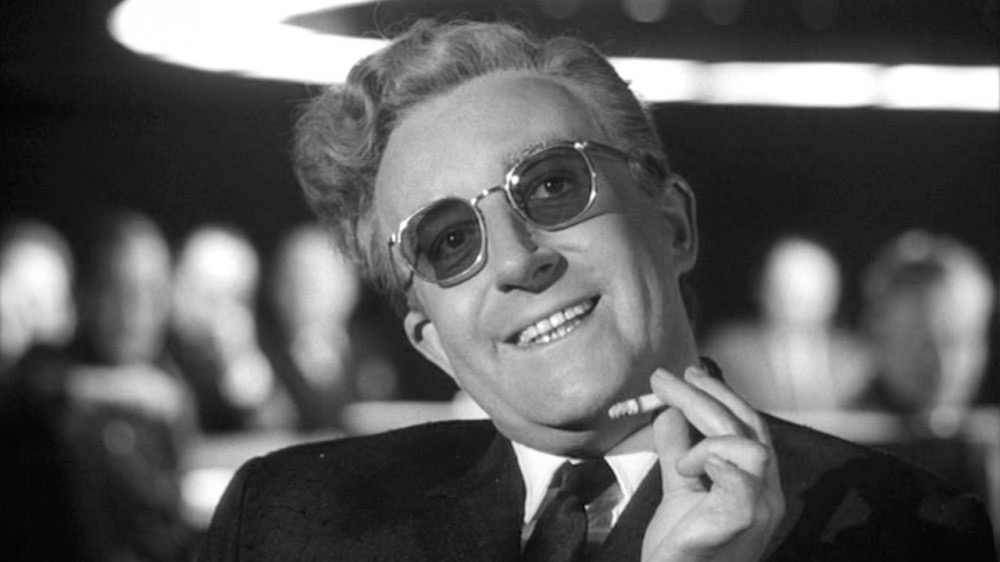
In tracking the evolution of the Mad Scientist archetype in comics across the 1930s, you can almost see a culture both engaging its reservations about progress and then reconciling that ambivalence. It is ironic that many of the early 30s fears about science untethered from principle would be vindicated by the end of WWII in 1945. The marriage of science and politics had produced ghastly new tools of mass murder – demonstrated for all to see in Dresden, Auschwitz and Nagasaki. Earlier in the 30s, mad science had been aligned with grisly violations of nature and human autonomy. The villains themselves seemed possessed by a singleminded pursuit of scientific process without regard for principle or humanity. As we moved towards a post-war “American Way,” there was little time for questioning the underlying values of scientific progress. After all, America itself recruited Nazi Germany’s lead V-2 rocket scientist, the same Werner Von Braun who helped rain death on London, to help design our forays into space. Because, well, Communism. This was an era of nuclear and space races, a rising military-industrial complex, technology driving convenience and abundance for an expanding middle class. Questioning the underlying logic, values and culture of scientism would be left to a 60s counterculture. The mad scientists would have to wait for resurrection in Dr. Strangelove or Gravity’s Rainbow. But that is another story.
Discover more from Panels & Prose
Subscribe to get the latest posts sent to your email.

